
 Download PDF
Market Overview
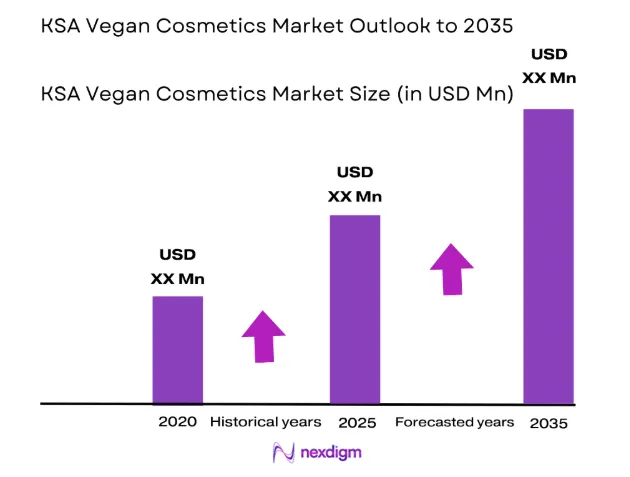
The KSA vegan cosmetics market was valued at USD ~million in the latest published market reading, while the broader Saudi cosmetics market reached USD ~billion and the wider Saudi beauty and personal care market was reported at USD ~billion. Demand is being pushed by ethical-beauty adoption, halal-aligned ingredient preferences, and digital retail scale-up. On the channel side, Nice One, which identifies itself as the Kingdom’s largest online beauty and personal care platform, offered 28,000+ products from 1,200+ brands, showing how assortment breadth is accelerating market monetization.
Within the Kingdom, Riyadh and the Western urban cluster led by Jeddah dominate beauty demand because they combine dense affluent populations, premium retail infrastructure, and faster fulfillment economics. Nice One’s prospectus shows Riyadh generated 29.8 of local revenue in the prior period and 27.9 in the latest interim reading, while the Western region averaged about 44 of revenue and rose to 45.9 in the latest interim period. The company also expanded warehousing and same-day delivery in Jeddah, Makkah, and Taif, reinforcing western-city dominance in beauty commerce.
Market Segmentation
By Product Type
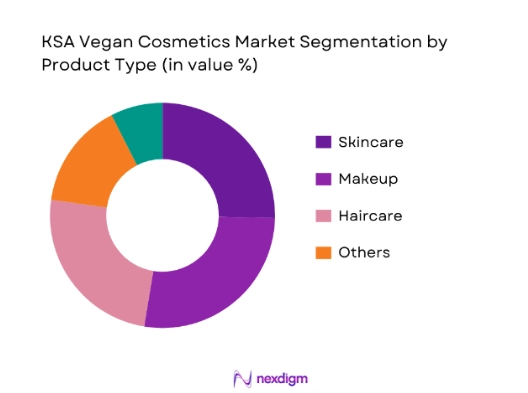
Publicly accessible sources for KSA vegan cosmetics confirm that skincare is the leading product segment, while broader global vegan cosmetics datasets place skincare/facial products at a little over one-third of market demand. In Saudi Arabia, skincare leads because the use case is highly localized: heat, dryness, sun exposure, and sensitivity concerns make moisturizers, cleansers, SPF-adjacent routines, and barrier-support products more repeat-driven than color cosmetics. This is also where vegan, clean, and halal-compatible positioning overlap most naturally, making skincare the easiest segment for brands to localize and premiumize. The category further benefits from routine purchasing, easier ingredient storytelling, and stronger trust-building through dermatologist-friendly and sensitive-skin claims. For KSA specifically, Deep Market Insights identifies skincare as the largest product segment; global vegan cosmetics benchmarks from Precedence Research and Dimension Market Research place skincare/facial products above 36 share, which aligns with Saudi demand conditions.
By Distribution Channel
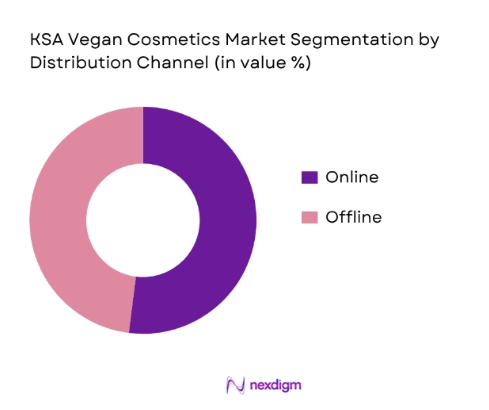
By distribution channel, online retail is the structurally dominant growth engine for vegan cosmetics in Saudi Arabia, even if public sources do not disclose a complete audited KSA vegan channel split. The reason is straightforward: vegan beauty shoppers are ingredient-led, discovery-led, and comparison-led. That behavior fits e-commerce better than traditional shelves because online platforms allow claim filtering, review reading, price comparison, and access to imported niche brands. TechSci specifically identifies online as the fastest-growing sales channel in KSA vegan cosmetics, while Nice One’s IPO materials describe it as the Kingdom’s largest online beauty platform. In the broader KSA beauty and personal care market, Redseer notes that online penetration has already reached 20, ahead of the UAE. For vegan cosmetics, this matters because the category typically over-indexes to digitally native consumers, influencer discovery, and marketplace-led assortment expansion.
Competitive Landscape
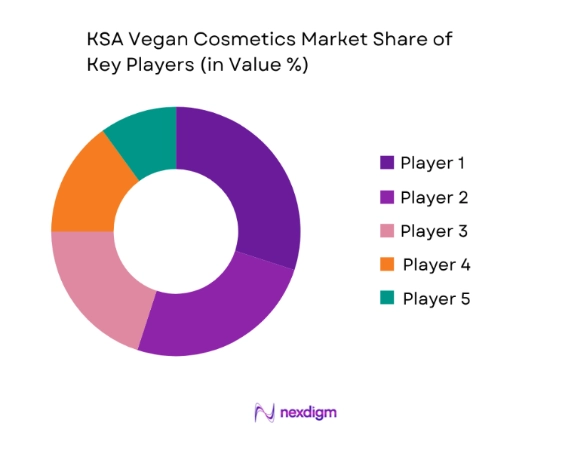
The KSA vegan cosmetics market remains fragmented but platform-concentrated. Brand power sits with a mix of homegrown regional players and international vegan or vegan-forward brands, while market access is increasingly mediated by a limited set of strong channels such as Sephora KSA, Nice One, Amazon.sa, noon, and direct-to-consumer websites. This creates a two-layer competitive structure: brands compete on claims, formulas, shades, and pricing, but they also compete on digital shelf visibility, review density, and retail-platform placement. Homegrown names such as Asteri Beauty gain an advantage from Saudi-native positioning and climate-adapted formulations, while imported brands benefit from global brand equity and broader innovation pipelines.
| Company | Establishment Year | Headquarters | Vegan / Ethical Proposition | Core KSA Category Focus | Main KSA Route-to-Market | KSA Positioning | Price Tier | Market-Specific Strength |
| Asteri Beauty | 2023* | Riyadh | ~ | ~ | ~ | ~ | ~ | ~ |
| Lush | 1995 | Poole, UK | ~ | ~ | ~ | ~ | ~ | ~ |
| KVD Beauty | 2008 | San Francisco, US | ~ | ~ | ~ | ~ | ~ | ~ |
| e.l.f. Cosmetics | 2004 | Oakland, US | ~ | ~ | ~ | ~ | ~ | ~ |
| Rare Beauty | 2020 | El Segundo, US | ~ | ~ | ~ | ~ | ~ | ~ |
KSA Vegan Cosmetics Market Analysis
Growth Drivers
Demand Elasticity
Demand elasticity in the KSA vegan cosmetics market is improving because discretionary beauty spending is being supported by stronger household purchasing capacity, deeper labor-market participation, and a much more digital retail environment. The World Bank shows Saudi Arabia’s GDP reached USD 1.24 trillion in 2024, with GDP per capita at USD 35,121.7 and total population at 35,300,280. The same source shows inflation at only 1.7 in 2024, which matters for beauty because lower inflation preserves room for non-essential categories such as premium skincare, vegan color cosmetics, and ethical personal care. On the forward macro side, the IMF lists Saudi Arabia’s population at 36.726 million and projected real GDP growth at 3.1 for 2026, indicating a larger consumer base and continued economic expansion. The labor side also supports elasticity: GASTAT reports Saudi female labor-force participation at 36.3 in Q1 2025, while Saudi female unemployment declined to 10.5 and the employment-to-population ratio for core working-age Saudis reached 65.9. In vegan cosmetics, this directly strengthens repeat purchase potential because the category over-indexes toward urban, working, digitally engaged consumers who can trade up based on ingredient ethics, cruelty-free positioning, and skin-safety preferences. In short, the market’s elasticity is not being driven by price cuts; it is being driven by income depth, labor participation, and rising digital convenience across the Kingdom.
Adoption Catalysts
Adoption of vegan cosmetics in Saudi Arabia is being accelerated by digital infrastructure, payment readiness, and a beauty-specific online ecosystem that now operates at national scale. The World Bank records 100 internet use in Saudi Arabia in 2024, removing one of the biggest historical frictions for claim-led categories that require digital discovery, ingredient reading, and review comparison. SAMA states that electronic payments accounted for 79 of all retail payments in 2024, while non-cash transactions reached 12.6 billion; in 2025, that rose further to 85 and 14.6 billion transactions. This matters for vegan cosmetics because the category depends heavily on mobile-first research and seamless checkout, especially for imported niche brands and repeat skincare purchases. At the category-platform level, Nice One’s official disclosures show over 5 million registered customers, more than 10 million app downloads, more than 28,000 products, and relationships with 1,200+ international brands. Its app and website are therefore not just distribution points; they are adoption engines that broaden access to vegan and vegan-adjacent brands outside physical shelf constraints. GASTAT also reported Saudi female labor-force participation at 36.2 in Q3 2024 and 36.3 in Q1 2025, reinforcing the growth of an economically active, digitally connected beauty consumer base. Together, these indicators explain why vegan cosmetics adoption in KSA is becoming structurally easier, faster, and more scalable.
Market Challenges
Compliance Burden
Compliance burden remains a real constraint for the KSA vegan cosmetics market because every SKU must move through a regulated pre-market framework before commercial sale, and vegan brands usually carry more complex claim architecture than conventional products. The SFDA states that cosmetic products may not be imported, traded, or marketed in Saudi Arabia unless they are notified in the Kingdom’s electronic listing system, and its public cosmetics list makes clear that notifiers assume full responsibility for the products they place on the market. The current regulatory structure also sits across multiple Gulf standards, including GSO 1943, GSO 2528, and GSO 2020, which increases documentation complexity for brands making vegan, cruelty-free, clean, fragrance-free, or halal-compatible claims simultaneously. The licensed-establishments portal also shows that market participation is filtered through licensed importers, distributors, warehouses, and local manufacturers rather than direct ad hoc selling. This burden is amplified by market momentum: Saudi imports increased 15.0 in September 2024, and GASTAT reported that imports rose 7.3 in Q1 2025, meaning higher trade volumes are moving through the same regulatory and customs architecture. For vegan cosmetics specifically, compliance is harder than for standard beauty because ingredient-origin scrutiny, animal-derivative exclusion, and claims substantiation all need to align with SFDA and Gulf requirements. As a result, compliance is not just an administrative cost; it is a gating factor that shapes launch speed, assortment depth, and channel readiness in the Kingdom.
Import Reliance
Import reliance is still a defining challenge for KSA vegan cosmetics because the category is brand-led, claim-led, and innovation-led, and much of that innovation still enters through international supply chains rather than domestic manufacturing. Saudi trade data confirms that imports remain elevated: GASTAT reported import growth of 15.0 in September 2024, followed by a further 7.3 rise in Q1 2025. China alone accounted for 26.6 of total Saudi imports in Q1 2025, illustrating how external trade partners continue to shape product availability and replenishment conditions. At the retail layer, Nice One’s Saudi Exchange disclosure shows partnerships with 1,200+ international brands and over 28,000 SKUs, with the number of products from global brands rising from 8,000 to 14,000 in 2024. That is commercially positive, but it also highlights dependence on imported or internationally sourced portfolios for assortment depth. Even where products are sourced through local suppliers, market entry still often relies on Saudi importers and distributors that sit between foreign manufacturers and the consumer. Vegan cosmetics are especially exposed because many hero brands in makeup, skin care, and clean-beauty adjacencies are foreign-owned and launch first in mature western or global prestige channels before reaching KSA. This means lead times, customs procedures, compliance sequencing, and distributor capability materially influence in-stock levels and new-launch speed. In practice, the market is growing, but the supply chain remains structurally external-facing rather than fully localized.
Market Opportunities
White Space Potential
White space potential in KSA vegan cosmetics is strongest where ethical positioning overlaps with Saudi-specific demand conditions: premium skincare, fragrance-free and sensitive-skin formulas, climate-resilient makeup, and halal-compatible vegan beauty. The opportunity is supported by macro and investment data rather than future assumptions. World Bank data shows a 2024 population of 35,300,280, GDP per capita of USD 35,121.7, and internet usage at 100, all of which support addressable demand for specialist beauty categories. The IMF places population at 36.726 million in 2026, indicating continued consumer-base expansion. On the capital side, GASTAT reports net FDI inflows of SAR 22.2 billion in Q1 2025, with inward FDI flows of SAR 24.0 billion, signaling a market environment open to new branded concepts, private-label development, and foreign beauty participation. Labor-market indicators also reinforce the gap: Saudi female labor-force participation reached 36.3 in Q1 2025, while Saudi women’s unemployment fell to 10.5. That points to a larger pool of working female consumers who are the most relevant target for routine vegan skincare and premium cosmetics. The white space is therefore not generic; it is concentrated in underserved intersections where imported prestige beauty has not fully localized to Saudi skin concerns, Arabic-first communication, or halal-adjacent vegan trust cues. Brands that address those gaps with faster compliance execution and sharper localization have a realistic path to stand out.
New Launch Headroom
New launch headroom in the KSA vegan cosmetics market is substantial because channel infrastructure is expanding faster than localized vegan assortment depth. SAMA reports 14.6 billion electronic transactions in 2025, up from 12.6 billion in 2024, confirming that Saudi retail is becoming even more checkout-ready for digitally discovered beauty launches. At the same time, Nice One’s disclosures show a base of more than 5 million registered customers, more than 10 million app downloads, over 28,000 products, and 1,200+ international brands, while also indicating that products from global brands increased from 8,000 to 14,000 in 2024. The same report notes a new 14,500 square meter Riyadh warehouse, a planned Jeddah warehouse to improve western-region delivery speed, 52 refrigerated vehicles, and a same-day delivery rate of 23. Those numbers show that Saudi beauty infrastructure is already prepared to support broader vegan launches across skincare, color cosmetics, body care, and wellness-adjacent categories. Yet the market still has clear whitespace in Saudi-native vegan brands, gender-neutral ranges, refillable formats, and clinically positioned vegan skin solutions. The point is not that distribution is missing; it is that distribution has outpaced specialized vegan assortment. When logistics, payments, digital traffic, and consumer access are already in place, launch headroom becomes a product-strategy issue rather than a market-readiness issue.
Future Outlook
Over the medium term, KSA vegan cosmetics is positioned for sustained expansion because the category sits at the intersection of several durable demand drivers: ethical consumption, ingredient transparency, premiumization, female workforce participation, social-commerce influence, and online beauty retail scale. Saudi Arabia is already one of the region’s most digitally engaged beauty markets, and platform-led discovery continues to lower entry barriers for niche vegan brands. At the same time, local relevance matters more than ever: brands that align vegan claims with halal compatibility, climate performance, and Arabic-first communication are likely to outperform imported one-size-fits-all propositions.
The strongest opportunities sit in vegan skincare, desert-proof complexion products, sensitive-skin and fragrance-free lines, premium masstige makeup, and social-commerce-led launches. Channel competition will intensify, but assortment breadth and delivery speed will remain decisive. Nice One’s category scale, Sephora’s prestige pull, and direct-to-consumer localization will continue to shape the market’s next stage. Public forecasts differ on absolute market values, but all accessible sources point in the same direction: Saudi vegan beauty remains a growth market, not a mature one.
Major Players
- Asteri Beauty
- Lush
- Sephora Collection
- KVD Beauty
- Urban Decay
- e.l.f. Cosmetics
- essence
- Catrice
- Rare Beauty
- Huda Beauty
- REFY
- Kosas
- Milk Makeup
- tarte
- The Body Shop
Key Target Audience
- Chief Executive Officers, vegan beauty and cosmetics brands
- Chief Commercial Officers, prestige and masstige beauty houses
- Heads of Market Entry and Regional Expansion, international cosmetics companies
- Category Heads, specialty beauty retail and e-commerce marketplaces
- Procurement and Sourcing Heads, importers, distributors, and private-label operators
- Investments and venture capitalist firms
- Government and regulatory bodies (Saudi Food and Drug Authority; Ministry of Commerce; Ministry of Investment; Zakat, Tax and Customs Authority)
- Strategy and Corporate Development Heads, omnichannel beauty retailers
Research Methodology
Step 1: Identification of Key Variables
The first step mapped the KSA vegan cosmetics ecosystem across brands, importers, digital marketplaces, prestige retailers, regulators, and consumers. Desk research was used to identify the variables with the greatest commercial influence: vegan claim architecture, halal compatibility, channel structure, price ladder, retail presence, and digital assortment depth. This stage also separated pure-play vegan brands from vegan-forward brands to avoid inflating the competitive set.
Step 2: Market Analysis and Construction
In the second stage, the market was constructed using a blended top-down and bottom-up framework. Top-down validation relied on published Saudi cosmetics and beauty-market values, while bottom-up interpretation examined retailer assortment breadth, platform scale, customer reach, and regional fulfillment data. This allowed the niche vegan category to be understood within the wider Saudi beauty economy rather than in isolation.
Step 3: Hypothesis Validation and Expert Consultation
The third step tested the working market hypotheses against public evidence from specialized market reports, retailer disclosures, and brand statements. Particular attention was paid to whether skincare genuinely led the category, whether online channels were structurally advantaged, and whether Riyadh and the western urban corridor dominated beauty demand. Conflicting published market values were compared, and only directly attributable figures were retained.
Step 4: Research Synthesis and Final Output
The final step synthesized the quantitative and qualitative findings into an investor- and operator-oriented market narrative. Official regulatory sources, listed-company disclosures, KSA-facing retailer pages, and specialist industry reports were triangulated to produce the final output. Where public sources did not disclose audited KSA-only subsegment percentages, this was explicitly flagged and the nearest defensible benchmark was used only as directional support.

- Executive Summary
- Research Methodology(Market Definitions and Assumptions, Vegan Cosmetics Inclusion/Exclusion Criteria, Product Universe Mapping, SFDA/GHAD-Based Product Validation Approach, KSA Retail Audit Framework, E-commerce Assortment Tracking Approach, Brand Claim Verification Framework, Pricing Benchmarking Methodology, Demand-Side Consumer Insight Approach, Distributor/Retailer Interview Approach, Market Sizing Approach, Bottom-to-Top Build-Up Model, Top-to-Bottom Validation Model, Data Triangulation and Forecasting Logic, Limitations and Risk Flags)

- Definition and Scope
- Category Genesis and Evolution in KSA
- Market Structure and Operating Model
- KSA Beauty Consumption Context
- Vegan vs. Natural vs. Organic vs. Clean vs. Halal Positioning Map
- Import Dependency and Local Market Development Landscape
- Value Chain Analysis
- Supply Chain Architecture
- Trade Route and Go-to-Market Flow
- Key Demand Centers in the Kingdom
- Buying Journey and Conversion Funnel
- Business Cycle and Seasonality Map
- New Product Launch and Innovation Pipeline Overview

- Growth Drivers (Demand Elasticity, Adoption Catalysts, Consumer Motivation Index, Premiumization Drivers, Digital Acceleration)
- Market Challenges (Compliance Burden, Import Reliance, Shelf Competition, Consumer Education Gap, Margin Pressure)
- Market Opportunities (White Space Potential, New Launch Headroom, Margin Pools, Channel Expansion Potential, Portfolio Adjacency)
- Market Trends (Innovation Frequency, Trend Adoption Speed, Claim Evolution, Retail Merchandising Shift, Consumer Preference Drift)
- Government Regulations and Compliance Landscape (SFDA Notification, GHAD Listing
- PESTLE Analysis
- Porter’s Five Forces Analysis
- SWOT Analysis
- Stakeholder Ecosystem (Brand Owners, Importers, Distributors, Retailers, Marketplaces, Certification Bodies)
- Trade and Supply Risk Mapping (Lead Time Risk, FX Exposure, Freight Dependency, Inventory Risk, Regulatory Hold Risk)

- By Value (2020-2025)
- By Volume (2020-2025)
- By Average Selling Price (2020-2025)
- By Per Capita Spend (2020-2025)
- By Import Value Contribution (2020-2025)
- By Online vs. Offline Sales Contribution (2020-2025)

- By Product Type (In Value%)
Facial Skincare
Lip Cosmetics
Eye Cosmetics
Face Makeup
Base Makeup and Primers
Makeup Removers and Cleansers
Body Care and Bath Cosmetics
Nail Cosmetics - By Ingredient/Claim Architecture (In Value%)
Vegan Only
Vegan + Cruelty-Free
Vegan + Halal-Aligned
Vegan + Clean Beauty
Vegan + Organic/Natural Positioned - By Consumer Gender (In value%)
Women
Men
Gender-Neutral/Unisex Buyers - By Age Cohort (In Value%)
Gen Z
Millennials
Gen X
Mature Consumers - By Price Tier (In Value%)
Mass
Masstige
Premium
Prestige/Luxury Vegan - By Distribution Channel (In Value%)
Specialty Beauty Retail
Brand-Owned E-commerce
Online Marketplaces
Hypermarkets and Supermarkets
Pharmacies and Drugstores
Department Stores
Professional Salons and Beauty Studios - By Region (In Value%)
Riyadh / Central Region
Jeddah / Western Region
Makkah & Madinah Cluster
Eastern Region
Southern Region
Northern Region - By Purchase Mission (In Value%)
Daily Use
Occasion/Glam Use
Sensitive Skin / Dermatology-Led Purchase
Gifting
Trial/Discovery Kits - By Packaging Format (In Value%)
Bottles
Tubes
Jars
Sticks
Pumps
Refill Pods/Refill Packs

- Market Share of Major Players ( By Overall Market, By Product Type, By Channel Presence, By Claim Architecture)
- Cross Comparison Parameters (Vegan/Cruelty-Free Certification Architecture, Halal-Compatibility Positioning, SFDA/GHAD Product Notification Breadth, Hero SKU ASP in SAR, KSA Retail Door Presence, E-commerce Assortment Depth Across Sephora/FACES/Nice One/noon/Amazon, Ingredient Exclusion Matrix, Promotional Intensity During Key Retail Events)
- Competitive Positioning Matrix (Brand Equity, Price Ladder, Assortment Breadth, Innovation Cadence, KSA Accessibility)
- Pricing Analysis (SAR per SKU, SAR per ml/g, Promo Discount Band, Bundle Economics, Premium Gap)
- Shelf and Assortment Benchmarking (SKU Count, Shade Depth, Best-Seller Mix, Newness Ratio, Refill Availability)
- Digital Shelf Analysis (Search Visibility, Review Count, Rating Quality, Marketplace Presence, Content Quality Score)
- Brand Claim Benchmarking (Vegan Claim, Cruelty-Free Claim, Clean Claim, Fragrance-Free Claim, Sensitive Skin Claim)
- SWOT Analysis of Major Players (Brand Strength, Market Weakness, KSA Opportunity, Competitive Threat)
- Detailed Profiles of Major Companies
Asteri Beauty
Lush
Sephora Collection
KVD Beauty
Urban Decay
e.l.f. Cosmetics
essence
Catrice
Rare Beauty
Huda Beauty
REFY
Kosas
Milk Makeup
tarte
FACES Private/Exclusive Vegan Portfolio

- Consumer Persona Mapping (Beauty Orientation, Ethical Purchase Intent, Sensitivity Concerns, Digital Affinity, Willingness to Pay)
- Demand and Consumption Analysis (Usage Frequency, Routine Depth, Multi-Category Penetration, Replenishment Cycle, Trial-to-Repeat Conversion)
Purchase Decision Analysis (Discovery Trigger, Evaluation Criteria, Claim Importance, Retail Influence, Review Dependence) - Needs and Pain Point Analysis (Shade Suitability, Heat Resistance, Ingredient Trust, Price Accessibility, Authenticity Assurance)
- Brand Loyalty and Switching Analysis (Retention Rate, Brand Substitution Drivers, Trial Stickiness, Promotion Sensitivity, Hero SKU Dependence)
- Customer Cohort Analysis (Age Cohort, Income Proxy, Channel Preference, Premium Uptake, Basket Composition)Consumer Review and Sentiment Analysis (Rating Density, Review Themes, Complaint Clusters, Repeat Advocacy, Net Sentiment)

- By Value (2026-2035)
- By Volume (2026-2035)
- By Average Selling Price (2026-2035)
- By Per Capita Spend (2026-2035)
- By Online vs. Offline Mix (2026-2035)
- By Import Value Contribution (2026-2035)


 Request a Sample
 Ask for Customization
 Get a Quote
 Enquire Now