
 Download PDF
Market Overview
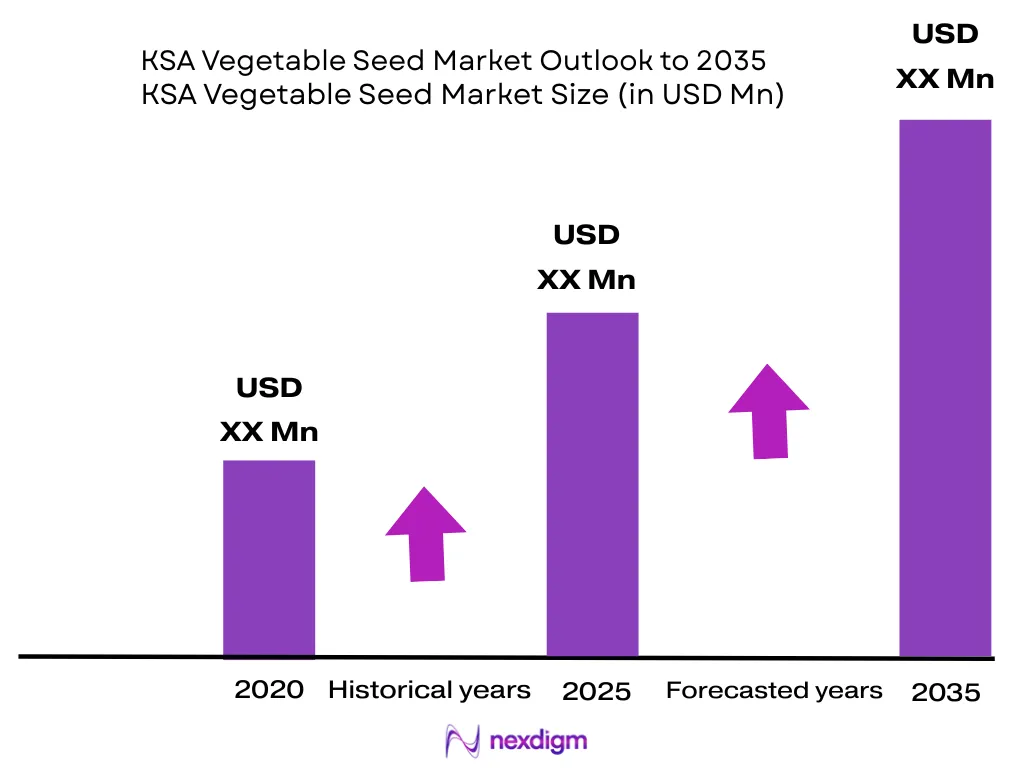
The KSA Vegetable Seed Market is valued at USD ~ million, based on a five-year historical analysis and triangulation of Saudi vegetable-seed revenue growth, protected farming, tomato output and imported hybrid seed demand. The market is driven by greenhouse vegetable expansion, hybrid tomato and cucumber seed use, hydroponics and food-security investments. Tomato production exceeded 691,875 tons, while greenhouse tomato output crossed 299,581 tons, making protected-crop genetics central to seed demand. Riyadh, Qassim, Eastern Province, Tabuk, Al Jouf, Hail, Makkah and Madinah dominate the KSA Vegetable Seed Market because they combine greenhouse clusters, open-field vegetable farming, distributor networks, foodservice demand and food-security projects. Riyadh leads due to retail demand, greenhouse projects and importer presence; Qassim and Hail support traditional vegetable farming; Tabuk is relevant because of NEOM-linked agri-tech projects; Eastern Province supports hydroponics and commercial greenhouse demand.
Market Segmentation
By Breeding Technology
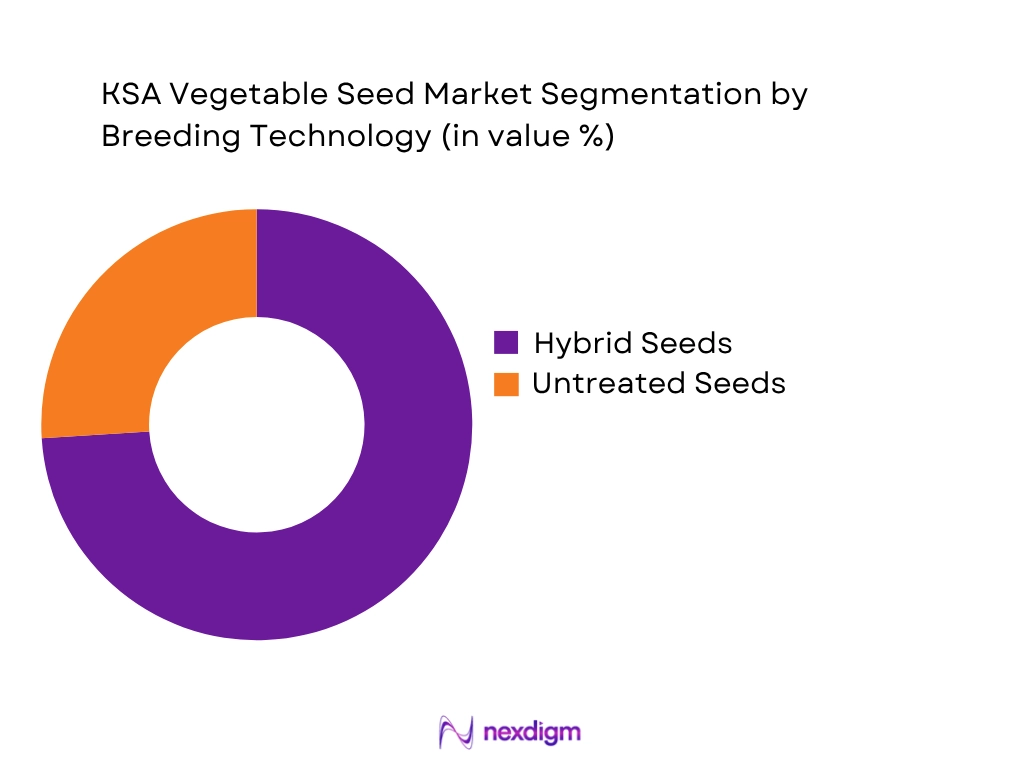
KSA Vegetable Seed Market is segmented by breeding technology into hybrid F1 seeds, CEA-specific hybrid seeds, open-pollinated seeds and organic and untreated seeds. Recently, hybrid F1 seeds have a dominant market share in KSA under the breeding technology segmentation because growers need heat tolerance, salinity tolerance, disease resistance, uniform fruit size and predictable yield under arid conditions. Tomato, cucumber, pepper, melon, eggplant and lettuce are the most important hybrid-demand crops because they are widely grown in greenhouses, net houses and irrigated farms. CEA-specific hybrids are gaining relevance for hydroponic lettuce, high-wire tomato, greenhouse cucumber and capsicum. Open-pollinated seeds remain relevant for small farms, home gardens and seasonal crops such as okra, melon and leafy greens, but commercial growers prefer hybrids because crop failure risk is high in desert agriculture.
By Cultivation Mechanism
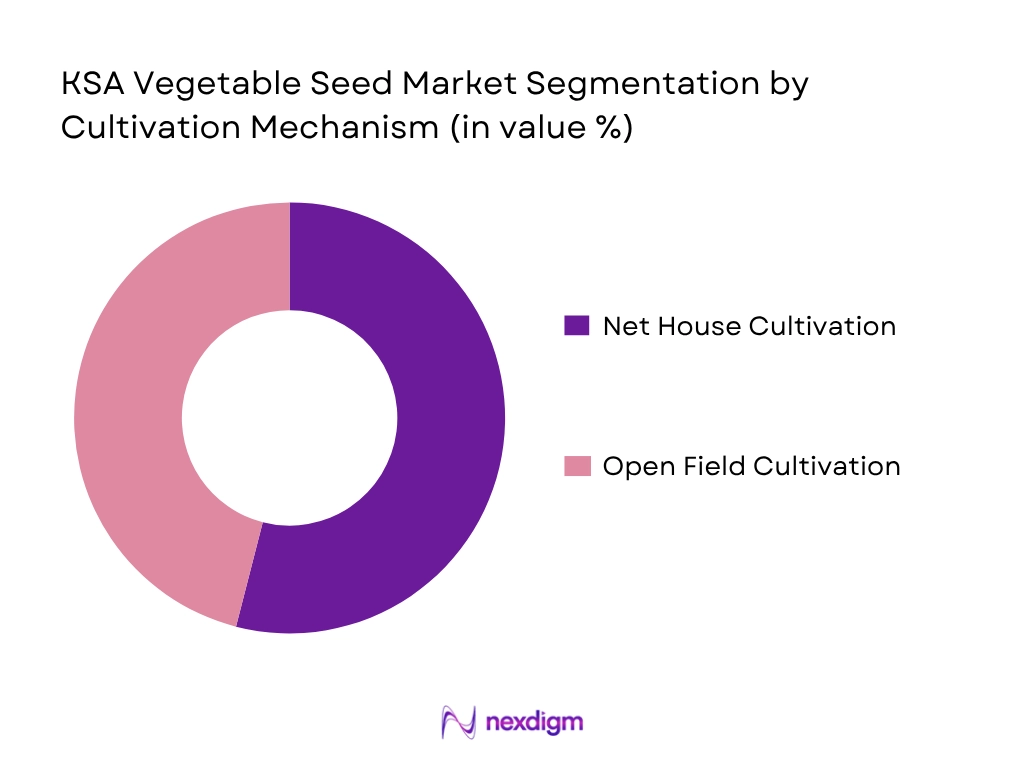
KSA Vegetable Seed Market is segmented by cultivation mechanism into greenhouse and net house cultivation, open field cultivation, hydroponic cultivation, vertical farming and home garden cultivation. Recently, greenhouse and net house cultivation has a dominant market share in KSA under cultivation mechanism segmentation because protected systems reduce exposure to extreme heat, sandstorms, pests and water stress. Greenhouses are used for tomato, cucumber, pepper, eggplant, lettuce and melon, where seed performance depends on germination, uniformity, disease resistance and high-temperature tolerance. Open-field cultivation remains important for onion, watermelon, melon, okra, eggplant and seasonal vegetables, especially in Qassim, Hail, Al Jouf and other traditional farming zones. Hydroponics is expanding because it supports water-efficient production of lettuce, herbs, tomato and cucumber. Vertical farming remains smaller but strategically relevant in Riyadh, Jeddah and NEOM-linked innovation zones.
Competitive Landscape
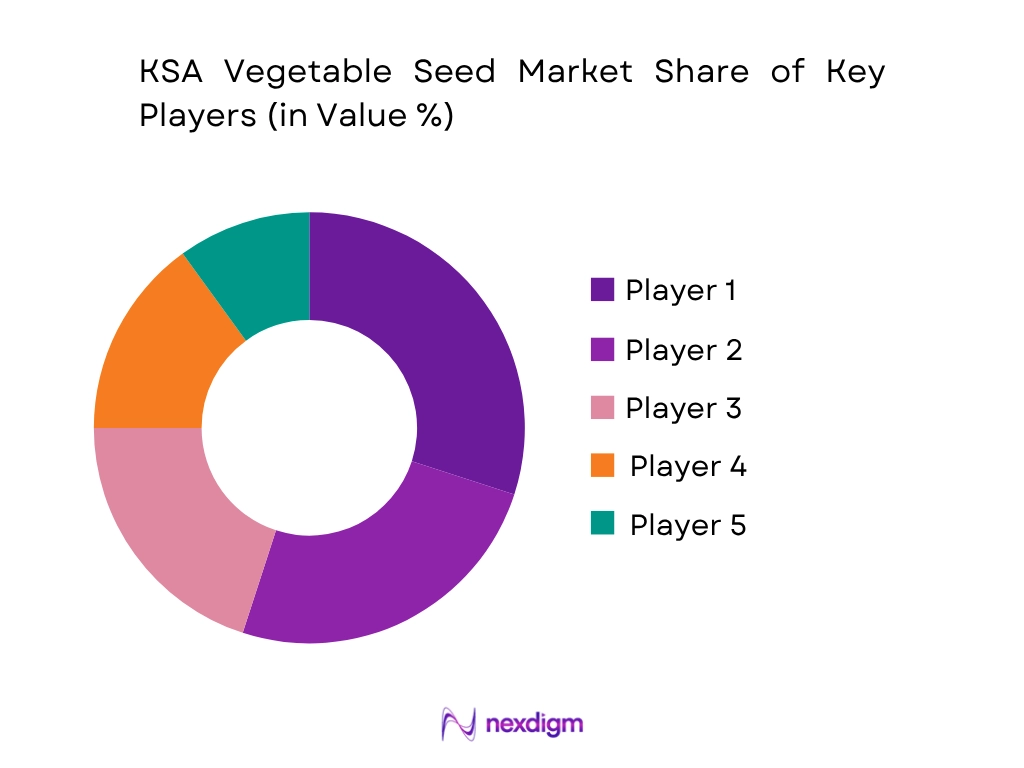
The KSA Vegetable Seed Market is dominated by international vegetable-seed companies, regional distributors, greenhouse-technology suppliers and food-security project operators. Rijk Zwaan, Enza Zaden, Syngenta, Bayer/Seminis and BASF/Nunhems compete through premium tomato, cucumber, pepper, lettuce and melon genetics. Competition is shaped by heat-tolerant varieties, salinity performance, MEWA import compliance, local trialing, greenhouse technical support, hydroponic suitability and distributor reach. Regional players and agri-tech farms influence variety selection through grower demonstrations and controlled-environment performance trials.
| Company | Establishment Year | Headquarters | Key KSA Vegetable Seed Focus | Main Crop Families | Distribution Strength | CEA Portfolio | Seed Technology Focus | Market Positioning |
| Rijk Zwaan | 1924 | De Lier, Netherlands | ~ | ~ | ~ | ~ | ~ | ~ |
| Enza Zaden | 1938 | Enkhuizen, Netherlands | ~ | ~ | ~ | ~ | ~ | ~ |
| Syngenta Vegetable Seeds | 2000 | Basel, Switzerland | ~ | ~ | ~ | ~ | ~ | ~ |
| Bayer CropScience / Seminis | 1863 | Leverkusen, Germany | ~ | ~ | ~ | ~ | ~ | ~ |
| BASF Vegetable Seeds / Nunhems | 1865 | Ludwigshafen, Germany | ~ | ~ | ~ | ~ | ~ | ~ |
KSA Vegetable Seed Market Analysis
Growth Drivers
Greenhouse Vegetable Expansion Supports Premium Hybrid Seed Demand
KSA Vegetable Seed Market is supported by rapid greenhouse vegetable production, which requires high-germination, heat-tolerant and disease-resistant seeds for tomato, cucumber, pepper, lettuce and herbs. GASTAT reported greenhouse vegetable production of 797 thousand tons and greenhouse vegetable area of 7.8 thousand hectares, with more than 121 thousand cultivated greenhouses. Tomatoes led greenhouse output at 329 thousand tons, followed by cucumbers at more than 232 thousand tons. Saudi Arabia’s macro base supports high-value seed adoption, with World Bank reporting GDP of USD 1.24 trillion, GDP per capita of USD 35,121.7, and population of 35 million.
Open-Field Vegetable Scale Sustains Seasonal Seed Replacement
KSA Vegetable Seed Market is also supported by open-field vegetable cultivation, where short-cycle crops create recurring demand for hybrid and open-pollinated seeds. GASTAT reported open-field vegetable area of 89.7 thousand hectares and production of 2,745 thousand tons. Potatoes ranked first with 624 thousand tons, followed by watermelon with about 612 thousand tons, indicating large seasonal demand for seed potatoes, watermelon seeds, melon seeds, onion seeds, okra seeds and other field vegetable categories. World Bank data shows Saudi Arabia’s GDP at USD 1.24 trillion and GDP per capita at USD 35,121.7, supporting commercial farm input spending.
Market Challenges
Arid Production Conditions Increase Dependence on Protected-Crop Seed Performance
KSA Vegetable Seed Market faces production risk because vegetable cultivation depends on varieties that can perform under desert heat, water stress and controlled-environment systems. GASTAT reported that greenhouse vegetables produced 797 thousand tons from 7.8 thousand hectares, while open-field vegetables produced 2,745 thousand tons from 89.7 thousand hectares. This structure shows why seed performance must align with both high-density protected systems and wider seasonal field production. Crop failure in tomato, cucumber, pepper and melon directly affects replanting decisions. World Bank data shows Saudi Arabia’s population at 35 million, creating sustained food demand despite production constraints.
Agricultural Import Dependence and Permit Compliance Add Supply-Chain Complexity
KSA Vegetable Seed Market faces operational complexity from import dependence and phytosanitary controls. GASTAT reported agricultural crop imports of 18,762 thousand tons and agricultural crop exports of 506 thousand tons, showing the country’s large external agricultural supply interface. MEWA’s plant-health function includes legislation and standards for internal and external plant quarantine operations, while Saudi import guidance requires prior import permits and health documentation for regulated agricultural consignments. For vegetable seed importers, these requirements affect hybrid tomato, cucumber, lettuce, pepper and melon seed availability. World Bank reports Saudi GDP of USD 1.24 trillion, making uninterrupted agricultural input logistics commercially important.
Market Opportunities
Tomato and Cucumber Greenhouse Output Creates Scope for CEA-Specific Seeds
KSA Vegetable Seed Market has a clear opportunity in controlled-environment agriculture seed portfolios. GASTAT reported greenhouse tomato production of 329 thousand tons and cucumber production exceeding 232 thousand tons, within total greenhouse vegetable output of 797 thousand tons. These crops require premium hybrids with heat tolerance, uniform fruiting, disease resistance, high-wire suitability, strong germination and compatibility with fertigation systems. More than 121 thousand cultivated greenhouses create a large technical base for seed trials, seedling nurseries and distributor advisory. World Bank reports GDP per capita of USD 35,121.7, supporting investment in premium seeds for commercial greenhouse farms.
Organic and Transitional Farming Supports Untreated and Traceable Seed Demand
KSA Vegetable Seed Market has an opportunity in untreated, organic-aligned and traceable vegetable seeds as local production diversifies. GASTAT reported total organic agriculture area of 20.7 thousand hectares, including 12.5 thousand hectares for perennial trees excluding palms and 6.2 thousand hectares for palm trees. Total organic crop production reached 98.3 thousand tons. Although vegetables are not the largest organic category, the formal organic base supports demand for documented inputs, low-residue seed channels, seed traceability and premium farm positioning. World Bank data shows Saudi Arabia’s GDP of USD 1.24 trillion and population of 35 million, supporting premium food demand.
Future Outlook
The KSA Vegetable Seed Market is expected to grow at around 8.6% CAGR during 2026–2035, supported by greenhouse farming, hydroponics, food-security projects, imported hybrid seeds and demand for local fresh produce. Growth will remain concentrated in tomato, cucumber, lettuce, pepper, melon, eggplant, herbs and microgreens. Over the next phase, Saudi vegetable-seed demand will shift toward seeds designed for protected cultivation, desert climate performance and water-efficient production. High-wire tomato, greenhouse cucumber, lettuce, basil, pepper and melon will create higher-value demand for CEA-specific genetics. Open-field farming will continue supporting melon, watermelon, onion, okra and eggplant seeds, but the most differentiated opportunity will come from high-tech farms. Seed companies will increasingly compete through local trials, technical advisory, disease-resistance packages, heat tolerance and hydroponic performance. Food-security programmes, NEOM/Topian initiatives, large farms and retailers will encourage demand for traceable, high-germination and climate-tested seeds. Pelleted lettuce seeds, primed herb seeds, disease-tested tomato seeds and saline-condition varieties will become strategic opportunity areas.
Major Players
- Rijk Zwaan Middle East
- Enza Zaden Middle East
- Syngenta Vegetable Seeds
- Bayer CropScience / Seminis / De Ruiter
- BASF Vegetable Seeds / Nunhems
- Sakata Seed Middle East
- HM.CLAUSE Middle East
- Bejo Seeds
- Hazera Seeds
- East-West Seed
- Takii Seed
- Known-You Seed
- Genesis Seeds
- Red Sea Farms
- Topian / NEOM Food Company
Key Target Audience
- Vegetable Seed Manufacturers
- Hybrid Vegetable Seed Breeding Companies
- Commercial Greenhouse Operators
- Hydroponic and Vertical Farming Operators
- Seed Importers and Agri-Input Distributors
- Food Security and Greenhouse Project Developers
- Investments and Venture Capitalist Firms
- Government and Regulatory Bodies
Research Methodology
Step 1: Identification of Key Variables
The initial phase involves constructing an ecosystem map for the KSA Vegetable Seed Market, covering seed companies, importers, distributors, greenhouse operators, hydroponic farms, nurseries, retailers and regulators. The objective is to identify critical variables such as crop family, cultivation mechanism, hybrid adoption, food-security demand and import dependence.
Step 2: Market Analysis and Construction
In this phase, historical data is compiled for domestic vegetable production, greenhouse output, tomato self-sufficiency, protected farming, imported seed reliance and crop-wise demand. The market is constructed through bottom-up modelling based on farm type, crop cycles, seed rate, seed format, distributor margins and protected-cultivation usage.
Step 3: Hypothesis Validation and Expert Consultation
Market hypotheses are validated through structured interviews with seed importers, greenhouse operators, hydroponic farm managers, nursery operators, distributors and food-security project stakeholders. These consultations support assumptions on hybrid adoption, crop-specific demand, seed replacement, import lead times, local trials and technical-support requirements.
Step 4: Research Synthesis and Final Output
The final phase integrates secondary research, primary insights, company portfolio mapping and bottom-up market modelling into a validated report. The output is cross-checked across market size, segmentation, competitive landscape, regulatory framework and future outlook to provide a business-focused view of the KSA Vegetable Seed Market.

- Executive Summary
- Research Methodology (Market Definitions and Assumptions, Vegetable Seed Taxonomy, Hybrid/Open-Pollinated/Organic/Untreated/CEA-Specific Seed Classification, Market Sizing Approach, Top-Down Seed Revenue Validation, Bottom-Up Greenhouse/Open-Field Crop Requirement Model, Primary Interviews with Seed Importers/Distributors/Greenhouse Operators/Hydroponic Farms/Food Security Projects, MEWA Import Compliance Review, Dealer Channel Mapping, Limitations and Future Conclusions)

- Definition and Scope
- Overview Genesis
- Evolution of Vegetable Seed Demand in Saudi Arid Agriculture
- Timeline of Major Players
- Business Cycle
- Supply Chain and Value Chain Analysis

- Growth Drivers (Food Security Policy, Hydroponic Adoption, Greenhouse Investments, Seed Replacement, Retail Demand, Water-Saving Agriculture)
- Market Challenges (Seed Import Dependency, Phytosanitary Compliance, High Greenhouse Input Requirement, Climate Stress, Limited Water Resources, Technical Skill Gaps)
- Opportunities (Greenhouse-Specific Genetics, Hydroponic Leafy Greens, Heat-Tolerant Hybrids, Seedling Nurseries, Organic Seeds, Digital Advisory)
- Trends (Hybridization, Greenhouse Specialization, Water-Saving Agriculture, Seed Enhancement, Vertical Farming, Retail Traceability)
- SWOT Analysis
- Porter’s Five Forces
- PESTLE Analysis

- By Value (2020-2025)
- By Volume (2020-2025)
- By Average Realization per Kilogram/Thousand Seeds (2020-2025)

- By Crop Family (In Value %)
Tomato Seeds
Cucumber Seeds
Leafy Green Seeds
Pepper and Capsicum Seeds
Melon and Watermelon Seeds - By Distribution Channel (In Value %)
Direct-to-Farm Sales
Seed Importers and Local Distributors
Agri-Input Distributors
Hydroponic Solution Providers
Farm Project and Turnkey Suppliers - By End User (In Value %)
Commercial Greenhouse Operators
Hydroponic Farms
Vertical Farms
Open-Field Farms
Organic Farms
- By Region (In Value %)
Riyadh
Makkah
Madinah
Qassim
Eastern Province

- Market Share of Major Players (Commercial Vegetable Seed Revenue, Crop-Family Share, Hybrid Share, Greenhouse Presence)
- Cross Comparison Parameters (Greenhouse-Specific Hybrid Portfolio Breadth, Heat and Salinity Tolerance Trait Depth, MEWA Import Compliance Capability, Protected-Cultivation Variety Portfolio, Hydroponic Leafy Green Seed Strength, Seed Treatment/Pelleting Capability, Distributor and Technical Support Network, Local Trial and Farm Advisory Support)
- SWOT Analysis of Major Players
- Detailed Profiles of Major Companies
Rijk Zwaan Middle East
Enza Zaden Middle East
Syngenta Vegetable Seeds
Bayer CropScience / Seminis / De Ruiter
BASF Vegetable Seeds / Nunhems
Sakata Seed Middle East
HM.CLAUSE Middle East
Bejo Seeds
Hazera Seeds
East-West Seed
Takii Seed
Known-You Seed
Genesis Seeds
Red Sea Farms
Topian / NEOM Food Company

- Commercial Greenhouse Operator Analysis
- Hydroponic Farm Operator Analysis
- Vertical Farm Operator Analysis
- Open-Field Farm Analysis
- Organic and Low-Residue Farm Analysis

- By Value (2026-2035)
- By Volume (2026-2035)
- By Average Realization per Kilogram/Thousand Seeds (2026-2035)


 Request a Sample
 Ask for Customization
 Get a Quote
 Enquire Now