
 Download PDF
Market Overview
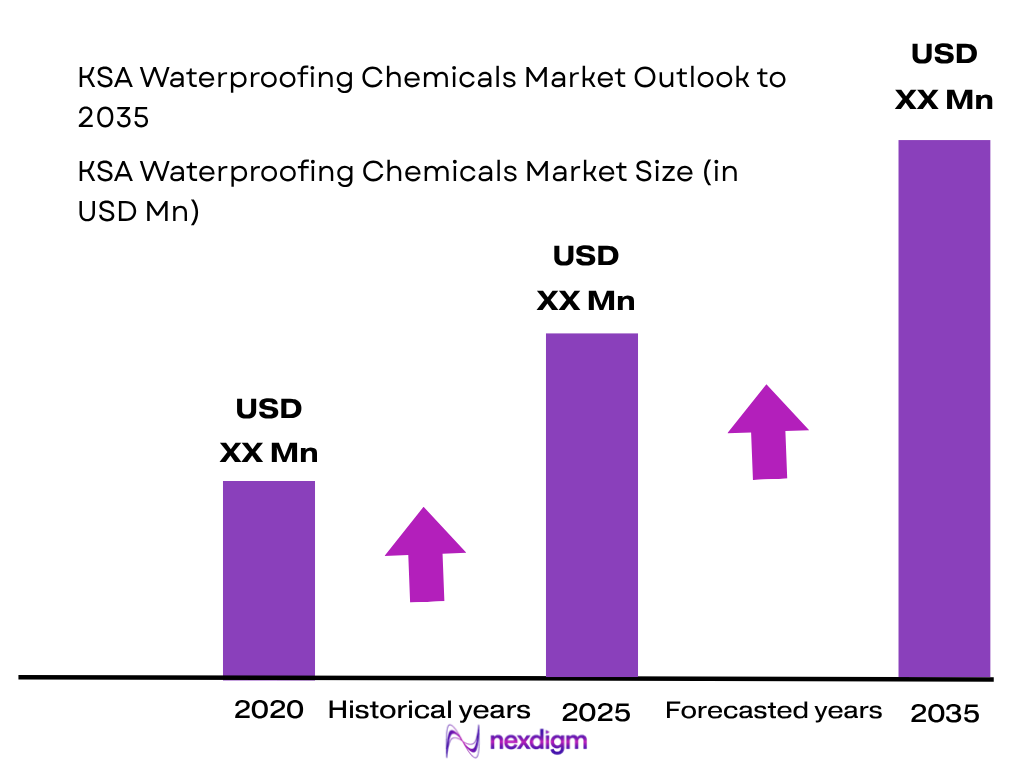
The KSA Waterproofing Chemicals Market is supported by the country’s exceptionally large construction and investment base. Saudi Arabia recorded GDP of approximately USD ~ billion and GDP per capita of USD 35,121.7 in 2024, while gross capital formation represented 32.4% of GDP, illustrating the scale of investment supporting construction-intensive applications. GASTAT reported real GDP growth of 1.3 in 2024, with non-oil activities expanding 4.3, reinforcing the diversification-led construction environment. These conditions support demand for below-grade, roof, concrete, infrastructure and water-structure waterproofing systems.
Riyadh, Jeddah, Makkah, Madinah and the Eastern Province constitute the principal demand centers for KSA Waterproofing Chemicals because they combine dense urban construction, infrastructure development, commercial real estate, hospitality, industrial activity and major public investment programs. Riyadh is particularly important because of its concentration of government, commercial and large-scale development activity, while Jeddah combines residential, hospitality, logistics and infrastructure requirements. Makkah and Madinah generate specialized waterproofing demand from pilgrimage-related facilities, hotels and transport infrastructure, while the Eastern Province benefits from industrial, energy and logistics development.
Market Segmentation
By Product Type
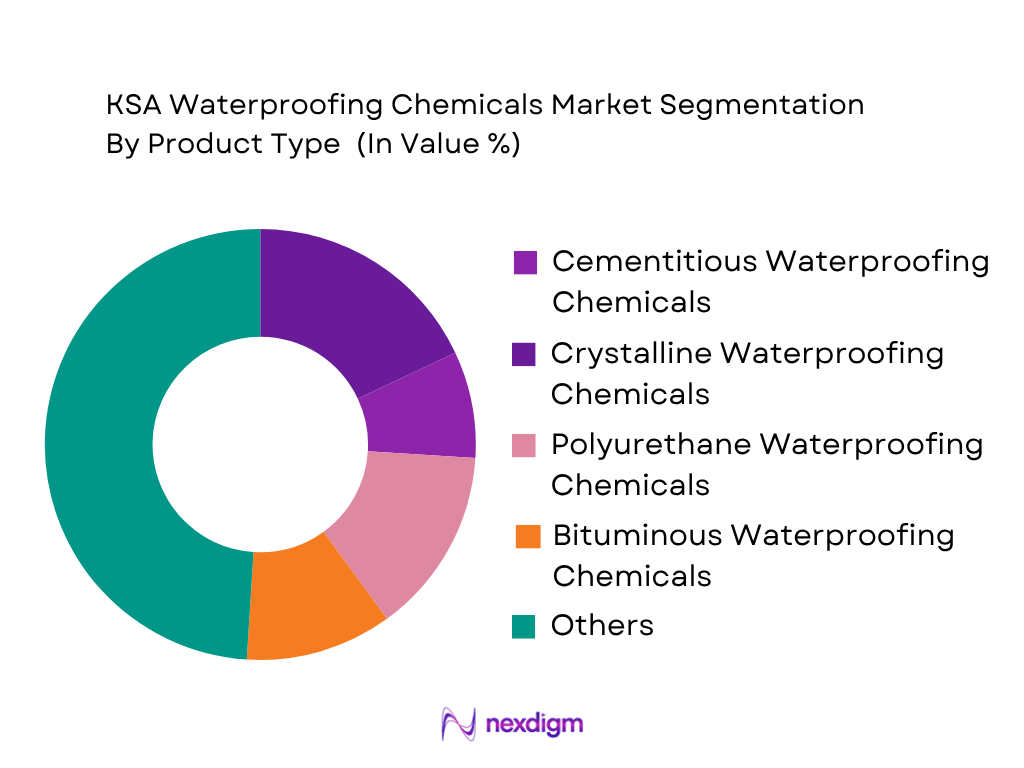
The KSA Waterproofing Chemicals Market is segmented by product type into cementitious waterproofing coatings, polyurethane waterproofing coatings, polyurea waterproofing systems, bituminous waterproofing coatings, acrylic waterproofing coatings, crystalline waterproofing systems, epoxy waterproofing systems, integral waterproofing admixtures, injection grouting chemicals, and silane and siloxane treatments. Polyurethane waterproofing coatings are expected to represent the dominant sub-segment because of their suitability for roofs, podiums, terraces, wet areas, concrete decks and complex geometries. Their seamless application, adhesion and crack-bridging characteristics make them suitable for projects where continuity of the waterproofing layer is important. Polyurethane systems can also be formulated for demanding environmental conditions, making them relevant to Saudi Arabia’s high temperatures and intense solar exposure. Meanwhile, crystalline systems remain important for concrete structures where integral protection is preferred, and polyurea offers rapid application for large project areas. The broad application flexibility of polyurethane therefore gives it a strong position across commercial buildings, hospitality assets, infrastructure and below-grade construction.
By Application
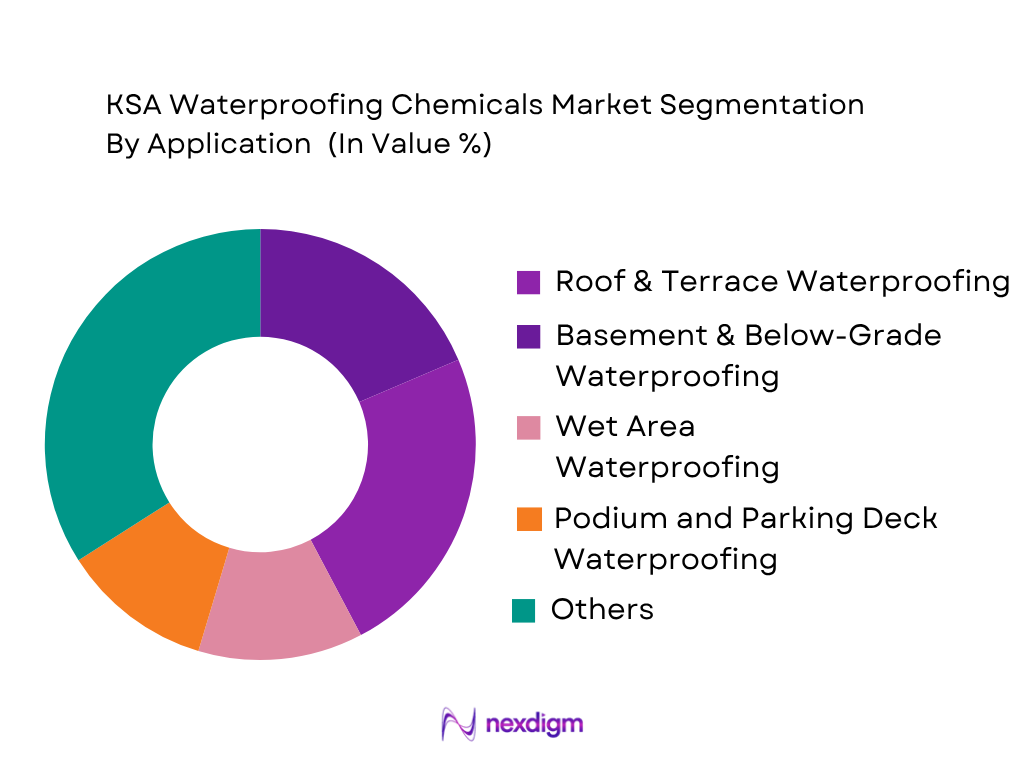
The KSA Waterproofing Chemicals Market is segmented by application into roof and terrace waterproofing, basement and below-grade waterproofing, wet-area waterproofing, water-tank and reservoir waterproofing, swimming-pool waterproofing, podium and parking-deck waterproofing, bridge and infrastructure waterproofing, tunnel waterproofing, concrete-joint and crack waterproofing, and façade and building-envelope waterproofing. Basement and below-grade waterproofing represents the dominant application because deep foundations, underground parking, basements, utility structures and below-ground infrastructure require continuous protection from groundwater and hydrostatic pressure. The importance of this application is reinforced by Saudi Arabia’s growing urban developments and large-scale mixed-use projects. Below-grade systems also have high consequences for project durability because waterproofing failures can affect structural concrete, reinforcement, finishes and building operations. Chemical systems including polyurethane, cementitious coatings, crystalline technologies, injection grouts and waterstops can be selected according to substrate conditions and water pressure. The application therefore provides a broad addressable base across residential, commercial, hospitality, infrastructure and giga-project construction.
Competitive Landscape
The KSA Waterproofing Chemicals Market contains global construction-chemical manufacturers, specialist waterproofing companies and regional suppliers competing through product breadth, technical specification, contractor relationships, certification, project references and local availability. Companies such as Sika, Fosroc, Mapei, Saint-Gobain Weber and Henkel have broad waterproofing portfolios spanning below-grade structures, roofs, concrete protection, joints and water-retaining infrastructure. Competitive differentiation increasingly depends on technical support and project qualification rather than product availability alone. Sika’s acquisition of Riyadh-based Gulf Seal further illustrates the strategic importance of Saudi waterproofing capabilities and local manufacturing presence.
| Major Player | Establishment Year | Headquarters | Core Waterproofing Chemistry | Key Application Strength | KSA Project Positioning | Distribution Capability | Technical Support |
| Sika | 1910 | Baar, Switzerland | ~ | ~ | ~ | ~ | ~ |
| Fosroc | 1934 | Staffordshire, UK | ~ | ~ | ~ | ~ | ~ |
| Mapei | 1937 | Milan, Italy | ~ | ~ | ~ | ~ | ~ |
| Saint-Gobain Weber | 1902 | Paris, France | ~ | ~ | ~ | ~ | ~ |
| Henkel / Polybit | 1876 | Düsseldorf, Germany | ~ | ~ | ~ | ~ | ~ |
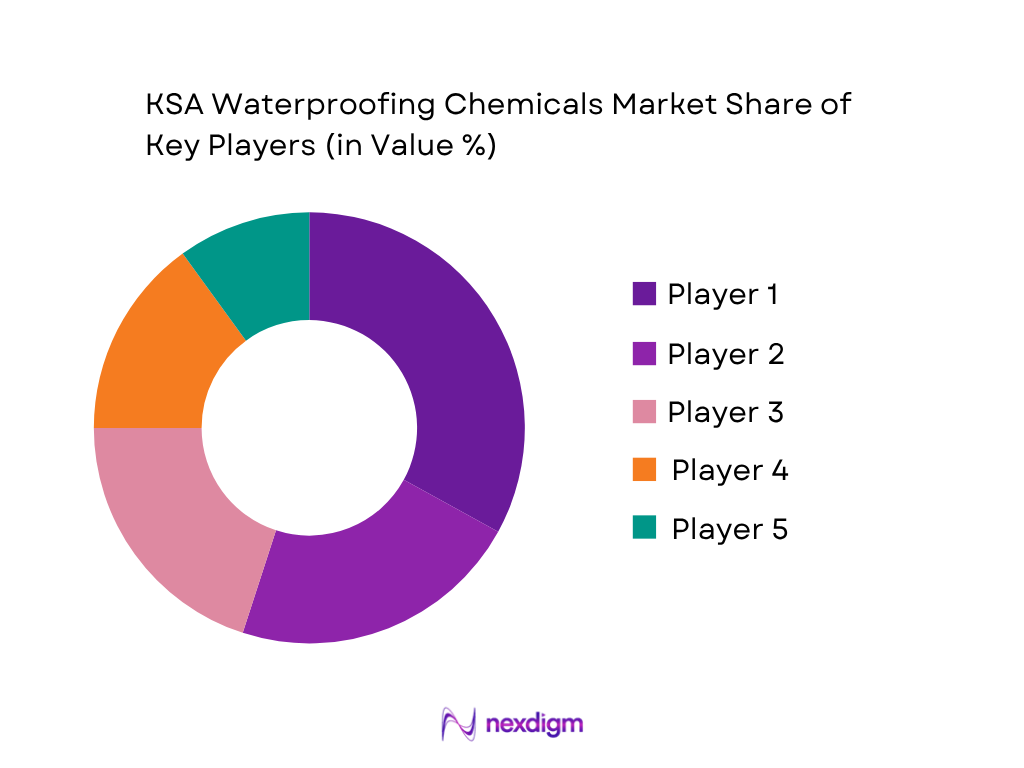
KSA Waterproofing Chemicals Market Analysis
Growth Drivers
Vision 2030 Construction Transformation
The KSA Waterproofing Chemicals Market is being supported by the continued expansion of non-oil economic activity and construction-led diversification under Vision 2030. Saudi Arabia’s real GDP increased by 1.3% in 2024, while non-oil activities expanded by 4.3%, demonstrating continued momentum outside the petroleum sector. GASTAT reported that construction-related and other non-oil activities contributed to this expansion, creating demand for building-envelope, basement, roof, concrete and infrastructure protection systems. The IMF subsequently reported that non-oil real GDP grew by 4.2% in 2024, with construction among the activities leading expansion. This environment is relevant to waterproofing chemicals because new commercial buildings, residential developments, hospitality assets, transportation facilities and industrial projects require protection against moisture ingress throughout foundations, roofs, wet areas and concrete structures. Vision 2030’s economic diversification framework is also increasing investment in sectors that require specialized construction materials rather than relying exclusively on conventional building activity. The combination of infrastructure development, private investment and non-oil expansion therefore creates a broad project pipeline for waterproofing manufacturers and applicators. Demand is particularly relevant for polyurethane, cementitious, crystalline, polyurea and injection systems used where conventional protection requires additional chemical performance.
Giga and Mega Project Expansion
The expansion of large-scale development programs provides a significant structural driver for the KSA Waterproofing Chemicals Market because mega-projects require waterproofing across multiple asset classes and construction stages. Saudi Arabia’s transformation strategy explicitly emphasizes large investments, while the IMF identifies strong domestic demand and government-led projects as important contributors to continued non-oil growth. In 2024, Saudi Arabia’s non-oil activities grew by 4.3%, while government activities expanded by 2.6%, reinforcing the broader investment environment supporting major developments. Large projects create requirements for basement waterproofing, podium decks, roofs, water-retaining structures, tunnels, utility corridors and concrete joints. The technical requirements are particularly demanding where structures are exposed to high temperatures, thermal movement and prolonged service conditions. NEOM, Red Sea tourism developments, transportation infrastructure and other large-scale developments therefore provide potential applications for seamless polyurethane and polyurea coatings, cementitious systems, crystalline concrete protection and injection grouts. Waterproofing also becomes strategically important because remedial access can be difficult after project completion, making specification and installation quality important during initial construction. As project owners increasingly emphasize durability and lifecycle performance, chemical waterproofing systems can gain relevance where continuous protection, substrate adhesion and compatibility with concrete repair systems are required.
Market Challenges
Extreme Heat and UV Exposure
Extreme climatic conditions represent a significant technical challenge for the KSA Waterproofing Chemicals Market because waterproofing systems installed on exposed roofs, terraces, podiums and external concrete structures must withstand intense solar radiation and repeated thermal movement. Saudi Arabia’s arid environment makes temperature resistance particularly important when selecting polymer-based waterproofing systems. The challenge is not limited to the chemical formulation itself; substrate movement, expansion joints, surface preparation and detailing around penetrations can influence long-term performance. Systems installed on roofs can experience repeated heating and cooling cycles, while exposed concrete can undergo dimensional movement that places additional stress on coatings and joints. Manufacturers therefore need products with appropriate UV resistance, flexibility, adhesion and crack-bridging characteristics for specific applications. Contractors also need application conditions to be controlled because substrate temperature and moisture can affect curing and film formation. These requirements can increase the technical complexity of projects compared with applications in milder climates. The challenge creates a need for application-specific specifications rather than treating waterproofing as a standardized commodity. It also increases the importance of manufacturer technical support, substrate assessment, primer selection, coating thickness control and inspection procedures. Consequently, climatic exposure can raise the performance threshold for waterproofing chemicals used throughout Saudi Arabia’s construction and infrastructure ecosystem.
Skilled Applicator Shortages and Application Complexity
Application quality represents a major challenge for the KSA Waterproofing Chemicals Market because advanced chemical systems require appropriate substrate preparation, mixing, application thickness, curing conditions and detailing. Polyurethane, polyurea, crystalline and injection systems can have substantially different installation requirements, meaning contractors must possess product-specific technical knowledge. Complex projects involving basements, tunnels, water tanks and podiums also contain joints, penetrations, construction interfaces and drainage details that require careful treatment. Saudi Arabia’s rapidly expanding construction environment increases the number of projects requiring specialist waterproofing services, while inconsistent application practices can create performance risks even when the specified product is technically suitable. Moisture conditions are another consideration for certain coatings and primers, making pre-application inspection important. Failure at a joint or penetration can compromise an otherwise continuous waterproofing system, increasing remediation requirements and project disruption. These factors make contractor training, certification, inspection and technical supervision important competitive differentiators. Manufacturers therefore need to support products with detailed application systems rather than relying solely on material supply. For developers and contractors, selection increasingly depends on documented technical performance, compatibility with concrete substrates and availability of qualified applicators. The challenge can also favor established suppliers with stronger technical-service networks and project-specific specification capabilities.
Market Opportunities
NEOM and Giga-Project Waterproofing
Giga-project development creates a substantial opportunity for the KSA Waterproofing Chemicals Market because large master-planned developments require waterproofing across residential, hospitality, commercial, transportation, utility and infrastructure assets. Saudi Arabia’s Vision 2030 framework identifies major projects as an important component of economic transformation, while the IMF notes that government-led projects and strong domestic demand continue to support non-oil activity. The opportunity extends beyond individual buildings because integrated developments require underground utilities, foundations, basements, parking structures, water infrastructure and transportation systems. These applications create potential demand for multiple chemical technologies, including polyurethane coatings, polyurea spray systems, crystalline concrete waterproofing, injection grouts and integral waterproofing admixtures. Large projects also provide opportunities for specification-led suppliers because technical approval, testing and project documentation are often established before procurement. The scale and complexity of such developments can favor suppliers capable of providing complete waterproofing systems rather than isolated products. Waterproofing manufacturers can also differentiate through technical design assistance, mock-up testing, substrate assessment and applicator training. As developers emphasize asset durability and reduced maintenance requirements, systems capable of protecting concrete and building envelopes over extended service periods become increasingly relevant. This creates a pathway for premium, technically differentiated waterproofing solutions across Saudi Arabia’s expanding development ecosystem.
Water and Wastewater Infrastructure Protection
Water infrastructure provides another important opportunity for the KSA Waterproofing Chemicals Market because Saudi Arabia’s arid environment makes reliable water supply, desalination, storage, transmission and wastewater treatment strategically important. The National Transformation Program’s 2024 reporting identifies expansion of desalinated water resources, wastewater services, strategic water storage and water-transmission networks as national priorities. Saudi Arabia’s 2024 Vision 2030 reporting states that the Kingdom has more than 4 billion cubic meters of annual desalination capacity and highlights a drinking-water storage network described as the world’s largest. These assets require protection for concrete tanks, reservoirs, treatment structures, pipelines, channels and associated infrastructure. Chemical waterproofing technologies can be applied where structures must resist continuous water exposure, hydrostatic pressure and concrete permeability. Crystalline systems can provide integral concrete protection, while polyurethane, cementitious and injection systems can address joints, cracks and localized leakage. Rehabilitation creates an additional opportunity because existing water infrastructure requires maintenance without necessarily replacing entire structures. Suppliers that combine waterproofing with concrete repair, corrosion protection and joint treatment can therefore address broader project requirements. The strategic importance of water security supports continued infrastructure development and creates a specialized demand environment for waterproofing systems capable of operating in water-retaining and wastewater applications.
Future Outlook
Over the forecast period, the KSA Waterproofing Chemicals Market is expected to benefit from continued development of large-scale urban, tourism, hospitality, infrastructure and industrial projects. Demand is expected to move toward higher-performance waterproofing systems capable of handling heat, UV exposure, thermal movement, hydrostatic pressure and aggressive service environments. Below-grade construction, roof restoration, concrete rehabilitation and water infrastructure should remain important application areas. Advanced polyurea, polyurethane, crystalline and integrated concrete-protection technologies are likely to gain greater specification attention as project owners prioritize durability and lifecycle performance.
Major Players
- Sika
- Fosroc
- Mapei
- Saint-Gobain Weber
- Henkel / Polybit
- Jotun
- BASF / Master Builders Solutions
- Pidilite / Dr. Fixit
- Kryton International
- Penetron
- DCP International
- Al Muqarram Group
- Terraco
- BITUMAT
- Soprema
Key Target Audience
- Waterproofing Chemical Manufacturers and Construction Chemical Producers
- Real Estate Developers and Giga-Project Developers
- Main Contractors and Specialist Waterproofing Contractors
- Infrastructure Developers and Project Owners
- Industrial, Logistics and Data Center Facility Owners
- Investments and Venture Capitalist Firms
- Government and Regulatory Bodies (Ministry of Municipalities and Housing, Ministry of Transport and Logistic Services, Saudi Standards, Metrology and Quality Organization)
- Facility Management Companies and Building Asset Owners
Research Methodology
Step 1: Identification of Key Variables
The initial phase involves constructing a KSA Waterproofing Chemicals Market ecosystem covering raw-material suppliers, waterproofing manufacturers, distributors, contractors, applicators, developers, infrastructure authorities and project owners. Product chemistry, application, construction activity, end-use sector, waterproofed area and project specifications are identified as core market variables.
Step 2: Market Analysis and Construction
Historical market information is compiled through construction activity, infrastructure investment, manufacturer product portfolios, project applications and chemical consumption indicators. The analysis separates new construction from refurbishment and evaluates demand across roofs, basements, water structures, infrastructure, industrial facilities and commercial buildings.
Step 3: Hypothesis Validation and Expert Consultation
Market hypotheses are validated through consultations with waterproofing manufacturers, distributors, contractors, applicators, architects and engineering professionals. Discussions focus on product selection, application conditions, specification practices, technology adoption, project pipelines, contractor capabilities and regional differences across KSA.
Step 4: Research Synthesis and Final Output
The final stage triangulates manufacturer-level information, project-level evidence, construction indicators and demand-side assessments. Bottom-up product consumption estimates are reconciled against top-down construction expenditure and waterproofing application requirements to establish a consistent market framework and forecast outlook.

- Executive Summary
- Research Methodology (Market Definition and Scope, KSA Waterproofing Chemicals Classification, Waterproofing Chemistry Mapping, Cementitious Waterproofing Assessment, Polyurethane Waterproofing Evaluation, Polyurea System Assessment, Bituminous Waterproofing Analysis, Crystalline Waterproofing Evaluation, Injection Grouting Assessment, Integral Waterproofing Admixture Analysis, Waterproofing Performance Mapping, Hydrostatic Pressure Resistance Assessment, Crack-Bridging Capability Analysis, Adhesion Strength Evaluation, Chemical Resistance Assessment, UV and Thermal Stability Assessment, Application Condition Analysis, Construction Activity Mapping, Infrastructure Rehabilitation Assessment, Building Renovation Assessment, Precast and Cast-In-Situ Construction Assessment, Project Specification Analysis, Domestic Manufacturing Capability Assessment, Import Dependency Assessment, Supply-Side Assessment, Demand-Side Assessment, Top-Down Market Sizing, Bottom-Up Market Sizing, Primary Industry Interviews, Data Triangulation, Forecasting Framework)

- Definition and Scope
- KSA Waterproofing Chemicals Industry Evolution and Development of Cementitious Waterproofing, Polymer-Modified Waterproofing Systems, Polyurethane Waterproofing Coatings, Polyurea Spray Systems, Bituminous Waterproofing Coatings, Acrylic Waterproofing Systems, Crystalline Concrete Waterproofing, Epoxy Waterproofing Systems, Injection Grouting Chemicals, Integral Waterproofing Admixtures, Concrete Protection Systems, Roof Waterproofing Technologies, Below-Grade Waterproofing Systems, Water-Tank Waterproofing, Bridge and Tunnel Waterproofing, High-Performance Building Envelope Systems, Low-VOC Waterproofing Chemistry and Advanced Liquid-Applied Waterproofing
- Waterproofing Chemicals Value Chain Analysis
- Waterproofing Chemicals Supply Chain Analysis
- Cement and Mineral Binder Suppliers, Polymer and Resin Suppliers, Bitumen Suppliers, Chemical Additive Manufacturers, Polyurethane Raw Material Suppliers, Acrylic Polymer Suppliers, Crystalline Technology Developers, Waterproofing Chemical Manufacturers, Construction Chemical Distributors, Specialist Waterproofing Contractors, Applicators, Main Contractors, Infrastructure Contractors, Architects, Engineering Consultants, Real Estate Developers, Giga-Project Developers, Infrastructure Owners, Facility Management Companies and Building Owners

- Growth Drivers (Vision 2030 Construction Transformation, Giga and Mega Project Expansion, Residential Construction, Commercial Real Estate Development, Hospitality and Tourism Infrastructure, NEOM Development, Red Sea Tourism Development, Infrastructure Modernization, Transportation Infrastructure Expansion, Water and Wastewater Infrastructure Development)
- Market Challenges (Extreme Heat and UV Exposure, Thermal Cycling, Substrate Moisture Conditions, Skilled Applicator Shortages, Surface Preparation Complexity, Imported Specialty Chemical Dependence, Product Compatibility Requirements, Application Quality Variability, Complex Project Specifications, Competition from Sheet and Membrane Systems)
- Market Opportunities (Giga-Project Waterproofing, NEOM Infrastructure Waterproofing, Below-Grade Waterproofing Modernization, Infrastructure Rehabilitation, Water and Wastewater Infrastructure Protection, Roof Restoration, Low-VOC Waterproofing Formulations, Polyurea Spray Applications, High-Performance Polyurethane Systems, Crystalline Concrete Waterproofing, Bridge and Tunnel Protection, Integrated Waterproofing and Concrete Protection Systems)
- Market Trends (Seamless Liquid-Applied Waterproofing, High-Performance Polyurea Adoption, Crystalline Concrete Protection, Low-VOC Formulation Development, Integrated Concrete Repair and Waterproofing, Faster-Curing Systems, Long-Life Roof Protection, Advanced Below-Grade Systems, Waterproofing System Certification, Digital Construction Quality Monitoring)
- Government Regulations and Standards (Saudi Building Code Requirements, Saudi Building Code Structural Requirements, Saudi Building Code Fire and Life Safety Requirements, SASO Construction Product Requirements, Saudi Standards for Concrete and Construction Chemicals, ASTM Waterproofing Test Methods, ACI Concrete Protection Requirements, Façade and Building Envelope Requirements, Environmental and Chemical Compliance Requirements, Product Conformity and Certification Requirements)
- SWOT Analysis
- Porter’s Five Forces Analysis
- PESTLE Analysis
- Stakeholder Ecosystem
- Competition Ecosystem

- By Market Value (2020-2025)
- By Waterproofing Chemical Consumption Volume (2020-2025)
- By Installed Waterproofed Surface Area (2020-2025)
- By Construction Application Volume (2020-2025)
- By New Construction Waterproofing Volume (2020-2025)
- By Renovation and Refurbishment Waterproofing Volume (2020-2025)
- By Residential Waterproofing Volume (2020-2025)

- By Product Type (In Value %)
Cementitious Waterproofing Coatings
Polyurethane Waterproofing Coatings
Polyurea Waterproofing Systems
Bituminous Waterproofing Coatings
Acrylic Waterproofing Coatings
Crystalline Waterproofing Systems
Epoxy Waterproofing Systems
Integral Waterproofing Admixtures
Injection Grouting Chemicals
Silane and Siloxane Waterproofing Treatments - By Application (In Value %)
Roof and Terrace Waterproofing
Basement and Below-Grade Waterproofing
Wet Area Waterproofing
Water Tank and Reservoir Waterproofing
Swimming Pool Waterproofing
Podium and Parking Deck Waterproofing
Bridge and Infrastructure Waterproofing
Tunnel Waterproofing
Concrete Joint and Crack Waterproofing
Façade and Building Envelope Waterproofing
Industrial Floor and Process Area Waterproofing - By Construction Activity (In Value %)
New Building Construction
Building Renovation and Refurbishment
Infrastructure Rehabilitation
Roof Restoration
Concrete Repair and Protection
Below-Grade Retrofitting
Waterproofing Failure Remediation
Giga and Mega Project Construction - By End-Use Sector (In Value %)
Residential Buildings
Commercial Offices
Retail and Shopping Centers
Hotels and Hospitality
Industrial and Manufacturing Facilities
Warehouses and Logistics Facilities
Data Centers
Healthcare Facilities
Educational and Institutional Buildings
Government and Civic Buildings
Religious and Pilgrimage Facilities
Sports and Entertainment Infrastructure - By End-User (In Value %)
Real Estate Developers
Main Contractors
Specialist Waterproofing Contractors
Infrastructure Developers
Industrial Facility Owners
Giga-Project Developers
Facility Management Companies
Government Infrastructure Authorities
Property Owners and Operators - By Region (In Value %)
Riyadh
Jeddah
Makkah
Madinah
Eastern Province
NEOM Region
Red Sea Development Corridor
Asir
Rest of KSA

- Market Share of Major Players (By KSA Revenue, Waterproofing Product Portfolio, Waterproofing Chemistry Coverage, Application Coverage, Giga-Project Qualification, Infrastructure Project Presence, Residential Project Coverage, Commercial Project Coverage, Contractor Network Reach, Distribution Network Coverage, Technical Support Capability, Applicator Training Capability, Product Certification, Project Reference Base, Local Manufacturing and Stocking Capability)
- Cross Comparison Parameters (Waterproofing Chemistry Portfolio Breadth, Polyurethane and Polyurea System Capability, Crystalline Waterproofing Technology Capability, Below-Grade Waterproofing Coverage, Roof and Podium Waterproofing Capability, Concrete Repair and Protection Portfolio, KSA Distribution and Contractor Network Reach, Technical Specification and Applicator Support Capability)
- SWOT Analysis of Major Players
- Detailed Profiles of Major Companies
Sika Saudi Arabia
Fosroc Saudi Arabia
Mapei Saudi Arabia
Saint-Gobain Weber
Henkel / Polybit
Jotun Saudi Arabia
BASF / Master Builders Solutions
Pidilite / Dr. Fixit
Kryton International
Penetron
DCP International
Al Muqarram Group
Terraco
BITUMAT
Soprema

- Waterproofing Specification Requirement Assessment
- Residential Building Waterproofing Demand Analysis
- Commercial Building Waterproofing Requirement Assessment
- Luxury Hotel and Resort Waterproofing Assessment
- Giga and Mega Project Waterproofing Requirement Analysis
- NEOM and New-Generation City Infrastructure Assessment
- Industrial and Logistics Facility Waterproofing Analysis
- Data Center Waterproofing Requirement Assessment
- Water and Wastewater Infrastructure Waterproofing Analysis

- By Market Value (2026-2035)
- By Waterproofing Chemical Consumption Volume (2026-2035)
- By Installed Waterproofed Surface Area (2026-2035)
- By Construction Application Volume (2026-2035)
- By New Construction Waterproofing Volume (2026-2035)
- By Renovation and Refurbishment Waterproofing Volume (2026-2035)
- By Residential Waterproofing Volume (2026-2035)


 Request a Sample
 Ask for Customization
 Get a Quote
 Enquire Now