

 Download PDF
 Download PDF
Market Overview
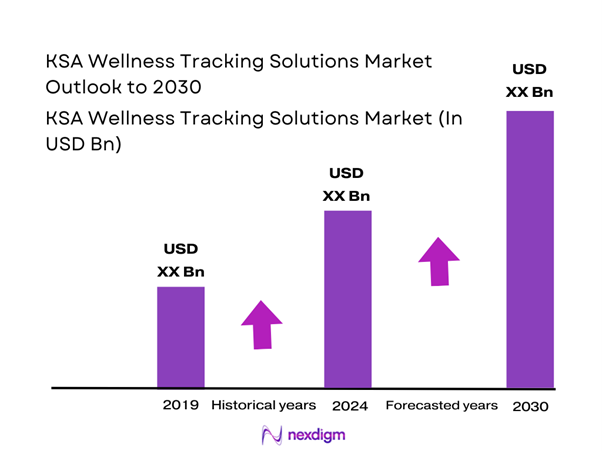
The KSA wellness tracking solutions market is valued at USD ~ billion in the latest year, supported by a strong prior-year base in adjacent “wearable computing” demand of USD ~ million, reflecting sustained consumer pull for wrist-worn tracking and upgrades into multi-sensor devices (sleep, SpO₂, heart rate, activity). Growth is being reinforced by broader fitness-app monetization—Saudi Arabia’s fitness app revenues reached USD ~ million in the latest year—making devices + apps a coupled ecosystem rather than standalone purchases.
Within KSA, Riyadh leads enterprise adoption (employer wellness programs, digital-health partnerships, premium device ASPs), Jeddah drives lifestyle-led uptake (consumer retail, fitness communities, coastal leisure sports), and the Eastern Province (Dammam/Khobar) benefits from higher corporate density and structured workforce health initiatives. On supplier influence, the ecosystem is shaped by device and OS powerhouses headquartered outside KSA—especially the U.S. (Apple/Google), South Korea (Samsung), and China (Huawei/Xiaomi)—because their operating systems, app stores, and hardware reference designs set the interoperability standards that KSA buyers (consumers, insurers, employers) typically standardize on.
Market Segmentation
By Fitness App Type
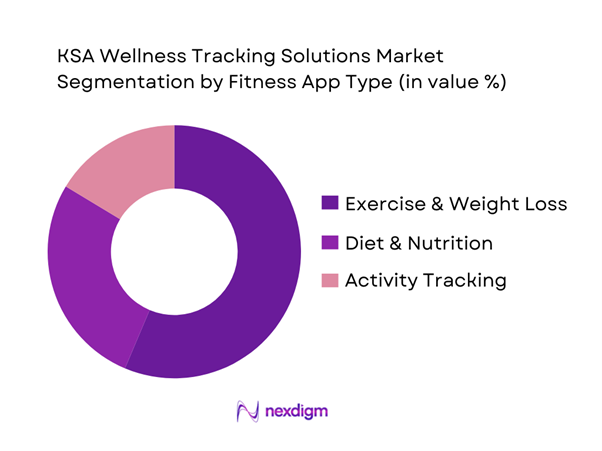
Saudi Arabia’s wellness tracking ecosystem includes a large software layer (fitness/wellness apps) that complements wearables. The fitness app market is segmented by type into exercise & weight loss, diet & nutrition, and activity tracking. Recently, exercise & weight loss has the dominant market share because it is the default entry point for most users (structured workout plans, coaching content, habit loops, and wearable-compatible training metrics). It also benefits from stronger monetization mechanics (subscriptions, bundled plans, premium coaching) and higher repeat engagement versus passive tracking-only use cases.
By Platform
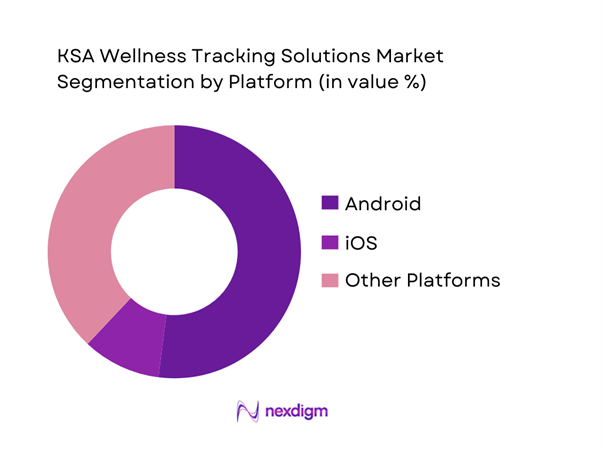
Within the most monetized fitness-app subtype (exercise & weight loss), the market is segmented by platform into Android, iOS, and other platforms. Recently, Android dominates because its handset base is broad across price tiers, it is frequently bundled with OEM wellness ecosystems (device companion apps and integrations), and it benefits from wider reach across mass-market consumers who enter wellness tracking through affordable smartphones and mid-tier wearables.
Competitive Landscape
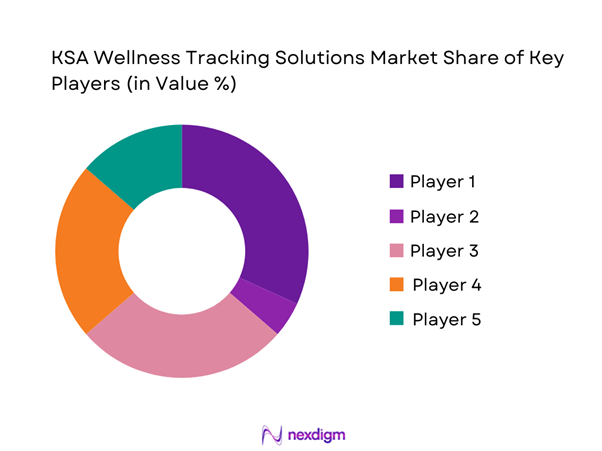
The KSA wellness tracking solutions market is characterized by ecosystem competition: a small set of operating-system and device-stack leaders strongly influence user lock-in (device + companion app + health data layer), while specialists (rings, straps, coaching apps, and analytics platforms) compete on accuracy, battery life, and specific wellness programs (sleep, stress, weight management). This creates a two-speed market—platform leaders capture mass distribution, while niche brands win premium or condition-specific cohorts.
| Company | Est. Year | HQ | KSA Availability / Channel Focus | Core Wellness Tracking Strength | Ecosystem & App Integration | Battery / Form-Factor Edge | Typical Buyer Segment | Partnerships / Institutional Angle |
| Apple (Apple Watch + Health) | 1976 | USA | ~ | ~ | ~ | ~ | ~ | ~ |
| Samsung (Galaxy Watch + Samsung Health) | 1938 | South Korea | ~ | ~ | ~ | ~ | ~ | ~ |
| Huawei (Watch/Band + Huawei Health) | 1987 | China | ~ | ~ | ~ | ~ | ~ | ~ |
| Garmin | 1989 | USA | ~ | ~ | ~ | ~ | ~ | ~ |
| Google (Fitbit) | 2016* | USA | ~ | ~ | ~ | ~ | ~ | ~ |
KSA Wellness Tracking Solutions Market Analysis
Growth Drivers
Vision-aligned preventive care demand
Saudi Arabia’s wellness tracking pull is reinforced by a prevention-first health agenda and the country’s scale of addressable population and spending capacity. The Kingdom’s mid-year population is ~ million, creating a large base of working-age residents who are increasingly “mobile-first” and therefore reachable by app- and wearable- led behavior change journeys. Macroeconomically, Saudi Arabia’s economy is sized at USD ~ trillion, with GDP per capita of USD ~, supporting premium uptake for multi-sensor wearables and subscription wellness services in major cities. On the public investment side, the government’s Health & Social Development sector allocation is SAR ~ billion, signaling sustained system-level focus on improving population wellbeing outcomes (which, operationally, encourages digital prevention tooling, nudges, and monitoring). In parallel, private health coverage continues expanding—beneficiaries rising from ~ million to ~ million between adjacent recent years, supporting insurer-driven prevention programs where wellness tracking is used to sustain engagement and reduce downstream claims pressure.
Employer healthcare cost optimization focus
Employers in KSA are increasingly pressured to manage healthcare utilization for a large, growing insured base—this is a direct tailwind for wellness tracking solutions packaged as employee wellbeing, engagement, and early-risk identification tools. Mandatory private health insurance beneficiaries increased from ~ million to ~ million in the most recently reported step-up, which expands the pool of employer-linked policies where prevention benefits (step challenges, sleep programs, weight management modules) can be embedded. Macro conditions also support structured employer programs: Saudi Arabia’s GDP per capita is USD ~, enabling companies—especially in Riyadh, Eastern Province, and large industrial clusters—to fund benefit enhancements that improve retention and productivity. Public-sector prioritization further normalizes wellbeing investments: the Health & Social Development sector allocation is SAR ~ billion, which strengthens the broader ecosystem (providers, platforms, digital health infrastructure) that employers plug into. On the scale side, the Kingdom’s total population is ~ million—a large workforce market—while “always-on connectivity” makes digital wellbeing practical at scale: internet penetration reached ~ and mobile phones accounted for ~ of internet usage, meaning employer wellness programs can be deployed via smartphones with optional wearables rather than relying on onsite-only interventions.
Challenges
Data privacy and consent management
Wellness tracking solutions process health-adjacent personal data (biometrics, location-linked activity, sleep routines), so privacy compliance is a binding constraint in Saudi Arabia. A key operational milestone is that the Personal Data Protection Law (PDPL) became fully enforceable on ~, raising compliance expectations for consent collection, lawful basis, purpose limitation, and data subject rights—especially for apps and platforms operating across employer, insurer, and consumer channels. This matters because the market’s scale is large and digitally dense: Saudi Arabia’s population is ~ million, internet penetration reached ~, and mobile phones account for ~ of internet usage—so even small consent-design flaws can propagate quickly across millions of users. High connectivity also increases data exhaust: mobile telecom subscriptions at ~ million support always-on tracking and frequent syncing, but also expand the risk surface for data transfers, third-party SDKs, and cross-border processing. From a macro standpoint, the economy’s size—USD ~ trillion—attracts global platforms and vendors, yet PDPL enforcement forces them to adapt governance and data handling to local requirements, which can slow deployments and raise implementation burden for enterprise rollouts.
Integration complexity across ecosystems
In KSA, wellness tracking is rarely a single product—it’s an ecosystem chain (device sensors → phone OS health layer → app analytics → employer/insurer dashboards). Integration complexity rises because the market is simultaneously very connected and highly diverse. Saudi Arabia’s internet penetration is ~ and mobile phones represent ~ of usage, so users expect “instant sync” experiences; when integrations fail (permissions, Bluetooth pairing, OS updates), churn increases. Performance expectations are also high: average mobile download speed reached ~ Mbps and fixed broadband averaged ~ Mbps, meaning latency or data gaps are more likely to be blamed on platforms rather than networks—raising reputational risk for wellness providers. The telecom base scale adds complexity: mobile subscriptions at ~ million imply multi-device and multi-SIM behaviors that can complicate identity resolution. On the institutional side, payer and employer channels are expanding: private health insurance beneficiaries rose from ~ million to ~ million in recent reporting, increasing demand for secure data-sharing, API access, and standardized reporting—yet many consumer ecosystems are not designed for enterprise-grade interoperability. Finally, PDPL enforceability from ~ adds integration friction because data flows must be justified, consented, and auditable—often requiring architecture changes before employers or payers will approve integration at scale.
Opportunities
Rewards-based wellness models
Rewards-based wellness is a strong growth opportunity in KSA because the addressable base is large, digitally reachable, and increasingly insured—ideal conditions for incentive loops that depend on scale. The private health insurance beneficiary base rose from ~ million to ~ million in recent reporting, expanding the member pool where insurers can embed activity rewards, streak-based incentives, and preventive nudges tied to engagement. Beyond residents, visitor health insurance beneficiaries reached ~ for tourism and pilgrimage-linked products—a high-volume cohort where short-duration incentives can be deployed at scale via mobile onboarding. The macro environment supports reward redemption ecosystems: GDP per capita of USD ~ and a total GDP of USD ~ trillion underpin a robust retail and services economy where rewards can be meaningful. Delivery feasibility is unusually strong: internet penetration is ~, mobile phones account for ~ of browsing, and mobile telecom subscriptions reached ~ million—so incentive programs can be executed through apps with push notifications and wallet integrations. Compliance readiness becomes a differentiator: PDPL enforceability from ~ means rewards programs that manage consent transparently and minimize data collection can scale faster through employer and payer approvals.
Women’s health and localized wellness modules
Women’s health and localization represent a high-value opportunity because KSA is large enough to support tailored modules and has the digital infrastructure to distribute them rapidly. The population base is ~ million, and near-universal connectivity—~ internet penetration with ~ of browsing via mobile phones—means specialized modules can reach users without requiring clinic-first pathways. The economic capacity to pay for premium experiences is also present: GDP per capita is USD ~, supporting subscription wellness plans and premium wearable adoption that improves women’s health tracking use-cases. Public-sector prioritization strengthens the ecosystem: the Health & Social Development sector allocation is SAR ~ billion, which supports broader health initiatives and raises demand for structured preventive tools that can complement primary care access. From a compliance standpoint, PDPL being fully enforceable since ~ increases trust requirements—women’s health modules often involve sensitive data categories, so platforms that implement explicit consent flows, clear data minimization, and secure storage will be better positioned to partner with employers and insurers. Finally, mobile subscriptions of ~ million create multiple engagement touchpoints (phones + wearables), enabling personalized coaching journeys that remain active through reminders and culturally relevant content calendars.
Future Outlook
Over the next planning cycle, KSA’s wellness tracking solutions market is expected to expand through a combination of sensor upgrades (better sleep, stress, and cardio signals), software-led personalization (AI coaching, adaptive plans, contextual nudges), and institutional pull from employers and payers who want measurable health engagement rather than generic wellness benefits. The market will also move toward interoperability expectations (device-to-app-to-provider), while buyers increase scrutiny of data governance, consent, and cybersecurity as health-adjacent data volumes rise.
Major Players
- Apple
- Samsung Electronics
- Huawei
- Xiaomi
- Garmin
- Polar
- Oura
- Withings
- WHOOP
- Amazfit
- Philips
- Omron
- Strava
Key Target Audience
- Wearables OEMs and consumer-electronics brands
- Mobile network operators and device distributors
- Health insurers and payer administrators
- Large employers and corporate HR/Benefits teams
- Healthcare provider groups and hospital networks
- Digital health platform operators / app publishers
- Investments and venture capitalist firms
- Government and regulatory bodies
Research Methodology
Step 1: Identification of Key Variables
We construct the ecosystem map for the KSA wellness tracking solutions market, covering device OEMs, OS/app ecosystems, retailers, e-commerce channels, employers, and payers. Secondary research is used to define variables such as device form factors, app monetization models, data flows, and interoperability requirements, and to align the scope with what is purchased as “wellness tracking solutions” in KSA.
Step 2: Market Analysis and Construction
We compile historical demand signals and revenue benchmarks from credible country-level and category-level sources, separating device-led wellness tracking from app-led wellness tracking. This phase includes triangulation across device categories (smartwatches, bands, rings) and software categories (fitness app types, platforms) to build a coherent market picture and adoption logic.
Step 3: Hypothesis Validation and Expert Consultation
We validate hypotheses via structured expert consultations with channel partners (retail/e-commerce), enterprise wellness stakeholders, and category specialists. These interviews confirm which product bundles actually sell in KSA, what drives repeat purchases (upgrades, subscriptions), and what barriers (privacy, accuracy perceptions, affordability) constrain conversion.
Step 4: Research Synthesis and Final Output
We synthesize results into a decision-oriented market narrative, linking category growth to buyer priorities (consumer, enterprise, payer). Outputs include segment dominance logic, competitive benchmarking, and implementation implications (interoperability, cybersecurity, channel strategy), ensuring internal consistency with validated market sizing references.

- Executive Summary
- Research Methodology (Market Definitions and Assumptions, Abbreviations, Scope Boundary for Wellness Tracking Solutions, Market Sizing Approach, Data Triangulation Framework, Primary Interview Approach, Secondary Source Mapping, Demand-Side vs Supply-Side Modeling, Validation and Reconciliation Logic, Limitations and Future Conclusions)

- Definition and Scope
- Overview Genesis
- Timeline of Major Players
- Business Cycle
- Supply Chain and Value Chain Analysis

- Growth Drivers
Vision-aligned preventive care demand
Employer healthcare cost optimization focus
Wearable and smartphone penetration
Retail, telecom, and OEM bundling strategies
Payer-led wellness incentive programs - Challenges
Data privacy and consent management
Integration complexity across ecosystems
User engagement decay and churn
Clinical validation gaps
Fragmented digital health ecosystems - Opportunities
Rewards-based wellness models
Women’s health and localized wellness modules
Arabic-first personalization and coaching
Chronic risk adjacent wellness solutions
Sports and mega-event driven wellness adoption - Trends
AI-driven wellness coaching
Multimodal biometric tracking
Ring-based and discreet wearables
Community-driven corporate wellbeing platforms
Wellness-to-care continuum convergence - Regulatory & Policy Landscape
- SWOT Analysis
- Stakeholder & Ecosystem Analysis
- Porter’s Five Forces Analysis
- Competitive Intensity & Ecosystem Mapping

- By Value, 2019–2024
- By Subscriptions and Active Plans, 2019–2024
- Installed Base of Active Users and Active Devices, 2019–2024
- By ARPU and Revenue per Active User, 2019–2024

- By Fleet Type (in Value %)
Wellness apps
Device-linked platforms
Clinical-grade wellness monitoring solutions
Corporate wellness platforms
Payer-linked wellness programs - By Application (in Value %)
Physical activity and sedentary behavior tracking
Sleep and recovery monitoring
Weight management and nutrition tracking
Mental wellbeing and mindfulness tracking
Women’s wellness and family health modules - By Technology Architecture (in Value %)
Standalone consumer application architecture
Device-first companion application architecture
Employer-sponsored integrated platforms
Insurer and payer embedded platforms
Provider ecosystem integrated platforms - By Connectivity Type (in Value %)
Smartphone-only tracking
Fitness bands
Smartwatches
Rings and specialized wearables
Connected health devices - By End-Use Industry (in Value %)
Individual consumers
Employers
Insurers and TPAs
Healthcare providers
Government and public sector programs - By Region (in Value %)
Central
Western
Eastern
Southern
Northern

- Market share snapshot by revenue, active users, subscriptions, and enterprise accounts
- Cross Comparison Parameters (KSA active user base, engagement performance metrics, biometric breadth, ecosystem compatibility, payer and employer partnership depth, integration readiness, localization strength, trust and compliance posture)
- SWOT analysis of major players
- Pricing and packaging benchmarking
- Detailed Profiles of Major Companies
Apple
Samsung Electronics
Huawei
Xiaomi
Garmin
Fitbit
Amazfit / Zepp Health
Oura
WHOOP
Polar
Withings
Okadoc
Altibbi
Seha Virtual Hospital / Seha

- Demand and utilization patterns
- Budgeting and procurement behavior
- Buyer journey and decision-making framework
- Pain points and unmet needs
- Adoption barriers by user segment

- By Value, 2025–2030
- By Subscriptions and Active Plans, 2025–2030
- Installed Base of Active Users and Active Devices, 2025–2030
- By ARPU and Revenue per Active User, 2025–2030


 Request a Sample
 Ask for Customization
 Get a Quote
 Enquire Now