

 Download PDF
Market Overview
The KSA Wood Based Panel Market is valued at approximately USD ~ billion in 2024, based on the report framework. Underlying trade indicators show strong demand: Saudi Arabia imported USD 252.71 million of plywood, veneered panels and similar laminated wood in the preceding period, while particleboard imports subsequently reached USD 68.66 million and 132.94 million kg. Furniture production, residential interiors, kitchens, wardrobes, hospitality fit-outs and commercial construction support consumption of MDF, particleboard, plywood and decorative boards.
Riyadh, Jeddah and the Dammam-Khobar-Dhahran corridor represent important KSA Wood Based Panel Market demand and distribution centers because they concentrate construction, furniture manufacturing, joinery, warehousing and interior fit-out activity. The market is also highly connected to international suppliers: Saudi particleboard imports reached 132.94 million kg, led by Romania, Thailand, China, Italy and Turkey, while imports of a major plywood and laminated-panel category reached USD 187.44 million, led primarily by China and Indonesia.
Market Segmentation
By Product Type
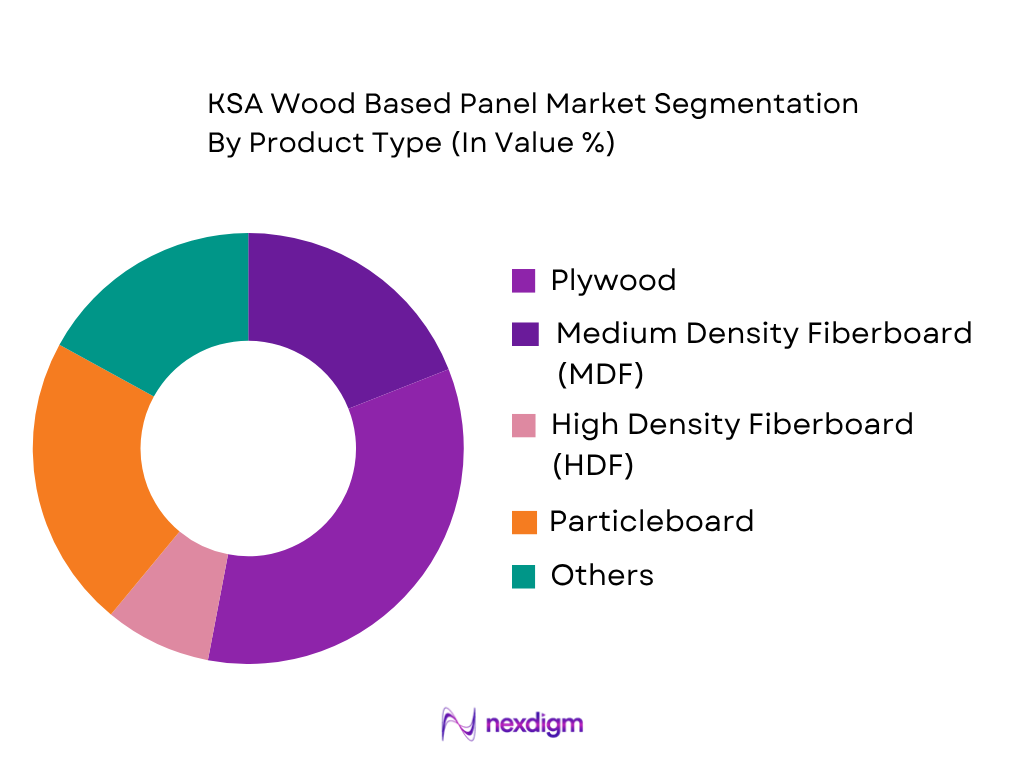
The KSA Wood Based Panel Market is segmented by product type into medium-density fibreboard, high-density fibreboard, particleboard, plywood, oriented strand board, melamine-faced boards and other engineered wood panels. MDF is positioned as the dominant sub-segment in this report framework because it is extensively applicable to furniture, wardrobes, kitchen cabinetry, shelving, wall panels, doors and decorative interior components. MDF offers a smooth and uniform surface that is suitable for machining, routing, painting, laminating and application of decorative surfaces, making it particularly relevant for Saudi Arabia’s furniture and fit-out ecosystem. Particleboard also has a significant role in ready-to-assemble and cost-sensitive furniture applications. Import statistics demonstrate the depth of panel demand: Saudi Arabia imported 132.94 million kg of particleboard under the relevant trade classification, while imports of plywood, veneered panels and similar laminated products under another major classification reached USD 187.44 million. The combination of imported supply, domestic processing and project-based consumption supports a diversified wood-panel product mix.
By Application
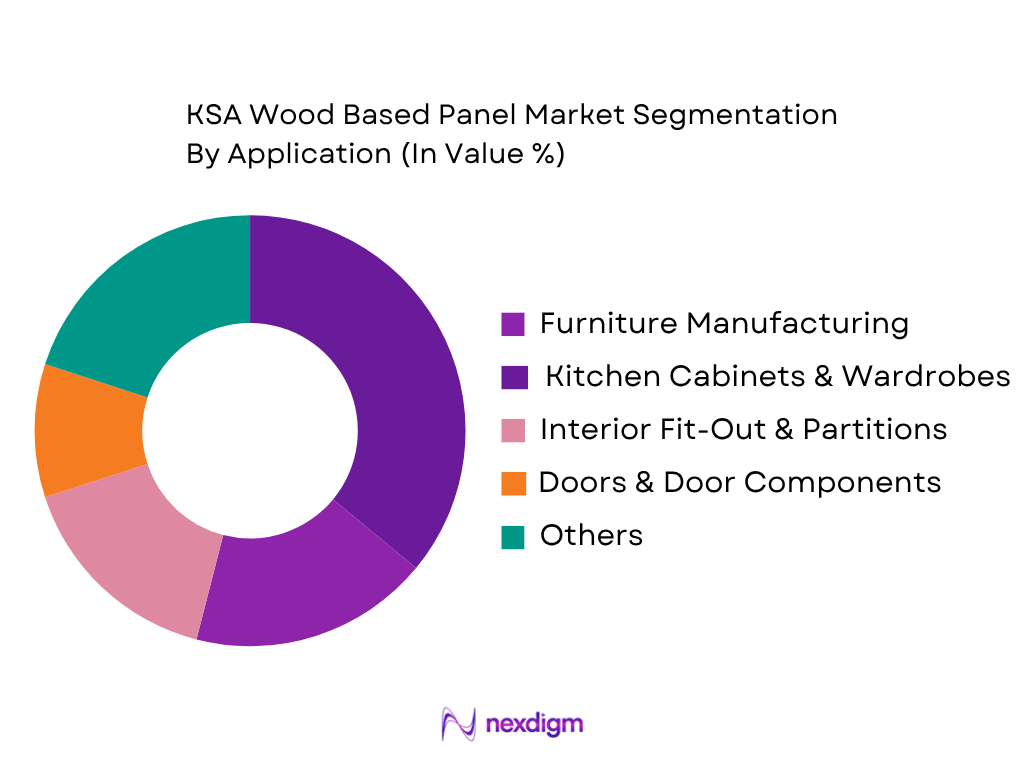
The KSA Wood Based Panel Market is segmented by application into furniture manufacturing, kitchen cabinets and wardrobes, interior fit-out and partitions, doors and door components, construction applications, retail fixtures, flooring substrates and other industrial applications. Furniture manufacturing is positioned as the dominant application in this report framework, reflecting the suitability of MDF and particleboard for modular furniture, bedroom furniture, storage systems, office furniture, shelving and residential furnishing. Wood panels allow manufacturers to standardize thickness, automate cutting, apply decorative surfaces and produce components using CNC machinery. Kitchen cabinets and wardrobes represent another important consumption channel because melamine-faced MDF and particleboard can combine decorative flexibility with repeatable manufacturing. Saudi Arabia’s substantial dependence on imported panel products also provides evidence of a broad downstream processing base. Imports of particleboard reached USD 68.66 million, while the relevant plywood and laminated-panel category recorded USD 187.44 million. Construction, hospitality and retail fit-outs provide additional demand for decorative wall panels, partitions, cabinetry and customized joinery.
Competitive Landscape
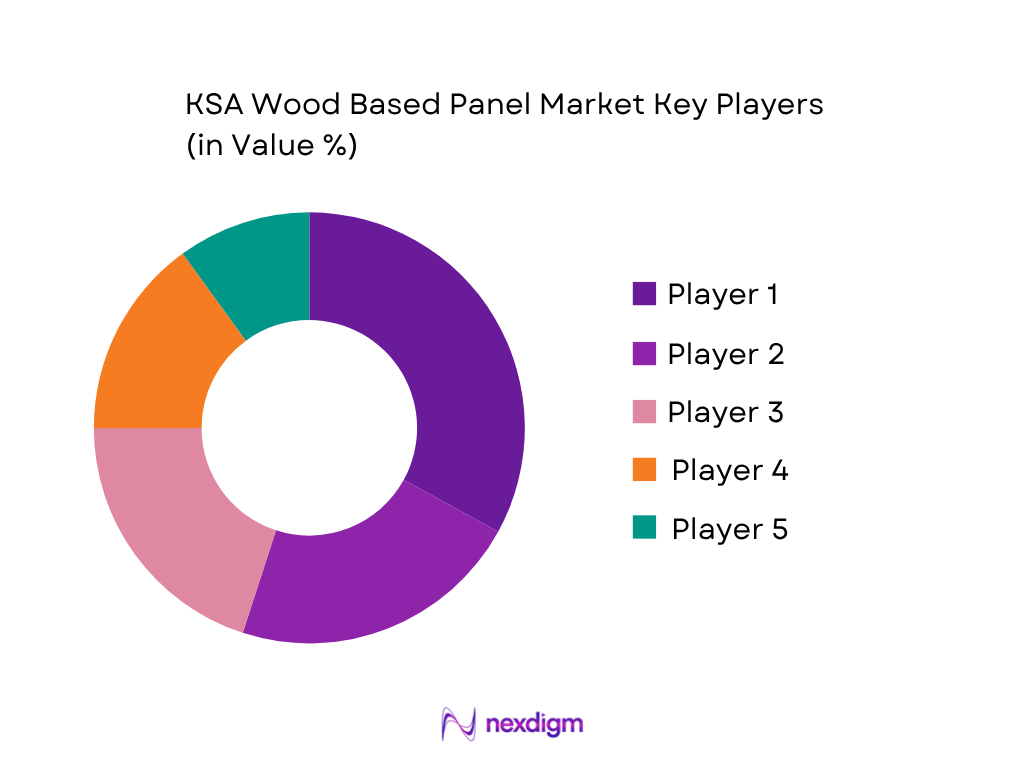
The KSA Wood Based Panel Market is characterized by competition between international engineered-wood manufacturers, regional suppliers, importers and domestic building-material companies. International companies compete through MDF, particleboard, plywood, OSB and decorative-board portfolios, while Saudi distributors provide inventory availability and project access. Product quality, decorative range, moisture resistance, emission performance, panel thickness availability and supply reliability are important competitive parameters. Import data indicate a geographically diversified supply base spanning Europe and Asia, reinforcing the importance of distribution and stock availability.
| Company | Establishment Year | Headquarters | Key Panel Products | Decorative Board Capability | Moisture-Resistant Products | Low-Emission/Sustainable Offering | Furniture & Joinery Focus | KSA/Regional Market Relevance |
| Kronospan | 1897 | Salzburg, Austria | ~ | ~ | ~ | ~ | ~ | ~ |
| EGGER Group | 1961 | St. Johann in Tirol, Austria | ~ | ~ | ~ | ~ | ~ | ~ |
| Sonae Arauco | 2016 | Maia, Portugal | ~ | ~ | ~ | ~ | ~ | ~ |
| Pfleiderer Group | 1894 | Neumarkt, Germany | ~ | ~ | ~ | ~ | ~ | ~ |
| Kastamonu Entegre | 1969 | Istanbul, Türkiye | ~ | ~ | ~ | ~ | ~ | ~ |
KSA Wood Based Panel Market Analysis
Growth Drivers
Expanding Residential Stock and Interior Fit-Out Demand
Saudi Arabia’s expanding residential base is directly supporting consumption of MDF, particleboard, plywood, melamine-faced boards and other panels used in kitchens, wardrobes, doors, shelving and fixed furniture. Official housing statistics recorded 4.4 million dwellings occupied by Saudi households in 2024, representing 233,000 additional dwellings compared with the 2022 census. Apartments accounted for approximately 1.98 million of these occupied Saudi-household dwellings when the published distribution is applied, while villas represented roughly 1.36 million, creating a substantial installed base for cabinetry, joinery, refurbishment and replacement furniture. Saudi Statistics Authority Saudi Arabia’s macroeconomic environment reinforces this demand: World Bank data recorded USD 1,239.8 billion GDP and USD 35,121.7 GDP per capita in 2024, alongside consumer-price inflation of 1.7. World Bank Open Data These indicators matter for wood panels because household formation and residential completion translate into requirements for modular kitchens, wardrobes, doors, storage systems and decorative interiors. The demand base also extends beyond new construction: millions of existing dwellings create recurring refurbishment requirements, supporting processed panels with decorative laminates, CNC compatibility, moisture resistance and standardized thicknesses rather than limiting demand to structural construction applications.
Hospitality Expansion Driving Furniture and Decorative Panel Consumption
Hospitality development is creating a second demand engine for the KSA Wood Based Panel Market because hotels and serviced accommodation require large quantities of casegoods, wardrobes, headboards, doors, vanity units, wall panels, reception joinery and other engineered-wood interior products. Official Saudi tourism-establishment statistics recorded 2,802 licensed tourist hospitality facilities in Q1 2024, comprising 1,441 hotels and 1,361 serviced apartments and other hospitality facilities. By Q1 2025, the licensed base had expanded to 4,988 facilities, including 2,414 hotels and 2,574 serviced apartments and other facilities. Tourism employment also increased from 944,299 workers in Q1 2024 to 983,253 in Q1 2025, indicating expansion of the operating hospitality ecosystem. Saudi Statistics Authority The supporting macroeconomic base is substantial: World Bank data put Saudi GDP at USD 1,239.8 billion and GDP per capita at USD 35,121.7 in 2024. World Bank Open Data For panel suppliers, hospitality expansion favors melamine-faced MDF, decorative plywood, moisture-resistant boards and higher-finish surfaces because hotel interiors require repeatable room packages and large-volume customized joinery.
Market Challenges
Heavy Dependence on Imported Wood Panels and Multiple Overseas Supply Corridors
Import dependence is a structural challenge for Saudi wood-panel suppliers because substantial volumes of particleboard, fibreboard and plywood are sourced from geographically dispersed manufacturing bases. Saudi Arabia imported 132,940,000 kg of particleboard in 2024, including 34,301,900 kg from Thailand, 24,465,000 kg from Romania, 19,831,400 kg from China, 12,199,900 kg from Türkiye and 11,568,200 kg from Italy. WITS The dependence is even more visible in dense fibreboard: imports of fibreboard above 0.8 g/cm³ reached 956,388,000 kg, of which Thailand supplied 540,495,000 kg, China 297,555,000 kg and Indonesia 71,283,500 kg. WITS Plywood with at least one non-coniferous outer ply added another 184,268 cubic metres of imports. WITS This internationally dispersed sourcing exposes Saudi distributors, furniture producers and joinery companies to shipping schedules, port handling, inventory planning and supplier-country availability. World Bank data place Saudi GDP at USD 1,239.8 billion in 2024, demonstrating the scale of the economy that these imported material flows must serve. World Bank Open Data Maintaining sufficient inventories across different thicknesses, densities and surface grades therefore remains operationally important.
Limited Domestic Forestry Base Constrains Local Fibre and Timber Feedstock Availability
Saudi Arabia’s natural resource profile creates a fundamental constraint for large-scale conventional wood-panel manufacturing because domestic forestry cannot provide the abundant industrial timber base available to major global MDF, particleboard and plywood producing countries. World Bank environmental data report forest area at only 0.5 of Saudi Arabia’s land area in the latest available reading, while the country supported GDP of USD 1,239.8 billion in 2024 and GDP per capita of USD 35,121.7. World Bank Open Data The resulting feedstock constraint is visible in trade flows. Saudi Arabia imported 956,388,000 kg of dense fibreboard under HS 441119 in 2024 and another 132,940,000 kg of particleboard under HS 441010. WITS Imports of one non-coniferous plywood classification reached 184,268 cubic metres, including 144,577 cubic metres from China and 14,738 cubic metres from Indonesia. WITS For domestic panel manufacturing, this means any capacity expansion must solve feedstock availability through imported fibre, industrial wood residues, recycled wood streams or alternative fibre inputs. The constraint is therefore more complex than adding press capacity: manufacturers need dependable collection, sorting, cleaning and fibre-preparation systems capable of producing consistent board quality.
Market Opportunities
Local Panel Processing and Manufacturing Localization
Saudi Arabia’s large existing import flows create a foundation for future localization of MDF, particleboard processing, laminating and furniture-component manufacturing. In 2024, the country imported 132,940,000 kg of particleboard, while dense fibreboard imports reached 956,388,000 kg. WITS At the same time, Saudi Arabia exported 14,192,400 kg of particleboard, including 12,003,100 kg to Kuwait, 1,010,000 kg to Jordan and 775,717 kg to Bahrain, demonstrating that Saudi-based panel activity already connects with neighboring GCC and regional markets. WITS Plywood, veneered-panel and similar laminated-product exports also reached regional destinations including the UAE, Yemen, Kuwait, Jordan and Qatar. WITS The domestic macroeconomic base supports further industrial development: World Bank figures show Saudi GDP of USD 1,239.8 billion and GDP per capita of USD 35,121.7 in 2024. World Bank Open Data These conditions create future opportunities for local laminating, melamine facing, panel sizing, CNC cutting, edge processing and ready-to-assemble furniture components. Localization does not necessarily require replacing all imported wood fibre; downstream conversion can capture more value from imported boards while serving Saudi furniture, cabinetry and fit-out customers with shorter processing chains.
Higher-Performance Panels for Housing, Hospitality and Interior Projects
Future growth opportunities are emerging for moisture-resistant MDF, fire-performance boards, low-emission panels and decorative melamine products as Saudi Arabia’s residential and hospitality building stock expands. Official housing statistics recorded 4.4 million dwellings occupied by Saudi households in 2024, including an increase of 233,000 dwellings from the 2022 census baseline. Saudi Statistics Authority Hospitality infrastructure provides another specification-driven customer base: licensed tourist accommodation facilities increased from 2,802 in Q1 2024 to 4,988 in Q1 2025, while hotels alone increased from 1,441 to 2,414. Tourism-sector employment reached 983,253 workers in Q1 2025, compared with 944,299 in Q1 2024. Saudi Statistics Authority These applications require panels capable of meeting different demands for surface appearance, machining, humidity exposure, durability and interior performance. The macroeconomic environment also provides purchasing capacity, with World Bank data recording USD 35,121.7 GDP per capita and USD 1,239.8 billion GDP in 2024. World Bank Open Data Suppliers that develop moisture-resistant boards, decorative finishes, lower-emission resin systems and project-specific panel grades can therefore address higher-value requirements across hotels, serviced apartments, kitchens, wardrobes, commercial fit-outs and residential interiors.
Future Outlook
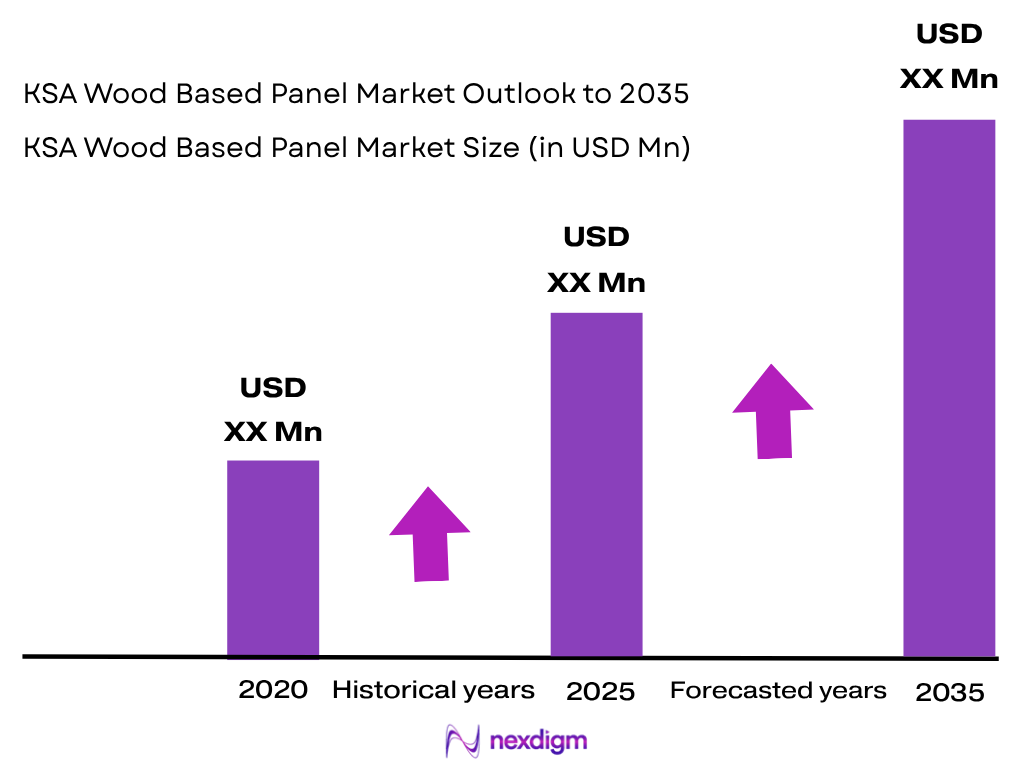
The KSA Wood Based Panel Market is expected to expand through 2035, supported by continued residential development, furniture manufacturing, hospitality projects, commercial interiors, entertainment developments and demand for prefabricated joinery. The forecast CAGR for 2026–2035 is ~%, as a placeholder for the final market model. Demand is expected to increasingly favor processed and value-added panels rather than undifferentiated raw boards, particularly melamine-faced MDF, moisture-resistant boards, low-emission products and customized decorative panels. Localization represents an important strategic direction. Saudi Arabia’s dependence on imported panels creates opportunities for domestic board processing, laminating, cutting, CNC machining and furniture-component manufacturing. Particleboard imports alone reached 132.94 million kg, compared with 54.52 million kg in the preceding reported period under the same trade classification, illustrating the scale and variability of external sourcing.
Major Players
- Kronospan
- EGGER Group
- Sonae Arauco
- Pfleiderer Group
- FINSA
- Evergreen Fibreboard Berhad
- Kastamonu Entegre
- ARAUCO
- Greenpanel Industries
- Greenply Industries
- Century Plyboards
- Merino Industries
- Swiss Krono Group
- West Fraser Timber
- Bawan Company
Key Target Audience
- Wood Based Panel Manufacturers
- Furniture and Modular Furniture Manufacturers
- Wood Panel Importers and Distributors
- Joinery, Kitchen and Cabinet Manufacturers
- Real Estate Developers and Interior Fit-Out Contractors
- Building Material and Decorative Surface Suppliers
- Investments and Venture Capitalist Firms
- Government and Regulatory Bodies (Ministry of Industry and Mineral Resources, Saudi Standards, Metrology and Quality Organization, Saudi Authority for Industrial Cities and Technology Zones, Zakat, Tax and Customs Authority)
Research Methodology
Step 1: Identification of Key Variables
The initial phase involves constructing an ecosystem map encompassing major stakeholders across the KSA Wood Based Panel Market, including panel manufacturers, international suppliers, importers, distributors, furniture manufacturers, joinery companies, interior contractors and developers. Product variables cover MDF, HDF, particleboard, plywood, OSB and decorative panels, while technical variables include thickness, density, moisture resistance, emission performance, surface finish and machinability.
Step 2: Market Analysis and Construction
Historical KSA Wood Based Panel Market analysis combines panel import volumes, trade values, country-of-origin flows, domestic processing activity and demand from furniture, construction and interior fit-out applications. A bottom-up model assesses suppliers, distributors, panel categories and downstream users, while the top-down approach evaluates construction, furniture manufacturing and trade activity. The two approaches are reconciled to establish the market structure and product-level demand.
Step 3: Hypothesis Validation and Expert Consultation
Market hypotheses are validated through structured discussions and computer-assisted telephone interviews with panel distributors, furniture manufacturers, joinery operators, procurement executives, contractors and other industry participants. Interviews examine panel specifications, sourcing countries, procurement patterns, stock availability, product substitution, decorative preferences and project demand. Findings are cross-checked against customs data, company information and relevant government statistics before assumptions are finalized.
Step 4: Research Synthesis and Final Output
The final stage triangulates supply-side findings with downstream consumption patterns across furniture, kitchens, wardrobes, doors, hospitality interiors, commercial fit-outs and construction applications. Import flows and company-level information are reconciled with primary inputs to validate the bottom-up assessment. Forecast scenarios incorporate localization, construction activity, furniture manufacturing, decorative-board adoption, sustainability requirements and product innovation to establish the final KSA Wood Based Panel Market outlook.

- Executive Summary
- Research Methodology (Market Definitions and Assumptions, KSA Wood Based Panel Market Classification, Product Scope and HS Code Mapping, MDF and HDF Assessment, Particleboard Assessment, Plywood Assessment, OSB Assessment, Decorative Panel Assessment, Melamine-Faced Board Assessment, Raw Wood and Fibre Input Assessment, Resin and Adhesive Assessment, Panel Thickness Mapping, Density and Mechanical Performance Assessment, Moisture-Resistance Assessment, Formaldehyde Emission Assessment, Surface Finish Assessment, Furniture and Joinery Demand Assessment, Construction and Fit-Out Demand Assessment, Import Dependency Assessment, Country-of-Origin Mapping, Domestic Production Assessment, Supply-Side Assessment, Demand-Side Assessment, Top-Down Market Sizing, Bottom-Up Market Sizing, Primary Industry Interviews, Trade Flow Assessment, Data Triangulation, Forecasting Framework)

- Definition and Scope
- KSA Wood Based Panel Industry Evolution and Development of Plywood, Particleboard, MDF, HDF, OSB, Melamine-Faced Boards, Veneered Panels, Laminated Boards, Moisture-Resistant Panels, Fire-Retardant Panels, Decorative Panels, Furniture Boards, Structural Panels, Recycled-Wood Panels and Low-Emission Engineered Wood Products
- Wood Based Panel Value Chain Analysis
- Wood Based Panel Supply Chain Analysis
- Timber and Wood Fibre Suppliers, Recycled Wood Suppliers, Resin and Adhesive Suppliers, Wax and Additive Suppliers, Decorative Paper Suppliers, Wood Based Panel Manufacturers, Laminating and Surface-Finishing Companies, Importers, Distributors, Panel Cutting and CNC Processing Facilities, Furniture Manufacturers, Kitchen and Cabinet Manufacturers, Door Manufacturers, Joinery Contractors, Interior Fit-Out Contractors, Construction Contractors, Real Estate Developers, Hospitality Developers and Retail Building Material Suppliers

- Growth Drivers (Vision 2030 Construction Programs, Residential Development, Hospitality and Tourism Expansion, Furniture Manufacturing Demand, Interior Fit-Out Activity, Kitchen and Wardrobe Installation, Commercial Real Estate Development, Entertainment Project Development, Modular Furniture Adoption, Growth in Engineered Wood Usage)
- Market Challenges (Limited Domestic Forestry Resources, Imported Raw Material Dependency, International Freight Exposure, Wood Fibre Availability, Moisture and Heat Performance Requirements, Formaldehyde Emission Compliance, Fire Performance Requirements, Competition from Alternative Interior Materials, Panel Storage Requirements, Supply Chain Lead-Time Volatility)
- Market Opportunities (Local MDF and Particleboard Manufacturing, Furniture Manufacturing Localization, Recycled-Wood Panel Production, Low-Emission MDF, Moisture-Resistant Panels, Fire-Retardant Panels, Decorative Melamine Boards, Hospitality Interior Panels, Giga-Project Fit-Out Demand, Modular Furniture Components, Sustainable Certified Wood Panels, High-Performance Architectural Panels)
- Market Trends (Melamine-Faced MDF Adoption, Ready-to-Process Furniture Boards, CNC-Compatible Panels, Low-Emission Engineered Wood, Decorative Surface Innovation, Moisture-Resistant MDF, Fire-Retardant Boards, Wood-Grain Surface Replication, Recycled Wood Fibre Utilization, Prefabricated Joinery Components, Modular Interior Systems, Digital Panel Cutting and Nesting)
- Government Regulations and Standards (Saudi Standards, Metrology and Quality Organization Requirements, SABER Product Conformity Requirements, Saudi Building Code Requirements, Saudi Fire Code Requirements, Furniture Performance and Safety Requirements, Formaldehyde Emission Requirements, Product Labeling Requirements, Import Conformity Assessment, Customs Classification Requirements, Sustainable Building Material Requirements, Wood Product Quality and Performance Standards)
- SWOT Analysis (Import Dependency, Established Distribution Network, Growing Downstream Demand, Limited Forestry Base, Local Manufacturing Potential, Product Substitution Risk)
- Porter’s Five Forces Analysis (Supplier Bargaining Power, Buyer Bargaining Power, Threat of Imports, Threat of Substitutes, Competitive Rivalry)
- PESTLE Analysis (Vision 2030 Policies, Construction Activity, Furniture Consumption, Manufacturing Localization, Product Compliance, Sustainability Requirements)
- Stakeholder Ecosystem (Raw Material Suppliers, Manufacturers, Importers, Distributors, Furniture OEMs, Joinery Companies, Contractors, Developers, Government Authorities)

- By Market Value (2020-2025)
- By Panel Consumption Volume (2020-2025)
- By Import Value (2020-2025)
- By Import Volume (2020-2025)
- By Domestic Production Volume (2020-2025)

- By Product Type (In Value %)
Medium Density Fibreboard (MDF)
High Density Fibreboard (HDF)
Particleboard
Plywood
Oriented Strand Board (OSB)
Melamine-Faced Boards
Veneered Wood Panels
Laminated Wood Panels
Structural Wood Panels
Decorative Wood Panels
Other Engineered Wood Panels - By Panel Grade (In Value %)
Standard Interior Grade Panels
Moisture-Resistant Panels
Fire-Retardant Panels
Exterior Grade Panels
Structural Grade Panels
Furniture Grade Panels
Low-Formaldehyde and Low-Emission Panels
High-Density and High-Strength Panels - By Surface and Finish Type (In Value %)
Raw and Unfinished Panels
Melamine-Faced Panels
Veneered Panels
High-Pressure Laminate Faced Panels
Paintable and Lacquered Panels
Acrylic-Faced Panels
PET-Faced Panels
Wood-Grain Decorative Panels
Solid-Color Decorative Panels - By Application (In Value %)
Furniture Manufacturing
Kitchen Cabinets and Wardrobes
Doors and Door Components
Interior Wall Paneling
Partitions and Interior Fit-Out
Flooring Substrates
Ceilings
Shelving and Storage Systems
Retail Fixtures and Displays
Construction Formwork
Structural Sheathing
Packaging and Industrial Applications - By End User (In Value %)
Residential Construction and Interiors
Commercial Offices
Hospitality and Hotels
Retail and Shopping Centers
Furniture Manufacturing
Joinery and Carpentry
Kitchen and Cabinet Manufacturing
Interior Fit-Out Companies
Industrial and Warehouse Construction
Entertainment and Cultural Developments
Healthcare and Educational Buildings
Government and Institutional Projects - By Distribution Channel (In Value %)
Wood Panel Importers and Distributors
Building Material Distributors
Furniture OEM Direct Procurement
Joinery and Fit-Out Contractor Procurement
Construction Contractor Procurement
Specialty Timber and Panel Dealers
Wholesale Building Material Markets
Retail Building Material Stores
Project-Based Direct Sales - By Region (In Value %)
Riyadh and Central Region
Jeddah and Western Region
Makkah
Madinah
Eastern Province
Dammam-Khobar-Dhahran
Tabuk and NEOM Region
Southern Saudi Arabia
Rest of KSA

- Market Share of Major Players (By KSA Revenue, Panel Sales Volume, MDF Portfolio, Particleboard Portfolio, Plywood Portfolio, OSB Portfolio, Decorative Board Portfolio, Melamine-Faced Board Portfolio, Furniture Industry Presence, Joinery and Fit-Out Presence, Distribution Reach, Product Availability, Project Sales Capability, Sustainable Panel Portfolio)
- Cross Comparison Parameters (MDF and Particleboard Portfolio Breadth, Decorative and Melamine-Faced Board Range, Moisture-Resistant and Fire-Retardant Panel Capability, Panel Thickness and Density Range, Low-Emission and Sustainability Certification Capability, KSA Distribution and Stock Availability, Furniture and Joinery Customer Penetration, Interior Fit-Out and Project Specification Capability)
- SWOT Analysis of Major Players (Product Portfolio, Saudi Distribution, Brand Positioning, Supply Reliability, Sustainability Capability)
- Detailed Profiles of Major Companies
Kronospan
EGGER Group
Sonae Arauco
Pfleiderer Group
FINSA
Evergreen Fibreboard Berhad
Kastamonu Entegre
ARAUCO
Greenpanel Industries
Greenply Industries
Century Plyboards
Merino Industries
Swiss Krono Group
West Fraser Timber
Bawan Company

- Furniture Manufacturer Panel Requirement Assessment
- Kitchen and Cabinet Manufacturer Requirement Assessment
- Joinery Contractor Procurement Assessment
- Interior Fit-Out Contractor Requirement Assessment
- Real Estate Developer Interior Material Assessment
- Hospitality Interior Panel Requirement Assessment
- Furniture OEM Procurement Behavior Assessment

- By Market Value (2026-2035)
- By Panel Consumption Volume (2026-2035)
- By Import Value (2026-2035)
- By Import Volume (2026-2035)
- By Domestic Production Volume (2026-2035)


 Request a Sample
 Ask for Customization
 Get a Quote
 Enquire Now