
 Download PDF
Market Overview
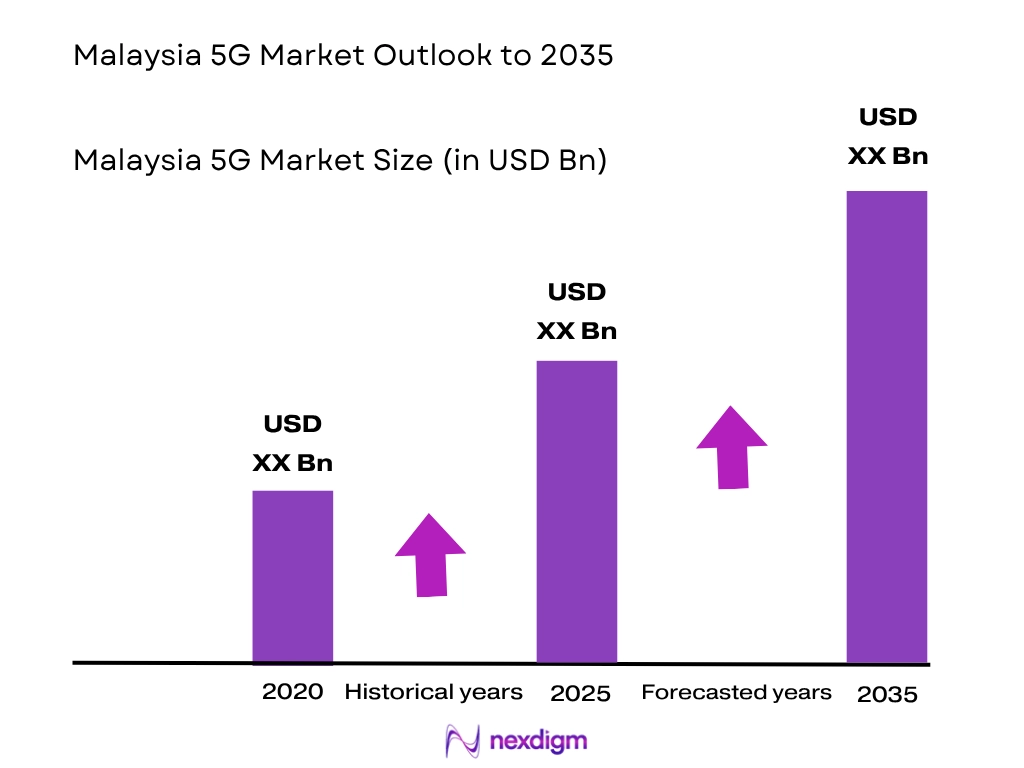
The Malaysia 5G market is currently valued at approximately USD ~ billion, reflecting widespread deployment of 5G infrastructure, rising smartphone penetration and increasing demand for high‑speed mobile data services. The underlying mobile services market is forecast to generate USD ~ billion in total mobile revenue in 2025, with 5G adoption driving data usage growth and higher ARPU for broadband services. This expansion is supported by government‑led infrastructure rollout and commercial uptake across consumer and enterprise segments, including mobile broadband, IoT, and digital services, driving both subscription and infrastructure markets.
Kuala Lumpur, Selangor and Johor Bahru dominate Malaysia’s 5G uptake due to their high population densities, well‑developed digital infrastructure and concentration of enterprise digitalisation initiatives. Urban centres have historically received accelerated deployment of 5G sites and extensive fiber backhaul, enabling broader service availability and better quality of experience versus rural regions. Population density and business activity attract both private investment and early adopter consumers, facilitating faster adoption cycles in these cities versus less urbanised markets.
Market Segmentation
By Adoption Type
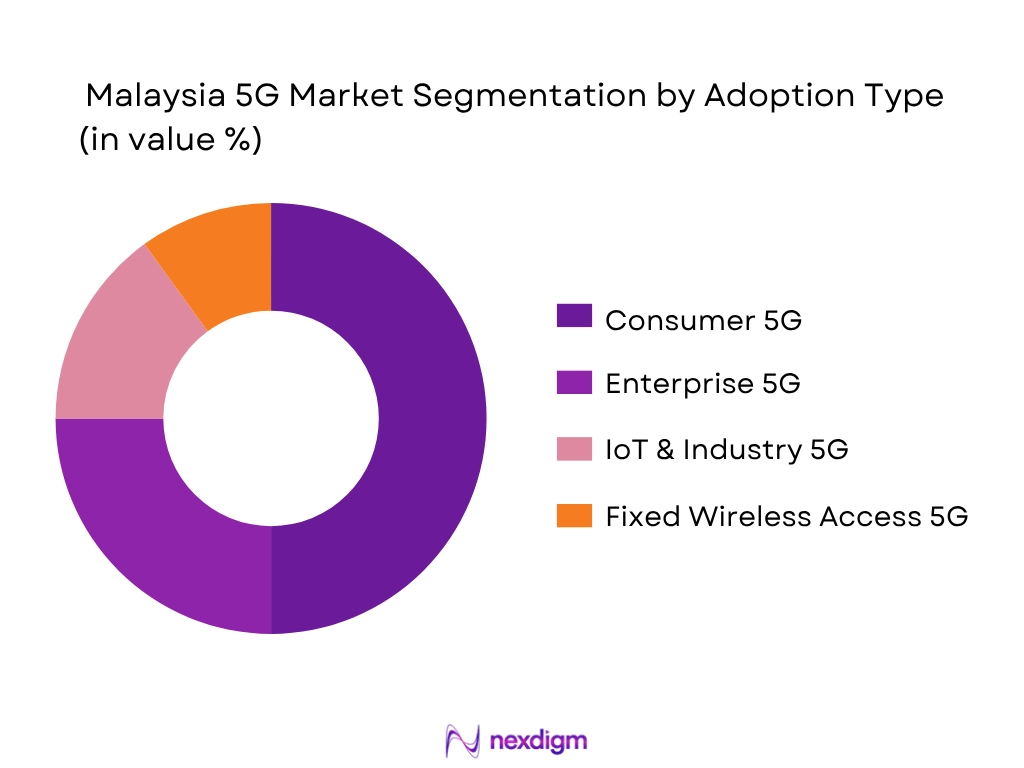
Malaysia’s consumer 5G segment leads market share due to the early ramp‑up of mobile broadband subscriptions across urban and peri‑urban areas after widespread coverage expansion. Operator initiatives and affordable handset availability have increased uptake among smartphone users, driving significant user additions in consumer 5G. Enterprise and industrial segments are emerging, fuelled by digital transformation initiatives within manufacturing, logistics and smart building applications, yet adoption remains nascent compared to consumer uptake, reflecting ongoing enterprise digitalisation. Private network utilisation is expanding, especially in high‑density campuses, though typically requires incremental infrastructure investments from operators and enterprises alike. The fixed wireless access segment also gains traction as a complementary broadband solution, particularly where fiber reach is limited.
By Use Case Segment
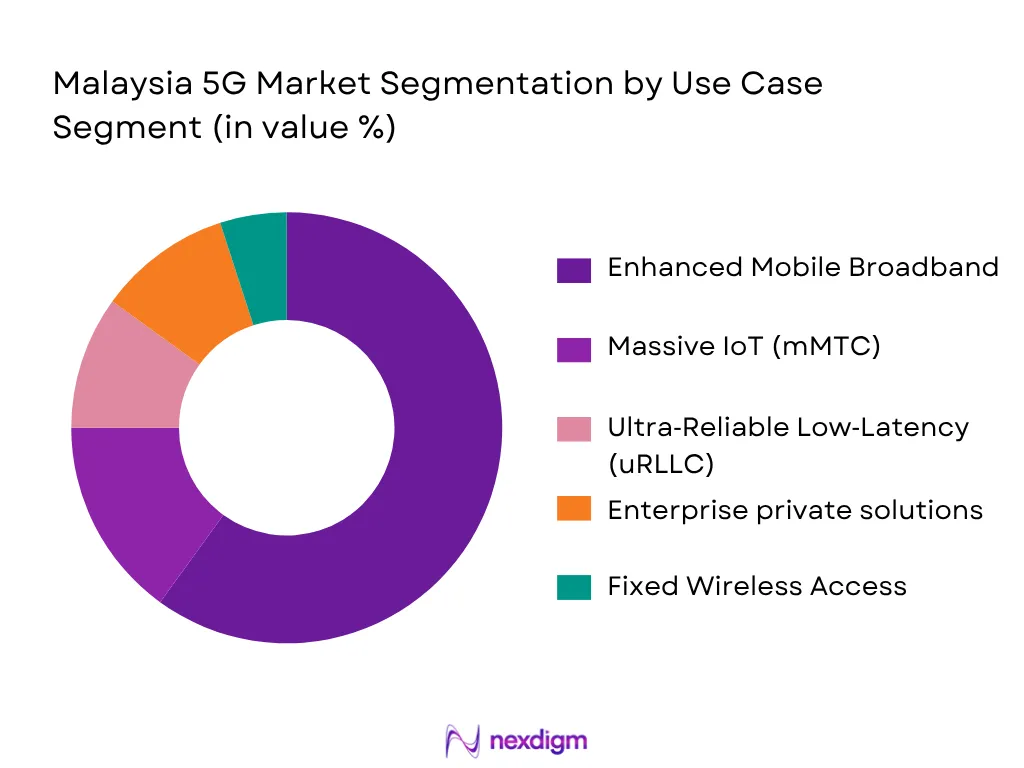
The eMBB sub‑segment dominates the Malaysia 5G market, driven by demand for high‑speed mobile internet, streaming, gaming and mobile video use cases in both consumer and commercial environments. Rapid growth of smartphone penetration and data‑intensive services has made high‑throughput connectivity a core driver of 5G adoption, supported by nationwide coverage improvements and operator service plans. Massive IoT use cases are expanding, particularly as enterprises explore connectivity for logistics, utilities and environmental monitoring. uRLLC segment applications, including industrial automation and critical communications, currently trail behind eMBB due to slower adoption of standalone 5G core and network slicing infrastructure, though enterprise demand is growing. Fixed wireless access and private enterprise solutions provide alternative connectivity options, contributing to diversified revenue streams but remain smaller portions of total market value.
Competitive Landscape
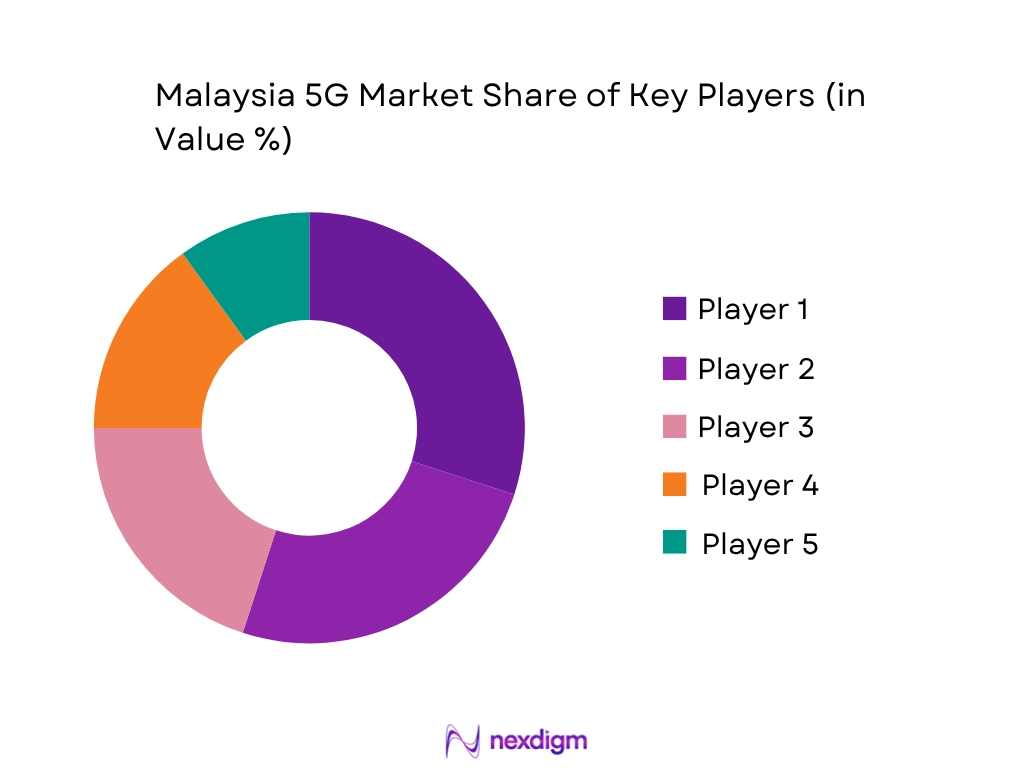
The Malaysia 5G market features a mix of incumbent telcos and infrastructure partners playing critical roles in roll‑out and service delivery. Major operators like CelcomDigi and Maxis have significant subscriber bases and network footprint, while newer entrants and infrastructure vendors help drive infrastructure upgrades. This concentrated competitive landscape reflects both network ownership models and differentiated offerings across consumer and enterprise segments.
| Company | Est. Year | Headquarters | Network Scope | 5G Deployment Model | Subscriber Base | ARPU Strategy | Enterprise 5G Offerings | Infrastructure Partners |
| CelcomDigi | 2024 | Kuala Lumpur | ~ | ~ | ~ | ~ | ~ | ~ |
| Maxis | 1993 | Kuala Lumpur | ~ | ~ | ~ | ~ | ~ | ~ |
| Digi Telecommunications | 1995 | Kuala Lumpur | ~ | ~ | ~ | ~ | ~ | ~ |
| U Mobile | 2007 | Kuala Lumpur | ~ | ~ | ~ | ~ | ~ | ~ |
| YES (YTL) | 1990s | Kuala Lumpur | ~ | ~ | ~ | ~ | ~ | ~ |
Malaysia 5G Market Analysis
Growth Drivers
Rapid urban mobile broadband adoption
Malaysia’s urban connectivity landscape is a key driver of 5G uptake, supported by very high internet access figures. In 2024, 97% of the Malaysian population had access to at least one device with 5G mobile Internet coverage, while urban internet penetration reached 99%, significantly higher than rural figures, indicating widespread readiness for high‑speed digital consumption in cities like Kuala Lumpur, Penang, and Johor Bahru. Average mobile broadband performance in 2024 saw mobile download speeds of 153.20 Mbps, underpinning consumer and business demand for faster, low‑latency connectivity that 5G promises. Additionally, statistics show 7,065 5G sites established nationwide with coverage of 81.5% of populated areas, serving 11.9 million 5G subscribers as of April 2024, illustrating how urban infrastructure expansion correlates with mobile broadband adoption. These figures, combined with broader internet usage nearing universal levels (98% of the population uses the internet), demonstrate the foundational digital readiness that accelerates 5G demand among both consumers and enterprises.
Enterprise Digitalisation Initiatives
Enterprise adoption of 5G in Malaysia is gaining traction as organisations seek connectivity that supports automation, IoT, and digital workflow improvements. By April 2024, Malaysia had deployed 5G coverage to 95 industrial parks nationwide, part of broader digital transformation programs that target sectors including manufacturing, logistics, healthcare, and plantations with advanced connectivity solutions. Concurrently, government initiatives intend to showcase at least 40 distinct 5G private network use cases across these sectors, reflecting institutional commitment to drive enterprise digitalisation. This enterprise focus is supported by national macroeconomic fundamentals. Malaysia’s ICT and e‑commerce sectors contributed RM451.3 billion to the economy in 2024, or 23.4% of GDP, highlighting the digital economy’s scale and the role advanced connectivity can play in enabling service and manufacturing innovations. As enterprises increasingly embed digital technology into operations, 5G becomes essential for supporting real‑time analytics, remote monitoring, and multi‑device connectivity at industrial scale, making enterprise digitalisation a central market driver.
Market Challenges
High Infrastructure Rollout Costs
The expansion of 5G infrastructure in Malaysia is capital intensive, demonstrated by the scale of network deployment and site build‑out figures that have already been achieved. As of April 2024, 7,065 5G transmitter sites had been constructed nationwide to support 5G services, reaching 81.5% of populated areas, which highlights both the rapid pace of deployment and the extensive investment required for broad network coverage. Establishing and maintaining this many sites demands significant upfront costs for spectrum, tower deployment, fiber backhaul, and radio access network equipment. Moreover, as Malaysia transitions to a dual‑network model with additional standalone 5G operators, new capital expenditure layers are introduced, increasing total industry infrastructure costs. These financial pressures are compounded by the need to support advanced enterprise use cases and private network capabilities, which require enhanced infrastructure beyond basic mobile broadband. The economic backdrop reveals Malaysia’s GDP was approximately USD 421.97 billion in 2024, with services and manufacturing accounting for the majority of growth, indicating that telecom infrastructure must compete for investment against other capital‑intensive sectors within the economy. High deployment costs remain a structural challenge that can slow network rollouts, especially in lower‑density and rural areas where cost recovery is more difficult.
Limited Standalone 5G Coverage
While Malaysia has achieved broad 5G population coverage, the transition from non‑standalone (NSA) 5G to full standalone (SA) 5G, which enables low‑latency services and advanced enterprise applications, remains a challenge. As of mid‑2025, overall 5G population coverage was approximately 82.4% across populated regions; however, SA deployments by operators beyond the primary wholesale network are still emerging, with commercial standalone services rolling out only recently. Moreover, there remains an imbalance in regional coverage: East Malaysia states like Sarawak and Sabah reported lower levels of 5G coverage (62% and 68.6% respectively) compared with Peninsular regions, underscoring the uneven spread of advanced network infrastructure. In addition, existing data indicate that 5G mobile broadband penetration was around 82.7 per 100 people in 2025, suggesting a gap between coverage availability and user uptake an issue partly attributable to limited SA service options and device readiness. Without widespread SA 5G networks, Malaysian enterprises and consumers cannot fully leverage features like network slicing and ultra‑reliable, low‑latency connectivity that differentiate 5G from enhanced 4G services. This constraint limits innovation adoption in industrial automation, smart transportation, and real‑time IoT analytics, creating a significant barrier to the market’s full potential.
Market Opportunities
Private 5G Networks for Manufacturing and Logistics
Malaysia is actively positioning 5G as a foundational technology for industrial digital transformation, with strategies to foster private network deployments tailored to manufacturing and logistics needs. Official statements indicate that 95 industrial parks have established 5G coverage as of April 2024, enabling dedicated connectivity for enterprise use cases where reliability and low latency are critical. Furthermore, government plans include demonstrating at least 40 distinct 5G private network use cases across sectors such as oil and gas, manufacturing, logistics, healthcare, and plantations, signalling strong institutional support to embed 5G into core industry workflows. These efforts are aligned with the digital economy’s scale, where the ICT sector’s contribution to Malaysia’s GDP was valued at USD 100 billion in 2024, underscoring the substantial role digital infrastructure plays in economic activity. Private 5G networks offer opportunities to optimise supply chains, automate operations, and enable advanced analytics, which are key priorities for enterprises competing on productivity and efficiency. This establishes a growing addressable market for enterprise‑grade 5G solutions that can accelerate operational transformation and attract enterprise investment in advanced connectivity solutions.
Smart City IoT Platforms
Smart city initiatives represent another key opportunity area for the Malaysia 5G market, driven by expanding IoT deployments that require robust, high‑capacity connectivity. Although specific IoT market numbers for 2024 are limited, high IPv6 adoption of over 68% as of mid‑2025 demonstrates readiness for large‑scale IP‑based device deployments necessary for smart city infrastructures such as sensor networks, traffic management systems, and utility monitoring. Additionally, internet usage across Malaysia stands at 98% of the population with mobile connectivity readily available, providing fertile ground for IoT ecosystems that integrate with 5G networks. With urban centres prioritising digital service delivery, the combination of 5G coverage and IPv6 adoption supports advanced IoT platforms that can process increasing volumes of data from connected devices. These platforms enable services ranging from public safety to environmental monitoring, enhancing urban management capabilities. The intersection of 5G connectivity and IoT platform expansion attracts partners and solutions providers targeting smart city applications, presenting a growing commercial opportunity in this domain.
Future Outlook
Based on the trajectory of technology adoption, infrastructure expansion, and projected market dynamics in related telecom reports, Malaysia’s 5G market is expected to grow at a compound annual growth rate (CAGR) of 20–25 % between 2026 and 2035, supported by increasing standalone (SA) 5G deployments, enterprise 5G use cases, private 5G investments, and digital transformation demand across sectors. The long‑term outlook for the Malaysia 5G market is positive, with continued expansion of network coverage and adoption across consumer and enterprise segments. Advancements in standalone 5G architecture and enterprise digitalisation will support new high‑value use cases, including industrial automation, smart infrastructure and low‑latency services. Government initiatives to expand digital connectivity, increase private 5G networks and support IoT ecosystems will further accelerate market growth. Over the medium to long term, 5G is expected to shift from primarily consumer broadband to being an essential backbone for industry‑grade digital transformation across sectors in Malaysia.
Major Players
- CelcomDigi
- Maxis
- Digi Telecommunications
- U Mobile
- YES (YTL Communications)
- Digital Nasional Berhad (DNB)
- Telekom Malaysia / Unifi Mobile
- Huawei Technologies (Network vendor)
- Ericsson Malaysia
- Nokia Malaysia
- ZTE Malaysia
- Samsung Networks Malaysia
- Qualcomm Technologies Malaysia
- Cisco Systems (Malaysia)
- Time dotCom
Key Target Audience
- Telecom Operators (e.g., CelcomDigi, Maxis)
- Enterprise IT & Network Infrastructure Buyers
- Private Network / Industrial IoT Implementers
- Investments and Venture Capitalist Firms
- Government and Regulatory Bodies (MCMC, Ministry of Communications & Digital)
- CIO/CTO Decision Makers in Manufacturing Sector
- Smart Cities & Public Safety Program Heads
- Mobile Broadband Product Strategy Leaders
Research Methodology
Step 1: Data Collection & Variable Identification
The initial phase involves gathering comprehensive secondary data from market reports, telecom bodies and regulatory disclosures to identify key variables influencing Malaysia’s 5G market, including network coverage metrics, subscription base, revenue figures and infrastructure investments.
Step 2: Market Analysis & Construction
This phase analyses historical data on rollout progress, operator performance, revenue segments and technology deployment, ensuring models integrate both consumer and enterprise adoption drivers to accurately construct baseline market size and share.
Step 3: Hypothesis Validation & Expert Consultations
Market assumptions are validated through interviews with regional telecom experts, operator strategy leads, and infrastructure partners to refine insights on usage trends, deployment challenges and growth opportunities across market segments.
Step 4: Synthesis & Report Output
Final synthesis consolidates findings into a validated narrative, aligning quantitative estimates with qualitative insights and benchmarking against comparable Southeast Asian 5G markets to ensure robustness of forecasts and derived market size.

- Executive Summary
- Research Methodology (Market Definitions & Malaysia 5G Scope, Data Sources & Periods, Primary & Secondary Validation, Top-Down Market Estimation Framework, Bottom-Up Market Estimation Framework, Forecasting Logic and Scenario Setting, Data Validation and Limitations)

- Definition, Technology Scope & 5G Service Models
- National Telecom Landscape
- 5G Network Evolution Pathway
- Spectrum Policy & Governance
- Infrastructure & Deployment Models
- 5G Ecosystem Map

- Growth Drivers (rapid urban mobile broadband adoption, enterprise digitalisation initiatives, industrial IoT expansion, smart city deployments, rising smartphone penetration)
- Market Challenges (high infrastructure rollout costs, limited standalone 5G coverage, spectrum allocation complexities, rural connectivity gaps, interoperability with legacy 4G networks)
- Opportunity Areas (private 5G networks for manufacturing and logistics, smart city IoT platforms, high-speed fixed wireless access, enterprise edge computing adoption, telehealth and remote learning solutions)
- Technology and Product Trends (network slicing, standalone 5G core deployment, ultra-reliable low-latency communications (uRLLC), massive MIMO adoption, mid-band and mmWave spectrum integration)
- Import, Taxation and Consumer-Protection Factors (spectrum license regulation by MCMC, import duties on network equipment, VAT compliance, local cybersecurity standards, quality assurance certification for 5G devices)
- Stakeholder Ecosystem (telecom operators, infrastructure vendors, system integrators, government agencies, enterprise IT buyers, fiber providers, IoT platform providers, network maintenance service providers)
- Porter’s Five Forces (substitutes: 4G LTE, Wi-Fi broadband; new entrants: emerging operators and private network providers; supplier power: network equipment vendors; price rivalry: service plan competition; channel bargaining: retail and enterprise distribution networks)
- Category SWOT Analysis (strength: strong urban adoption, high ARPU potential; weakness: limited rural penetration, high Capex; opportunity: enterprise network adoption, IoT integration; threat: regulatory delays, competitive price erosion)
- White-Space Opportunity Map (private industrial 5G deployments, enterprise IoT hubs, smart city edge networks, fixed wireless access expansion, high-speed rural broadband initiatives)

- By Total Revenue (2020-2025)
- By Subscription Base (2020-2025)
- By Data Traffic Volume (2020-2025)
- By Average Revenue per User (2020-2025)

- By Deployment Model (In Value%)
Wholesale National Network
Standalone Operator Networks
Private 5G Networks
Fixed Wireless Access
Campus 5G Networks - By Spectrum Band Utilisation (In Value%)
Sub‑6 GHz Adoption
mmWave Deployment
Mid‑Band vs Low‑Band Share - By Customer Type (In Value%)
Consumer Mobile Broadband
Enterprise & B2B
IoT/M2M Segment - By Use Case/Application (In Value%)
Enhanced Mobile Broadband (eMBB)
Industry 4.0 & Manufacturing Automation
Smart Cities & Public IoT
Healthcare & Remote Services
Logistics & Connected Vehicles
- By Geography (In Value%)
Urban Concentrations (Klang Valley, Penang, Johor)
East Malaysia (Sabah & Sarawak Coverage Gaps)
Rural & Peri‑Urban Nodes
Northern Region (Kedah, Perlis, Penang outskirts)
Southern Corridor (Melaka, Negeri Sembilan)

- Market Share of Major Players (on the basis of subscription value, data volume usage, spectrum ownership, network coverage, enterprise adoption, ARPU, and distribution channel)
- Cross‑Comparison Parameters (Company Overview, 5G Network Strategy (Deployment, SA Roadmap),Spectrum Portfolio (Bands & Holdings), Capex & Investment Focus (Infrastructure Spend), Service Quality Metrics (Speed, Latency, Availability), Distribution & Retail Footprint, Partnerships & Ecosystem Alliances, Enterprise Solutions Portfolio)
- SWOT Analysis of Major Players (strengths: brand recognition and subscriber base; weaknesses: limited rural reach; opportunities: private 5G, IoT, smart city adoption; threats: regulatory delays, aggressive pricing from competitors)
- SKU-Level Pricing and Promotion Analysis (postpaid/prepaid plan pricing, data bundle promotions, enterprise network package pricing, ARPU by plan type, device-linked promotions)
- Marketplace Visibility and Review Benchmarking (online plan subscriptions, customer rating depth, review velocity for 5G plans and devices, operator app store ranking, enterprise solution adoption frequency, bestseller/most-subscribed plan visibility)
- Detailed Profiles of Major Companies
CelcomDigi
Maxis
U Mobile
Telekom Malaysia / Unifi Mobile
YES 5G
YTL Communications
DNB (Digital Nasional Berhad)
Huawei Malaysia
Ericsson Malaysia
ZTE Malaysia
Nokia Malaysia
Samsung Networks Malaysia
Time dotCom
Telekom Malaysia Enterprise Solutions
Cisco Systems

- Household Archetypes and Usage Patterns (urban households with high smartphone penetration, SMEs and tech-forward offices, industrial campuses, rural early adopters, public institutions adopting smart city or IoT initiatives)
- Purchase Decision Matrix (subscription plan choice, device compatibility, network coverage quality, data speed requirements, enterprise solution integration, latency performance, multi-device support)
- Budget Allocation and Financing Behavior (monthly ARPU sensitivity, preference for postpaid vs prepaid plans, enterprise budget allocation for private networks, financing for IoT or smart infrastructure, bundling willingness with fiber or cloud services)
- Consumer Needs, Desires and Pain Points (high-speed, uninterrupted connectivity, low-latency experience, reliable coverage in urban and peri-urban areas, ease of subscription activation, trust in network quality and customer service, privacy and data security concerns)
- Channel Preference and Trust Signals (official telecom outlets, online subscriptions via operator portals, retail stores, authorized device resellers, influencer recommendations for consumer uptake, verified enterprise integrator partners)
- Post-Purchase Usage and Upgrade Cycle (hourly data consumption trends, upgrade triggers for higher bandwidth plans, device compatibility refresh cycles, enterprise private network expansion, IoT network scaling)

- By Total Revenue (2026-2035)
- By Subscription Base (2026-2035)
- By Data Traffic Volume (2026-2035)
- By Average Revenue per User (2026-2035)


 Request a Sample
 Ask for Customization
 Get a Quote
 Enquire Now