

 Download PDF
Market Overview
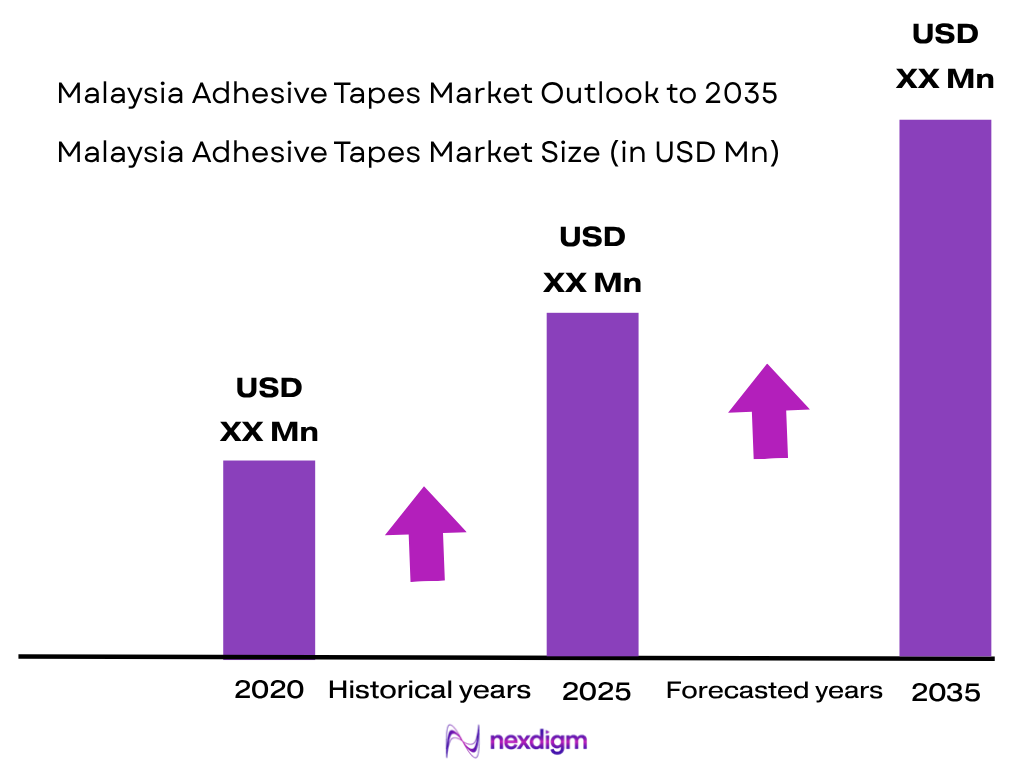
The Malaysia Adhesive Tapes Market is valued at ~USD XX million in 2024, with the market supported by packaging, electrical and electronics, semiconductor manufacturing, automotive, construction, HVAC and industrial assembly applications. Malaysia’s manufacturing sales reached RM1.9 trillion in 2024, compared with the 2023 level, while electronic components, communication equipment and consumer electronics manufacturing grew 4.0 in 2024 after declining in the preceding period. These activities create recurring requirements for mounting, insulation, sealing, masking and component-assembly tapes.
Malaysia’s adhesive-tape demand is concentrated around Selangor, Penang, Johor and Kuala Lumpur, reflecting their manufacturing, electronics, logistics and investment ecosystems. Selangor recorded RM101.1 billion of approved investments in 2024, while Kuala Lumpur recorded RM91.5 billion and Johor RM48.5 billion. Penang remains particularly important for electronics and semiconductor manufacturing. Malaysia also attracted RM378.5 billion in approved investments overall, strengthening the industrial base that consumes specialty tapes for electronics assembly, packaging, automotive production, construction and equipment manufacturing.
Market Segmentation
By Adhesive Technology
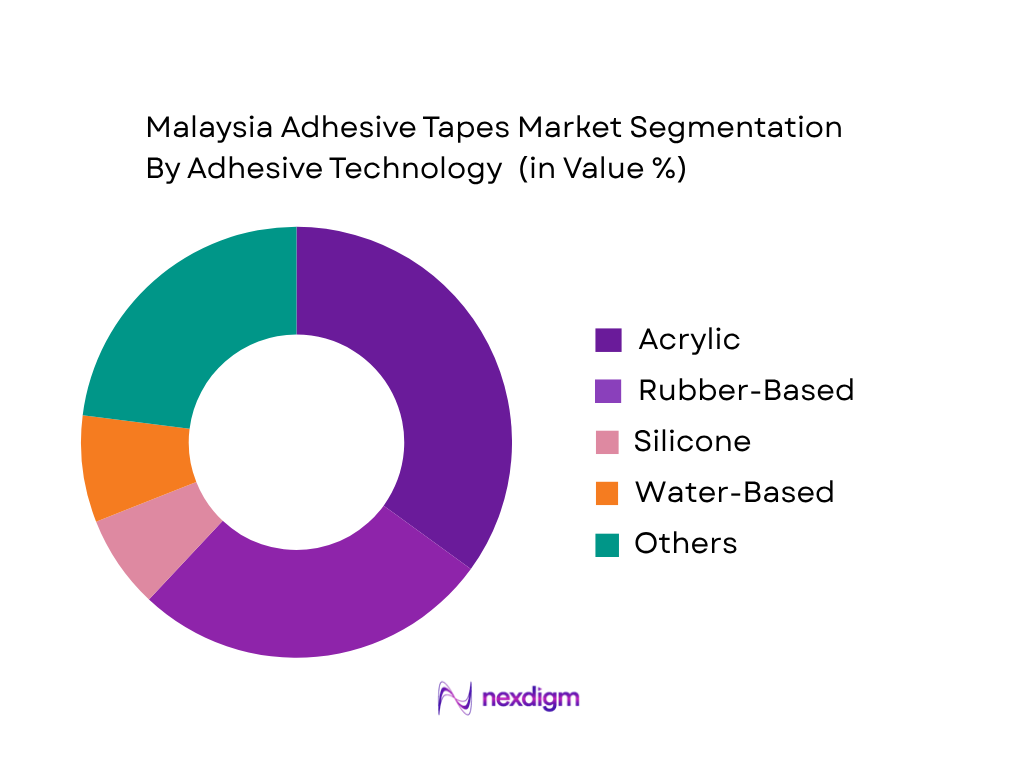
Malaysia Adhesive Tapes Market is segmented by adhesive technology into acrylic, rubber-based, silicone, water-based, solvent-based and hot-melt tapes. Acrylic adhesive tapes are expected to represent the dominant segment at XX% in 2024, supported by their broad applicability across packaging, electronics, automotive assembly, construction, mounting and industrial applications. Acrylic systems provide a useful balance of adhesion, durability, temperature resistance and substrate compatibility, making them suitable for applications where conventional mechanical fastening is increasingly replaced by bonding. The strength of Malaysia’s electronics ecosystem further supports demand for technically specified acrylic tapes. MIDA reported RM55.8 billion of approved E&E manufacturing investments in 2024, while the semiconductor industry alone received RM48.1 billion across 46 projects. Such investment encourages higher-value applications involving component mounting, insulation, protection, thermal management and assembly. Rubber-based and hot-melt products remain important for packaging and general-purpose applications, while silicone tapes address higher-temperature and specialty requirements. Water-based and solvent-based technologies serve more application-specific requirements.
By End-Use Industry
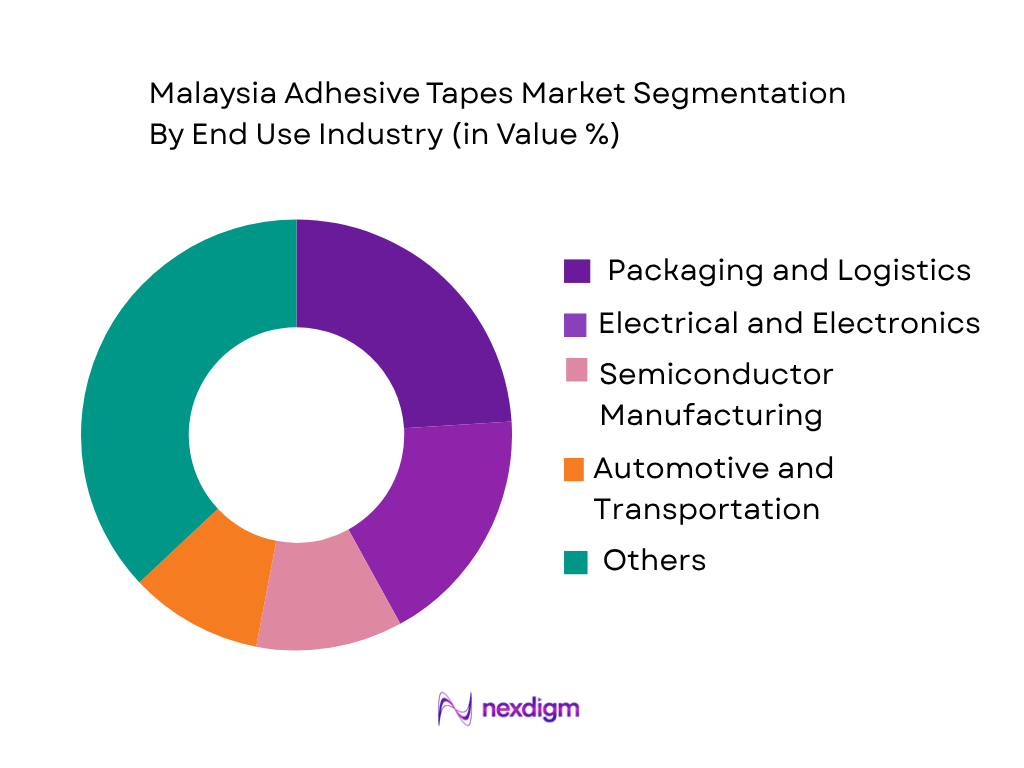
Malaysia Adhesive Tapes Market is segmented by end-use industry into packaging and logistics, electrical and electronics, semiconductor manufacturing, automotive and transportation, construction and interior fit-out, HVAC and MEP, healthcare and pharmaceuticals, industrial manufacturing, furniture and interiors, food and beverage, and marine and specialty applications. Electrical and electronics is expected to hold the leading position at XX% in 2024, reflecting Malaysia’s established electronics manufacturing and semiconductor ecosystem. MIDA identifies E&E as a central pillar of Malaysian manufacturing, while the country accounts for 13 of global chip assembly, testing and packaging activities according to MIDA. Adhesive tapes are increasingly relevant to component fixation, insulation, wire management, thermal management, protection and precision assembly. Packaging remains another major consumption center because Malaysia recorded RM1,288.1 billion in e-commerce transaction income in 2024, with manufacturing generating RM633.5 billion in e-commerce income. Automotive demand also provides an additional application base: Malaysian vehicle production reached 790,347 units in 2024.
Competitive Landscape
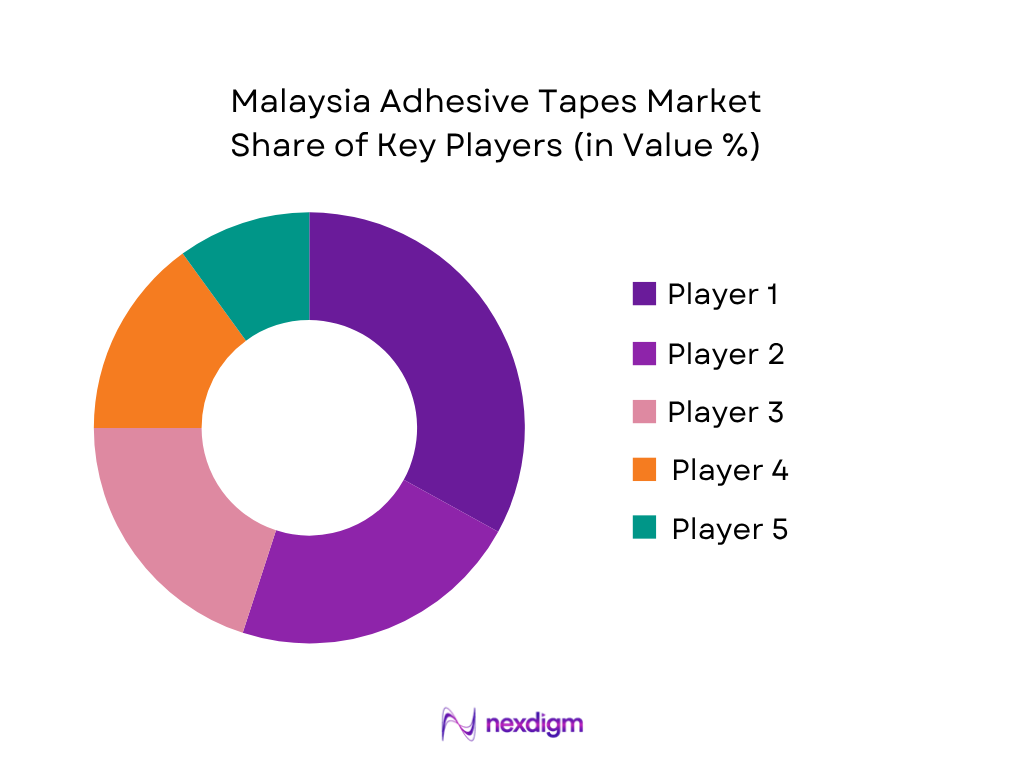
The Malaysia Adhesive Tapes Market comprises global adhesive specialists, diversified chemical companies and regional tape manufacturers and converters. Competition is shaped by adhesive-technology breadth, industrial-grade performance, local availability, customization, technical support and access to Malaysia’s electronics, automotive, packaging and manufacturing clusters. The competitive environment is particularly technology-driven because Malaysia’s E&E sector attracted RM55.8 billion in approved manufacturing investments in 2024, creating demand for increasingly specialized bonding and assembly solutions.
| Company | Establishment Year | Headquarters | Adhesive Technology Breadth | Key Tape Applications | Malaysia Market Position | Local/Regional Supply Capability | Technical Service Focus |
| 3M Company | 1902 | St. Paul, USA | ~ | ~ | ~ | ~ | ~ |
| tesa SE | 1941 | Norderstedt, Germany | ~ | ~ | ~ | ~ | ~ |
| Nitto Denko Corporation | 1918 | Osaka, Japan | ~ | ~ | ~ | ~ | ~ |
| Avery Dennison Corporation | 1935 | Mentor, USA | ~ | ~ | ~ | ~ | ~ |
| Henkel AG & Co. KGaA | 1876 | Düsseldorf, Germany | ~ | ~ | ~ | ~ | ~ |
Malaysia Adhesive Tapes Market Analysis
Growth Drivers
Electronics and Semiconductor Manufacturing Expansion
Malaysia’s adhesive tapes demand is closely linked to its highly developed electrical and electronics ecosystem, particularly semiconductor assembly, testing, packaging, printed circuit boards, consumer electronics and precision components where double-sided, insulating, thermal-management and protective tapes are used. The country’s E&E trade reached RM1,056 billion in 2024, compared with RM931.40 billion in 2023, while semiconductor trade reached RM655.13 billion, including RM387.95 billion of exports. E&E manufacturing contributed 7.3% of GDP, and the sector attracted RM55.8 billion of investment, including RM48.1 billion for semiconductors. Malaysia’s semiconductor ecosystem is therefore generating a substantial installed base of precision manufacturing operations requiring process tapes, masking tapes, bonding tapes and electrically functional adhesive systems. The National Semiconductor Strategy, introduced in May 2024, specifically targets expanded production capacity, advanced packaging, research-driven innovation and talent development. MIDA also reported 46 approved semiconductor projects representing RM48.1 billion of investment and 21,722 employment opportunities. These industrial developments create a structural requirement for higher-performance adhesive tapes capable of meeting cleanroom, dielectric, temperature-resistance, dimensional-stability and automated-assembly requirements.
Packaging and E-Commerce Fulfilment
Packaging, parcel handling and logistics represent another significant demand engine for Malaysia’s adhesive tapes because carton sealing, bundling, labeling, palletisation, protective packaging and automated fulfilment operations rely heavily on pressure-sensitive and hot-melt tape formats. Malaysia recorded RM1,288.1 billion in e-commerce transaction income in 2024, compared with RM1,184.1 billion in 2023. Manufacturing alone generated RM633.5 billion of e-commerce transaction income, while domestic e-commerce transactions reached RM1,150.1 billion. The manufacturing component of domestic e-commerce transactions reached RM587.4 billion, up from RM543.3 billion previously. At the broader industrial level, Malaysian manufacturing sales reached approximately RM1.9 trillion in 2024, while export-oriented industries represented 70.1% of manufacturing sales in the December 2024 release. This combination of manufacturing throughput, cross-border trade and digitally enabled fulfilment expands the requirement for carton-sealing tapes, filament-reinforced tapes, printed tapes, double-sided mounting tapes and specialty packaging solutions. The increasing penetration of automated packing and distribution also favours tapes with consistent unwind, adhesion, shear resistance and machine compatibility.
Market Challenges
Imported Master-Roll Dependency
Malaysia’s adhesive-tape industry faces supply-chain exposure where manufacturers and converters depend on imported polymer films, adhesive chemistries, master rolls, release liners and other intermediate materials. International trade data identifies US$27.32 billion of imports under HS 3919-related self-adhesive plastic plates, sheets, film, foil, tape, strip and other flat shapes in the reported trade dataset, illustrating the scale and internationalisation of the broader product category. At the national level, Malaysia’s E&E sector recorded RM455.68 billion of imports in 2024, while semiconductor imports reached RM267.18 billion, reinforcing the economy’s dependence on internationally sourced industrial inputs and components. For tape converters, exposure to overseas suppliers can create longer replenishment cycles, qualification requirements when changing materials and vulnerability to shipping disruptions. Feedstock exposure also extends upstream because adhesive systems depend on acrylic monomers, synthetic rubber, silicones, resins, plastic films and specialty additives. The challenge is particularly relevant for high-performance tapes where changing a film, adhesive formulation or liner can require renewed customer qualification. Malaysia’s manufacturing localisation agenda therefore creates an incentive for domestic tape-conversion capabilities and regional sourcing of qualified raw materials.
Humid Tropical Conditions and Advanced-Tape Qualification Requirements
Malaysia’s tropical operating environment creates demanding conditions for adhesive tapes used in electronics, construction, HVAC, automotive and industrial applications. High moisture exposure, elevated temperatures and prolonged environmental exposure can affect adhesive tack, peel adhesion, shear strength, liner stability and dimensional performance, increasing the technical requirements for products deployed in outdoor or temperature-sensitive applications. The challenge is amplified by the increasing sophistication of Malaysia’s manufacturing base. Manufacturing-sector sales reached approximately RM1.9 trillion in 2024, while electronic components, communication equipment and consumer electronics recorded 4.0% growth and electrical equipment remained a major industrial category. Malaysia also attracted RM120.5 billion of manufacturing approved investments in 2024, creating additional demand for materials capable of satisfying increasingly stringent production specifications. High-value electronics and semiconductor applications can require controlled adhesion, low outgassing, dielectric insulation, clean removal and resistance to thermal cycling, while construction and HVAC applications require durability under heat and humidity. Consequently, commodity tape suppliers face a qualification barrier when entering technically demanding accounts: customers may require documented performance testing, substrate compatibility, process validation and consistency across production batches before approving a new tape specification.
Market Opportunities
Semiconductor and Electronics Tapes
Malaysia’s expanding semiconductor and electronics ecosystem creates a strong opportunity for specialised adhesive tapes used in wafer processing, component protection, PCB assembly, thermal management, insulation, die-cut components, masking and advanced packaging. Semiconductor trade reached RM655.13 billion in 2024, consisting of RM387.95 billion in exports and RM267.18 billion in imports, while semiconductor investment reached RM48.1 billion across 46 approved projects. These projects were associated with 21,722 employment opportunities, demonstrating the scale of industrial activity being added to the semiconductor ecosystem. Malaysia’s National Semiconductor Strategy also targets expansion beyond established assembly and testing capabilities toward higher-value activities and advanced packaging. This creates an addressable opportunity for tapes that provide controlled thickness, high dielectric strength, thermal conductivity, clean removability, chemical resistance and precision die-cutting. The wider E&E sector attracted RM55.8 billion of investment and generated RM1,056 billion of trade, supporting demand beyond semiconductors into consumer electronics, industrial electronics and electrical equipment. Local converters that can combine imported specialty adhesive technology with precision slitting, coating, laminating and die-cutting capabilities can therefore move toward higher-value applications rather than competing solely in commodity carton-sealing tapes.
Thermal-Management, HVAC and Solar Applications
Malaysia’s industrial construction, data-centre development and renewable-energy activity creates an opportunity for thermal-management tapes, HVAC foil tapes, insulation bonding systems and solar assembly tapes. Construction work completed reached RM158.8 billion in 2024, with the electrical installation and plumbing, heat and air-conditioning installation activities forming part of the special-trade segment. Data-centre development is particularly relevant because MIDA reported RM90.2 billion in committed foreign direct investment for 12 data centres between 2021 and June 2024, while approved data-centre capacity had reached 4 GW. The expansion of these facilities requires extensive HVAC, insulation, cable management, electrical installation and thermal-control materials. Malaysia also continues to develop solar capacity, with MIDA reporting individual 2026 solar projects such as a 99.99 MW installation in Kedah and another 99.99 MW project in Kelantan. These applications create opportunities for tapes designed for foil-to-insulation bonding, vapor-barrier sealing, thermal interface attachment, cable fixing, photovoltaic module assembly and weather-resistant installation. Suppliers capable of providing low-VOC, flame-retardant, heat-resistant and high-humidity-performing products can address applications where conventional commodity tapes provide inadequate durability.
Future Outlook
Over the coming decade, the Malaysia Adhesive Tapes Market is expected to benefit from continued expansion of electronics and semiconductor manufacturing, packaging activity, automotive production and advanced industrial assembly. Malaysia’s manufacturing sales reached RM1.9 trillion in 2024, while approved investments reached RM378.5 billion, providing a broad industrial foundation for future tape consumption. Demand is expected to shift progressively toward high-performance acrylic foam, electronics-grade, thermal-management, EV assembly, low-VOC and sustainable tape systems. Semiconductor investments are particularly relevant because Malaysia approved 46 semiconductor projects worth RM48.1 billion in 2024, creating opportunities for precision bonding, protection, insulation and clean manufacturing applications.
Major Players
- 3M Company
- tesa SE
- Nitto Denko Corporation
- Avery Dennison Corporation
- Henkel AG & Co. KGaA
- Sika AG
- Saint-Gobain
- Lohmann GmbH & Co. KG
- LINTEC Corporation
- Berry Global Group, Inc.
- ORAFOL Europe GmbH
- Shurtape Technologies, LLC
- Intertape Polymer Group
- Scapa Group
- Loytape Industries Sdn. Bhd.
Key Target Audience
- Adhesive Tape Manufacturers and Converters
- Packaging and Flexible-Packaging Manufacturers
- Electrical, Electronics and Semiconductor Manufacturers
- Automotive OEMs and Component Manufacturers
- Construction, HVAC and MEP Material Suppliers
- Industrial Manufacturing and Assembly Companies
- Investments and Venture Capitalist Firms (Malaysian Investment Development Authority, institutional investors, private-equity and industrial investment firms)
- Government and Regulatory Bodies (Malaysian Investment Development Authority, Ministry of Investment, Trade and Industry, Department of Standards Malaysia, Department of Occupational Safety and Health)
Research Methodology
Step 1: Identification of Key Variables
The initial stage establishes the Malaysia Adhesive Tapes Market ecosystem across adhesive manufacturers, backing-material suppliers, tape producers, converters, distributors and industrial end users. Variables include adhesive chemistry, backing material, tape construction, application, end-use industry, production capability, imports, local conversion and technical specifications.
Step 2: Market Analysis and Construction
Historical market information is structured using adhesive technology, tape construction, backing material, application and end-use consumption. Manufacturing activity, electronics investment, automotive production, packaging demand and trade flows are used to establish the underlying demand framework and identify the principal consumption centers.
Step 3: Hypothesis Validation and Expert Consultation
Market hypotheses are validated through discussions with tape manufacturers, converters, distributors, packaging companies, electronics manufacturers, automotive suppliers and industrial procurement personnel. Interviews focus on product specifications, qualification requirements, switching behavior, local conversion, imported supply and application-specific demand.
Step 4: Research Synthesis and Final Output
The final analysis triangulates bottom-up company and application assessments with manufacturing, trade and investment indicators. Company-level information is reconciled against Malaysia’s industrial structure to determine technology adoption, end-use demand, competitive positioning and opportunities for specialty-tape expansion.

- Executive Summary
- Research Methodology (Market Definition and Scope, Adhesive Tape Classification, Top-Down Market Sizing, Bottom-Up Market Reconstruction, Volume Conversion, Import-Export Validation, End-Use Demand Mapping, Distributor Assessment, Converter Assessment, Primary Industry Interviews, Secondary Research, Data Triangulation, Forecasting Framework, Sensitivity Analysis, Assumptions and Limitations)

- Definition and Scope
- Evolution of Malaysia’s Adhesive Tapes Industry
- Adhesive Tapes Industry Ecosystem
- Malaysia Adhesive Tapes Value Chain Analysis
- Malaysia Adhesive Tapes Supply Chain Analysis
- Raw Material Ecosystem

- Growth Drivers (Electronics and Semiconductor Manufacturing Expansion, Packaging and E-Commerce Fulfilment, Automotive Production, Construction Activity, HVAC Installation, Electrical Infrastructure, Industrial Automation and Lightweight Bonding Adoption)
- Market Challenges (Imported Master-Roll Dependency, Polymer and Adhesive Feedstock Exposure, Humid Tropical Conditions, Performance Degradation, Commodity-Tape Competition, Advanced-Tape Qualification Requirements, Technical Application Knowledge and Limited Specialty-Tape Capacity)
- Market Opportunities (High-Performance Acrylic Foam Tapes, Semiconductor and Electronics Tapes, EV and Battery Assembly Tapes, Sustainable BOPP Packaging Tapes, Low-VOC Adhesive Systems, HVAC Foil Tapes, Solar Applications, Thermal-Management Tapes, Smart Functional Tapes and Local Specialty-Tape Conversion)
- Market Trends (Lightweight Bonding, Replacement of Mechanical Fasteners, Premiumization of Industrial Tapes, Low-VOC Chemistry, Sustainable Backings, High-Temperature Adhesives, Electrification, Semiconductor Miniaturization, Die-Cut Components and Customized Tape Solutions)
- Government and Regulatory Framework (Standards Malaysia Requirements, Department of Occupational Safety and Health Requirements, Environmental Compliance, Chemical Management, Product Safety, Industrial Standards, Packaging Requirements and Labelling)
- Porter’s Five Forces Analysis
- PESTLE Analysis
- SWOT Analysis

- By Market Value (2020-2025)
- By Volume Consumption (2020-2025)
- By Average Selling Price (2020-2025)
- By Adhesive Technology (2020-2025)
- By Tape Construction (2020-2025)
- By Backing Material (2020-2025)
- By End-Use Industry (2020-2025)
- By Application (2020-2025)

- By Adhesive Technology (In Value %)
Acrylic Adhesive Tapes
Rubber-Based Adhesive Tapes
Silicone Adhesive Tapes
Water-Based Adhesive Tapes
Solvent-Based Adhesive Tapes
Hot-Melt Adhesive Tapes
Hybrid and Specialty Adhesive Systems - By Tape Construction (In Value %)
Single-Sided Tapes
Double-Sided Tapes
Transfer Tapes
Filament and Reinforced Tapes
Masking Tapes
Packaging and Carton-Sealing Tapes
Electrical Insulation Tapes
Protective Surface Tapes
Specialty Industrial Tapes - By Backing Material (In Value %)
BOPP Backing
PET Backing
PVC Backing
Paper and Crepe Paper Backing
PE and Polyolefin Backing
Foam Backing
Aluminum Foil Backing
Nonwoven Backing
Specialty Film Backings - By End-Use Industry (In Value %)
Packaging and Logistics
Electrical and Electronics
Semiconductor Manufacturing
Automotive and Transportation
Construction and Interior Fit-Out
HVAC and MEP
Healthcare and Pharmaceuticals
Industrial Manufacturing
Food and Beverage
Marine and Specialty Applications - By Application (In Value %)
Carton Sealing and Case Closing
Bundling and Palletizing
Mounting and Assembly
Thermal Insulation and HVAC Sealing
Surface Protection
Masking and Paint Application
Splicing and Web Joining
Lamination and Composite Assembly
Component Fixation
Automotive Trim Attachment
Signage and Graphic Mounting
Die-Cut Component Assembly - By Performance Requirement (In Value %)
High-Temperature Resistance
High Shear Strength
High Peel Adhesion
UV Resistance
Moisture and Humidity Resistance
Chemical Resistance
Flame Retardancy
Low-VOC Performance
Outdoor Durability
Clean Removability

- Market Share of Major Players (By Value, Volume, Adhesive Technology, Tape Construction, Backing Material, End-Use Industry, Application and Distribution Channel)
- Cross Comparison Parameters (Product Portfolio Breadth, Local Manufacturing and Conversion Capacity, Adhesive Technology Depth, Specialty-Tape Capability, E&E and Semiconductor Tape Portfolio, Automotive Tape Portfolio, Die-Cutting and Customization Capability, Distribution and Technical-Service Network)
- SWOT Analysis of Major Players
- Detailed Profiles of Major Companies
3M Company
tesa SE
Nitto Denko Corporation
Avery Dennison Corporation
Henkel AG & Co. KGaA
Sika AG
Saint-Gobain
Lohmann GmbH & Co. KG
LINTEC Corporation
Berry Global Group, Inc.
ORAFOL Europe GmbH
Shurtape Technologies, LLC
Intertape Polymer Group
Scapa Group
Loytape Industries Sdn. Bhd.

- Packaging and Logistics End Users
- Electrical and Electronics End Users
- Semiconductor End Users
- Automotive End Users
- Construction End Users
- HVAC and MEP End Users
- End-User Switching Analysis

- By Market Value (2026-2035)
- By Volume Consumption (2026-2035)
- By Average Selling Price (2026-2035)
- By Adhesive Technology (2026-2035)
- By Tape Construction (2026-2035)
- By Backing Material (2026-2035)
- By End-Use Industry (2026-2035)
- By Application (2026-2035)


 Request a Sample
 Ask for Customization
 Get a Quote
 Enquire Now