
 Download PDF
Market Overview
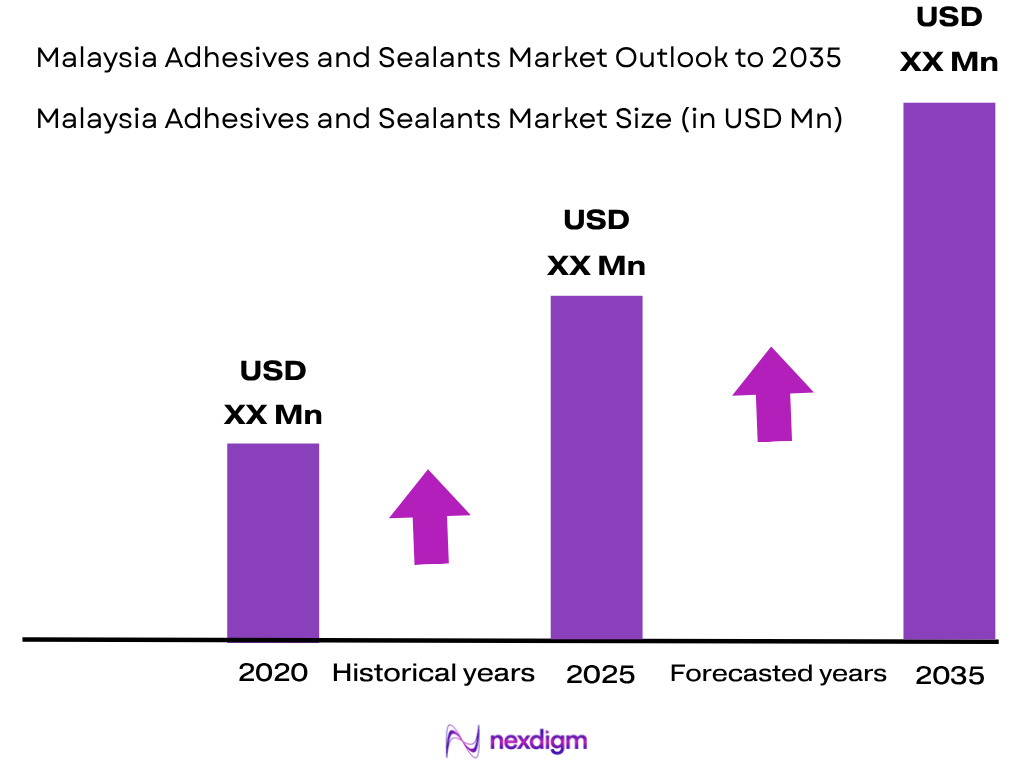
The Malaysia Adhesives and Sealants Market is valued at ~USD XXX million, with demand supported by electronics and electrical manufacturing, packaging, construction, automotive production, furniture and industrial assembly. Malaysia’s economy reached RM1.93 trillion at current prices, while manufacturing and services together contributed 82.5% of GDP, providing a broad industrial base for adhesive consumption. Construction work completed reached RM158.8 billion, while automotive production reached 790,347 vehicles, strengthening demand for bonding, sealing, laminating and assembly applications across industrial value chains.
The Malaysia Adhesives and Sealants Market is concentrated around Selangor, Penang, Johor, Kuala Lumpur and Sarawak, reflecting the geographic distribution of manufacturing, construction and industrial activity. Selangor recorded RM9.4 billion of construction work in the fourth quarter, while Johor recorded RM7.4 billion and Sarawak RM4.6 billion, demonstrating the importance of these locations for construction-related adhesive and sealant demand. Penang’s electronics ecosystem and Johor’s manufacturing and industrial corridors further support specialty adhesive consumption, particularly for electronics, packaging, automotive components and industrial assembly.
Market Segmentation
By Product Type
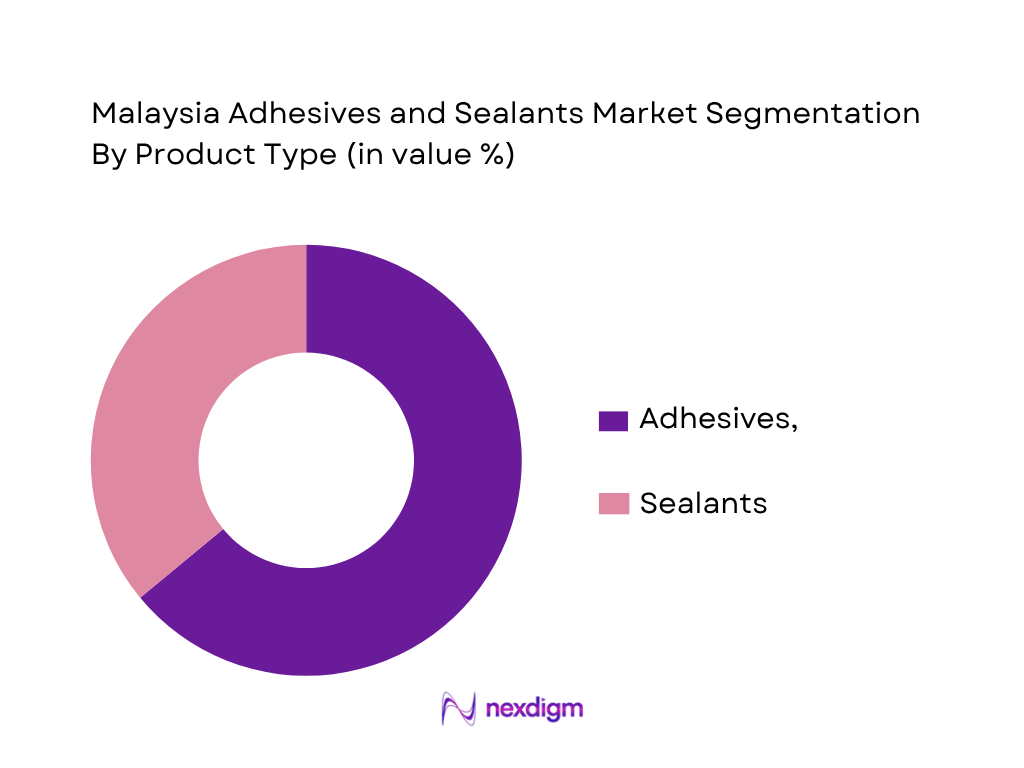
The Malaysia Adhesives and Sealants Market is segmented by product type into adhesives and sealants. Adhesives represent the dominant sub-segment, supported by their broader utilization across packaging, electronics, semiconductor-related applications, furniture, footwear, automotive components and industrial assembly. Malaysia’s electronics manufacturing ecosystem creates demand for epoxy, acrylic, polyurethane, silicone and UV-curable adhesives used for component bonding, encapsulation, insulation and protection. Packaging applications further consume hot-melt, water-based and pressure-sensitive adhesives for cartons, labels, flexible packaging and case sealing. Sealants maintain strong demand in construction, façade systems, glazing, waterproofing, sanitary applications, automotive body sealing and industrial joints. Construction activity reached RM158.8 billion in completed work, reinforcing demand for silicone, polyurethane and hybrid sealants. Automotive production of 790,347 vehicles also creates applications for windshield bonding, body sealing and component assembly. Adhesives therefore benefit from a wider application base spanning both manufacturing and consumer-oriented industries, while sealants are more concentrated in construction, transportation and protective sealing applications.
By End-Use Industry
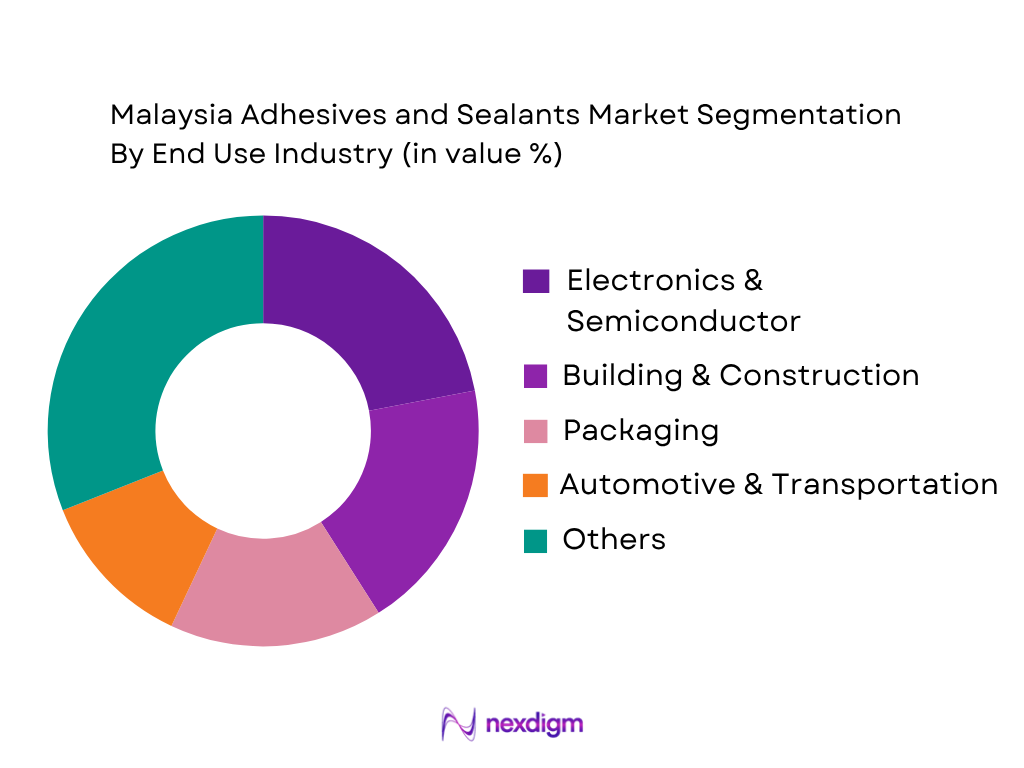
The Malaysia Adhesives and Sealants Market is segmented by end-use industry into electronics and semiconductor, packaging, building and construction, automotive and transportation, furniture and woodworking, footwear and leather, healthcare, industrial manufacturing, marine and offshore, and renewable energy. Electronics and semiconductor manufacturing represents a major high-value consumption center because adhesive materials are required for component assembly, encapsulation, thermal management, insulation and protection. Malaysia’s manufacturing capital stock in the electrical, electronic and optical products segment reached RM141.1 billion, demonstrating the scale of the underlying industrial ecosystem. Packaging and construction provide substantial volume demand through laminating, carton sealing, flooring, tiling, glazing, façade sealing and waterproofing applications. Automotive production of 790,347 units creates requirements for structural adhesives, glass bonding and body sealing. Furniture manufacturing also supports adhesive consumption through wood bonding, edge assembly and panel production. The breadth of Malaysia’s manufacturing ecosystem makes industrial and electronics applications particularly important for specialty adhesives, while construction and packaging provide significant recurring demand for mainstream adhesive and sealant formulations.
Competitive Landscape
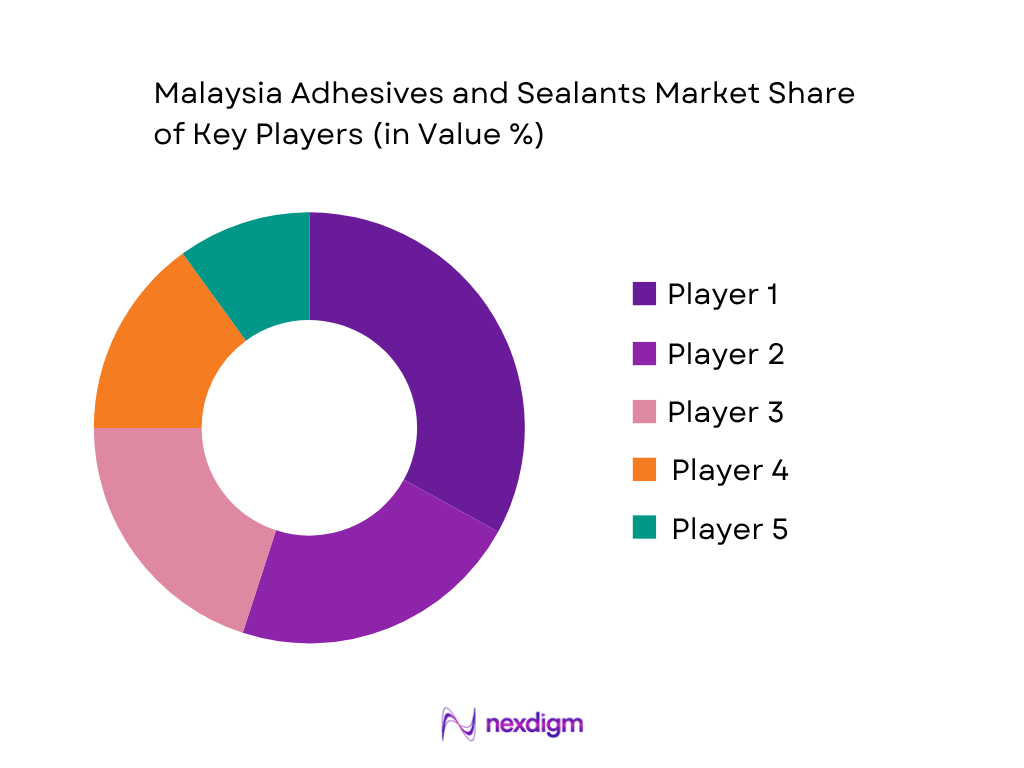
The Malaysia Adhesives and Sealants Market comprises global adhesive specialists, diversified chemical manufacturers and regional construction-chemical suppliers. Competition is shaped by resin technology, application engineering, OEM qualification, product certification, distributor reach and the ability to serve electronics, packaging, construction and automotive customers. Major participants include Henkel, Sika, Bostik, H.B. Fuller and 3M, with portfolios spanning industrial adhesives, construction systems, packaging adhesives, automotive bonding and specialty sealants. Bostik, for example, maintains Malaysian offerings across construction sealing and bonding, flexible packaging, automotive assembly and EV-related applications.
| Major Player | Establishment Year | Headquarters | Core Product Categories | Key Malaysia Applications | Technology Portfolio | Distribution / Manufacturing Presence | Key End-Use Exposure |
| Henkel AG & Co. KGaA | 1876 | Düsseldorf, Germany | ~ | ~ | ~ | ~ | ~ |
| Sika AG | 1910 | Baar, Switzerland | ~ | ~ | ~ | ~ | ~ |
| Arkema / Bostik | 1889 | Colombes, France | ~ | ~ | ~ | ~ | ~ |
| H.B. Fuller | 1887 | St. Paul, Minnesota, USA | ~ | ~ | ~ | ~ | ~ |
| 3M | 1902 | St. Paul, Minnesota, USA | ~ | ~ | ~ | ~ | ~ |
Malaysia Adhesives and Sealants Market Analysis
Growth Drivers
Expansion of Electronics and Semiconductor Manufacturing
Malaysia’s expanding electronics and semiconductor manufacturing ecosystem is a major growth driver for the Adhesives and Sealants Market because these industries require precision bonding, encapsulation, component protection, thermal management and insulation materials. Malaysia’s Electrical and Electronics industry recorded RM1.056 trillion in total trade in 2024, including RM601.18 billion of exports and RM455.68 billion of imports. Semiconductor products alone generated RM655.13 billion of trade, comprising RM387.95 billion of exports and RM267.18 billion of imports. The industry also attracted RM55.8 billion in investment, including RM48.1 billion directed toward semiconductors, strengthening the domestic manufacturing base for adhesive-intensive applications. Malaysia’s ICT manufacturing industry expanded strongly, while computer, electronics and optical-product manufacturing contributed to manufacturing sales growth. These activities require epoxy, acrylic, silicone, polyurethane, UV-curable and thermally conductive adhesive systems for semiconductor packaging, printed circuit boards, sensors, displays, electronic modules and precision assemblies. The concentration of advanced manufacturing in Penang, Selangor, Johor and other industrial corridors creates recurring demand for technically qualified bonding materials. The continuing development of semiconductor packaging, testing and assembly capabilities therefore provides a structural demand base for higher-performance adhesives and sealants.
Growth of Electrical and Electronic Exports, Packaging and Manufacturing Activity
Malaysia’s export-oriented manufacturing structure creates sustained demand for adhesives and sealants used in electronics, packaging, industrial products and consumer goods. Total Malaysian trade reached RM2.9 trillion in 2024, comprising approximately RM1.5 trillion of exports and RM1.4 trillion of imports, demonstrating the scale of cross-border manufacturing and distribution activity requiring industrial bonding and sealing solutions. Manufacturing-sector sales reached approximately RM1.9 trillion, while the sector employed around 2.40 million people, creating a broad industrial customer base for adhesive technologies. Electrical and electronics products recorded RM601.18 billion in exports, while ICT-product exports reached RM449.7 billion, supporting demand for specialty materials used in electronic assembly and protective applications. E-commerce activity also generated RM258.2 billion in 2024, creating additional requirements for corrugated boxes, labels, tapes, cartons and protective packaging. Adhesives are integral to carton forming, case sealing, flexible packaging, labeling and packaging conversion, while sealants support industrial equipment, warehouse infrastructure and packaging machinery. Malaysia’s strong manufacturing and export ecosystem therefore supports both high-volume adhesive consumption in packaging and higher-value specialty applications in electronics and precision manufacturing.
Market Challenges
Dependence on Imported Specialty Resins and Chemicals
Dependence on international chemical supply chains presents a structural challenge for Malaysia’s Adhesives and Sealants Market, particularly for specialty products requiring epoxy resins, polyurethane intermediates, acrylic monomers, silicone materials, additives and performance-enhancing chemicals. Malaysia recorded approximately RM2.9 trillion in total merchandise trade in 2024, with imports reaching approximately RM1.4 trillion, demonstrating the economy’s extensive integration with international supply networks. The manufacturing sector recorded approximately RM1.9 trillion in sales, creating substantial industrial demand for chemical inputs while also exposing manufacturers to disruptions in international sourcing. Malaysia’s chemical, rubber and plastics ecosystem forms an important part of the domestic manufacturing base, but specialty adhesive formulations can still require imported grades and intermediates that are not available in sufficient domestic volumes. Global transportation disruptions, supplier concentration, foreign-exchange movements and changes in petrochemical availability can therefore affect material availability and production planning. Adhesive manufacturers serving semiconductor, electronics and automotive customers face additional requirements for consistent resin quality and batch-to-batch performance, limiting the ability to substitute materials quickly. Maintaining sufficient inventories, qualifying multiple suppliers and developing localized formulation capabilities can increase operational complexity. The challenge is particularly relevant for high-performance adhesive systems where alternative raw materials require extensive technical validation before customer approval.
Exposure to Global Electronics Cycles and Environmental Compliance Requirements
Malaysia’s strong dependence on electronics manufacturing creates both demand opportunities and cyclical risks for the Adhesives and Sealants Market. The Electrical and Electronics industry generated RM1.056 trillion in total trade in 2024, while semiconductor trade reached RM655.13 billion, making electronics a critical industrial demand center for specialty adhesives. Semiconductor exports alone reached RM387.95 billion, while imports reached RM267.18 billion, highlighting the sector’s integration into global technology supply chains. Changes in international semiconductor orders, electronics inventories and downstream manufacturing schedules can consequently influence procurement volumes for bonding, encapsulation and protection materials. Adhesive suppliers serving this industry must maintain high technical specifications while managing fluctuations in production requirements. Environmental compliance adds another layer of complexity. Manufacturers increasingly need water-based, solvent-free and low-emission formulations while maintaining adhesion, curing speed, thermal stability and reliability. Malaysia’s manufacturing sector recorded approximately RM1.9 trillion in sales and employed around 2.40 million people, meaning environmental and occupational requirements affect a broad industrial base. Companies must also manage chemical handling, waste treatment and product documentation requirements. The combined impact of electronics-cycle exposure and compliance requirements can increase formulation, qualification and technical-service demands, particularly for suppliers targeting semiconductor and precision-electronics customers.
Market Opportunities
Semiconductor and Electronics Bonding Solutions
Malaysia’s growing semiconductor ecosystem creates an opportunity for suppliers of specialized adhesives and sealants designed for advanced electronics manufacturing. Semiconductor trade reached RM655.13 billion in 2024, with exports of RM387.95 billion and imports of RM267.18 billion, demonstrating the scale of the domestic and international semiconductor value chain. Semiconductor-related investment reached RM48.1 billion, strengthening Malaysia’s manufacturing capacity and supporting additional applications for die attach, underfill, encapsulation, component protection, thermal management and electronic assembly. The broader Electrical and Electronics sector attracted RM55.8 billion in investment, while total E&E trade reached RM1.056 trillion, creating a substantial addressable industrial ecosystem for specialty bonding technologies. As manufacturers move toward increasingly compact and performance-sensitive electronic assemblies, conventional mechanical joining becomes less suitable for many applications, increasing the relevance of precision adhesive dispensing and curing systems. Opportunities exist for epoxy, acrylic, silicone, UV-curable, electrically insulating and thermally conductive formulations designed for semiconductor packaging and electronic modules. Suppliers with localized technical support can address qualification requirements, process optimization and application-specific formulation needs. The concentration of electronics manufacturing in established industrial clusters also creates opportunities for distributors and manufacturers to build application laboratories, technical centers and inventory hubs close to major customers.
Sustainable Packaging, Construction and Local Specialty Adhesive Manufacturing
Malaysia’s expanding construction, packaging and manufacturing activities create opportunities for sustainable adhesive and sealant technologies while also supporting greater localization of specialty formulation. Construction work completed reached RM158.8 billion in 2024, while gross fixed capital formation reached RM396.9 billion, indicating substantial investment activity across infrastructure, buildings, machinery and industrial assets. The packaging opportunity is supported by e-commerce activity worth RM258.2 billion, which generates requirements for corrugated packaging, cartons, labels, tapes and protective packaging systems. Sustainable water-based, low-VOC, solvent-free and recyclable-packaging adhesives can address changing requirements from manufacturers seeking improved environmental performance without sacrificing bonding efficiency. Construction applications provide opportunities for silicone, polyurethane and hybrid sealants in glazing, façades, flooring, waterproofing and building-envelope applications. Malaysia’s manufacturing sector generated approximately RM1.9 trillion in sales, providing a substantial industrial base for localized adhesive formulation and distribution. Developing domestic capabilities for specialty resins, formulated adhesives and application-specific sealants can reduce reliance on imported materials while improving supply responsiveness. Regional ASEAN integration provides an additional commercial pathway because Malaysia recorded approximately RM2.9 trillion in total trade, supporting its role as a manufacturing and distribution hub for specialty chemical products.
Future Outlook
Over the coming decade, the Malaysia Adhesives and Sealants Market is expected to develop alongside the country’s electronics, semiconductor, packaging, construction and automotive industries. The expansion of high-value electronics manufacturing should support demand for specialty adhesives used in precision assembly, encapsulation and component protection. Construction activity will sustain consumption of waterproofing, façade, glazing, flooring and structural sealing systems. Automotive manufacturing and the gradual development of electric mobility should create additional applications for lightweight bonding and battery-related materials. Sustainability requirements are also expected to accelerate the transition toward water-based, low-VOC, solvent-free and recyclable adhesive technologies. Malaysia’s position within ASEAN manufacturing supply chains provides an additional opportunity for suppliers to serve regional customers through localized production, technical support and distribution infrastructure.
Major Players
- Henkel AG & Co. KGaA
- Sika Malaysia
- Arkema / Bostik Malaysia
- H.B. Fuller Malaysia
- 3M Malaysia
- Dow Chemical Malaysia
- Wacker Chemicals Malaysia
- BASF Malaysia
- KCC Malaysia
- DIC Corporation Malaysia
- Jowat Malaysia
- Huntsman Malaysia
- MAPEI Malaysia
- Soudal Malaysia
- Aica Malaysia
Key Target Audience
- Adhesives and Sealants Manufacturers
- Electronics and Semiconductor Manufacturers
- Packaging Converters and Flexible Packaging Manufacturers
- Automotive OEMs and Automotive Component Manufacturers
- Construction Chemical Manufacturers and Building Material Suppliers
- Furniture, Woodworking, Footwear and Industrial Product Manufacturers
- Investments and Venture Capitalist Firms
- Government and Regulatory Bodies (Ministry of Investment, Trade and Industry, Department of Environment, Department of Occupational Safety and Health, Construction Industry Development Board, Standards and Industrial Research Institute of Malaysia)
Research Methodology
Step 1: Identification of Key Variables
The initial phase involves constructing a Malaysia Adhesives and Sealants Market ecosystem covering resin manufacturers, chemical suppliers, adhesive formulators, sealant producers, distributors and major industrial consumers. Variables include resin chemistry, technology type, production capacity, imports, applications, end-use industries and regional demand. Particular attention is given to electronics, semiconductor, packaging, construction and automotive applications.
Step 2: Market Analysis and Construction
Historical and current market information is compiled across adhesives and sealants, followed by segmentation by resin type, technology, application and end-use industry. The analysis evaluates domestic production, imports, exports, industrial consumption and distribution structures. Bottom-up calculations incorporate company-level product exposure and application-level demand, while top-down analysis validates the resulting market structure.
Step 3: Hypothesis Validation and Expert Consultation
Market hypotheses are developed using secondary research and subsequently validated through interviews with adhesive manufacturers, distributors, packaging converters, construction companies, automotive suppliers and electronics manufacturers. Expert discussions assess procurement behavior, product specifications, technology preferences, supplier relationships and application requirements. The resulting insights are used to refine assumptions and validate market segmentation.
Step 4: Research Synthesis and Final Output
The final stage integrates supply-side, demand-side and company-level findings into a consolidated Malaysia Adhesives and Sealants Market model. Data are cross-checked across product categories, applications, end-use industries and geographic markets to identify inconsistencies. The completed analysis presents market size, segmentation, competitive structure, industry dynamics, opportunities and future market development.

- Executive Summary
- Research Methodology (Market Definition and Scope, Malaysia Adhesives and Sealants Market Classification, Adhesive and Sealant Product Mapping, Resin Chemistry Assessment, Adhesive Technology Assessment, Sealant Technology Assessment, Application-Level Demand Analysis, End-Use Industry Assessment, Domestic Manufacturing Capacity Mapping, Import Dependency Assessment, Export and Re-Export Trade Analysis, Raw Material Supply Assessment, Demand-Side Assessment, Supply-Side Assessment, Top-Down Market Sizing, Bottom-Up Market Sizing, Primary Industry Interviews, Manufacturer and Distributor Interviews, Data Triangulation, Forecasting Framework, Market Share Validation, Limitations and Future Conclusions)

- Definition and Scope
- Malaysia Adhesives and Sealants Industry Evolution
- Adhesives and Sealants Value Chain Analysis Supply Chain Analysis
- Petrochemical Feedstock Suppliers
- Malaysia Industrial Adhesives and Sealants Ecosystem Mapping
- Peninsular Malaysia and East Malaysia Demand Structure Assessment

- Growth Drivers (Expansion of Electronics and Semiconductor Manufacturing, Growth of Electrical and Electronic Exports, Packaging and FMCG Manufacturing Expansion, Construction and Infrastructure Development, Automotive Component Manufacturing Growth, Furniture and Woodworking Industry Expansion, Expansion of Industrial Manufacturing, Growth of E-Commerce Packaging, Renewable Energy Development, Increasing Adoption of High-Performance Bonding Technologies)
- Market Challenges (Dependence on Imported Specialty Resins and Chemicals, Petrochemical Feedstock Price Volatility, Exposure to Global Electronics Cycles, Environmental and VOC Compliance Requirements, Competition from Low-Cost Regional Suppliers, Limited Specialty Formulation Capabilities, Supply Chain Disruptions, Technical Qualification Requirements, Skilled Application Workforce Constraints)
- Market Opportunities (Semiconductor and Electronics Bonding Solutions, Low-VOC and Water-Borne Adhesive Expansion, Sustainable Packaging Adhesives, High-Performance Automotive Bonding, Solar Energy Adhesive Applications, Industrial Automation Adhesives, Construction Sealant Expansion, Bio-Based Adhesive Formulations, Local Specialty Resin and Adhesive Manufacturing, Malaysia-Based Regional Export Opportunities)
- Market Trends (Electronics-Grade Adhesive Adoption, Semiconductor Packaging Bonding, Shift Toward Water-Borne Adhesives, Low-VOC Formulation Development, Hot-Melt Adhesive Expansion, Silicone and MS Polymer Sealant Adoption, Lightweight Automotive Bonding, Sustainable Packaging Solutions, Automated Adhesive Dispensing, High-Performance Industrial Bonding)
- Government Regulations (Department of Environment Environmental Quality Requirements, Department of Occupational Safety and Health Chemical Regulations, Standards and Industrial Research Institute of Malaysia Standards, Construction Industry Development Board Construction Requirements, Environmental Management Requirements, Scheduled Waste Regulations, Chemical Classification and Labelling Requirements, Food-Contact Packaging Requirements, Occupational Health and Safety Requirements)
- SWOT Analysis
- Porter’s Five Forces Analysis
- PESTLE Analysis
- Stakeholder Ecosystem
- Competition Ecosystem

- By Market Value (2020-2025)
- By Market Volume (2020-2025)
- By Adhesives Consumption Volume (2020-2025)
- By Sealants Consumption Volume (2020-2025)
- By Domestic Production Volume (2020-2025)

- By Adhesives Resin Type (In Value %)
Polyurethane Adhesives
Epoxy Adhesives
Acrylic Adhesives
Silicone Adhesives
Cyanoacrylate Adhesives
VAE / EVA Adhesives
Polyvinyl Acetate Adhesives
Rubber-Based Adhesives
Other Specialty Adhesive Resins - By Adhesives Technology (In Value %)
Reactive Adhesives
Hot-Melt Adhesives
UV-Cured Adhesives
Pressure-Sensitive Adhesives
Structural Adhesives - By Sealants Resin Type (In Value %)
Polyurethane Sealants
Acrylic Sealants
Polysulfide Sealants
MS Polymer Sealants
Hybrid Polymer Sealants
Epoxy Sealants
Butyl Sealants
Other Specialty Sealant Resins - By Application Type (In Value %)
Paper and Packaging
Building and Construction
Electronics and Electrical
Semiconductor and Precision Electronics
Automotive and Transportation
Footwear and Leather
Healthcare and Medical
Marine and Offshore
General Industrial Assembly - By End-Use Industry (In Value %)
Packaging Industry
Construction Industry
Electronics and Semiconductor Industry
Automotive Industry
Furniture and Woodworking Industry
Footwear and Leather Industry
Healthcare Industry
Oil and Gas Industry
Marine Industry
Renewable Energy Industry
Industrial Manufacturing Industry - By Distribution Channel (In Value %)
Direct Industrial Sales
Authorized Distributors
Specialty Chemical Distributors
Construction Material Dealers
Hardware and Building Material Retailers
Industrial Supply Companies
OEM Procurement Channels
E-Commerce and Online Industrial Platforms
Dealer and Applicator Networks

- Market Share of Major Players (By Malaysia Revenue, Adhesives Sales Volume, Sealants Sales Volume, Resin Portfolio, Technology Portfolio, Electronics and Semiconductor Exposure, Construction Application Coverage, Automotive Application Coverage, Production Capacity, Distribution Network Coverage, Regional Presence, Industrial Customer Coverage, Product Certification Coverage, R&D and Application-Laboratory Capability)
- Cross Comparison Parameters (Adhesives and Sealants Revenue, Adhesive Resin Portfolio Breadth, Sealant Resin Portfolio Breadth, Electronics and Semiconductor Bonding Capability, Packaging and Construction Application Coverage, Automotive and Industrial Application Capability, Sustainable and Low-VOC Product Portfolio, Distribution Network Reach)
- SWOT Analysis of Major Players
- Detailed Profiles of Major Companies
Henkel Malaysia
Sika Malaysia
H.B. Fuller Malaysia
3M Malaysia
Arkema / Bostik Malaysia
Dow Chemical Malaysia
Wacker Chemicals Malaysia
BASF Malaysia
KCC Malaysia
DIC Corporation Malaysia
Jowat Malaysia
Huntsman Malaysia
MAPEI Malaysia
Soudal Malaysia
Aica Malaysia

- Electronics Manufacturer Adhesive Procurement Assessment
- Semiconductor Packaging Adhesive Requirement Analysis
- Electrical and Electronic Component Manufacturer Bonding Assessment
- Flexible Packaging Converter Adhesive Procurement Analysis
- Corrugated Packaging Manufacturer Adhesive Requirement Assessment
- Building and Construction Contractor Sealant Procurement Analysis
- Automotive Component Manufacturer Adhesive Application Assessment
- Furniture and Woodworking Manufacturer Adhesive Procurement Analysis

- By Market Value (2026-2035)
- By Market Volume (2026-2035)
- By Adhesives Consumption Volume (2026-2035)
- By Sealants Consumption Volume (2026-2035)
- By Application Type (2026-2035)


 Request a Sample
 Ask for Customization
 Get a Quote
 Enquire Now