

 Download PDF
 Download PDF
Market Overview
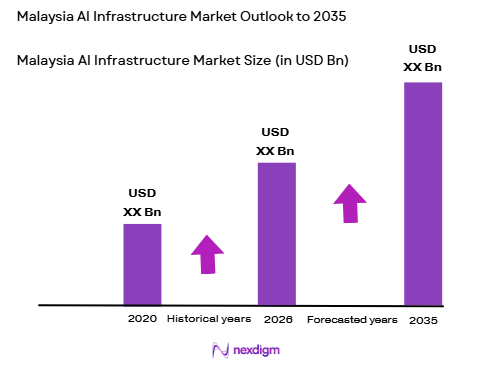
Malaysia’s AI infrastructure market reached approximately USD ~ billion based on a recent historical assessment, driven by accelerated hyperscale data center development, enterprise AI adoption, and national digitalization programs. Government-backed initiatives such as the Malaysia Digital Economy Blueprint and large-scale cloud region investments by global technology firms have expanded high-performance computing capacity and interconnection networks. Enterprise spending on AI servers, storage systems, and advanced networking hardware has also risen across manufacturing, finance, and public-sector analytics workloads.
Kuala Lumpur and Johor have emerged as dominant AI infrastructure hubs due to proximity to subsea cable landings, power availability, and established data center clusters, while Penang benefits from semiconductor and electronics manufacturing ecosystems supporting AI hardware deployment. International cloud and colocation providers have concentrated facilities in these regions to serve regional digital services demand and cross-border data flows. Strong industrial digitalization in these states further reinforces concentrated infrastructure deployment and ecosystem maturity.
Market Segmentation
By Product Type
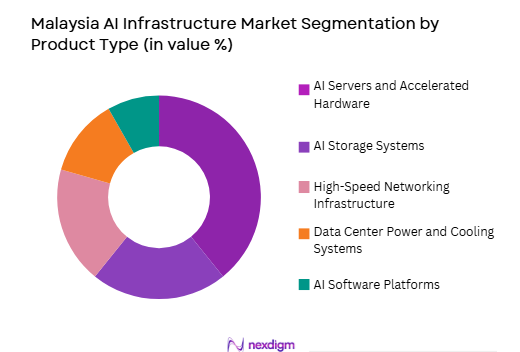
Malaysia AI infrastructure market is segmented by product type into AI servers and accelerated hardware, AI storage systems, high-speed networking infrastructure, data center power and cooling systems, and AI software platforms. Recently, AI servers and accelerated hardware has a dominant market share due to factors such as rapid hyperscale deployments, enterprise model training demand, and strong presence of global GPU and server vendors establishing regional infrastructure capacity to support large-scale artificial intelligence workloads across industries.
By Deployment Environment
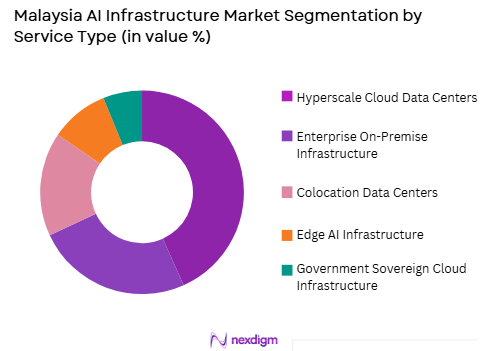
Malaysia AI infrastructure market is segmented by deployment environment into hyperscale cloud data centers, enterprise on-premise infrastructure, colocation data centers, edge AI infrastructure, and government sovereign cloud infrastructure. Recently, hyperscale cloud data centers has a dominant market share due to factors such as regional cloud region investments, demand for scalable AI compute capacity, and concentration of multinational technology providers expanding Southeast Asian service coverage through Malaysia-based facilities.
Competitive Landscape
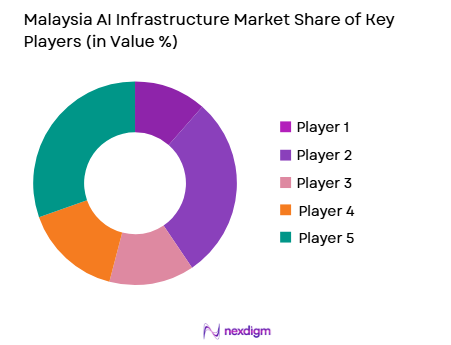
Malaysia’s AI infrastructure market shows moderate consolidation with global hyperscale cloud providers, semiconductor vendors, and data center operators dominating large-scale deployments, while regional integrators and telecom operators compete in enterprise and edge infrastructure segments. Strategic partnerships between GPU manufacturers, server OEMs, and colocation firms influence procurement cycles and technology adoption. Entry barriers remain high due to capital intensity and power infrastructure requirements, reinforcing leadership positions of multinational technology firms with established regional presence.
| Company Name | Establishment Year | Headquarters | Technology Focus | Market Reach | Key Products | Revenue | Data Center Capacity in Malaysia |
| NVIDIA Corporation | 1993 | USA | ~ | ~ | ~ | ~ | ~ |
| Intel Corporation | 1968 | USA | ~ | ~ | ~ | ~ | ~ |
| Dell Technologies | 1984 | USA | ~ | ~ | ~ | ~ | ~ |
| Equinix Inc. | 1998 | USA | ~ | ~ | ~ | ~ | ~ |
| Microsoft Corporation | 1975 | USA | ~ | ~ | ~ | ~ | ~ |
Malaysia AI Infrastructure Market Analysis
Growth Drivers
National Digital Economy and Hyperscale Data Center Expansion
Malaysia’s AI infrastructure market growth is strongly driven by national digitalization policies and large-scale hyperscale data center investments that expand computing capacity, interconnection bandwidth, and enterprise AI adoption across industries. Government programs promoting cloud-first public services and digital industrial transformation have accelerated procurement of AI servers, high-performance storage, and advanced networking equipment across ministries and state agencies. Simultaneously, multinational cloud providers have selected Malaysia as a regional hub due to favorable power availability, land costs, and connectivity to Southeast Asian markets, leading to construction of hyperscale facilities equipped with high-density GPU clusters. These deployments require substantial investments in cooling systems, energy distribution, and optical networking infrastructure, stimulating local supply chains and integrator ecosystems. Enterprise demand has also increased as financial institutions, manufacturers, and logistics companies deploy AI analytics platforms requiring scalable compute and storage backends. The concentration of semiconductor manufacturing and electronics assembly in Penang supports regional hardware supply and integration capability for AI infrastructure components.
Enterprise AI Adoption Across Manufacturing, Finance, and Public Services
Rapid integration of artificial intelligence across Malaysia’s core economic sectors is significantly accelerating infrastructure investment requirements for compute, storage, and networking platforms capable of supporting advanced analytics and automation workloads. Manufacturing companies are deploying machine vision, predictive maintenance, and digital twin systems that rely on GPU-accelerated processing clusters and high-speed data pipelines to handle sensor-generated industrial data streams. Financial institutions are expanding AI-driven fraud detection, credit risk modeling, and customer analytics platforms that require secure, low-latency data processing environments and scalable storage architectures within domestic data centers. Public sector agencies are implementing national AI platforms for smart city management, healthcare analytics, and digital governance, driving procurement of sovereign cloud infrastructure and high-performance computing nodes. These deployments necessitate enterprise-grade AI servers, software frameworks, and network fabrics optimized for distributed model training and inference across multiple operational sites.
Market Challenges
Power Availability Constraints and Data Center Energy Intensity
Malaysia’s AI infrastructure expansion faces significant challenges associated with high electricity demand and energy intensity of hyperscale data centers and GPU-accelerated computing environments required for artificial intelligence workloads. AI training clusters consume substantially more power per rack than conventional IT equipment, increasing strain on regional grid capacity and necessitating costly upgrades in transmission infrastructure and substation development. Concentrated data center growth in Kuala Lumpur and Johor has intensified competition for industrial power connections, delaying project timelines and increasing capital expenditure for energy provisioning. Cooling requirements for high-density AI servers further elevate electricity consumption and water usage, creating environmental and sustainability concerns that influence permitting processes and regulatory oversight. Renewable energy sourcing remains limited relative to rapidly rising data center demand, constraining operators seeking to meet corporate decarbonization commitments and environmental standards. Utility pricing structures and long-term power purchase agreements also affect operational cost predictability for AI infrastructure investors, complicating financial planning for hyperscale expansions. Grid reliability considerations are critical because AI data centers require uninterrupted power to prevent computational disruptions and hardware damage, necessitating redundant energy systems and backup generation capacity.
Skilled Workforce Shortage in AI Infrastructure Engineering and Operations
The development and operation of advanced AI infrastructure in Malaysia are constrained by a limited pool of specialized professionals capable of designing, deploying, and maintaining high-performance computing systems and hyperscale data center environments. AI infrastructure requires expertise in GPU cluster architecture, parallel computing frameworks, data center power engineering, and thermal management, disciplines that remain scarce within the domestic labor market. Rapid expansion of cloud regions and colocation facilities has intensified competition for experienced engineers, increasing recruitment costs and project staffing risks for operators and technology vendors. Dependence on expatriate specialists for complex infrastructure integration elevates operational expenses and introduces regulatory considerations related to foreign workforce policies. Educational institutions are expanding digital and engineering programs, yet industry demand for AI infrastructure skills is growing faster than graduate supply, prolonging talent shortages.
Opportunities
Regional AI Cloud Hub Positioning Within Southeast Asia
Malaysia has a significant opportunity to position itself as a regional artificial intelligence cloud and data center hub serving Southeast Asian digital economies through strategic geographic, economic, and connectivity advantages. Its central location and strong subsea cable connectivity enable low-latency data exchange with major regional markets, supporting cross-border AI services and distributed computing architectures. Competitive land and energy costs relative to neighboring advanced economies provide favorable conditions for hyperscale infrastructure investment and long-term expansion planning. Government digital economy initiatives and investment incentives encourage multinational cloud providers to establish regional AI platforms within Malaysia, strengthening ecosystem scale and vendor presence. Demand for localized data processing driven by regulatory and sovereignty considerations across Southeast Asia increases reliance on proximate infrastructure hubs capable of hosting AI workloads securely. Malaysia’s mature electronics and semiconductor manufacturing base further supports supply chain availability for AI hardware components and system integration services.
Adoption of Edge AI Infrastructure for Industrial and Smart City Applications
Increasing deployment of edge artificial intelligence systems across industrial automation, transportation, and urban management environments presents a major growth opportunity for Malaysia’s AI infrastructure ecosystem beyond centralized data centers. Manufacturing plants, logistics hubs, and urban surveillance networks require localized AI processing to enable real-time analytics, low-latency decision making, and autonomous operational control, driving demand for distributed compute nodes and edge servers. Smart city initiatives involving traffic management, public safety monitoring, and environmental sensing rely on AI inference at the network edge, expanding infrastructure requirements across municipalities. Telecommunications operators deploying 5G networks are integrating edge computing platforms to support AI-enabled services such as predictive maintenance and intelligent mobility systems. These distributed deployments require ruggedized AI hardware, compact storage solutions, and resilient networking architectures optimized for decentralized environments.
Future Outlook
Malaysia’s AI infrastructure market is expected to expand steadily as hyperscale data center construction, enterprise AI deployment, and regional cloud hub positioning accelerate infrastructure investment. Continued digital economy policies, connectivity upgrades, and semiconductor ecosystem strengths will support sustained computing capacity growth. Expansion of edge AI and sovereign cloud initiatives will diversify deployment models. Power infrastructure modernization and workforce development will influence scalability and competitiveness across the ecosystem.
Major Players
- NVIDIA Corporation
- Intel Corporation
- Dell Technologies
- Hewlett Packard Enterprise
- Microsoft Corporation
- Amazon Web Services
- Google LLC
- Equinix Inc.
- Digital Realty
- Telekom Malaysia
- Maxis Berhad
- Huawei Technologies
- Lenovo Group
- Supermicro
- Oracle Corporation
Key Target Audience
- Hyperscale cloud service providers
- Data center developers and operators
- Telecommunications companies
- Semiconductor and AI hardware manufacturers
- Enterprise IT infrastructure buyers
- Investments and venture capitalist firms
- Government and regulatory bodies
- Industrial automation and smart city solution providers
Research Methodology
Step 1: Identification of Key Variables
Key variables such as AI server deployment capacity, hyperscale data center investments, enterprise AI adoption rates, and national digital policy initiatives were identified. Infrastructure components including compute, storage, networking, and power systems were mapped across deployment environments. Regional investment flows and sectoral demand drivers were also defined.
Step 2: Market Analysis and Construction
Primary and secondary data sources were synthesized to construct Malaysia’s AI infrastructure market model. Industry investment announcements, vendor revenues, and infrastructure capacity metrics were analyzed to estimate market size and segmentation shares. Regional deployment patterns and technology adoption trends were incorporated into the framework.
Step 3: Hypothesis Validation and Expert Consultation
Market assumptions and structural drivers were validated through expert consultation with data center operators, AI hardware vendors, and telecom infrastructure specialists. Technical feasibility, deployment costs, and adoption trajectories were assessed. Feedback refined segmentation structure and growth dynamics interpretation.
Step 4: Research Synthesis and Final Output
Validated datasets and qualitative insights were synthesized into a structured market report. Competitive landscape mapping, driver analysis, and opportunity assessment were integrated with segmentation outputs. Final outputs were reviewed for consistency, logical coherence, and alignment with Malaysia’s digital infrastructure development context.

- Executive Summary
- Research Methodology (Definitions, Scope, Industry Assumptions, Market Sizing Approach, Primary & Secondary Research Framework, Data Collection & Verification Protocol, Analytic Models & Forecast Methodology, Limitations & Research Validity Checks)

- Market Definition and Scope
- Value Chain & Stakeholder Ecosystem
- Regulatory / Certification Landscape
- Sector Dynamics Affecting Demand
- Strategic Initiatives & Infrastructure Growth

- Growth Drivers
National AI roadmap and digital economy investments
Expansion of hyperscale and colocation data centers
Enterprise AI adoption across finance and manufacturing - Market Challenges
Power availability and sustainability constraints for data centers
High capital intensity of accelerated computing infrastructure
Skills gaps in AI infrastructure deployment and operations - Market Opportunities
Regional AI hub positioning leveraging ASEAN connectivity
Edge AI infrastructure for 5G and smart city applications
Public sector AI infrastructure modernization programs - Trends
Adoption of GPU dense and liquid cooled AI servers
Growth of sovereign and compliant cloud AI platforms
Integration of AI workloads into telecom edge networks - Government regulations
National AI and digital infrastructure policies
Data sovereignty and cross border data flow regulations
Green data center and energy efficiency standards - SWOT analysis
- Porters five forces

- By Market Value, 2020-2025
- By Installed Units, 2020-2025
- By Average System Price, 2020-2025
- By System Complexity Tier, 2020-2025

- By System Type (In Value%)
AI Compute Servers and Accelerated Hardware
AI Storage and Data Management Systems
AI Networking and Interconnect Infrastructure
AI Software Platforms and Middleware
Edge AI Infrastructure Systems - By Platform Type (In Value%)
Hyperscale Cloud Data Centers
Enterprise Private Data Centers
Telecom Edge Facilities
Colocation AI Data Centers
Hybrid Multi-cloud Platforms - By Fitment Type (In Value%)
Greenfield AI Data Center Deployments
Brownfield Data Center Upgrades
Modular AI Infrastructure Units
On-premise Enterprise Installations
Edge Site Installations - By End User Segment (In Value%)
Telecommunications and Digital Service Providers
Financial Services and Fintech Firms
Government and Smart City Agencies
Manufacturing and Industrial Enterprises
Healthcare and Research Institutions - By Procurement Channel (In Value%)
Direct OEM Procurement
System Integrator Contracts
Cloud Service Provider Bundles
Telecom Operator Procurement
Government Tenders and Frameworks

- Market Share Analysis
- Cross Comparison Parameters (Compute Performance Density, Data Center Scale, Energy Efficiency, AI Software Integration, Deployment Model, Network Latency Optimization, Cooling Technology, Scalability Architecture, Sovereign Compliance Capability, Edge Integration Readiness)
- SWOT Analysis of Key Competitors
- Pricing & Procurement Analysis
- Key Players
Telekom Malaysia
Maxis Business
YTL Communications
Huawei Technologies Malaysia
Dell Technologies
Hewlett Packard Enterprise
IBM
Oracle
Microsoft
Amazon Web Services
Google Cloud
NVIDIA
Cisco Systems
Schneider Electric
Equinix

- Telecom operators investing in edge AI and 5G integrated infrastructure
- Banks deploying AI platforms for analytics, risk, and digital services
- Government agencies building sovereign AI compute capacity
- Manufacturers adopting AI infrastructure for automation and vision systems

- Forecast Market Value, 2026-2035
- Forecast Installed Units, 2026-2035
- Price Forecast by System Tier, 2026-2035
- Future Demand by Platform, 2026-2035


 Request a Sample
 Ask for Customization
 Get a Quote
 Enquire Now