
 Download PDF
Market Overview
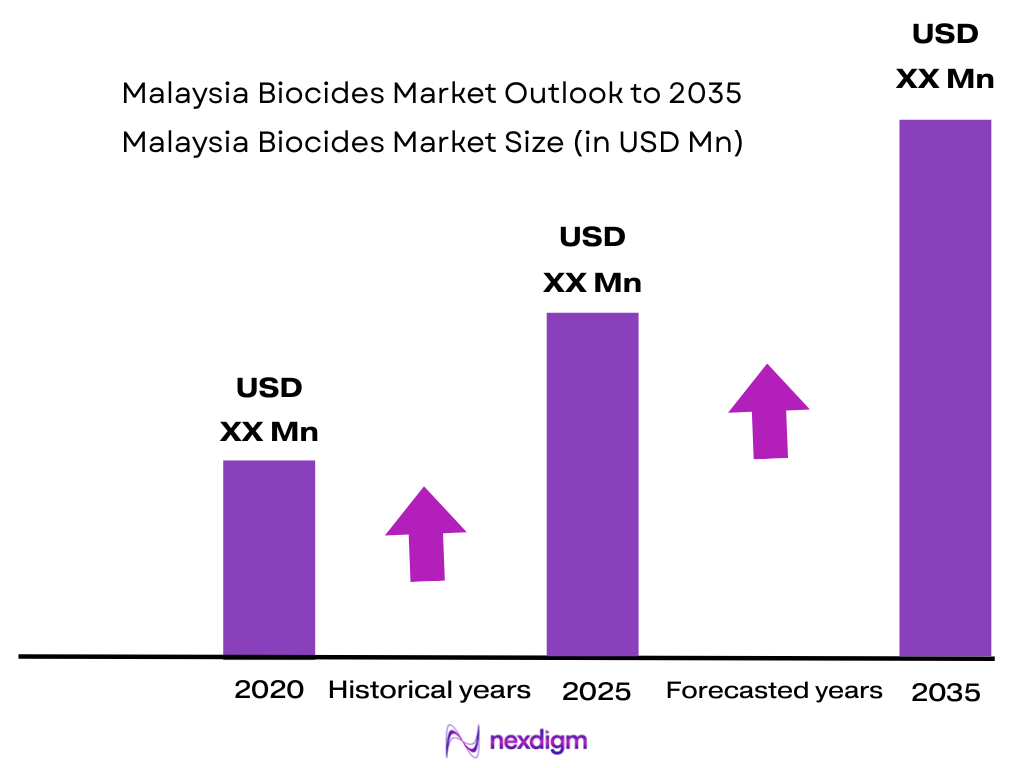
The Malaysia Biocides Market is valued at ~USD XX million in 2024, with demand linked to water treatment, industrial cooling, food processing, palm-oil processing, pharmaceuticals, paints and coatings, aquaculture and manufacturing. Malaysia’s GDP reached USD 422.23 billion in 2024, compared with USD 399.95 billion in 2023, while real GDP growth accelerated to 5.1 from 3.5. Manufacturing expanded 4.2 after 0.7 in 2023, while petroleum, chemical, rubber and plastic products increased 3.2. These industrial activities create recurring microbial-control requirements.
The Malaysia Biocides Market is concentrated around Selangor, Kuala Lumpur, Johor and Pulau Pinang, reflecting their dense manufacturing, commercial, pharmaceutical, electronics, logistics and water-intensive industrial ecosystems. Selangor generated RM432.9 billion of GDP, Kuala Lumpur RM251.9 billion, Johor RM158.0 billion and Pulau Pinang RM121.4 billion in 2024. Selangor, Kuala Lumpur and Johor also attracted RM101.1 billion, RM91.5 billion and RM48.5 billion respectively in approved investments, reinforcing their importance as industrial and commercial demand centers.
Market Segmentation
By Product Type
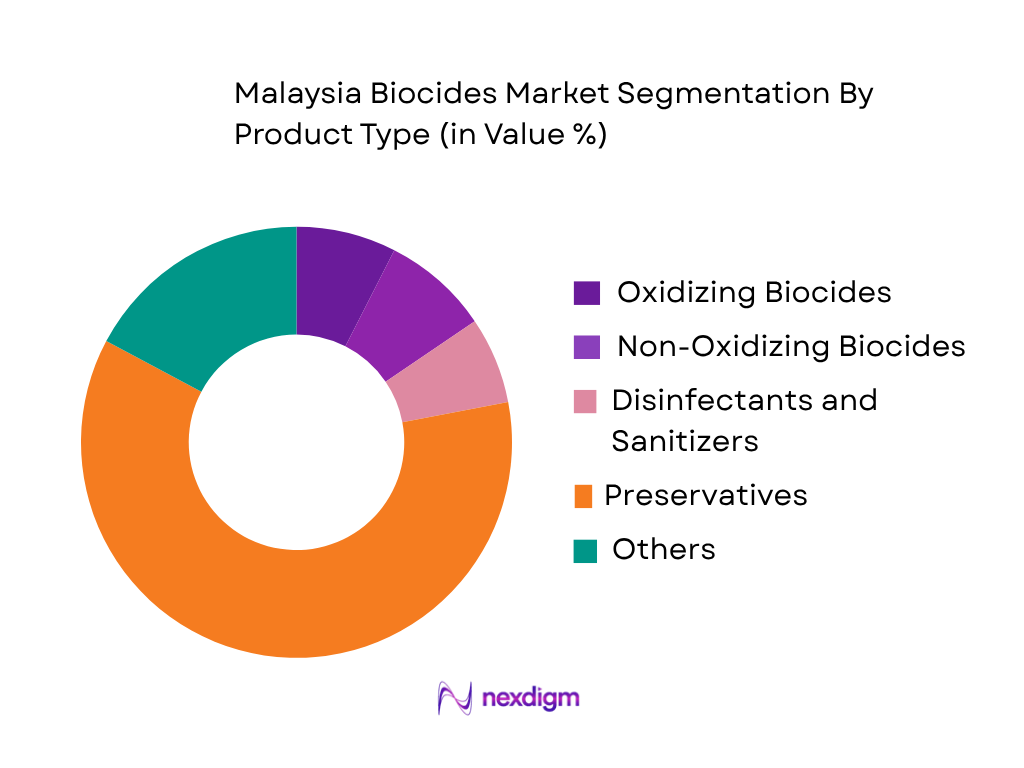
The Malaysia Biocides Market is segmented by product type into oxidizing biocides, non-oxidizing biocides, disinfectants and sanitizers, preservatives, antimicrobial additives, algaecides, fungicides, biofilm-control agents and other specialty biocides. Preservatives are positioned as the dominant sub-segment because Malaysia has broad downstream manufacturing activity involving paints and coatings, personal care, food ingredients, industrial formulations and consumer products where microbial spoilage can affect product stability. The country’s manufacturing sector expanded 4.2 in 2024, while food processing grew 4.7, supporting recurring preservation requirements. Petroleum, chemical, rubber and plastic products also increased 3.2, reinforcing the industrial formulation base.
By Application
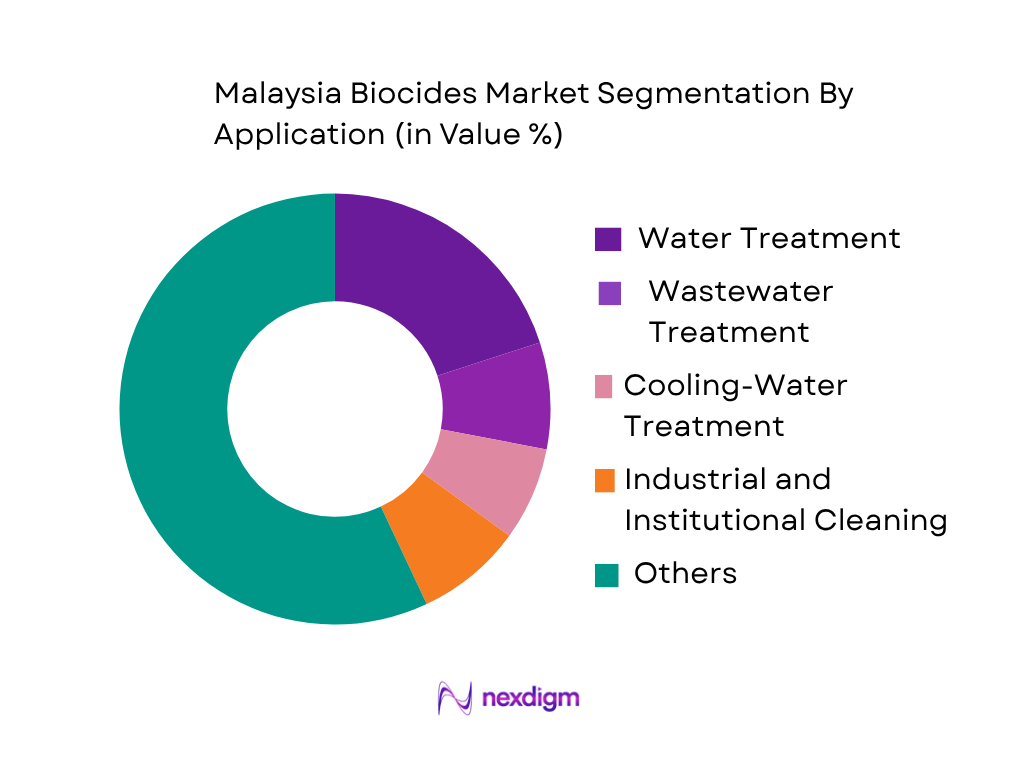
The Malaysia Biocides Market is segmented by application into water treatment, wastewater treatment, cooling-water treatment, industrial and institutional cleaning, food and beverage processing, paints and coatings, personal care and cosmetics, pulp and paper, textiles, oil and gas and petrochemicals, agriculture, aquaculture, marine and healthcare applications. Water treatment represents the leading application because microbial control is integral to municipal, industrial and process-water systems, cooling operations and wastewater management. Malaysia’s water, sewerage and waste-management activity forms part of the service economy, while manufacturing represented 23.1 of national GDP in 2024. Industrial expansion therefore creates recurring demand for microbial management in process and wastewater systems.
Competitive Landscape
The Malaysia Biocides Market is characterized by international specialty-chemical manufacturers, water-treatment companies and microbial-control specialists serving industrial and institutional customers through direct sales, technical-service organizations and chemical distributors. Competition is differentiated by active-substance breadth, formulation expertise, regulatory support, water-treatment capability and access to Malaysia’s manufacturing clusters. The country’s RM378.5 billion in approved investments across 6,700 projects in 2024 further strengthens the underlying industrial customer base.
| Major Player | Establishment Year | Headquarters | Active-Substance Portfolio | Water-Treatment Capability | Industrial Biocide Applications | Regulatory & Technical Support | Malaysia Distribution Reach |
| LANXESS | 2004 | Cologne, Germany | ~ | ~ | ~ | ~ | ~ |
| BASF | 1865 | Ludwigshafen, Germany | ~ | ~ | ~ | ~ | ~ |
| Ecolab | 1923 | St. Paul, USA | ~ | ~ | ~ | ~ | ~ |
| Arxada | 2021 | Basel, Switzerland | ~ | ~ | ~ | ~ | ~ |
| Nouryon | 2018 | Amsterdam, Netherlands | ~ | ~ | ~ | ~ | ~ |
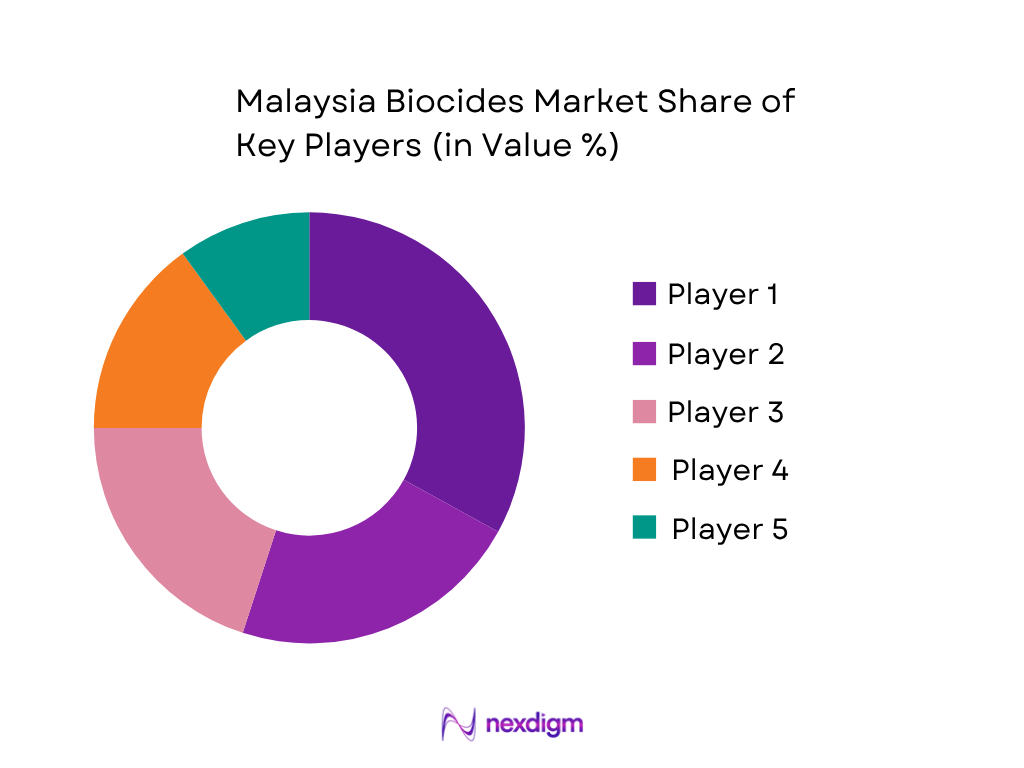
Malaysia Biocides Market Analysis
Growth Drivers
Water and Wastewater Treatment Expansion
Malaysia’s water-intensive economic structure is creating a broad operating base for biocides used in potable-water systems, industrial process water, cooling systems and wastewater treatment. The national water-production dataset maintained by the Department of Statistics Malaysia and the National Water Services Commission tracks production in million litres per day across Malaysia’s states, reflecting the scale of the managed-water infrastructure that requires microbial control. The wider economy also expanded to RM1.65 trillion in 2024, while the construction sector grew 17.5, creating additional requirements for water infrastructure and treatment systems. Manufacturing contributed 23.1 of national economic activity and grew 4.2, supported by electrical and electronic products, petroleum, chemicals, rubber and plastics. These industries generate recurring process-water and wastewater streams where microbial growth can impair equipment, membranes and treatment performance. Manufacturing fixed-asset acquisition also increased 11.8, with electrical, electronic and optical products increasing 15.6, indicating continued investment in facilities that require controlled water environments. The combination of expanding industrial capacity, water infrastructure and wastewater-management requirements therefore strengthens the addressable operating base for oxidizing biocides, non-oxidizing biocides, biofilm-control products and disinfectants across Malaysian industrial facilities.
Palm Oil Processing and Food Manufacturing
Malaysia’s large palm-oil and food-processing ecosystem provides a significant market-specific demand base for microbial-control chemicals across mills, refineries, processing lines, storage systems and associated wastewater facilities. The Department of Statistics Malaysia reported fresh fruit bunch production of 100,163.5 thousand tonnes in 2024, while palm oil generated RM38.1 billion of agricultural value added. Palm-oil output increased 5.1, following growth of 0.2 in the preceding period, reinforcing the scale of processing activity requiring sanitation, preservation and microbial management. Manufacturing activity was supported by food processing and vegetable and animal oils and fats, while fixed-asset acquisition in food, beverages and tobacco increased 10.1. Malaysia’s agricultural sector also expanded 3.1, with livestock growing 3.3 and fisheries 2.9. Aquaculture production reached 511.9 thousand metric tonnes, compared with 506.8 thousand tonnes previously, while freshwater aquaculture reached 119.5 thousand tonnes. These production volumes support recurring requirements for disinfectants, preservatives, fungicides and other microbial-control products in food plants, palm-oil processing environments and aquaculture facilities. The combination of agricultural throughput, food manufacturing investment and aquatic production therefore provides multiple industrial pathways for biocide consumption.
Market Challenges
Imported Specialty-Active Dependency
Malaysia’s advanced manufacturing base increases the need for specialized chemical inputs while simultaneously exposing biocide users and formulators to international specialty-chemical supply conditions. Manufacturing contributed 23.1 of national economic activity in 2024 and grew 4.2, with electrical, electronic and optical products increasing 4.1 and petroleum, chemical, rubber and plastic products increasing 3.2. Manufacturing fixed-asset acquisition increased 11.8, while investment in electrical, electronic and optical products and transport equipment increased 15.6. This expanding industrial base requires increasingly application-specific microbial-control chemistry for semiconductor facilities, electronics manufacturing, cooling systems, coatings, process water and industrial sanitation. At the same time, Malaysia’s chemical-product producer-price index declined 0.8 in 2024 after declining 3.3 previously, while coke and refined petroleum products declined 12.7. Such movements demonstrate that chemical supply conditions can vary materially across product groups. For biocide formulators and industrial users, dependence on imported active ingredients and specialized intermediates can therefore create procurement complexity, qualification requirements and supply-continuity risks. The challenge is particularly relevant for applications requiring narrowly defined active-substance specifications, membrane compatibility, low-residual chemistry or specialized biofilm-control performance.
Environmental Discharge Controls and Aquatic Toxicity
Environmental management presents a material challenge because Malaysia’s biocide demand spans water treatment, wastewater, aquaculture, palm-oil processing and industrial discharge systems where active substances can ultimately interact with aquatic environments. Aquaculture production reached 511.9 thousand metric tonnes in 2024, including 392.4 thousand tonnes of brackishwater production and 119.5 thousand tonnes of freshwater production. Marine fish landings also increased 9.6, while freshwater aquaculture production increased 5.7, highlighting the importance of aquatic production systems where microbial-control products must balance efficacy with environmental compatibility. Malaysia’s mining and quarrying sector grew 0.9, natural-gas activity increased 3.0 and construction expanded 17.5, adding further industrial sites generating treated wastewater and discharge streams. Biocide selection consequently has to consider residual concentrations, aquatic toxicity, degradation characteristics and compatibility with downstream biological wastewater treatment. Resistance management adds another operational constraint because repeated exposure to the same active chemistry can reduce microbial-control effectiveness and encourage switching between oxidizing and non-oxidizing technologies. These requirements increase formulation, monitoring and treatment-management complexity for suppliers serving Malaysia’s water-intensive industrial and agricultural ecosystems.
Market Opportunities
Advanced Water-Treatment Biocides
Malaysia’s continuing investment in industrial production and water infrastructure creates an opportunity for higher-performance biocides designed specifically for membranes, cooling systems, process water and wastewater reuse. Manufacturing accounted for 23.1 of national economic activity in 2024 and expanded 4.2, while manufacturing fixed-asset acquisition increased 11.8. Electrical, electronic and optical products recorded a 4.1 increase, and investment in that product group and transport equipment increased 15.6. These figures indicate an expanding installed base of sophisticated industrial facilities where microbial fouling can affect water systems, equipment reliability and production continuity. Malaysia’s national water dataset tracks water production in million litres per day across 16 states, providing evidence of a substantial managed-water infrastructure. The opportunity therefore extends beyond conventional disinfection toward membrane-compatible preservatives, biofilm-control agents, low-residual formulations and targeted non-oxidizing chemistries. Such products can address specific microbial-control requirements in industrial water circuits while reducing unnecessary chemical loading. The opportunity is further reinforced by construction activity, which expanded 17.5 and supported continued development of industrial and commercial facilities. Suppliers capable of combining microbial efficacy with membrane compatibility, wastewater-treatment compatibility and environmental performance can therefore address a broader range of Malaysian industrial water applications.
Palm-Oil Mill Biocide Applications and Aquaculture Microbial Control
Malaysia’s agricultural and aquatic production base creates opportunities for specialized biocides addressing microbial growth in palm-oil mills, processing-water systems, ponds, hatcheries and associated sanitation environments. Fresh fruit bunch production reached 100,163.5 thousand tonnes in 2024, while palm oil generated RM38.1 billion in agricultural value added. Palm-oil output increased 5.1, supporting continued throughput through mills and downstream processing facilities. Aquaculture production reached 511.9 thousand metric tonnes, including 392.4 thousand tonnes from brackishwater systems and 119.5 thousand tonnes from freshwater systems. Freshwater aquaculture increased 5.7, while marine fish landings increased 9.6. These volumes create application opportunities for biofilm-control products, disinfectants, algaecides and targeted microbial-control chemistry where water quality and hygiene directly influence production environments. Food, beverage and tobacco manufacturing investment also increased 10.1, reinforcing the need for sanitation and microbial management across processing facilities. The opportunity is therefore not limited to conventional industrial water treatment: suppliers can develop application-specific formulations for palm-oil processing, food sanitation and aquaculture while emphasizing controlled residuals and compatibility with biological treatment systems. Local formulation and regional distribution can further improve responsiveness across these geographically dispersed end-use sectors.
Future Outlook
The Malaysia Biocides Market is expected to expand as industrial water management, manufacturing, food processing, pharmaceutical production and advanced electronics continue to require reliable microbial-control solutions. Manufacturing grew 4.2 in 2024, while electrical, electronic and optical products recovered 4.1 after contracting 1.6 in 2023. Malaysia also recorded RM378.5 billion in approved investments and more than 207,000 jobs from approved projects, supporting additional industrial infrastructure and future demand for specialized microbial-control chemistry. Key future opportunities include advanced membrane protection, cooling-tower treatment, wastewater reuse, biofilm-specific technologies, low-residual chemistry, aquaculture applications, palm-oil processing and electronics manufacturing. Malaysia’s semiconductor ecosystem is particularly relevant: the country’s E&E industry attracted RM85.4 billion in approved investments in 2023, while Malaysia accounted for 13 of global chip assembly, testing and packaging activities according to MIDA.
Major Players
- LANXESS
- BASF
- Ecolab
- Arxada
- Nouryon
- Clariant
- Evonik Industries
- Solenis
- Kemira
- Buckman
- Thor Group
- Italmatch Chemicals
- Dow
- Henkel
- Lonza
Key Target Audience
- Biocide manufacturers and active-substance producers
- Water-treatment chemical manufacturers and industrial water-service providers
- Paints, coatings, polymers and specialty-formulation manufacturers
- Food, beverage, pharmaceutical and personal-care manufacturers
- Palm-oil processors, aquaculture operators and agricultural producers
- Investments and venture capitalist firms
- Government and regulatory bodies (Department of Environment Malaysia, Ministry of Health Malaysia, Department of Occupational Safety and Health, Ministry of Agriculture and Food Security)
- Industrial chemical distributors and specialty-chemical procurement organizations
Research Methodology
Step 1: Identification of Key Variables
The initial phase involves mapping Malaysia’s complete biocides ecosystem across active-substance producers, formulators, importers, distributors and downstream users. Variables include product type, active substance, formulation, application, end-use industry, domestic production, imports, exports and regulatory status. Particular attention is given to water treatment, palm-oil processing, food manufacturing, electronics and industrial cooling.
Step 2: Market Analysis and Construction
Historical market information is compiled using official Malaysian economic and industrial datasets alongside customs, company disclosures and regulatory information. Demand indicators include manufacturing output, food processing, industrial investment, water-management activity, pharmaceutical production and electronics manufacturing. The resulting database is structured by product type, application, end-use industry and customer group.
Step 3: Hypothesis Validation and Expert Consultation
Market hypotheses are validated through discussions with manufacturers, distributors, water-treatment specialists, formulation companies and major industrial consumers. Interviews focus on active-substance selection, microbial-control requirements, purchasing behavior, regulatory constraints, formulation trends and supply-chain exposure. Technical feedback is used to reconcile bottom-up consumption estimates with industry-level indicators.
Step 4: Research Synthesis and Final Output
The final stage integrates primary research, official statistics, company information, trade data and regulatory evidence into a single market model. Bottom-up estimates are cross-checked against manufacturing activity, industrial investment and end-use demand indicators. Segment-level findings are then synthesized into the Malaysia Biocides Market forecast and competitive assessment.

- Executive Summary
- Research Methodology (Market Definition and Scope, Biocide Product-Type Mapping, Active-Substance Classification, Market Sizing Framework, Top-Down Analysis, Bottom-Up Analysis, Demand-Side Assessment, Supply-Side Assessment, Import-Export Validation, Primary Research, Regulatory Database Assessment, Industry Interviews, Data Triangulation, Forecasting Framework, Scenario Analysis, Assumptions and Limitations)

- Definition and Scope
- Malaysia Biocides Industry Structure
- Biocidal Active-Substance Ecosystem
- Biocide Formulation and Blending Landscape
- Malaysia Microbial-Control Industry Evolution
- Malaysia Biocides Value Chain Analysis

- Market Growth Drivers (Water and Wastewater Treatment Expansion, Industrial Water Demand, Palm Oil Processing, Food and Beverage Manufacturing, Aquaculture Production, Pharmaceutical Manufacturing, Electronics and Semiconductor Manufacturing, Oil and Gas Activity)
- Market Challenges (Imported Specialty-Active Dependency, Chemical Registration Requirements, Environmental Discharge Controls, Aquatic Toxicity, Biocide Resistance, Hazardous Chemical Handling, Specialty-Chemical Supply-Chain Exposure, Product-Quality Variability)
- Market Opportunities (Advanced Water-Treatment Biocides, Wastewater-Reuse Applications, Cooling-Tower Microbial Control, Palm-Oil Mill Biocide Applications, Aquaculture Microbial Control, Food-Processing Sanitation, Low-Toxicity Formulations, Biofilm-Control Technologies, Local Formulation and Regional Distribution)
- Market Trends (Low-Residual Biocide Chemistry, Biofilm-Specific Treatment, Sustainable Active Substances, Automated Chemical Dosing, Industrial Water Recycling, Advanced Disinfection, Online Microbial Monitoring, Membrane Protection, Integrated Microbial Management, Treated-Article Compliance)
- SWOT Analysis
- Porter’s Five Forces Analysis
- PESTLE Analysis

- By Market Value (2020-2025)
- By Biocidal Active-Substance Consumption Volume (2020-2025)
- By Formulated Biocide Consumption Volume (2020-2025)
- By Domestic Production (2020-2025)
- By Imports and Exports (2020-2025)
- By Product Type (2020-2025)
- By Application (2020-2025)
- By End-Use Industry (2020-2025)

- By Product Type (In Value %)
Oxidizing Biocides
Non-Oxidizing Biocides
Disinfectants and Sanitizers
Preservatives
Antimicrobial Additives
Algaecides
Fungicides
Biofilm-Control Agents
Antifouling Biocides
Rodenticides
Insecticides and Acaricides
Other Specialty Biocides - By Active Substance (In Value %)
Chlorine-Based Biocides
Bromine-Based Biocides
Chlorine Dioxide
Hydrogen Peroxide
Peracetic Acid
Glutaraldehyde
Isothiazolinones
Quaternary Ammonium Compounds
DBNPA
Bronopol
Copper-Based Biocides
Phenolic Compounds
Organic Acid-Based Biocides
Other Active Substances - By Application (In Value %)
Water Treatment
Wastewater Treatment
Cooling-Water Treatment
Industrial and Institutional Cleaning
Food and Beverage Processing
Paints and Coatings
Personal Care and Cosmetics
Pulp and Paper - By End-Use Industry (In Value %)
Municipal Water and Wastewater
Industrial Water Treatment
Palm Oil Processing
Food and Beverage Manufacturing
Pharmaceutical Manufacturing
Agriculture and Animal Production
Aquaculture and Fisheries - By Formulation Type (In Value %)
Liquid Biocides
Powder and Granular Biocides
Concentrated Formulations
Ready-to-Use Disinfectants
Water-Soluble Formulations
Emulsion and Dispersion Formulations
Controlled-Release Formulations - By Functional Requirement (In Value %)
Bacterial Control
Fungal Control
Algae Control
Biofilm Control
Slime Control
Disinfection
Preservation
Biofouling Prevention
Membrane Protection

- Market Share of Major Players (By Value, Volume, Product Type, Active Substance, Application, End-Use Industry, Distribution Channel)
- Cross Comparison Parameters (Active-Substance Portfolio Breadth, Formulation Portfolio Breadth, Industrial Water-Treatment Capability, Palm-Oil Industry Capability, Food and Beverage Sanitation Capability, Pharmaceutical and Healthcare Capability, Regulatory and Technical-Service Expertise, Malaysia Manufacturing and Distribution Reach)
- SWOT Analysis of Major Players
- Detailed Profiles of Major Companies
LANXESS
BASF
Arxada
Ecolab
Nouryon
Clariant
Evonik Industries
Solenis
Kemira
Buckman
Thor Group
Italmatch Chemicals
Dow
Henkel
Lonza

- Industrial Water-Treatment Demand Assessment
- Palm-Oil Processing Customer Analysis
- Food and Beverage Customer Analysis
- Pharmaceutical and Life-Sciences Customer Analysis
- Electronics and Semiconductor Customer Analysis
- Paints and Coatings Customer Analysis
- Pulp and Paper Customer Analysis
- Textile and Rubber Customer Analysis

- By Market Value (2026-2035)
- By Biocidal Active-Substance Consumption Volume (2026-2035)
- By Formulated Biocide Consumption Volume (2026-2035)
- By Domestic Production (2026-2035)
- By Imports and Exports (2026-2035)
- By Product Type (2026-2035)
- By Application (2026-2035)
- By End-Use Industry (2026-2035)


 Request a Sample
 Ask for Customization
 Get a Quote
 Enquire Now