
 Download PDF
Market Overview
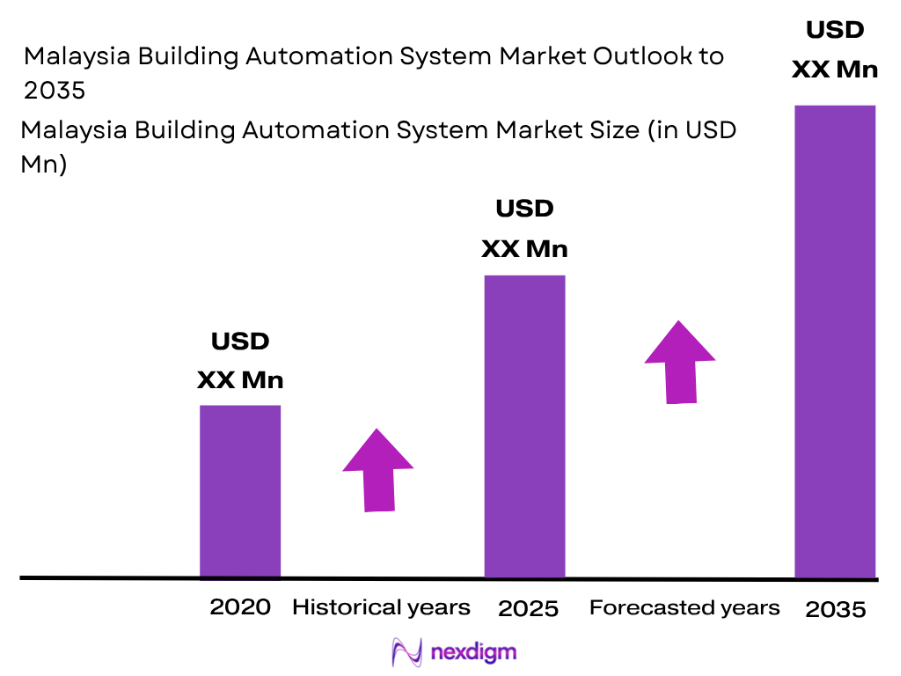
The Malaysia Building Automation System Market is estimated at ~USD ~ billion in 2024, with a forecast CAGR of ~% during 2026–2035. Demand is supported by the expansion of Malaysia’s construction and commercial-building base, rising investment in energy-efficient building systems, HVAC automation and digital facility management. The latest two-year construction data show work completed increasing from RM132.2 billion to RM158.8 billion, while the construction sector’s GDP growth accelerated from 6.0 to 17.5. Non-residential construction reached RM44.4 billion, creating a substantial addressable base for BMS, HVAC controls, lighting automation and energy-management systems.
The Malaysia Building Automation System Market is concentrated around Selangor, Kuala Lumpur, Johor and Penang, supported by dense commercial development, industrial facilities, data-centre investment, hospitality assets and modern mixed-use developments. Construction activity provides a clear indicator of this concentration: the latest quarterly data identified Selangor, Johor, Wilayah Persekutuan and Sarawak as accounting for nearly two-thirds of construction work completed. Selangor benefits from extensive commercial and industrial development, while Kuala Lumpur has a large concentration of offices, hotels, shopping centres and high-rise mixed-use properties requiring integrated HVAC, lighting, security and energy-management systems.
Market Segmentation
By System Component
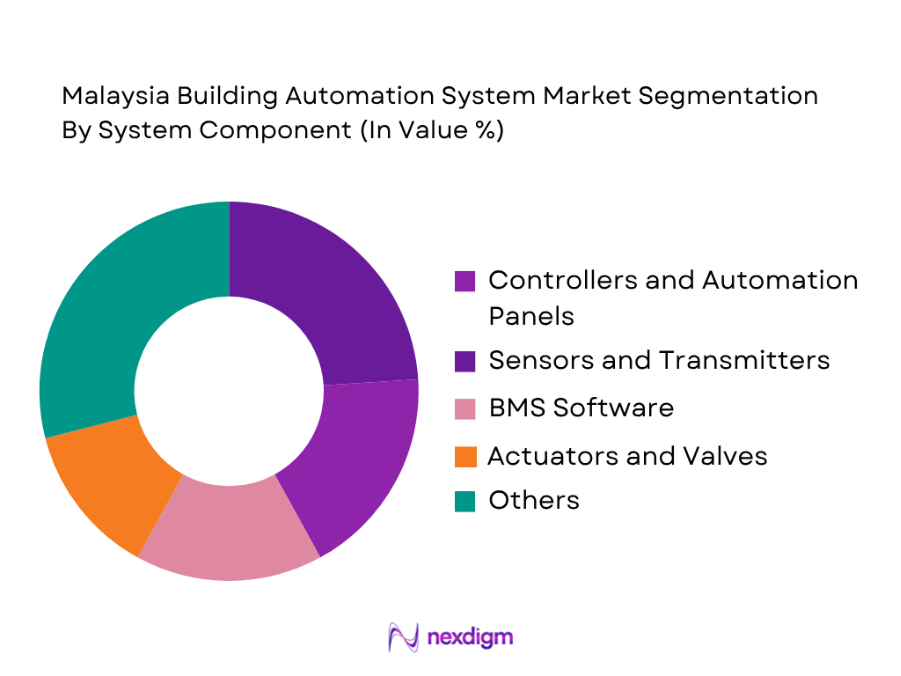
The Malaysia Building Automation System Market is segmented by system component into controllers and automation panels, sensors and transmitters, actuators and valves, room automation controllers, gateways and protocol converters, operator workstations, BMS software and energy-management software. Controllers and automation panels are expected to represent the dominant segment because they provide the central control layer connecting HVAC equipment, lighting, meters, sensors and other building systems. The growing complexity of commercial and industrial buildings increases the need for programmable controllers capable of managing multiple systems through open communication protocols. The development of Malaysia’s construction sector provides a broad installation base, with RM158.8 billion of construction work completed and RM44.4 billion attributable to non-residential buildings. Energy-management requirements further strengthen controller demand because automated control strategies depend on continuous data acquisition and command execution. The implementation of Malaysia’s Energy Efficiency and Conservation Act creates additional relevance for energy monitoring, management systems and building-level control infrastructure. As buildings become more connected, controllers are increasingly required to support BACnet, Modbus, KNX, DALI, IP networking and cloud connectivity.
By End-Use Building
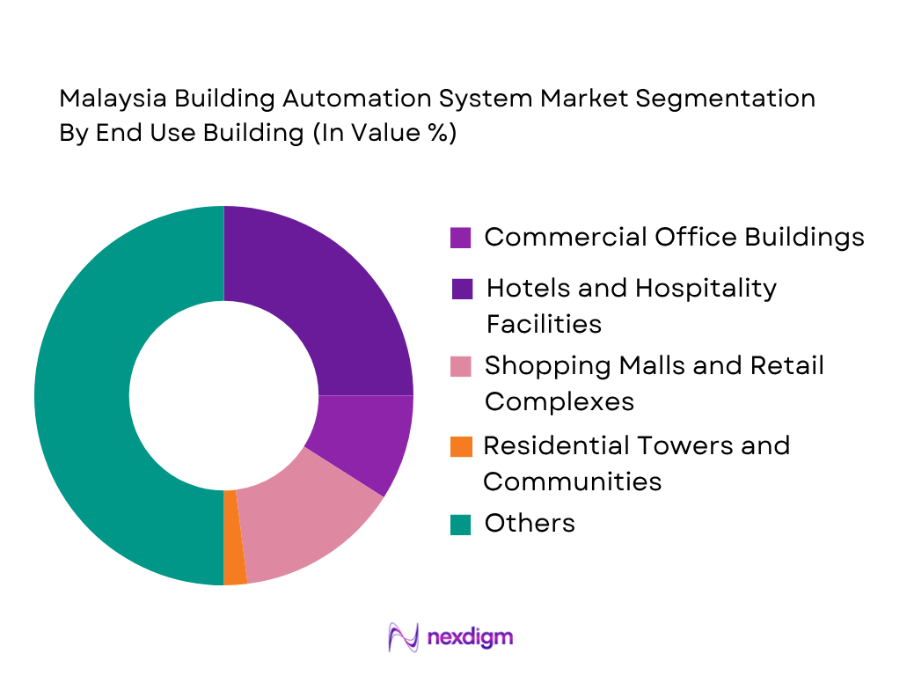
The Malaysia Building Automation System Market is segmented by end-use building into commercial offices, shopping malls and retail buildings, hotels and hospitality facilities, data centres, industrial facilities, healthcare facilities, educational buildings, government and civic buildings, airports and transportation facilities, and residential and mixed-use buildings. Commercial offices are expected to represent the leading sub-segment because large office buildings require centralized control of HVAC, lighting, access systems, energy meters and indoor environmental conditions. The segment also benefits from the concentration of modern office stock in Kuala Lumpur and Selangor. Malaysia’s non-residential construction activity reached RM44.4 billion, while the construction sector expanded 17.5. These conditions support continued deployment of integrated building controls in new developments and renovation projects.
Competitive Landscape
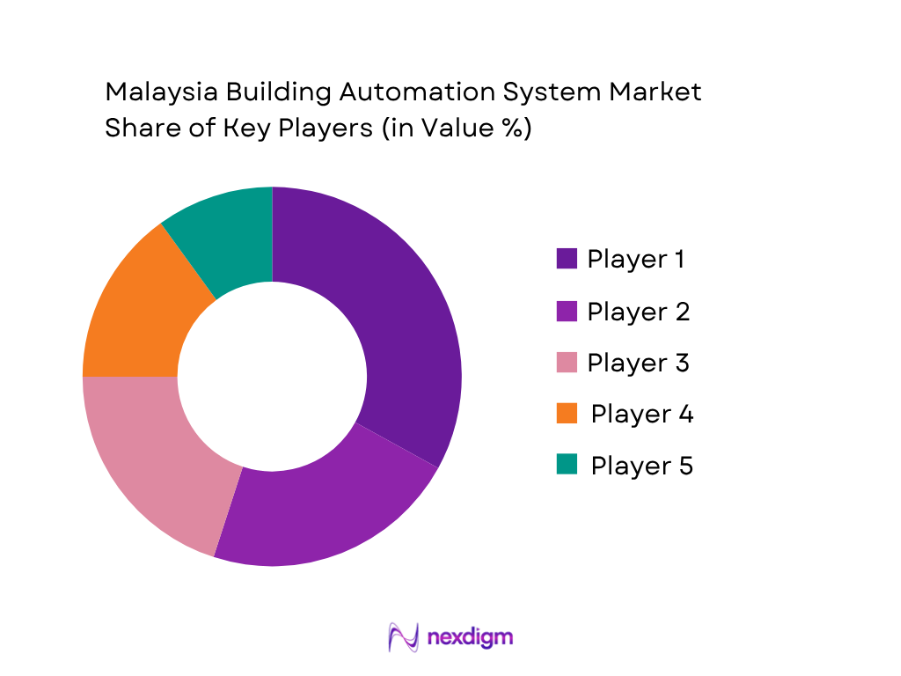
The Malaysia Building Automation System Market is characterized by global building-technology companies competing with specialized controls providers and system integrators. Major participants differentiate through BMS software, HVAC automation, energy management, open-protocol compatibility, cybersecurity, cloud platforms, analytics and local integration capabilities. Johnson Controls, Siemens, Schneider Electric, Honeywell and ABB maintain broad technology portfolios spanning building controls, HVAC, energy management and digital building platforms. Their competitive positioning is reinforced by extensive installed bases and integration capabilities across commercial, industrial, infrastructure and institutional facilities.
| Company | Established | Headquarters | BMS Capability | HVAC Automation | Energy Management | Open Protocols | Cloud / Digital Platform | Malaysia Presence |
| Johnson Controls | 1885 | Cork, Ireland | ~ | ~ | ~ | ~ | ~ | ~ |
| Siemens | 1847 | Munich, Germany | ~ | ~ | ~ | ~ | ~ | ~ |
| Schneider Electric | 1836 | Rueil-Malmaison, France | ~ | ~ | ~ | ~ | ~ | ~ |
| Honeywell | 1906 | Charlotte, USA | ~ | ~ | ~ | ~ | ~ | ~ |
| ABB | 1988 | Zurich, Switzerland | ~ | ~ | ~ | ~ | ~ | ~ |
Malaysia Building Automation System Market Analysis
Growth Drivers
Energy Efficiency & Conservation Requirements
Malaysia’s tightening energy-efficiency framework is strengthening the underlying requirement for automated building controls, particularly in large commercial, industrial and institutional facilities. The Energy Efficiency and Conservation Act 2024 (Act 861), administered by the Energy Commission, provides a formal national framework covering energy consumers, persons in charge of buildings, energy managers and energy auditors, with the framework taking effect on 1 January 2025. The Energy Commission has also issued 7 comprehensive guidelines and 3 detailed guides, including guidance covering Energy Management Systems and energy-efficiency reporting. This creates a stronger operational role for building automation systems because centralized monitoring, automated scheduling, HVAC optimization, sub-metering, equipment sequencing and fault detection can provide the control infrastructure required for systematic energy management. Malaysia’s economic expansion provides a large building base in which these technologies can be deployed. Department of Statistics Malaysia reported national GDP of RM1.65 trillion in 2024, compared with RM1.57 trillion in 2023, while the construction sector expanded 17.5 in 2024 compared with 6.0 in 2023. Construction work completed reached RM158.8 billion, including RM44.4 billion from non-residential buildings. Special trade activities, which include electrical installation and plumbing, heat and air-conditioning installation, reached RM17.5 billion. These figures directly support demand for automated HVAC controls, smart meters, sensors, controllers and integrated BMS platforms in new and renovated buildings.
Commercial & Digital Building Expansion
Expansion of commercial construction, industrial investment and digital infrastructure is creating a wider installed base for building automation systems across Malaysia. Department of Statistics Malaysia recorded RM158.8 billion of construction work completed in 2024, with RM44.4 billion associated with non-residential buildings and RM61.1 billion with civil engineering. The non-residential building segment increased 15.5, while the construction sector overall expanded 17.5. The investment environment is also supporting technology-intensive facilities. The Malaysian Investment Development Authority reported RM378.5 billion in approved investments during 2024, including RM252.7 billion in services and RM120.5 billion in manufacturing. The information and communication subsector attracted RM136.0 billion, reflecting substantial investment in digital infrastructure and technology-intensive operations. Data-centre development is particularly relevant to building automation because these facilities require continuous cooling, environmental monitoring, electrical supervision, equipment sequencing and highly reliable facility-management systems. MIDA reported RM24.1 billion of digital infrastructure investments in 2024, covering data centres, cloud computing and data-hosting projects, within RM113.8 billion accumulated during 2021–2024. Malaysia also recorded RM141.72 billion in digital investments during the first ten months of 2024. These investments support demand for advanced HVAC automation, energy monitoring, predictive maintenance, power-management interfaces, environmental sensors and centralized facility-control platforms. The concentration of development in Selangor, Johor and Kuala Lumpur further strengthens deployment potential because these areas combine commercial buildings, industrial facilities, data centres and mixed-use developments.
Market Challenges
Integration & Legacy-System Complexity
Integration complexity remains a significant constraint for the Malaysia Building Automation System Market because building portfolios frequently contain HVAC, electrical, lighting, access-control, fire-safety and metering equipment installed at different stages and using different control architectures. Department of Statistics Malaysia recorded RM158.8 billion in construction work completed during 2024, demonstrating the scale of new assets entering the built environment, while the existing stock continues to require modernization rather than complete replacement. The challenge is particularly relevant to retrofit projects where a building owner must integrate existing chillers, air-handling units, variable-air-volume systems, pumps, sensors, meters and lighting controllers with a new BMS without disrupting building operations. Malaysia’s construction statistics recorded RM17.5 billion of special trade activities in 2024, including RM1.1 billion of electrical installation and RM1.0 billion of plumbing, heat and air-conditioning installation in the fourth quarter alone. These figures demonstrate the breadth of building-services infrastructure that may need to be coordinated during construction and modernization. The Energy Commission’s 2024 regulatory framework also creates formal responsibilities for energy consumers, building personnel and energy managers, increasing the importance of reliable energy data and system integration. Proprietary communication architectures can make this difficult where legacy equipment cannot communicate directly with modern BACnet, Modbus, KNX or IP-based platforms. Consequently, system integrators increasingly need protocol gateways, middleware, engineering configuration, commissioning and point-by-point validation. The requirement for uninterrupted operation also makes migration considerably more complex in hospitals, hotels, shopping centres, manufacturing facilities and data centres.
Skills, Cybersecurity & Commissioning Constraints
The Malaysia Building Automation System Market faces technical challenges arising from the need for specialized engineering capabilities across controls, HVAC, networking, cybersecurity, electrical systems and data management. The increasing sophistication of facilities is expanding the number of technical interfaces that must be designed, configured and maintained. Malaysia’s digital-infrastructure investment provides a clear illustration: MIDA reported RM113.8 billion of investments in data centres, cloud computing and data-hosting projects between 2021 and 2024, including RM24.1 billion in 2024. MIDA also reported that investments approved for data centres and cloud services during 2021–2023 were associated with 2,325 high-value jobs, including data scientists, data analysts, data engineers, cybersecurity analysts and network engineers. These figures indicate the increasingly specialized technical environment surrounding digitally managed facilities. Building automation deployments require related capabilities in controls engineering, network architecture, BACnet and Modbus integration, cybersecurity configuration, sensor calibration, HVAC sequencing, analytics and commissioning. Cybersecurity becomes particularly important when BMS platforms connect building equipment to corporate networks or cloud services. A poorly segmented BMS network can potentially expose HVAC, access, lighting or energy-management infrastructure to broader IT risks. Commissioning also remains demanding because hundreds or thousands of points may need verification against design sequences. Data-centre projects impose particularly strict requirements because cooling, power and environmental controls must remain operational continuously. Malaysia’s National Cloud Policy, introduced in 2024, also emphasizes user trust and data security, reinforcing the importance of secure digital infrastructure. The combination of technical complexity, specialized skills, cybersecurity requirements and commissioning workload can lengthen deployment cycles and increase the engineering resources required for successful BMS implementation.
Market Opportunities
Building Retrofit & Energy Optimization
Existing-building modernization represents a significant opportunity for the Malaysia Building Automation System Market because the country’s building stock contains large volumes of HVAC, electrical and mechanical equipment that can be digitally monitored and optimized without replacing the entire building. The regulatory environment is increasingly supportive of this opportunity. The Energy Efficiency and Conservation Act 2024 became effective on 1 January 2025, and the Energy Commission has developed 7 guidelines and 3 detailed guides, including specific guidance for Energy Management Systems, energy-efficiency reporting and energy managers. This provides a stronger institutional basis for deploying automated measurement, monitoring and control systems. The size of the construction and building-services ecosystem further supports retrofit potential. Malaysia recorded RM158.8 billion in construction work completed in 2024, with RM44.4 billion attributable to non-residential buildings. Special trade activities reached RM17.5 billion, while fourth-quarter electrical installation amounted to RM1.1 billion and plumbing, heat and air-conditioning installation reached RM1.0 billion. These activities are directly relevant to the equipment and infrastructure controlled by BMS platforms. Retrofit opportunities extend across office buildings, shopping centres, hotels, hospitals, universities, government facilities and industrial campuses. Modern BMS solutions can connect existing chillers, AHUs, pumps, lighting, meters and environmental sensors while adding analytics and automated scheduling. Energy optimization can also combine occupancy information, indoor-air-quality measurements and equipment performance data to adjust operating conditions dynamically. The opportunity therefore extends beyond installing controllers: system providers can generate demand through energy monitoring, HVAC optimization, automated fault detection, digital metering, predictive maintenance and centralized multi-building dashboards.
Data Centres & Smart Digital Facilities
Rapid investment in Malaysia’s digital infrastructure is creating an important opportunity for specialized building automation systems capable of managing high-density cooling, electrical infrastructure, environmental conditions and facility performance. MIDA reported RM24.1 billion of digital infrastructure investments in 2024 across data centres, cloud computing and data-hosting projects, contributing to RM113.8 billion accumulated from 2021 through 2024. MIDA also reported RM90.2 billion in foreign direct investment committed to 12 data centres between 2021 and June 2024. These facilities require sophisticated automation because cooling, electrical distribution, environmental monitoring and equipment reliability must operate continuously. The opportunity is strengthened by Malaysia’s broader digital investment environment. Approved investments reached RM378.5 billion in 2024, with the services sector attracting RM252.7 billion and the information and communication subsector attracting RM136.0 billion. Google separately announced RM9.4 billion for its first Malaysian data centre and cloud region, demonstrating the scale of individual digital-infrastructure projects. These developments create requirements for high-availability BMS architectures, intelligent cooling controls, power monitoring, automated alarms, predictive maintenance, environmental sensors and integration with computerized maintenance-management systems. Advanced platforms can also support digital twins and AI-assisted optimization by combining equipment telemetry with operating schedules and environmental conditions. The Government of Malaysia has emphasized efficient water and power use in the development of sustainable data centres, further reinforcing the relevance of automation technologies for resource monitoring and operational efficiency. As data-centre capacity expands, vendors with capabilities in HVAC control, electrical monitoring, open-protocol integration, cybersecurity and high-availability architecture are positioned to address a technically demanding application segment.
Future Outlook
Over the forecast period, the Malaysia Building Automation System Market is expected to benefit from continued commercial construction, industrial investment, building retrofits and stronger energy-efficiency requirements. The regulatory environment is becoming increasingly supportive of systematic energy management following implementation of the Energy Efficiency and Conservation Act 2024. The market is expected to move beyond conventional BMS installations toward cloud-connected platforms, AI-enabled analytics, predictive maintenance, digital twins and automated energy optimization. Retrofit applications should become increasingly important as existing commercial and industrial buildings seek better control over HVAC, lighting and electricity consumption.
Major Players
- Johnson Controls International plc
- Siemens AG
- Schneider Electric SE
- Honeywell International Inc.
- ABB Ltd.
- Robert Bosch GmbH
- Mitsubishi Electric Corporation
- Carrier Global Corporation
- Trane Technologies plc
- Delta Controls Inc.
- Legrand SA
- Delta Electronics Inc.
- Azbil Corporation
- Distech Controls Inc.
- Automated Logic Corporation
Key Target Audience
- Commercial Building Owners and Developers
- Facility Management Companies
- HVAC and MEP System Integrators
- Industrial Facility Operators
- Data Centre Developers and Operators
- Investments and Venture Capitalist Firms
- Government and Regulatory Bodies (Suruhanjaya Tenaga, Ministry of Energy Transition and Water Transformation, Ministry of Investment, Trade and Industry)
- Building Automation Equipment Manufacturers and Distributors
Research Methodology
Step 1: Identification of Key Variables
The initial phase involves constructing an ecosystem map encompassing BMS manufacturers, HVAC-control suppliers, sensor manufacturers, system integrators, facility-management companies, developers and building owners. Key variables include system components, building type, automation functionality, communication protocol, deployment model, retrofit activity and regional demand.
Step 2: Market Analysis and Construction
Historical market information is compiled using construction activity, non-residential building development, fixed-asset investment, industrial investment and energy-efficiency indicators. The analysis evaluates BMS, HVAC controls, lighting controls, smart metering, energy-management platforms and integrated building systems to establish the market structure.
Step 3: Hypothesis Validation and Expert Consultation
Market hypotheses are validated through discussions with building automation manufacturers, HVAC specialists, MEP contractors, system integrators, facility managers, developers and building owners. These consultations assess technology adoption, procurement criteria, retrofit requirements, protocol preferences, integration complexity and demand for cloud-based and AI-enabled platforms.
Step 4: Research Synthesis and Final Output
The final phase integrates secondary data, industry information and expert inputs to establish market estimates, segmentation structures, competitive positioning and forecasts. Company analysis evaluates BMS platforms, HVAC capabilities, energy-management technologies, interoperability, digital platforms, cybersecurity and Malaysia-specific distribution and technical-support capabilities.

- Executive Summary
- Research Methodology (Market Definition and Scope, Malaysia Building Automation System Classification, Building Management System Architecture Mapping, HVAC Automation Assessment, Lighting Control Assessment, Energy Management System Evaluation, Access and Security Integration Assessment, Fire and Life-Safety Integration Assessment, Smart Metering Assessment, Room Automation Assessment, Sensors and Actuators Assessment, Controllers and Gateways Assessment, Communication Protocol Mapping, BACnet and KNX Deployment Assessment, DALI Integration Assessment, Cloud-Based BMS Assessment, Edge Computing Assessment, AI-Enabled Building Analytics Assessment, Demand-Response Capability Assessment, Building Retrofit Assessment, New-Build Automation Assessment, Commercial Building Automation Assessment, Industrial Facility Automation Assessment, Data Center Automation Assessment, Supply-Side Assessment, Demand-Side Assessment)

- Definition and Scope
- Malaysia Building Automation System Industry Evolution and Development of Building Management Systems, HVAC Controls, Intelligent Lighting Controls, Energy Management Systems, Smart Metering, Occupancy-Based Controls, IoT Building Sensors, Cloud-Based BMS Platforms, AI-Enabled Building Analytics, Digital Twin Integration, Integrated Security Systems, Access Control Automation, Fire and Life-Safety Integration, Demand-Response Automation, Predictive Maintenance Platforms, Smart Building Platforms, Multi-Site Building Management, Open-Protocol Automation and Building Decarbonization Technologies
- Building Automation System Value Chain Analysis
- Building Automation System Supply Chain Analysis
- HVAC Equipment Manufacturers, Chiller and Cooling-System Suppliers, Sensors and Actuators Manufacturers, Building Controllers and Gateway Suppliers, Lighting Control Manufacturers, Smart Meter Manufacturers, Access Control Providers, Fire and Life-Safety System Providers, BMS Software Developers, Cloud Platform Providers, Network Infrastructure Providers, Building Automation System Integrators, Electrical and MEP Contractors, Facility Management Companies, Property Developers, Commercial Building Owners, Industrial Facility Operators and Data Center Operators

- Growth Drivers (Energy Efficiency and Conservation Requirements, Commercial Building Modernization, HVAC Optimization, Smart Building Development, Industrial Digitalization, Data Center Expansion, Building Retrofit Activity, Indoor Air Quality Management, Energy Management System Adoption, Renewable Energy Integration, Demand-Response Capability, Facility Operating Cost Optimization)
- Market Challenges (High System Integration Complexity, Legacy Building Controls, Fragmented MEP Infrastructure, Interoperability Requirements, Proprietary Protocol Dependencies, Cybersecurity Risks, Skilled Automation Engineer Shortages, Retrofit Installation Constraints, High Commissioning Requirements, Long Building Upgrade Cycles, Data Governance Requirements, Multiple-System Integration Complexity)
- Market Opportunities (Building Automation Retrofit Programs, Energy Optimization of Existing Buildings, Cloud-Based BMS Platforms, AI-Enabled Predictive Building Operations, Smart HVAC Optimization, Digital Twin Integration, Demand-Response Automation, Indoor Air Quality Monitoring, Automated Energy Metering, Cybersecurity-Enabled Building Controls, Data Center Automation, Multi-Site Facility Management Platforms, Smart Building-as-a-Service, Open-Protocol Building Automation, Local KNX and BACnet Integration)
- Market Trends (Cloud-Based BMS, AI-Based Energy Optimization, Occupancy-Based HVAC Control, Wireless Building Sensors, Smart Metering, Open-Protocol Integration, Digital Twins, Predictive Maintenance, Edge-Based Building Analytics, Integrated Lighting and HVAC Control, Indoor Air Quality Monitoring, Cybersecurity Integration, Remote Facility Management, Building Electrification and Decarbonization)
- Government Regulations and Standards (Energy Efficiency and Conservation Act 2024, Energy Efficiency and Conservation Regulations 2024, Energy Intensity Labelling Requirements, Minimum Energy Performance Standards, MS 1525 Energy Efficiency Requirements, Uniform Building By-Laws, Suruhanjaya Tenaga Energy Management Requirements, Green Building Certification Requirements, Electrical Safety Requirements, Fire Safety Requirements, Building Energy Audit Requirements, Data and Cybersecurity Requirements)
- SWOT Analysis
- Porter’s Five Forces Analysis
- PESTLE Analysis
- Stakeholder Ecosystem
- Competition Ecosystem

- By Market Value (2020-2025)
- By Installed Building Automation Systems (2020-2025)
- By Number of Automated Buildings (2020-2025)
- By Connected HVAC Control Points (2020-2025)
- By Connected Lighting Control Points (2020-2025)
- By Smart Metering Installations (2020-2025)

- By System Component (In Value %)
Controllers and Automation Panels
Sensors and Transmitters
Actuators and Valves
Room Automation Controllers
Gateways and Protocol Converters
Human-Machine Interfaces and Operator Workstations
Building Management Software
Energy Management Software - By Building System (In Value %)
HVAC Automation
Lighting Automation
Energy Management
Access Control and Security
Fire and Life-Safety Integration
Elevator and Escalator Monitoring
Smart Metering
Indoor Air Quality Monitoring
Shading and Blind Control - By Communication Protocol (In Value %)
BACnet
KNX
Modbus
DALI
LonWorks
MQTT and IoT Protocols
OPC UA
Proprietary Building Automation Protocols - By Deployment Type (In Value %)
New Construction
Building Retrofit
Partial-System Retrofit
Full BMS Replacement
Multi-Site Building Automation - By End-Use Building (In Value %)
Commercial Offices
Shopping Malls and Retail Buildings
Hotels and Hospitality
Healthcare Facilities
Data Centers
Industrial Facilities
Educational Institutions
Government and Civic Buildings
Airports and Transportation Facilities
Residential and Mixed-Use Buildings - By Region (In Value %)
Kuala Lumpur
Selangor
Penang
Johor
Sarawak
Sabah
Perak
Negeri Sembilan
Melaka
Rest of Malaysia

- Market Share of Major Players (By Malaysia Revenue, BMS Platform Portfolio, HVAC Automation Capability, Lighting Control Capability, Energy Management Capability, Building IoT Integration, Open-Protocol Compatibility, Cloud BMS Capability, AI Analytics Capability, System Integration Network, Retrofit Capability, Data Center Automation Capability, Cybersecurity Capability, Local Distribution Presence, Technical Support Coverage)
- Cross Comparison Parameters (BMS Platform Interoperability, HVAC Control Point Capacity, BACnet and KNX Compatibility, Energy Management and Metering Capability, Cloud and Edge Architecture, AI Predictive Analytics Capability, Cybersecurity and Remote Access Capability, Malaysia Project References and Local Technical Support)
- SWOT Analysis of Major Players
- Detailed Profiles of Major Companies
Johnson Controls International plc
Honeywell International Inc.
Siemens AG
Schneider Electric SE
ABB Ltd.
Robert Bosch GmbH
Mitsubishi Electric Corporation
Carrier Global Corporation
Trane Technologies plc
Delta Controls Inc.
Legrand SA
Delta Electronics Inc.
Azbil Corporation
Distech Controls Inc.
Automated Logic Corporation

- Building Energy Management Requirement Assessment
- HVAC Automation Requirement Analysis
- Commercial Building Retrofit Requirement Assessment
- Smart Lighting Control Requirement Analysis
- Indoor Air Quality Management Requirement Assessment
- Energy Monitoring and Metering Requirement Analysis
- Data Center Automation Requirement Assessment
- Industrial Facility Automation Requirement Analysis

- By Market Value (2026-2035)
- By Installed Building Automation Systems (2026-2035)
- By Number of Automated Buildings (2026-2035)
- By Connected HVAC Control Points (2026-2035)
- By Connected Lighting Control Points (2026-2035)
- By Smart Metering Installations (2026-2035)


 Request a Sample
 Ask for Customization
 Get a Quote
 Enquire Now
