

 Download PDF
Market Overview
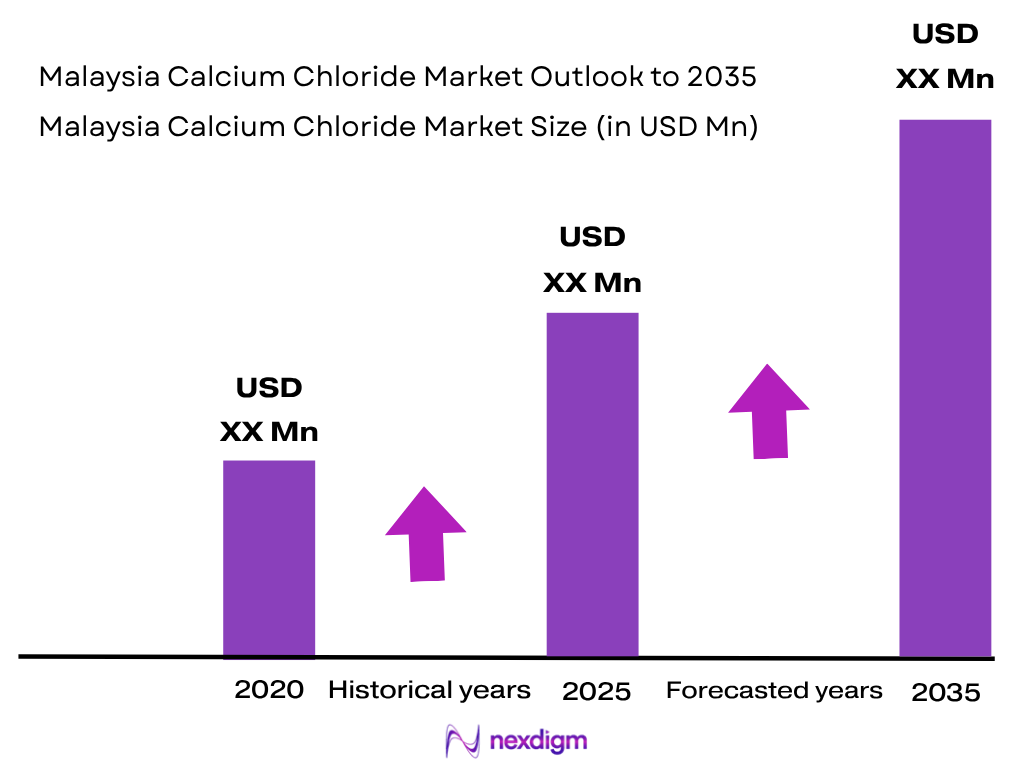
Malaysia Calcium Chloride MarketThe is estimated at USD ~XX million in 2024, compared with USD ~XX million in 2023, with demand supported by water treatment, food processing, construction chemicals, oilfield applications and industrial moisture control. The market is also closely connected to Malaysia’s broader manufacturing base: the Department of Statistics Malaysia reported manufacturing-sector sales of RM1.9 trillion in 2024, up from the preceding period, while food, beverages and tobacco remained an important manufacturing contributor. Calcium chloride’s multiple industrial functions support recurring demand across these applications.
Malaysia’s calcium chloride supply structure is strongly connected to international trade, with China, India, Thailand and European suppliers forming important external sources. World Bank WITS records USD 9.66 million of Malaysian calcium chloride imports under HS 282720 in 2024, with China supplying USD 5.90 million, India USD 1.05 million and Thailand USD 0.83 million. Malaysia also exported USD 3.45 million, led by shipments to Thailand, Brunei and Singapore. This trade orientation reflects Malaysia’s position as an industrial and regional distribution hub.
Market Segmentation
By Form Type
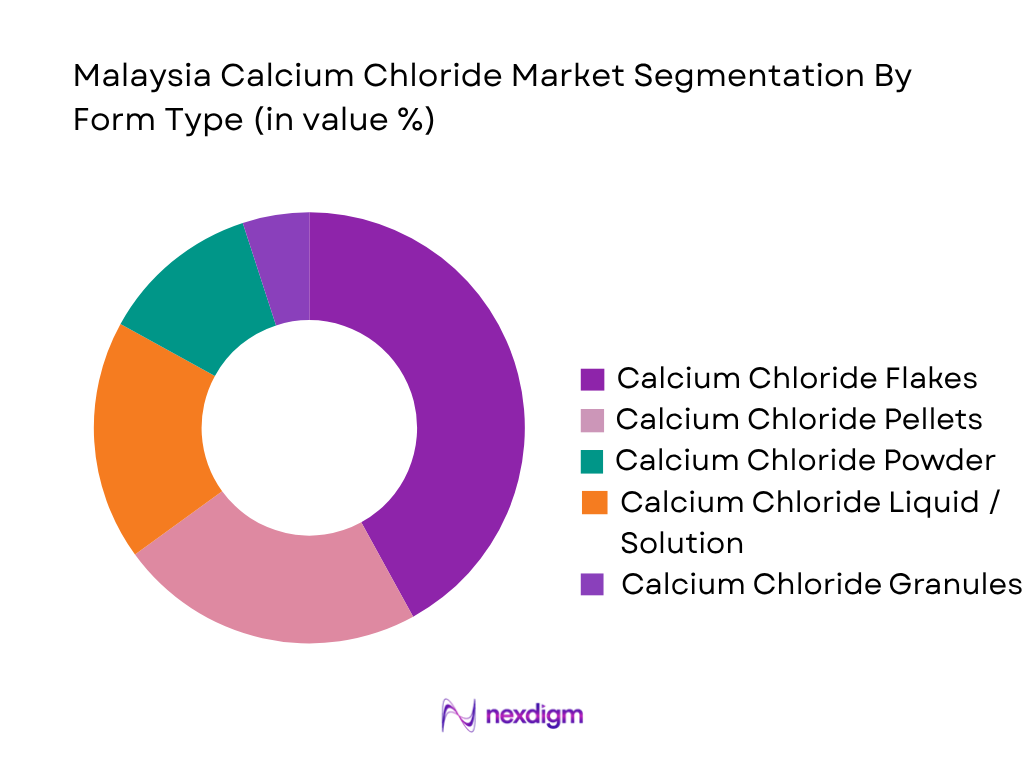
Malaysia Calcium Chloride Market is segmented by form type into calcium chloride flakes, pellets, powder, granules, liquid solution and prills. Calcium chloride flakes are expected to represent the dominant sub-segment because they provide a practical balance between concentration, handling, storage and industrial dosing. Malaysian suppliers actively market 74% calcium chloride dihydrate flakes for desiccant, drying, dust-control, water-treatment and general industrial applications. Liquid calcium chloride is also relevant for applications requiring direct dosing and easier incorporation into process streams. Powder and granular forms serve industrial formulations, moisture control and chemical processing, while pellets and prills are more specialized formats. The breadth of applications is supported by calcium chloride’s hygroscopicity and high water solubility. Local suppliers also demonstrate multiple packaging configurations, including 25 kg bags and larger bulk formats, allowing flakes to serve both medium-volume industrial buyers and larger manufacturing customers.
By Application Type
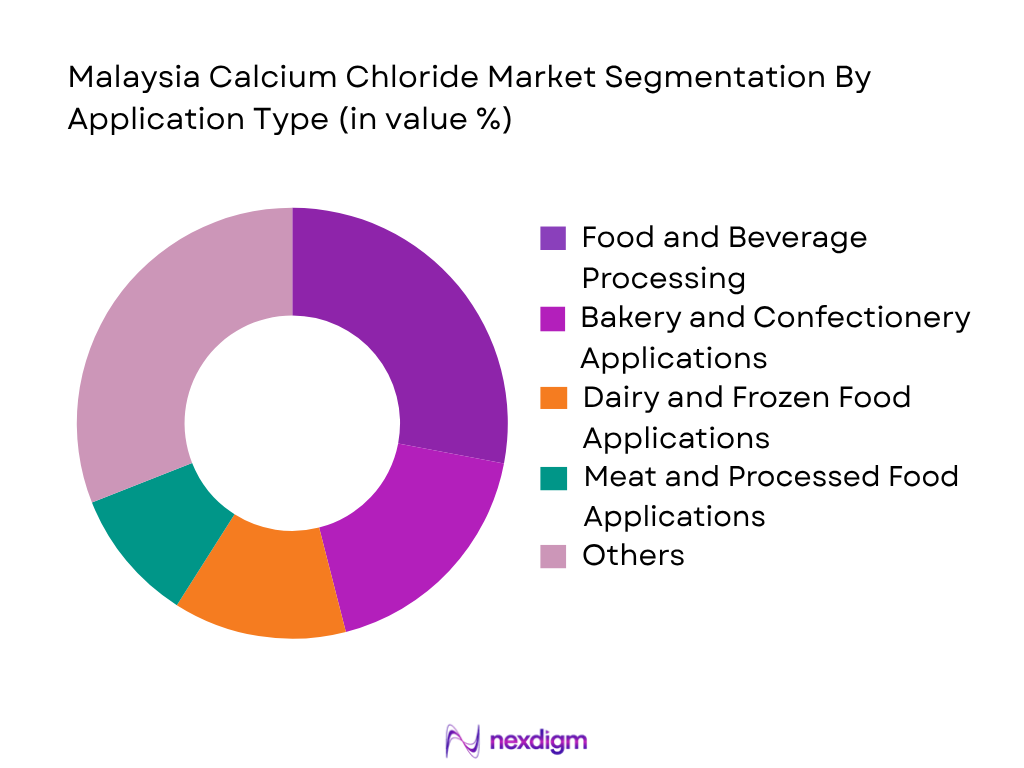
Malaysia Calcium Chloride Market is segmented by application type into water and wastewater treatment, oil and gas drilling fluids, construction and concrete acceleration, food processing and preservation, refrigeration and brine systems, dust control and road stabilization, mining and mineral processing, agriculture and fertilizer applications, and chemical processing and industrial manufacturing. Water treatment and wastewater treatment represents a key demand area because calcium chloride can contribute to industrial water-treatment processes and is used in applications requiring controlled calcium-ion addition. Oil and gas represents another important industrial application because calcium chloride is used in drilling-fluid and completion-brine systems. Food processing creates demand for food-grade calcium chloride as a firming agent and processing aid, while construction applications use calcium chloride for concrete-related purposes. Malaysian suppliers also identify dust control, drying and moisture management as applications.
Competitive Landscape
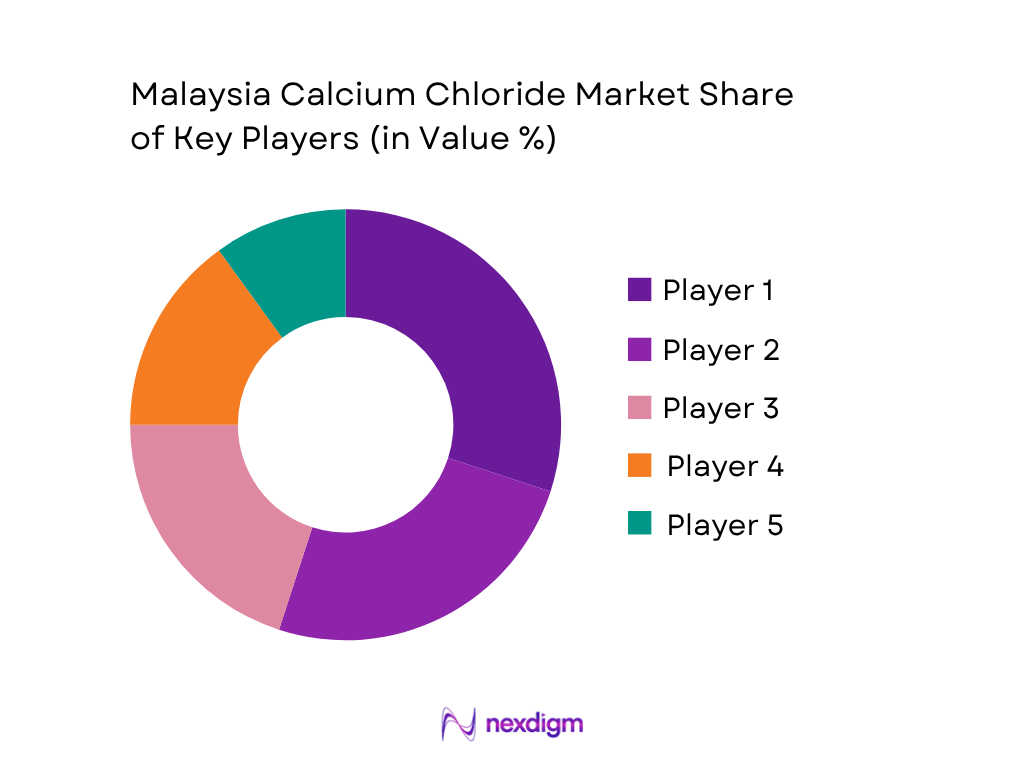
The Malaysia Calcium Chloride Market includes international chemical manufacturers, specialty chemical suppliers, distributors and Malaysia-based industrial chemical companies. The competitive structure combines imported products with local distribution and selected domestic manufacturing capabilities. Malaysia-based suppliers such as Mey Chern Chemicals identify calcium chloride liquid as one of their industrial products, while LSM Industries supplies calcium chloride flakes in bulk. International suppliers and distributors such as Solvay, Brenntag and Univar Solutions provide multiple calcium chloride grades, forms and application-specific products.
| Company | Established | Headquarters | Malaysia Supply Presence | Product Forms | Key Grades | Major Applications | Distribution Capability | Certification / Quality Focus |
| Solvay | 1863 | Brussels, Belgium | ~ | ~ | ~ | ~ | ~ | ~ |
| Brenntag | 1874 | Essen, Germany | ~ | ~ | ~ | ~ | ~ | ~ |
| Univar Solutions | 1924 | Downers Grove, USA | ~ | ~ | ~ | ~ | ~ | ~ |
| Mey Chern Chemicals | 1986 | Klang, Selangor, Malaysia | ~ | ~ | ~ | ~ | ~ | ~ |
| LSM Industries | 2018 | Telok Gong, Selangor, Malaysia | ~ | ~ | ~ | ~ | ~ | ~ |
Malaysia Calcium Chloride Market Analysis
Growth Drivers
Expansion of Manufacturing and Chemical-Processing Activity
Malaysia’s expanding manufacturing base is a direct demand-supporting factor for calcium chloride because the chemical is used in moisture control, dust suppression, water treatment, industrial processing and selected chemical applications. The manufacturing sector grew 4.2% in 2024, compared with 0.7% in 2023, while manufacturing contributed 23.1% of national GDP. Manufacturing sales reached approximately RM1.9 trillion in 2024, increasing by 4.6%. Within manufacturing, petroleum, chemical, rubber and plastic products increased 3.2%, while non-metallic mineral, basic metal and fabricated metal products increased 7.5%. These industries provide relevant downstream channels for calcium chloride, particularly where moisture management, mineral processing and industrial treatment are required. Malaysia’s 2024 calcium chloride imports under HS 282720 reached USD9.66 million, demonstrating established external procurement requirements. China supplied approximately USD5.90 million, while India supplied USD1.05 million, confirming the importance of imported industrial supply. The combination of stronger manufacturing output, chemical-sector activity and established import flows supports continuing calcium chloride consumption across Malaysian industrial users. The expansion of industrial production also creates recurring requirements for process chemicals used in manufacturing and maintenance activities. Higher factory utilization can increase the frequency of chemical procurement and bulk deliveries. The presence of established international suppliers further enables Malaysian manufacturers to source different grades according to technical requirements. This creates a sustained industrial demand base for calcium chloride across manufacturing-related applications.
Acceleration of Construction and Infrastructure Activity
Malaysia’s construction expansion creates additional calcium chloride demand through applications including dust control, concrete-related processes, moisture management and selected industrial construction activities. The construction sector grew 17.5% in 2024, compared with 6.0% in 2023, making construction one of the country’s fastest-expanding major economic sectors. Construction work completed reached RM158.8 billion during 2024, with residential buildings, special trade activities, non-residential buildings and civil engineering contributing to the expansion. Construction activity was particularly concentrated in Selangor, Johor, Kuala Lumpur and Sarawak, which together represented 62.3% of construction work done in the fourth quarter. Selangor alone recorded RM9.4 billion of quarterly construction work, followed by Johor at RM7.4 billion. Calcium chloride can benefit from this construction ecosystem through moisture-control and dust-suppression requirements, while downstream demand can also arise from associated aggregates, mineral handling and industrial operations. Malaysia’s 2024 calcium chloride exports reached 5.60 million kg, indicating an active regional supply chain alongside domestic consumption. Continued civil-engineering activity can support recurring requirements for industrial chemicals used around construction sites and material-handling operations. The concentration of construction activity in major economic states also provides suppliers with identifiable regional demand centers. Bulk chemical distributors can therefore align warehouse locations and delivery networks with areas showing stronger construction and infrastructure activity. The combination of infrastructure development and industrial expansion creates multiple channels through which calcium chloride suppliers can serve the Malaysian market.
Market Challenges
High Dependence on Imported Calcium Chloride Supply
Malaysia’s calcium chloride market faces supply-chain exposure because a substantial portion of internationally traded calcium chloride entering the country originates from overseas producers. Malaysia’s 2024 calcium chloride imports reached USD9.66 million under HS 282720, with China supplying USD5.90 million and approximately 16.11 million kg, India supplying USD1.05 million and approximately 3.41 million kg, and Thailand supplying USD0.83 million. Additional supply came from France, South Korea, Germany, Slovenia, Italy and Indonesia. This sourcing structure exposes Malaysian buyers to international freight availability, port logistics, foreign production disruptions and changes in supplier availability. The challenge is particularly relevant for industrial users requiring continuous bulk deliveries because interruptions can affect water-treatment operations, manufacturing processes and other calcium-chloride-dependent applications. Malaysia also exported USD3.45 million of calcium chloride and 5.60 million kg during the same period, showing that the country operates as both an importer and regional supplier. Consequently, maintaining diversified procurement channels and adequate inventory becomes important for users with recurring industrial requirements. Dependence on external producers can also increase lead-time uncertainty when international logistics conditions change. Importers must manage customs procedures, shipping schedules, storage requirements and supplier qualification simultaneously. This makes supply-chain planning an important component of calcium chloride procurement for Malaysian industrial customers. Greater supplier diversification and locally available inventory can reduce exposure to unexpected interruptions in international supply.
Exposure to Industrial-Cycle Fluctuations and Downstream Demand Variability
Calcium chloride consumption is closely connected with industrial activities such as manufacturing, construction, chemical processing, water treatment and mineral-related operations, making demand sensitive to changes in downstream production. Malaysia’s economic data shows that this exposure can produce different demand conditions across industries. Manufacturing expanded 4.2% in 2024, while construction grew 17.5%. At the same time, mining and quarrying increased only 0.9%, illustrating the uneven performance among potential calcium-chloride-consuming sectors. Manufacturing food processing grew 4.7%, while petroleum, chemical, rubber and plastic products increased 3.2%. Such variation means calcium chloride suppliers cannot depend equally on every end-use segment. Manufacturing labour productivity reached RM134,532 per person in 2024, while construction labour productivity reached RM47,223 per person, reflecting differences in operating structures across downstream industries. For calcium chloride suppliers, fluctuations in construction projects, manufacturing utilization and industrial production can therefore alter order volumes and inventory requirements. Demand can also vary according to project cycles, production schedules and seasonal operating conditions. Suppliers serving several end-use industries can reduce dependence on any single downstream sector. However, maintaining multiple grades, packaging formats and delivery arrangements can increase operational complexity. The challenge is therefore not only cyclical demand but also the need to maintain flexible supply planning across industries with different procurement patterns.
Market Opportunities
Expansion of Regional Calcium Chloride Distribution
Malaysia has an opportunity to strengthen its position as a regional calcium chloride distribution and export hub because existing trade flows already connect Malaysian suppliers with several Asian and international destinations. Malaysia exported 5.60 million kg of calcium chloride worth USD3.45 million in 2024. Thailand received approximately 3.82 million kg worth USD2.56 million, while Brunei received approximately 1.19 million kg worth USD457,000 and Singapore received 271,093 kg worth USD173,360. Malaysia also supplied calcium chloride to the United States, Spain, Indonesia, Côte d’Ivoire and other destinations. This established export network provides a platform for suppliers to expand distributor relationships and serve nearby markets with relatively efficient logistics routes. The opportunity is reinforced by Malaysia’s broader integration with regional manufacturing and trading networks. At the domestic level, manufacturing sales reached approximately RM1.9 trillion in 2024, while transportation and storage activity grew 10.7%, supporting the logistics ecosystem required for chemical distribution. Expanding warehousing, bulk handling and regional distributor coverage could strengthen Malaysia’s role within Southeast Asian calcium chloride supply chains. Suppliers can also develop regional stocking points to reduce delivery times for neighboring markets. Export-oriented distributors may benefit from established maritime connections through Malaysia’s major ports. The combination of existing export volumes, industrial infrastructure and regional connectivity provides a foundation for expanding calcium chloride distribution beyond domestic customers.
Growth in Water Treatment and Industrial Chemical Applications
Calcium chloride suppliers can target expanding industrial and infrastructure applications where the chemical is used for moisture control, dust suppression, water-treatment processes and other technical functions. Malaysia’s construction work reached RM158.8 billion in 2024, while the manufacturing sector recorded approximately RM1.9 trillion in sales. The country also recorded RM427.7 billion in manufacturing net capital stock, with petroleum, chemical, rubber and plastic products accounting for 36.3% of manufacturing net capital stock. These figures indicate a substantial installed industrial base in which technical chemicals can support ongoing processing and maintenance requirements. Malaysia’s transportation and storage sector grew 10.7% in 2024, strengthening the logistics infrastructure serving industrial users. Calcium chloride suppliers can use this environment to develop differentiated technical grades, bulk-delivery arrangements and application-specific supply programs for water-treatment operators, construction companies, industrial processors and chemical users. The opportunity is particularly relevant because Malaysia imported USD9.66 million of calcium chloride in 2024, demonstrating established demand that can be served through specialized distribution and application support. Suppliers can also strengthen customer retention by providing technical documentation, consistent specifications and reliable delivery schedules. Industrial customers increasingly require predictable chemical quality because process interruptions can affect production continuity. Application-focused supply models can therefore create opportunities beyond conventional commodity distribution while supporting broader industrial consumption.
Future Outlook
Over the forecast period, the Malaysia Calcium Chloride Market is expected to expand through increasing industrial applications, water-treatment requirements, food-processing activity, oil and gas operations and chemical distribution. The country’s established manufacturing base provides a broad downstream customer ecosystem, while calcium chloride’s ability to function as a drying agent, calcium source, brine component and processing chemical supports application diversification. Malaysia’s geographical position also enables regional distribution into Southeast Asian markets. The World Bank trade data already shows Malaysian calcium chloride exports reaching Thailand, Brunei, Singapore and other destinations, providing an established foundation for regional trade expansion.
Major Players
- Ingredion Incorporated
- Cargill Incorporated
- Archer Daniels Midland Company (ADM)
- Tetra Technologies, Inc.
- Solvay
- Brenntag SE
- Univar Solutions Inc.
- Nouryon
- Nedmag B.V.
- Tate & Lyle PLC
- Nedmag Calcium Chloride
- Mey Chern Chemicals Sdn Bhd
- LSM Industries (M) Sdn Bhd
- Ward Chemical Inc.
- Tiger Calcium Services Inc.
Key Target Audience
- Calcium Chloride Manufacturers and Chemical Producers
- Industrial Chemical Importers and Distributors
- Water and Wastewater Treatment Companies
- Oil and Gas Operators and Oilfield Service Providers
- Food Processing and Food Ingredient Manufacturers
- Construction Chemical and Ready-Mix Concrete Companies
- Investments and Venture Capitalist Firms (Industrial Chemicals, Specialty Chemicals and Water Infrastructure)
- Government and Regulatory Bodies (Department of Environment, Department of Occupational Safety and Health, Ministry of Health Malaysia)
Research Methodology
Step 1: Identification of Key Variables
The initial phase involves mapping the Malaysia Calcium Chloride Market ecosystem across manufacturers, importers, distributors and end-use industries. Variables include calcium chloride form, grade, application, trade flow, domestic production, consumption and distribution structure. International trade data is cross-checked against Malaysian industrial indicators and company-level product information.
Step 2: Market Analysis and Construction
Historical market analysis combines import and export statistics, domestic supply indicators and downstream industrial demand. HS 282720 trade flows are examined to identify Malaysia’s major calcium chloride trading partners, while manufacturing, oil and gas, food-processing and water-treatment indicators are used to establish demand relationships.
Step 3: Hypothesis Validation and Expert Consultation
Market hypotheses are validated through discussions with chemical manufacturers, distributors, industrial buyers and application specialists. Interviews focus on procurement volumes, preferred grades, product forms, application requirements, import dependence, customer specifications and changes in purchasing patterns. These inputs are triangulated against documented company capabilities and trade statistics.
Step 4: Research Synthesis and Final Output
The final stage integrates demand-side and supply-side findings into a unified Malaysia Calcium Chloride Market model. Company information, trade flows, application requirements and downstream industry indicators are reconciled to establish market segmentation and competitive benchmarks. Forecast assumptions are then applied consistently across consumption, production, imports, exports and application demand.

- Executive Summary
- Research Methodology (Market Definition and Scope, Malaysia Calcium Chloride Market Classification, Calcium Chloride Demand Assessment, Domestic Production Assessment, Import Dependency Analysis, Export Flow Assessment, Form-Level Consumption Mapping, Application-Level Demand Assessment, End-Use Industry Assessment, Supply-Side Capacity Mapping, Distributor and Trader Assessment, Trade Data Validation, Top-Down Market Sizing, Bottom-Up Market Sizing, Demand-Side Validation, Supply-Side Validation, Data Triangulation, Forecasting Framework)

- Definition and Scope
- Malaysia Calcium Chloride Industry Evolution and Development of Chemical Manufacturing, Import Distribution and Industrial Chemical Infrastructure
- Calcium Chloride Production Ecosystem, Import Supply Base,
- Distribution Network and End-Use Industry Structure
- Malaysia Calcium Chloride Value Chain Analysis
- Malaysia Calcium Chloride Supply Chain Analysis
- Chemical Manufacturers, Importers, Distributors, Industrial Chemical Traders, Water Treatment Suppliers, Oilfield Chemical Suppliers, Food Ingredient Suppliers, Construction Chemical Suppliers, End-Use Industries
- Calcium Chloride Integration Across Water Treatment, Oil and Gas, Construction, Food Processing, Refrigeration, Mining, Agriculture, Chemical Processing, Pharmaceutical Applications and Industrial Manufacturing

- Growth Drivers (Expansion of Water Treatment Infrastructure, Growth of Oil and Gas Activities, Construction and Infrastructure Development, Expansion of Food Processing, Increasing Industrial Chemical Consumption, Growth of Refrigeration and Cold Chain Infrastructure, Mining and Mineral Processing Activities, Demand for Industrial Moisture Control Solutions)
- Market Challenges (High Import Dependence, International Calcium Chloride Supply Volatility, Exposure to Global Chemical Commodity Prices, Freight and Logistics Constraints, Feedstock Availability, Quality and Purity Requirements, Regulatory Compliance, Storage and Handling Requirements)
- Market Opportunities (Expansion of Industrial Water Treatment, Growing Oilfield Chemical Applications, Food-Grade Calcium Chloride Adoption, Cold Chain and Refrigeration Expansion, Construction Chemical Applications, Mining and Mineral Processing Growth, Specialty-Grade Calcium Chloride Development, Regional Export and Distribution Opportunities)
- Market Trends (Industrial-Grade Product Consolidation, Higher Demand for High-Purity Grades, Food-Grade Calcium Chloride Adoption, Bulk Packaging Expansion, Import Source Diversification, Integrated Chemical Distribution, Application-Specific Formulation, Sustainable Chemical Processing)
- Regulatory and Standards Landscape (Department of Environment Chemical and Environmental Requirements, Department of Occupational Safety and Health Chemical Safety Requirements, Ministry of Health Food Safety Requirements, Food Regulations, Environmental Quality Requirements, Hazardous Chemical Handling Requirements, Industrial Chemical Storage Standards, Food-Grade Quality Standards, International Chemical Specifications)
- SWOT Analysis
- Porter’s Five Forces Analysis
- PESTLE Analysis
- Stakeholder Ecosystem
- Competition Ecosystem

- By Market Value (2020-2025)
- By Consumption Volume (2020-2025)
- By Domestic Production Volume (2020-2025)
- By Import Volume (2020-2025)
- By Export Volume (2020-2025)
- By Apparent Consumption (2020-2025)
- By Average Import Value per Kg (2020-2025)

- By Form Type (In Value %)
Calcium Chloride Flakes
Calcium Chloride Pellets
Calcium Chloride Powder
Calcium Chloride Granules
Calcium Chloride Liquid Solution
Calcium Chloride Prills - By Purity Grade (In Value %)
Industrial Grade Calcium Chloride
Food Grade Calcium Chloride
Pharmaceutical Grade Calcium Chloride
Technical Grade Calcium Chloride
Reagent Grade Calcium Chloride - By Application Type (In Value %)
Water Treatment and Wastewater Treatment
Oil and Gas Drilling Fluids
Construction and Concrete Acceleration
Food Processing and Food Preservation
Refrigeration and Brine Systems
Dust Control and Road Stabilization
Mining and Mineral Processing
Agriculture and Fertilizer Applications
Chemical Processing and Industrial Manufacturing - By End-Use Industry (In Value %)
Water and Wastewater Treatment Industry
Oil and Gas Industry
Construction Industry
Food and Beverage Industry
Chemical Manufacturing Industry
Mining Industry
Agriculture Industry
Pharmaceutical Industry
Refrigeration and Cold Chain Industry
Pulp, Paper and Textile Industry - By Distribution Channel (In Value %)
Direct Manufacturer Supply
Chemical Importers and Distributors
Industrial Chemical Traders
Specialty Chemical Distributors
Food Ingredient Distributors
Oilfield Chemical Suppliers
Construction Chemical Suppliers
Online Industrial Chemical Platforms - By Region (In Value %)
Central Malaysia
Southern Malaysia
Northern Malaysia
East Coast Malaysia
East Malaysia

- Market Share of Major Players (By Malaysia Revenue, Calcium Chloride Sales Volume, Import Volume, Export Volume, Production Capacity, Form Portfolio, Purity Grade Portfolio, Application Coverage, End-Use Industry Coverage, Distribution Network Reach, Customer Base Coverage, Regional Supply Capability)
- Cross Comparison Parameters (Calcium Chloride Revenue, Calcium Chloride Production Capacity, Import Supply Capability, Form Portfolio Breadth, Purity Grade Coverage, Water Treatment Application Capability, Oil and Gas Application Exposure, Distribution Network Reach)
- SWOT Analysis of Major Players
- Competitive Positioning Matrix
- Detailed Profiles of Major Companies
Tetra Technologies, Inc.
Occidental Petroleum Corporation
Nedmag B.V.
Nouryon
Tiger Calcium Services Inc.
Ward Chemical Inc.
HaloPolymer
Qingdao Haida Chemical Co., Ltd.
Weifang Haizhiyuan Chemical Industry Co., Ltd.
Tianjin Bohua Yongli Chemical Industry Co., Ltd.
Shandong Haihua Group
Solvay
Brenntag SE
Univar Solutions Inc.
Nedmag Calcium Chloride

- Water Treatment Operator Calcium Chloride Procurement Assessment
- Municipal Water Treatment Chemical Requirement Analysis
- Industrial Wastewater Treatment Demand Assessment
- Oilfield Calcium Chloride Requirement Analysis
- Construction Chemical Manufacturer Demand Assessment
- Ready-Mix Concrete and Cement Industry Application Assessment
- Food Manufacturer Food-Grade Calcium Chloride Procurement Analysis
- Refrigeration and Cold Storage Calcium Chloride Requirement Assessment
- Mining and Mineral Processing Chemical Consumption Analysis
- Agricultural Calcium Chloride Application Assessment
- Pharmaceutical Grade Calcium Chloride Procurement Analysis
- Chemical Manufacturer Feedstock and Process Requirement Assessment
- Industrial Distributor Inventory and Procurement Assessment

- By Market Value (2026-2035)
- By Calcium Chloride Consumption Volume (2026-2035)
- By Domestic Production Volume (2026-2035)
- By Import Volume (2026-2035)
- By Export Volume (2026-2035)
- By Apparent Consumption (2026-2035)
- By Form Type (2026-2035)
- By Application Type (2026-2035)


 Request a Sample
 Ask for Customization
 Get a Quote
 Enquire Now