

 Download PDF
Market Overview
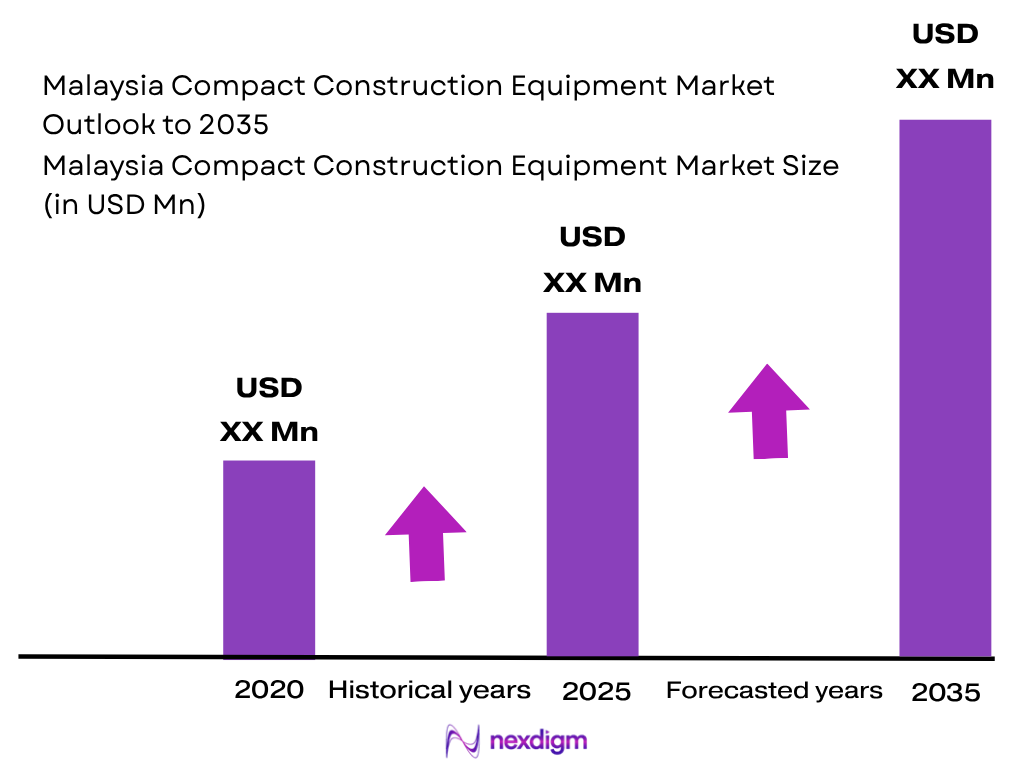
The Malaysia Compact Construction Equipment Market is estimated at ~USD XX million in 2024, compared with ~USD XX million in 2023, with demand closely linked to construction activity, infrastructure development, equipment replacement and rental utilization. Malaysia’s construction work value increased from RM132.2 billion to RM158.8 billion, while the construction sector recorded strong expansion. Civil engineering, residential development, non-residential construction and specialized trade activities provide the principal operating base for compact machinery, particularly excavators, loaders and compact rollers.
The strongest demand concentration is associated with Selangor, Johor, Kuala Lumpur, Sarawak and Penang, reflecting their concentration of residential, commercial, industrial, infrastructure and civil-engineering projects. Construction activity is particularly significant in Selangor and Johor because of large-scale urban development, industrial investment and infrastructure connectivity. The latest construction data recorded RM9.4 billion of quarterly work in Selangor and RM7.4 billion in Johor, while Wilayah Persekutuan recorded RM4.7 billion and Sarawak RM4.6 billion, demonstrating the importance of these construction centers.
Market Segmentation
By Equipment Type
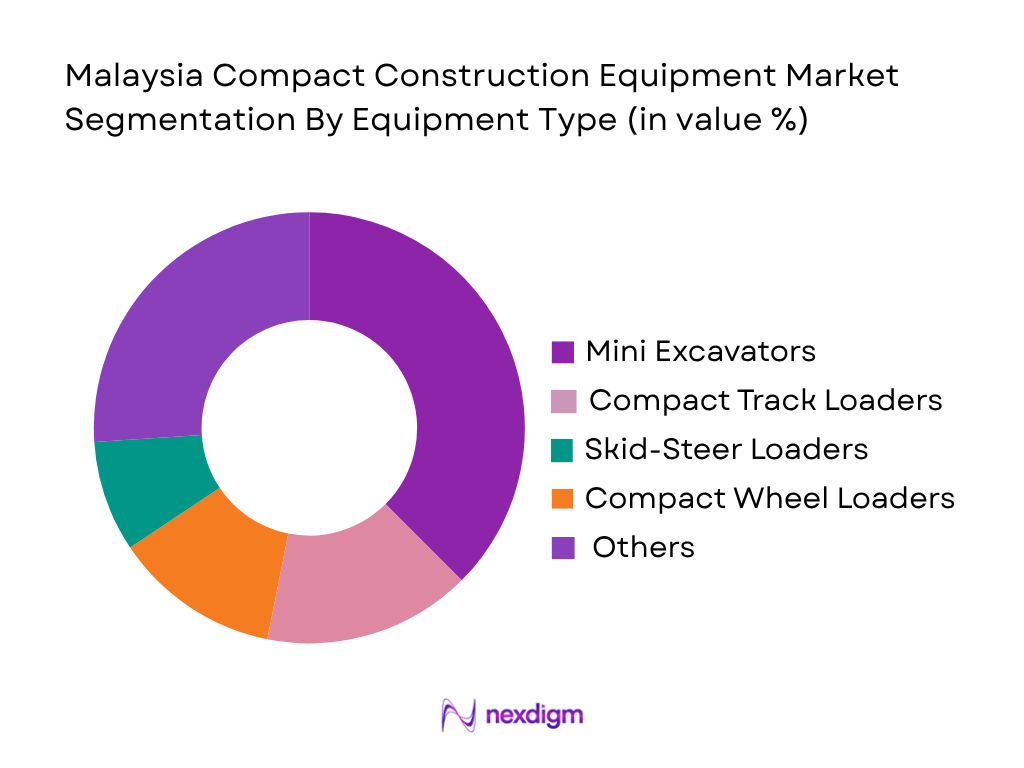
The Malaysia Compact Construction Equipment Market is segmented by equipment type into mini excavators, skid-steer loaders, compact track loaders, compact wheel loaders, compact backhoe loaders, mini loaders, compact rollers and small articulated loaders. Mini excavators are positioned as the leading segment because their compact footprint, maneuverability and attachment compatibility make them suitable for residential construction, drainage, utility installation, landscaping, road maintenance and foundation preparation. Their ability to operate in constrained work areas is particularly relevant in Malaysia’s urban construction environment. Skid-steer and compact track loaders provide complementary capabilities for loading, grading, demolition and material movement, while compact rollers support road and surface-compaction requirements. Equipment rental companies also create demand for versatile machines capable of serving multiple contractors and applications. The strong construction pipeline further supports equipment replacement and fleet expansion.
By Application
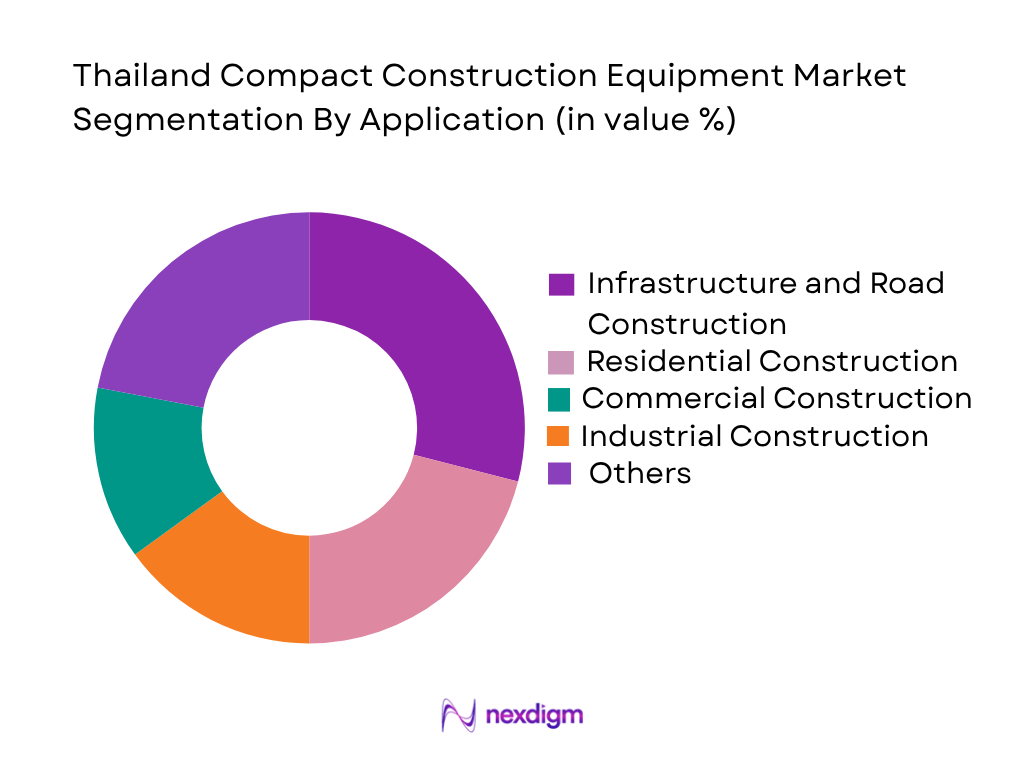
The Malaysia Compact Construction Equipment Market is segmented by application into excavation and trenching, loading and material handling, grading and site preparation, lifting and placement, demolition, landscaping and grounds development, compaction, road construction and maintenance, utility installation and maintenance, and agricultural and land development. Excavation and trenching are positioned as the leading application because foundations, drainage systems, underground utilities, telecommunications infrastructure and site preparation require compact equipment capable of operating around existing structures. Mini excavators are particularly suitable because they combine digging performance with transportability and attachment flexibility. Loading and material handling also generate substantial equipment utilization across construction and industrial sites. Road infrastructure supports demand for compact rollers and loaders, while utility development requires maneuverable equipment for water, electricity, drainage and telecommunications projects. Malaysia’s civil-engineering construction activity provides a substantial demand base for these applications.
Competitive Landscape
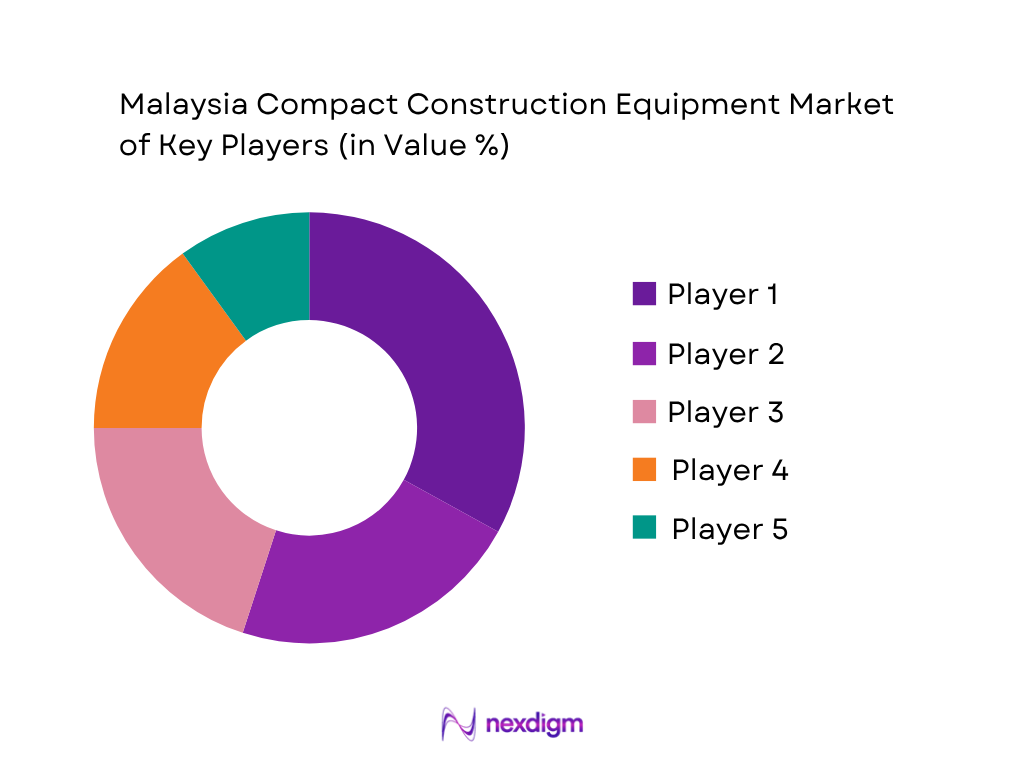
The Malaysia Compact Construction Equipment Market comprises international construction-equipment manufacturers with established product portfolios covering excavators, loaders, compact machinery, attachments and related services. Competition is influenced by equipment reliability, operating specifications, dealer coverage, spare-parts availability, financing support, rental relationships and aftermarket service. Major manufacturers such as Caterpillar, Komatsu, JCB, Kubota and Volvo Construction Equipment participate across complementary equipment categories and compete through product breadth, technology, service infrastructure and fleet-support capabilities.
| Company | Establishment Year | Headquarters | Key Compact Equipment Portfolio | Mini Excavator Presence | Loader Presence | Dealer & Service Network | Telematics / Digital Capability | Electric Equipment Capability |
| Caterpillar Inc. | 1925 | Irving, Texas, USA | ||||||
| Komatsu Ltd. | 1921 | Tokyo, Japan | ||||||
| JCB | 1945 | Rocester, UK | ||||||
| Kubota Corporation | 1890 | Osaka, Japan | ||||||
| Volvo Construction Equipment | 1832 | Gothenburg, Sweden |
Malaysia Compact Construction Equipment Market Analysis
Growth Drivers
Construction Infrastructure Expansion
Malaysia’s construction infrastructure pipeline is a major demand driver for compact construction equipment, particularly mini excavators, compact loaders and compact rollers used in site preparation, utility work, drainage, road construction and confined urban projects. Construction work done reached RM158.8 billion in 2024, while civil engineering generated RM61.1 billion, residential buildings generated RM35.8 billion, non-residential buildings generated RM44.4 billion, and special trade activities generated RM17.5 billion. Within civil engineering, roads and railways accounted for RM6.9 billion, while utility projects accounted for RM6.8 billion in the fourth quarter alone. This project mix creates recurring requirements for machines capable of excavation, trenching, material movement and surface preparation. Selangor recorded RM9.4 billion of construction work, Johor RM7.4 billion, Wilayah Persekutuan RM4.7 billion, and Sarawak RM4.6 billion, indicating multiple geographically concentrated construction centers. The continued development of residential areas, industrial facilities, transportation networks and utility infrastructure supports demand for compact equipment where maneuverability and transportability are important. These conditions also encourage contractors to select multi-purpose machines that can perform several activities through interchangeable attachments, improving utilization across different project phases.
Residential, Non-Residential Construction and Civil Engineering Development
Malaysia’s broad construction activity is supporting demand across several compact-equipment applications rather than creating dependence on a single project category. The construction sector recorded RM158.8 billion of work done in 2024, with residential construction contributing RM35.8 billion, non-residential construction contributing RM44.4 billion, civil engineering contributing RM61.1 billion, and special trade activities contributing RM17.5 billion. Residential construction increased to RM35.8 billion, while non-residential construction included commercial and industrial facilities requiring excavation, loading, grading, landscaping and site-development machinery. Civil engineering activity is particularly relevant to compact equipment because road, railway, drainage and utility projects frequently require machinery capable of operating around existing infrastructure. Fourth-quarter civil-engineering work included RM6.9 billion from roads and railways and RM6.8 billion from utility projects. Special trade activities also included RM1.2 billion of site preparation, RM1.1 billion of electrical installation and RM1.0 billion of plumbing, heat and air-conditioning installation. This diversified project structure supports equipment utilization across excavation, trenching, material handling, grading, demolition and utility installation, strengthening the underlying requirement for compact machinery across contractor fleets.
Market Challenges
Equipment Financing Requirements and Construction Cyclicality
Equipment acquisition represents a significant capital commitment for contractors, making financing availability and project visibility important considerations in Malaysia’s compact construction equipment market. The construction sector recorded RM158.8 billion of work done in 2024, but demand is distributed across project categories with different completion cycles and procurement requirements. Private-sector activity contributed RM27.0 billion of fourth-quarter construction work, while public-sector activity contributed RM15.1 billion, demonstrating the importance of both commercial and government-linked projects. Contractors therefore need to align equipment purchases with confirmed project pipelines, utilization expectations and cash-flow requirements. Construction activity can also vary between residential, commercial, infrastructure and specialized trade projects, creating uneven requirements for specific machine types. Equipment owners additionally need to maintain machines through replacement parts, hydraulic components, undercarriage components and scheduled servicing. In the fourth quarter, special trade activities generated RM4.7 billion, including RM1.2 billion from site preparation and RM1.1 billion from electrical installation, illustrating how specialized contractors operate within separate project cycles. These conditions can encourage contractors to defer ownership purchases, rely on rental fleets or acquire used equipment when utilization visibility is limited.
Imported Equipment Dependency and Maintenance Requirements
Malaysia’s compact construction equipment ecosystem remains exposed to imported machinery, components and replacement parts, making supply continuity and after-sales support important considerations for contractors and rental operators. The need for reliable maintenance is amplified by the diverse equipment applications generated by the construction sector. Malaysia recorded RM158.8 billion of construction work in 2024, including RM61.1 billion in civil engineering and RM44.4 billion in non-residential construction. These activities require machines to remain operational across excavation, loading, grading, roadwork, utility installation and site preparation. Equipment downtime can affect project sequencing because compact machines are frequently deployed in confined work zones where replacement equipment may not be immediately available. Fourth-quarter utility projects generated RM6.8 billion, while roads and railways generated RM6.9 billion, indicating substantial activity where equipment availability can directly affect construction schedules. The challenge is particularly relevant for machines requiring specialized hydraulic components, electronic controls, tracks, tires and engine components. Dealer service coverage, parts inventory and technician availability therefore influence equipment selection alongside purchase specifications. Contractors may favor manufacturers with established Malaysian distribution and aftermarket networks because rapid access to parts and technical support can reduce operational disruption across geographically dispersed construction projects.
Market Opportunities
Mini Excavator Adoption and Utility Construction Equipment Demand
Malaysia’s growing utility, site-preparation and civil-engineering activity creates an opportunity for wider adoption of compact excavators, particularly mini excavators designed for confined excavation, drainage, trenching and infrastructure maintenance. Civil engineering generated RM61.1 billion of construction work in 2024, while fourth-quarter roads and railway construction generated RM6.9 billion and utility projects generated RM6.8 billion. Special trade activities additionally included RM1.2 billion in site preparation and RM1.0 billion in plumbing, heat and air-conditioning installation. These activities require machinery that can access restricted sites while performing excavation, trenching and material-handling tasks. Compact excavators can address this requirement through smaller operating footprints, transportability and compatibility with buckets, breakers, augers and other attachments. The opportunity extends to telecommunications, electricity, water, drainage and building-services projects where contractors often operate alongside existing infrastructure. Malaysia’s construction concentration in Selangor, Johor, Wilayah Persekutuan and Sarawak provides multiple regional demand centers, with the four areas collectively recording substantial construction activity. As contractors undertake increasingly specialized utility and maintenance work, compact machinery can provide an equipment solution that is easier to mobilize than larger construction machines while retaining sufficient digging and lifting capability for smaller project environments.
Data Center Construction, Smart Equipment and Telematics Adoption
Malaysia’s rapidly expanding digital-infrastructure ecosystem creates a specialized opportunity for compact construction equipment used during data-center site preparation, utility installation, electrical works, landscaping and supporting infrastructure development. MIDA reported RM113.8 billion in digital infrastructure investments between 2021 and 2024, including data centers, cloud computing and data-hosting projects, with RM24.1 billion recorded during 2024 alone. Malaysia also secured RM141.72 billion in digital investments during the first 10 months of 2024. Individual technology projects include Google’s planned RM9.4 billion investment in a Malaysian data center and cloud region and AWS’s commitment of RM29.2 billion through 2038. Such developments require extensive site preparation, utility infrastructure, electrical installation, drainage, access roads and landscaping before and during facility construction. These requirements create potential demand for compact excavators, loaders, rollers and attachment-based machines. The same projects also provide an environment for telematics-enabled equipment because contractors can monitor machine utilization, operating hours, location and maintenance requirements across complex sites. The combination of large digital-infrastructure projects and increasingly technology-enabled construction practices creates an opportunity for suppliers offering compact equipment integrated with fleet-management and machine-monitoring systems.
Future Outlook
Over the next decade, the Malaysia Compact Construction Equipment Market is expected to be shaped by infrastructure development, urban construction, industrial investment, equipment rental expansion and increasing contractor mechanization. Demand for compact machinery is likely to remain closely connected to civil engineering, residential construction, utility installation and specialized construction activities. Equipment manufacturers are also expected to increase their focus on telematics, fuel efficiency, electric powertrains, operator assistance and attachment compatibility. Malaysia’s construction sector recorded RM158.8 billion in construction work in 2024, providing a substantial underlying activity base for equipment demand.
Major Players
- Caterpillar Inc.
- Komatsu Ltd.
- JCB
- Kubota Corporation
- Volvo Construction Equipment
- Hitachi Construction Machinery
- SANY Heavy Industry
- XCMG Group
- Kobelco Construction Machinery
- HD Hyundai Construction Equipment
- DEVELON
- LiuGong
- Bobcat Company
- Takeuchi
- Manitou
Key Target Audience
- Construction Equipment Manufacturers and OEMs
- Construction Equipment Dealers and Distributors
- Equipment Rental and Fleet Management Companies
- Construction Contractors and Infrastructure Developers
- Investments and Venture Capitalist Firms
- Government and Regulatory Bodies (Ministry of Works Malaysia, Construction Industry Development Board Malaysia, Department of Occupational Safety and Health)
- Equipment Financing and Leasing Providers
- Construction Machinery Aftermarket, Parts and Service Providers
Research Methodology
Step 1: Identification of Key Variables
The initial phase involves constructing an ecosystem map covering OEMs, dealers, rental companies, contractors, infrastructure developers and aftermarket participants within the Malaysia Compact Construction Equipment Market. Equipment categories, operating weights, applications, powertrains, attachments and distribution channels are defined to establish the market framework.
Step 2: Market Analysis and Construction
Historical market information is compiled by assessing equipment sales, installed fleet, replacement demand, rental purchases, construction activity and application-level utilization. Top-down analysis is aligned with construction-sector indicators, while bottom-up analysis evaluates equipment categories, manufacturer presence, dealer activity and end-user demand.
Step 3: Hypothesis Validation and Expert Consultation
Market hypotheses are validated through consultations with equipment manufacturers, dealers, rental companies, contractors and industry participants. Discussions focus on fleet procurement, equipment utilization, replacement cycles, application demand, rental penetration, financing conditions, technology adoption and aftermarket requirements.
Step 4: Research Synthesis and Final Output
The final stage triangulates secondary information, company-level data, industry interviews and equipment-level estimates to establish the market baseline. Bottom-up equipment calculations are reconciled with construction activity and demand-side indicators, followed by segmentation, competitive benchmarking and forecasting through the 2035 outlook period.

- Executive Summary
- Research Methodology (Market Definition and Scope, Compact Construction Equipment Classification, Equipment Weight Classification, Operating Capacity Assessment, Powertrain Mapping, Hydraulic System Assessment, Attachment Compatibility Analysis, Equipment Utilization Assessment, Rental Fleet Assessment, Dealer Network Mapping, Aftermarket Assessment, Import and Distribution Analysis, Demand-Side Assessment, Supply-Side Assessment, Top-Down Market Sizing, Bottom-Up Market Sizing, Primary Industry Interviews, Data Triangulation, Forecasting Framework)

- Definition and Scope
- Malaysia Compact Construction Equipment Industry Evolution and Development of Mini Excavators, Skid-Steer Loaders, Compact Track Loaders, Compact Wheel Loaders, Compact Backhoe Loaders, Mini Loaders, Compact Rollers, Small Articulated Loaders, Zero-Tail-Swing Equipment, Attachment-Based Compact Machines, Telematics-Enabled Equipment, Machine-Control Equipment, Battery-Electric Compact Equipment and Operator-Assistance Technologies
- Compact Construction Equipment Value Chain Analysis
- Compact Construction Equipment Supply Chain Analysis
- Engine and Powertrain Suppliers, Hydraulic Component Suppliers, Track and Tire Manufacturers, Steel and Structural Component Suppliers, Attachment Manufacturers, Compact Equipment OEMs, Authorized Dealers, Independent Dealers, Equipment Rental Companies, Equipment Financing Providers, Used Equipment Dealers, Auction Platforms, General Contractors, Infrastructure Contractors, Utility Contractors, Landscaping Contractors, Municipalities and Industrial End Users

- Growth Drivers (Construction Infrastructure Expansion, Residential and Non-Residential Construction Activity, Civil Engineering Development, Utility and Telecommunications Installation, Equipment Rental Expansion, Urban Construction Requirements, Contractor Mechanization, Landscaping and Grounds Maintenance, Industrial Development)
- Market Challenges (Equipment Financing Requirements, Imported Equipment Dependency, Skilled Operator Availability, Equipment Maintenance and Spare Parts Requirements, Construction Cyclicality, Limited Electric Equipment Charging Infrastructure, Equipment Transportation Constraints, Used Equipment Competition, Hydraulic Component Availability)
- Market Opportunities (Mini Excavator Adoption, Compact Track Loader Expansion, Rental Fleet Modernization, Battery-Electric Compact Equipment, Utility Construction Equipment Demand, Infrastructure Development, Data Center Construction, Smart Construction Equipment, Telematics and Fleet Management, Attachment-Based Equipment Utilization)
- Market Trends (Mini Excavator Adoption, Zero-Tail-Swing Equipment, Compact Track Loader Utilization, Multi-Function Attachments, Telematics Integration, Machine-Control Technology, Fuel-Efficient Equipment, Battery-Electric Compact Equipment, Remote Equipment Monitoring, Predictive Maintenance)
- Government Regulations and Standards (Department of Occupational Safety and Health Requirements, Construction Industry Development Board Requirements, Department of Environment Regulations, Road Transport Department Requirements, Occupational Safety Requirements, Machinery Import Requirements, Diesel Emission Requirements, Equipment Certification Requirements, Workplace Safety Standards)
- SWOT Analysis
- Porter’s Five Forces Analysis
- PESTLE Analysis
- Stakeholder Ecosystem
- Competition Ecosystem

- By Market Value (2020-2025)
- By New Equipment Unit Sales (2020-2025)
- By Installed Equipment Base (2020-2025)
- By Average Selling Price per Equipment Unit (2020-2025)
- By Mini Excavator Unit Sales (2020-2025)
- By Skid-Steer Loader Unit Sales (2020-2025)

- By Equipment Type (In Value %)
Mini Excavators
Skid-Steer Loaders
Compact Track Loaders
Compact Wheel Loaders
Compact Backhoe Loaders
Mini Loaders
Compact Rollers
Small Articulated Loaders - By Application (In Value %)
Excavation and Trenching
Loading and Material Handling
Grading and Site Preparation
Lifting and Placement
Demolition
Landscaping and Grounds Development
Compaction
Road Construction and Maintenance
Utility Installation and Maintenance
Agricultural and Land Development - By End-Use Industry (In Value %)
Residential Construction
Commercial Construction
Infrastructure and Civil Engineering
Utility and Telecommunications Construction
Industrial Construction
Landscaping and Grounds Maintenance
Agriculture and Plantation
Municipal and Public Works
Mining and Quarrying
Equipment Rental - By Operating Weight (In Value %)
Below 2 Tonnes
2-5 Tonnes
5-8 Tonnes
8-10 Tonnes
Above 10 Tonnes - By Sales Channel (In Value %)
OEM-Authorized Dealers
Independent Equipment Dealers
Direct OEM Sales
Equipment Rental Companies
Used Equipment Dealers
Equipment Auctions
Equipment Trading and Import Companies - By Geography (In Value %)
Selangor
Johor
Kuala Lumpur
Sarawak
Sabah
Penang
Perak
Pahang
Kedah
Rest of Malaysia

- Market Share of Major Players (By Malaysia Revenue, Equipment Unit Sales, Mini Excavator Sales, Loader Sales, Dealer Network Coverage, Rental Fleet Presence, Product Portfolio, Aftermarket Revenue, Attachment Portfolio, Electric Equipment Capability, Telematics Capability, Installed Equipment Base)
- Cross Comparison Parameters (Compact Equipment Product Portfolio Breadth, Mini Excavator Operating Weight Range, Rated Operating Capacity, Auxiliary Hydraulic Flow, Attachment Compatibility, Dealer and Service Network Coverage, Rental Fleet Penetration, Telematics and Fleet Management Capability)
- SWOT Analysis of Major Players
- Competitive Positioning Matrix
- Detailed Profiles of Major Companies
Caterpillar Inc.
Komatsu Ltd.
Volvo Construction Equipment
Hitachi Construction Machinery
SANY Heavy Industry
JCB
Kubota Corporation
Kobelco Construction Machinery
XCMG Group
HD Hyundai Construction Equipment
DEVELON
LiuGong
Bobcat Company
Takeuchi
Manitou

- General Contractor Equipment Requirement Assessment
- Specialty Contractor Equipment Demand Analysis
- Residential Construction Equipment Requirement Assessment
- Infrastructure Contractor Equipment Assessment
- Utility and Telecommunications Contractor Equipment Assessment
- Landscaping Contractor Equipment Requirement Assessment
- Plantation and Agricultural Equipment Requirement Assessment
- Municipal and Public Works Equipment Assessment
- Equipment Rental Fleet Procurement Assessment

- By Market Value (2026-2035)
- By New Equipment Unit Sales (2026-2035)
- By Installed Equipment Base (2026-2035)
- By Average Selling Price per Equipment Unit (2026-2035)
- By Mini Excavator Unit Sales (2026-2035)
- By Skid-Steer Loader Unit Sales (2026-2035)


 Request a Sample
 Ask for Customization
 Get a Quote
 Enquire Now