
 Download PDF
Market Overview
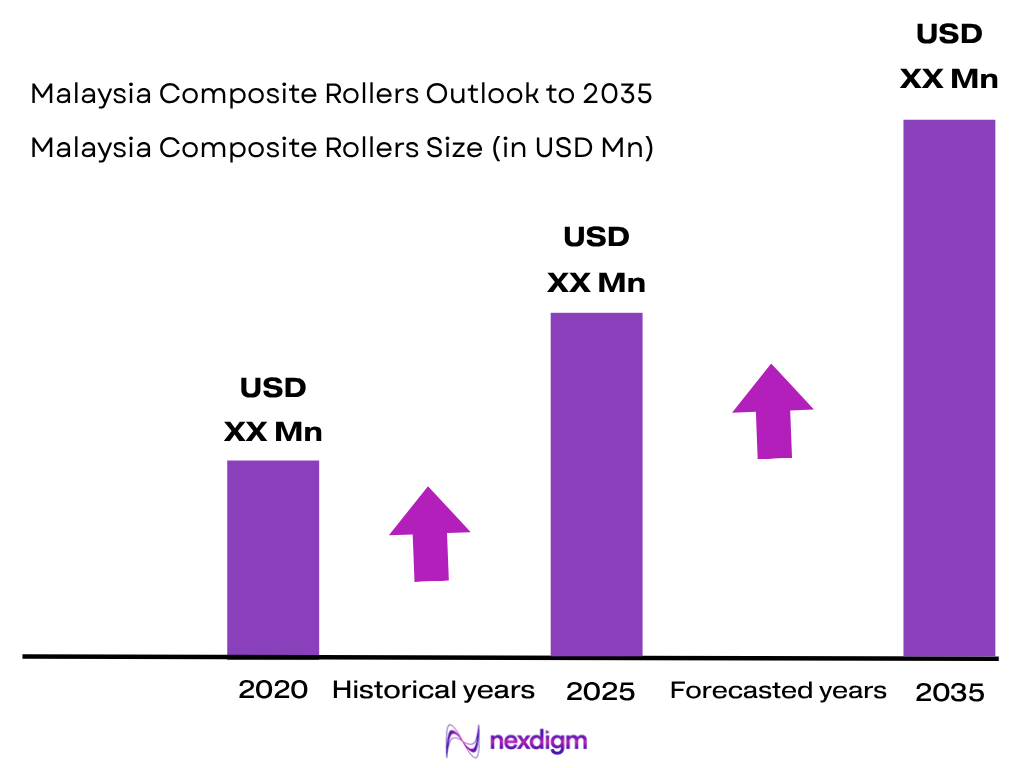
The Malaysia Composite Rollers Market is estimated at ~USD XX million in 2024, with a forecast CAGR of ~XX% during 2026-2035. The market is supported by Malaysia’s expanding manufacturing ecosystem, particularly printing, packaging, flexible-film conversion, electronics, food processing, and industrial automation. Malaysia recorded RM120.5 billion in approved manufacturing investments, covering 1,108 projects and approximately 87,695 job opportunities, creating a substantial installed base of machinery that can require lightweight, precision-engineered rollers.
Selangor, Penang, Johor, Kuala Lumpur, and Kedah represent important demand centres for Malaysia Composite Rollers Market because of their concentration of manufacturing facilities, electronics production, packaging operations, logistics infrastructure, and industrial parks. Selangor recorded RM101.1 billion in approved investments, while Kuala Lumpur recorded RM91.5 billion, Johor RM48.5 billion, Kedah RM45.8 billion, and Penang RM32.0 billion. MIDA Penang and Kedah are particularly relevant to high-precision electronics and semiconductor equipment, while Selangor and Johor provide broad manufacturing and packaging demand.
Market Segmentation
By Material Type
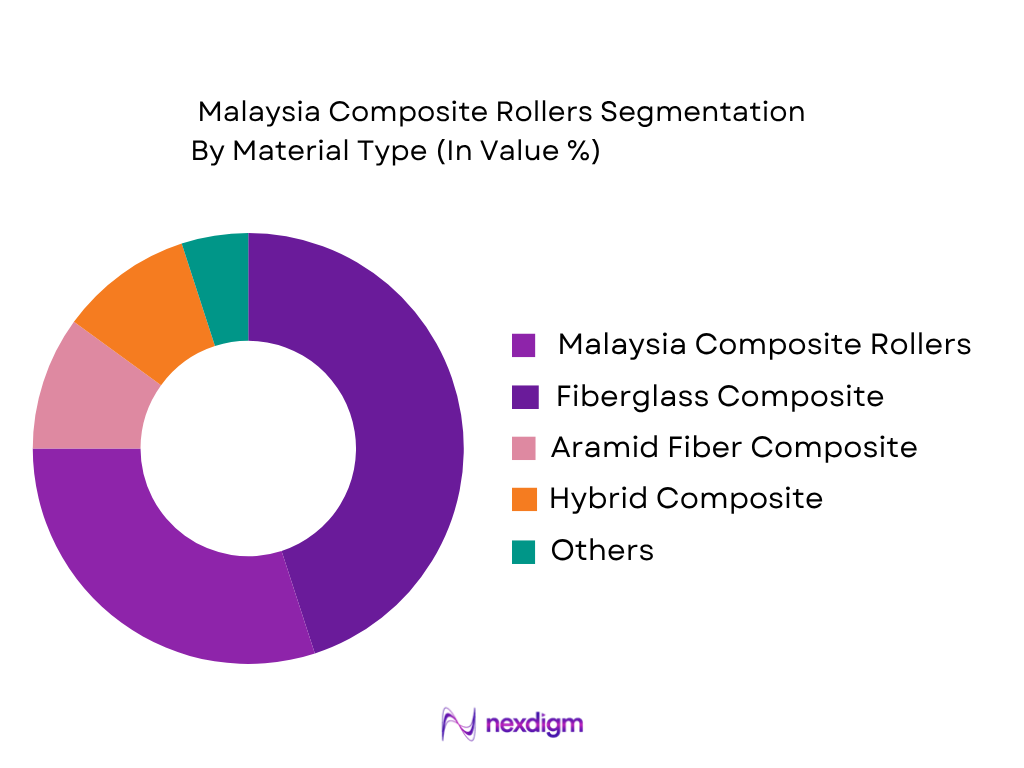
Malaysia Composite Rollers Market is segmented by material type into carbon fiber composite rollers, fiberglass composite rollers, hybrid fiber composite rollers, aramid fiber composite rollers, basalt fiber composite rollers, and glass-carbon hybrid composite rollers. Carbon fiber composite rollers are expected to represent the dominant material category, with an illustrative market share of ~XX% in 2024, because they combine low weight with high stiffness, dimensional stability, and strong dynamic performance. These characteristics are particularly relevant to high-speed printing, converting, coating, laminating, and film-processing equipment. Carbon fiber construction can reduce roller inertia and structural loading, allowing machinery designers to target higher operating speeds and faster acceleration and deceleration. Malaysia’s expanding electronics and manufacturing ecosystem also creates opportunities for precision composite components. MIDA reported RM55.8 billion of approved E&E investments within the manufacturing sector, demonstrating the scale of Malaysia’s high-value industrial ecosystem. MIDA The availability of advanced manufacturing capabilities further supports adoption of engineered composite rollers for demanding production environments.
By Application
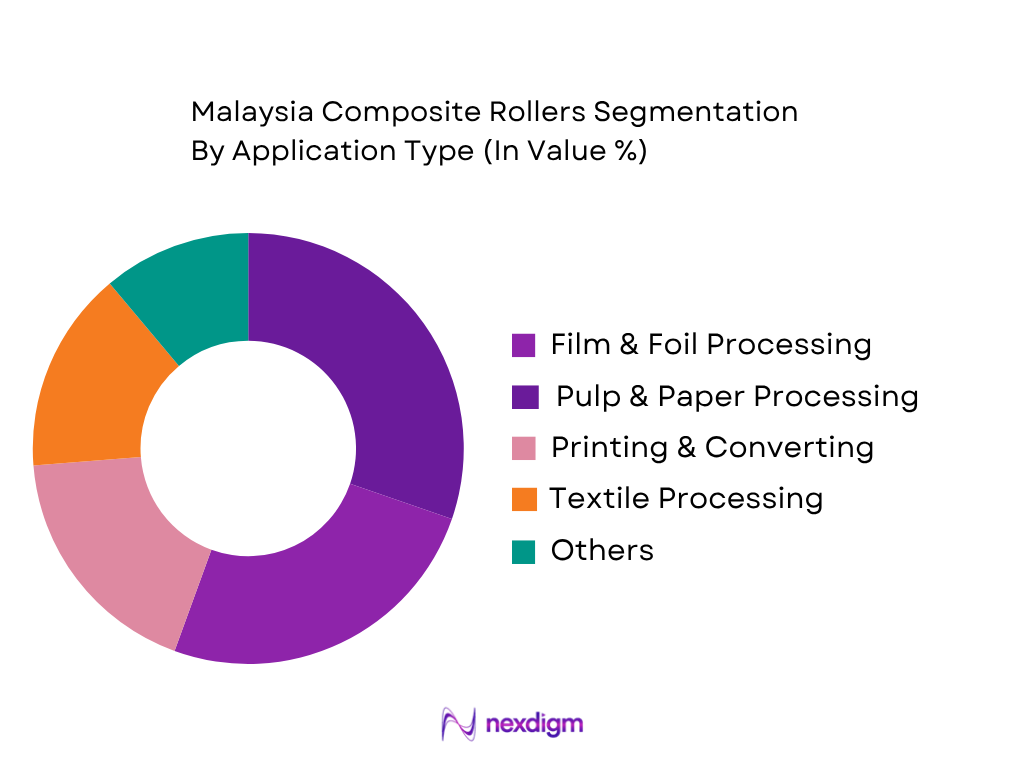
Malaysia Composite Rollers Market is segmented by application into printing and packaging, plastic film and flexible packaging, paper and corrugated processing, textile processing, laminating and coating, food processing, electronics and semiconductor processing, wood and panel processing, and industrial automation. Printing and packaging applications are expected to hold the largest position, with an illustrative market share of ~XX% in 2024, because rollers are fundamental components in web handling, tension control, printing, coating, laminating, and converting machinery. Malaysia’s substantial manufacturing base supports this application, with manufacturing sales reaching RM1.9 trillion and the electrical and electronics and basic-metal-related industries contributing to industrial activity. Department of Statistics Malaysia Flexible packaging applications particularly benefit from lightweight rollers because high-speed web-processing lines require precise tension control and stable roller geometry. Composite construction can also provide corrosion resistance in environments involving inks, coatings, adhesives, solvents, humidity, and cleaning chemicals. Increasing automation and investment in machinery and equipment provide additional opportunities for composite roller integration.
Competitive Landscape
The Malaysia Composite Rollers Market includes specialized roller manufacturers, industrial roller suppliers, rubber and polyurethane roller companies, and international composite-technology providers. Competition is shaped by material engineering capability, dynamic balancing, surface treatment, customization, manufacturing precision, and the ability to supply rollers for high-speed printing, converting, film, paper, textile, and electronics machinery. Malaysia’s manufacturing investment environment creates a broad customer base for precision machinery components. MIDA recorded 1,108 approved manufacturing projects and RM120.5 billion in approved manufacturing investments, while the machinery and equipment ecosystem continues to emphasize automation and advanced manufacturing.
| Company | Establishment Year | Headquarters | Core Roller Capability | Material Capability | Major Applications | Customization Capability | Surface Engineering | Regional Reach |
| Kossan Industries | 1979 | Malaysia | ~ | ~ | ~ | ~ | ~ | ~ |
| UKO Rubber Industries | 1980 | Malaysia | ~ | ~ | ~ | ~ | ~ | ~ |
| Dura Wheels | — | Malaysia | ~ | ~ | ~ | ~ | ~ | ~ |
| Double E Company | 1972 | United States | ~ | ~ | ~ | ~ | ~ | ~ |
| American Roller | 1934 | United States | ~ | ~ | ~ | ~ | ~ | ~ |
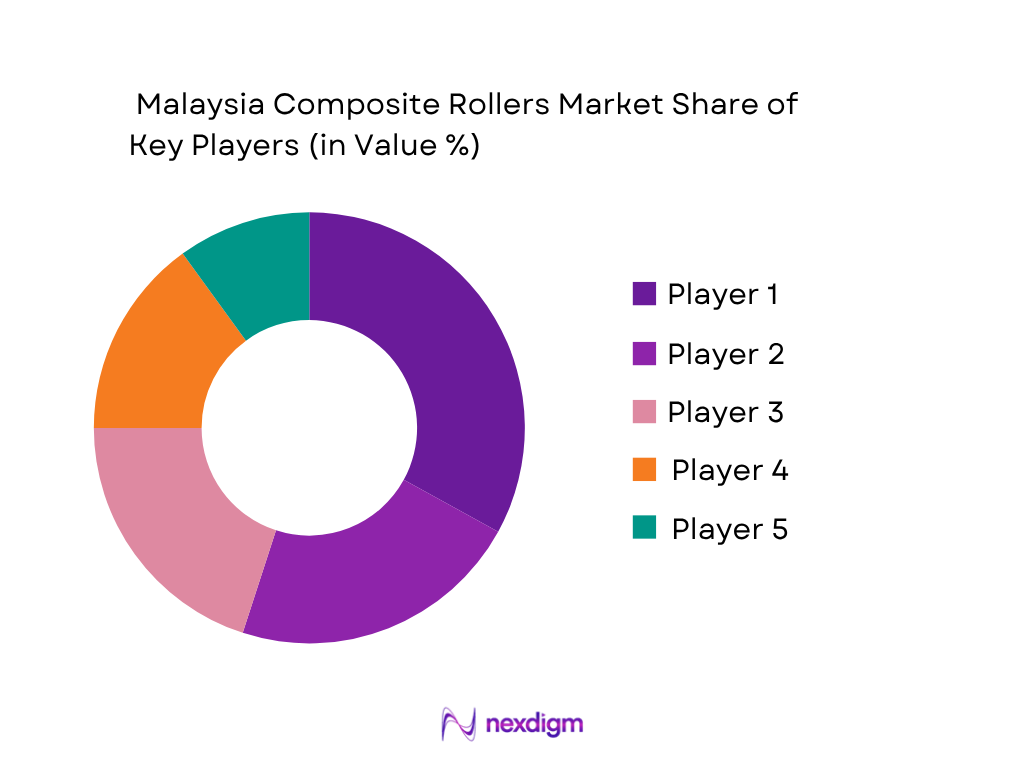
Malaysia Composite Rollers Market Analysis
Growth Drivers
Expansion of Flexible Packaging Manufacturing
Malaysia’s expanding manufacturing base is creating a broader requirement for precision web-handling equipment, including composite rollers used in film, foil, laminating, coating, slitting and converting lines. The manufacturing sector recorded RM1.9 trillion in sales in 2024, while the wood, furniture, paper products and printing subsector recorded growth of 2.0% in the fourth quarter. Malaysia’s total trade also reached RM2.9 trillion, with exports of RM1.5 trillion, reinforcing the importance of export-oriented manufacturing and packaging supply chains. Composite rollers can support these applications through lower rotating mass, dimensional stability and suitability for high-speed web processing. The manufacturing ecosystem is additionally being reinforced by RM120.5 billion in approved manufacturing investments, providing a substantial pipeline for new and upgraded production facilities. The combination of paper, printing, packaging and export manufacturing activity provides a market-specific demand base for lightweight rollers that can reduce inertial loads and support higher line speeds. This environment is particularly relevant to carbon-fiber and fiberglass roller suppliers targeting Malaysian converting and packaging equipment manufacturers, where precision, balance and controlled web tension are important operating requirements.
Electronics and Semiconductor Manufacturing Expansion
Malaysia’s electronics and semiconductor ecosystem is a major structural driver for composite rollers because advanced production equipment requires lightweight, dynamically stable and precision-engineered rotating components. The manufacturing sector’s electronic components, communication equipment and consumer electronics segment grew 4.0% in 2024, while Malaysia approved RM48.1 billion of semiconductor-industry investments across 46 projects, expected to create 21,722 employment opportunities. The investment pipeline included 20 expansion or diversification projects and 26 new projects, demonstrating activity across both established facilities and new manufacturing capacity. Malaysia’s semiconductor ecosystem is also strategically significant within international supply chains, with the government identifying semiconductor investment and advanced manufacturing as priorities under the National Semiconductor Strategy. Composite rollers can address specific requirements in electronics production, including lightweight web handling, high rotational stability, controlled thermal behavior and resistance to selected corrosive processing environments. The wider manufacturing investment environment further strengthens the addressable customer base: Malaysia recorded RM378.5 billion in approved investments across sectors in 2024, while foreign direct investment reached RM51.5 billion. These indicators support continued equipment investment and create opportunities for specialized composite roller suppliers serving semiconductor equipment, precision automation and electronics manufacturing applications.
Market Challenges
High Composite Roller Manufacturing Costs
Composite rollers face a commercialization challenge because their production requires specialized fiber materials, resin systems, controlled composite lay-up or winding, curing, precision machining, balancing and surface finishing. Malaysia’s manufacturing environment is highly integrated with international supply chains: total imports reached RM1.37 trillion in 2024, while total trade reached RM2.9 trillion. This creates exposure to imported carbon fiber, specialty resins, precision components and production technologies where local availability may be narrower than for conventional metallic roller materials. The manufacturing sector nevertheless remains substantial, recording RM1.9 trillion in sales in 2024, meaning composite rollers compete against established metallic solutions across a large industrial customer base. For purchasers, the decision therefore depends not only on initial acquisition expenditure but also on operating requirements such as rotational speed, allowable deflection, dynamic balance, thermal stability and maintenance intervals. The technical qualification process can also lengthen adoption because rollers may need application-specific engineering rather than standardized replacement. Malaysia’s RM120.5 billion in approved manufacturing investments indicates a strong industrial investment pipeline, but suppliers must demonstrate measurable operational benefits within individual production lines to overcome established purchasing practices.
Dependence on Imported Carbon Fiber Materials
Dependence on international supply chains presents a specific challenge for Malaysian composite-roller manufacturers and equipment integrators, particularly where high-modulus or specialized carbon-fiber reinforcement is required. Malaysia imported RM1.37 trillion of goods in 2024, while intermediate, capital and consumption-goods imports all reached record levels, illustrating the scale of external industrial-input dependence. At the same time, Malaysia’s semiconductor and electronics industries are increasingly investment intensive: the semiconductor sector alone attracted RM48.1 billion in approved investments across 46 projects. This creates opportunities for advanced composite applications but also raises expectations for reliable material availability, documented specifications and consistent production quality. Carbon-fiber roller production can require controlled fiber architecture, resin compatibility, curing conditions and precision machining, meaning substitution between material grades may not be straightforward. Imported materials can consequently introduce lead-time and qualification considerations for roller manufacturers serving high-speed printing, converting, electronics and precision manufacturing lines. The challenge is amplified where customers require application-specific mechanical properties rather than generic composite components. Developing stronger domestic composite-processing capabilities could reduce these constraints over time, but current industrial supply chains remain deeply connected to imported materials and components.
Market Opportunities
Flexible Packaging Production Expansion
Continued expansion of Malaysia’s export-oriented manufacturing ecosystem creates an opportunity for composite rollers in flexible packaging, film converting, printing, laminating, coating and slitting equipment. Malaysia recorded RM1.5 trillion in exports and RM2.9 trillion in total trade in 2024, while manufacturing sales reached RM1.9 trillion. The country also recorded RM120.5 billion in approved manufacturing investments, supporting continued development and modernization of production facilities. Within manufacturing, the wood, furniture, paper products and printing subsector contributed to fourth-quarter expansion, indicating continuing activity across industries that use web-processing machinery. Composite rollers can be positioned in these applications where equipment operators require reduced rotating inertia, high-speed stability, controlled deflection and resistance to demanding production environments. The opportunity is not limited to direct roller replacement: new converting lines, machinery upgrades and production-line automation can create demand for engineered rollers designed around specific web widths, operating speeds and load requirements. Malaysia’s manufacturing investment environment therefore provides a basis for suppliers to develop application-specific composite roller solutions rather than compete solely as replacement-component vendors. Greater integration of precision manufacturing and automation can further increase the relevance of dynamically balanced carbon-fiber and fiberglass roller designs in high-speed web-processing equipment.
Electronics Manufacturing Applications
Malaysia’s rapidly developing electronics and semiconductor ecosystem creates an opportunity for composite rollers in precision manufacturing equipment, semiconductor processing systems, automated material handling and specialized web-processing applications. The electronic components, communication equipment and consumer electronics segment recorded 4.0% growth in 2024, while semiconductor-related projects attracted RM48.1 billion in approved investments across 46 projects and generated 21,722 planned employment opportunities. The broader investment pipeline is also substantial, with Malaysia securing RM378.5 billion in approved investments across the economy and RM120.5 billion within manufacturing. These figures indicate an industrial environment in which manufacturers are adding and upgrading production capacity, creating opportunities for engineered components with specific weight, dynamic-performance and dimensional-stability characteristics. Composite rollers can be particularly relevant where lower rotating mass supports faster acceleration and deceleration, while carbon-fiber construction can provide a high stiffness-to-weight ratio for precision applications. Suppliers can therefore target semiconductor equipment manufacturers, electronics production lines and automation integrators with application-specific roller assemblies rather than treating composite rollers as generic replacements for steel or aluminum. Malaysia’s established electronics supply chain and continuing semiconductor investment provide a concrete industrial base for this opportunity.
Future Outlook
The Malaysia Composite Rollers Market is expected to develop alongside the country’s advanced manufacturing, packaging, electronics, semiconductor, and industrial automation ecosystems. Demand will increasingly favour lightweight rollers capable of operating at higher speeds while maintaining dimensional stability and dynamic balance. Carbon-fiber and hybrid composite construction should receive attention where machinery manufacturers seek lower inertia and improved mechanical performance. Malaysia’s strong manufacturing investment pipeline provides a supporting environment for adoption, with RM120.5 billion of approved manufacturing investments recorded and RM55.8 billion directed toward E&E activities.
Major Players
- Kossan Industries Sdn. Bhd.
- UKO Rubber Industries Sdn. Bhd.
- Verstaerker Rolle (M) Sdn. Bhd.
- Dura Wheels Sdn. Bhd.
- Euroshore Sdn. Bhd.
- Haridsen Industries (M) Sdn. Bhd.
- Xinya Printing Machinery (M) Sdn. Bhd.
- Double E Company
- American Roller Company
- Menges Roller Company
- Webex Inc.
- Western Machine Works
- Maxcess
- Carbon Light
- Epsilon Composite
Key Target Audience
- Printing and packaging machinery manufacturers
- Flexible-film and converting equipment manufacturers
- Paper and corrugated processing companies
- Electronics and semiconductor manufacturing companies
- Industrial automation and machinery manufacturers
- Investments and venture capitalist firms
- Government and regulatory bodies (Malaysian Investment Development Authority, Ministry of Investment, Trade and Industry, Department of Occupational Safety and Health)
- Industrial component distributors and engineering procurement organizations
Research Methodology
Step 1: Identification of Key Variables
The initial phase involves mapping Malaysia’s composite roller ecosystem across material suppliers, roller manufacturers, machinery OEMs, industrial distributors, and end users. Key variables include roller material, diameter, length, weight, operating speed, load capacity, surface finish, dynamic balance, and application environment.
Step 2: Market Analysis and Construction
Historical and current information is compiled across printing, packaging, plastics, paper, textiles, electronics, food processing, and industrial automation. The assessment examines installed machinery, replacement requirements, composite penetration, production capabilities, imports, exports, and procurement patterns.
Step 3: Hypothesis Validation and Expert Consultation
Market hypotheses are validated through discussions with roller manufacturers, machinery OEMs, industrial users, distributors, and composite-material specialists. Interviews focus on material preferences, replacement cycles, technical specifications, customization requirements, and purchasing criteria.
Step 4: Research Synthesis and Final Output
The final analysis triangulates manufacturer information, industrial indicators, company disclosures, trade information, and application-level demand assessments. The resulting framework is used to establish market segmentation, competitive positioning, application opportunities, and the long-term outlook for Malaysia Composite Rollers Market.

- Executive Summary
- Research Methodology (Market Definitions and Assumptions, Malaysia Composite Rollers Market Classification, Composite Roller Technology Mapping, Carbon Fiber Composite Roller Assessment, Fiberglass Composite Roller Evaluation, Polymer Matrix Composite Assessment, Thermoset and Thermoplastic Composite Analysis, Filament Winding Process Assessment, Roll-Wrapping Technology Evaluation, Pultrusion Process Assessment, Composite Core Manufacturing Analysis, Roller Surface Engineering Assessment, Dynamic Balancing Assessment, Runout and Deflection Analysis, Load Capacity Evaluation, Thermal Resistance Assessment, Corrosion Resistance Assessment, Weight Reduction Analysis, High-Speed Web Handling Assessment, Industrial Application Mapping, Manufacturing Capability Assessment, Domestic Supply Assessment, Import Dependency Assessment, Demand-Side Assessment, Supply-Side Assessment, Top-Down Market Sizing, Bottom-Up Market Sizing, Primary Industry Interviews, Data Triangulation, Forecasting Framework, Limitations and Future Conclusions)

- Definition and Scope
- Malaysia Composite Rollers Industry Evolution
- Composite Rollers Value Chain Analysis
- Composite Rollers Supply Chain Analysis

- Growth Drivers (Expansion of Flexible Packaging Manufacturing, Growth of Printing and Converting Operations, Electronics and Semiconductor Manufacturing Expansion, Industrial Automation Adoption, Textile Manufacturing Activity, Paper and Corrugated Packaging Demand, Lightweight Machinery Requirements, High-Speed Web Processing Requirements, Growth of Precision Manufacturing)
- Market Challenges (High Composite Roller Manufacturing Costs, Limited Local Composite Roller Specialization, Dependence on Imported Carbon Fiber Materials, Complex Composite Machining Requirements, Limited Standardization Across Industrial Applications, High Initial Replacement Costs, Technical Qualification Requirements, Maintenance and Repair Complexity, Supply Chain Dependence)
- Market Opportunities (Flexible Packaging Production Expansion, Electronics Manufacturing Applications, Carbon Fiber Roller Adoption, High-Speed Printing and Converting Applications, Lightweight Industrial Equipment Development, Advanced Composite Manufacturing Localization, Precision Web Handling Solutions, Semiconductor Manufacturing Equipment, Automated Production Line Modernization)
- Market Trends (Carbon Fiber Roller Adoption, Lightweight Roller Design, High-Speed Web Handling, Precision Dynamic Balancing, Hybrid Composite Construction, Advanced Surface Coatings, Automated Composite Manufacturing, Low-Inertia Roller Development, Sustainable Composite Materials)
- Government Regulations and Standards (Malaysian Occupational Safety and Health Requirements, Department of Occupational Safety and Health Requirements, Standards Malaysia Requirements, SIRIM Standards, Environmental Quality Requirements, Machinery Safety Requirements, Industrial Equipment Standards, Electrical and Electronics Manufacturing Requirements, Packaging Manufacturing Requirements)
- SWOT Analysis
- Porter’s Five Forces Analysis
- PESTLE Analysis
- Stakeholder Ecosystem
- Competition Ecosystem

- By Market Value (2020-2025)
- By Composite Roller Production Volume (2020-2025)
- By Installed Roller Units (2020-2025)
- By Composite Roller Consumption Volume (2020-2025)
- By Carbon Fiber Composite Roller Volume (2020-2025)
- By Fiberglass Composite Roller Volume (2020-2025)

- By Material Type (In Value %)
Carbon Fiber Composite Rollers
Fiberglass Composite Rollers
Hybrid Fiber Composite Rollers
Aramid Fiber Composite Rollers
Basalt Fiber Composite Rollers
Glass-Carbon Hybrid Composite Rollers - By Resin Matrix Type (In Value %)
Epoxy Matrix Composite Rollers
Polyester Matrix Composite Rollers
Vinyl Ester Matrix Composite Rollers
Polyurethane Matrix Composite Rollers
Thermoplastic Matrix Composite Rollers
High-Temperature Resin Composite Rollers - By Roller Type (In Value %)
Idler Rollers
Guide Rollers
Spreader Rollers
Tension Control Rollers
Pressure Rollers
Drive Rollers
Cooling Rollers
Heating Rollers
Coating Rollers - By Application (In Value %)
Printing and Packaging
Plastic Film and Flexible Packaging
Paper and Corrugated Processing
Textile Processing
Laminating and Coating
Food Processing
Electronics and Semiconductor Processing
Wood and Panel Processing
Material Handling and Automation - By End-Use Industry (In Value %)
Printing Industry
Packaging Industry
Plastic Film Industry
Paper Industry
Textile Industry
Food and Beverage Industry
Electronics and Semiconductor Industry
Wood and Furniture Industry
Industrial Manufacturing - By Region (In Value %)
Selangor
Penang
Johor
Kuala Lumpur
Perak
Negeri Sembilan
Sarawak
Sabah
Rest of Malaysia

- Market Share of Major Players (By Revenue, Material Type, Roller Type, Application, End-Use Industry, Manufacturing Capacity, Carbon Fiber Capability, Fiberglass Capability, Customization Capability, Surface Treatment Capability, Distribution Reach)
- Cross Comparison Parameters (Composite Material Technology Capability, Roller Weight Reduction Performance, Maximum Operating Speed Capability, Dynamic Balancing Precision, Load Bearing Capability, Thermal Resistance Performance, Surface Engineering Capability, Industry-Specific Application Experience)
- SWOT Analysis of Major Players
- Detailed Profiles of Major Companies
Kossan Industries Sdn. Bhd.
Verstaerker Rolle (M) Sdn Bhd
UKO Rubber Industries Sdn Bhd
Euroshore Sdn Bhd
Dura Wheels Sdn Bhd
Haridsen Industries (M) Sdn Bhd
Xinya Printing Machinery (M) Sdn Bhd
Epsilon Composite
Double E Company
Menges Roller Company
Webex Inc.
Western Machine Works
American Roller Company
Maxcess
Carbon Light

- Printing Machinery Requirement Assessment
- Flexible Packaging Machinery Demand Analysis
- Plastic Film Processing Requirement Assessment
- Paper and Corrugated Processing Requirement Analysis
- Textile Machinery Roller Requirement Assessment
- Electronics and Semiconductor Equipment Assessment
- Food Processing Equipment Requirement Analysis
- Industrial Automation Roller Requirement Assessment

- By Market Value (2026-2035)
- By Composite Roller Production Volume (2026-2035)
- By Installed Roller Units (2026-2035)
- By Composite Roller Consumption Volume (2026-2035)
- By Carbon Fiber Composite Roller Volume (2026-2035)
- By Fiberglass Composite Roller Volume (2026-2035)


 Request a Sample
 Ask for Customization
 Get a Quote
 Enquire Now