
 Download PDF
Market Overview
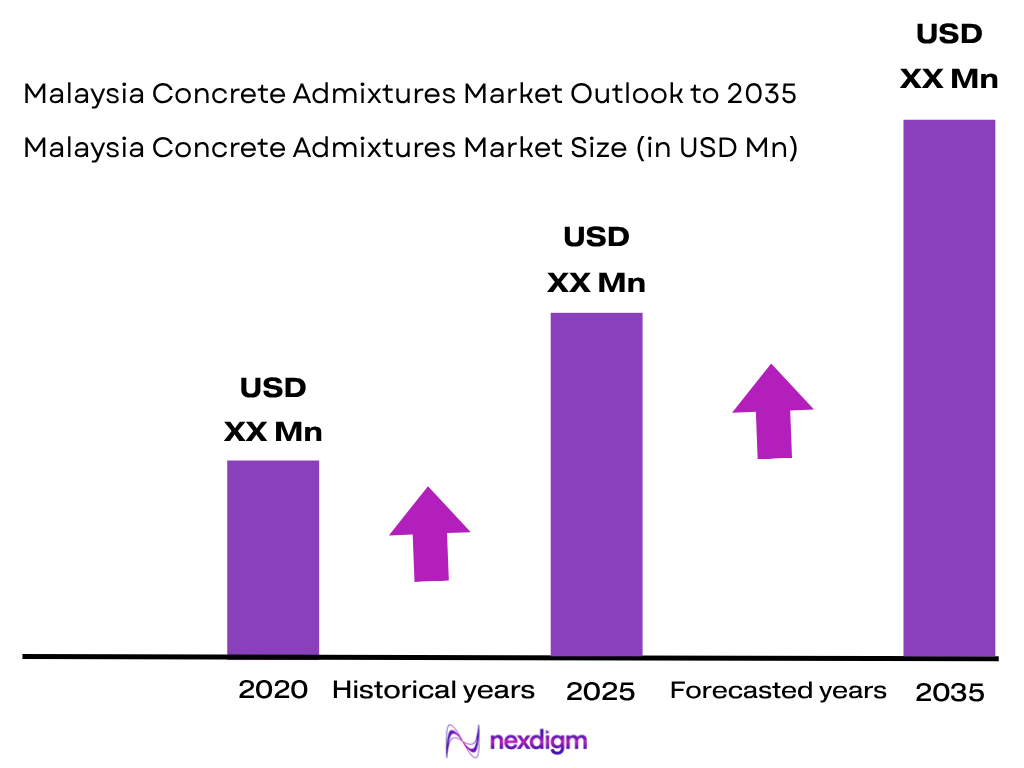
The Malaysia Concrete Admixtures Market is valued at approximately ~USD XX million, supported by expanding ready-mix consumption, infrastructure development, industrial construction and data-centre investment. Construction work completed increased from RM132.2 billion to RM158.8 billion across the latest two annual observations. Non-residential construction, residential projects and civil engineering consequently generate sustained demand for superplasticizers, retarders, waterproofing agents, accelerators and durability-enhancing concrete admixtures.
Selangor, Johor, Kuala Lumpur and Sarawak dominate Malaysia Concrete Admixtures demand because they concentrate large building, industrial and infrastructure pipelines. In the latest quarterly observation, construction work reached RM9.4 billion in Selangor, RM7.4 billion in Johor, RM4.7 billion across the Federal Territories and RM4.6 billion in Sarawak. Johor’s expanding non-residential and data-centre ecosystem particularly strengthens requirements for high-strength, pumped, waterproof and mass-concrete admixture systems.
Market Segmentation
By Product Type
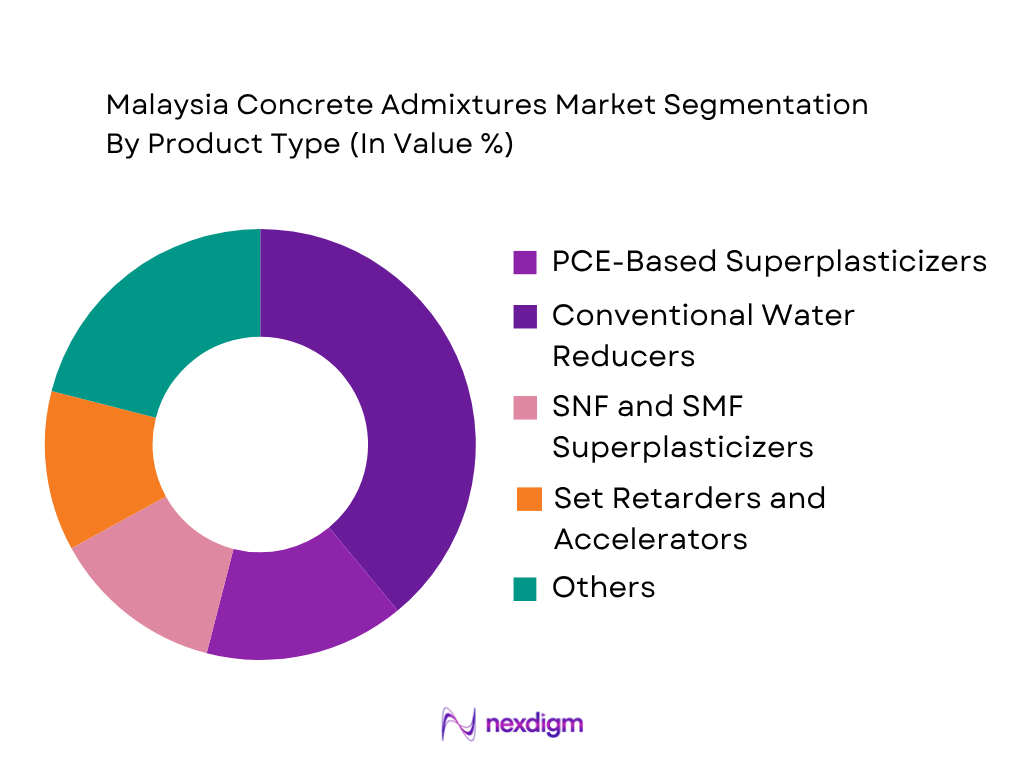
The Malaysia Concrete Admixtures Market is segmented by product type into PCE-based superplasticizers, conventional water reducers, SNF and SMF superplasticizers, set retarders and accelerators, waterproofing admixtures, viscosity modifiers and other specialty admixtures. PCE-based superplasticizers represent the dominant segment because Malaysia’s ready-mix, high-rise, infrastructure and data-centre projects increasingly require substantial water reduction combined with long slump retention. PCE chemistry allows concrete producers to tailor dispersion and workability for tropical operating conditions, long transport periods and extensive pumping. Modern Malaysian product portfolios already include PCE-based superplasticizers developed for ready-mix applications and extra-long workability retention. The shift toward high-strength concrete, self-compacting mixes, large raft foundations and more efficient binder use also favours PCE technology over older-generation water reducers. Mapei Malaysia, for example, markets multiple PCE-based systems for ready-mix, precast, extended workability and more sustainable concrete production, demonstrating the increasing technical importance of this chemistry in the country.
By Concrete Type
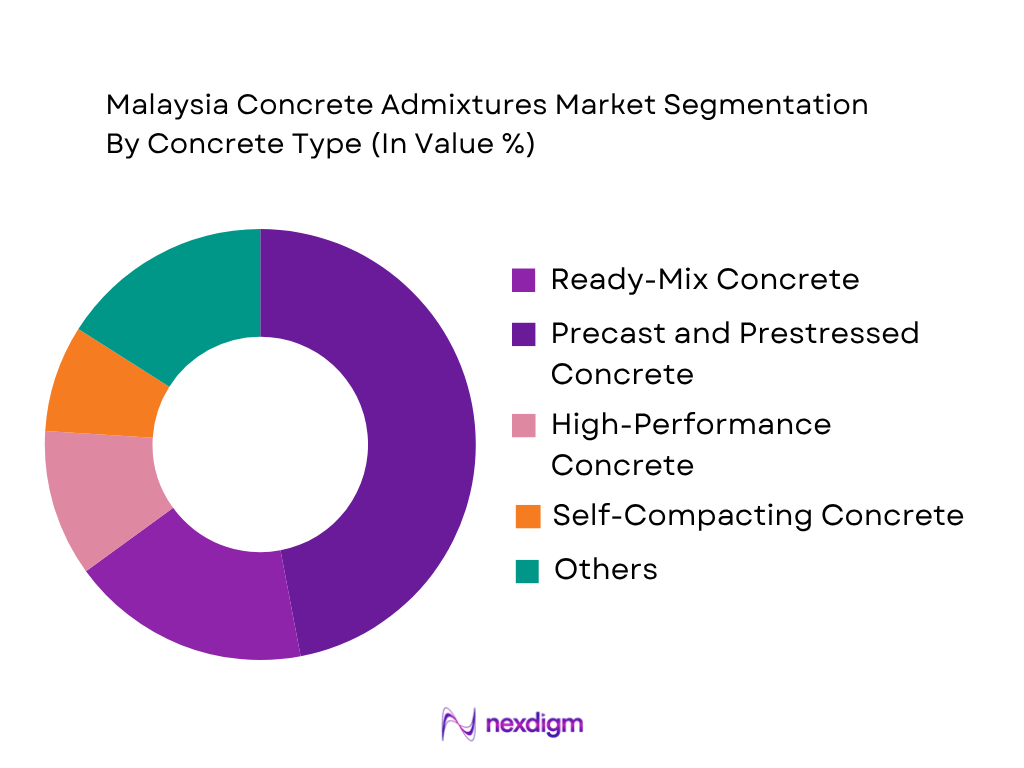
The Malaysia Concrete Admixtures Market is segmented by concrete type into ready-mix concrete, precast and prestressed concrete, high-performance concrete, self-compacting concrete, mass concrete, shotcrete and other specialty concrete. Ready-mix concrete holds the dominant position because Malaysia’s urban and industrial construction ecosystem increasingly depends on centralized batching and controlled delivery to high-rise, commercial, infrastructure and data-centre projects. Ready-mix plants require reliable slump retention, pumping performance, delayed setting under tropical conditions and consistent compatibility with locally available cement and supplementary cementitious materials. Construction work completed reached RM158.8 billion in the latest full annual observation, with residential, non-residential and civil engineering projects all contributing to concrete consumption. Malaysia-specific product portfolios from Sika and Mapei also emphasize ready-mix applications, high-strength concrete, watertight concrete and extended-workability systems. As Johor and Klang Valley projects become larger and more technically demanding, ready-mix producers increasingly rely on admixture suppliers for mix optimization, dosage calibration and concrete-performance troubleshooting.
Competitive Landscape
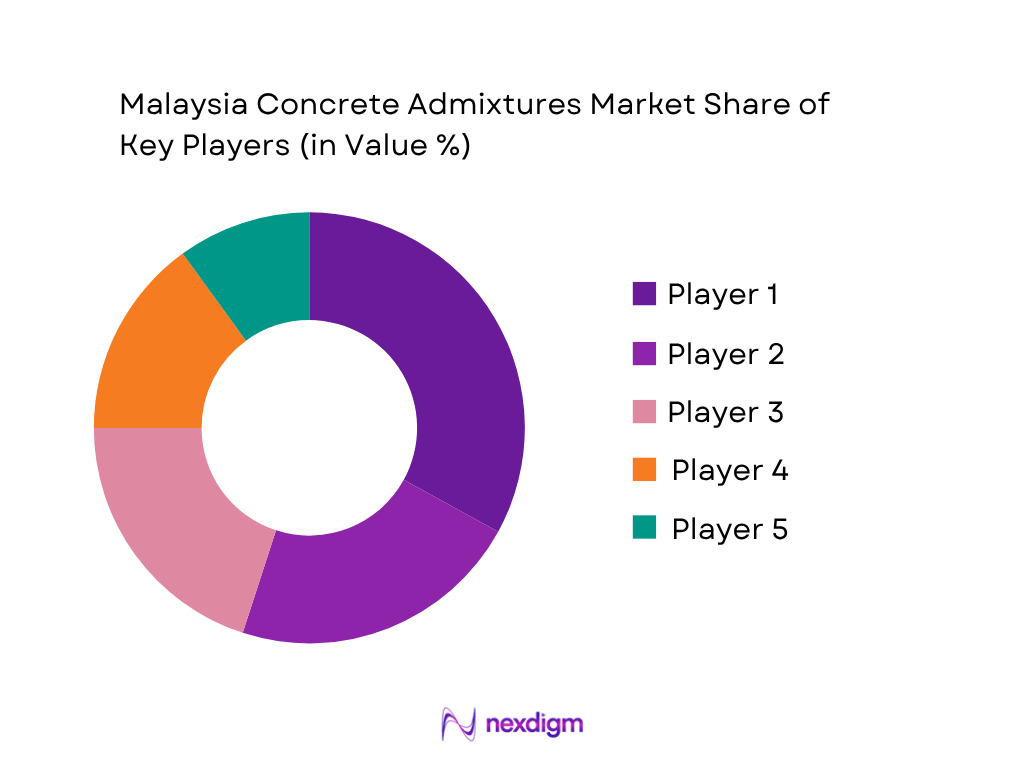
The Malaysia Concrete Admixtures Market combines global construction-chemical manufacturers with regional and local suppliers competing across superplasticizers, waterproofing, durability systems, precast solutions and technical concrete services. Sika, Mapei, Fosroc, CHRYSO and GCP possess broad technology portfolios suited to ready-mix, precast and infrastructure applications. Competitive differentiation increasingly depends on PCE formulation capability, cement compatibility testing, long-slump-retention performance, field troubleshooting, local inventory and the ability to support data-centre and infrastructure concrete specifications. Sika maintains a dedicated Malaysian concrete-admixtures operation, while Mapei operates a local Concrete Admixtures Division and CHRYSO maintains a Kuala Lumpur presence.
| Company | Establishment Year | Headquarters | Superplasticizer Capability | Slump-Retention Capability | Precast / Early-Strength Capability | Waterproofing / Durability | Technical Mix Support | Malaysia Presence |
| Sika | 1910 | Baar, Switzerland | ~ | ~ | ~ | ~ | ~ | ~ |
| Mapei | 1937 | Milan, Italy | ~ | ~ | ~ | ~ | ~ | ~ |
| Fosroc | 1972 | Dubai, UAE | ~ | ~ | ~ | ~ | ~ | ~ |
| CHRYSO | 1942 | Courbevoie, France | ~ | ~ | ~ | ~ | ~ | ~ |
| GCP Applied Technologies | 2016 | Alpharetta, USA | ~ | ~ | ~ | ~ | ~ | ~ |
Malaysia Concrete Admixtures Market Analysis
Growth Drivers
Data Centre Construction and Non-Residential Concrete Demand
Malaysia’s rapid build-out of data centres and other non-residential facilities is creating a stronger requirement for high-performance concrete admixtures used in raft foundations, heavily reinforced structural elements, waterproof basements and large continuous pours. Malaysia recorded RM158.8 billion of construction work in 2024, while non-residential activity remained one of the principal contributors to industry expansion. Johor alone recorded RM7.4 billion of construction work in the final quarter, including RM3.0 billion from non-residential buildings. Digital infrastructure adds another layer of demand: 12 data-centre projects worth RM90.2 billion had received approval through June 2024, while 10 operating data centres were reported in Johor during 2024. In 2025, national construction work increased further to RM178.6 billion, supported by continued strength in non-residential buildings. Malaysia’s macroeconomic base also remained supportive, with 2024 GDP at approximately USD 422.23 billion and GDP per capita at USD 11,874.4. These conditions favour PCE superplasticizers, retarders, crystalline waterproofing admixtures and shrinkage-control systems that enable longer slump retention, lower water demand and controlled mass-concrete placement.
Infrastructure, Ready-Mix and Industrial Construction Expansion
Malaysia’s expanding civil-engineering, manufacturing and urban construction pipeline is increasing consumption of concrete admixtures across ready-mix, precast and infrastructure applications. Construction work reached RM158.8 billion in 2024, with civil-engineering work in the fourth quarter alone contributing RM15.6 billion, including RM6.9 billion from roads and railways and RM6.8 billion from utility projects. Approved investments across the economy reached RM378.5 billion during 2024, spanning 6,700 projects, while manufacturing accounted for RM120.5 billion. In 2025, approved investments climbed to RM426.7 billion, and construction work rose to RM178.6 billion, enlarging the pipeline of factories, warehouses, transport infrastructure and utility assets requiring concrete. Malaysia’s GDP stood at approximately USD 422.23 billion in 2024, with GDP per capita of USD 11,874.4, providing a broad macroeconomic foundation for sustained construction activity. Ready-mix producers serving these projects require admixtures that provide controlled workability, improved pumpability, faster strength development and consistent water reduction. This directly supports demand for PCE superplasticizers, retarders, accelerators and multi-functional performance admixtures.
Market Challenges
Cement Compatibility and Rapid Slump Loss under Tropical Conditions
Malaysia’s concrete admixture market faces a technical challenge from hot-weather workability loss and variation in cement and supplementary cementitious material characteristics. Large urban and infrastructure projects depend heavily on centralized ready-mix production, meaning concrete must retain its workability during transport, queuing and pumping. The scale of this requirement is substantial: construction work reached RM158.8 billion in 2024 and expanded further to RM178.6 billion in 2025, increasing the number of technically demanding pours handled by ready-mix suppliers. Selangor alone recorded RM9.4 billion of construction work in the final quarter of 2024, while Johor recorded RM7.4 billion, creating concentrated demand in regions where transport congestion and high ambient temperatures can accelerate slump loss. Malaysia’s 2024 GDP reached approximately USD 422.23 billion, while GDP per capita stood at USD 11,874.4, supporting a mature construction ecosystem but also increasing expectations for predictable high-performance concrete. PCE chemistry can react differently with cement fineness, sulfate balance, slag, fly ash and aggregate fines, so suppliers must conduct plant-level compatibility testing rather than rely on one universal formulation across Malaysia.
Dependence on Imported Specialty Chemical Feedstocks
Malaysia’s concrete admixture sector remains exposed to imported specialty chemical inputs used in PCE superplasticizers, waterproofing systems, shrinkage reducers and other advanced formulations. National imports reached RM1,370.2 billion in 2024, while total merchandise trade reached approximately RM2.9 trillion, illustrating the scale of Malaysia’s integration with international supply chains. This creates operational exposure for admixture manufacturers that depend on polyether monomers, acrylic derivatives, specialty surfactants, preservatives and functional polymers sourced across Asia and other regions. The challenge becomes more significant as construction demand expands: construction work increased from RM158.8 billion in 2024 to RM178.6 billion in 2025, while manufacturing investment reached RM120.5 billion in 2024, adding more industrial projects requiring consistent concrete performance. Malaysia’s GDP stood at USD 422.23 billion in 2024, with GDP per capita at USD 11,874.4, demonstrating substantial domestic demand but not eliminating dependence on external chemical supply. Any disruption in feedstock availability can complicate production scheduling, reformulation and batch consistency. Suppliers with local blending capacity, multiple approved raw-material sources and larger safety stocks therefore hold a stronger competitive position.
Market Opportunities
PCE Superplasticizers and Long Slump-Retention Systems
Malaysia presents a strong future opportunity for advanced PCE-based superplasticizers and long-retention admixture systems because the current construction pipeline increasingly involves high-rise buildings, data centres, infrastructure and industrial facilities requiring long pumping distances and tightly controlled workability. Construction work reached RM158.8 billion in 2024 and increased to RM178.6 billion in 2025, demonstrating a substantial operating base for continued admixture adoption. Data-centre activity is particularly relevant: 12 projects worth RM90.2 billion had received approval through June 2024, while digital investments reached RM141.72 billion during the first ten months of 2024. In 2025, information and communications attracted RM152.9 billion of approved investments, reflecting continued expansion of digital infrastructure. Malaysia’s 2024 GDP stood at approximately USD 422.23 billion, with GDP per capita at USD 11,874.4, supporting continued demand for technically advanced construction materials. These current conditions create a foundation for future adoption of customized PCE polymers offering higher water reduction, extended slump retention, improved pumping characteristics and better compatibility with slag- and fly-ash-containing binders used in large-scale Malaysian concrete projects.
Low-Carbon Concrete, Precast and High-Productivity Admixture Systems
Malaysia’s growing manufacturing and construction investment base creates future opportunities for admixtures that improve binder efficiency, accelerate precast production and support lower-carbon concrete formulations. Approved investments reached RM378.5 billion in 2024 across 6,700 projects, including RM120.5 billion in manufacturing. This expanded further to RM426.7 billion in 2025, while the first half of 2026 recorded RM218.5 billion across 2,746 approved projects, including RM51.3 billion in manufacturing. These investments translate into factories, industrial campuses, warehouses and supporting infrastructure that increasingly use precast piles, beams, wall panels and high-performance ready-mix concrete. Malaysia’s GDP stood at approximately USD 422.23 billion in 2024, while GDP per capita reached USD 11,874.4, providing the macroeconomic capacity for more advanced material specifications. Admixtures that enable lower water-cement ratios, faster demoulding, higher supplementary-cementitious-material usage and improved durability can help contractors shorten production cycles while improving structural performance. Future opportunities therefore extend beyond conventional water reducers toward high-early-strength PCE systems, shrinkage reducers, viscosity modifiers, waterproofing technologies and mix-optimization services tailored to precast and low-clinker concrete applications.
Future Outlook
The Malaysia Concrete Admixtures Market is expected to expand at approximately ~XX.X% CAGR during 2026–2035, supported by non-residential development, infrastructure investment, data centres, industrial projects and increasing technical requirements for high-performance concrete. Growth will progressively shift toward PCE superplasticizers, long-slump-retention technologies, integral waterproofing systems and admixtures designed to improve binder efficiency. Malaysia recorded RM378.5 billion in approved investments in 2024, compared with RM329.5 billion in the preceding period. Selangor attracted RM101.1 billion, Kuala Lumpur RM91.5 billion and Johor RM48.5 billion, providing a substantial development pipeline for industrial, commercial and technology-related construction.
Major Players
- Sika Kimia Sdn. Bhd.
- Mapei Malaysia Sdn. Bhd.
- Fosroc Malaysia
- CHRYSO Malaysia
- GCP Applied Technologies
- MC-Bauchemie Malaysia
- Normet Malaysia
- Xypex Chemical Corporation
- Kryton International
- Penetron International
- Euclid Chemical
- MUHU Construction Materials
- Kao Chemicals
- Denka Construction Solutions Malaysia
- Pentens Holdings Sdn. Bhd.
Key Target Audience
- Concrete Admixture and Construction Chemical Manufacturers
- Ready-Mix Concrete Producers
- Precast, Prestressed and IBS Component Manufacturers
- Cement Manufacturers
- Infrastructure, EPC and General Contractors
- Property, Industrial and Data Centre Developers
- Investments and Venture Capitalist Firms
- Government and Regulatory Bodies (Construction Industry Development Board Malaysia, Ministry of Works Malaysia, Department of Standards Malaysia, SIRIM Berhad)
Research Methodology
Step 1: Identification of Key Variables
The initial phase develops an ecosystem map covering admixture manufacturers, chemical feedstock suppliers, cement producers, ready-mix operators, precast manufacturers, contractors, developers and distributors. Key variables include concrete volume, admixture dosage, PCE penetration, water-reduction requirement, slump-retention duration, concrete application, cement type, regional construction activity and project specification.
Step 2: Market Analysis and Construction
Historical market development is evaluated through top-down and bottom-up approaches. The top-down framework analyses Malaysian construction work, infrastructure activity, industrial investment and development pipelines. The bottom-up assessment estimates admixture consumption using ready-mix volumes, precast production, average dosage, product chemistry, project type and concrete performance requirements.
Step 3: Hypothesis Validation and Expert Consultation
Market hypotheses are validated through structured interviews with admixture manufacturers, ready-mix producers, cement companies, precast manufacturers, concrete technologists and contractors. These consultations validate PCE usage, SNF substitution, slump-retention requirements, cement compatibility, dosage practices, technical specifications, supplier qualification and purchasing behaviour.
Step 4: Research Synthesis and Final Output
The final phase triangulates primary research with construction statistics, investment data, company product portfolios and concrete-technology benchmarks. Top-down construction demand is reconciled with bottom-up admixture-consumption estimates to develop market segmentation, competitive positioning, product trends, regional opportunities and the final outlook for the Malaysia Concrete Admixtures Market.

- Executive Summary
- Research Methodology (Market Definitions and Assumptions, Malaysia Concrete Admixtures Market Classification, Chemical Admixture Scope, Water-Reducing Admixture Assessment, High-Range Water Reducer Assessment, PCE Superplasticizer Assessment, SNF Superplasticizer Assessment, SMF Superplasticizer Assessment, Retarding Admixture Assessment, Accelerating Admixture Assessment, Air-Entraining Admixture Assessment, Waterproofing Admixture Assessment, Crystalline Waterproofing Admixture Assessment, Shrinkage-Reducing Admixture Assessment, Corrosion-Inhibiting Admixture Assessment, Viscosity-Modifying Admixture Assessment, Ready-Mix Concrete Assessment, Precast and Prestressed Concrete Assessment, High-Performance Concrete Assessment, Self-Compacting Concrete Assessment, Infrastructure Concrete Assessment, Cement Compatibility Assessment, Slump Retention Assessment, Water Reduction Assessment, Early Strength Assessment, Setting-Time Assessment, Pumpability Assessment, MS EN 934-2 Compliance Assessment, CIDB Ready-Mixed Concrete Assessment, Supply-Side Assessment, Demand-Side Assessment, Top-Down Market Sizing, Bottom-Up Concrete-Volume-Based Sizing, Primary Industry Interviews, Construction Project Pipeline Assessment, Ready-Mix Plant Mapping, Precast Plant Mapping, Data Triangulation, Forecasting Framework)

- Definition and Scope
- Malaysia Concrete Admixtures Industry Evolution and Development of Conventional Water Reducers, Lignosulfonate Admixtures, SNF-Based Superplasticizers, SMF-Based Superplasticizers, Polycarboxylate Ether Superplasticizers, Slump-Retention Admixtures, Set Retarders, Accelerators, Air-Entraining Agents, Crystalline Waterproofing Admixtures, Hydrophobic Waterproofing Admixtures, Shrinkage-Reducing Admixtures, Corrosion Inhibitors, Viscosity-Modifying Agents, Self-Compacting Concrete Admixtures, High-Performance Concrete Systems, Precast and Prestressed Concrete Admixtures, Low-Carbon Concrete Admixture Systems
- Concrete Admixtures Value Chain Analysis
- Concrete Admixtures Supply Chain Analysis
- Polyether Monomer Suppliers, Acrylic Acid Suppliers, Naphthalene Feedstock Suppliers, Formaldehyde Suppliers, Lignosulfonate Suppliers, Specialty Polymer Manufacturers, PCE Mother-Liquor Suppliers, Local Admixture Formulators, Construction Chemical Manufacturers, Cement Producers, Ready-Mix Concrete Producers, Precast Concrete Manufacturers, IBS Component Manufacturers, Infrastructure Contractors, Property Developers, Data Centre Contractors, Concrete Testing Laboratories, Chemical Distributors, Technical Service Providers

- Growth Drivers (Data Centre Construction, Klang Valley High-Rise Development, Johor Industrial Expansion, Infrastructure Project Pipeline, MRT and Rail Construction, Highway and Bridge Projects, Ready-Mix Concrete Penetration, Precast and IBS Adoption, Industrial Park Expansion, High-Strength Concrete Demand, Pumped Concrete Requirement, Faster Construction Cycles, Durability Requirements)
- Market Challenges (Cement Chemistry Variability, Aggregate Quality Variation, PCE-Cement Compatibility, Rapid Slump Loss in Tropical Conditions, Imported Polyether Monomer Dependence, Specialty Chemical Import Exposure, Local Formulation Consistency, Ready-Mix Delivery Delays, Over-Dosage Risk, Admixture Storage Stability, Skilled Concrete Technologist Availability, Contractor Price Sensitivity)
- Market Opportunities (PCE Superplasticizers, Long Slump-Retention Admixtures, Data Centre Concrete Solutions, High-Performance Infrastructure Concrete, Precast and Prestressed Admixtures, IBS Concrete Systems, Crystalline Waterproofing Admixtures, Shrinkage-Reducing Systems, Corrosion Inhibitors, Low-Carbon Concrete Admixtures, Local PCE Blending, Cement Optimization Services)
- Market Trends (Shift from SNF to PCE Technology, Extended Slump-Retention Products, High Pumpability Concrete, Self-Compacting Concrete, Automated Admixture Dosing, Ready-Mix Quality Digitization, Multi-Functional Admixture Packages, Crystalline Waterproofing Adoption, Lower Water-Cement Ratios, Low-Clinker Concrete Compatibility, Precast Cycle-Time Optimization, Sustainable Concrete Formulation)
- Government Regulations and Standards (MS EN 934-2 Concrete Admixture Requirements, CIDB Ready-Mixed Concrete Production and Conformity Requirements, Malaysian Standards for Concrete, Construction Material Quality Requirements, SIRIM Product Testing, Environmental Requirements for Chemical Manufacturing, Occupational Chemical Handling Requirements, Construction Product Conformity Requirements)
- Raw Material Analysis (Polyether Monomers, Acrylic Acid, Maleic Anhydride, Naphthalene, Formaldehyde, Lignosulfonates, Calcium Nitrate, Calcium Nitrite, Silicates, Crystalline Active Chemicals, Organic Acids, Surfactants, Defoamers, Preservatives)
- Cement-Admixture Compatibility Analysis (Cement Mineralogy, C3A Content, Sulfate Balance, Cement Fineness, Fly Ash Content, Slag Content, Silica Fume Content, PCE Adsorption, Slump Retention)
- Concrete Mix Economics Assessment (Admixture Dosage, Water Reduction, Cement Optimization, Pumping Productivity, Cycle-Time Reduction, Formwork Turnaround, Precast Demoulding)
- SWOT Analysis
- Porter’s Five Forces Analysis
- PESTLE Analysis
- Stakeholder Ecosystem

- By Market Value (2020-2025)
- By Consumption Volume (2020-2025)
- By Average Admixture Dosage per Cubic Metre (2020-2025)
- By Water-Reducing Admixture Consumption (2020-2025)
- By PCE Superplasticizer Consumption (2020-2025)
- By SNF and SMF Superplasticizer Consumption (2020-2025)
- By Retarding Admixture Consumption (2020-2025)

- By Product Type (In Value %)
Normal Water-Reducing Admixtures
High-Range Water-Reducing Admixtures
PCE-Based Superplasticizers
SNF-Based Superplasticizers
SMF-Based Superplasticizers
Set-Retarding Admixtures
Set-Accelerating Admixtures
Air-Entraining Admixtures
Waterproofing Admixtures
Crystalline Waterproofing Admixtures
Viscosity-Modifying Admixtures
Shrinkage-Reducing Admixtures
Corrosion-Inhibiting Admixtures
Multi-Functional Concrete Admixture Packages - By Chemical Base (In Value %)
Polycarboxylate Ether
Sulfonated Naphthalene Formaldehyde
Sulfonated Melamine Formaldehyde
Lignosulfonates
Acrylic Polymer Systems
Silicate-Based Systems
Crystalline Reactive Chemicals
Calcium Nitrate and Nitrite Systems
Organic Retarder Systems
Specialty Surfactants
Hybrid Polymer Chemistries - By Concrete Type (In Value %)
Ready-Mix Concrete
Precast Concrete
Prestressed Concrete
Self-Compacting Concrete
High-Strength Concrete
High-Performance Concrete
Mass Concrete
Pumped Concrete
Shotcrete
Underwater Concrete
Fiber-Reinforced Concrete
Low-Carbon Concrete - By Functional Performance (In Value %)
Water Reduction
Slump Retention
Early Strength Development
Delayed Setting
Accelerated Setting
Pumpability Enhancement
Viscosity Control
Segregation Resistance
Waterproofing and Permeability Reduction
Shrinkage Control
Corrosion Protection
Durability Enhancement - By End-Use Construction (In Value %)
High-Rise Residential Buildings
Commercial Buildings
Office Towers
Retail and Mixed-Use Developments
Data Centres
Industrial and Manufacturing Facilities
Warehouses and Logistics Facilities
Hotels and Hospitality Buildings
Healthcare Facilities
Educational Buildings
Government and Institutional Buildings
Premium Residential Developments - By Infrastructure Application (In Value %)
Expressways and Highways
Bridges and Viaducts
Rail and MRT Infrastructure
Airports
Ports and Marine Infrastructure
Water Treatment Plants
Drainage and Flood-Mitigation Infrastructure
Power Generation Infrastructure
Industrial Parks
Underground Structures
Tunnels
Utility Infrastructure - By Construction Method (In Value %)
Cast-in-Place Concrete
Ready-Mix Pumped Concrete
Precast Construction
Prestressed Construction
Industrialised Building System Construction
Slipform Construction
Segmental Construction
Shotcrete Application
Mass Concrete Placement
Modular Concrete Construction - By Customer Type (In Value %)
Ready-Mix Concrete Producers
Precast Concrete Manufacturers
Prestressed Concrete Manufacturers
IBS Component Manufacturers
Infrastructure Contractors
General Contractors
Property Developers
Data Centre Developers and Contractors
Industrial Developers
Government Project Contractors
Concrete Product Manufacturers
Construction Material Distributors - By Sales Channel (In Value %)
Direct Manufacturer-to-Ready-Mix Producer
Direct Manufacturer-to-Precast Producer
Direct Project Sales
Distributor-Led Sales
Cement Producer Partnership
Contractor Procurement
Technical Specification Sales
Project-Based Supply Agreements - By Region (In Value %)
Selangor
Kuala Lumpur
Johor
Penang
Perak
Negeri Sembilan
Melaka
Pahang
Sarawak
Sabah
Klang Valley
Johor Data Centre Corridor
Northern Industrial Corridor
Rest of Malaysia

- Market Share of Major Players (By Malaysia Revenue, Consumption Volume, Ready-Mix Concrete Penetration, Precast Concrete Penetration, Infrastructure Project Exposure, Data Centre Project Exposure, PCE Superplasticizer Portfolio, Waterproofing Admixture Portfolio, Local Manufacturing Capacity, Local Blending Capacity, Technical Laboratory Capability, Regional Distribution Coverage, Key Account Base, Major Project References)
- Cross Comparison Parameters (Concrete Admixture Product Portfolio Breadth, PCE Superplasticizer and Long Slump-Retention Technology Capability, Ready-Mix Precast and IBS Application Expertise, Infrastructure and Data Centre Concrete Project Experience, Malaysia Manufacturing and Local Blending Capacity, Cement Compatibility Testing and Concrete Laboratory Capability, Peninsular Malaysia Sabah and Sarawak Distribution and Technical Support Coverage, Low-Carbon Waterproofing and Multi-Functional Admixture Innovation Capability)
- SWOT Analysis of Major Players
- Detailed Profiles of Major Companies
Sika Kimia Sdn. Bhd.
Mapei Malaysia Sdn. Bhd.
Fosroc Malaysia
CHRYSO Malaysia
GCP Applied Technologies
MC-Bauchemie Malaysia
Normet Malaysia
Xypex Chemical Corporation
Kryton International
Penetron International
Euclid Chemical
MUHU Construction Materials
Kao Chemicals
Denka Construction Solutions Malaysia
Pentens Holdings Sdn. Bhd.

- Ready-Mix Producer Requirement Assessment
- Precast Manufacturer Requirement Assessment
- Prestressed Concrete Manufacturer Requirement Assessment
- IBS Manufacturer Requirement Assessment
- Infrastructure Contractor Requirement Assessment
- High-Rise Contractor Requirement Assessment
- Data Centre Contractor Requirement Assessment
- Cement Producer Collaboration Assessment
- Property Developer Concrete Performance Requirement Assessment
- Concrete Technologist Specification Assessment
- Slump Retention Requirement Assessment
- Early Strength Requirement Assessment
- Durability Requirement Assessment
- Technical Service Requirement Assessment
- Customer Pain Point Analysis

- By Market Value (2026-2035)
- By Consumption Volume (2026-2035)
- By Average Admixture Dosage per Cubic Metre (2026-2035)
- By Water-Reducing Admixture Consumption (2026-2035)
- By PCE Superplasticizer Consumption (2026-2035)
- By SNF and SMF Superplasticizer Consumption (2026-2035)
- By Retarding Admixture Consumption (2026-2035)


 Request a Sample
 Ask for Customization
 Get a Quote
 Enquire Now