
 Download PDF
Market Overview
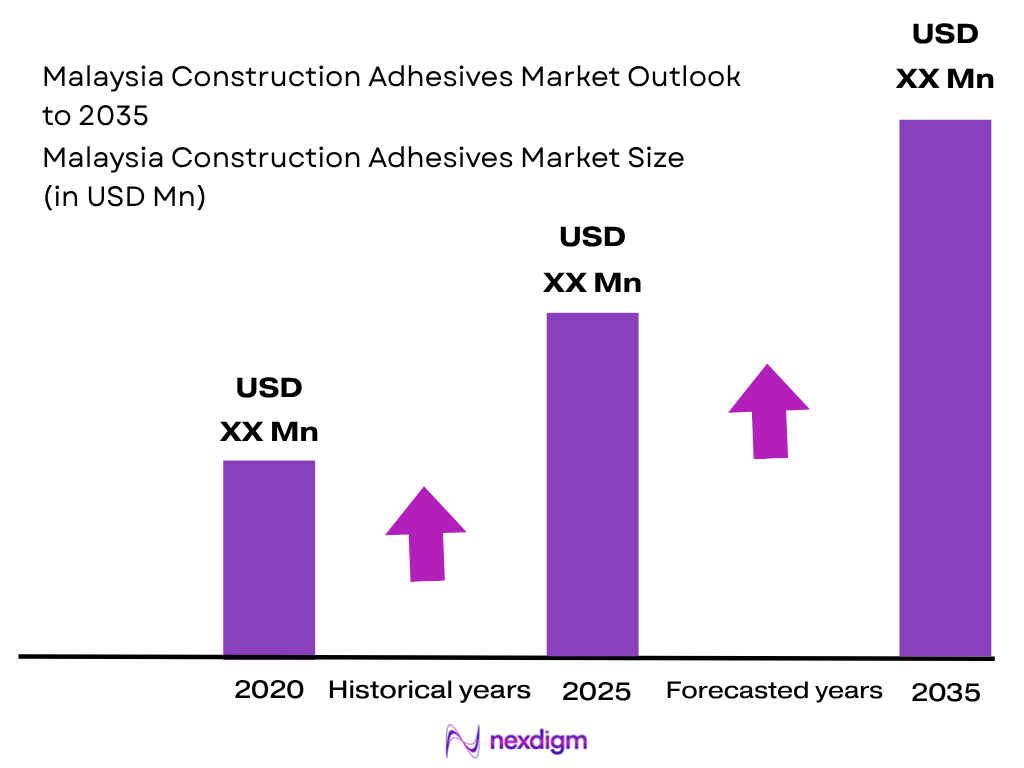
The Malaysia Construction Adhesives Market is valued at approximately ~USD XX million, supported by expanding residential, commercial, industrial and infrastructure construction. Construction work done increased from RM132.2 billion to RM158.8 billion across the latest two annual observations. Within the latest period, residential buildings contributed RM35.8 billion, non-residential buildings RM44.4 billion, civil engineering RM61.1 billion and specialised construction activities RM17.5 billion, supporting broad adhesive consumption.
Selangor, Kuala Lumpur, Johor and Penang dominate Malaysia Construction Adhesives demand because they concentrate high-rise housing, commercial fit-outs, industrial plants, data centres and refurbishment activity. In the latest quarterly construction dataset, Selangor recorded RM9.4 billion of work done, Johor RM7.4 billion and the Federal Territories RM4.7 billion. Johor’s growing data-centre ecosystem and Selangor’s large residential and non-residential base make both especially important for tile, flooring and structural adhesives.
Market Segmentation
By Adhesive Chemistry
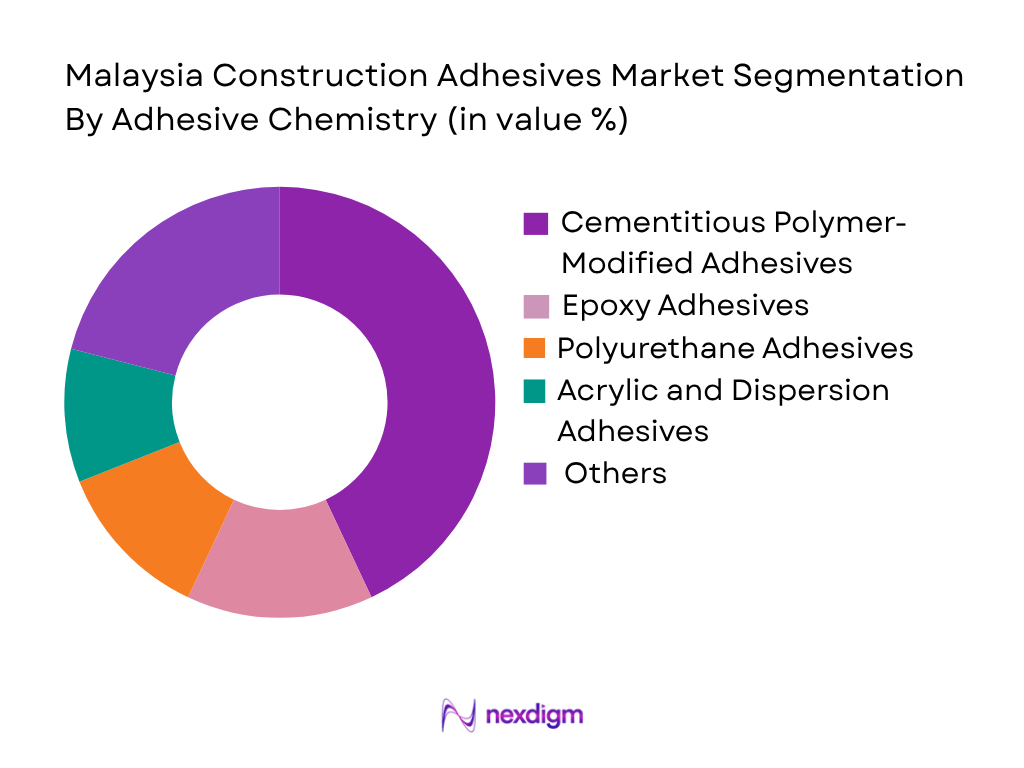
The Malaysia Construction Adhesives Market is segmented into cementitious polymer-modified adhesives, epoxy adhesives, polyurethane adhesives, acrylic adhesives, hybrid polymer systems and other specialty chemistries. Cementitious polymer-modified adhesives hold the dominant market share because ceramic, porcelain and natural-stone installation remains a major construction application across residential, commercial and hospitality projects. Cement-based products are well suited to concrete, screed and masonry substrates that are widespread in Malaysia. Performance grades covering C1, C2, extended open time, rapid setting and S1/S2 deformability also allow suppliers to address applications from standard wall tiling to high-traffic, wet-area and large-format installations. Bostik Malaysia, for example, markets C1, C2, S1 and S2 cementitious systems, while Sika Malaysia offers high-performance cementitious tile adhesives compatible with porcelain, mosaics and existing tile surfaces.
By Application
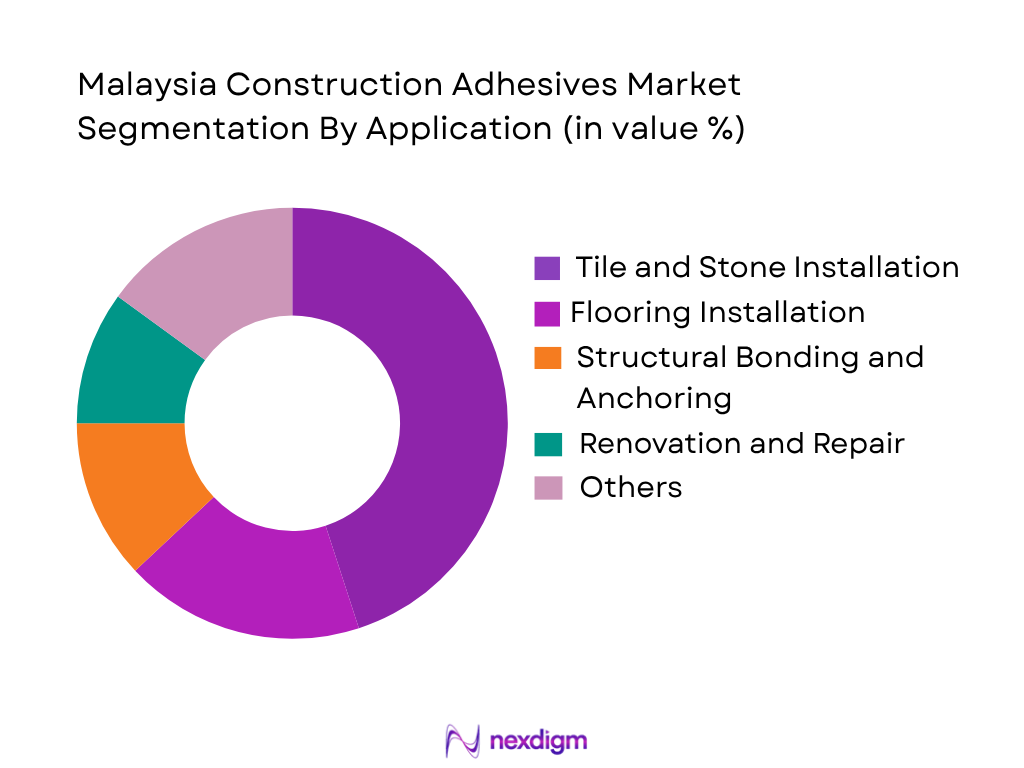
The Malaysia Construction Adhesives Market is segmented into tile and stone installation, flooring, structural bonding, façade and panel bonding, IBS and precast bonding, and renovation applications. Tile and stone installation represents the dominant application segment because residential apartments, shopping centres, hotels, healthcare facilities and institutional buildings use extensive ceramic, porcelain and natural-stone finishes. The shift toward larger porcelain formats also raises demand for flexible C2S1 and C2S2 adhesives, extended open-time products and rapid-setting systems. Malaysia-specific supplier portfolios demonstrate this application breadth: Bostik offers standard, high-strength, deformable and rapid-set tile products, while Mapei Malaysia maintains dedicated tile-and-stone installation systems together with resilient and textile flooring solutions. Industrial and data-centre construction adds incremental demand for flooring and structural adhesives, but tile installation remains broader across building types and refurbishment cycles.
Competitive Landscape
The Malaysia Construction Adhesives Market includes multinational construction-chemical suppliers with local manufacturing, regional distribution and contractor-support capabilities. Sika, Mapei, Bostik, ARDEX and Henkel compete across tile adhesives, flooring systems, structural epoxies, polyurethane bonding and low-emission products. Competitive differentiation is increasingly based on EN 12004 performance classes, flexible large-format tile systems, low-VOC portfolios, project specification support, local warehousing and technical assistance for contractors.
| Company | Establishment Year | Headquarters | Tile Adhesive Capability | Flooring Adhesive Capability | Structural Bonding Capability | Green / Low-VOC Portfolio | Technical Support | Malaysia Presence |
| Sika | 1910 | Baar, Switzerland | ~ | ~ | ~ | ~ | ~ | ~ |
| Mapei | 1937 | Milan, Italy | ~ | ~ | ~ | ~ | ~ | ~ |
| Bostik | 1889 | Colombes, France | ~ | ~ | ~ | ~ | ~ | ~ |
| ARDEX | 1949 | Witten, Germany | ~ | ~ | ~ | ~ | ~ | ~ |
| Henkel | 1876 | Düsseldorf, Germany | ~ | ~ | ~ | ~ | ~ | ~ |
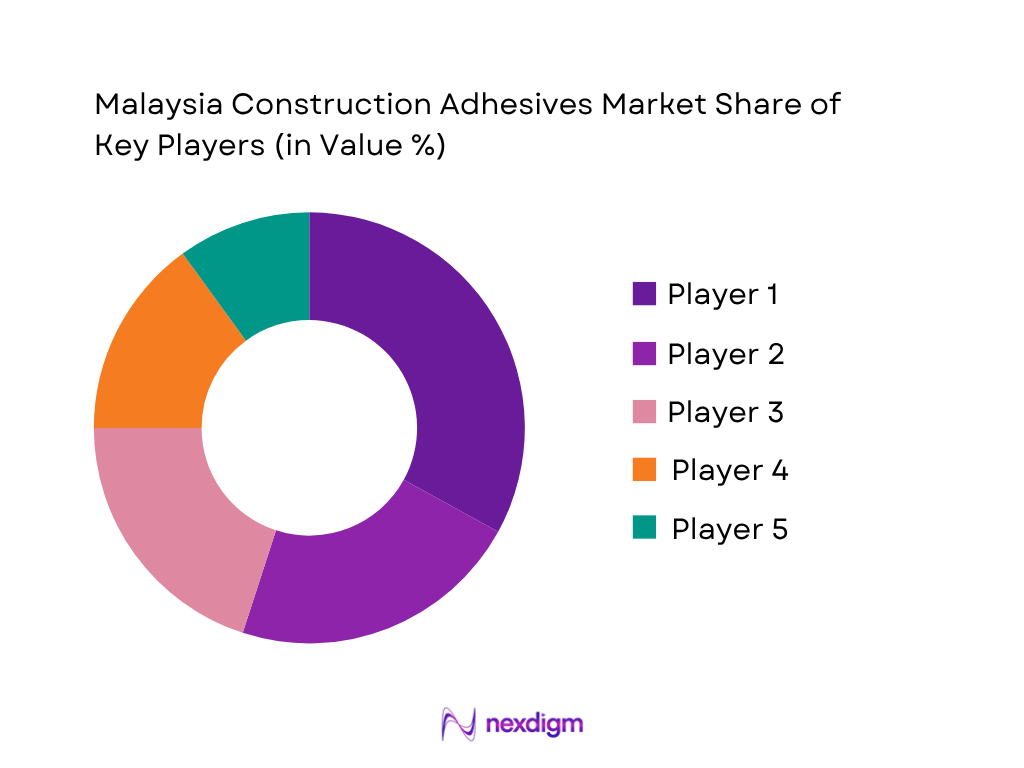
Malaysia Construction Adhesives Market Analysis
Growth Drivers
Expansion of Residential, Commercial and Infrastructure Construction
Malaysia’s expanding construction workload is directly increasing demand for cementitious tile adhesives, flooring adhesives, structural epoxies, polyurethane systems and refurbishment bonding products. Construction work completed reached RM158.8 billion in 2024 and increased further to RM178.6 billion in 2025, demonstrating a substantially larger installation base for building-finishing materials. During the fourth quarter of 2024 alone, civil engineering work accounted for RM15.6 billion, including RM6.9 billion of roads and railways and RM6.8 billion of utility projects, while non-residential buildings contributed RM11.8 billion and residential buildings RM9.9 billion. By the fourth quarter of 2025, non-residential construction reached RM14.0 billion and residential construction RM10.5 billion. Selangor generated RM11.0 billion of quarterly construction work and Johor RM8.3 billion, reinforcing demand in two of Malaysia’s largest construction-adhesive consumption hubs. Malaysia’s macroeconomic base also supports continued building activity, with World Bank data recording USD422.23 billion in GDP and USD11,874.4 GDP per capita in 2024. This combination supports expanding consumption of tile-setting, flooring, anchoring and structural bonding systems.
Industrial, Data Centre and High-Specification Building Investment
Malaysia’s industrial and digital infrastructure expansion is driving construction-adhesive demand toward technically demanding applications such as raised-floor bonding, epoxy anchoring, polyurethane flooring, panel installation, structural repair and high-performance tile systems. Digital investments approved during the first ten months of 2024 reached RM141.72 billion, while Malaysia ended 2024 with 54 operating data centres providing 504.8 MW of capacity. Johor emerged as a major cluster, while Klang Valley remained another core data-centre location. Total approved Malaysian investments reached RM384.4 billion in 2024 and RM426.7 billion in 2025, covering 8,390 projects in the latter period. In the first half of 2026, another RM218.5 billion across 2,746 projects was approved, including RM51.3 billion in manufacturing investment. Selangor attracted RM70.0 billion and Johor RM59.4 billion during that six-month period, reinforcing the two markets most relevant to new industrial floors, interior fit-outs and technical bonding applications. Malaysia’s 2024 GDP of USD422.23 billion and GDP per capita of USD11,874.4 provide additional macroeconomic support for specification-intensive construction investment.
Market Challenges
Imported Specialty Polymer and Resin Dependency
The Malaysia Construction Adhesives Market faces significant supply-chain exposure because many advanced formulations depend on imported epoxy resins, polyurethane intermediates, redispersible polymer powders, acrylic components, cellulose ethers and specialty performance additives. Malaysia imported RM1,370.2 billion of goods in 2024, while total merchandise trade reached approximately RM2.9 trillion, demonstrating the scale of the country’s dependence on cross-border supply networks. In December 2024 alone, imports reached RM119.3 billion, of which intermediate goods accounted for RM60.9 billion and capital goods RM17.4 billion. These intermediate-goods flows are relevant to domestic adhesive manufacturers because locally blended cementitious products still require imported polymer modifiers and chemical additives, while epoxy, PU and hybrid-polymer products frequently depend on regional or global chemical supply chains. Construction activity simultaneously reached RM158.8 billion in 2024 and RM178.6 billion in 2025, meaning supply interruptions can affect an expanding base of tile, flooring, façade and structural-bonding projects. Malaysia’s 2024 GDP stood at USD422.23 billion, with GDP per capita at USD11,874.4, but the large domestic economy does not eliminate external feedstock exposure, making diversified sourcing and local inventory capacity strategically important.
Tropical Moisture Conditions and Increasing Installation Complexity
Malaysia’s construction-adhesive suppliers must address increasingly demanding installation environments as construction volumes rise across high-rise residential, commercial, industrial and data-centre projects. Construction work reached RM158.8 billion in 2024 and RM178.6 billion in 2025, expanding the number of sites where substrate preparation, moisture management, open time and adhesive deformability influence installation performance. In the fourth quarter of 2025, Selangor alone recorded RM11.0 billion of construction activity, including RM4.6 billion in non-residential buildings and RM3.0 billion in residential buildings, while Johor recorded RM8.3 billion. These high-volume construction corridors increasingly use porcelain, large-format tiles, resilient flooring and technical interior finishes that require controlled adhesive thickness, sufficient coverage and appropriate C2, S1 or S2 performance. Malaysia’s tropical operating environment further increases the importance of moisture-resistant, extended-open-time and flexible systems for exterior, wet-area and high-temperature applications. The World Bank recorded Malaysia’s 2024 GDP at USD422.23 billion and GDP per capita at USD11,874.4, reflecting a sizeable construction economy in which installation failures can generate substantial rework. This makes contractor training, substrate diagnosis and field technical support critical competitive capabilities for suppliers.
Market Opportunities
High-Performance Flexible Tile and Rapid-Setting Adhesive Systems
Malaysia’s growing construction and refurbishment base creates substantial future growth potential for C2, S1, S2, extended-open-time and rapid-setting cementitious adhesives designed for porcelain, large-format tiles, wet areas and high-traffic installations. Construction work completed amounted to RM158.8 billion in 2024 before increasing to RM178.6 billion in 2025, enlarging the installed base of residential, commercial and institutional surfaces requiring tile and stone systems. During the fourth quarter of 2025, residential buildings accounted for RM10.5 billion of work and non-residential buildings RM14.0 billion, while Selangor and Johor together generated RM19.3 billion of construction activity. Approved investments further strengthen the addressable project pipeline: Malaysia recorded RM426.7 billion across 8,390 projects in 2025, followed by RM218.5 billion across 2,746 projects during the first half of 2026. These current project volumes provide a foundation for increased specification of deformable adhesives, tile-over-tile products and fast-curing systems where installation productivity and reliable bonding are critical. Malaysia’s 2024 GDP of USD422.23 billion and GDP per capita of USD11,874.4 support continued upgrading toward higher-performance building materials rather than basic site-mixed installation methods.
Data Centre, Industrial Flooring and Structural Bonding Applications
Malaysia’s data-centre and manufacturing expansion creates a future opportunity for construction adhesives beyond conventional tile installation, particularly epoxy anchoring, polyurethane flooring, panel bonding, hybrid polymers, raised-floor systems and concrete repair adhesives. Digital investments approved in the first ten months of 2024 totaled RM141.72 billion, while the country had 54 operational data centres with 504.8 MW of capacity at the end of that year. Malaysia subsequently recorded RM426.7 billion of approved investments across 8,390 projects in 2025, and the first half of 2026 added RM218.5 billion across 2,746 projects. Manufacturing alone accounted for RM51.3 billion of first-half 2026 approvals, while Selangor received RM70.0 billion, Johor RM59.4 billion, Kuala Lumpur RM26.6 billion and Penang RM20.2 billion. These locations overlap with Malaysia’s strongest industrial, data-centre and commercial construction corridors, creating conditions for increased use of chemically resistant flooring, high-load structural adhesives and fast-cure repair systems. The macroeconomic backdrop remains supportive, with World Bank data showing 2024 GDP of USD422.23 billion and GDP per capita of USD11,874.4, providing a strong base for continued specification-driven adhesive adoption.
Future Outlook
The Malaysia Construction Adhesives Market is projected to expand at approximately ~XX.X% CAGR during 2026–2035, supported by residential construction, industrial development, data-centre investment, commercial fit-out and renovation activity. Demand is expected to move toward C2S1 and C2S2 tile adhesives, rapid-setting systems, low-VOC flooring products, structural epoxies and hybrid polymers.
Malaysia recorded RM378.5 billion of approved investments across 6,700 projects in the latest full annual investment cycle, including RM120.5 billion in manufacturing and RM252.7 billion in services. Selangor attracted RM101.1 billion, Kuala Lumpur RM91.5 billion and Johor RM48.5 billion, strengthening the development pipeline in Malaysia’s key adhesive-consuming regions.
Major Players
- Sika Malaysia
- Mapei Malaysia Sdn. Bhd.
- Bostik Malaysia
- ARDEX Malaysia
- Henkel Malaysia
- H.B. Fuller Malaysia
- Saint-Gobain Weber Malaysia
- Fosroc Malaysia
- Tremco CPG Malaysia
- Soudal Malaysia
- 3M Malaysia
- Dow Malaysia
- Wacker Chemicals Malaysia
- MC-Bauchemie Malaysia
- Pentens Holdings Sdn. Bhd.
Key Target Audience
- Construction Adhesive Manufacturers
- Tile, Stone and Flooring Material Distributors
- Tiling, Flooring and Interior Fit-Out Contractors
- General Contractors and Structural Repair Contractors
- Property, Industrial and Data Centre Developers
- Building Material Importers and Distributors
- Investments and Venture Capitalist Firms
- Government and Regulatory Bodies (Construction Industry Development Board Malaysia, Department of Standards Malaysia, SIRIM Berhad, Ministry of Works Malaysia)
Research Methodology
Step 1: Identification of Key Variables
The initial phase involves constructing an ecosystem map covering raw-material suppliers, adhesive manufacturers, dry-mix producers, distributors, contractors, developers and specifiers within the Malaysia Construction Adhesives Market. Key variables include chemistry, consumption volume, application area, EN 12004 classification, regional demand, renovation intensity, local manufacturing and import dependency.
Step 2: Market Analysis and Construction
Historical market development is evaluated through top-down and bottom-up models. The top-down framework assesses construction work done, residential and non-residential activity, industrial investment and infrastructure development. The bottom-up assessment evaluates installed tile and flooring area, adhesive dosage, chemistry mix, project specifications, contractor usage and local versus imported supply.
Step 3: Hypothesis Validation and Expert Consultation
Market hypotheses are validated through structured interviews and CATI-based discussions with adhesive manufacturers, tile contractors, flooring installers, distributors, developers and building-material suppliers. Consultations assess technology adoption, product selection, large-format tile requirements, pricing dynamics, low-VOC demand, installation challenges and project qualification practices.
Step 4: Research Synthesis and Final Output
The final stage triangulates primary findings with official construction data, investment indicators, manufacturer portfolios and technical standards. Top-down construction demand is reconciled with bottom-up adhesive consumption to establish segmentation, competitive positioning, application trends and the long-term outlook for the Malaysia Construction Adhesives Market.

- Executive Summary
- Research Methodology (Market Definitions and Assumptions, Malaysia Construction Adhesives Market Classification, Cementitious Adhesive Scope, Polymer-Modified Mortar Assessment, Epoxy Adhesive Assessment, Polyurethane Adhesive Assessment, Acrylic Adhesive Assessment, Hybrid Polymer Adhesive Assessment, Tile Adhesive Assessment, Flooring Adhesive Assessment, Structural Bonding Assessment, Concrete-to-Concrete Bonding Assessment, Anchoring Adhesive Assessment, IBS Component Bonding Assessment, Precast Bonding Assessment, Grab Adhesive Assessment, Large-Format Tile Assessment, Wet-Area Tiling Assessment, Exterior Tiling Assessment, Swimming Pool Adhesive Assessment, Industrial Flooring Adhesive Assessment, Data Centre Flooring Adhesive Assessment, EN 12004 Classification Mapping, EN 12002 Deformability Assessment, ISO 13007 Assessment, Tensile Adhesion Strength Assessment, CIDB Construction Material Assessment, SIRIM Product Testing Assessment, Green Building Index Compatibility Assessment, GreenRE Compatibility Assessment)

- Definition and Scope
- Malaysia Construction Adhesives Industry Evolution and Development of Conventional Cement-Sand Tile Setting, Polymer-Modified Cementitious Tile Adhesives, Flexible Tile Adhesives, Rapid-Setting Tile Adhesives, Large-Format Tile Adhesives, Epoxy Structural Adhesives, Polyurethane Construction Adhesives, Acrylic Adhesives, Synthetic Rubber Grab Adhesives, Hybrid Polymer Adhesives, High-Grab Nail-Free Adhesives, Wet-Area and Swimming Pool Adhesives, Flooring Adhesives, LVT Adhesives, Wood Flooring Adhesives, Concrete Bonding Agents, Anchoring Epoxies, IBS and Precast Component Bonding Systems, Façade and Panel Bonding Systems, Low-VOC Construction Adhesives and C1-C2-S1-S2
- Performance-Classified Tile Adhesive Systems
- Construction Adhesives Value Chain Analysis
- Construction Adhesives Supply Chain Analysis
Cement Suppliers, Redispersible Polymer Powder Suppliers, Cellulose Ether Suppliers, Acrylic Polymer Suppliers, Epoxy Resin Suppliers, Polyurethane Raw Material Suppliers, Silane and Hybrid Polymer Suppliers, Mineral Filler Suppliers, Construction Adhesive Manufacturers, Dry-Mix Mortar Producers, Local Blenders, Importers

- Growth Drivers (Klang Valley Residential Construction, Johor Data Centre Expansion, Industrial Park Development, Commercial Fit-Out Activity, High-Rise Construction, Hospitality Renovation, Retail Refurbishment, Ceramic and Porcelain Tile Adoption, Large-Format Tile Penetration, LVT and Resilient Flooring Demand, Infrastructure Expansion, IBS and Precast Adoption, Building Maintenance and Renovation)
- Market Challenges (Price Sensitivity, Traditional Cement-Sand Installation Practices, Installer Skill Gaps, Tropical Humidity and Moisture Exposure, Inconsistent Substrate Preparation, Tile Debonding Risk, Imported Polymer Raw Material Dependence, Product Misapplication, Large-Format Tile Installation Complexity, Regional Distribution Fragmentation, Specification Compliance, Low-VOC Requirements, Fast Construction Schedules)
- Market Opportunities (Flexible C2S1 and C2S2 Tile Adhesives, Large-Format Tile Installation, Renovation Adhesives, Structural Epoxy Bonding, Anchoring Adhesives, IBS and Precast Bonding Systems, Low-VOC Adhesives, Hybrid Polymer Grab Adhesives, Wet-Area and Swimming Pool Systems, Industrial Flooring Adhesives, Data Centre Flooring Adhesives, Tile-over-Tile Systems, Local Dry-Mix Manufacturing)
- Market Trends (Polymer-Modified Cementitious Adhesives, Flexible Tile Adhesives, Large-Format Porcelain Tiles, Extended Open-Time Products, Rapid-Setting Adhesives, Ready-to-Mix Dry Mortars, High-Grab Construction Adhesives, Hybrid Adhesive-Sealants, Low-VOC Formulations, LVT Flooring Adhesives, Tile-over-Tile Renovation, Complete Installation-System Selling, Contractor Training Platforms)
- Government Regulations and Standards (CIDB Construction Material Requirements, SIRIM Testing and Certification Requirements, EN 12004 Tile Adhesive Classification, EN 12002 Deformability Requirements, ISO 13007 Tile Installation Standards, Occupational Chemical Handling Requirements, Green Building Index Requirements, GreenRE Requirements, Low-VOC Indoor Environmental Quality Requirements, Construction Product Conformity Requirements)
- SWOT Analysis
- Porter’s Five Forces Analysis
- PESTLE Analysis
- Stakeholder Ecosystem
- Construction Adhesives Manufacturing and Project Ecosystem

- By Market Value (2020-2025)
- By Consumption Volume (2020-2025)
- By Cementitious Adhesive Consumption (2020-2025)
- By Tile Adhesive Consumption (2020-2025)
- By Epoxy Adhesive Consumption (2020-2025)
- By Polyurethane and Hybrid Adhesive Consumption (2020-2025)
- By Flooring Adhesive Consumption (2020-2025)
- By Structural Bonding Adhesive Consumption (2020-2025)
- By Residential Construction Adhesive Consumption (2020-2025)
- By Commercial Construction Adhesive Consumption (2020-2025)
- By Industrial and Data Centre Adhesive Consumption (2020-2025)
- By Renovation and Repair Adhesive Consumption (2020-2025)
- By Locally Manufactured Adhesive Consumption (2020-2025)
- By Imported Adhesive Consumption (2020-2025)

- By Adhesive Chemistry (In Value %)
Cementitious Polymer-Modified Adhesives
Epoxy Adhesives
Polyurethane Adhesives
Acrylic Adhesives
Synthetic Rubber Adhesives
Silicone-Based Adhesives
MS Polymer and Hybrid Adhesives
Vinyl and PVA-Based Adhesives
Other Specialty Construction Adhesives - By Product Type (In Value %)
Standard Tile Adhesives
Heavy-Duty Tile Adhesives
Flexible Tile Adhesives
Large-Format Tile Adhesives
Rapid-Setting Tile Adhesives
Wet-Area and Swimming Pool Adhesives
Ready-Mixed Tile Adhesives
Structural Epoxy Adhesives
Concrete Bonding Adhesives
Anchoring Adhesives
IBS and Precast Bonding Adhesives
Grab and Nail-Free Adhesives
Flooring Adhesives
Panel and Façade Adhesives
Industrial and Data Centre Flooring Adhesives - By Application (In Value %)
Floor Tiling
Wall Tiling
Large-Format Tile Installation
Porcelain and Vitrified Tile Installation
Natural Stone Installation
Swimming Pool and Wet-Area Tiling
Tile-on-Tile Installation
Wood and Laminate Flooring
Vinyl and Resilient Flooring
Luxury Vinyl Tile Installation
Concrete-to-Concrete Bonding
Precast and IBS Component Bonding
Structural Repair Bonding
Rebar and Anchor Fixing
Façade and Wall Panel Bonding
Interior Fit-Out and Decorative Bonding - By Performance Requirement (In Value %)
High Tensile Adhesion Strength
Extended Open Time
Slip Resistance
High Deformability
Rapid Setting
Water Immersion Resistance
Heat Resistance
Exterior Weather Resistance
High Initial Grab
Gap-Filling Capability
Wet-Surface Adhesion
Structural Load Transfer
Low-VOC Performance
Chemical Resistance
Tropical Humidity Resistance - By Region (In Value %)
Selangor
Kuala Lumpur
Johor
Penang
Negeri Sembilan
Melaka
Perak
Pahang
Sarawak
Sabah
Klang Valley
Johor Data Centre Corridor
Northern Industrial Corridor
East Coast Malaysia
Rest of Malaysia

- Market Share of Major Players (By Malaysia Revenue, Adhesive Consumption Volume, Tile Adhesive Portfolio, Structural Adhesive Portfolio, Flooring Adhesive Portfolio, Flexible Adhesive Portfolio, Industrial and Data Centre Exposure, Retail Presence, Contractor Coverage, Project Specification Exposure, Local Manufacturing Capacity, Local Dry-Mix Blending Capability, Technical Laboratory Capability, Installer Training Coverage, Distributor Network)
- Cross Comparison Parameters (Tile Adhesive Performance-Class Portfolio, Structural Epoxy and Anchoring Adhesive Capability, Large-Format C2S1 and C2S2 Tile Adhesive Capability, Malaysia Manufacturing and Local Dry-Mix Blending Presence, Hardware Dealer and Distributor Network Reach, Technical Training and Installer Support Capability, Wet-Area Flooring and Tropical Moisture Bonding Capability, Industrial Data Centre IBS and Project-Specification Exposure)
- SWOT Analysis of Major Players
- Competitive Positioning Matrix
- Major Companies
Sika Malaysia
Mapei Malaysia Sdn. Bhd.
Bostik Malaysia
ARDEX Malaysia
Henkel Malaysia
H.B. Fuller Malaysia
Saint-Gobain Weber Malaysia
Fosroc Malaysia
Tremco CPG Malaysia
Soudal Malaysia
3M Malaysia
Dow Malaysia
Wacker Chemicals Malaysia
MC-Bauchemie Malaysia
Pentens Holdings Sdn. Bhd.

- Tile Contractor Requirement Assessment
- General Contractor Procurement Assessment
- Flooring Contractor Requirement Assessment
- Structural Repair Contractor Requirement Assessment
- Property Developer Adhesive Specification Assessment
- Industrial Developer Adhesive Requirement Assessment
- Data Centre Contractor Requirement Assessment
- Interior Fit-Out Contractor Requirement Assessment
- Hardware Dealer Requirement Assessment
- Large-Format Tile Installation Requirement Assessment
- Wet-Area Adhesive Requirement Assessment
- Structural Adhesive Performance Assessment
- Technical Service and Installer Training Requirement Assessment

- By Market Value (2026-2035)
- By Consumption Volume (2026-2035)
- By Cementitious Adhesive Consumption (2026-2035)
- By Tile Adhesive Consumption (2026-2035)
- By Epoxy Adhesive Consumption (2026-2035)
- By Polyurethane and Hybrid Adhesive Consumption (2026-2035)
- By Flooring Adhesive Consumption (2026-2035)
- By Structural Bonding Adhesive Consumption (2026-2035)
- By Residential Construction Adhesive Consumption (2026-2035)
- By Commercial Construction Adhesive Consumption (2026-2035)
- By Industrial and Data Centre Adhesive Consumption (2026-2035)
- By Renovation and Repair Adhesive Consumption (2026-2035)
- By Locally Manufactured Adhesive Consumption (2026-2035)
- By Imported Adhesive Consumption (2026-2035)


 Request a Sample
 Ask for Customization
 Get a Quote
 Enquire Now
