

 Download PDF
Market Overview
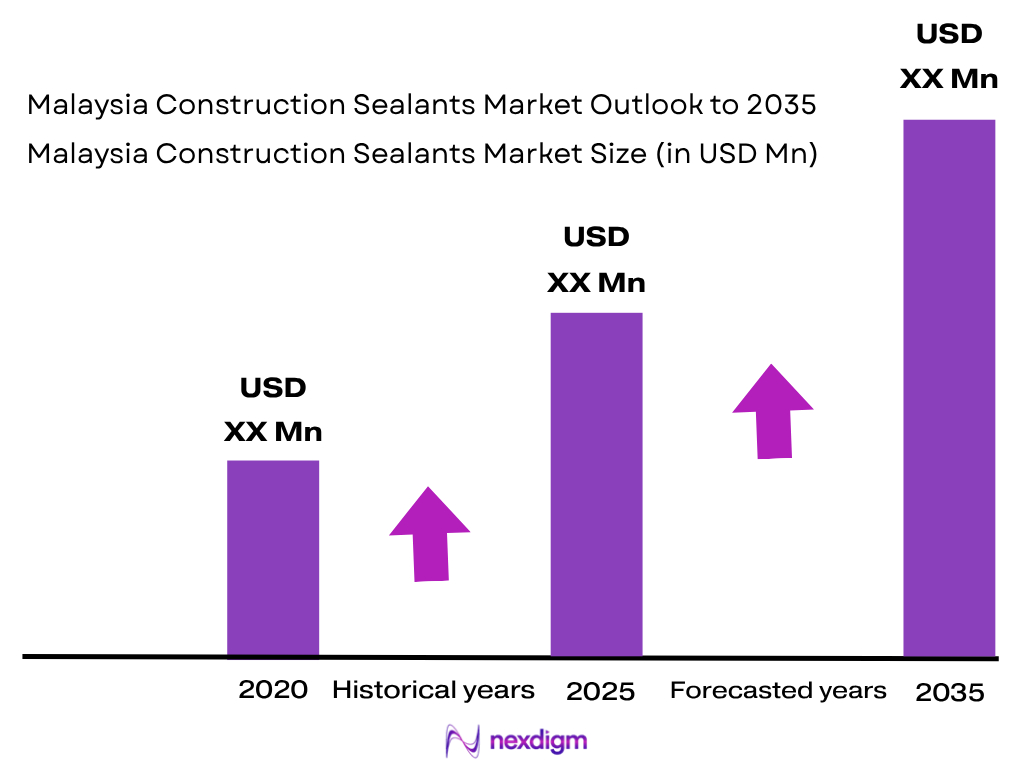
The Malaysia Construction Sealants Market is valued at approximately ~USD XX million, supported by high-rise construction, façades, precast concrete, glazing, wet areas and industrial development. Construction work done increased from RM132.2 billion to RM158.8 billion across the two latest annual observations. Quarterly residential construction simultaneously increased from RM7.1 billion to RM9.9 billion, while non-residential activity moved from RM9.5 billion to RM11.8 billion, expanding demand for silicone, polyurethane, hybrid and fire-rated sealants.
Selangor, Johor and Kuala Lumpur are the leading Malaysia Construction Sealants Market demand centres because they combine dense residential towers, curtain-wall buildings, data centres, industrial facilities and infrastructure. Selangor’s quarterly construction work increased from RM8.6 billion to RM9.4 billion, Johor from RM4.0 billion to RM7.4 billion, and the Federal Territories from RM4.0 billion to RM4.7 billion across the two observations, supporting façade, glazing, firestop and precast-joint sealant consumption.
Market Segmentation
By Chemistry Type
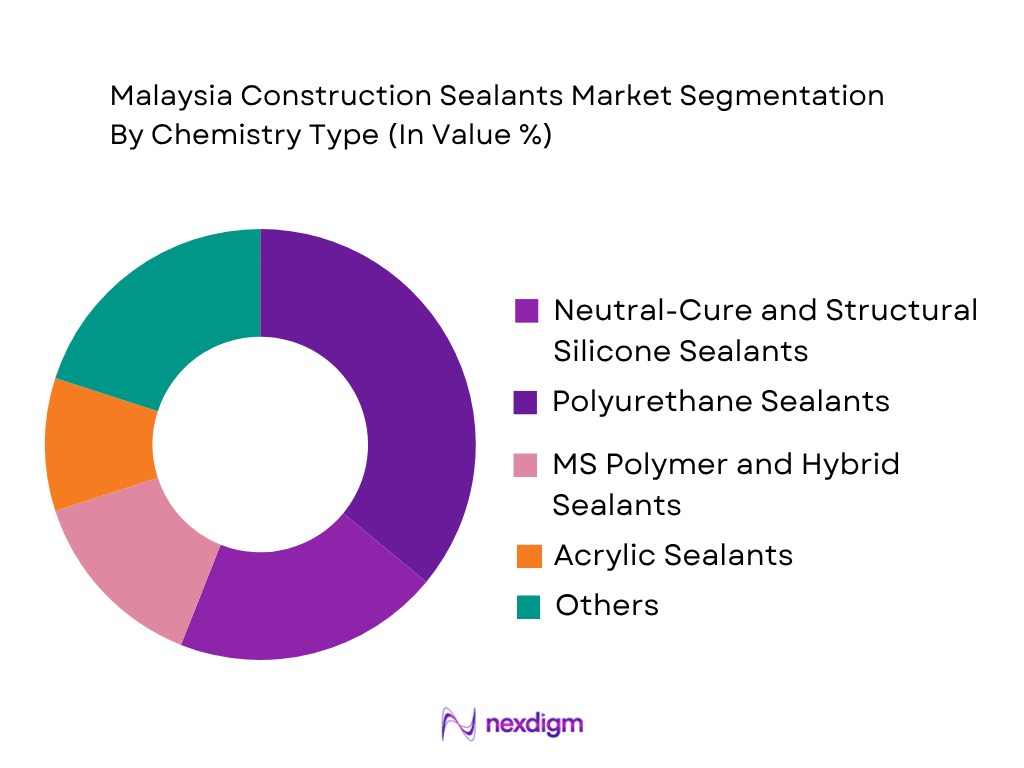
The Malaysia Construction Sealants Market is segmented into neutral-cure silicone, acetoxy silicone, structural glazing silicone, polyurethane, MS polymer and hybrid, acrylic, polysulfide, butyl and fire-rated sealant systems. Silicone sealants hold the dominant modeled share because Malaysia’s high-rise and commercial building stock relies heavily on aluminium-and-glass façades, windows, curtain walls and weathersealing applications where UV resistance, elasticity and long-term weatherability are critical. Neutral-cure products are especially suited to aluminium, glass and many coated substrates, while structural silicones are used where glass or façade panels form part of engineered curtain-wall assemblies. Malaysia’s tropical humidity and rainfall further increase the value of sealants that resist long-term weather exposure without embrittlement. Sika’s local façade portfolio includes one- and two-part structural glazing silicones, while Dow’s structural and weathersealing technologies are designed for glass, aluminium, steel, stone, concrete and other façade substrates. This broad compatibility supports silicone’s leading position across both new-build and refurbishment applications.
By Application
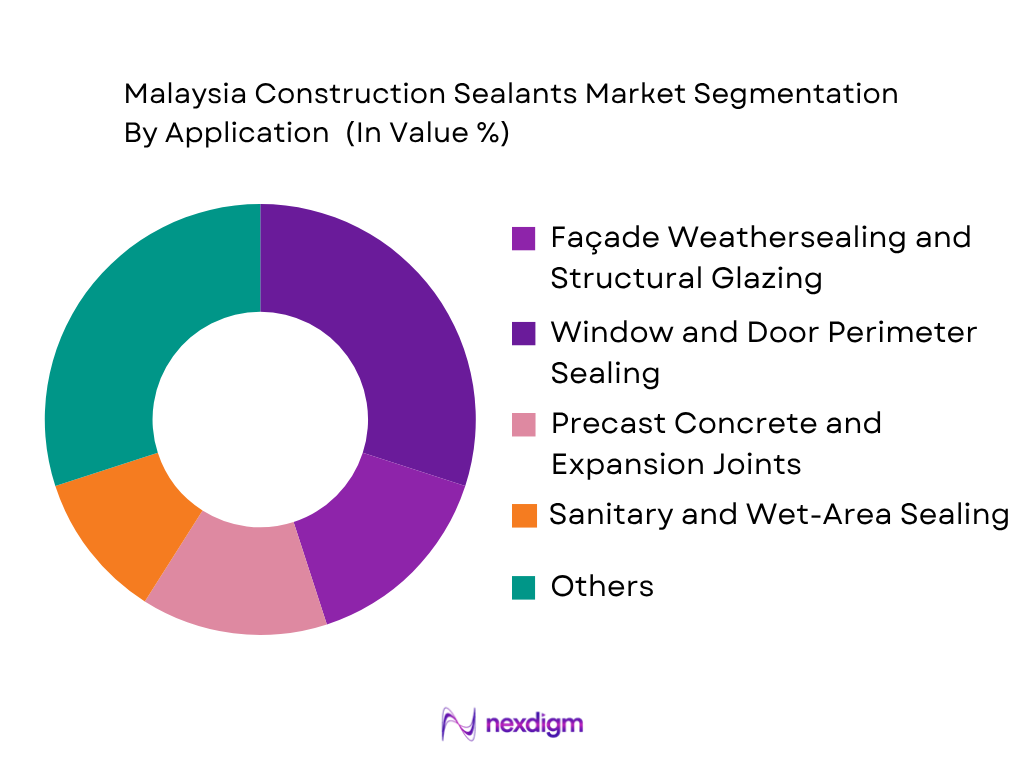
The Malaysia Construction Sealants Market is segmented into façade weathersealing, structural glazing, window and door perimeter sealing, precast joints, sanitary applications, floor joints, roofing, firestop and infrastructure joints. Façade, glazing and building-envelope sealing represents the dominant modeled application group because Malaysia’s major construction corridors contain large volumes of high-rise residential, commercial and mixed-use buildings with aluminium-and-glass exterior systems. These structures require weathersealing at curtain-wall joints, panel interfaces, window perimeters and façade movement joints to control rainwater and air infiltration while accommodating thermal and structural movement. The technical importance of this application is illustrated by structural silicone systems designed to comply with recognized façade standards and maintain mechanical performance under prolonged UV, heat and humidity exposure. Malaysia’s construction output also remains concentrated in Selangor, Johor and the Federal Territories, where façade-intensive non-residential and residential developments are most prevalent. Repair and resealing of existing towers provides a recurring aftermarket alongside new construction.
Competitive Landscape
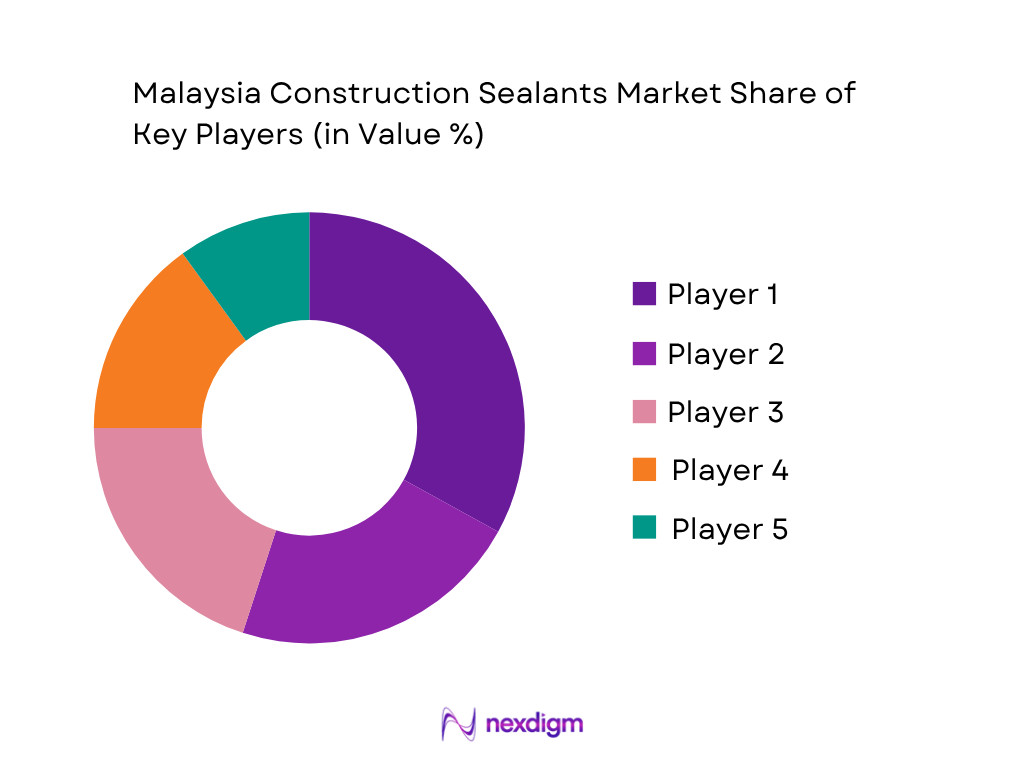
The Malaysia Construction Sealants Market combines multinational silicone and construction-chemical specialists with suppliers possessing strong local formulation, façade-engineering, firestop and contractor-support capabilities. Sika, Tremco CPG, Bostik, MAPEI and Dow compete across façade weathersealing, structural glazing, concrete joints, sanitary sealing and specialty applications. Competitive differentiation increasingly depends on movement capability, substrate compatibility, local technical testing, applicator support and the ability to offer complete sealing systems instead of isolated cartridges.
| Major Player | Establishment Year | Headquarters | Silicone / Façade Capability | PU / Hybrid Capability | Firestop Capability | Malaysia Presence | Applicator / Contractor Support | Technical Testing Capability |
| Sika | 1910 | Baar, Switzerland | ||||||
| Tremco CPG | 1928 | Beachwood, Ohio, USA | ||||||
| Bostik / Arkema | 1889 | Colombes, France | ||||||
| MAPEI | 1937 | Milan, Italy | ||||||
| Dow / DOWSIL | 1897 | Midland, Michigan, USA |
Malaysia Construction Sealants Market Analysis
Growth Drivers
High-Rise, Commercial and Data Centre Construction Expanding Sealant Demand
Malaysia’s expanding non-residential and high-rise construction base is increasing demand for structural glazing silicone, façade weatherseal, window perimeter sealants, firestop materials and precast-joint systems. DOSM recorded RM158.8 billion of construction work completed in 2024, including RM44.4 billion of non-residential buildings, RM35.8 billion of residential buildings and RM17.5 billion of special trade activities. The construction pipeline remained strong into 2026, when second-quarter work reached RM47.8 billion, including RM14.0 billion of non-residential buildings and RM10.9 billion of residential buildings. Data-centre development adds higher-specification demand: MIDA reported 12 approved data-centre projects worth RM90.2 billion, with 6 operating projects worth RM68.9 billion and another 6 projects under planning or construction. These buildings require dense façade joints, cable penetrations, MEP firestopping, roof joints and acoustic sealing. Johor alone had 9 completed data centres totaling 1,280 MW and 6 more approaching 1,490 MW. The macroeconomic backdrop supports continued construction, with the IMF recording 2024 nominal GDP at USD422.2 billion, population at 34.1 million and GDP per capita at USD12,397.
Selangor and Johor Construction Concentration Supports Façade, Precast and Window Sealants
Sealant demand in Malaysia is being reinforced by the concentration of construction activity in Selangor, Johor and the Federal Territories, where curtain-wall buildings, precast structures, windows, doors and industrial facilities generate extensive joint-sealing requirements. DOSM recorded RM9.4 billion of construction work in Selangor and RM7.4 billion in Johor in the fourth quarter of 2024, with Johor alone contributing RM3.0 billion of non-residential building activity. By the second quarter of 2026, Selangor’s construction value had reached RM12.2 billion, including RM4.8 billion of non-residential work and RM3.2 billion of residential work, while Johor recorded RM9.4 billion, including RM3.5 billion of non-residential construction. Such concentration supports recurring requirements for structural silicone, polyurethane movement-joint sealants, sanitary silicone and hybrid window-perimeter systems. High-rise and industrial projects also increase sealant consumption because greater façade area and larger numbers of precast or curtain-wall interfaces translate into more linear joint metres requiring engineered weathersealing. Malaysia’s 2024 macroeconomic base remains substantial, with IMF data recording USD422.2 billion in nominal GDP and 34.1 million people, providing the economic scale to sustain commercial and residential building investment.
Market Challenges
Installation Quality and Joint Design Create Significant Sealant Failure Risk
Construction sealants are highly sensitive to joint geometry, substrate condition and installation practice, creating a major performance challenge in Malaysia’s rapidly expanding construction sector. DOSM recorded RM158.8 billion of construction work in 2024 and RM94.3 billion during the first half of 2026, indicating a large volume of façades, precast joints, windows, wet areas and firestop penetrations being installed over a short period. The second quarter of 2026 alone included RM16.7 billion of civil engineering, RM14.0 billion of non-residential work and RM10.9 billion of residential construction. At this scale, poor backer-rod sizing, three-sided adhesion, contamination, incorrect primer use or inadequate joint depth can translate into adhesive failure, cohesive tearing or premature weatherseal breakdown. Malaysia’s high-moisture environment further increases sensitivity because surfaces may be wet during application and curing, while façade joints face repeated rainfall and thermal movement. Data-centre projects intensify the consequence of installation errors because failed firestop or air-sealing joints can affect compartmentation and environmental control. The IMF records 2024 nominal GDP at USD422.2 billion, GDP per capita at USD12,397 and population at 34.1 million, underscoring the scale of building assets dependent on reliable sealant installation.
Imported Chemical Inputs Increase Supply and Formulation Exposure
Malaysia’s construction sealant industry faces supply-chain risk because silicone polymers, polyurethane intermediates, silanes, plasticizers and specialty additives are connected to international chemical trade. MATRADE reported imports from China of RM296.45 billion in 2024, with chemicals and chemical products among the major categories. Imports from ASEAN reached RM327.17 billion, while imports from the United States reached RM126.26 billion and imports from the European Union reached RM103.07 billion; chemicals and chemical products were important import categories across several of these trade flows. For sealant producers, disruption in specialty feedstocks can affect formulation consistency, cure behavior, adhesion promoters and production scheduling, particularly for neutral-cure silicone, MS polymer and fire-rated products that require tightly controlled chemistry. The issue is especially relevant as Malaysia simultaneously expands non-residential and data-centre construction, which requires certified, project-specific sealant systems rather than easily substituted commodity materials. Construction work reached RM47.8 billion in the second quarter of 2026, increasing the need for dependable local stockholding and regional warehousing. The IMF recorded 2024 nominal GDP at USD422.2 billion, GDP per capita at USD12,397 and population at 34.1 million, demonstrating the large domestic economy exposed to international specialty-chemical supply conditions.
Market Opportunities
Data Centre Firestop and High-Performance Sealing Systems Offer Future Growth
Malaysia’s data-centre build-out creates a strong future opportunity for fire-rated sealants, acoustic sealants, structural silicone and high-performance air- and water-sealing systems. Current project activity already provides a substantial base: MIDA reported 12 approved data-centre projects worth RM90.2 billion, of which 6 projects worth RM68.9 billion were operating and another 6 were under planning or construction. Johor had 9 completed data centres totaling 1,280 MW and 6 additional projects with almost 1,490 MW under development. Mission-critical facilities contain dense networks of cable trays, pipes, ducts and electrical penetrations, increasing demand for fire-rated acrylic, silicone and intumescent systems that preserve compartment integrity. They also require tight façade, roof and floor-joint sealing to manage humidity, conditioned-air leakage and water ingress. Johor’s wider construction value reached RM9.4 billion in the second quarter of 2026, with RM3.5 billion coming from non-residential buildings, showing that digital infrastructure is developing within an already active construction ecosystem. Malaysia’s 2024 macroeconomic base remains supportive, with the IMF recording USD422.2 billion of nominal GDP and USD12,397 of GDP per capita, providing a strong current platform for future adoption of higher-value specification-led sealant technologies.
Structural Glazing, Hybrid Sealants and Façade Refurbishment Create Premium Opportunities
Malaysia’s expanding high-rise stock and ongoing commercial construction create future opportunities for structural glazing silicone, high-movement façade sealants, MS polymer systems and refurbishment-focused weathersealing. DOSM recorded RM44.4 billion of non-residential building work in 2024, while non-residential construction reached RM14.0 billion in the second quarter of 2026 alone. Selangor contributed RM4.8 billion of non-residential activity during that quarter and Johor RM3.5 billion, reinforcing the concentration of façade-intensive projects in markets where aluminium-and-glass curtain walls are common. New structures require weatherseal joints, structural silicone, window-perimeter sealing and natural-stone-compatible products, while the growing installed base creates recurring demand as original joints age under UV exposure, heavy rainfall and movement. Hybrid and MS polymer systems can gain where contractors want paintability, primerless adhesion and compatibility with concrete, aluminium and coated surfaces. Structural silicone also remains critical where façade panels transfer loads through bonded glazing systems. The macroeconomic environment supports continued specification-led construction: IMF data record Malaysia’s 2024 nominal GDP at USD422.2 billion, population at 34.1 million and GDP per capita at USD12,397. These current construction and macroeconomic indicators support future migration toward higher-performance, longer-service-life façade sealing systems.
Future Outlook
The Malaysia Construction Sealants Market is forecast to expand at approximately ~X.X% CAGR during 2026–2035, supported by sustained non-residential building activity, data-centre construction, high-rise development, façade refurbishment and stricter performance requirements. Growth is expected to migrate toward high-movement silicone, MS polymer, hybrid and fire-rated technologies where technical performance and specification compliance matter more than commodity sealing. Malaysia’s construction pipeline remains active. Construction work done reached RM46.5 billion in the first quarter of 2026 and RM47.8 billion in the second quarter, taking first-half activity to RM94.3 billion. Non-residential construction reached RM13.9 billion and then RM14.0 billion in those quarters, while residential construction reached RM10.5 billion and RM10.9 billion. These segments directly support sealant demand across curtain walls, windows, precast panels, internal joints and wet areas.
Major Players
- Sika Malaysia
- Tremco CPG Malaysia
- Bostik Malaysia / Arkema
- MAPEI Malaysia Sdn. Bhd.
- Fosroc Malaysia / Saint-Gobain
- Dow / DOWSIL
- Wacker Chemie
- Soudal Malaysia
- Henkel Malaysia
- 3M Malaysia
- H.B. Fuller
- Shin-Etsu Silicone
- KCC Silicone
- MC-Bauchemie Malaysia
- Denka Construction Solutions Malaysia
Key Target Audience
- Construction Sealant and Specialty Chemical Manufacturers
- Façade and Structural Glazing Contractors
- Precast and Industrialised Building System Manufacturers
- Main Contractors and Property Developers
- Firestop and Passive Fire Protection Contractors
- Building Material and Construction Chemical Distributors
- Investments and Venture Capitalist Firms
- Government and Regulatory Bodies (Construction Industry Development Board Malaysia, SIRIM QAS International, Public Works Department Malaysia, Fire and Rescue Department of Malaysia, Department of Standards Malaysia)
Research Methodology
Step 1: Identification of Key Variables
The initial phase involves constructing an ecosystem map covering sealant manufacturers, silicone and polymer suppliers, façade contractors, glazing fabricators, precast producers, distributors and applicators. Desk research identifies critical variables including chemistry type, joint geometry, movement requirement, substrate, construction activity, packaging format, façade system, firestop application and regional project concentration.
Step 2: Market Analysis and Construction
Historical demand for the Malaysia Construction Sealants Market is assessed through top-down and bottom-up approaches. Top-down analysis evaluates residential, non-residential, special-trade and infrastructure activity, while bottom-up modelling estimates sealant demand using façade area, joint length, joint dimensions, cartridge or sausage-pack coverage, glazing volume and application-specific consumption.
Step 3: Hypothesis Validation and Expert Consultation
Market hypotheses are validated through computer-assisted telephone interviews with manufacturers, façade contractors, glazing fabricators, firestop applicators, distributors and precast contractors. These consultations validate silicone versus polyurethane usage, structural-glazing demand, joint-design practices, compatibility testing, packaging preferences, project approvals and technical-service expectations.
Step 4: Research Synthesis and Final Output
The final phase triangulates DOSM construction statistics, MIDA investment information, manufacturer disclosures, applicable technical standards and primary research. Bottom-up sealant consumption is reconciled against project and construction activity to produce the final chemistry, application, regional and competitive framework for the Malaysia Construction Sealants Market.

- Executive Summary
- Research Methodology (Market Definitions and Assumptions, Malaysia Construction Sealants Market Boundary, Construction Sealant versus Adhesive Classification, Silicone Sealant Assessment, Polyurethane Sealant Assessment, MS Polymer and Hybrid Sealant Assessment, Acrylic Sealant Assessment, Polysulfide Sealant Assessment, Butyl Sealant Assessment, Fire-Rated Sealant Assessment, Structural Glazing Silicone Assessment, Insulating Glass Sealant Assessment, Façade Joint Sealant Assessment, Precast Concrete Joint Assessment, Window and Door Perimeter Assessment, Sanitary Sealant Assessment, Floor Joint Assessment, Roofing Sealant Assessment, Infrastructure Joint Assessment, Data Centre Sealant Assessment, New-Build Demand Assessment, Repair and Refurbishment Assessment, ASTM C920 Mapping, ISO 11600 Mapping, EN 15651 Mapping, Firestop Compliance Assessment, Low-VOC Assessment, Applicator Mapping, Distributor Mapping, Supply-Side Assessment, Demand-Side Assessment, Top-Down Market Sizing, Bottom-Up Market Sizing, Primary Industry Interviews, Construction Pipeline Assessment, Data Triangulation, Forecasting Framework)

- Definition and Scope
- Evolution of Construction Sealant Technology in Malaysia, Transition from Conventional Acrylic and Polysulfide Sealants to Neutral-Cure Silicone, Polyurethane and Hybrid Polymer Systems, Development of Structural Glazing Silicone, Weatherseal Silicone, Precast Joint Sealants, Sanitary Silicone, Floor Joint Sealants, Fire-Rated Sealants, Acoustic Sealants, Roof and Gutter Sealants, Low-VOC Sealants, High-Movement Façade Sealants, Primerless Sealants, Data Centre and Mission-Critical Sealing Systems
- Construction Sealants Industry Value Chain Analysis
- Construction Sealants Supply Chain Analysis
- Silicone Polymer Suppliers, Silane Suppliers, Polyurethane Raw Material Suppliers, MS Polymer Suppliers, Acrylic Polymer Suppliers, Plasticizer Suppliers, Mineral Filler Suppliers, Pigment Suppliers, Sealant Manufacturers, Local Formulators, Cartridge and Sausage-Pack Manufacturers, Importers, Construction Chemical Distributors, Aluminium and Glazing Fabricators, Façade Contractors, Precast Contractors, Waterproofing Contractors, Firestop Applicators, Main Contractors, Developers, Facility Managers, Testing Laboratories

- Growth Drivers (High-Rise Residential Construction, Klang Valley Commercial Development, Johor Data Centre Construction, Curtain Wall and Façade Expansion, Precast Concrete Adoption, Aluminium Window and Door Installation, Industrial Facility Development, Semiconductor Construction, Firestop Compliance, Building Refurbishment, Tropical Rainfall Exposure, Preventive Façade Maintenance)
- Market Challenges (Poor Joint Design, Incorrect Sealant Selection, Substrate Contamination, Primer Application Variability, Sealant Cohesive Failure, Adhesive Failure, Joint Movement Miscalculation, Sealant Bubbling, Moisture Exposure During Cure, Imported Polymer Dependence, Applicator Skill Variation, Low-Cost Silicone Competition, Counterfeit Products, Compatibility with Natural Stone and Coatings)
- Market Opportunities (Structural Glazing Silicone, High-Movement Façade Sealants, MS Polymer and Hybrid Sealants, Data Centre Firestop Systems, Low-VOC Sealants, Precast Concrete Joint Sealants, Natural Stone-Compatible Silicone, Sanitary Anti-Fungal Sealants, Infrastructure Joint Sealants, Façade Refurbishment, Primerless Sealants, Acoustic Sealants, Sustainable Packaging and Low-Emission Systems)
- Market Trends (Neutral-Cure Silicone Adoption, Hybrid Polymer Sealants, High-Movement Polyurethane Systems, Primerless Adhesion, Low-Modulus Façade Sealants, Structural Silicone Glazing, Fire-Rated Sealants, Low-VOC Formulations, Mould-Resistant Sanitary Silicone, Paintable Hybrid Sealants, Cartridge-to-Sausage-Pack Transition, System-Based Façade Sealing, Digital Joint Design)
- Government Regulations and Standards (CIDB Construction Product Requirements, SIRIM Product Certification, ASTM C920 Sealant Performance Requirements, ISO 11600 Building Construction Joint Sealants, EN 15651 Non-Structural Joint Sealant Requirements, Fire Resistance and Passive Fire Protection Requirements, Uniform Building By-Laws, JKR Construction Specifications, Occupational Safety and Health Requirements, Chemical Classification Labelling and Packaging Requirements)
- SWOT Analysis
- Porter’s Five Forces Analysis
- PESTLE Analysis
- Stakeholder Ecosystem

- By Market Value (2020-2025)
- By Sealant Consumption Volume (2020-2025)
- By Silicone Sealant Consumption (2020-2025)
- By Polyurethane Sealant Consumption (2020-2025)
- By Hybrid and MS Polymer Sealant Consumption (2020-2025)
- By Acrylic Sealant Consumption (2020-2025)
- By Structural Glazing Sealant Consumption (2020-2025)

- By Chemistry Type (In Value %)
Neutral-Cure Silicone Sealants
Acetoxy Silicone Sealants
Structural Glazing Silicone Sealants
Polyurethane Sealants
Hybrid Polyurethane Sealants
MS Polymer and SMP Sealants
Acrylic Sealants
Polysulfide Sealants
Butyl Sealants
Fire-Rated Acrylic Sealants
Fire-Rated Silicone Sealants
Intumescent Sealants
Specialty Elastomeric Sealants - By Application (In Value %)
Façade Weathersealing
Structural Glazing
Window and Door Perimeter Sealing
Precast Concrete Joint Sealing
Expansion and Movement Joints
Floor and Pavement Joints
Bathroom and Sanitary Sealing
Kitchen Sealing
Roof and Gutter Sealing
Metal Roofing Joints
Firestop Penetration Sealing
Acoustic Joint Sealing
Infrastructure Joint Sealing
Water-Retaining Structure Joints - By Building Type (In Value %)
High-Rise Residential Buildings
Landed Residential Buildings
Commercial Offices
Shopping Malls
Hotels and Resorts
Hospitals and Healthcare Facilities
Educational Buildings - Data Centres
Semiconductor and Electronics Facilities
Industrial and Manufacturing Facilities
Warehouses and Logistics Facilities
Government Buildings
Transportation Infrastructure
Mixed-Use Developments - By Joint Type (In Value %)
Façade Movement Joints
Precast Panel Joints
Construction Joints
Expansion Joints
Control Joints
Window Perimeter Joints
Door Perimeter Joints
Curtain Wall Joints
Floor Joints
Roof Joints
Sanitary Joints
Fire-Rated Penetration Joints - By Performance Requirement (In Value %)
High Movement Capability
Low-Modulus Performance
High-Modulus Performance
UV and Weathering Resistance
Tropical Humidity Resistance
Mould and Fungal Resistance
Primerless Adhesion
Paintability
Fast Skin Formation
Chemical Resistance
Water Immersion Resistance
Fire Resistance
Acoustic Performance
Low-VOC Performance
Natural Stone Compatibility

- Market Share of Major Players (By Malaysia Revenue, Sealant Consumption Volume, Silicone Sealant Portfolio, Polyurethane Sealant Portfolio, Hybrid Sealant Portfolio, Structural Glazing Exposure, Façade Weatherseal Exposure, Precast Joint Exposure, Fire-Rated Sealant Exposure, Sanitary Sealant Exposure, Local Manufacturing Presence, Distributor Network, Façade Contractor Reach, Technical Laboratory Capability, Project Specification Presence)
- Cross Comparison Parameters (Construction Sealant Chemistry Portfolio Breadth, Structural Glazing and Façade Weatherseal Capability, Polyurethane MS Polymer and High-Movement Joint Capability, Fire-Rated Acoustic and Data Centre Sealing Capability, Malaysia Manufacturing Formulation and Packaging Footprint, Façade Glazing Precast and Applicator Network Reach, ASTM C920 ISO 11600 EN 15651 and Green-Building Compliance Capability, Joint Design Compatibility Testing Technical Training and Jobsite Support Capability)
- SWOT Analysis of Major Players (Technology Portfolio, Local Manufacturing, Distribution, Specification Strength, Applicator Reach)
- Major Companies
Sika Malaysia
Tremco CPG Malaysia
Bostik Malaysia / Arkema
MAPEI Malaysia Sdn. Bhd.
Fosroc Malaysia / Saint-Gobain
Dow / DOWSIL
Wacker Chemie
Soudal Malaysia
Henkel Malaysia
3M Malaysia
H.B. Fuller
Shin-Etsu Silicone
KCC Silicone
MC-Bauchemie Malaysia
Denka Construction Solutions Malaysia

- Façade Contractor Requirement Assessment
- Glazing Fabricator Requirement Assessment
- Precast Contractor Requirement Assessment
- Main Contractor Procurement Assessment
- Firestop Applicator Requirement Assessment
- Window Fabricator Requirement Assessment
- Roofing Contractor Requirement Assessment
- Developer Specification Assessment
- Architect and Façade Consultant Requirement Assessment

- By Market Value (2026-2035)
- By Sealant Consumption Volume (2026-2035)
- By Silicone Sealant Consumption (2026-2035)
- By Polyurethane Sealant Consumption (2026-2035)
- By Hybrid and MS Polymer Sealant Consumption (2026-2035)
- By Acrylic Sealant Consumption (2026-2035)
- By Structural Glazing Sealant Consumption (2026-2035)


 Request a Sample
 Ask for Customization
 Get a Quote
 Enquire Now
