
 Download PDF
Market Overview
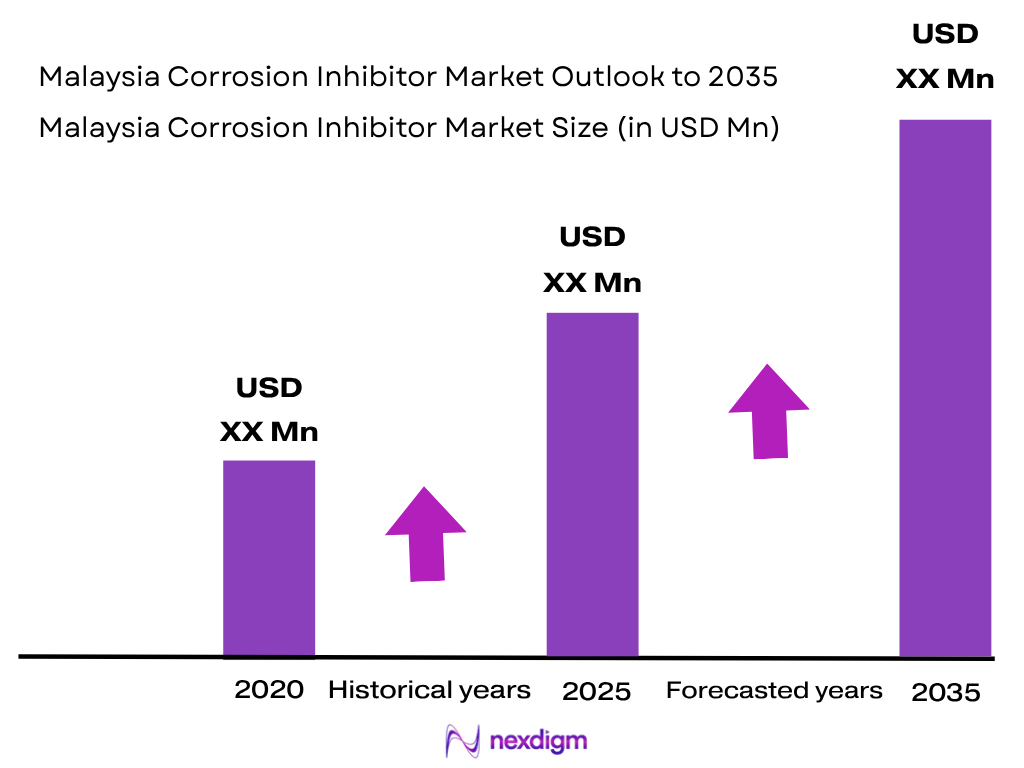
The Malaysia Corrosion Inhibitor Market is valued at approximately ~USD XX million, supported by corrosion-control demand across oil and gas production, pipelines, refineries, petrochemicals, cooling systems and boilers. Malaysia’s manufacturing-sector sales increased from RM1.8 trillion in the preceding annual period to RM1.9 trillion in the latest annual period, expanding the installed industrial asset base requiring corrosion protection. Petroleum, chemical, rubber and plastic manufacturing also returned to growth, supporting recurring specialty-chemical consumption.
Selangor, Johor, Terengganu, Sarawak and Sabah represent the most important corrosion-inhibitor demand centres. Selangor combines major manufacturing clusters with chemical-processing and industrial-water demand, while Johor contains significant refining, petrochemical and manufacturing infrastructure. Terengganu, Sarawak and Sabah benefit from upstream and downstream hydrocarbon activity and associated pipeline and processing assets. Manufacturing employment rose from 2.37 million people to 2.40 million people, indicating continued industrial activity supporting cooling-water, boiler and process-equipment corrosion-control requirements.
Market Segmentation
By Chemistry Type
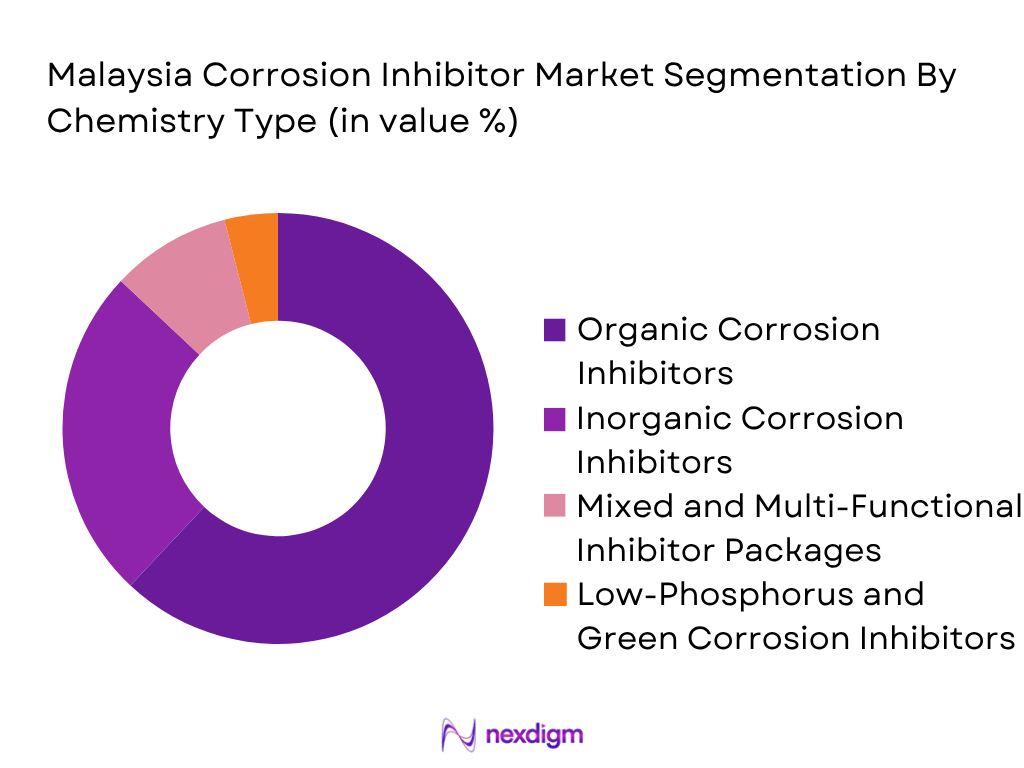
The Malaysia Corrosion Inhibitor Market is segmented by chemistry type into organic corrosion inhibitors, inorganic corrosion inhibitors, mixed and multi-functional inhibitor packages, and low-phosphorus or green corrosion inhibitors. Organic corrosion inhibitors hold the dominant position, driven primarily by the requirements of Malaysia’s oil and gas, refinery and petrochemical sectors. Film-forming amines, imidazoline derivatives and other organic compounds can establish protective films on metallic surfaces and are particularly suitable for carbon-steel pipelines and hydrocarbon-processing equipment. Their applicability in continuous-injection and batch-treatment programs also strengthens their adoption. Baker Hughes, for example, describes corrosion-control programs for sour, high-CO₂, oxygen-ingress and high-pressure/high-temperature production environments, reflecting the importance of specialized organic chemistry in petroleum operations. Growing demand for performance optimization and extended equipment life further supports this segment.
By End-Use Industry
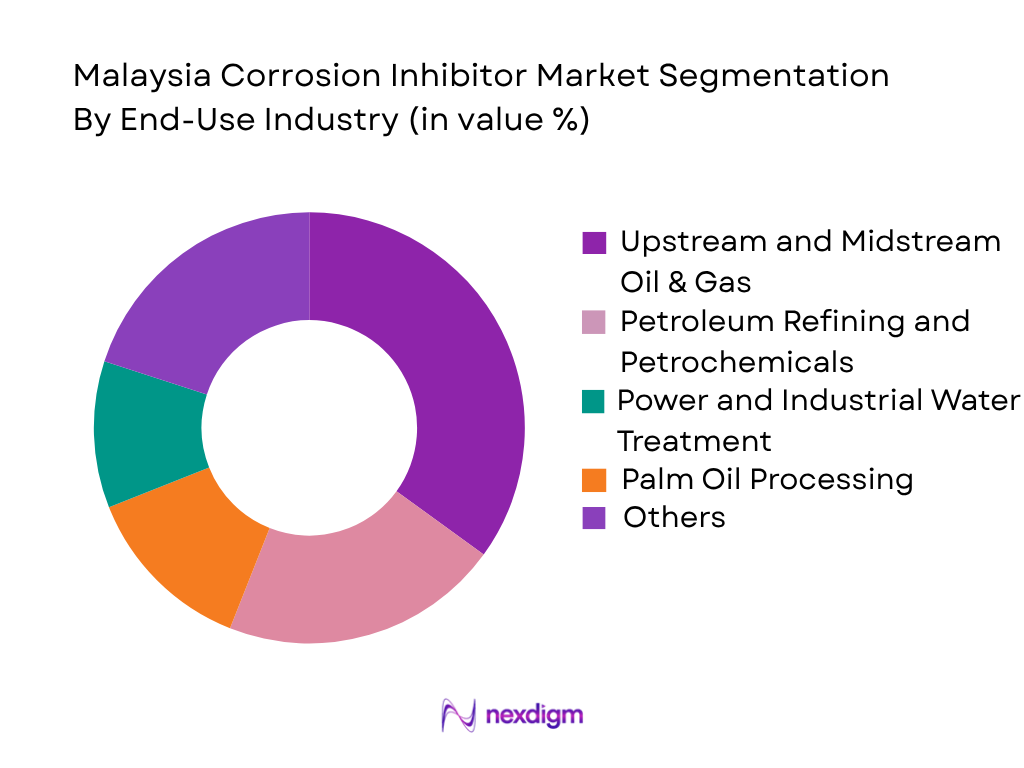
The Malaysia Corrosion Inhibitor Market is segmented by end-use industry into upstream and midstream oil and gas, petroleum refining and petrochemicals, power and industrial water treatment, palm oil processing, electronics and general manufacturing, and other industrial applications. Upstream and midstream oil and gas represent the dominant segment because corrosion-management chemicals are required across producing wells, flowlines, crude pipelines, wet-gas pipelines, water-injection systems and associated process equipment. Operating environments containing carbon dioxide, hydrogen sulfide, produced water and oxygen can accelerate internal corrosion and require continuous or periodic treatment. Malaysia’s established offshore hydrocarbon infrastructure in Peninsular Malaysia, Sabah and Sarawak consequently creates recurring demand rather than one-time chemical consumption. Specialized suppliers also offer batch and continuous-injection approaches specifically for challenging production environments, reinforcing oil and gas as a technically intensive market for inhibitors.
Competitive Landscape
The Malaysia Corrosion Inhibitor Market has a combination of multinational specialty-chemical companies, global oilfield-service companies, water-treatment specialists and domestic chemical formulators. Nalco Water, Kurita Water Industries, Solenis, Baker Hughes and Veolia have strong capabilities across industrial-water or oilfield applications, while Malaysian suppliers compete through local blending, technical responsiveness, customized formulations and proximity to industrial customers. Competition increasingly depends on treatment performance, dosage economics, corrosion monitoring, field technical support and the ability to provide integrated chemical-treatment programs rather than chemical supply alone.
| Company | Establishment Year | Headquarters | Malaysia Presence | Key Corrosion-Inhibitor Focus | Oil & Gas Capability | Industrial Water Capability | Service Model | Major End Markets |
| Ecolab / Nalco Water | 1923 | St. Paul, Minnesota, USA | ~ | ~ | ~ | ~ | ~ | ~ |
| Kurita Water Industries | 1949 | Tokyo, Japan | ~ | ~ | ~ | ~ | ~ | ~ |
| Solenis | 1907 | Wilmington, Delaware, USA | ~ | ~ | ~ | ~ | ~ | ~ |
| Baker Hughes | 1907 heritage | Houston, Texas, USA | ~ | ~ | ~ | ~ | ~ | ~ |
| Veolia | 1853 heritage | Aubervilliers, France | ~ | ~ | ~ | ~ | ~ | ~ |
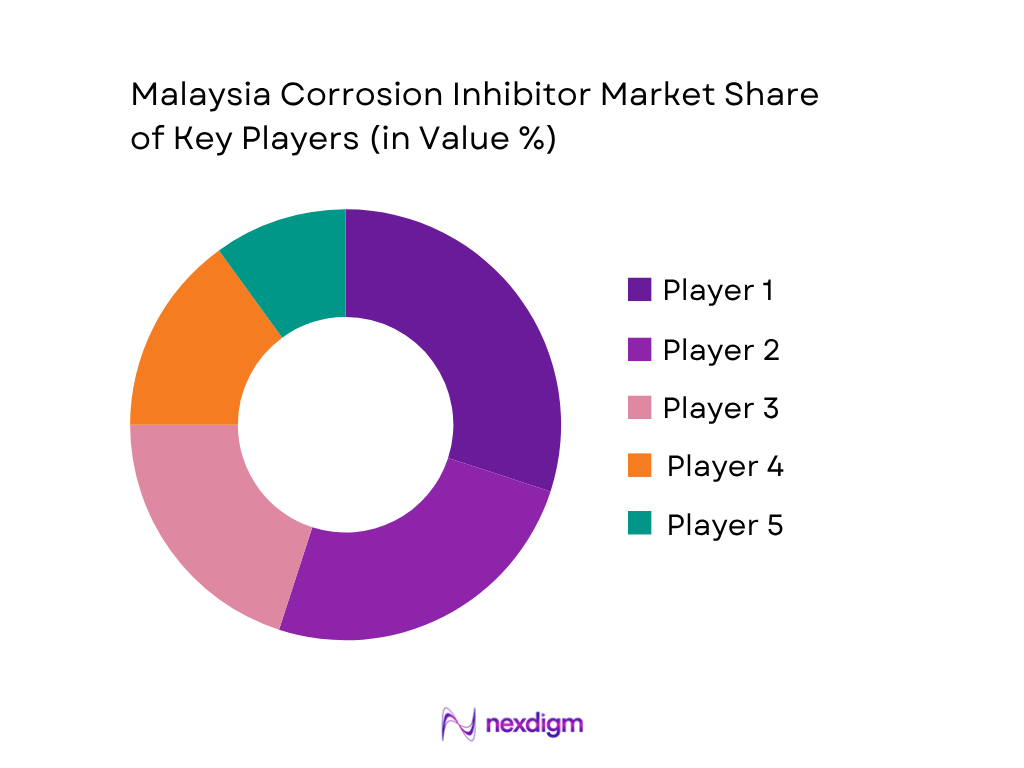
Malaysia Corrosion Inhibitor Market Analysis
Growth Drivers
Expanding Oil & Gas Production and Hydrocarbon Asset-Integrity Requirements
Malaysia’s large upstream hydrocarbon system is a fundamental demand driver for corrosion inhibitors because wells, flowlines, production facilities, water-injection systems and pipelines require continuous protection against CO₂, H₂S, produced water and oxygen-related corrosion. PETRONAS reported a record 2,000 thousand barrels of oil equivalent per day from Malaysia operations in 2024, while group-wide average production reached 2,451 thousand barrels of oil equivalent per day, compared with 2,431 thousand barrels per day in the preceding period. PETRONAS also recorded 21 projects achieving first hydrocarbon production across Malaysia and Indonesia, 17 final investment decisions, including 11 in Malaysia, and 19 exploration discoveries across its operating portfolio. The Malaysia Bid Round additionally resulted in 14 production-sharing contracts involving 12 operators, covering 11 discovered-resource opportunities and 3 exploration blocks. These figures indicate a substantial installed and expanding hydrocarbon asset base requiring corrosion-management programs. The wider macroeconomic setting also supports industrial expenditure: the IMF records Malaysia’s 2024 nominal GDP at USD422.2 billion and population at 34.1 million. Sources: PETRONAS and International Monetary Fund.
Large Manufacturing and Process-Industry Base Supporting Recurring Treatment Demand
Malaysia’s extensive manufacturing ecosystem creates recurring corrosion-inhibitor demand across cooling towers, boilers, heat exchangers, process-water circuits, condensate systems and metallic production equipment. The Department of Statistics Malaysia reported manufacturing-sector sales of RM1.9 trillion in 2024, with December alone recording RM158.4 billion. Manufacturing represented a major component of national industrial activity, while petroleum, chemical, rubber and plastic manufacturing remained an important process-industry cluster where corrosion management directly affects equipment reliability. MIDA recorded RM120.5 billion of approved manufacturing investments across 1,108 projects in 2024, associated with 87,695 employment opportunities. The same official investment dataset recorded 92 chemicals and chemical-products projects involving RM10.6251 billion, alongside 10 petroleum-products and petrochemical projects involving RM2.7069 billion. These projects expand the addressable installed base of vessels, piping, boilers, cooling systems and process equipment requiring chemical protection. At the national level, DOSM valued Malaysia’s current-price GDP at RM1.93 trillion, while the IMF reported nominal GDP of USD422.2 billion. Sources: Department of Statistics Malaysia, Malaysian Investment Development Authority and International Monetary Fund.
Market Challenges
Dependence on Imported Chemicals and Exposure to International Supply Chains
Malaysia’s corrosion-inhibitor industry operates within a chemical supply chain that remains materially exposed to imported active ingredients, solvents, specialty intermediates and formulated products. MATRADE reported total Malaysian imports of RM1.371 trillion in 2024, including RM104.14 billion of chemicals and chemical products and RM127.37 billion of petroleum products. Imports from China alone reached RM296.45 billion, with chemicals and chemical products identified among the principal import categories, while imports from the United States reached RM126.26 billion and likewise included chemicals as a major component. Imports from ASEAN totalled RM327.17 billion, again with chemical products among the principal categories. For corrosion-inhibitor suppliers, this international sourcing exposure can complicate raw-material availability, formulation continuity, inventory planning and customer-specific product qualification, particularly for specialized amines, phosphonates, imidazoline intermediates and high-performance additives. Malaysia’s overall merchandise trade reached RM2.879 trillion, demonstrating the economy’s deep integration with cross-border supply chains. The IMF places nominal GDP at USD422.2 billion, reinforcing the scale of the industrial economy dependent on imported intermediate goods. Sources: MATRADE, Department of Statistics Malaysia and International Monetary Fund.
Diverse Industrial Operating Conditions Increase Formulation and Technical-Service Complexity
The Malaysia Corrosion Inhibitor Market faces significant technical complexity because suppliers must serve multiple metallurgies, water chemistries, pressures, temperatures and corrosion mechanisms rather than a standardized application environment. MIDA identifies 6 operating oil refineries in Malaysia, while PETRONAS reported Malaysia production reaching 2,000 thousand barrels of oil equivalent per day in 2024. Beyond hydrocarbons, DOSM recorded RM1.9 trillion in annual manufacturing sales, meaning corrosion-inhibitor suppliers must address applications spanning petroleum processing, chemical production, metals, food manufacturing, electronics and general industrial utilities. MIDA’s investment data further recorded 1,108 manufacturing projects in 2024, including 92 chemical-product projects, 131 fabricated-metal projects, 139 machinery-and-equipment projects, 110 food-manufacturing projects and 10 petroleum and petrochemical projects. Each group presents different pH conditions, dissolved solids, process temperatures, metallurgy and chemical-compatibility requirements. Consequently, corrosion-inhibitor suppliers require laboratory testing, application engineering, dosing optimization and monitoring capability rather than relying on one universal formulation. Malaysia’s 2024 GDP reached RM1.93 trillion at current prices, highlighting the scale of industrial assets requiring differentiated corrosion-management approaches. Sources: MIDA, PETRONAS and Department of Statistics Malaysia.
Market Opportunities
Localization of Specialty Chemical Formulation and Technical Manufacturing
Malaysia offers a strong future opportunity for localized corrosion-inhibitor formulation as investment moves toward higher-value specialty chemicals and advanced industrial materials. MIDA recorded RM24.9 billion of approved investment in the chemicals industry in 2025 across 113 projects, associated with 7,102 employment opportunities. Of this investment, RM5.8 billion originated domestically and RM19.1 billion came from foreign sources. This expanding chemical-manufacturing platform can support local blending, customization and production of film-forming inhibitors, water-treatment packages and application-specific formulations, reducing reliance on fully formulated imports while improving delivery responsiveness to Malaysian industrial customers. Malaysia also recorded RM426.7 billion in total approved investments in 2025 across 8,390 projects, expected to generate 244,902 jobs, indicating a substantial pipeline of new industrial assets potentially requiring cooling-water, boiler-water and process-equipment corrosion control. The country already had 6 oil refineries identified by MIDA, providing a concentrated downstream customer base for specialty chemical treatment. The IMF records Malaysia’s 2024 nominal GDP at USD422.2 billion, demonstrating the underlying economic scale supporting localization. Sources: Malaysian Investment Development Authority and International Monetary Fund.
New Upstream, Gas and Carbon-Management Infrastructure Expanding Advanced Inhibitor Applications
Future corrosion-inhibitor opportunities are strengthening around Malaysia’s upstream resource development, high-CO₂ gas handling and emerging carbon-management infrastructure. PETRONAS concluded the Malaysia Bid Round with 14 new production-sharing contracts involving 12 operators, encompassing 11 discovered-resource opportunities and 3 exploration blocks. During 2024, PETRONAS also reached final investment decision on 11 projects in Malaysia and achieved record domestic production of 2,000 thousand barrels of oil equivalent per day. These activities enlarge the potential installed base of wells, gathering lines, pipelines and processing equipment requiring film-forming and continuous-injection corrosion inhibitors. PETRONAS additionally advanced carbon-capture and storage development through acquisition of land at Kuantan Port for a southern hub and technical work related to storage capacity in the Penyu Basin. Such infrastructure creates future requirements for corrosion management in CO₂ transportation and associated steel systems, where water content and dense-phase CO₂ conditions can impose demanding integrity requirements. Malaysia’s broader macroeconomic base remains substantial, with the IMF reporting USD422.2 billion in nominal GDP and 34.1 million people in 2024. Sources: PETRONAS, Malaysia Petroleum Management and International Monetary Fund.
Future Outlook
The Malaysia Corrosion Inhibitor Market is forecast to expand at approximately ~X.X% CAGR during 2026-2035, supported by continuing investment in asset integrity, refinery and petrochemical operations, industrial water management, energy infrastructure and high-value manufacturing. Demand is expected to shift progressively toward higher-performance formulations offering lower dosage, longer film persistence, wider compatibility and improved environmental characteristics.
Future growth will also be influenced by Malaysia’s large industrial production base. Manufacturing activity includes electronics, fabricated metals, petroleum and chemical products, food processing and other water- and equipment-intensive sectors, creating recurring requirements for cooling-water and boiler corrosion treatment. Malaysia’s manufacturing sector recorded RM1.9 trillion in annual sales, demonstrating the scale of the industrial customer pool addressed by specialty water-treatment chemicals.
Major Players
- Nalco Water – An Ecolab Company
- Solenis
- Kurita Water Industries / Kurita Water Malaysia
- Veolia Water Technologies
- SLB
- Baker Hughes
- Dorf Ketal
- SumiSaujana TCM Chemicals Sdn Bhd
- HB Laboratories Sdn Bhd
- Panorama Oil & Gas Sdn Bhd
- Duro Kimia Sdn Bhd
- Techkem Water Technologies Sdn Bhd
- I-Chem Solution Sdn Bhd
- Prima Techno Chemicals Sdn Bhd
- Cosmic Discovery Sdn Bhd
Key Target Audience
- Corrosion Inhibitor Manufacturers and Formulators
- Oilfield Production Chemical Manufacturers and Suppliers
- Industrial Water Treatment Chemical Companies and Service Providers
- Oil & Gas, Refinery, Petrochemical and Industrial Plant Operators
- Specialty Chemical Distributors and Importers
- EPC, Asset Integrity and Industrial Maintenance Companies
- Investments and Venture Capitalist Firms
- Government and Regulatory Bodies (Department of Environment Malaysia, Department of Occupational Safety and Health Malaysia, Ministry of Investment, Trade and Industry, Malaysian Investment Development Authority)
Research Methodology
Step 1: Identification of Key Variables
The initial stage involves building the complete Malaysia Corrosion Inhibitor Market ecosystem, covering raw-material suppliers, chemical formulators, distributors, oilfield-service companies, industrial water-treatment providers and end users. Secondary research is used to identify critical variables including treated asset base, corrosion exposure, chemistry type, dosage rate, treatment frequency, selling price, import dependency and local formulation capacity.
Step 2: Market Analysis and Construction
Historical market demand is assessed through a combination of top-down and bottom-up approaches. The top-down assessment examines Malaysia’s oil and gas production infrastructure, refinery and petrochemical activity, manufacturing output and industrial-water demand, while the bottom-up model evaluates corrosion-inhibitor consumption by application, dosage intensity, number of treated assets, treatment frequency and supplier revenue.
Step 3: Hypothesis Validation and Expert Consultation
Initial market hypotheses are validated through structured interviews with corrosion specialists, chemical suppliers, industrial-water treatment companies, oil and gas procurement teams, distributors and plant-maintenance professionals. These discussions are used to understand realized pricing, customer qualification requirements, treatment programs, formulation preferences, competitive positioning and changing inhibitor consumption patterns across major Malaysian industrial applications.
Step 4: Research Synthesis and Final Output
Information collected through primary interviews is reconciled with company information, government industrial statistics, trade indicators, technical literature and end-use demand benchmarks. Supply-side revenue estimates are cross-checked against application-based consumption calculations, and discrepancies are investigated through additional validation. The resulting dataset is triangulated to develop the final market size, segmentation, competitive assessment and forecast.

- Executive Summary
- Research Methodology (Market Definition and Scope, Malaysia Corrosion Inhibitor Market Classification, Organic and Inorganic Corrosion Inhibitor Demand Assessment, Film-Forming Amine and Imidazoline Consumption Mapping, Oil-Soluble Water-Soluble and Water-Dispersible Corrosion Inhibitor Demand Assessment, Domestic Formulation and Blending Capacity Assessment, Import Dependency Analysis, Amine Imidazoline Phosphonate Nitrite Molybdate Silicate Zinc Salt and Solvent Raw Material Assessment, Corrosion Inhibitor Formulation Blending Dosing and Injection Technology Mapping, Installed Oil and Gas Pipeline Refinery Petrochemical Cooling Water and Boiler Asset Base Assessment)

- Definition and Scope
- Malaysia Corrosion Inhibitor Industry Evolution and Development of Oilfield Corrosion Inhibitors, Cooling Water Corrosion Inhibitors, Boiler Water Corrosion Inhibitors, Refinery Corrosion Inhibitors and Industrial Water Treatment Chemical Ecosystem
- Organic Corrosion Inhibitor, Inorganic Corrosion Inhibitor, Film-Forming Amine, Imidazoline, Phosphonate, Nitrite, Molybdate, Silicate, Zinc-Based and Multi-Functional Inhibitor Industry Structure
- Malaysia Corrosion Inhibitor Value Chain Analysis
- Malaysia Corrosion Inhibitor Supply Chain Analysis
- Specialty Chemical Raw Material Supplier, Active Ingredient Supplier, Corrosion Inhibitor Formulator, Chemical Blender, Distributor, Oilfield Chemical Service Provider, Water Treatment Contractor, EPC Contractor, Asset Integrity Service Provider and Industrial End-User Ecosystem Analysis

- Growth Drivers (Large Offshore and Onshore Oil and Gas Asset Base, Corrosion Control Requirement in Crude Wet Gas and Dehydrated Gas Pipelines, High Carbon Dioxide and Sour Gas Corrosion Exposure, Refinery and Petrochemical Asset Integrity Demand, Increasing Cooling Water and Boiler Treatment Requirement, Industrial Water Reuse and Reliability Requirements, Palm Oil Processing Chemical Treatment Demand)
- Market Challenges (Dependence on Imported Specialty Active Ingredients, Volatility in Amine Phosphonate Solvent and Metal Salt Prices, Long Product Qualification and Field Trial Cycles, Price Competition in Standard Industrial Water Treatment Chemicals, Offshore Chemical Logistics and Inventory Requirements, Compatibility Issues with Scale Inhibitors Biocides Demulsifiers and Oxygen Scavengers)
- Market Opportunities (High Carbon Dioxide Gas Field Corrosion Protection, Corrosion Inhibitors for Carbon Capture Utilization and Storage Pipelines, Local Formulation and Blending Expansion, Phosphorus-Free Cooling Water Treatment Programs, Bio-Based and Green Corrosion Inhibitors, Smart Chemical Injection and Automated Dosing Systems, Multi-Functional Scale and Corrosion Treatment Packages)
- Market Trends (Film-Persistent Corrosion Inhibitor Adoption, Imidazoline-Based Oilfield Treatment, Low-Phosphorus and Phosphorus-Free Formulations, Multi-Functional Water Treatment Chemicals, Automated Chemical Injection, Online Corrosion Monitoring, Data-Driven Dosage Optimization, Green and Biodegradable Corrosion Inhibitors, High-Temperature and Sour-Service Formulations)
- Regulatory and Standards Landscape (Malaysia Occupational Safety and Health Chemical Classification Requirements, CLASS Regulations, Safety Data Sheet and Hazard Labelling Requirements, Department of Environment Industrial Effluent Requirements, Scheduled Waste Management Requirements, Chemical Storage and Transportation Compliance, PETRONAS Technical and Product Qualification Requirements)
- SWOT Analysis
- Porter’s Five Forces Analysis
- PESTLE Analysis
- Stakeholder Ecosystem
- Competition Ecosystem

- By Market Value (2020-2025)
- By Corrosion Inhibitor Consumption Volume (2020-2025)
- By Oil and Gas Corrosion Inhibitor Consumption Volume (2020-2025)
- By Industrial Water Treatment Corrosion Inhibitor Consumption Volume (2020-2025)
- By Domestic Corrosion Inhibitor Formulation Value (2020-2025)
- By Domestic Corrosion Inhibitor Formulation Volume (2020-2025)
- By Corrosion Inhibitor Import Value (2020-2025)
- By Average Selling Price (2020-2025)

- By Chemistry Type (In Value %)
Organic Corrosion Inhibitors
Film-Forming Amines
Imidazolines and Imidazoline Derivatives
Quaternary Ammonium Compounds
Organic Phosphonates
Carboxylate-Based Inhibitors
Phosphate-Based Inhibitors
Nitrite and Nitrate-Based Inhibitors
Molybdate-Based Inhibitors
Silicate-Based Inhibitors
Zinc-Based Inhibitors
Mixed and Multi-Functional Corrosion Inhibitor Packages
Phosphorus-Free and Low-Phosphorus Corrosion Inhibitors
Bio-Based and Green Corrosion Inhibitors - By Product Formulation (In Value %)
Water-Soluble Corrosion Inhibitors
Oil-Soluble Corrosion Inhibitors
Water-Dispersible Corrosion Inhibitors
Solvent-Based Corrosion Inhibitors
Concentrated Liquid Corrosion Inhibitors
Solid and Controlled-Release Corrosion Inhibitors
Multi-Functional Scale and Corrosion Inhibitor Packages - By Corrosion Mechanism Addressed (In Value %)
Carbon Dioxide Corrosion
Hydrogen Sulfide and Sour Corrosion
Oxygen-Induced Corrosion
Microbiologically Influenced Corrosion
Under-Deposit Corrosion
Top-of-Line Corrosion
Preferential Weld Corrosion
Galvanic Corrosion
Naphthenic Acid Corrosion
General and Uniform Corrosion
Pitting and Localized Corrosion - By Application (In Value %)
Oil and Gas Production Systems
Crude Oil Pipelines
Wet Gas Pipelines
Dehydrated Gas Pipelines
Water Injection Systems
Downhole and Well Treatment Systems
Refinery Process Units
Petrochemical Process Systems
Cooling Water Systems
Cooling Towers
Closed-Loop Chilled Water Systems
Boiler Feedwater Systems
Steam and Condensate Systems
Heat Exchangers
Process Water Systems
Hydrotesting Applications
Storage Tanks and Terminals - By End-Use Industry (In Value %)
Upstream Oil and Gas
Midstream Oil and Gas
Petroleum Refining
Petrochemicals
Chemical Manufacturing
Power Generation
Palm Oil Mills and Refineries
Pulp and Paper
Food and Beverage Processing
Electronics and Semiconductor Manufacturing
Metal Processing
General Manufacturing
Commercial HVAC and District Cooling
Marine and Offshore Facilities
Water and Wastewater Treatment

- Growth Drivers (Large Offshore and Onshore Oil and Gas Asset Base, Corrosion Control Requirement in Crude Wet Gas and Dehydrated Gas Pipelines, High Carbon Dioxide and Sour Gas Corrosion Exposure, Refinery and Petrochemical Asset Integrity Demand, Increasing Cooling Water and Boiler Treatment Requirement, Industrial Water Reuse and Reliability Requirements, Palm Oil Processing Chemical Treatment Demand)
- Market Challenges (Dependence on Imported Specialty Active Ingredients, Volatility in Amine Phosphonate Solvent and Metal Salt Prices, Long Product Qualification and Field Trial Cycles, Price Competition in Standard Industrial Water Treatment Chemicals, Offshore Chemical Logistics and Inventory Requirements, Compatibility Issues with Scale Inhibitors Biocides Demulsifiers and Oxygen Scavengers)
- Market Opportunities (High Carbon Dioxide Gas Field Corrosion Protection, Corrosion Inhibitors for Carbon Capture Utilization and Storage Pipelines, Local Formulation and Blending Expansion, Phosphorus-Free Cooling Water Treatment Programs, Bio-Based and Green Corrosion Inhibitors, Smart Chemical Injection and Automated Dosing Systems, Multi-Functional Scale and Corrosion Treatment Packages)
- Market Trends (Film-Persistent Corrosion Inhibitor Adoption, Imidazoline-Based Oilfield Treatment, Low-Phosphorus and Phosphorus-Free Formulations, Multi-Functional Water Treatment Chemicals, Automated Chemical Injection, Online Corrosion Monitoring, Data-Driven Dosage Optimization, Green and Biodegradable Corrosion Inhibitors, High-Temperature and Sour-Service Formulations)
- Regulatory and Standards Landscape (Malaysia Occupational Safety and Health Chemical Classification Requirements, CLASS Regulations, Safety Data Sheet and Hazard Labelling Requirements, Department of Environment Industrial Effluent Requirements, Scheduled Waste Management Requirements, Chemical Storage and Transportation Compliance, PETRONAS Technical and Product Qualification Requirements)
- SWOT Analysis
- Porter’s Five Forces Analysis
- PESTLE Analysis
- Stakeholder Ecosystem
- Competition Ecosystem

- PETRONAS and Upstream Operator Corrosion Inhibitor Procurement Assessment
- Crude Oil Wet Gas and Dehydrated Gas Pipeline Corrosion Treatment Requirement Analysis
- Refinery Corrosion Inhibitor Requirement Assessment
- Petrochemical and Chemical Plant Corrosion Control Assessment
- Gas Processing and High Carbon Dioxide Service Corrosion Inhibitor Procurement Analysis
- Power Generation Cooling Water and Boiler Corrosion Inhibitor Requirement Assessment
- Palm Oil Mill Boiler and Process Water Corrosion Treatment Assessment
- Industrial Manufacturing Cooling Tower and Closed-Loop Corrosion Control Analysis
- Water Treatment Contractor Corrosion Inhibitor Procurement Assessment
- EPC Contractor and Asset Integrity Service Provider Chemical Requirement Assessment

- By Market Value (2026-2035)
- By Corrosion Inhibitor Consumption Volume (2026-2035)
- By Oil and Gas Corrosion Inhibitor Consumption Volume (2026-2035)
- By Industrial Water Treatment Corrosion Inhibitor Consumption Volume (2026-2035)
- By Domestic Corrosion Inhibitor Formulation Value (2026-2035)
- By Domestic Corrosion Inhibitor Formulation Volume (2026-2035)
- By Corrosion Inhibitor Import Value (2026-2035)
- By Average Selling Price (2026-2035)


 Request a Sample
 Ask for Customization
 Get a Quote
 Enquire Now