
 Download PDF
Market Overview
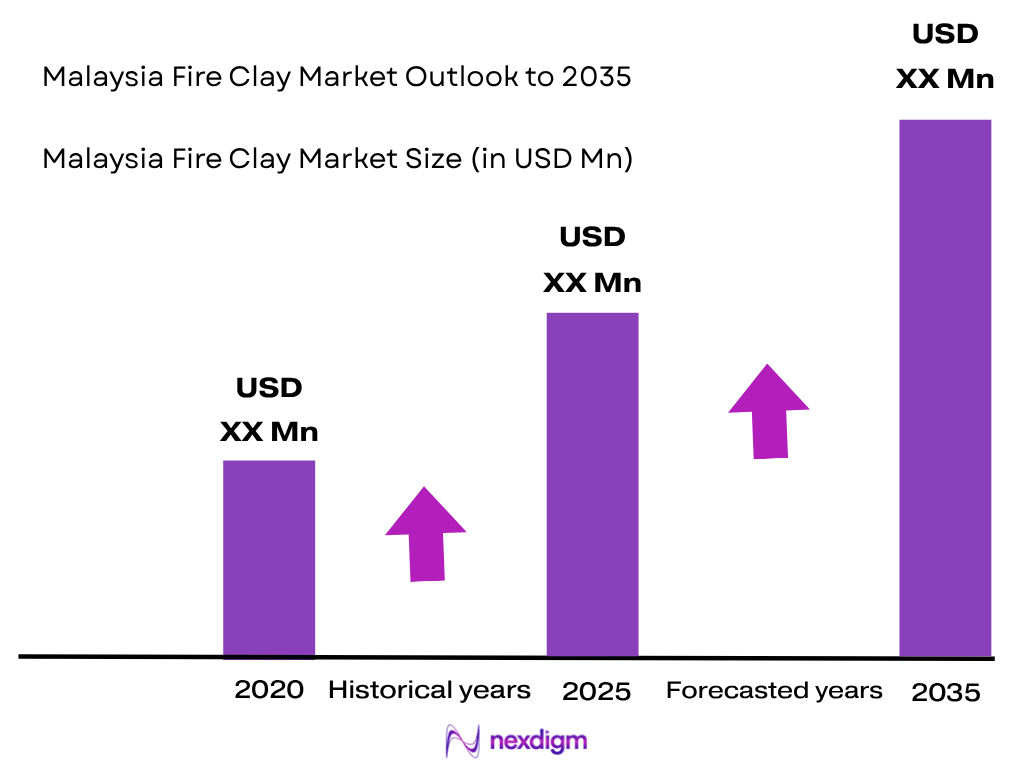
The Malaysia Fire Clay Market is valued at approximately USD ~ million, based on the report’s market-sizing framework. As a verified demand-side indicator, Malaysia imported 995,760 kg valued at USD 468,060 in 2023, increasing to 1,559,740 kg valued at USD 963,060 in 2024 under HS 250830. Demand is supported by firebrick, refractory castable, furnace-lining, cement, foundry, ceramic and other high-temperature industrial applications. World Integrated Trade Solution.
Perak and Selangor are important Malaysian clusters because Perak accommodates industrial-mineral processing and refractory manufacturing, while Selangor hosts refractory manufacturers, distributors and industrial customers. Malaysia’s imported supply also demonstrates the importance of China, the United States and Japan: their respective supplies moved from 403,528 kg, 280,003 kg and 257,200 kg in 2023 to 653,078 kg, 419,043 kg and 296,200 kg in 2024, reinforcing their role as major external sources. World Integrated Trade Solution.
Market Segmentation
By Fire Clay Grade
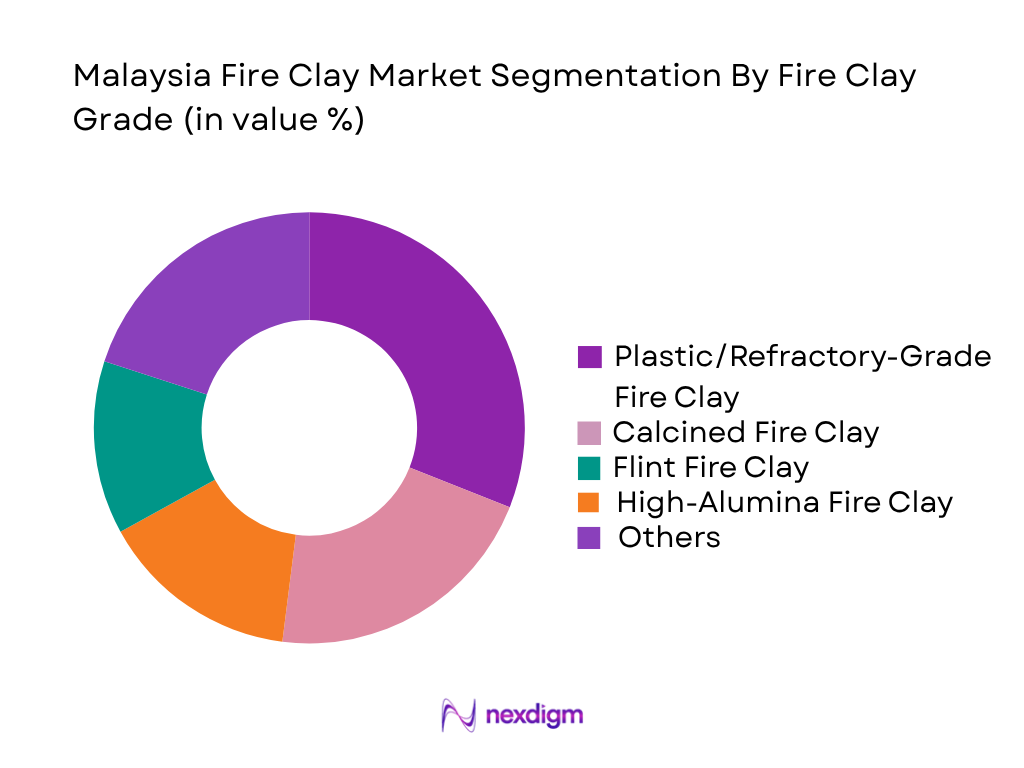
The Malaysia Fire Clay Market is segmented by grade into plastic fire clay, semi-flint fire clay, flint fire clay, calcined fire clay, high-alumina fire clay, low-iron fire clay and other specialized grades. Refractory-grade/plastic fire clay represents the dominant modeled segment, supported by its suitability for firebrick, refractory mortar, furnace-lining and related thermal applications. Its combination of plasticity, aluminosilicate chemistry, refractory performance and compatibility with shaped refractory manufacturing gives it broad industrial applicability. Demand is reinforced by Malaysia’s domestic refractory ecosystem, which manufactures firebricks, castables, mortars and insulation materials for cement plants, boilers, foundries, steel facilities and other high-temperature industries. Fire Clay is also frequently blended with other aluminosilicate raw materials to obtain application-specific refractoriness, strength and thermal properties. Malaysian refractory manufacturers consequently require consistency in alumina content, iron impurities, particle-size distribution and fired properties.
By Application
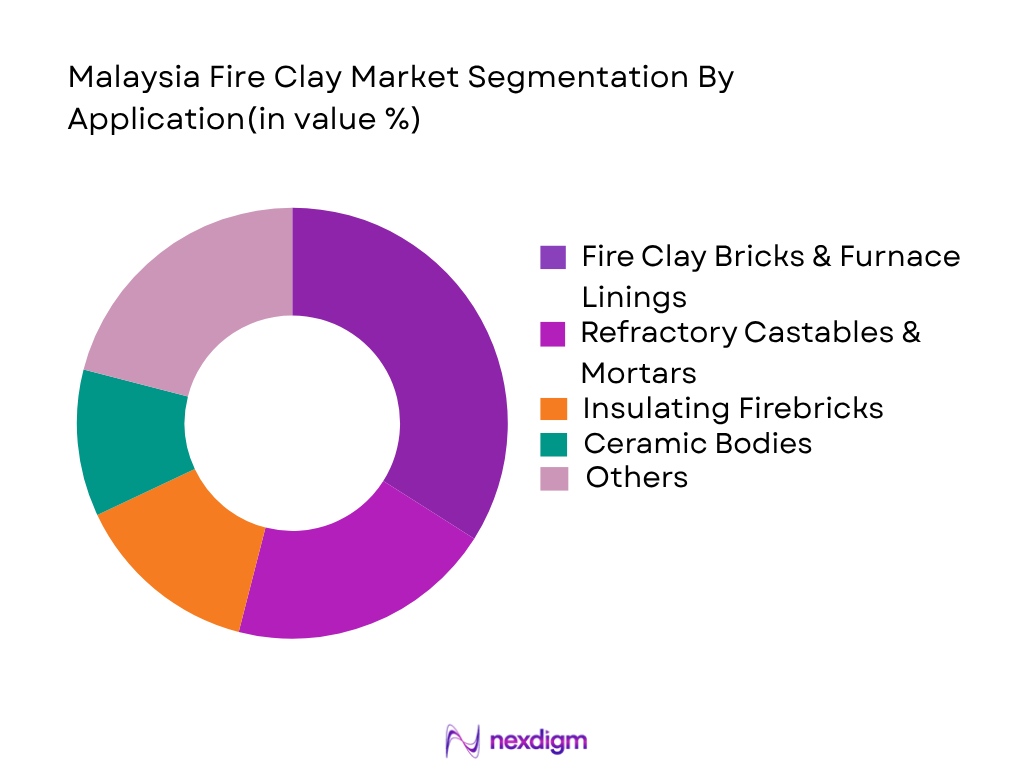
The Malaysia Fire Clay Market is segmented by application into fire clay bricks, insulating firebricks, refractory castables and mortars, ramming/plastic refractories, ceramic bodies, sanitaryware, vitrified clay products and kiln/furnace linings. Fire clay bricks and refractory lining applications constitute the dominant modeled application group because Malaysia has a substantial base of industries requiring thermal protection and periodic refractory maintenance. Firebrick Industries manufactures firebricks for foundries, boilers and cement plants, while ARM supplies refractory products to steel, aluminium, cement, lime, petrochemical and foundry customers. Refracon similarly serves power, petrochemical, refinery, steel, aluminium, cement, mineral-processing and incineration operations. These applications create recurring requirements because refractory linings deteriorate through thermal cycling, abrasion, chemical attack and prolonged exposure to high operating temperatures. Fire clay remains relevant where its thermal performance provides an economical balance between service conditions and refractory cost.
Competitive Landscape
The Malaysia Fire Clay Market operates through a combination of industrial-mineral processors, refractory manufacturers, firebrick manufacturers, importers, distributors and refractory engineering companies. Competition therefore extends beyond direct extraction of fire clay to processing capability, refractory formulation, technical specifications, furnace-lining expertise, local inventories and after-sales services. Established participants include Firebrick Industries, Associated Refractories Manufacturer, Isolite, Refracon and Kaolin (Malaysia), with differentiated positions across industrial minerals, firebricks, monolithic refractories and insulation products. Sericite Supplier.
| Major Player | Establishment | Headquarters / Malaysian Base | Core Offering | Fire Clay/Refractory Exposure | Processing/Manufacturing Capability | Major End Users | Technical Capability | Malaysia Footprint |
| Firebrick Industries (M) Sdn. Bhd. | 1980 | Ipoh, Perak | ~ | ~ | ~ | ~ | ~ | ~ |
| Associated Refractories Manufacturer Sdn. Bhd. | 1991 | Rawang, Selangor | ~ | ~ | ~ | ~ | ~ | ~ |
| Isolite Insulating Firebrick Sdn. Bhd. | 1990 | Chemor, Perak | ~ | ~ | ~ | ~ | ~ | ~ |
| Refracon Sdn. Bhd. | 1985 | Shah Alam, Selangor | ~ | ~ | ~ | ~ | ~ | ~ |
| Kaolin (Malaysia) Sdn. Bhd. | 1970 | Puchong/Tapah | ~ | ~ | ~ | ~ | ~ | ~ |
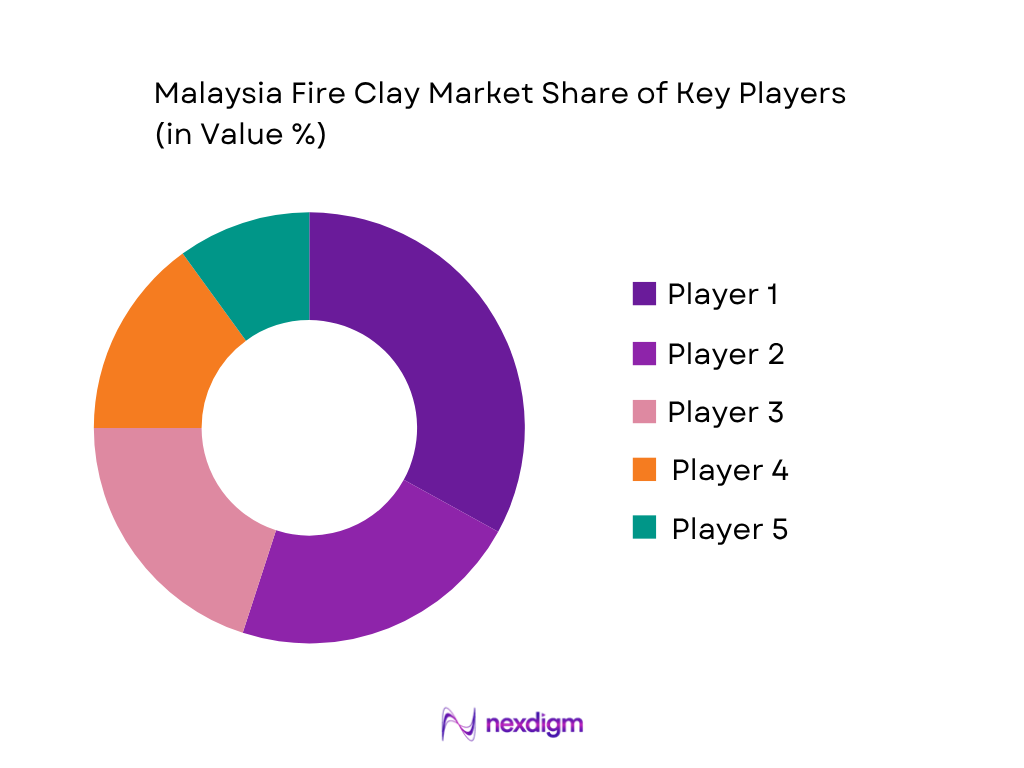
Malaysia Fire Clay Market Analysis
Growth Drivers
Expanding Refractory-Consuming Manufacturing Base
Malaysia’s expanding industrial base provides a strong demand foundation for fire clay used in firebricks, refractory mortars, castables, furnace linings and other heat-resistant applications. The Department of Statistics Malaysia recorded RM1.9 trillion in manufacturing sales during 2024, while national GDP reached RM1.93 trillion at current prices. The IMF separately recorded nominal GDP at US$422.2 billion and a population of 34.1 million, indicating the scale of the industrial economy supporting refractory-consuming activities. More directly, MIDA recorded 56 approved non-metallic mineral manufacturing projects involving RM5.3 billion of investment and 2,905 potential jobs in 2024. This category is particularly relevant to fire clay because it encompasses downstream mineral-based manufacturing activities such as ceramics and other heat-processed mineral products. MIDA also recorded RM1.56 billion of approved investment across 10 basic-metal projects, another important refractory-consuming industrial category. Together, continued capital deployment into non-metallic minerals and metals sustains demand for furnace construction, kiln operations, maintenance shutdowns and refractory replacement, supporting consumption of qualified fire-clay-based materials. Furthermore, MIDA recorded 131 approved fabricated-metal projects involving RM3.70 billion of investment, broadening Malaysia’s metal-processing infrastructure. Petroleum products, including petrochemicals, attracted another RM2.71 billion across 10 approved projects, supporting additional high-temperature processing installations. These industrial activities reinforce recurring requirements for refractory linings and fire-clay-containing materials across Malaysia’s manufacturing ecosystem.
Strong Fire Clay Import Flows Supporting Industrial Consumption
Malaysia’s direct fire-clay trade data demonstrate an established requirement for externally sourced refractory raw material. World Bank WITS data based on UN Comtrade records show that Malaysia imported exactly 1,559,740 kilograms of fire clay under HS 250830 during 2024. China supplied 653,078 kilograms, the United States 419,043 kilograms, Japan 296,200 kilograms, Poland 108,000 kilograms, Spain 54,080 kilograms, Singapore 26,550 kilograms, and South Korea 2,000 kilograms. These physical-volume figures are especially relevant because they demonstrate commercial movement of fire clay without relying on market-size or pricing assumptions. The wider macroeconomic environment also supported industrial material flows: DOSM reported Malaysia’s total merchandise trade at RM2.9 trillion, comprising exports of RM1.5 trillion and imports of RM1.4 trillion during 2024. The IMF recorded Malaysia’s nominal economy at US$422.2 billion, reinforcing the scale of the manufacturing and trading platform supporting industrial-material procurement. The diversity of supplying countries indicates that Malaysian refractory and mineral users already operate international sourcing channels capable of accessing different fire-clay specifications required for industrial applications. China, the United States and Japan together supplied 1,368,321 kilograms, demonstrating the importance of these three origins within the supply chain. Poland and Spain collectively supplied another 162,080 kilograms, providing supplementary European sourcing options. This multi-country procurement structure supports availability of different mineralogical and refractory specifications for Malaysian industrial users.
Market Challenges
Dependence on Concentrated Imported Fire Clay Supply
Malaysia’s reliance on imported fire clay creates a market-specific supply-security challenge because a substantial portion of physical imports comes from a relatively small group of overseas origins. World Bank WITS/UN Comtrade data show 1,559,740 kilograms of Malaysian fire-clay imports in 2024. China alone supplied 653,078 kilograms, followed by the United States with 419,043 kilograms and Japan with 296,200 kilograms. The next suppliers were considerably smaller: Poland supplied 108,000 kilograms, Spain 54,080 kilograms, Singapore 26,550 kilograms, South Korea 2,000 kilograms, Other Asia 650 kilograms, India 104 kilograms, France 30 kilograms, and the United Kingdom only 1 kilogram. This sourcing structure exposes Malaysian refractory manufacturers and industrial consumers to disruptions affecting international shipping, raw-material availability and supplier qualification. The challenge matters within Malaysia’s broader import-intensive trading system: DOSM recorded total merchandise imports of RM1.4 trillion in 2024. The IMF placed Malaysia’s economy at US$422.2 billion, highlighting how industrial supply chains operate within a large, globally connected economy where disruptions in specialist mineral inputs can affect downstream production continuity. The gap between the 653,078 kilograms supplied by China and the 108,000 kilograms supplied by the fourth-largest origin, Poland, illustrates the concentration of commercially significant supply among a limited number of countries. Alternative suppliers such as India, France and the United Kingdom provided only small quantities during the period. Consequently, qualifying additional suppliers with comparable alumina content, refractoriness and mineral consistency remains important for improving supply resilience.
Raw-Material Availability and Industrial Maintenance Constraints
Reliable fire-clay supply is particularly important because Malaysian refractory manufacturers must maintain material consistency while downstream furnaces and kilns require scheduled and emergency maintenance. DOSM explicitly identified insufficient supply of materials and repair and maintenance of machinery and equipment among the principal causes preventing manufacturing plants from achieving full capacity utilisation during the fourth quarter of 2024. This is relevant to fire clay because refractory production depends on controlled aluminosilicate feedstock, while downstream users cannot freely substitute raw materials without validating refractoriness, alumina chemistry, impurities, plasticity and fired performance. Malaysia imported 1,559,740 kilograms of HS 250830 fire clay during 2024, including 653,078 kilograms from China, 419,043 kilograms from the United States, 296,200 kilograms from Japan and 108,000 kilograms from Poland, demonstrating the need to coordinate multiple international sources. The issue sits within a manufacturing sector that generated RM1.9 trillion in sales during 2024 and attracted 1,108 approved manufacturing projects involving RM120.5 billion of capital investment. These projects were associated with 87,695 potential jobs, illustrating the scale of industrial capacity being developed and maintained. Non-metallic mineral manufacturing alone accounted for 56 approved projects, while fabricated metal products accounted for another 131 projects. Maintaining consistent refractory-material availability therefore becomes increasingly important as Malaysia’s installed base of kilns, furnaces and thermal-processing equipment expands.
Market Opportunities
Domestic Beneficiation and Import Substitution of Refractory-Grade Fire Clay
Malaysia has a clear opportunity to strengthen domestic beneficiation, classification, calcination and specification-controlled preparation of refractory clay because current trade flows demonstrate an established requirement for imported material. World Bank WITS/UN Comtrade recorded 1,559,740 kilograms of Malaysian fire-clay imports in 2024, sourced from at least 11 identifiable overseas origins, including 653,078 kilograms from China, 419,043 kilograms from the United States, 296,200 kilograms from Japan, 108,000 kilograms from Poland and 54,080 kilograms from Spain. These current physical flows establish a measurable addressable base for Malaysian processors capable of qualifying locally processed material against downstream specifications. The investment environment also supports additional mineral-processing capability. MIDA recorded 56 approved non-metallic mineral projects involving RM5.3 billion of investment and creating 2,905 potential jobs in 2024; domestic investment within this category amounted to RM3.1 billion and foreign investment to RM2.2 billion. At the macroeconomic level, Malaysia generated RM1.93 trillion of nominal GDP in 2024. This combination of existing imports and active mineral-sector investment creates room for beneficiation-led localization rather than dependence exclusively on overseas processed feedstock. Malaysia’s manufacturing investment pipeline also contained 1,108 approved projects, creating a substantial industrial customer ecosystem for processed minerals. The country’s RM1.4 trillion merchandise import base demonstrates the scale of existing international procurement channels that domestic processors could selectively replace. Local beneficiation could particularly target applications requiring controlled particle size, alumina chemistry, reduced impurities and consistent refractory characteristics.
Expansion of Higher-Specification Fire Clay Supply for New Industrial Capacity
Malaysia’s pipeline of industrial investment creates an opportunity for fire-clay suppliers to move toward specification-controlled refractory feedstocks serving kilns, furnaces, foundries, metal processing and non-metallic mineral manufacturing. MIDA recorded RM120.5 billion of approved manufacturing investment across 1,108 projects in 2024, associated with 87,695 potential jobs. Within industries particularly relevant to refractory demand, non-metallic mineral products attracted RM5.29 billion across 56 projects, basic metal products attracted RM1.56 billion across 10 projects, fabricated metal products attracted RM3.70 billion across 131 projects, and petroleum products including petrochemicals attracted RM2.71 billion across 10 projects. These are current investment indicators rather than future demand forecasts, but they establish a broader installed industrial base in which high-temperature processing and refractory maintenance are relevant. Malaysia’s manufacturing sector simultaneously generated RM1.9 trillion in sales during 2024. The IMF recorded national nominal GDP at US$422.2 billion and DOSM reported GDP of RM1.93 trillion at current prices, supporting the case for suppliers developing beneficiated, calcined and tightly specified fire-clay feedstocks for Malaysia’s increasingly capital-intensive industrial ecosystem. The 2,905 potential jobs associated specifically with non-metallic mineral projects also indicate continued expansion of mineral-processing capabilities and industrial activity. Basic metals and fabricated metals together accounted for 141 approved projects, strengthening the downstream ecosystem where refractory products are required for heat-intensive operations. Suppliers that can provide technically consistent aluminosilicate feedstocks can therefore target both established refractory producers and new industrial facilities requiring reliable furnace and kiln lining materials.
Future Outlook
The Malaysia Fire Clay Market is forecast to expand at a CAGR of approximately ~% during 2026-2035. Future demand will be linked primarily to refractory replacement cycles, cement and lime production, foundry operations, petrochemical facilities, boilers, industrial furnaces, ceramic manufacturing and development of higher-performance refractory formulations. Import substitution represents an important structural opportunity. Malaysia’s fire-clay imports rose materially between the two latest reported trade periods, demonstrating dependence on external sources for specific grades and specifications. World Integrated Trade Solution Domestic beneficiation, controlled grinding, particle classification and calcination could allow local suppliers to address a greater proportion of industrial specifications.
Higher-value opportunities are expected around beneficiated, calcined and application-specific refractory clay formulations rather than undifferentiated raw clay. Buyers increasingly evaluate alumina content, iron oxide impurities, refractoriness, thermal stability, particle-size distribution and consistency before approving raw materials for refractory formulations.
Major Players
- Sibelco Malaysia Sdn. Bhd.
- Kaolin (Malaysia) Sdn. Bhd.
- Firebrick Industries (M) Sdn. Bhd.
- Isolite Insulating Firebrick Sdn. Bhd.
- Associated Refractories Manufacturer Sdn. Bhd.
- Refracon Sdn. Bhd.
- Refracon Refractories Manufacturer Sdn. Bhd.
- DAV Refractory Sdn. Bhd.
- Refrateck Engineering Sdn. Bhd.
- Deltech Engineering Sdn. Bhd.
- Sing Lian Ping Engineering Construction Sdn. Bhd.
- Claytan Industries Sdn. Bhd.
- Claybricks & Tiles Sdn. Bhd.
- Saint-Gobain Performance Ceramics & Refractories
- Ganesha’s Refractories
Key Target Audience
- Fire Clay and Industrial Clay Producers
- Refractory and Firebrick Manufacturers
- Ceramic, Sanitaryware and Vitrified Clay Product Manufacturers
- Cement, Steel, Foundry, Petrochemical and Industrial Furnace Operators
- Industrial Mineral Importers, Distributors and Refractory Material Suppliers
- Investments and Venture Capitalist Firms
- Mining, Mineral Processing and Refractory Technology Companies
- Government and Regulatory Bodies (Department of Mineral and Geoscience Malaysia [JMG], Ministry of Natural Resources and Environmental Sustainability [NRES], Department of Environment Malaysia [DOE], Royal Malaysian Customs Department)
Research Methodology
Step 1: Identification of Key Variables
The initial research phase develops an ecosystem map covering fire clay miners, industrial-mineral processors, importers, refractory manufacturers, distributors and major consuming industries. Secondary research identifies variables including alumina content, refractory grade, import dependence, application mix, firebrick production, industrial furnace activity, refractory replacement cycles and average selling prices.
Step 2: Market Analysis and Construction
Historical market information is analyzed using a combination of supply-side and demand-side models. The top-down approach examines industrial mineral consumption, HS 250830 trade flows and refractory-consuming industries, while the bottom-up model assesses supplier volumes, imported quantities, refractory production and end-user consumption. WITS/UN Comtrade data provide an independently reported reference point for Malaysia’s fire-clay import flows. World Integrated Trade Solution.
Step 3: Hypothesis Validation and Expert Consultation
Market hypotheses are validated through structured primary interviews and computer-assisted telephone interviews with industrial-mineral suppliers, refractory manufacturers, procurement professionals, distributors and end-user industries. Discussions focus on fire clay grades, pricing structures, procurement volumes, import origins, refractory replacement cycles, technical specifications, supplier qualification procedures and substitution by alternative refractory materials.
Step 4: Research Synthesis and Final Output
The final stage triangulates primary research with company disclosures, trade statistics, industrial data and bottom-up consumption calculations. Supplier capabilities and application coverage are cross-checked against manufacturer information, while inconsistencies are reviewed through additional validation. Market forecasts incorporate downstream industrial demand, refractory replacement requirements, import dependence, material substitution, pricing trends and potential domestic processing expansion.

- Executive Summary
- Research Methodology (Market Definition and Scope, Malaysia Fire Clay Market Classification, Fire Clay Grade Mapping, Refractory-Grade Fire Clay Assessment, Ceramic-Grade Fire Clay Evaluation, Plastic Fire Clay Analysis, Flint Fire Clay Assessment, Semi-Flint Fire Clay Evaluation, Calcined Fire Clay Analysis, High-Alumina Fire Clay Assessment, Fire Clay Mineralogical Composition Mapping, Alumina Content Assessment, Silica Content Assessment, Iron Oxide Impurity Evaluation, Refractoriness Assessment, Pyrometric Cone Equivalent Analysis, Plasticity Assessment, Particle Size Distribution Analysis, Thermal Performance Assessment, Fire Clay Processing Technology Mapping, Beneficiation Requirement Assessment, Calcination Process Evaluation, Refractory Application Mapping, Ceramic Application Assessment, Domestic Fire Clay Production Assessment, Import Supply Assessment, Supply-Side Assessment, Demand-Side Assessment, Top-Down Market Sizing, Bottom-Up Market Sizing, Primary Industry Interviews, Trade Data Reconciliation, Data Triangulation, Forecasting Framework)

- Definition and Scope
- Malaysia Fire Clay Industry Evolution and Development of Refractory Clay Mining, Industrial Clay Extraction, Kaolinitic Clay Development, Refractory Manufacturing, Firebrick Production, Ceramic Manufacturing, Sanitaryware Production, Clay Beneficiation, Mineral Processing, Calcination Infrastructure, Imported Refractory Raw Material Supply, Industrial Furnace Development, Cement and Lime Production, Foundry Operations, Petrochemical Processing, Boiler Applications, Palm Oil Mill Furnace Applications and High-Temperature Industrial Infrastructure Expansion
- Fire Clay Value Chain Analysis
- Fire Clay Supply Chain Analysis
- Fire Clay Miners, Industrial Clay Producers, Mineral Beneficiation Companies, Calcined Clay Producers, Importers, Mineral Traders, Refractory Manufacturers, Firebrick Producers, Monolithic Refractory Manufacturers, Ceramic Manufacturers, Sanitaryware Producers, Industrial Mineral Distributors, Refractory Contractors, Furnace Operators, Cement Producers, Foundries, Petrochemical Plants, Palm Oil Mills and Industrial End Users

- Growth Drivers (Refractory Replacement Demand, Expansion of Ceramic and Sanitaryware Manufacturing, Cement and Lime Production Activity, Industrial Furnace Utilization, Foundry and Metal Processing Demand, Petrochemical Processing Activity, Palm Oil Mill Boiler and Furnace Demand, Development of Domestic Refractory Manufacturing, Increasing Demand for High-Temperature Industrial Materials, Import Substitution Potential)
- Market Challenges (Dependence on Imported Refractory-Grade Fire Clay, Variability in Domestic Fire Clay Quality, Alumina and Iron Oxide Content Variability, Competition from High-Alumina Refractories, Competition from Mullite and Bauxite-Based Refractories, Energy-Intensive Calcination and Processing, Freight and Import Cost Volatility, End-User Qualification Requirements, Environmental Compliance for Clay Extraction, Limited Availability of Consistent High-Grade Deposits)
- Market Opportunities (Domestic Fire Clay Beneficiation, Import Substitution of Refractory-Grade Clay, Calcined Fire Clay Production, High-Alumina Fire Clay Development, Customized Refractory Clay Blending, Fire Clay Processing and Classification, Refractory Recycling and Spent Firebrick Recovery, Local Refractory Raw Material Supply, ASEAN Fire Clay Export Opportunities, Mine-Waste and Kaolinitic Clay Valorization)
- Market Trends (Increasing Demand for Higher-Alumina Fire Clay Grades, Adoption of Beneficiated Fire Clay, Growth of Calcined Fire Clay Applications, Shift toward Monolithic Refractories, Application-Specific Refractory Formulations, Increasing Fire Clay Quality-Control Requirements, Local Inventory and Rapid-Delivery Models, Refractory Raw Material Localization, Recycling of Spent Refractory Materials, Development of Customized Particle-Size and Mineralogical Specifications)
- Government Regulations and Standards (Mineral Development Act, State Mineral and Land Administration Requirements, Environmental Quality Act, Environmental Impact Assessment Requirements, Mineral Extraction and Mining Approval Requirements, Department of Minerals and Geoscience Malaysia Guidelines, Customs HS 250830 Fire-Clay Classification, Occupational Safety and Health Requirements, Air Emission and Dust Control Requirements, Scheduled Waste Management Requirements, Mine Rehabilitation and Environmental Management Requirements)
- SWOT Analysis
- Porter’s Five Forces Analysis
- PESTLE Analysis
- Stakeholder Ecosystem
- Competition Ecosystem

- By Market Value (2020-2025)
- By Fire Clay Consumption Volume (2020-2025)
- By Average Selling Price (2020-2025)
- By Domestic Fire Clay Supply Volume (2020-2025)
- By Imported Fire Clay Volume (2020-2025)
- By Refractory-Grade Fire Clay Consumption Volume (2020-2025)
- By Ceramic-Grade Fire Clay Consumption Volume (2020-2025)
- By Calcined Fire Clay Consumption Volume (2020-2025)
- By Refractory and Ceramic Application Consumption Volume (2020-2025)

- By Fire Clay Grade (In Value %)
Plastic Fire Clay
Semi-Flint Fire Clay
Flint Fire Clay
Calcined Fire Clay
High-Alumina Fire Clay
Low-Iron Fire Clay
Refractory-Grade Fire Clay
Ceramic-Grade Fire Clay
Beneficiated Fire Clay
Blended Refractory Clay - By Application (In Value %)
Fire Clay Bricks
Insulating Firebricks
Refractory Castables
Refractory Mortars
Ramming and Plastic Refractories
Ceramic Bodies
Sanitaryware and Fireclay Sanitary Products
Vitrified Clay Products
Kiln and Furnace Linings
Other High-Temperature Applications - By Alumina Content (In Value %)
Below 25% Al₂O₃
25%-30% Al₂O₃
30%-35% Al₂O₃
35%-40% Al₂O₃
Above 40% Al₂O₃
Standard Refractory Alumina Grades
High-Alumina Transitional Grades
Application-Specific Alumina Grades - By Processing and Product Form (In Value %)
Run-of-Mine Fire Clay
Lump Fire Clay
Crushed Fire Clay
Ground and Powdered Fire Clay
Washed Fire Clay
Beneficiated Fire Clay
Calcined Fire Clay
Blended Fire Clay - By End-User (In Value %)
Refractory Manufacturers
Iron and Steel Companies and Foundries
Cement and Lime Producers
Ceramic and Tile Manufacturers
Sanitaryware Manufacturers
Glass Manufacturers
Petrochemical and Refinery Operators
Boiler and Power Generation Operators
Palm Oil Mills
Waste Incineration and Industrial Furnace Operators - By Source (In Value %)
Domestically Extracted Fire Clay
Imported Fire Clay
Captive Fire Clay Supply
Merchant Fire Clay Supply
Direct Import Supply
Industrial Mineral Distributor Supply
Reprocessed Refractory Clay Feedstock
Customized Refractory Clay Blends - By Region (In Value %)
Perak
Selangor
Johor
Penang
Kedah
Negeri Sembilan
Melaka
Pahang
Sabah
Sarawak

- Market Share of Major Players (By Malaysia Revenue, Fire Clay and Refractory Product Portfolio, Fire Clay Grade Coverage, Alumina Grade Range, Refractoriness and PCE Capability, Firebrick Product Coverage, Monolithic Refractory Capability, Ceramic Raw Material Coverage, Processing and Manufacturing Capacity, Domestic Stocking Capability, End-User Industry Coverage, Distribution Network, Technical Testing Capability, Customized Formulation Capability, Aftermarket and Technical Support)
- Cross Comparison Parameters (Al₂O₃ Grade Range, Refractoriness and PCE Capability, Fire Clay and Refractory Product Portfolio Breadth, Processing and Refractory Manufacturing Capacity, Domestic Stocking and Lead-Time Capability, End-Use Industry Coverage, Technical Testing and Customized Formulation Capability, Malaysia Distribution and Customer-Service Reach)
- SWOT Analysis of Major Players
- Competitive Positioning Matrix
- Fire Clay Grade, Mineralogical Composition and Refractory Performance Benchmarking
- Refractory Application and End-Use Industry Compatibility Assessment
- Local Distribution, Technical Support and Fire Clay Supply Capability Assessment
- Detailed Profiles of Major Companies
Sibelco Malaysia Sdn. Bhd.
Kaolin (Malaysia) Sdn. Bhd.
Firebrick Industries (M) Sdn. Bhd.
Isolite Insulating Firebrick Sdn. Bhd.
Associated Refractories Manufacturer Sdn. Bhd.
Refracon Sdn. Bhd.
Refracon Refractory Manufacturers Sdn. Bhd.
DAV Refractory Sdn. Bhd.
Refrateck Engineering Sdn. Bhd.
Deltech Engineering Sdn. Bhd.
Sing Lian Ping Engineering Construction Sdn. Bhd.
Claytan Industries Sdn. Bhd.
Claybricks & Tiles Sdn. Bhd.
Saint-Gobain Performance Ceramics & Refractories
Ganesha’s Refractories

- Refractory Manufacturer Fire Clay Requirement Assessment
- Firebrick Manufacturing Raw Material Requirement Analysis
- Iron and Steel and Foundry Refractory Demand Assessment
- Cement and Lime Kiln Fire Clay Requirement Analysis
- Ceramic and Tile Manufacturing Fire Clay Demand Assessment
- Sanitaryware Fire Clay Requirement Evaluation
- Petrochemical and Refinery Refractory Demand Analysis
- Palm Oil Mill Boiler and Furnace Requirement Assessment
- Industrial Furnace and Kiln Fire Clay Requirement Analysis
- Fire Clay Alumina Content Requirement Assessment
- Fire Clay Refractoriness and Pyrometric Cone Equivalent Requirement Analysis
- Fire Clay Particle Size and Plasticity Requirement Assessment
- Fire Clay Replacement and Refractory Relining Cycle Assessment
- Domestic versus Imported Fire Clay Procurement Assessment
- Fire Clay Supplier Qualification and Technical Approval Analysis

- By Market Value (2026-2035)
- By Fire Clay Consumption Volume (2026-2035)
- By Average Selling Price (2026-2035)
- By Domestic Fire Clay Supply Volume (2026-2035)
- By Imported Fire Clay Volume (2026-2035)
- By Refractory-Grade Fire Clay Consumption Volume (2026-2035)
- By Ceramic-Grade Fire Clay Consumption Volume (2026-2035)
- By Calcined Fire Clay Consumption Volume (2026-2035)
- By Refractory and Ceramic Application Consumption Volume (2026-2035)


 Request a Sample
 Ask for Customization
 Get a Quote
 Enquire Now