
 Download PDF
Market Overview
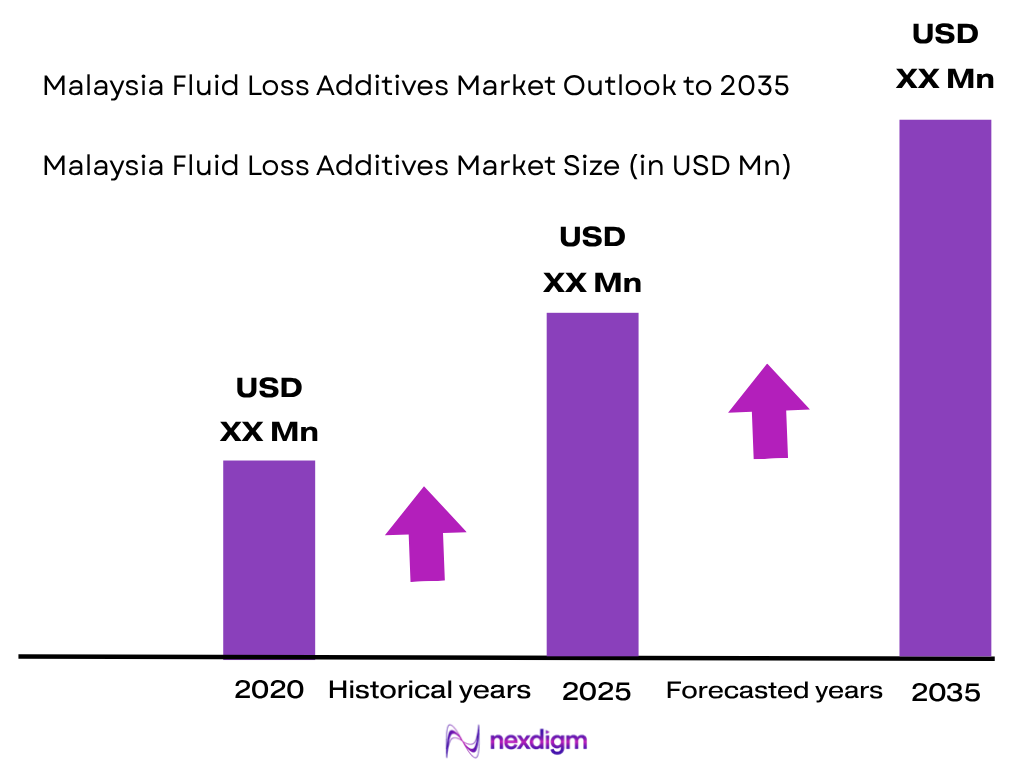
The Malaysia Fluid Loss Additives Market is valued at approximately ~USD XX million, supported by offshore drilling, development wells, mature-field interventions and cementing requirements. Malaysia’s crude oil and condensate production moved from 188.8 million barrels in the preceding period to 181.6 million barrels in the latest period, while natural gas production increased from 2,862.0 billion cubic feet to 2,948.8 billion cubic feet. These upstream volumes sustain demand for drilling-fluid filtration control, reservoir protection and cement fluid-loss additives.
Sarawak, Sabah and offshore Peninsular Malaysia dominate Malaysia Fluid Loss Additives demand because they contain the country’s primary producing basins, development projects and offshore drilling infrastructure. Upstream activity strengthened from 21 exploration discoveries and 2 exploration-appraisal successes in the preceding period to 80 exploration and development wells, more than 600 million barrels of oil equivalent of discovered resources and 17 first-hydrocarbon projects in the latest period, supporting chemical demand across drilling, cementing and well-completion operations.
Market Segmentation
By Product Chemistry
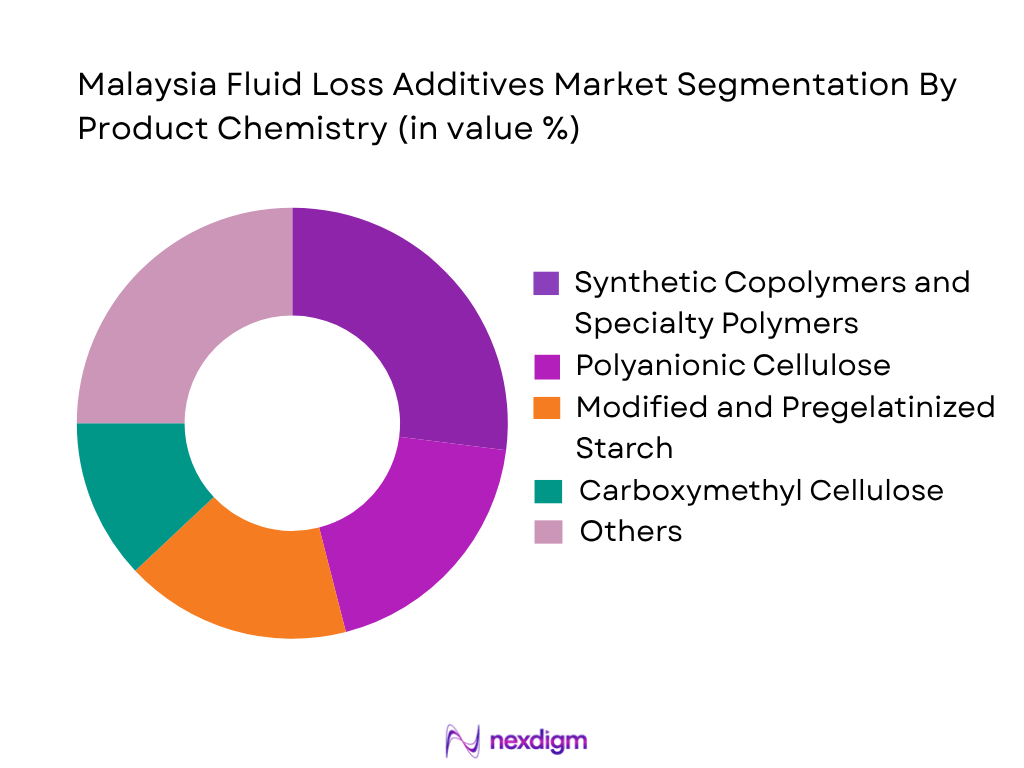
The Malaysia Fluid Loss Additives Market is segmented into polyanionic cellulose, carboxymethyl cellulose, modified starch, synthetic copolymers, AMPS-based polymers, polyacrylates, lignite-based additives, latex systems and other specialized formulations. Synthetic copolymers are considered the dominant value segment because Malaysia’s offshore well portfolio increasingly includes deepwater, extended-reach, high-temperature and high-salinity applications where conventional filtration-control materials may face thermal or chemical limitations. These polymers can be engineered to provide stable filtration control while interacting predictably with rheology modifiers, weighting agents and brine systems. PAC, CMC and modified starch remain important because they are widely used in water-based drilling fluids and can provide effective filter-cake control in conventional drilling environments. However, Sabah deepwater developments, Sarawak gas projects and technically demanding development wells support greater use of synthetic chemistry. Reservoir protection is also increasing the importance of low-damaging additives that produce thin, removable filter cakes and limit fluid invasion into producing formations.
By Fluid System
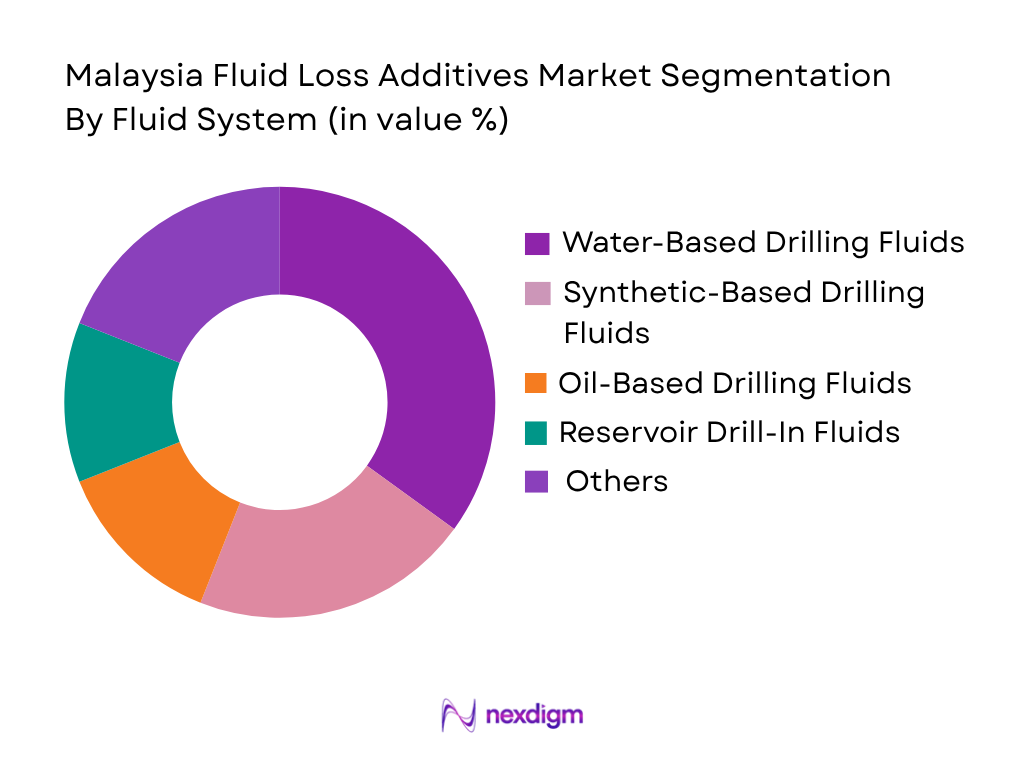
The Malaysia Fluid Loss Additives Market is segmented by fluid system into water-based drilling fluids, oil-based mud, synthetic-based mud, reservoir drill-in fluids, completion and workover fluids, and cement slurries. Water-based drilling fluids are considered the dominant segment because they are applicable across a broad range of Malaysian exploration and development wells and consume established filtration-control products including PAC, CMC, modified starch and synthetic polymers. High-performance water-based systems are becoming increasingly sophisticated as operators seek improved shale inhibition, wellbore stability and environmental performance. Synthetic-based systems remain particularly important in complex offshore and deepwater wells where lubricity, thermal stability and wellbore control are critical. Reservoir drill-in fluids represent another strategically important category because formation protection is essential when drilling productive intervals. Cement slurries also consume dedicated fluid-loss reducers during primary and remedial cementing, creating an additional demand channel outside conventional drilling-fluid applications.
Competitive Landscape
The Malaysia Fluid Loss Additives Market includes integrated international oilfield-service companies, independent drilling-fluid specialists, specialty-chemical manufacturers and Malaysian OGSE suppliers. Competition is driven by product qualification, filtration performance, HPHT capability, brine tolerance, reservoir compatibility, local stock availability and technical support. PETRONAS-led procurement and the wider production-sharing-contractor ecosystem make local vendor networks and offshore logistics particularly important. Malaysia also has more than 3,500 oil and gas businesses, providing an established base for specialist supply, engineering and field support.
| Major Player | Establishment Year | Headquarters | Fluid Loss Additive Capability | Fluid System Coverage | HPHT / Deepwater Capability | Malaysia Supply Presence | Cementing Capability | Technical & Field Support |
| SLB / M-I SWACO | 1926 | Houston, USA | ~ | ~ | ~ | ~ | ~ | ~ |
| Halliburton / Baroid | 1919 | Houston, USA | ~ | ~ | ~ | ~ | ~ | ~ |
| Baker Hughes | 1907 roots | Houston, USA | ~ | ~ | ~ | ~ | ~ | ~ |
| Newpark Fluids Systems | 1932 roots | The Woodlands, USA | ~ | ~ | ~ | ~ | ~ | ~ |
| Hextar Kimia Sdn. Bhd. | 1985 | Selangor, Malaysia | ~ | ~ | ~ | ~ | ~ | ~ |
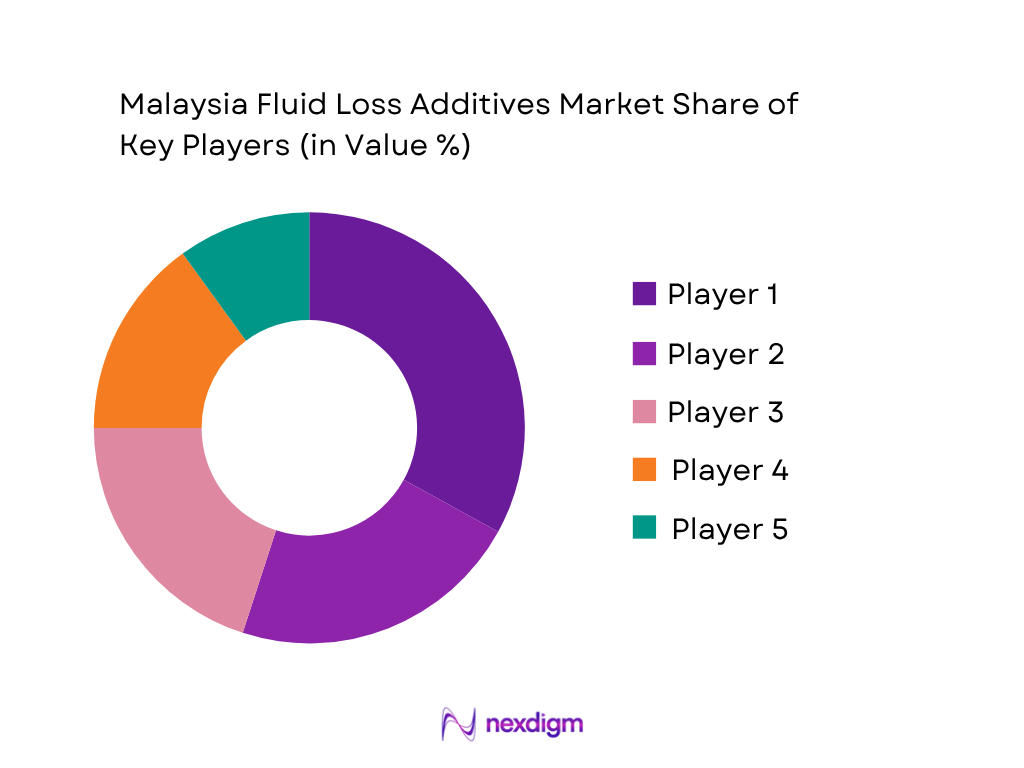
Malaysia Fluid Loss Additives Market Analysis
Growth Drivers
Sustained Offshore Drilling and Development Activity
Malaysia’s Fluid Loss Additives Market is supported by an active upstream drilling and development base that requires filtration-control additives across drilling, reservoir drill-in, completion and cementing fluids. In 2024, 80 exploration and development wells were drilled in Malaysia, while more than 600 million barrels of oil equivalent were added through new resource discoveries and 17 projects achieved first hydrocarbon. Malaysia Bid Round activity also generated 14 new production sharing contracts involving 12 operators, including 11 discovered-resource opportunities and 3 exploration blocks. These figures directly support fluid-loss additive consumption because every drilling program requires control of filtrate invasion, filter-cake thickness and formation exposure under varying salinity and temperature conditions. Crude oil and condensate production reached 45.7 million barrels in the fourth quarter of 2024, while natural gas production reached 792.8 billion cubic feet during the same period. The IMF records Malaysia’s nominal GDP at USD422.2 billion in 2024, with a population of 34.1 million and GDP per capita of USD12,397. This economic and upstream base supports continuing demand for PAC, CMC, modified starches and synthetic polymers across offshore well construction.
Deepwater, HPHT and Reservoir-Protection Requirements
Malaysia’s increasingly complex offshore portfolio is strengthening demand for higher-performance fluid-loss additives capable of operating in deepwater, high-temperature, high-salinity and pressure-sensitive formations. PETRONAS reported more than 600 million barrels of oil equivalent of resources discovered in 2024 from 9 new discoveries and 1 successful appraisal, while its wider upstream operations recorded average production of 2,451 thousand barrels of oil equivalent per day. Malaysia also signed 14 production sharing contracts during the year, broadening the range of future drilling environments that require customized mud and cement chemistry. Complex Sabah and Sarawak wells increase the relevance of AMPS-based polymers, synthetic copolymers and reservoir drill-in additives because these products can maintain filtration control where conventional starch or cellulose products may degrade or become less effective. Malaysia’s oil and gas services ecosystem includes more than 3,500 businesses, supporting field engineering, testing, blending and offshore logistics. The IMF places Malaysia’s nominal GDP at USD422.2 billion in 2024, with GDP per capita of USD12,397. These conditions create a strong technical demand base for high-performance additives focused on thermal stability, brine compatibility and reservoir protection.
Market Challenges
Dependence on Imported Specialty Chemicals and Polymer Feedstocks
Malaysia’s Fluid Loss Additives Market remains exposed to international chemical and polymer supply chains because many high-performance synthetic polymers, cellulose derivatives and specialty intermediates used in drilling and cementing formulations are imported. Malaysia’s total imports reached RM1,370.2 billion in 2024, reflecting the country’s large dependence on internationally sourced intermediate and capital goods. Fluid-loss products used in offshore operations often require specific molecular structures, salt tolerance and temperature resistance, limiting the ability to substitute raw materials quickly when international supply is disrupted. This challenge is more acute for HPHT and reservoir drill-in formulations where changing polymer chemistry can materially affect filtration behavior, rheology and filter-cake quality. Domestic oil and gas investment remains substantial, with RM1.79 billion of approved oil and gas investments across 5 projects in 2024, but local manufacturing capacity does not eliminate exposure to overseas feedstocks. Malaysia’s IMF-reported nominal GDP stood at USD422.2 billion, while GDP per capita reached USD12,397 and the population was 34.1 million. Consequently, suppliers must maintain larger inventories, diversify raw-material sources and preserve formulation compatibility across imported batches to support uninterrupted offshore drilling programs.
Upstream Activity Concentration and Project Qualification Complexity
The Malaysia Fluid Loss Additives Market is also challenged by concentrated upstream procurement and strict product-qualification requirements. PETRONAS, through Malaysia Petroleum Management, governs the country’s petroleum resources and oversees production sharing arrangements, making operator qualification, vendor licensing and technical approval critical for fluid-loss additive suppliers. During 2024, 14 production sharing contracts were awarded to 12 operators, while 11 discovered-resource opportunities and 3 exploration blocks formed part of the awarded portfolio. Although this creates demand, it also means suppliers must satisfy technical requirements across a relatively concentrated group of major operators and service companies. Products must often be validated for API filtration, HPHT filtration, brine tolerance, thermal stability and compatibility with drilling-fluid or cementing systems before they are accepted for offshore deployment. Malaysia drilled 80 exploration and development wells in 2024, meaning product performance failures can directly affect high-value well operations and therefore face significant scrutiny. The IMF records national nominal GDP at USD422.2 billion, with population at 34.1 million and GDP per capita of USD12,397. For smaller suppliers, qualification timelines, documentation demands and field-trial requirements can therefore slow commercial entry despite strong upstream activity.
Market Opportunities
Deepwater Sabah and New PSC Development Create Future Demand
Malaysia’s deepwater and newly awarded upstream acreage create a strong future opportunity for advanced fluid-loss additives, particularly synthetic polymers, reservoir drill-in formulations and HPHT cementing additives. Malaysia Bid Round 2024 concluded with 14 production sharing contracts involving 12 operators, covering 11 discovered-resource opportunities and 3 exploration blocks. In addition, Malaysia Bid Round 2025 offered 5 exploration blocks and 3 discovered-resource clusters, while the Mutiara Cluster off Sabah contains 5 fields: Nymphe, Nymphe North, Kuda Terbang, Benrinnes and Mutiara Hitam. Current upstream activity provides the technical foundation for future additive consumption: Malaysia drilled 80 exploration and development wells in 2024 and added more than 600 million barrels of oil equivalent through discoveries. These wells require filtration-control products capable of managing high temperatures, salinity, pressure differentials and reservoir sensitivity. Malaysia’s wider economic base remains supportive, with IMF-reported nominal GDP of USD422.2 billion in 2024, GDP per capita of USD12,397, and population of 34.1 million. These current indicators support future opportunities for suppliers offering low-damage reservoir systems, thermally stable polymers and deepwater-compatible cement fluid-loss technologies.
Local Blending, Stocking and OGSE Integration Can Expand
Malaysia has a clear opportunity to localize more fluid-loss additive blending, packaging, warehousing and technical support through its established oil and gas services and equipment ecosystem. The country has more than 3,500 oil and gas businesses, while approved oil and gas investments reached RM1.79 billion across 5 projects in 2024. This existing industrial base can support local stocking of PAC, CMC, starch derivatives and synthetic polymers, along with toll blending and customized offshore formulations. Localisation becomes particularly valuable because Malaysia imported RM1,370.2 billion of goods during 2024, demonstrating the scale of exposure to external supply chains. Suppliers that maintain inventory near Labuan, Kemaman, Kerteh, Miri and Bintulu can reduce mobilization delays for offshore wells and improve responsiveness when fluid programs require additional filtration-control chemicals. Malaysia’s broader investment environment also provides capacity for expansion, with RM378.5 billion of approved investments across 6,700 projects in 2024, including RM170.4 billion of foreign investment. The IMF records nominal GDP of USD422.2 billion and GDP per capita of USD12,397. These current conditions support future growth in local formulation, technical laboratories, offshore call-off inventory and PETRONAS-aligned vendor partnerships.
Future Outlook
The Malaysia Fluid Loss Additives Market is forecast to expand at approximately ~X.X% CAGR during 2026-2035, supported by continuing offshore development, deeper and more complex wells, mature-field optimization and increased emphasis on reservoir protection. Sabah deepwater development and Sarawak gas activity are expected to generate demand for high-performance synthetic polymers and specialized filtration-control systems. Future product development will increasingly emphasize thermal stability, salinity resistance, reduced formation damage and compatibility with high-performance water-based and synthetic-based fluid systems. Suppliers capable of providing application-specific formulations rather than commodity additives are likely to gain greater strategic relevance.
Mature producing fields will create an additional demand pool through infill drilling, workovers, well interventions and eventual plug-and-abandonment activity. These operations require fluid-loss control across drilling, completion and cementing systems while operating within depleted or pressure-sensitive reservoirs. Localization will also shape future competition. Malaysian blending, stocking and packaging can reduce dependence on long international lead times, while PETRONAS licensing, local technical support and offshore supply-base access will remain important elements of supplier positioning.
Major Players
- SLB / M-I SWACO
- Halliburton / Baroid
- Baker Hughes
- Newpark Fluids Systems
- Dorf Ketal
- Nouryon
- BASF
- Dow
- SNF
- Kemira
- Solvay
- Hextar Kimia Sdn. Bhd.
- JVK Resources
- Malaya OGS Sdn. Bhd.
- MEI Group / SINO MUD
Key Target Audience
- Fluid Loss Additive and Oilfield Specialty Chemical Manufacturers
- Drilling Fluid and Well Cementing Service Companies
- Oil and Gas Operators and Production Sharing Contractors
- Offshore Drilling and Well Construction Companies
- Specialty Chemical Importers, Distributors and Local Blenders
- Investments and Venture Capitalist Firms
- Government and Regulatory Bodies (PETRONAS Malaysia Petroleum Management, Malaysian Investment Development Authority, Department of Occupational Safety and Health Malaysia, Department of Environment Malaysia, Malaysian Maritime Enforcement Agency)
- Offshore Supply Base, Warehousing and Oilfield Logistics Companies
Research Methodology
Step 1: Identification of Key Variables
The initial phase involves constructing an ecosystem map encompassing major participants in the Malaysia Fluid Loss Additives Market, including chemical manufacturers, drilling-fluid companies, cementing service providers, operators, PSC contractors, local distributors and offshore supply bases. Extensive desk research is used to identify relevant chemistries, fluid systems, well environments and procurement channels. Key variables include additive consumption, fluid-system mix, well complexity, local inventory and offshore activity.
Step 2: Market Analysis and Construction
Historical market conditions are evaluated through Malaysia’s upstream drilling programs, crude oil and gas activity, deepwater development, well interventions and cementing operations. The top-down approach assesses overall drilling and well-construction activity, while the bottom-up method evaluates supplier shipments, additive consumption, product portfolios, drilling-fluid volumes and project-level demand. Results are reconciled across Peninsular Malaysia, Sabah and Sarawak to construct the market framework.
Step 3: Hypothesis Validation and Expert Consultation
Market hypotheses are validated through computer-assisted telephone interviews and structured consultations with fluid-service companies, specialty-chemical distributors, mud engineers, cementing specialists, operators and offshore logistics providers. Discussions assess additive dosages, chemistry selection, temperature and salinity requirements, procurement practices and product qualification procedures. This process helps distinguish commodity filtration-control products from HPHT, reservoir-friendly and application-specific formulations.
Step 4: Research Synthesis and Final Output
The final stage triangulates supplier information with PETRONAS activity data, government petroleum statistics, upstream project pipelines and primary interviews. Demand is cross-checked across water-based fluids, synthetic-based systems, reservoir drill-in fluids, completion fluids and cementing applications. Forecasting incorporates deepwater development, mature-field intervention, Malaysia Bid Round activity, environmental requirements, local-content development and high-performance polymer adoption to produce the final Malaysia Fluid Loss Additives Market outlook.

- Executive Summary
- Research Methodology (Market Definitions and Assumptions, Fluid Loss Additives Market Boundary, Drilling Fluid and Cementing Additive Classification, Consumption Volume Assessment, Offshore Application Mapping, Water-Based Mud Assessment, Oil-Based Mud Assessment, Synthetic-Based Mud Assessment, Reservoir Drill-In Fluid Assessment, Cement Slurry Additive Assessment, Polymer Chemistry Assessment, Polyanionic Cellulose Assessment, Carboxymethyl Cellulose Assessment, Modified Starch Assessment, Synthetic Polymer Assessment, AMPS-Based Polymer Assessment, Lignite and Humate Assessment, Latex-Based Additive Assessment, API Fluid Loss Testing Assessment, HPHT Filtration Assessment, Filter Cake Quality Assessment, Thermal Stability Assessment, Salt and Brine Compatibility Assessment, Formation Damage Assessment, Deepwater Well Assessment, HPHT Well Assessment, Mature-Field Workover Assessment, PETRONAS Activity Assessment, Malaysia Bid Round and PSC Pipeline Assessment, Top-Down Market Sizing, Bottom-Up Market Sizing, Demand-Side Assessment, Supply-Side Assessment, PETRONAS-Licensed Supplier Mapping, Primary Industry Interviews, Offshore Project Pipeline Assessment, Data Triangulation, Forecasting Framework)

- Definition and Scope
- Evolution of Fluid Loss Control Technologies in Malaysia, Development from Conventional PAC, CMC and Starch-Based Additives to Synthetic High-Temperature Polymers, Evolution of Water-Based, Oil-Based and Synthetic-Based Fluid Systems, Development of Reservoir Drill-In Fluids and HPHT Filtration Control, Malaysia Fluid Loss Additives Industry Value Chain, Oilfield Chemical Supply Chain, Offshore OGSE Ecosystem Mapping
- Polymer Feedstock Suppliers, Cellulose Derivative Producers, Starch Derivative Suppliers, Synthetic Polymer Manufacturers, Specialty Chemical Producers, Fluid Loss Additive Formulators, Local Chemical Blenders, PETRONAS-Licensed Suppliers, Oilfield Chemical Distributors, Bulk Chemical Storage Operators, Drum and IBC Packaging Providers, Labuan Offshore Supply Base Operators, Kemaman Supply Base Operators, Bintulu and Miri Logistics Providers, Drilling Fluid Service Companies, Cementing Service Companies, Offshore Drilling Contractors, Production Sharing Contract Operators, PETRONAS Carigali, Independent Upstream Operators, Testing Laboratories, Offshore Logistics Providers

- Growth Drivers (PETRONAS Upstream Development Wells, Sabah Deepwater Development, Sarawak Gas Development, Malaysia Bid Round Activity, Mature-Field Infill Drilling, HPHT Well Requirements, Extended-Reach Drilling, Reservoir Protection Requirements, Plug and Abandonment Activity, Local OGSE Ecosystem)
- Market Challenges (Upstream Capital Expenditure Cyclicality, Imported Polymer Dependence, Product Qualification Requirements, PETRONAS Vendor Registration, Deepwater Technical Complexity, HPHT Performance Risk, Feedstock Supply Volatility, Offshore Logistics Complexity, Environmental Compliance, Customer Concentration)
- Market Opportunities (Sabah Deepwater Fluid Systems, Sarawak Gas Well Additives, HPHT Synthetic Polymers, Reservoir Drill-In Fluid Additives, Mature-Field Workover Chemicals, Plug and Abandonment Fluids, Low-Toxicity Offshore Additives, Local Chemical Blending, Local Content Expansion, Advanced Cementing Fluid Loss Additives)
Market Trends (High-Performance Water-Based Mud, Synthetic Polymer Adoption, Low-Toxicity Formulations, Brine-Tolerant Polymers, Reservoir-Friendly Filter Cakes, HPHT Testing, Digital Mud Monitoring, Customized Additive Blends, Localized Inventory, Local Chemical Manufacturing, Sustainable Packaging) - Government Regulations and Standards (Petroleum Development Act, PETRONAS Malaysia Petroleum Management Requirements, Production Sharing Contract Framework, PETRONAS Licensing and Registration Requirements, DOSH Chemical Safety Requirements, Department of Environment Scheduled Waste Requirements, GHS Chemical Classification, Offshore Chemical Handling Requirements, Malaysian Maritime Requirements)
- SWOT Analysis
- Porter’s Five Forces Analysis
- PESTLE Analysis
- Stakeholder Ecosystem
- Oilfield Chemicals and OGSE Competition Ecosystem

- By Market Value (2020-2025)
- By Consumption Volume (2020-2025)
- By Drilling Fluid Fluid Loss Additive Volume (2020-2025)
- By Cementing Fluid Loss Additive Volume (2020-2025)
- By Reservoir Drill-In Fluid Additive Volume (2020-2025)
- By Completion and Workover Fluid Loss Additive Volume (2020-2025)
- By Water-Based Fluid Additive Volume (2020-2025)
- By Oil-Based Fluid Additive Volume (2020-2025)
- By Synthetic-Based Fluid Additive Volume (2020-2025)
- By Polymer-Based Fluid Loss Additive Volume (2020-2025)
- By Cellulose and Starch-Based Additive Volume (2020-2025)
- By HPHT Fluid Loss Additive Volume (2020-2025)

- By Product Chemistry (In Value %)
Polyanionic Cellulose
Low-Viscosity PAC
High-Viscosity PAC
Carboxymethyl Cellulose
Modified Starch
Pregelatinized Starch
Synthetic Copolymers
Acrylamide-Based Polymers
AMPS-Based Polymers
Polyacrylate Fluid Loss Reducers
Lignite and Modified Lignite
Humate-Based Additives
Latex-Based Fluid Loss Additives
Resin-Based Fluid Loss Additives
Asphaltic and Gilsonite-Based Additives
Specialty HPHT Polymers
Biodegradable and Low-Toxicity Polymers - By Fluid System (In Value %)
Freshwater-Based Mud
Seawater-Based Mud
Saltwater Mud
KCl Polymer Mud
High-Performance Water-Based Mud
Oil-Based Mud
Invert Emulsion Mud
Synthetic-Based Mud
Reservoir Drill-In Fluid
Completion and Workover Fluid
High-Density Brine Systems
Cement Slurries - By Application (In Value %)
Drilling Fluid Filtration Control
Reservoir Drill-In Fluid Filtration Control
Primary Cementing Fluid Loss Control
Remedial Cementing
Completion Fluid Loss Control
Workover Fluid Loss Control
Filter Cake Formation
Formation Damage Reduction
Wellbore Strengthening Support
HPHT Filtration Control
Deepwater Well Construction
Extended-Reach Drilling
Plug and Abandonment Operations - By Basin and Offshore Region (In Value %)
Malay Basin
Penyu Basin
Sabah Basin
Northwest Sabah
Deepwater Sabah
Sandakan Basin
Sarawak Basin
Central Luconia
Baram Delta
Balingian Province
Offshore Terengganu
Other Malaysian Offshore Areas - By Supply Route (In Value %)
Direct Oilfield Service Company Procurement
PETRONAS-Licensed Vendor Procurement
Operator Direct Procurement
Local Chemical Blender Supply
Specialty Chemical Distributor Supply
Offshore Supply Base Distribution
Project-Based Imports
Regional Imports through Singapore
Local Warehousing and Call-Off Supply

- Market Share of Major Players (By Malaysia Revenue, Fluid Loss Additive Sales, Drilling Fluid Portfolio, Cementing Additive Portfolio, Deepwater Project Exposure, HPHT Product Capability, PETRONAS Project References, Local Inventory Availability, Local Blending Capability, Sabah Coverage, Sarawak Coverage, Peninsular Malaysia Coverage, Technical Laboratory Support, Field Service Capability)
- Cross Comparison Parameters (Fluid Loss Additive Chemistry Portfolio Breadth, HPHT Filtration Control Capability, Water-Based and Nonaqueous Fluid Compatibility, Salt and Brine Tolerance, Malaysia Offshore and Deepwater Project References, Local Stocking and Blending Capability, Technical Laboratory and Field Support, PETRONAS and OGSE Supply Network Strength)
- SWOT Analysis of Major Players
- Competitive Positioning Matrix
- Fluid Loss Additive Chemistry Benchmarking
- Major Companies
SLB / M-I SWACO
Halliburton / Baroid
Baker Hughes
Newpark Fluids Systems
Dorf Ketal
Nouryon
BASF
Dow
SNF
Kemira
Solvay
Hextar Kimia Sdn. Bhd.
JVK Resources
Malaya OGS Sdn. Bhd.
MEI Group / SINO MUD

- PETRONAS Carigali Requirement Assessment
- Production Sharing Contractor Requirement Assessment
- Drilling Fluid Service Company Requirement Assessment
- Cementing Service Company Requirement Assessment
- Offshore Drilling Contractor Requirement Assessment
- Deepwater Operator Requirement Assessment
- Mature-Field Operator Requirement Assessment
- Chemical Distributor Requirement Assessment
- Local Chemical Blender Requirement Assessment
- Mud Engineer Product Preference Assessment
- Well Construction Engineer Requirement Assessment
- HPHT Product Requirement Assessment
- Reservoir Compatibility Requirement Assessment
- HSE and Environmental Requirement Assessment

- By Market Value (2026-2035)
- By Consumption Volume (2026-2035)
- By Drilling Fluid Fluid Loss Additive Volume (2026-2035)
- By Cementing Fluid Loss Additive Volume (2026-2035)
- By Reservoir Drill-In Fluid Additive Volume (2026-2035)
- By Completion and Workover Fluid Loss Additive Volume (2026-2035)
- By Water-Based Fluid Additive Volume (2026-2035)
- By Oil-Based Fluid Additive Volume (2026-2035)
- By Synthetic-Based Fluid Additive Volume (2026-2035)
- By Polymer-Based Fluid Loss Additive Volume (2026-2035)
- By Cellulose and Starch-Based Additive Volume (2026-2035)
- By HPHT Fluid Loss Additive Volume (2026-2035)


 Request a Sample
 Ask for Customization
 Get a Quote
 Enquire Now
