
 Download PDF
Market Overview
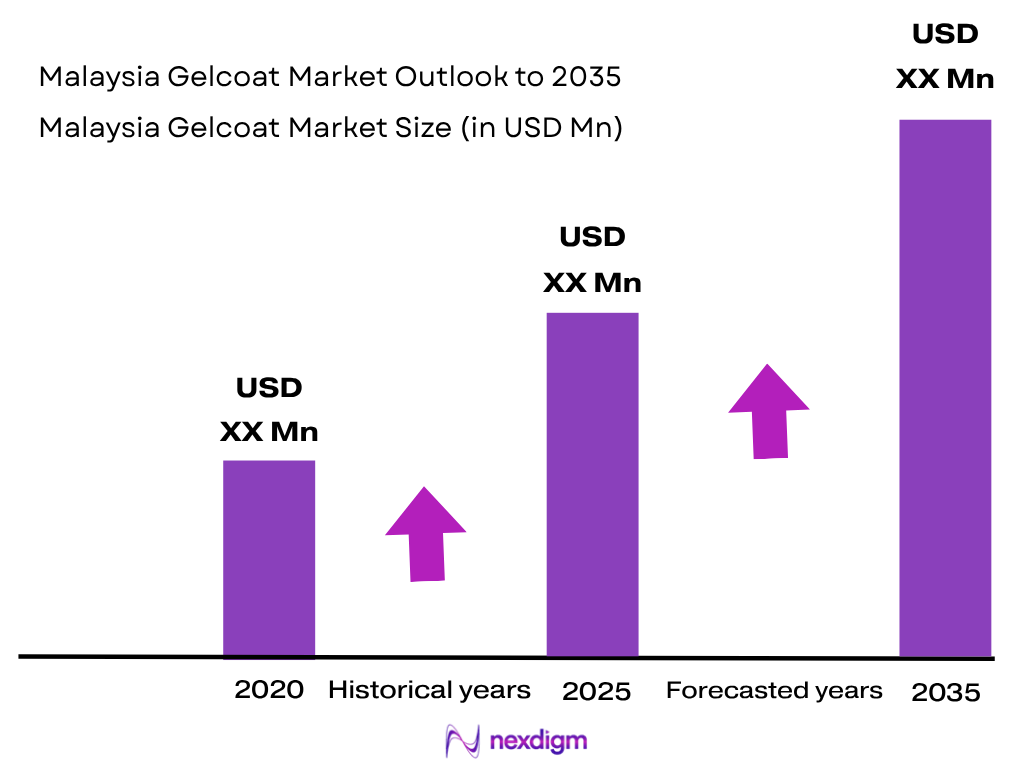
The Malaysia Gelcoat Market is valued at approximately USD ~XX million, based on historical market assessment. Demand is supported by marine composites, GRP tanks and pipes, construction products, automotive components and industrial fabrication. Construction work done increased from RM132.2 billion to RM158.8 billion, while Malaysian vehicle production increased from 774,600 units to 790,347 units, strengthening downstream demand for composite components, moulds, tooling and protective gelcoat surfaces.
Selangor, Johor, Kuala Lumpur and Sarawak form the principal Malaysian demand centres because they combine construction activity, chemical distribution, manufacturing, ports, shipyards and FRP fabrication. Selangor recorded RM9.4 billion of construction work in the latest fourth quarter, Johor RM7.4 billion, and Sarawak RM4.6 billion. National approved investments simultaneously increased from RM329.5 billion to RM378.5 billion, reinforcing industrial development around these manufacturing-intensive states and supporting demand for gelcoats and composite materials.
Market Segmentation
By Resin Chemistry
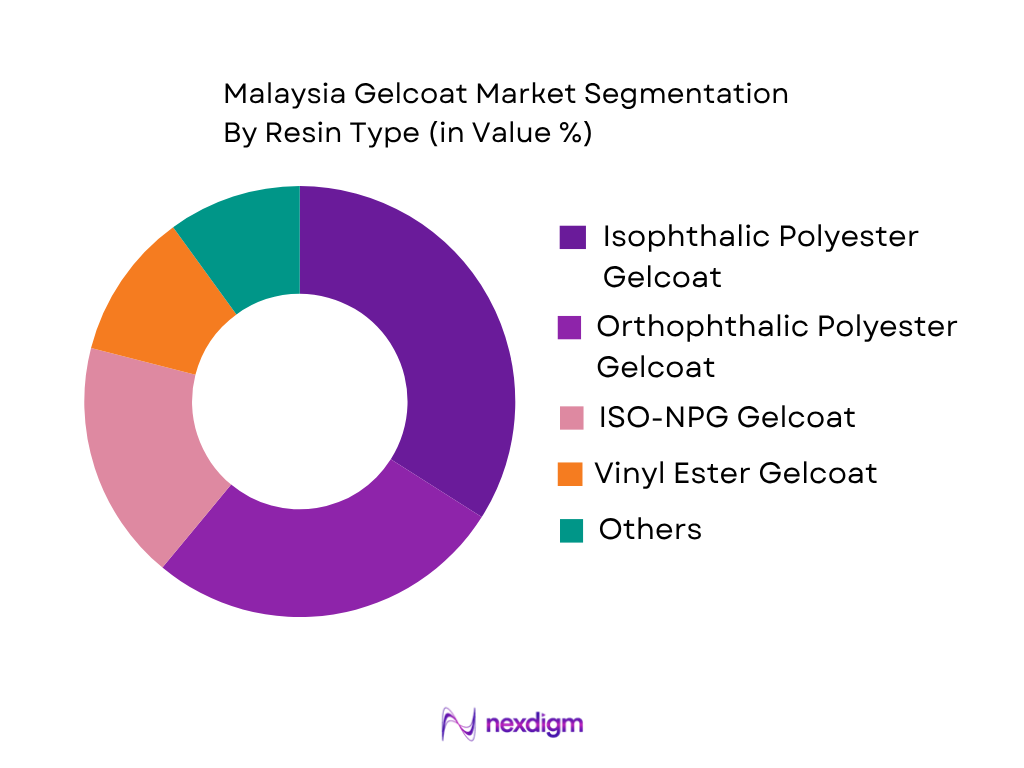
The Malaysia Gelcoat Market is segmented by resin chemistry into orthophthalic polyester, isophthalic polyester, ISO-NPG, vinyl ester, low-styrene/styrene-free and other specialty gelcoats. Isophthalic polyester gelcoat holds the dominant share in the report model because Malaysia has substantial exposure to marine fabrication, GRP water tanks, industrial moulding and outdoor composite products where improved water, weathering and chemical resistance is important. Local and regional suppliers offer isophthalic systems alongside general-purpose orthophthalic products, while Polynt’s Malaysia operation manufactures both orthophthalic and isophthalic POLYCOR gelcoats. Chemrex also markets isophthalic and ISO-NPG gelcoats for water tanks, sanitary products, swimming pools and marine boats. The broad applicability of isophthalic chemistry allows suppliers to address intermediate-performance applications without limiting products to highly specialized environments. ISO-NPG and vinyl ester systems occupy more performance-intensive niches where greater hydrolysis, chemical or weathering resistance is required, particularly across marine and industrial FRP applications.
By End-Use Application
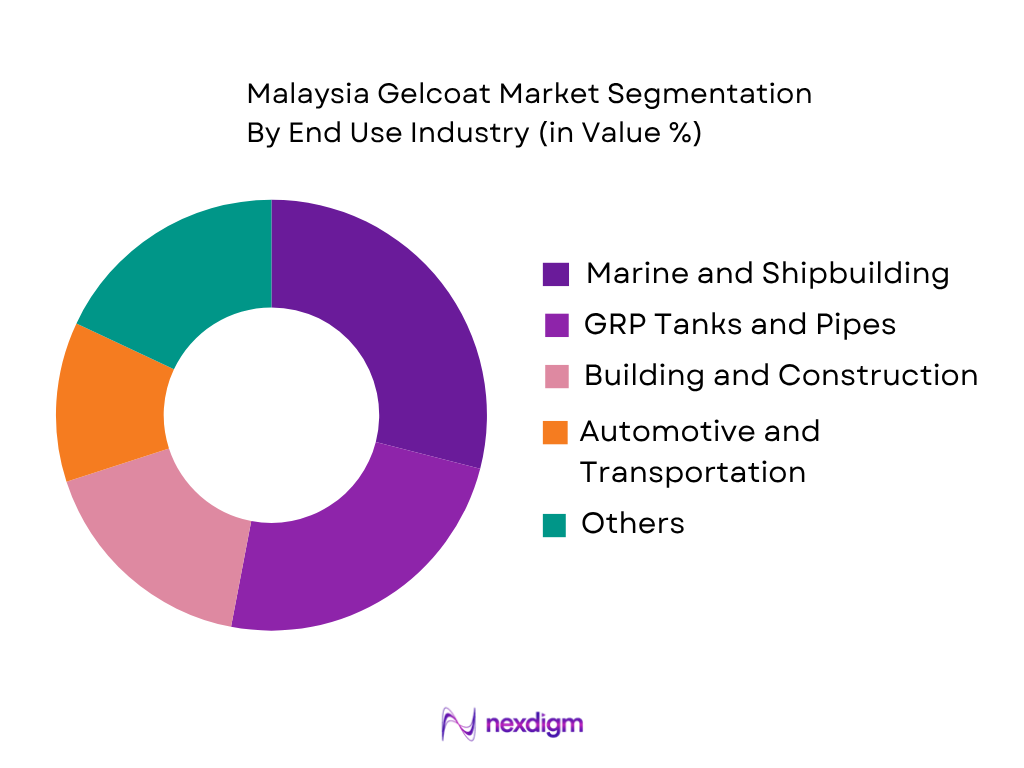
The Malaysia Gelcoat Market is segmented into marine and shipbuilding, GRP tanks and pipes, building and construction, automotive and transportation, sanitary and recreational products, and other industrial composites. Marine and shipbuilding applications hold the dominant share in the report model because Malaysia has an established shipbuilding, ship-repair and small-craft ecosystem requiring durable composite surfaces for hulls, decks, interior mouldings and ancillary structures. Malaysia has 99 registered shipyards, comprising 31 in Peninsular Malaysia and 68 in Sabah and Sarawak, and domestic yards can construct vessels of up to 30,000 DWT. Marine-grade gelcoats require strong resistance to water exposure, UV degradation, blistering and cosmetic deterioration, creating demand for isophthalic, ISO-NPG and vinyl ester technologies. Polynt’s Asia-Pacific portfolio specifically identifies boats and marine applications for ARMORCOTE and POLYCOR products, while Chemrex markets ISO-NPG formulations for marine boats. GRP tanks and pipes form another significant application because Malaysia has substantial chemical, water-treatment and industrial infrastructure requiring corrosion-resistant composite surfaces.
Competitive Landscape
The Malaysia Gelcoat Market combines domestic formulators and composite-material distributors with international resin groups supplying advanced gelcoat technologies. Competition is concentrated around resin chemistry breadth, marine performance, pigmentation capability, specialty grades, local inventory and technical service. Polynt has direct Malaysian manufacturing capability for gelcoats, while Chemrex and RP Products maintain local composite-material supply platforms. Scott Bader participates through its Asia-Pacific distribution structure, and allnex operates manufacturing locations in Malaysia within its broader specialty-resin platform.
| Company | Establishment Year | Headquarters | Key Gelcoat Chemistry | Major Malaysia Applications | Low-Emission Capability | Tooling/Specialty Capability | Malaysia Footprint |
| Polynt | 1955 | Scanzorosciate, Italy | ~ | ~ | ~ | ~ | ~ |
| Scott Bader | 1921 | Wollaston, Northamptonshire, UK | ~ | ~ | ~ | ~ | ~ |
| allnex | 2016 | Frankfurt am Main, Germany | ~ | ~ | ~ | ~ | ~ |
| RP Products | 2001 | Pasir Gudang, Johor, Malaysia | ~ | ~ | ~ | ~ | ~ |
| Chemrex Corporation | 2004 | Cheras, Selangor, Malaysia | ~ | ~ | ~ | ~ | ~ |
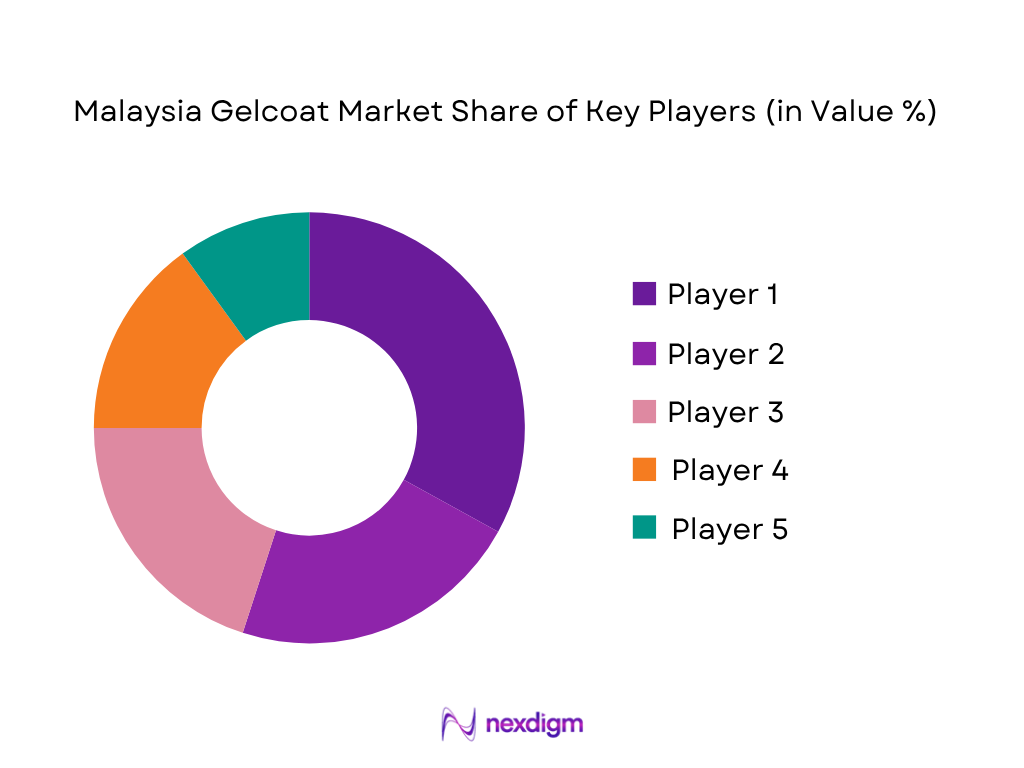
Malaysia Gelcoat Market Analysis
Growth Drivers
Expansion of Domestic Marine, Shipbuilding and GRP Fabrication Activity
Malaysia’s established shipbuilding, ship-repair and fiberglass-reinforced-plastic fabrication ecosystem is a direct growth driver for gelcoat consumption because boat hulls, decks, cabins, watercraft components, GRP tanks and marine structures require durable cosmetic and protective surfaces. Malaysian Investment Development Authority data show that the country has 99 registered shipyards, comprising 31 shipyards in Peninsular Malaysia and 68 in Sabah and Sarawak, while domestic yards have capability to construct vessels of up to 30,000 deadweight tonnes. Shipbuilding and ship-repair projects approved in 2024 included 5 projects, generating 152 employment opportunities and RM50 million of approved investment. These facilities provide an established customer base for marine-grade isophthalic, ISO-NPG, UV-resistant and chemical-resistant gelcoat formulations. The broader economic environment reinforces this demand base: World Bank data show Malaysia generated USD 422.23 billion of GDP in 2024, supported by a population of 35,557,673 and GDP per capita of USD 11,874.4. Malaysia’s construction sector simultaneously recorded RM158.8 billion of work completed in 2024, expanding the downstream market for GRP water tanks, pools, architectural composite elements and industrial fiberglass structures. These indicators collectively support recurring gelcoat demand across marine production, repairs and non-marine FRP fabrication.
Expansion of Construction, Automotive and Industrial Composite Applications
The widening use of composite components across Malaysian construction, automotive and industrial manufacturing provides another market-specific driver for gelcoat demand. Department of Statistics Malaysia data show construction work completed reached RM158.8 billion in 2024, including RM42.0 billion during the fourth quarter alone. Within that quarter, Selangor generated RM9.4 billion of construction work, Johor RM7.4 billion, the Federal Territories RM4.7 billion, and Sarawak RM4.6 billion, creating geographically concentrated demand for fiberglass tanks, architectural panels, pools, sanitary products, covers and industrial composite components. Automotive manufacturing provides an additional application platform: the Malaysian Automotive Association recorded production of 790,347 vehicles in 2024, compared with 774,600 vehicles in 2023, comprising 744,604 passenger vehicles and 45,743 commercial vehicles. Composite moulds, tooling surfaces and lightweight body or interior components can require specialized gelcoat systems during fabrication. Malaysia’s manufacturing investment pipeline further supports industrial composite demand; MIDA recorded RM120.5 billion of approved manufacturing investment in 2024, including RM15.8 billion in transport equipment, RM10.6 billion in chemicals and chemical products, and RM10.6 billion in machinery and equipment. World Bank data place national GDP at USD 422.23 billion in 2024, demonstrating the industrial scale supporting these downstream applications.
Market Challenges
Dependence on Specialty Resin, Additive and Petrochemical Supply Chains
Malaysia’s gelcoat industry remains exposed to specialty resin, styrene, pigment, catalyst, UV-stabilizer and performance-additive supply chains, creating a challenge for manufacturers seeking consistent chemistry, colour and curing performance. The scale of Malaysia’s reliance on international material flows is visible in Department of Statistics Malaysia trade data: total imports reached RM1,370.2 billion in 2024, while total national merchandise trade reached approximately RM2.9 trillion. Gelcoat formulators operate within this broader import-intensive industrial environment and must secure specialty raw materials while maintaining batch consistency for isophthalic, ISO-NPG, vinyl ester, tooling and fire-retardant products. Domestic chemical investment is expanding but remains concentrated across selected manufacturing activities. MIDA recorded 92 approved chemicals and chemical-products projects in 2024, representing RM10.6251 billion of capital investment, including RM4.2076 billion of domestic investment and RM6.4175 billion of foreign investment. The same category increased to 113 approved projects and RM24.8508 billion of investment in 2025, indicating ongoing capacity development but also continued dependence on global technology and capital. Malaysia’s 2024 economic base included USD 422.23 billion in GDP and 35,557,673 people, according to the World Bank. For gelcoat suppliers, the challenge is ensuring reliable resin chemistry, pigments and additives while supporting marine and industrial customers that require highly consistent formulation properties.
Application Quality, Skilled Processing and Marine Durability Requirements
Gelcoat performance depends heavily on controlled application conditions, catalyst ratios, film thickness, mould preparation, curing, pigmentation and laminate compatibility, making process consistency a major challenge in Malaysia’s fragmented FRP fabrication environment. This challenge is particularly important in marine applications, where inadequate application can contribute to pinholes, cracking, blistering, osmosis, poor gloss retention and premature surface deterioration. Malaysia has 99 registered shipyards, of which 68 are located in Sabah and Sarawak and 31 in Peninsular Malaysia, creating a geographically dispersed service and fabrication base that suppliers must support with technical guidance and application expertise. Domestic yards can build vessels up to 30,000 deadweight tonnes, requiring material systems suited to different vessel sizes and operating environments. Industrial diversification further increases application complexity. MIDA recorded 92 chemicals and chemical-products projects, 110 transport-equipment projects, 139 machinery-and-equipment projects, 91 plastic-products projects, and 56 non-metallic-mineral-products projects in 2024, demonstrating the breadth of manufacturing activities capable of using composite materials. World Bank data show Malaysia’s 2024 GDP at USD 422.23 billion and GDP per capita at USD 11,874.4. For gelcoat suppliers, sustaining quality across marine, tank, construction, automotive and tooling applications therefore requires stronger applicator training, formulation support, quality-control procedures and localized technical services.
Market Opportunities
Expansion of ISO-NPG, Vinyl Ester and Chemical-Resistant Gelcoat Applications
Malaysia presents a strong future opportunity for higher-performance ISO-NPG, vinyl ester and chemical-resistant gelcoats as marine, chemical-processing, water-storage and industrial FRP applications become more technically demanding. Current investment indicators demonstrate an expanding customer base capable of supporting these specialized products. MIDA approved 92 chemicals and chemical-products projects worth RM10.6251 billion in 2024, including 64 new projects representing RM7.8 billion and 28 expansion or diversification projects representing RM2.8 billion. These projects generated 4,476 employment opportunities, indicating continued development of Malaysia’s chemical-manufacturing ecosystem. Investment momentum strengthened further in 2025, when chemicals and chemical products attracted RM24.8508 billion across 113 approved manufacturing projects. These industrial facilities require tanks, piping, scrubbers, ducts, enclosures and corrosion-resistant process equipment, creating potential downstream applications for vinyl ester barrier systems and chemically resistant gelcoats. Malaysia’s marine base adds another opportunity, with 99 registered shipyards supporting new-build, maintenance and repair requirements. World Bank data show Malaysia’s economy generated USD 422.23 billion of GDP in 2024, with GDP per capita of USD 11,874.4 and population of 35,557,673. These current indicators provide a strong industrial foundation for future migration from general-purpose gelcoats toward specialized formulations offering improved hydrolysis, chemical and weathering resistance.
Localized Gelcoat Manufacturing, Colour Matching and ASEAN-Oriented Supply
Future expansion of localized gelcoat formulation, custom pigmentation, tooling products and application support represents a major opportunity for Malaysia because the country combines chemical manufacturing capability, strong logistics, broad merchandise trade and growing downstream industrial investment. MIDA recorded RM120.4836 billion of approved manufacturing investment across 1,108 projects in 2024, including RM10.6251 billion in chemicals and chemical products, RM15.8253 billion in transport equipment, RM5.2929 billion in non-metallic mineral products, and RM1.7649 billion in plastic products. In 2025, total approved manufacturing investment increased to RM131.2971 billion across 1,354 projects, while chemicals and chemical products alone accounted for 113 projects. This enlarging production ecosystem creates opportunities for local manufacturers to supply customized marine colours, ISO-NPG grades, tooling gelcoats, fire-resistant systems and short-batch formulations without depending entirely on imported finished products. Malaysia also recorded approximately RM2.9 trillion in merchandise trade during 2024, including RM1.5 trillion of exports and RM1,370.2 billion of imports, demonstrating logistics infrastructure capable of supporting regional sourcing and ASEAN distribution. World Bank data record USD 422.23 billion of GDP and 35,557,673 residents in 2024. These current fundamentals support future positioning of Malaysia as a regional gelcoat formulation, warehousing, technical-service and export platform serving Southeast Asian marine, infrastructure and industrial composite customers.
Future Outlook
The Malaysia Gelcoat Market is expected to expand at approximately ~XX.X% CAGR during 2026–2035, supported by marine composite demand, GRP infrastructure, industrial fabrication, construction activity and continuing development of specialty resin technologies. Demand is expected to gradually move toward ISO-NPG, vinyl ester, low-styrene and higher-weatherability systems as fabricators seek improved product performance. Marine and shipbuilding will remain strategically important because Malaysia possesses a distributed shipyard base across Peninsular Malaysia, Sabah and Sarawak. Suppliers capable of providing marine gelcoats, barrier coats, colour matching, application support and repair-compatible products should benefit from both new construction and maintenance-oriented composite activity.
Major Players
- Polynt Composites Malaysia Sdn. Bhd.
- WPCP Sdn. Bhd.
- Chemrex Corporation Sdn. Bhd.
- RP Products Malaysia
- ChemFiber Industries Sdn. Bhd.
- Scott Bader
- Polynt Group
- allnex Malaysia Sdn. Bhd.
- Spectra Composites
- GKFRP
- Chemitjaya Sdn. Bhd.
- G-FRP Venture Marketing Sdn. Bhd.
- INEOS Composites
- BÜFA Composite Systems
- Changzhou New Materials / Changyuan New Materials
Key Target Audience
- Gelcoat and Unsaturated Polyester Resin Manufacturers
- Fiberglass and FRP Composite Fabricators
- Marine Boatbuilders and Shipbuilding Companies
- GRP Tank, Pipe and Industrial Equipment Manufacturers
- Composite Raw Material Distributors and Chemical Suppliers
- Investments and Venture Capitalist Firms
- Government and Regulatory Bodies (Malaysian Investment Development Authority, Department of Environment Malaysia, Department of Occupational Safety and Health Malaysia, Standards Malaysia, Marine Department Malaysia)
- Automotive, Construction and Industrial Composite Product Manufacturers
Research Methodology
Step 1: Identification of Key Variables
The initial phase involves constructing an ecosystem map encompassing gelcoat manufacturers, resin formulators, raw-material suppliers, distributors, FRP fabricators, boatbuilders, tank manufacturers and industrial customers operating in the Malaysia Gelcoat Market. Secondary and proprietary databases are evaluated to identify demand variables including resin chemistry, gelcoat consumption, manufacturing capability, application mix, imports, marine exposure, industrial production and distribution structure.
Step 2: Market Analysis and Construction
Historical information for the Malaysia Gelcoat Market is assessed through both top-down and bottom-up methodologies. The top-down approach examines marine activity, construction, automotive production, chemical manufacturing and downstream FRP industries, while the bottom-up model assesses company sales, gelcoat volumes, application consumption and supplier footprints. Import flows and domestic formulation capacity are subsequently reconciled to minimize double counting and strengthen market estimates.
Step 3: Hypothesis Validation and Expert Consultation
Market hypotheses are validated through computer-assisted telephone interviews with gelcoat manufacturers, composite distributors, FRP fabricators, boatbuilders, tank manufacturers, pigment suppliers and technical specialists. Discussions assess resin selection, marine-grade specifications, ISO-NPG adoption, pigmentation requirements, spray application practices, local inventory availability and technical-service requirements. These primary interactions are used to validate market assumptions, competitive positioning and segmentation structures developed through secondary research.
Step 4: Research Synthesis and Final Output
The final phase integrates demand-side, supply-side, trade, company and application-level findings into a comprehensive Malaysia Gelcoat Market framework. Information obtained from suppliers and fabricators is compared against industrial activity and end-use indicators to validate bottom-up estimates. The resulting model supports market sizing, chemistry segmentation, end-use analysis, competitive benchmarking and long-term forecasting while identifying opportunities across marine, GRP infrastructure, construction and advanced composite applications.

- Executive Summary
- Research Methodology (Market Definition and Scope, Malaysia Gelcoat Market Classification, Orthophthalic-Isophthalic-ISO-NPG-Vinyl Ester Gelcoat Demand Assessment, Gelcoat Consumption Mapping, Domestic Gelcoat and UPR Production Capacity Assessment, Import Dependency Analysis, Styrene and Polyester Feedstock Assessment, Pigment and Additive Supply Mapping, Hand Lay-Up and Spray Application Assessment, End-Use Application Demand Mapping, Primary Industry Interviews, Top-Down Market Sizing, Bottom-Up Company Revenue and Volume Assessment, Trade Flow Analysis, Data Triangulation, Pricing Assessment, Forecasting Framework)

- Definition and Scope
- Malaysia Gelcoat Industry Evolution
- Gelcoat Resin Manufacturing
- Malaysia Gelcoat Value Chain Analysis
- Malaysia Gelcoat Supply Chain Analysis

- Growth Drivers (Expansion of Domestic Marine and Shipbuilding Activity, Growth of GRP Water Tank and Pipe Manufacturing, Increasing Fiberglass Use in Construction, Expansion of Industrial Composite Fabrication, Development of Johor Composite Manufacturing Cluster, Growth in Chemical-Resistant FRP Equipment, Increasing Demand for UV-Resistant Surfaces, Automotive Lightweight Composite Adoption, Increasing Local Composite Material Availability)
- Market Challenges (Styrene Emission Management, Dependence on Specialty Resin and Additive Feedstocks, Volatility in Petrochemical Inputs, Gelcoat Application Defect Management, Osmosis and Blistering Risk in Marine Applications, Colour Consistency Requirements, Skilled Spray Applicator Availability, Competition from Paint and Alternative Surface Systems, Imported Premium Gelcoat Competition, Small-Batch Custom Formulation Complexity)
- Market Opportunities (ISO-NPG Marine Gelcoat Expansion, Vinyl Ester Chemical-Resistant Gelcoats, Low-Styrene and Styrene-Free Product Development, Domestic Colour-Matching and Pigmentation Services, Specialty Gelcoats for GRP Tanks and Pipes, Tooling Gelcoat Expansion, Fire-Retardant Gelcoat Applications, Localized Gelcoat Manufacturing, Advanced Marine Composite Applications, ASEAN Export-Oriented Gelcoat Supply, Renewable-Energy Composite Surface Protection)
- Market Trends (Shift Toward ISO-NPG Chemistry, Higher UV and Weathering Resistance, Low-VOC and Low-Styrene Formulations, Pre-Pigmented Gelcoat Adoption, Automated Spray Application, High-Gloss Marine Finishes, Vinyl Ester Barrier Layers, Tooling System Integration, Customized Colour Formulation, Improved Osmosis Resistance, Sustainable Composite Formulation Development)
- Regulatory and Standards Landscape (Department of Occupational Safety and Health Chemical Exposure Requirements, Department of Environment Industrial Emission and Scheduled Waste Requirements, SIRIM Product Testing, Malaysian Marine Department Requirements, Potable Water Contact Standards, Fire Performance Requirements, Chemical Classification and Safety Data Sheet Compliance, Customs Classification for Unsaturated Polyester Resins and Gelcoat Inputs)
- SWOT Analysis
- Porter’s Five Forces Analysis
- PESTLE Analysis

- By Market Value (2020-2025)
- By Gelcoat Consumption Volume (2020-2025)
- By Domestic Gelcoat Production Volume (2020-2025)
- By Domestic Gelcoat Production Value (2020-2025)
- By Gelcoat Import Value (2020-2025)
- By Gelcoat Import Volume (2020-2025)

- By Resin Chemistry (In Value %)
Orthophthalic Polyester Gelcoat
Isophthalic Polyester Gelcoat
ISO-NPG Gelcoat
Vinyl Ester Gelcoat
Epoxy-Based Surface Coat
Acrylic-Modified Gelcoat
Low-Styrene Polyester Gelcoat
Styrene-Free Gelcoat|
Specialty Hybrid Gelcoat - By Product Function (In Value %)
General Purpose Gelcoat
Marine Grade Gelcoat
Tooling Gelcoat
Fire-Retardant Gelcoat
Chemical-Resistant Gelcoat
UV-Resistant Gelcoat
Food-Contact Grade Gelcoat
Sanitary Grade Gelcoat - By Application Method (In Value %)
Hand Lay-Up Gelcoat
Spray-Up Gelcoat
Airless Spray Gelcoat
Automated Spray Gelcoat
Brush and Roller Applied Gelcoat
Mould-Applied Gelcoat
Post-Applied Protective Gelcoat - By End-Use Application (In Value %)
Marine Boats and Vessel Components
GRP Water Tanks
GRP Chemical Tanks
GRP Pipes and Fittings
Building and Architectural Panels
Automotive and Transportation Components
Swimming Pools and Water Features - By End-Use Industry (In Value %)
Marine and Shipbuilding
Building and Construction
Water and Wastewater Infrastructure
Chemical and Petrochemical
Oil and Gas
Automotive and Transportation
Electrical and Electronics

- Market Share of Major Players (By Malaysia Revenue, Gelcoat Sales Volume, Resin Chemistry, Marine Exposure, Industrial FRP Exposure, Manufacturing Footprint, Distribution Coverage, Application Segment)
- Cross Comparison Parameters (Malaysia Gelcoat Revenue, Installed Gelcoat and UPR Production Capacity, Orthophthalic-Isophthalic-ISO-NPG-Vinyl Ester Portfolio Breadth, Marine-GRP Tank-Pipe-Construction Application Coverage, Low-Styrene and Styrene-Free Formulation Capability, Custom Pigmentation and Colour-Matching Capability, Malaysia Manufacturing and Distribution Footprint, Application Laboratory and FRP Technical-Service Capability)
- SWOT Analysis of Major Players
- Detailed Profiles of Major Companies
Polynt Composites Malaysia Sdn. Bhd.
WPCP Sdn. Bhd.
Chemrex Corporation Sdn. Bhd.
RP Products Malaysia
ChemFiber Industries Sdn. Bhd.
Scott Bader
Polynt Group
allnex Malaysia Sdn. Bhd.
Spectra Composites
GKFRP
Chemitjaya Sdn. Bhd.
G-FRP Venture Marketing Sdn. Bhd.
INEOS Composites
BÜFA Composite Systems
Changzhou New Materials / Changyuan New Materials

- Boatbuilder Gelcoat Procurement Assessment
- GRP Tank Manufacturer Requirement Analysis
- Architectural FRP Fabricator Requirement Analysis
- Automotive Composite Manufacturer Assessment
- Composite Mould Maker Assessment
- Industrial FRP Fabricator Assessment

- By Market Value (2026-2035)
- By Gelcoat Consumption Volume (2026-2035)
- By Domestic Gelcoat Production Volume (2026-2035)
- By Domestic Gelcoat Production Value (2026-2035)
- By Gelcoat Import Value (2026-2035)
- By Gelcoat Import Volume (2026-2035)


 Request a Sample
 Ask for Customization
 Get a Quote
 Enquire Now