
 Download PDF
Market Overview
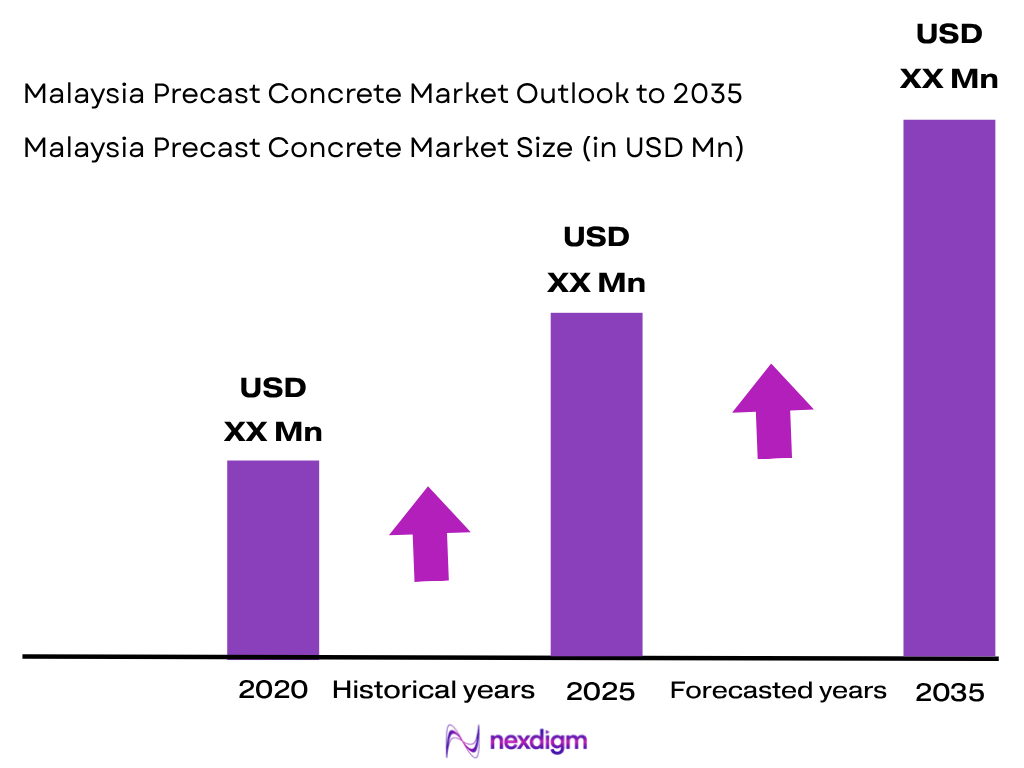
The Malaysia Hollow Concrete Blocks Market is valued at approximately USD ~ million, based on historical market assessment and industry demand analysis. Demand is supported by the expansion of national construction activity, with construction work done increasing from RM132.2 billion to RM158.8 billion across the two latest annual observations. Residential, non-residential, industrial and infrastructure construction supports consumption of cement-sand hollow blocks, concrete masonry units and other factory-manufactured walling products.
Selangor, Johor, Kuala Lumpur and Sarawak represent the principal demand centers because of their concentration of residential, commercial, industrial and infrastructure development. Construction activity reached RM9.4 billion in Selangor, RM7.4 billion in Johor, RM4.7 billion in the Federal Territories and RM4.6 billion in Sarawak during the latest reported quarter, compared with RM8.6 billion in Selangor and RM4.0 billion each in Johor and Sarawak in the comparable earlier construction environment.
Market Segmentation
By Product Type
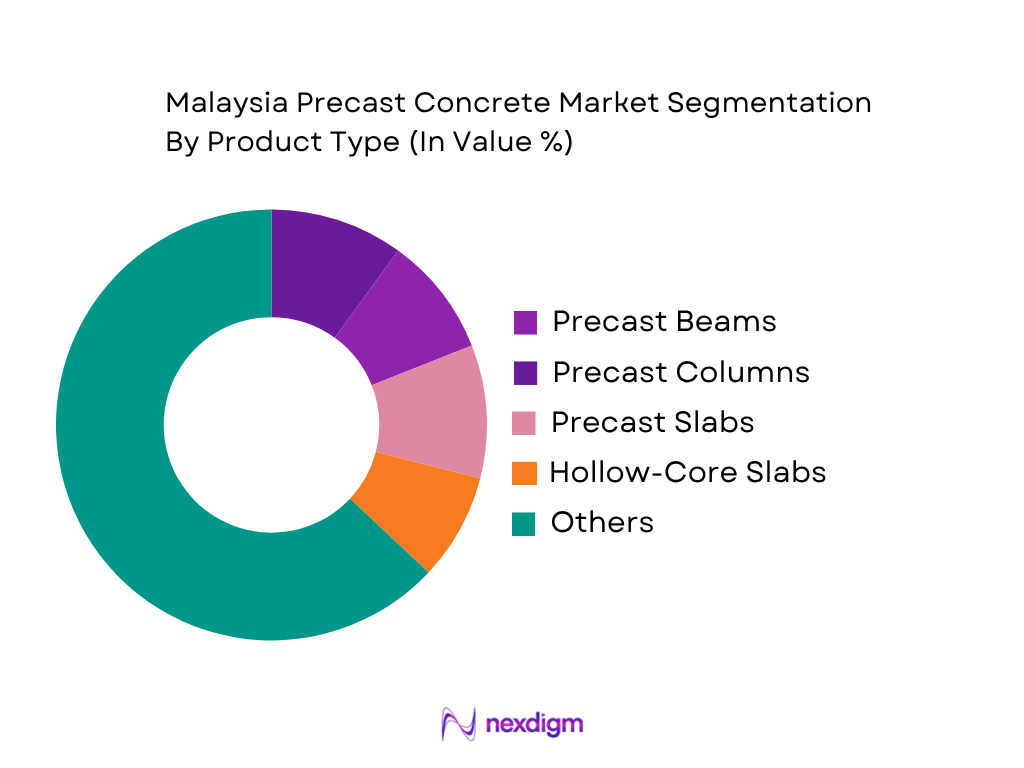
The Malaysia Hollow Concrete Blocks Market is segmented by product type into standard cement-sand hollow blocks, dense aggregate hollow blocks, lightweight aggregate hollow blocks, load-bearing hollow blocks and specialty concrete masonry units. Standard cement-sand and dense aggregate hollow blocks dominate the product segmentation, supported by their established use in internal partitions, external masonry, landed housing, industrial buildings and boundary walls. Their dominance is reinforced by Malaysia’s mature cement, sand and aggregate supply chain and widespread contractor familiarity with conventional mortar-laid masonry. Manufacturers can also produce these blocks using semi-automatic or fully automated vibro-press equipment across multiple wall thicknesses. CIDB recognizes concrete masonry units within the blockwork category under MS 2282-3, with testing covering dimensions, density, water absorption, compressive strength and capillary water absorption. This standardization supports conventional concrete masonry units in specification-driven projects, while lightweight and specialty blocks increasingly compete where reduced structural dead load, thermal performance or fire-rated construction is prioritized.
By End-Use Construction
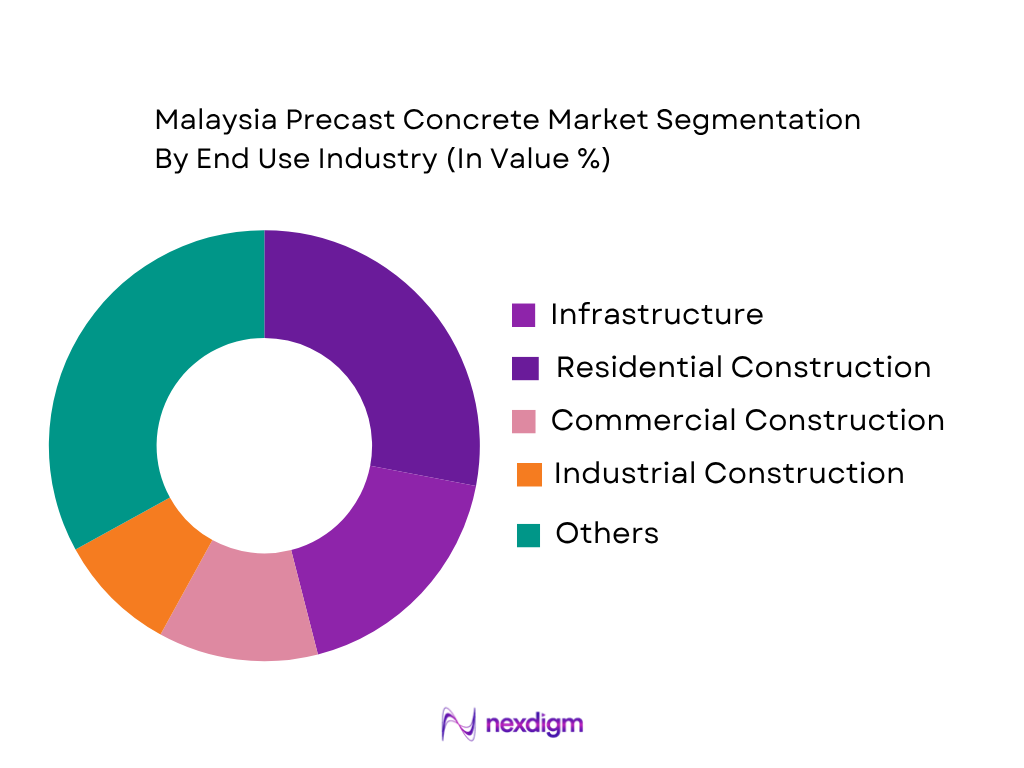
The Malaysia Hollow Concrete Blocks Market is segmented by end-use construction into residential buildings, commercial and mixed-use buildings, industrial and manufacturing facilities, warehouses and logistics facilities, and institutional and infrastructure-related buildings. Residential construction holds the dominant share, supported by hollow-block usage across landed houses, apartments, affordable housing, partitions, perimeter walls and ancillary structures. Concrete masonry remains particularly relevant where contractors require locally manufactured, familiar and structurally robust walling systems. Industrial construction is becoming increasingly important because Malaysia is attracting factories, logistics buildings and data-center developments. Johor has emerged as a particularly significant non-residential construction cluster, while Selangor and the Klang Valley combine residential, commercial and industrial demand. Hollow-block manufacturers therefore operate across a diversified construction base rather than relying on one building category, although residential activity remains the broadest volume-consumption channel for conventional blockwork.
Competitive Landscape
The Malaysia Hollow Concrete Blocks Market is fragmented across national, regional and state-focused manufacturers, with competition influenced strongly by manufacturing location and economical delivery radius. Established suppliers differentiate through hollow-block dimensions, SIRIM/CIDB certification, fire-rated products, production automation, palletized delivery and owned transportation. Johor, Selangor, Melaka, Sabah and Sarawak support distinct regional competitive ecosystems because concrete masonry units are comparatively heavy products for long-distance transportation. Sin Lian, for example, manufactures CMUs and hollow blocks in Johor and operates its own transportation capabilities, while Brikform supplies SIRIM-certified concrete blocks from Sabah.
| Major Player | Establishment | Headquarters / Base | Core Block Portfolio | Product Dimensions | Certification / Compliance | Manufacturing Capability | Distribution Strength | Primary Market Positioning |
| Sin Lian Group | 1974 | Johor | ~ | ~ | ~ | ~ | ~ | ~ |
| Premier Building Material Sdn. Bhd. | Not publicly disclosed | Selangor | ~ | ~ | ~ | ~ | ~ | ~ |
| Brikform Sdn. Bhd. | 2001-era corporate formation | Kota Kinabalu, Sabah | ~ | ~ | ~ | ~ | ~ | ~ |
| EKDA Industries Sdn. Bhd. | 2010 | Miri, Sarawak | ~ | ~ | ~ | ~ | ~ | ~ |
| Kelvin Eng Enterprise Sdn. Bhd. | 1992 | Melaka | ~ | ~ | ~ | ~ | ~ | ~ |
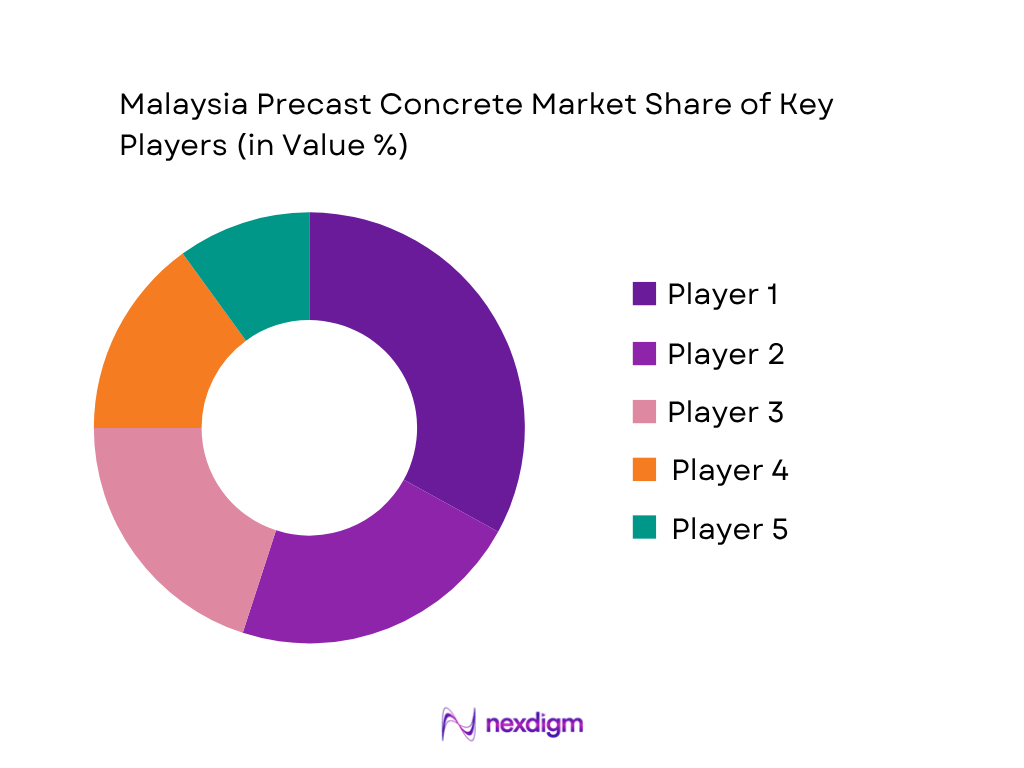
Malaysia Hollow Concrete Blocks Market Analysis
Growth Drivers
Strong Residential, Non-Residential and Industrial Construction Pipeline Expanding Concrete Block Consumption
Malaysia’s construction pipeline is a fundamental growth driver for hollow concrete blocks because the material is consumed directly in external masonry walls, internal partitions, service structures, landed housing, industrial facilities, warehouses and institutional buildings. Construction work done reached RM158.8 billion in 2024, including RM42.0 billion during the fourth quarter alone. Within that quarter, residential building work accounted for RM9.9 billion, non-residential buildings generated RM11.8 billion, civil engineering contributed RM15.6 billion, and special trades generated RM4.7 billion. The geographic distribution also aligns closely with major concrete-block consumption centers: Selangor recorded RM9.4 billion of construction work in the fourth quarter, Johor RM7.4 billion, the Federal Territories RM4.7 billion, and Sarawak RM4.6 billion. Johor’s non-residential building activity alone generated RM3.0 billion, demonstrating the importance of factories, commercial buildings, data centers and other non-residential projects to masonry demand. The investment pipeline reinforces this construction base. Malaysia approved RM378.5 billion of investments across 6,700 projects in 2024, including RM120.5 billion across 1,108 manufacturing projects. Selangor received RM101.1 billion of approved investments, Kuala Lumpur RM91.5 billion, Johor RM48.5 billion, Kedah RM45.8 billion, and Penang RM32.0 billion. These concentrations are important for hollow-block manufacturers because economical distribution is geographically constrained by product weight, making proximity to active construction corridors commercially significant. The manufacturing pipeline also supports demand for factory walls, internal partitions, substations, utility buildings, warehouses and worker-support facilities. Malaysia’s broader macroeconomic base provides additional context: IMF data record 2024 nominal GDP of US$422.2 billion, equivalent to approximately RM1.95 trillion, with a population of 34.1 million and GDP per capita of US$12,397. The combination of large-scale construction activity, manufacturing investment and concentrated development in Selangor and Johor therefore provides a measurable demand base for standard cement-sand hollow blocks, dense aggregate CMUs, load-bearing units and specialized concrete masonry.
Industrial Parks, Data Centers and Johor’s Investment Corridor Strengthening Non-Residential Block Demand
Industrial and digital-infrastructure development is becoming a particularly strong driver for the Malaysia Hollow Concrete Blocks Market because these projects generate extensive requirements for internal blockwork, perimeter structures, fire-separated rooms, utility buildings, warehouses and ancillary facilities. Malaysia recorded RM120.5 billion of approved manufacturing investments across 1,108 projects in 2024, while total approved investments reached RM378.5 billion across 6,700 projects. Johor received RM48.5 billion of approved investments during the same annual period, while its construction work done reached RM7.4 billion in the fourth quarter, including RM3.0 billion in non-residential buildings. Digital infrastructure adds another construction-intensive layer. During 2024, Malaysia reported that technology companies including AWS, Microsoft, Google and Oracle had committed a combined US$16.9 billion to the country’s technology and data-center ecosystem. A Southville City data-center expansion announced during 2024 involved an additional 200 MW after an initial 100 MW development agreement, while a separate Johor data-center investment announcement involved RM1 billion. These projects are relevant to hollow concrete masonry even when the primary data halls use specialized construction systems because campuses require administration buildings, utility enclosures, fire-rated compartments, security facilities, substations and other secondary structures where concrete masonry can be specified. The Johor-Singapore Special Economic Zone further strengthens the geographic concentration of demand. The formal incentive framework became effective in 2025, targeting manufacturing, digital economy, logistics, energy and other high-value activities across the zone. In the first half of 2025, approved investment within the JS-SEZ reached RM37.1 billion, consisting of approximately RM24 billion in services and RM13 billion in manufacturing; the investment facilitation center had handled 808 investor enquiries by September 2025. Malaysia’s macroeconomic foundation remains substantial, with IMF data placing 2024 nominal GDP at US$422.2 billion, population at 34.1 million, and GDP per capita at US$12,397. For hollow-block manufacturers, this industrialization pattern expands demand beyond traditional residential masonry and increases the strategic importance of Johor-based production, high-strength CMUs, fire-rated blocks, automated manufacturing and dependable bulk project delivery.
Market Challenges
Construction Labor Dependence and Masonry Installation Requirements Constrain Conventional Blockwork Productivity
Labor intensity remains a structural challenge for Malaysia’s Hollow Concrete Blocks Market because conventional blockwork requires repeated handling, mortar preparation, laying, alignment, joint finishing and movement of individual units across construction sites. CIDB recorded 465,591 registered foreign construction workers nationwide as of September 2024. The geographic concentration is especially relevant to hollow-block demand centers: 166,456 foreign construction workers were registered in Selangor and 150,699 in Kuala Lumpur, meaning these two locations alone accounted for more than 317,000 registered foreign construction workers. The scale of foreign-worker participation demonstrates the labor requirement of Malaysia’s construction ecosystem and creates an operational vulnerability for masonry-intensive building methods. CIDB introduced a registration regularization program running from May to December 2024 for foreign construction workers who held Temporary Work Visit Permits but had not been registered as construction personnel. CIDB subsequently launched its iENTRY system in October 2024, while source-country construction skills certification and online safety induction requirements were scheduled for enforcement from January 2025. These measures improve workforce governance but also increase the importance of documented worker competency and compliance for contractors. Hollow concrete blocks therefore compete not only against clay bricks but also against AAC, precast panels, drywall and larger-format industrialized wall systems that can reduce the number of individual masonry units handled on site. This challenge becomes more material as the volume of construction expands. Malaysia recorded RM158.8 billion of construction work done in 2024, including RM9.9 billion of residential and RM11.8 billion of non-residential building work during the fourth quarter. The industry must therefore support a large project pipeline while simultaneously improving site productivity. IMF data place Malaysia’s 2024 nominal GDP at US$422.2 billion, population at 34.1 million, and GDP per capita at US$12,397, illustrating the scale of the economy supporting this construction demand. For concrete-block manufacturers, the strategic response is increasingly tied to dimensional accuracy, larger-format units, palletized delivery, mechanized handling and IBS-compatible products that allow contractors to reduce laying complexity and improve productivity without abandoning concrete masonry.
Cement, Sand and Aggregate Variability Creates Production and Regional Supply-Chain Pressure
Malaysia’s hollow concrete block manufacturers are exposed directly to fluctuations in cement, sand and aggregate availability because conventional CMUs are high-volume cementitious products whose strength, density, water absorption and dimensional performance depend on consistent raw-material inputs. Government construction-material data show the extent of this operating challenge. In June 2024, the cement unit-price index increased across almost all monitored areas of Peninsular Malaysia, Sabah and Sarawak, with the strongest annual movement recorded in Selangor, Kuala Lumpur, Melaka and Negeri Sembilan. In August 2024, the sand unit-price index moved upward across several Peninsular Malaysian locations, with movements extending as high as 17.2 points on the indexed comparison, while Johor recorded a 1.6-point monthly movement in the cement index. By December 2024, the average reported Ordinary Portland Cement benchmark stood at RM23.25 per 50 kg bag; although pricing itself is not used here to size the hollow-block market, the government series demonstrates continuing geographic variation in a critical CMU input. The logistical problem is magnified by Malaysia’s physical market structure. Demand is distributed across Peninsular Malaysia, Sabah and Sarawak, while concrete blocks have relatively high unit weight and low economic value per transported tonne compared with many finished building products. Manufacturers therefore need localized plants, aggregate sources, curing areas, pallet inventories and delivery fleets rather than relying on a single national manufacturing location. The geographic distribution of construction underscores the issue: fourth-quarter 2024 work done reached RM9.4 billion in Selangor, RM7.4 billion in Johor, RM4.7 billion in the Federal Territories, and RM4.6 billion in Sarawak. These four markets alone represent substantially different quarry, transport and logistics environments. Total construction work done reached RM158.8 billion in 2024, increasing pressure on material supply chains serving residential and non-residential projects. Malaysia’s macroeconomic scale adds context, with IMF data recording US$422.2 billion of nominal GDP, 34.1 million people, and US$12,397 GDP per capita in 2024. Consequently, competitive hollow-block manufacturing requires more than installed press capacity: producers need secure cement and aggregate sourcing, regional plants, consistent mix designs, controlled curing and sufficiently dense distribution networks to maintain product quality across Malaysia’s geographically fragmented construction market.
Market Opportunities
Johor Industrial, Data Center and JS-SEZ Development Creates a High-Volume Future Blockwork Opportunity
Johor provides one of the strongest future opportunity corridors for Malaysia’s Hollow Concrete Blocks Market because current construction and investment data show an unusually dense concentration of non-residential development. Johor recorded RM7.4 billion of construction work done in the fourth quarter of 2024, including RM3.0 billion from non-residential buildings, making it Malaysia’s second-largest state construction center during the period. The state also attracted RM48.5 billion of approved investments in 2024. The digital-infrastructure pipeline reinforces this base: during 2024, Malaysia reported US$16.9 billion of technology commitments from AWS, Microsoft, Google and Oracle, while a Southville City data-center expansion agreement added 200 MW to an initial 100 MW development. Another Johor data-center announcement involved RM1 billion of investment. The opportunity broadened further with the establishment of the Johor-Singapore Special Economic Zone. The zone’s investment incentive framework became effective on 1 January 2025, covering high-value manufacturing and services activities. Importantly, current rather than future investment data already demonstrate traction: the JS-SEZ recorded RM37.1 billion of approved investments during the first half of 2025, including approximately RM24 billion in services and RM13 billion in manufacturing. By September 2025, the Invest Malaysia Facilitation Centre Johor had processed 808 enquiries and facilitated 11 potential projects representing RM1.3 billion through collaboration with Singapore agencies. This creates a favorable future addressable environment for hollow concrete block manufacturers because industrial parks and data-center campuses require factories, warehouses, utility buildings, offices, guardhouses, substations, service structures and fire-separated internal areas in addition to specialized primary facilities. Malaysia’s 2024 nominal GDP of US$422.2 billion, population of 34.1 million, and GDP per capita of US$12,397 provide the required macroeconomic context for sustained capital formation. Producers with Johor manufacturing capacity, automated vibro-press lines, high-strength blocks, fire-rated CMUs and dependable project logistics are therefore positioned to capture an expanding industrial walling opportunity without relying solely on conventional residential demand.
IBS-Compatible, Higher-Performance and Automated Concrete Masonry Can Capture the Shift toward Industrialized Construction
Malaysia’s transition toward more standardized and industrialized construction creates a future opportunity for hollow concrete block manufacturers that can move beyond commodity cement-sand blocks into factory-controlled CMUs with consistent strength, dimensions, density, water absorption and installation performance. The opportunity is supported by the scale of the existing construction and investment base rather than speculative future statistics. Malaysia completed RM158.8 billion of construction work in 2024, while the fourth quarter generated RM42.0 billion of work, including RM11.8 billion in non-residential buildings, RM9.9 billion in residential buildings, RM15.6 billion in civil engineering, and RM4.7 billion in specialist construction activities. At the same time, Malaysia approved RM378.5 billion across 6,700 investment projects in 2024, including RM120.5 billion across 1,108 manufacturing projects. This expanding project base increases the commercial value of repeatable factory production, predictable delivery schedules and standardized walling products. The labor structure strengthens the case for industrialized masonry: CIDB recorded 465,591 registered foreign construction workers as of September 2024, including 166,456 in Selangor and 150,699 in Kuala Lumpur. Reducing dependence on labor-intensive site practices therefore creates room for larger-format CMUs, accurate modular dimensions, palletized handling and mechanized installation support. Concrete masonry is already incorporated into Malaysia’s IBS framework, meaning manufacturers can align block production with industrialized construction principles rather than treating CMUs solely as traditional masonry. For hollow-block companies, the opportunity includes automated batching, high-pressure vibro-compaction, controlled curing, reduced dimensional variation, high-strength load-bearing units, lightweight aggregate blocks, reinforced hollow units and fire-rated products. Such capabilities can help defend concrete masonry against AAC, precast wall panels and lightweight partitions by improving construction productivity while retaining concrete’s durability and contractor familiarity. The macroeconomic environment supports capital investment in these technologies: IMF records Malaysia’s 2024 nominal GDP at US$422.2 billion, population at 34.1 million, and GDP per capita at US$12,397. With 1,108 manufacturing investment projects approved in 2024 and construction concentrated in major industrial regions, producers that combine automated production with certified performance have a measurable base from which to expand into higher-value blockwork
Future Outlook
The Malaysia Hollow Concrete Blocks Market is forecast to expand at a CAGR of approximately ~% during 2026–2035, supported by residential development, industrial construction, data centers, warehouses, logistics facilities and public infrastructure. Future competition will increasingly emphasize certified performance, automated manufacturing, consistent dimensions, reduced water absorption, improved strength-to-weight characteristics and reliable project delivery. Conventional cement-sand blocks will remain important, while lightweight, fire-rated, reinforced and lower-carbon concrete masonry products are expected to gain strategic importance.
Major Players
- Multi-Usage Cement Products Sdn. Bhd. / Multi-Usage Holdings Berhad
- Sin Lian Group
- Premier Building Material Sdn. Bhd.
- Brikform Sdn. Bhd.
- Cahya Mata Cement / CMS Concrete Products Sdn. Bhd.
- Lama Tiles Group
- Kelvin Eng Enterprise Sdn. Bhd.
- EKDA Industries Sdn. Bhd.
- Daya Builders Sdn. Bhd.
- QCP Group / QCP Manufacturing Sdn. Bhd.
- Pacific Evermerge Sdn. Bhd.
- Segi Naga / Seginiaga
- Starken AAC Sdn. Bhd.
- Teguh Structure (M) Sdn. Bhd.
- Eng Seng Precast Products
Key Target Audience
- Hollow Concrete Block and Concrete Masonry Unit Manufacturers
- Cement, Aggregate and Construction Material Suppliers
- Property Developers and Real Estate Development Companies
- General Contractors, IBS Contractors and Masonry Contractors
- Building Material Distributors and Construction Material Dealers
- Industrial Park, Data Center and Logistics Facility Developers
- Investments and Venture Capitalist Firms
- Government and Regulatory Bodies (Construction Industry Development Board Malaysia, Ministry of Works Malaysia, SIRIM QAS International, Ministry of Housing and Local Government)
Research Methodology
Step 1: Identification of Key Variables
The research begins by constructing the Malaysia Hollow Concrete Blocks Market ecosystem covering cement and aggregate suppliers, block manufacturers, distributors, developers, contractors and regulatory organizations. Critical variables include hollow-block production, plant capacity, product dimensions, compressive strength, density, water absorption, construction activity, regional demand, IBS certification and substitution from alternative walling systems.
Step 2: Market Analysis and Construction
Historical construction activity, building development, manufacturing capacity and block-consumption patterns are assessed using top-down and bottom-up approaches. Bottom-up analysis considers manufacturers, production facilities, utilization levels, regional delivery capabilities and major end-use sectors, while top-down analysis evaluates residential, commercial, industrial, institutional and infrastructure construction activity.
Step 3: Hypothesis Validation and Expert Consultation
Initial market hypotheses are validated through discussions with concrete-block manufacturers, construction material distributors, contractors, developers and technical industry participants. Primary interviews are used to test assumptions regarding product mix, utilization, regional demand, contractor preferences, block substitution, manufacturing technology and competitive positioning before final market estimates are established.
Step 4: Research Synthesis and Final Output
Primary and secondary findings are triangulated to construct the final Malaysia Hollow Concrete Blocks Market model. Supply-side manufacturing information is reconciled with project-level and construction-sector demand indicators, while company portfolios and product specifications are cross-checked to distinguish conventional hollow concrete masonry from AAC and other substitute walling technologies.

- Executive Summary
- Research Methodology (Market Definitions and Assumptions, Malaysia Hollow Concrete Blocks Market Classification, Concrete Masonry Unit Scope, Dense Aggregate versus Lightweight Aggregate CMU Mapping, Hollow versus Solid Block Assessment, Load-Bearing and Non-Load-Bearing Block Assessment, Blockwork IBS Classification, Block Dimension and Wall-Thickness Mapping, Compressive Strength Assessment, Gross and Net Dry Density Assessment, Water Absorption and Capillarity Assessment, Dimensional Tolerance Assessment, Fire-Rated Blockwork Assessment, Cement-Sand-Aggregate Mix Assessment, Manufacturing Technology Mapping, Installed Block Production Capacity Assessment, Plant Utilization Assessment, Peninsular Malaysia-Sabah-Sarawak Supply Assessment, CIDB IBS Manufacturer Mapping, Supply-Side Assessment, Demand-Side Assessment, Top-Down Market Sizing, Bottom-Up Block Consumption Analysis, Primary Manufacturer-Distributor-Contractor Interviews, Construction Project Pipeline Assessment, Data Triangulation, Forecasting Framework)

- Definition and Scope
- Malaysia Hollow Concrete Blocks Industry Evolution and Development of Aggregate Concrete Masonry Units, Cement-Sand Hollow Blocks, Solid Concrete Blocks, Load-Bearing Concrete Blocks, Non-Load-Bearing Blocks, Lightweight Aggregate Blocks, Fire-Rated Concrete Masonry, Architectural Ventilation Blocks, Fair-Face Blocks, Reinforced Hollow Blockwork, Automated Vibro-Pressed Blocks, IBS Blockwork Systems and Sustainable Concrete Masonry
- Hollow Concrete Blocks Value Chain Analysis
- Hollow Concrete Blocks Supply Chain Analysis
- Cement Manufacturers, Natural Sand Suppliers, Manufactured-Sand Suppliers, Quarry Aggregate Producers, Crushed-Stone Suppliers, Lightweight Aggregate Suppliers, Supplementary Cementitious Material Suppliers, Chemical Admixture Suppliers, Concrete Block Manufacturers, Vibro-Press Equipment Suppliers, Mold and Pallet Suppliers, Curing-System Providers, CIDB-Certified IBS Manufacturers, Testing and Certification Bodies, Building Material Distributors, Hardware and Construction Material Dealers, General Contractors, Masonry Contractors, Property Developers, Industrial Park Developers and Government Housing Agencies

- Growth Drivers (Landed and High-Rise Residential Construction, Industrial Park Expansion, Johor-Singapore Special Economic Zone Development, Data Center Construction, Manufacturing Facility Expansion, Warehouse and Logistics Development, Government Housing Programs, IBS Adoption, Factory-Manufactured Blockwork, Domestic Cement and Aggregate Availability, Faster Wall Construction, Standardized Concrete Masonry Products)
- Market Challenges (Competition from Clay Bricks, AAC Block Substitution, Lightweight Panel Substitution, Transportation Radius Constraints, Heavy Unit Weight, Cement Input Dependence, Aggregate Quality Variation, Water Absorption Control, Inconsistent Small-Scale Manufacturing Quality, Masonry Labor Availability, Regional Supply Fragmentation, Peninsular Malaysia-Sabah-Sarawak Logistics)
- Market Opportunities (Industrial and Data Center Buildings, Johor Construction Corridor, Affordable Housing, IBS Blockwork Systems, Lightweight Aggregate Hollow Blocks, High-Strength Load-Bearing Blocks, Fire-Rated Concrete Masonry, Reinforced Hollow Blockwork, Automated Vibro-Press Production, Recycled-Aggregate Blocks, Low-Carbon Cementitious Blocks, Architectural Ventilation Blocks, Direct Developer and Contractor Supply)
- Market Trends (IBS-Certified Blockwork Adoption, Automated Vibro-Press Manufacturing, Higher Dimensional Accuracy, Manufactured-Sand Utilization, Palletized Block Delivery, Factory-Controlled Curing, Lightweight Concrete Masonry, Fire-Rated Block Systems, Reinforced Hollow Blockwork, Low-Carbon Cementitious Mixes, Recycled Aggregate Utilization, Digital Factory Quality Control, Mechanized Material Handling)
- Government Regulations and Standards (CIDB Act 520 Construction Material Compliance, Fourth Schedule Construction Material Requirements, CIDB IBS Manufacturer and Product Assessment and Certification, CIS 24 IBS Assessment and Certification, MS 2282-3 Aggregate Concrete Masonry Units, Dense and Lightweight Aggregate Requirements, Dimensional Testing, Gross and Net Dry Density Testing, Compressive Strength Testing, Water Absorption Testing, Water Absorption by Capillarity, Fire-Rating Assessment, Factory Production Control, SIRIM Product Certification, QLASSIC Building Workmanship Requirements) Construction Industry Development Board
- SWOT Analysis
- Porter’s Five Forces Analysis
- PESTLE Analysis
- Stakeholder Ecosystem

- By Market Value (2020-2025)
- By Hollow Concrete Block Production Volume (2020-2025)
- By Hollow Concrete Block Consumption Volume (2020-2025)
- By Installed Concrete Block Manufacturing Capacity (2020-2025)
- By Production Capacity Utilization (2020-2025)
- By Dense Aggregate Concrete Masonry Unit Volume (2020-2025)

- By Product Type (In Value %)
Standard Cement-Sand Hollow Blocks
Dense Aggregate Concrete Hollow Blocks
Lightweight Aggregate Hollow Blocks
Load-Bearing Hollow Concrete Blocks
Non-Load-Bearing Hollow Concrete Blocks
Fire-Rated Hollow Concrete Blocks
Reinforced Hollow Concrete Masonry Units
Architectural and Ventilation Blocks
Specialty Concrete Masonry Units - By Block Width and Wall Thickness (In Value %)
70–90 mm Hollow Blocks
100–115 mm Hollow Blocks
125–140 mm Hollow Blocks
150–190 mm Hollow Blocks
Above 190 mm Heavy-Duty Blocks
Custom-Dimension Concrete Blocks - By Performance Classification (In Value %)
Standard Non-Structural Blocks
Load-Bearing Structural Blocks
High-Compressive-Strength Blocks
Lightweight Concrete Blocks
Low-Water-Absorption Blocks
Fire-Rated Blocks
Acoustic-Performance Blocks
Thermal-Performance Blocks
Specialty Performance Blocks - By Application (In Value %)
External Masonry Walls
Internal Partition Walls
Load-Bearing Walls
Reinforced Blockwork Walls
Boundary and Compound Walls
Industrial and Warehouse Walls
Fire-Rated Wall Assemblies
Service and Utility Structures
Architectural and Ventilation Walls - By End-Use Construction (In Value %)
Landed Residential Buildings
High-Rise Residential Buildings
Commercial and Mixed-Use Buildings
Industrial and Manufacturing Facilities
Warehouses and Logistics Facilities
Hotels and Hospitality Buildings
Educational and Healthcare Buildings
Government and Institutional Buildings
Infrastructure and Utility Facilities - By Manufacturing Technology (In Value %)
Fully Automated Vibro-Press Production
Semi-Automated Vibro-Press Production
Hydraulic Press Production
Automated Batching and Mixing
Automated Pallet Handling
Controlled Curing Systems
Lightweight Aggregate Block Manufacturing
Low-Carbon and Recycled-Material Block Manufacturing

- Market Share of Major Players (By Malaysia Revenue, Hollow Concrete Block Production Volume, Installed Manufacturing Capacity, Manufacturing Plant Footprint, Hollow Block Product Range, Block Dimension Portfolio, Load-Bearing Block Capability, Lightweight Block Capability, Vibro-Press Automation, CIDB IBS Certification, SIRIM Certification, Peninsular-East Malaysia Distribution Coverage, Dealer Network, Direct Project Supply Capability, Residential-Industrial-Institutional Project Portfolio)
- Cross Comparison Parameters (Annual Hollow Concrete Block and CMU Production Capacity, Hollow-Solid-Load-Bearing Block Product and Dimension Breadth, Compressive Strength-Density-Water Absorption and Capillarity Performance, Automated Vibro-Press-Batching-Curing and Palletization Capability, MS 2282-3-CIDB IBS-SIRIM Product Compliance and Certification, Dense-Lightweight-Recycled Aggregate Material Capability, Peninsular Malaysia-Sabah-Sarawak Manufacturing and Distribution Network, Residential-Industrial-Data Center-Government Project Supply Portfolio)
- SWOT Analysis of Major Players
- Major Companies
Multi-Usage Cement Products Sdn. Bhd.
Sin Lian Building Materials Group
Premier Building Material Sdn. Bhd.
Brikform Sdn. Bhd.
Cahya Mata Cement / CMS Concrete Products Sdn. Bhd.
Lama Tile (Sarawak) Sdn. Bhd. / Cinle Group
Kelvin Eng Enterprise Sdn. Bhd.
EKDA Industries (M) Sdn. Bhd.
Daya Builders Sdn. Bhd.
Teguh Structure (M) Sdn. Bhd.
QCP Paver Sdn. Bhd.
Pacific Evermerge Sdn. Bhd.
ESM Industries Sdn. Bhd. / Eng Seng Precast Products
Segi Naga Sdn. Bhd.
Starken AAC Sdn. Bhd.

- Residential Developer Masonry Requirement Assessment
- Industrial Developer Block Requirement Assessment
- Data Center and High-Specification Industrial Building Requirement Assessment
- General Contractor Block Procurement Assessment
- Masonry Contractor Product Selection Assessment
- IBS Contractor Blockwork Requirement Assessment
- Building Material Distributor Procurement Assessment
- Government and Affordable Housing Block Requirement Assessment

- By Market Value (2026-2035)
- By Hollow Concrete Block Production Volume (2026-2035)
- By Hollow Concrete Block Consumption Volume (2026-2035)
- By Installed Manufacturing Capacity (2026-2035)
- By Dense Aggregate Hollow Block Demand (2026-2035)


 Request a Sample
 Ask for Customization
 Get a Quote
 Enquire Now
