
 Download PDF
Market Overview
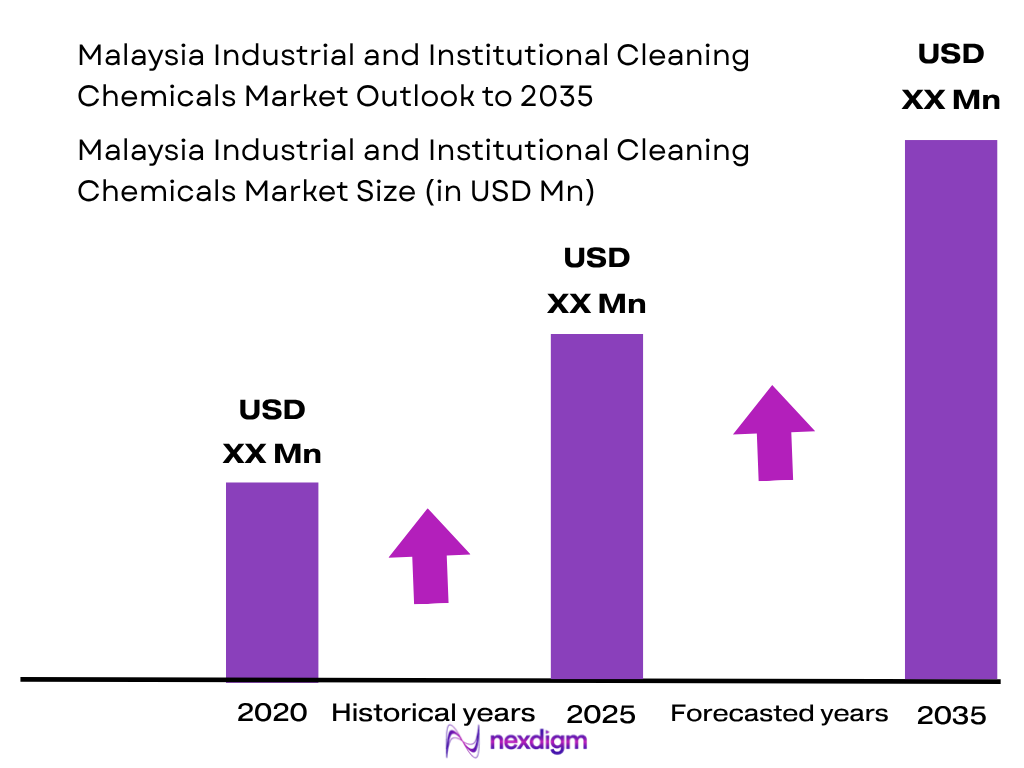
The Malaysia Industrial and Institutional Cleaning Chemicals Market is valued at approximately USD ~XX million, based on the report’s historical market assessment. Demand is underpinned by Malaysia’s large industrial and commercial operating base: national manufacturing sales reached RM1.9 trillion, while the preceding period recorded approximately RM1.8 trillion in manufacturing activity. Food processing, electronics, fabricated metals, chemicals, rubber and plastics remain major chemical-intensive industries, supporting recurring consumption of degreasers, sanitizers, disinfectants, CIP chemicals and surface cleaners.
Selangor, Kuala Lumpur, Johor and Penang represent the principal demand centres because they combine industrial parks, commercial properties, healthcare establishments, hotels, foodservice facilities and sophisticated distribution networks. Approved investment increased from RM329.5 billion to RM378.5 billion, with Selangor attracting RM101.1 billion, Kuala Lumpur RM91.5 billion, Johor RM48.5 billion and Penang RM32.0 billion in the latest period. Their concentration of factories and institutional facilities creates substantial recurring professional-cleaning requirements.
Market Segmentation
By Product Type
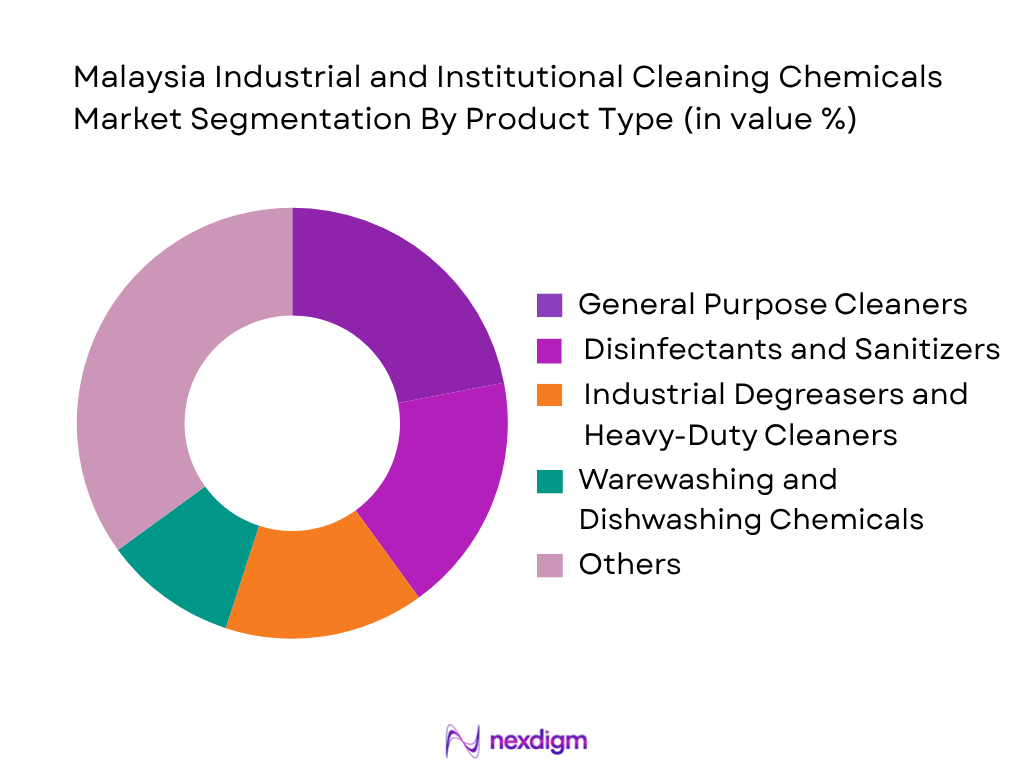
The Malaysia Industrial and Institutional Cleaning Chemicals Market is segmented by product type into general-purpose cleaners, disinfectants and sanitizers, industrial degreasers and heavy-duty cleaners, warewashing chemicals, laundry chemicals, floor-care chemicals, food-processing cleaning chemicals, surface and glass cleaners, vehicle-wash chemicals and specialty industrial chemicals. General-purpose cleaners hold the dominant position within the product segmentation because they are used across virtually every institutional and commercial environment, including offices, hotels, hospitals, retail premises, educational facilities, restaurants and manufacturing establishments. Their high cleaning frequency and broad compatibility with floors, work surfaces and common facility areas create recurring consumption. However, specialist categories are becoming increasingly important. Food-processing plants rely on alkaline cleaners, acidic descalers, foaming chemicals and sanitizers, while healthcare facilities require validated disinfection systems. Industrial manufacturing customers additionally consume higher-strength degreasers and equipment-cleaning formulations to remove oils, lubricants, carbon deposits and production residues.
By End-Use Industry
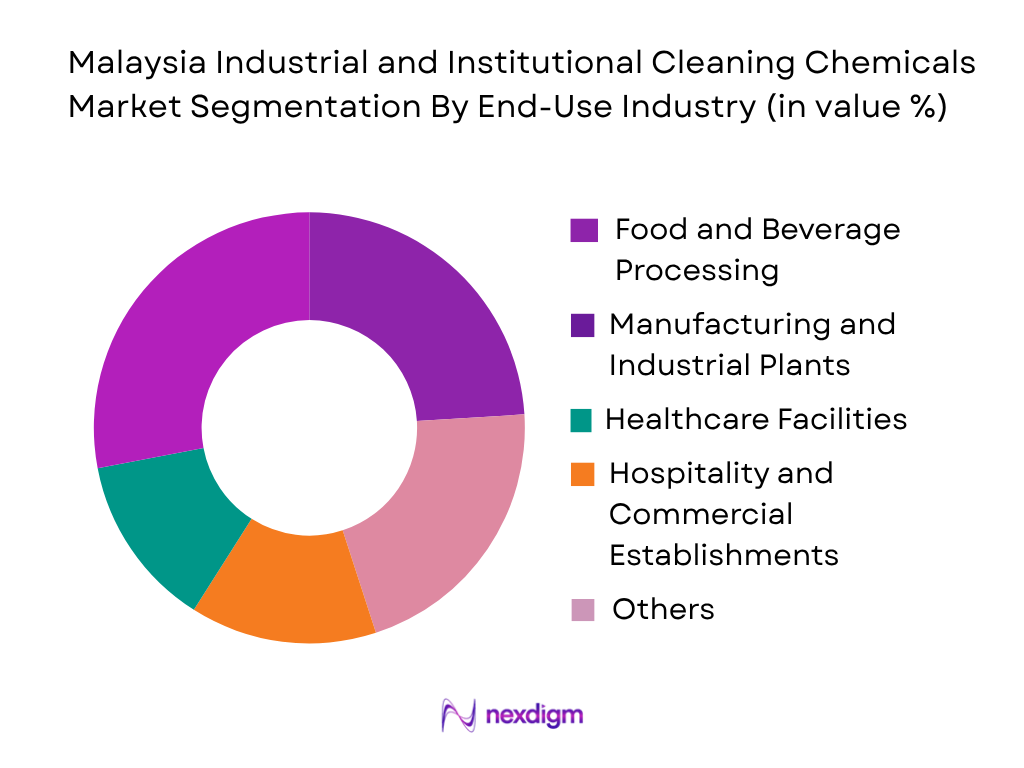
The Malaysia Industrial and Institutional Cleaning Chemicals Market is segmented by end-use industry into food and beverage processing, manufacturing and industrial plants, healthcare facilities, hospitality and commercial establishments, retail facilities, transportation and logistics, pharmaceutical manufacturing, educational institutions, oil and gas facilities, and government and public institutions. Food and beverage processing represents the leading end-use segment because hygiene is an operational requirement rather than discretionary facility expenditure. Malaysia has a well-developed food-processing ecosystem encompassing beverages, edible oils, dairy, processed food, meat, seafood and packaged-food production. These facilities require repetitive cleaning of processing equipment, tanks, filling lines, conveyors, production floors and food-contact surfaces. Consequently, consumption extends across alkaline CIP chemicals, acid descalers, sanitizers, foam cleaners and specialty detergents. DOSM reported food processing growth of 4.7% in its latest annual economic assessment, reinforcing the underlying industrial demand base for process-hygiene chemistry.
Competitive Landscape
The Malaysia Industrial and Institutional Cleaning Chemicals Market combines multinational hygiene-solution companies, domestic specialty-chemical manufacturers, professional janitorial suppliers and chemical distributors. Ecolab and Diversey compete through integrated chemical, dosing, hygiene-management and technical-service solutions, while Malaysian manufacturers such as Chempro Technology and Saraya Goodmaid/Goodmaid Chemicals provide localized formulation and institutional coverage. Raw-material distributors such as Brenntag Malaysia influence the upstream ecosystem by supplying ingredients and formulation support. Competition increasingly revolves around cost-per-use, dosing reliability, regulatory compliance, application expertise and sustainability rather than chemical price alone. Ecolab’s professional-cleaning heritage dates to 1923, while Diversey similarly traces its history to 1923.
| Company | Establishment Year | Headquarters | I&I Portfolio | Key End-Use Coverage | Local Manufacturing / Formulation | Dosing & Dispensing Capability | Technical Service | Sustainability Positioning |
| Ecolab | 1923 | St. Paul, Minnesota, USA | ~ | ~ | ~ | ~ | ~ | ~ |
| Diversey – A Solenis Company | 1923* | Wilmington, Delaware, USA** | ~ | ~ | ~ | ~ | ~ | ~ |
| Chempro Technology (M) Sdn Bhd | Local specialist | Klang, Selangor, Malaysia | ~ | ~ | ~ | ~ | ~ | ~ |
| Saraya Goodmaid / Goodmaid Chemicals | 1952*** | Osaka, Japan / Malaysia operations | ~ | ~ | ~ | ~ | ~ | ~ |
| Brenntag Malaysia | 1874 | Essen, Germany | ~ | ~ | ~ | ~ |
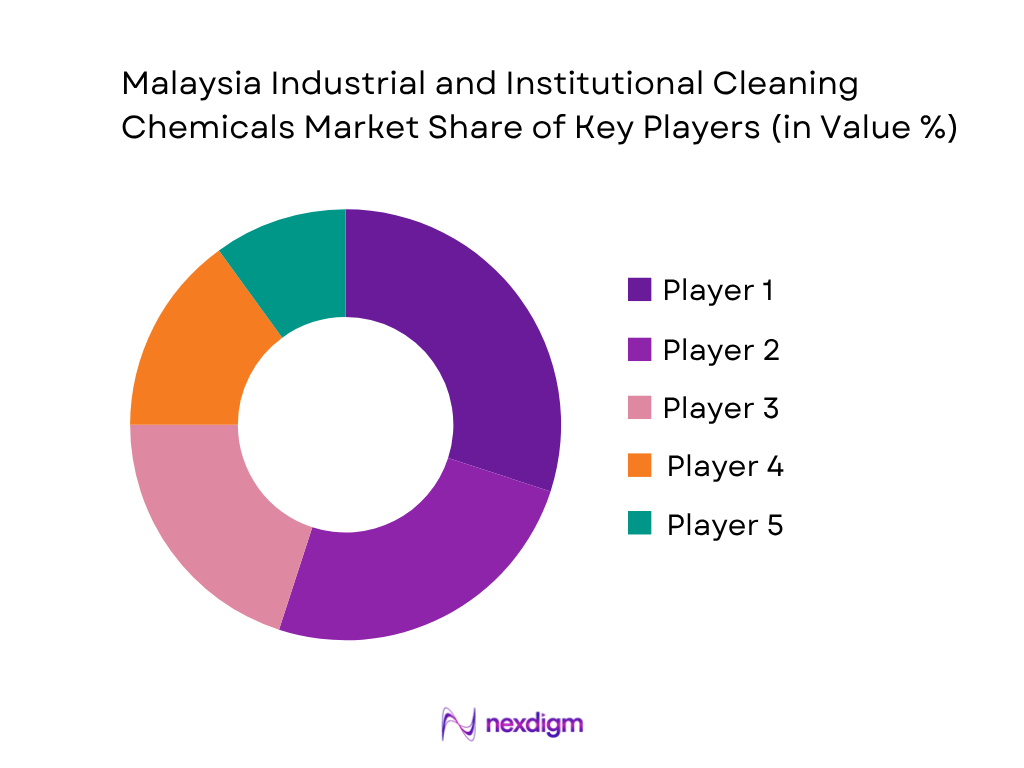
Malaysia Industrial and Institutional Cleaning Chemicals Market Analysis
Growth Drivers
Expanding Manufacturing Base Driving Industrial Cleaning Chemical Demand
Malaysia’s industrial base creates recurring demand for degreasers, alkaline cleaners, acidic descalers, disinfectants, equipment-cleaning chemicals and plant-hygiene formulations. Department of Statistics Malaysia reported RM1.9 trillion in manufacturing sales during 2024, while MIDA recorded RM120.5 billion in approved manufacturing investments spanning new facilities and industrial expansions. Chemicals and chemical products alone attracted RM10.6 billion across 92 approved projects, with these projects associated with 4,476 employment opportunities, demonstrating continued capacity creation in an industry directly connected with cleaning-chemical production and consumption. The electrical and electronics manufacturing segment supported approximately 655,000 jobs, while petroleum, chemical, rubber and plastic manufacturing accounted for around 462,000 jobs, indicating the scale of operational environments requiring machinery cleaning, floor maintenance, degreasing and contamination control. At the macroeconomic level, the World Bank recorded Malaysia’s GDP at USD422.23 billion and GDP per capita at USD11,874.4 in 2024, providing a strong economic platform for industrial output and professional hygiene expenditure. This dense manufacturing ecosystem directly supports regular consumption of industrial cleaning formulations across production lines, maintenance operations, warehouses and processing facilities.
Growing Healthcare and Tourism Sectors Supporting Institutional Cleaning Demand
Malaysia’s institutional cleaning requirement is supported by a large healthcare network and a strongly recovered visitor economy, both of which require continuous cleaning, disinfection, laundry care, washroom hygiene and foodservice sanitation. Ministry of Health statistics recorded 139 Ministry of Health hospitals with 41,209 official beds and 11 special medical institutions with 5,646 beds at the end of 2024. The private healthcare system additionally contained 214 hospitals with 19,920 beds, 812 haemodialysis centres, 4,309 private medical clinics and 4,320 private community pharmacies, creating thousands of facilities where professional disinfectants and institutional cleaners are routinely required. Tourism Malaysia separately recorded 25,016,698 international tourist arrivals and 37,961,485 total visitor arrivals during 2024. Major gateways handled substantial volumes, including 4,280,633 arrivals through KLIA, 3,727,173 through KLIA 2, and 1,126,530 through Penang International Airport. Malaysia’s World Bank-recorded GDP of USD422.23 billion further reflects the economic capacity underpinning hospitality, healthcare and commercial service activity. These institutional networks sustain high-frequency demand for surface cleaners, laundry chemicals, warewashing formulations and disinfectants.
Market Challenges
Dependence on Imported Chemical Inputs and International Supply Chains
Malaysia’s industrial and institutional cleaning chemicals industry remains exposed to imported surfactants, specialty additives, solvents, biocides, enzymes and other chemical intermediates used in professional formulations. MATRADE recorded total Malaysian imports of RM1.371 trillion during 2024, demonstrating the scale of the country’s integration with international supply networks. Imports from China alone reached RM296.45 billion, while imports from the United States totalled RM126.26 billion and imports from the European Union reached RM103.07 billion; chemicals and chemical products were identified among the major imported product groups from each of these trading partners. Malaysia also imported RM857.93 billion from free-trade-agreement partners, with chemical products again included among the principal imported categories. At the macroeconomic level, World Bank data placed Malaysia’s economic output at USD422.23 billion in 2024, highlighting the country’s substantial but globally integrated industrial economy. For cleaning chemical manufacturers and formulators, this import exposure can complicate raw-material availability, formulation consistency and production planning when international logistics or sourcing conditions change. Local formulators therefore remain dependent on resilient supplier networks, buffer inventories and alternative sourcing strategies for specialty chemical inputs.
Labour Availability and Technical Service Capacity
Industrial and institutional cleaning chemicals increasingly require technical support extending beyond product delivery, including dilution-system installation, hygiene audits, chemical handling training, CIP optimisation, workplace-safety documentation and troubleshooting. Malaysia’s labour-market statistics indicate a sizeable workforce requirement across the sectors most relevant to professional cleaning demand. The Department of Statistics Malaysia recorded 193,600 job vacancies across the economy during 2024, with manufacturing alone accounting for approximately 110,500 vacancies and services for around 25,000 vacancies. Manufacturing supported approximately 2.504 million jobs, including 655,000 positions in electrical, electronic and optical products, 462,000 positions in petroleum, chemical, rubber and plastic products, and 353,000 positions in food processing, beverages and tobacco. These industries are major consumers of specialist cleaning and sanitation chemicals, but their scale also increases demand for trained operators, maintenance teams and supplier technicians capable of handling chemical systems correctly. The World Bank reported Malaysia’s GDP per capita at USD11,874.4 in 2024, reflecting an economy increasingly oriented toward higher-productivity industrial and service activities. Supplier expansion therefore depends not only on chemical availability but also on sufficient technical and application-service capability.
Market Opportunities
Expansion of Food Processing, Healthcare and Professional Hygiene Programs
Malaysia offers substantial future opportunity for suppliers of CIP cleaners, food-contact sanitizers, healthcare disinfectants, laundry chemicals and controlled-dosing systems because current industrial and institutional infrastructure already creates a large recurring hygiene requirement. MIDA recorded 110 approved food-manufacturing projects during 2024, representing approximately USD1.37 billion in capital investment under its revised manufacturing-project statistics. Malaysia’s healthcare system simultaneously included 150 Ministry of Health hospitals and special medical institutions with 46,855 beds, while the private sector operated 214 hospitals with 19,920 beds and 812 haemodialysis centres. Tourism-related activity adds another demand layer, with Malaysia receiving 25,016,698 tourists during 2024, increasing the operational load across hotels, restaurants, airports, commercial laundries and public facilities. The IMF recorded Malaysia’s nominal GDP at approximately USD422.2 billion and population at 34.1 million for 2024, demonstrating the economic and demographic base supporting institutional service demand. These current indicators provide a clear foundation for future expansion of application-specific sanitation programs, particularly solutions combining chemicals with dispensing equipment, documented hygiene procedures, employee training and measurable consumption control rather than standalone commodity cleaners.
Local Oleochemical Integration and Sustainable Cleaning Formulation
Malaysia’s established palm and oleochemical value chain provides a significant future opportunity for locally formulated bio-based surfactants, biodegradable detergents and sustainable institutional cleaning products. Malaysian Palm Oil Board statistics recorded 19,338,266 tonnes of crude palm oil production in 2024, supported by 5,612,852 hectares of planted oil-palm area. More importantly for cleaning chemistry, Malaysia exported 2,993,592 tonnes of palm-based oleochemicals and 585,764 tonnes of palm-based finished products, demonstrating substantial domestic capability in feedstocks used across surfactants, fatty alcohols, soaps and detergent intermediates. MIDA also recorded RM10.6 billion of approved investment across 92 chemicals and chemical-products projects, including 64 new projects and 28 expansion or diversification projects, signalling continued development of the domestic chemical-processing ecosystem. The World Bank placed Malaysia’s GDP at USD422.23 billion in 2024, supporting continued industrial upgrading and value-added chemical manufacturing. These conditions create room for professional-cleaning suppliers to develop palm-derived formulations, concentrated products and lower-waste cleaning systems while reducing reliance on fully imported finished formulations and increasing local product development for food processing, hospitality, healthcare and industrial customers.
Future Outlook
The Malaysia Industrial and Institutional Cleaning Chemicals Market is forecast to expand at approximately ~X.X% CAGR during the forecast period, supported by manufacturing expansion, stricter hygiene protocols, food-processing investment, tourism growth and increased outsourcing of facility-management activities. Growth is expected to shift progressively from commodity cleaners toward application-specific, concentrated and technically supported hygiene systems. The strongest commercial opportunity will increasingly arise from cost-in-use optimization. Large customers are moving beyond comparisons based only on price per litre and evaluating chemical consumption per cleaning cycle, labour requirements, dilution accuracy, water utilization and equipment protection. This favours suppliers capable of integrating chemicals with controlled dispensers, training, hygiene audits and consumption monitoring.
Food and beverage processing will remain strategically attractive because cleaning is embedded into production cycles. CIP cleaners, foaming detergents, sanitizers and scale-control chemicals should benefit from continued investment in food manufacturing. Malaysia’s broader manufacturing sector generated RM1.9 trillion in sales, demonstrating the scale of the industrial facility base from which professional-cleaning demand is derived. Institutional demand will benefit from tourism, healthcare, commercial-property operations and facility-management outsourcing. Tourism Malaysia recorded 25,016,698 tourist arrivals in its latest full-period dataset compared with 20,141,846 previously, increasing cleaning loads in accommodation, foodservice and transport facilities.
Major Players
- Ecolab International Sdn Bhd
- Diversey Malaysia – A Solenis Company
- Chempro Technology (M) Sdn Bhd
- Saraya Goodmaid Sdn Bhd
- Goodmaid Chemicals Corporation Sdn Bhd
- PRO NC Hygiene Sdn Bhd
- MAZ Resources Sdn Bhd
- Uni K Asia Solutions Sdn Bhd
- Eagle Chemitech Resources Sdn Bhd
- Joywash Marketing
- Bio-Pro
- EC Unlimited Sdn Bhd
- Superior Janitorial Supplies Sdn Bhd
- Brenntag Malaysia Sdn Bhd
- Kao Oleochemical (Malaysia) Sdn Bhd
Key Target Audience
- Industrial and Institutional Cleaning Chemical Manufacturers
- Professional Hygiene and Sanitation Solution Providers
- Industrial Chemical and Janitorial Product Distributors
- Food and Beverage, Healthcare, Hospitality and Manufacturing Procurement
- Organizations
- Facility Management and Contract Cleaning Companies
- Raw Material, Surfactant, Biocide and Oleochemical Suppliers
- Investments and Venture Capitalist Firms
- Government and Regulatory Bodies (Department of Occupational Safety and Health Malaysia, Department of Environment Malaysia, Ministry of Health Malaysia, Malaysian Investment Development Authority, Ministry of Investment, Trade and Industry Malaysia)
Research Methodology
Step 1: Identification of Key Variables
The initial research stage develops a complete ecosystem map for the Malaysia Industrial and Institutional Cleaning Chemicals Market. Secondary research covers manufacturers, distributors, raw-material suppliers, cleaning contractors and major industrial and institutional end users. Key variables include product consumption, concentration ratios, average selling prices, manufacturing localization, import dependency, facility counts, cleaning frequency, regulatory compliance and distribution structures.
Step 2: Market Analysis and Construction
Historical demand is constructed using a combination of top-down and bottom-up techniques. The top-down assessment evaluates manufacturing output, food-processing activity, hospitality capacity, healthcare facilities and commercial infrastructure, while the bottom-up model estimates supplier revenues, chemical volumes, product prices and consumption per facility. Import-export movements and domestic production are reconciled to avoid double counting and to determine addressable professional-cleaning demand.
Step 3: Hypothesis Validation and Expert Consultation
Research hypotheses are validated through structured interviews and CATI-based discussions with cleaning-chemical manufacturers, distributors, procurement executives, facility managers, contract cleaners and application specialists. Interviews test assumptions regarding product mix, dilution ratios, customer purchasing cycles, distributor margins, pricing, technical-service requirements and competitive positioning. Feedback is used to adjust market shares and resolve inconsistencies between demand-side and supply-side datasets.
Step 4: Research Synthesis and Final Output
The final stage triangulates information from manufacturers, distributors, end users, government statistics and trade sources. Supplier-level sales estimates are cross-checked against facility consumption, cleaning frequency, average chemical dose and reported industrial activity. Forecast scenarios then incorporate manufacturing expansion, tourism and healthcare activity, pricing trends, concentrated-product adoption, sustainability requirements, chemical regulation and automation of dosing systems to develop the final market outlook.

- Executive Summary
- Research Methodology (Market Definition and Scope, Malaysia Industrial and Institutional Cleaning Chemicals Taxonomy, Industrial Cleaning Chemical Classification, Institutional Cleaning Chemical Classification, Professional Hygiene Solution Mapping, Cleaning Chemical Application Framework, Raw Material Assessment, Sustainable Cleaning Chemistry Evaluation, Market Sizing Framework, Top-Down Analysis, Bottom-Up Analysis, Domestic Manufacturing Assessment, Import Dependency Assessment, Demand-Side Assessment)

- Definition and Scope
- Malaysia Industrial and Institutional Cleaning Chemicals Industry Evolution and Professional Hygiene Development
- Industrial and Institutional Cleaning Chemicals Manufacturing and Formulation Process
- Cleaning Chemicals Value Chain Analysis
- Malaysia Industrial and Institutional Cleaning Chemicals Supply Chain Analysis
- Cleaning Chemical Raw Material Ecosystem Analysis
- Malaysia Cleaning Chemicals Import Dependency and Localization Assessment
- Industrial Cleaning Application Architecture and Institutional Hygiene Solution Framework

- Growth Drivers (Expansion of Food and Beverage Manufacturing, Growth of Electrical and Electronics Manufacturing, Increasing Hygiene Standards in Healthcare Facilities, Expansion of Hospitality and Foodservice Sector, Rising Demand for Professional Cleaning Services, Increasing Adoption of Concentrated Cleaning Chemicals, Growth of Outsourced Facility Management Services, Increasing Industrial Plant Maintenance Requirements)
- Market Challenges (Raw Material Price Volatility, Dependence on Imported Specialty Chemicals, Fragmented Distributor Landscape, Price Competition from Local Formulators, Chemical Handling and Storage Requirements, End-User Dilution and Dosing Errors, Logistics Costs in Sabah and Sarawak, Customer Focus on Purchase Price Rather than Cost-in-Use)
- Market Opportunities (High-Concentrate Cleaning Chemicals, Automated Chemical Dispensing Systems, Food and Beverage CIP Solutions, Halal-Compliant Cleaning Chemicals, Bio-Based and Palm-Derived Cleaning Chemistry, Enzyme-Based Cleaning Technologies, Water and Energy-Efficient Cleaning Solutions, Sustainable Institutional Hygiene Programs)
- Market Trends (Automated Dosing Systems, Concentrated Cleaning Chemical Adoption, Cost-in-Use Procurement Models, Biodegradable Formulations, Low-Temperature Cleaning Technologies, Closed-Loop Dispensing Systems, Refillable Packaging Solutions, Digital Hygiene Monitoring Systems)
- Regulatory and Standards Landscape (CLASS Regulations, GHS Classification Requirements, Safety Data Sheet Requirements, USECHH Regulations, Chemical Health Risk Assessment Requirements, Occupational Chemical Exposure Controls)
- SWOT Analysis
- Porter’s Five Forces Analysis
- PESTLE Analysis
- Stakeholder Ecosystem
- Competition Ecosystem

- By Market Value (2020-2025)
- By Cleaning Chemical Consumption Volume (2020-2025)
- By Domestic Production Volume (2020-2025)
- By Import Volume (2020-2025)
- By Export Volume (2020-2025)
- By Average Selling Price (2020-2025)
- By Industrial Facility Chemical Consumption Intensity (2020-2025)
- By Institutional Facility Chemical Consumption Intensity (2020-2025)

- By Product Type (In Value %)
General Purpose Cleaners
Disinfectants and Sanitizers
Industrial Degreasers and Heavy-Duty Cleaners
Warewashing and Dishwashing Chemicals
Laundry Care Chemicals
Floor Care Chemicals
Vehicle Wash Chemicals
Food Processing Cleaning Chemicals
Healthcare Cleaning Chemicals
Specialty Industrial Cleaning Chemicals
Surface and Glass Cleaning Chemicals - By Raw Material Type (In Value %)
Surfactants
Chlor-Alkali Chemicals
Solvents
Biocides
Acids and Alkalis
Chelating Agents
Enzymes
Quaternary Ammonium Compounds
Fragrances and Preservatives
Palm and Oleochemical-Based Raw Materials - By End-Use Industry (In Value %)
Food and Beverage Processing
Healthcare Facilities
Manufacturing and Industrial Plants
Hospitality and Commercial Establishments
Educational Institutions
Retail Facilities
Transportation and Logistics Facilities
Pharmaceutical Manufacturing
Oil and Gas Facilities
Government and Public Institutions - By Distribution Channel (In Value %)
Direct Manufacturer Sales
Industrial Chemical Distributors
Professional Cleaning Product Distributors
Facility Management Companies
Janitorial Supply Providers
B2B Digital Platforms
Institutional Procurement Contracts
Specialty Hygiene Solution Providers - By Formulation Type (In Value %)
Ready-to-Use Cleaning Chemicals
Standard Concentrated Liquids
High-Concentrate Cleaning Chemicals
Super-Concentrated Cleaning Chemicals
Powder and Granular Formulations
Solid and Tablet-Based Chemicals
Enzymatic Cleaning Formulations
Foaming Cleaning Formulations - By Region (In Value %)
Central Malaysia
Selangor
Kuala Lumpur
Putrajaya
Northern Malaysia
Penang
Kedah
Perak
Southern Malaysia
Johor
Negeri Sembilan
Melaka
East Coast Malaysia
Pahang
Terengganu
Kelantan
East Malaysia
Sabah
Sarawak
Labuan

- Market Share of Major Players (By Revenue, Volume, Product Category, Raw Material Type, End-Use Industry, Market Type, Distribution Channel)
- Cross Comparison Parameters (Product Portfolio Breadth, Industrial Cleaning Chemical Capability, Institutional Hygiene Solution Coverage, Malaysia Manufacturing and Blending Capability, Automated Dilution and Dosing-System Capability, Technical Service and Site Audit Strength, Nationwide Distribution and Service Reach, Sustainable and Concentrated Chemistry Portfolio)
- SWOT Analysis of Major Players
- Competitive Positioning Matrix
- Pricing and Distribution Network Benchmarking
- Detailed Profiles of Major Companies
Ecolab International Sdn Bhd
Diversey Malaysia
Chempro Technology (M) Sdn Bhd
Saraya Goodmaid Sdn Bhd
Goodmaid Chemicals Corporation Sdn Bhd
PRO NC Hygiene Sdn Bhd
MAZ Resources Sdn Bhd
Uni K Asia Solutions Sdn Bhd
Eagle Chemitech Resources Sdn Bhd
Joywash Marketing
Bio-Pro
EC Unlimited Sdn Bhd
Superior Janitorial Supplies Sdn Bhd
Brenntag Malaysia Sdn Bhd
Kao Oleochemical (Malaysia) Sdn Bhd

- Buyer Segmentation
- Procurement Behaviour
- Supplier Selection Criteria
- Buyer Pain Points
- Technology Adoption Assessment
- Replacement and Repurchase Behaviour

- By Market Value (2026-2035)
- By Cleaning Chemical Consumption Volume (2026-2035)
- By Domestic Production Volume (2026-2035)
- By Import Volume (2026-2035)
- By Export Volume (2026-2035)
- By Average Selling Price (2026-2035)
- By Industrial Facility Chemical Consumption Intensity (2026-2035)
- By Institutional Facility Chemical Consumption Intensity (2026-2035)


 Request a Sample
 Ask for Customization
 Get a Quote
 Enquire Now