
 Download PDF
Market Overview
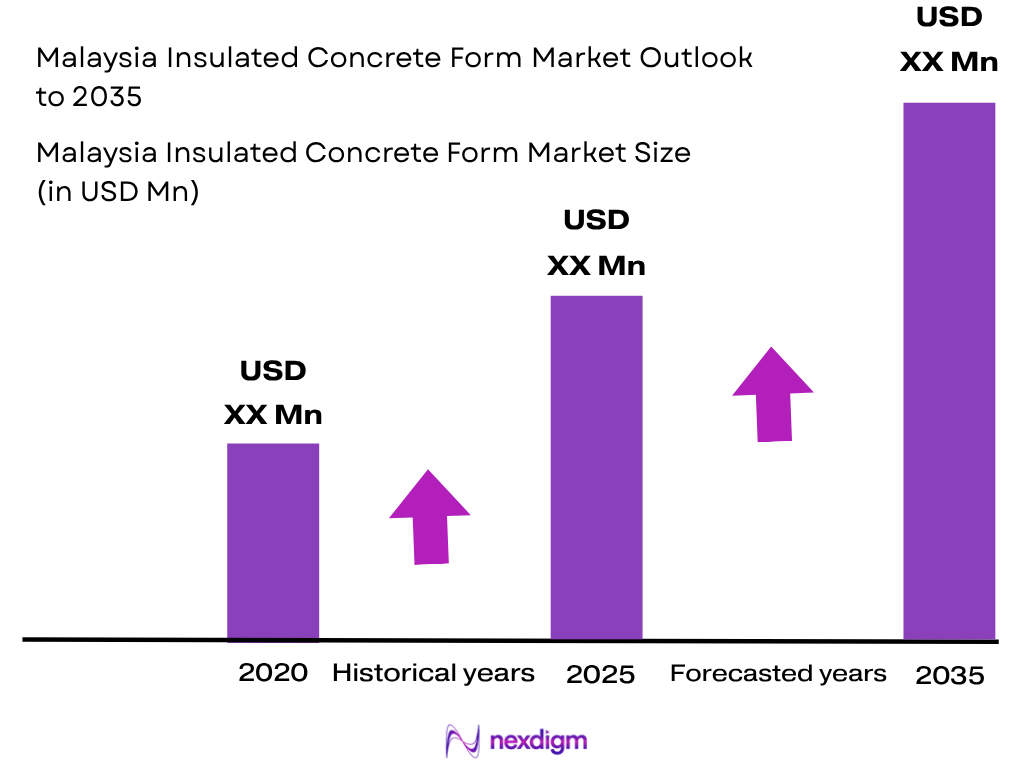
The Malaysia Insulated Concrete Form Market is valued at approximately USD ~XX million, based on historical market modelling. Construction work done increased from RM132.2 billion in the preceding full-year period to RM158.8 billion in the latest full-year period, while residential construction reached RM35.8 billion. Rising building activity, CIDB-supported Industrialised Building System adoption, construction labour reduction requirements, energy-efficient wall systems, and faster concrete construction are supporting ICF demand.
Selangor, Johor, Kuala Lumpur and Sarawak are the principal demand centres for the Malaysia Insulated Concrete Form Market due to their concentration of residential development, industrial projects, data centres, infrastructure and large contractor networks. Latest fourth-quarter construction work reached RM9.4 billion in Selangor, RM7.4 billion in Johor, RM4.7 billion in the Federal Territories and RM4.6 billion in Sarawak, providing a large addressable base for industrialised wall systems and permanent formwork solutions.
Market Segmentation
By ICF System Architecture
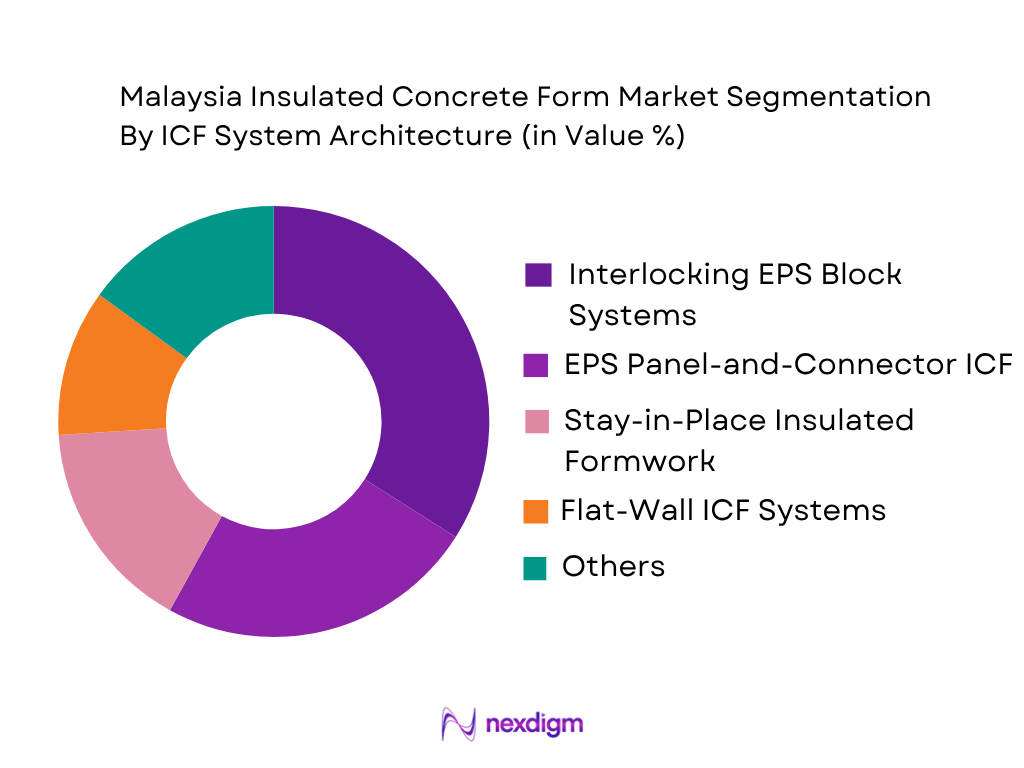
The Malaysia Insulated Concrete Form Market is segmented into interlocking EPS block systems, EPS panel-and-connector systems, flat-wall ICF systems, stay-in-place insulated formwork, composite permanent formwork and hybrid ICF-IBS systems. Interlocking EPS block ICF systems are estimated to hold the dominant share because they combine permanent insulation, modular assembly and reinforced concrete within a repeatable wall-building process. Malaysia’s hot and humid climate increases the relevance of continuous insulation, while developers are increasingly interested in technologies capable of reducing wet trades and dependence on skilled site labour. CIDB recognizes formwork, blockwork and other labour-saving construction technologies within its IBS certification structure, providing an institutional framework that supports industrialized wall solutions. Malaysia-based KOTO specifically positions its ICF system as an IBS solution and emphasizes controlled manufacturing, thermal insulation, lighter components and reduced site operations, demonstrating the applicability of this architecture to the local building environment.
By End-Use Construction
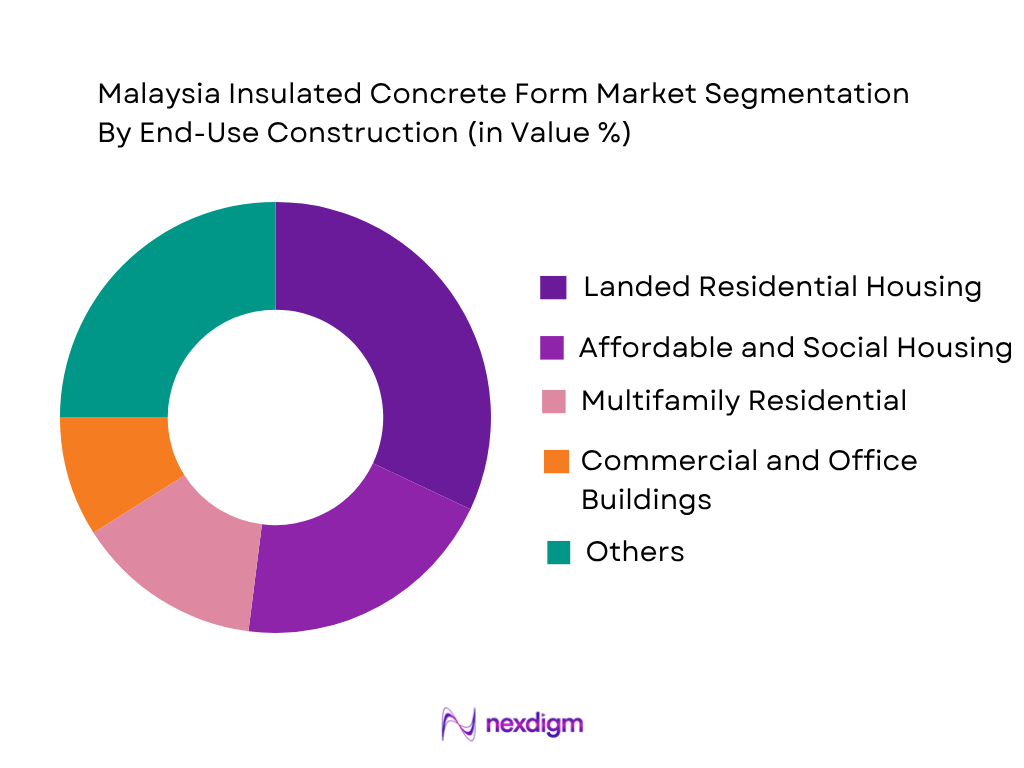
The Malaysia Insulated Concrete Form Market is segmented into landed residential housing, affordable housing, multifamily residential, commercial buildings, hospitality, schools, healthcare facilities, government buildings, industrial facilities and other specialized structures. Landed residential construction is estimated to hold the dominant share because ICF systems are particularly suited to repetitive low-rise walls, terrace houses, semi-detached houses and detached residential structures where complete wall sections can be assembled and concreted rapidly. Malaysia also maintains a substantial affordable-housing pipeline supported by federal and state programmes. Government planning documents reported 179,769 completed affordable homes and another 312,591 approved units at different stages of construction by March 2025, reinforcing demand for scalable building technologies. The market opportunity is strengthened by construction industrialization policies that prioritize quality, reduced labour intensity, standardization and faster delivery, characteristics directly aligned with permanent insulated formwork and ICF construction.
Competitive Landscape
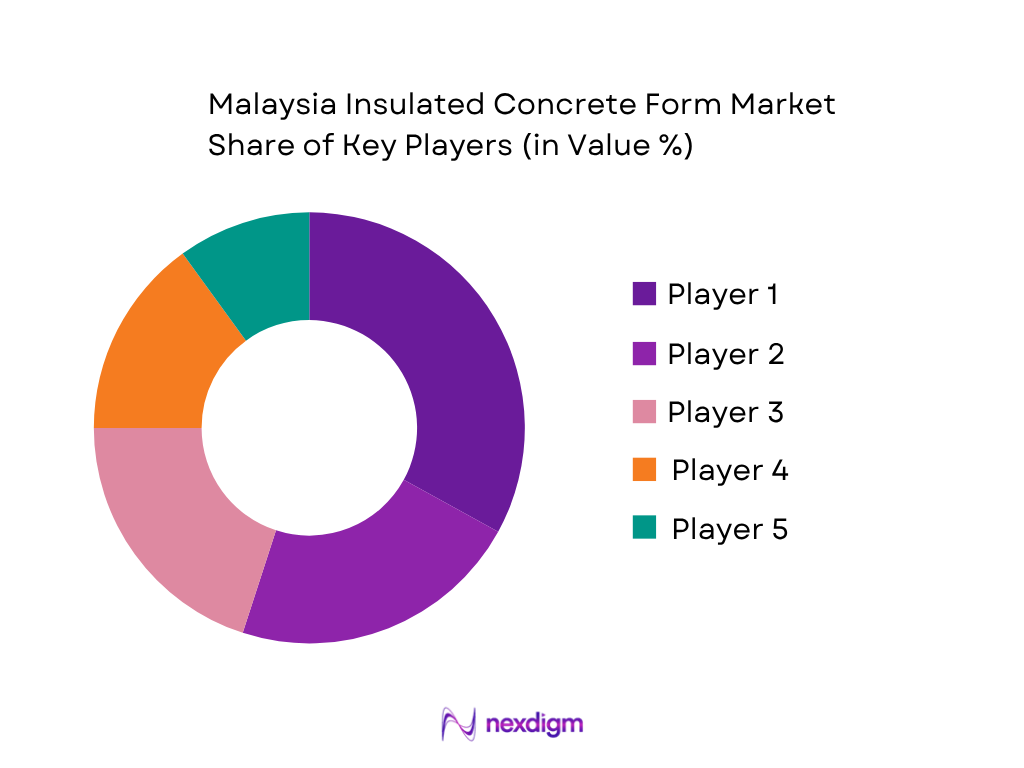
The Malaysia Insulated Concrete Form Market combines dedicated ICF suppliers with broader IBS, permanent-formwork and precast-concrete companies. KOTO represents one of the clearest Malaysia-based ICF-IBS propositions, while Tremco CPG provides access to Nudura insulated concrete form technology. LCM Casting Technology competes through Malaysian-developed stay-in-place concrete formwork, while large IBS participants such as Gamuda and MGB influence customer expectations for industrialized construction, factory production, quality control and reduced on-site labour. Competition therefore extends beyond ICF blocks alone to alternative wall-system technologies.
| Major Player | Establishment Year | Headquarters | Primary Technology | Malaysia Manufacturing / Delivery | Thermal Insulation Capability | Structural Concrete Integration | IBS Positioning | Key Applications |
| KOTO Corporation | Not publicly disclosed | Petaling Jaya, Selangor | ~ | ~ | ~ | ~ | ~ | ~ |
| Tremco CPG / Nudura | Parent-group heritage predates current structure | Asia-Pacific regional operations | ~ | ~ | ~ | ~ | ~ | ~ |
| LCM Casting Technology | Technology developed over 20 years ago | Malaysia | ~ | ~ | ~ | ~ | ~ | ~ |
| Gamuda IBS | Gamuda established 1976 | Petaling Jaya, Selangor | ~ | ~ | ~ | ~ | ~ | ~ |
| MGB Berhad | 2007 | Petaling Jaya, Selangor | ~ | ~ | ~ | ~ | ~ | ~ |
Malaysia Insulated Concrete Form Market Analysis
Growth Drivers
CIDB Industrialised Building System Adoption and Construction Labour Reduction Requirements
Malaysia’s policy-led transition toward Industrialised Building Systems is strengthening the commercial case for insulated concrete forms because ICF combines permanent formwork, structural concrete and insulation while reducing repetitive site activities. The Construction Industry Development Board classifies Malaysian IBS products across 6 specialization groups, including formwork, blockwork, precast concrete and other labour-saving systems, creating a formal certification pathway relevant to ICF. Department of Statistics Malaysia recorded 1.27 million construction-sector jobs and 1.25 million filled positions in the fourth quarter of 2024, alongside 25,700 construction vacancies, demonstrating the scale of labour requirements faced by contractors. Construction work completed reached RM158.8 billion in 2024, giving labour-efficient wall technologies a substantial project base. Malaysia’s nominal GDP reached RM1.952 trillion, equivalent to USD422.2 billion, while the population stood at 34.1 million in 2024 according to the International Monetary Fund. These indicators support greater use of factory-controlled ICF components that reduce conventional formwork operations, masonry work, repeated material handling and on-site workforce requirements while maintaining reinforced-concrete structural construction.
Affordable Housing and Residential Construction Expanding the Addressable ICF Project Base
Residential and affordable-housing development is another direct driver of the Malaysia Insulated Concrete Form Market because repetitive housing layouts, external structural walls and low-rise developments are well suited to standardized EPS forms filled with reinforced concrete. Department of Statistics Malaysia recorded total construction work of RM158.8 billion in 2024, with residential building activity representing one of the strongest construction components. Government planning documents subsequently recorded 179,769 affordable homes completed as of March 2025, with another 312,591 units approved and at different construction stages. Housing finance approved under Skim Jaminan Kredit Perumahan reached RM17.86 billion for 76,664 borrowers as of December 2024, providing an additional indicator of active housing demand. The IMF recorded Malaysian nominal GDP at RM1.952 trillion and population at 34.1 million in 2024. These conditions create opportunities for ICF in terrace houses, detached homes, semi-detached housing and affordable schemes where developers require faster wall erection, integrated insulation, repeatable construction detailing and lower dependence on numerous wet-trade activities.
Market Challenges
Strong Precast IBS and Conventional Construction Competition Restricting ICF Penetration
The Malaysia Insulated Concrete Form Market must compete against deeply established reinforced-concrete frame, masonry, precast concrete and reusable-formwork methods already embedded within contractor procurement and CIDB’s wider IBS ecosystem. CIDB recognizes 6 IBS specialization groups, meaning ICF does not compete only with traditional brickwork but also with certified precast concrete, blockwork, metal framing and other labour-saving systems. This competition is significant within a construction industry that completed RM158.8 billion of work in 2024 and supported 1.27 million construction jobs during the fourth quarter. Contractors therefore operate within a large existing supply network of concrete suppliers, formwork specialists, precasters, reinforcement contractors and masonry trades whose established operating processes can discourage switching to an unfamiliar wall system. Malaysia’s nominal GDP stood at RM1.952 trillion and population at 34.1 million in 2024, according to the IMF, illustrating the substantial construction economy in which ICF suppliers must build credibility. Wider adoption therefore depends on demonstrating reliable concrete placement, bracing, services integration, structural detailing, installer productivity and compatibility with Malaysian IBS assessment requirements rather than relying solely on insulation advantages.
Imported-System Dependence, Regional Logistics and Tropical Installation Complexity
Malaysia’s geography creates a significant challenge for ICF suppliers because demand is spread between Peninsular Malaysia and East Malaysia while specialized EPS forms, connectors, accessories or proprietary system components may require centralized production or imported supply. Department of Statistics Malaysia recorded total merchandise imports of approximately RM1.370 trillion in 2024, illustrating Malaysia’s substantial dependence on cross-border supply chains for industrial inputs and equipment. Construction activity is geographically dispersed: fourth-quarter work completed reached RM9.4 billion in Selangor, RM7.4 billion in Johor, RM4.7 billion in the Federal Territories and RM4.6 billion in Sarawak. Supplying lightweight but bulky ICF forms across these markets requires warehouse planning, regional inventories and dependable transport capacity, particularly for projects in Sabah and Sarawak. Malaysia’s 2024 nominal GDP was RM1.952 trillion, while the national population reached 34.1 million, according to the IMF. Beyond logistics, ICF suppliers must adapt wall assemblies to high rainfall, humidity, waterproofing, termite protection, services penetrations and exterior finishing conditions. These technical requirements raise the importance of trained installers, engineering support and locally adapted construction specifications.
Market Opportunities
Affordable ICF Housing and Government-Supported Industrialised Construction
Affordable housing offers one of the strongest future growth opportunities for the Malaysia Insulated Concrete Form Market because government-backed housing programmes require scalable construction systems capable of delivering standardized dwelling units with predictable quality and lower site-labour intensity. Malaysia’s Thirteenth Plan documentation recorded 179,769 affordable homes completed as of March 2025 and 312,591 additional units approved and under various stages of construction. Housing financing approved through Skim Jaminan Kredit Perumahan reached RM17.86 billion and supported 76,664 borrowers as of December 2024. These current indicators establish a substantial housing pipeline in which permanent insulated formwork can be evaluated for terrace housing, low-rise apartments and standardized residential layouts. The wider economic base is also supportive: the IMF placed Malaysia’s nominal GDP at RM1.952 trillion, equivalent to USD422.2 billion, with a population of 34.1 million in 2024. ICF suppliers that align products with CIDB IBS registration, standardized engineering, repeatable reinforcement details and contractor training can target government-linked developers and affordable-housing contractors seeking quicker structural wall construction combined with integrated thermal insulation and reduced wet trades.
Localized ICF Manufacturing and High-Performance Building Applications
Local ICF manufacturing represents a significant growth opportunity because Malaysia is simultaneously expanding construction activity, digital infrastructure and industrial investment, creating demand for efficient wall systems across residential, commercial and specialized buildings. MIDA reported RM378.5 billion of approved investments covering 6,700 projects in 2024, including RM120.5 billion in manufacturing approvals. The Digital Ministry also reported RM141.72 billion of approved digital investments during the first ten months of 2024, while MIDA recorded 12 data-centre projects involving RM90.2 billion of investment through June 2024. Six of those projects, representing RM68.9 billion, were already operating, including projects in Johor, Selangor and Kuala Lumpur. Malaysia’s nominal GDP reached RM1.952 trillion and population reached 34.1 million in 2024, according to the IMF. These current indicators support localized production of EPS forms, polypropylene connectors and integrated ICF wall components. Domestic manufacturing can improve availability for landed housing, worker accommodation, institutional buildings and ancillary data-centre facilities while reducing the logistical burden associated with importing bulky insulated forms and enabling product designs tailored to Malaysian tropical construction conditions.
Future Outlook
The Malaysia Insulated Concrete Form Market is expected to expand at approximately ~XX% CAGR during 2026–2035. Growth will be supported by continued building industrialization, rising residential construction, affordable-housing requirements, contractor productivity pressures and increasing emphasis on thermal performance in Malaysia’s tropical climate. Market development is likely to favour suppliers that can demonstrate CIDB-compatible IBS credentials, predictable installation procedures, engineering support and reliable domestic or regional manufacturing.
Major Players
- KOTO Corporation
- Tremco Construction Products Group Malaysia / Nudura
- LCM Casting Technology
- Aathaworld
- Gamuda IBS
- Sunway Construction
- Hume Concrete
- Eastern Pretech Malaysia
- Plytec Holding Berhad
- MGB Berhad
- SP Setia
- Sime Darby Property
- IJM Corporation
- Fox Blocks
- Amvic Building System
Key Target Audience
- Insulated Concrete Form and Permanent Formwork Manufacturers
- EPS and Insulation Material Manufacturers
- Industrialised Building System Contractors and Developers
- Residential, Affordable Housing and Township Developers
- Ready-Mix Concrete and Reinforcement Suppliers
- Building Material Distributors and Construction Technology Providers
- Investments and Venture Capitalist Firms
- Government and Regulatory Bodies (Construction Industry Development Board Malaysia, Ministry of Housing and Local Government, Public Works Department Malaysia, SIRIM Berhad, Department of Standards Malaysia)
Research Methodology
Step 1: Identification of Key Variables
The initial phase involves constructing an ecosystem map covering stakeholders across the Malaysia Insulated Concrete Form Market, including ICF manufacturers, EPS processors, formwork suppliers, ready-mix concrete producers, reinforcement suppliers, IBS contractors, residential developers and government agencies. Key variables include installed wall area, form consumption, concrete-core thickness, building applications, IBS certification, project pipeline, regional construction activity and domestic manufacturing capability.
Step 2: Market Analysis and Construction
Historical market data are assessed using top-down and bottom-up approaches. The top-down framework evaluates Malaysian construction work, residential and non-residential project activity, affordable-housing development, IBS adoption and regional building concentration. The bottom-up approach evaluates ICF supplier volumes, permanent formwork installations, estimated wall area, distributor throughput, construction project exposure and concrete requirements to establish the addressable market structure.
Step 3: Hypothesis Validation and Expert Consultation
Market hypotheses are validated through computer-assisted telephone interviews with ICF suppliers, IBS contractors, architects, structural engineers, developers, formwork specialists and building-material distributors. These consultations examine product adoption, installer productivity, concrete placement, thermal requirements, certification needs, competitive substitution from precast and conventional construction, regional procurement practices and the principal barriers affecting wider ICF acceptance in Malaysia.
Step 4: Research Synthesis and Final Output
The final phase integrates government construction statistics, CIDB information, company disclosures and primary market findings. Top-down estimates based on Malaysian building activity are reconciled against bottom-up supplier and installation indicators. This triangulation is used to refine market segmentation, competitive positioning, end-use demand, regional opportunity, technology adoption and the long-term development outlook for the Malaysia Insulated Concrete Form Market.

- Executive Summary
- Research Methodology (Market Definition and Scope, Malaysia Insulated Concrete Form Market Classification, ICF-IBS Product Mapping, EPS ICF Block and Panel Demand Assessment, Installed ICF Wall Area Mapping, Domestic ICF Manufacturing Capacity Assessment, Imported ICF System Assessment, EPS Raw Material Mapping, Reinforced Concrete Consumption Assessment, Steel Reinforcement Requirement Analysis, Ready-Mix Concrete Integration Assessment, Residential and Non-Residential Project Mapping, CIDB IBS Manufacturer Mapping, IBS Score Assessment, Primary Industry Interviews, Top-Down Construction Activity Assessment, Bottom-Up Company Revenue and Installation Volume Assessment, Data Triangulation, Pricing Assessment, Forecasting Framework)

- Definition and Scope
- Malaysia Insulated Concrete Form Industry Evolution
- Malaysia Insulated Concrete Form Value Chain Analysis
- Malaysia Insulated Concrete Form Supply Chain Analysis

- Growth Drivers (CIDB Industrialised Building System Adoption, Construction Labour Reduction Requirements, Affordable Housing Development, Expansion of Landed Residential Construction, Tropical Building Cooling Requirements, Demand for Faster Construction, Reduction of Wet Trades, Construction Waste Reduction, Factory-Controlled Building Components, Sustainable Construction Adoption)
- Market Challenges (Strong Competition from Conventional Reinforced Concrete and Brickwork, Precast Concrete IBS Competition, Limited ICF-Specific Installer Base, Contractor Familiarity with Conventional Formwork, Concrete Pouring and Consolidation Requirements, Form Alignment and Bracing Requirements, Imported ICF Technology Dependence, EPS Fire Performance Considerations, Tropical Moisture Detailing, East Malaysia Logistics Constraints)
- Market Opportunities (Affordable ICF Housing, Government IBS Projects, Landed Residential Development, Worker Accommodation, Schools and Institutional Buildings, Energy-Efficient Commercial Buildings, Data Centre Ancillary Buildings, Remote Sabah and Sarawak Construction, ICF Manufacturing Localization, Graphite EPS ICF Development, Recycled EPS Forms, Integrated Wall-and-Roof Systems, Regional ICF Technology Licensing)
- Market Trends (ICF-IBS Integration, Permanent EPS Formwork, Factory-Manufactured ICF Components, High-R-Value Wall Systems, Reduced Site Labour, Modular Wall Configuration, Pumped Concrete Integration, BIM-Assisted ICF Detailing, Flame-Retardant EPS, Low-Waste Construction, Integrated Thermal Envelope, Contractor Training and Technology Transfer)
- Government Regulations and Standards (CIDB Act 520 Requirements, CIDB IBS Manufacturer and Product Registration, CIS 24 IBS Assessment and Certification, IMPACT Certification, CIS 18 IBS Score, Product Certification Requirements, Uniform Building By-Laws, Malaysian Standards for Concrete and Structural Design, Fire Safety Requirements, Energy Efficiency Requirements, MyCREST Sustainable Construction Framework)
- SWOT Analysis
- Porter’s Five Forces Analysis
- PESTLE Analysis

- By Market Value (2020-2025)
- By ICF Block and Panel Consumption Volume (2020-2025)
- By Installed ICF Wall Area (2020-2025)
- By Domestic ICF Production Volume (2020-2025)
- By EPS Consumption in ICF Systems (2020-2025)

- By ICF System Architecture (In Value %)
Interlocking EPS Block ICF Systems
EPS Panel-and-Connector ICF Systems
Flat-Wall ICF Systems
Stay-in-Place Insulated Formwork Systems
Preassembled ICF Wall Systems
Knock-Down ICF Systems
Grid-Wall ICF Systems
Composite Permanent Formwork Systems
Hybrid ICF-IBS Systems - By Insulating Form Material (In Value %)
Standard Expanded Polystyrene ICF
High-Density EPS ICF
Flame-Retardant EPS ICF
Graphite-Enhanced EPS ICF
Recycled-Content EPS ICF
EPS-Cement Composite Formwork
Fibre-Cement Insulated Permanent Formwork
Magnesium Oxide Composite Permanent Formwork
Other Insulated Stay-in-Place Forms - By Concrete Core Configuration (In Value %)
Narrow Concrete Core Systems
Medium Concrete Core Systems
Wide Concrete Core Systems
Variable-Width Concrete Core Systems
Flat Monolithic Concrete Core
Grid-Type Reinforced Concrete Core
Load-Bearing Reinforced Concrete Core
Multi-Storey Structural Core Configuration
Application-Specific Engineered Concrete Core - By Building Application (In Value %)
External Load-Bearing Walls
Internal Structural Walls
External Building Envelope Walls
Foundation Walls
Basement Walls
Retaining Walls
Swimming Pools and Water Structures
ICF Floor Systems
Insulated Concrete Roof Systems
Industrial and Utility Structures - By End-Use Construction (In Value %)
Landed Residential Housing
Terrace Houses
Semi-Detached Houses and Bungalows
Affordable and Social Housing
Low-Rise Multifamily Residential
High-Rise Residential
Commercial and Office Buildings
Hotels and Hospitality
Schools and Educational Buildings
Government and Institutional Buildings
Industrial and Logistics Buildings
Data Centres and Mission-Critical Facilities - By Construction Delivery Model (In Value %)
Private Developer Projects
Government Housing Projects
Affordable Housing Projects
General Contractor-Led Projects
CIDB-Registered IBS Contractor Projects
Design-and-Build Projects
ICF Specialist Contractor Projects
Turnkey ICF Construction

- Market Share of Major Players (Malaysia Revenue, ICF Product Volume, Installed Wall Area, Residential Project Exposure, Commercial Project Exposure, Domestic Manufacturing Capability, Distribution Footprint, IBS Project Exposure)
- Cross Comparison Parameters (Malaysia ICF Revenue, ICF Block Panel and Permanent Formwork Portfolio Breadth, EPS Density R-Value and Tropical Thermal Performance Capability, Concrete Core and Structural Configuration Flexibility, CIDB IBS IMPACT and Product Certification Coverage, Malaysia Manufacturing Distribution and East Malaysia Supply Footprint, Residential Affordable Housing Commercial and Institutional Project Exposure, Structural Design Installer Training and On-Site Technical Support Capability)
- SWOT Analysis of Major Players (Product Architecture, Manufacturing Capability, Thermal Performance, IBS Positioning, Distribution Reach, Technical Support)
- Detailed Profiles of Major Companies
KOTO Corporation – Malaysia-Based KOTO ICF-IBS, K-Block Insulated Wall Components, Sustainable Building Systems, Design Support, Manufacturing and Project Delivery (KOTO)
Tremco Construction Products Group Malaysia / Nudura – Insulated Concrete Forms, Load-Bearing and Non-Load-Bearing Concrete Walls, Foundation Walls, Retaining Walls and Integrated Building Technology (Tremco CPg Asia Pacific)
LCM Casting Technology – Stay-in-Place Fibre-Cement and Magnesium-Oxide Formwork, Concrete-Infill Wall Systems, Affordable Housing Technology and Construction Technology Transfer (LCM Casting Technology)
Aathaworld – Malaysia ICF, EPS Sandwich Panel and Prefabricated IBS Building Material Supply and Project Solutions (Aathaworld)
Gamuda IBS – Precast Concrete IBS, Automated Manufacturing, Residential Building Systems and Industrialised Construction Solutions
Sunway Construction – IBS, Precast Concrete, Building Construction and Industrialised Project Delivery
Hume Concrete – Precast Concrete Building Components, Structural Concrete Systems and Industrialised Construction Products
Eastern Pretech Malaysia – Precast Structural Components, Wall Systems, Building Components and IBS Construction Solutions
Plytec Holding Berhad – Formwork Systems, Permanent Formwork Technology, Construction Engineering and Industrialised Building Solutions
MGB Berhad – Industrialised Building Systems, Precast Concrete Manufacturing, Residential Construction and Building Technology
SP Setia – Large-Scale Residential Development, Landed Housing, Sustainable Building Applications and IBS Demand Exposure
Sime Darby Property – Residential Development, Township Construction, Sustainable Building Specification and Industrialised Construction Demand
IJM Corporation – Building Construction, Residential Development, Infrastructure and Industrialised Construction Applications
Fox Blocks – EPS Insulated Concrete Forms, Reinforced Concrete Wall Systems, ICF Accessories and International ICF Technology Benchmark
Amvic Building System – EPS Stay-in-Place ICF, Reinforced Concrete Wall Systems, High-Thermal-Performance Forms and International ICF Technology Benchmark

- ICF Adoption Behaviour Assessment
- Residential Developer Requirement Assessment
- Government Housing Procurement Assessment
- Commercial Developer ICF Assessment
- Architect ICF Specification Assessment
- Structural Engineer ICF Assessment
- IBS Contractor Adoption Assessment
- Building Owner Requirement Assessment

- By Market Value (2026-2035)
- By ICF Block and Panel Consumption Volume (2026-2035)
- By Installed ICF Wall Area (2026-2035)
- By Domestic ICF Production Volume (2026-2035)
- By EPS Consumption in ICF Systems (2026-2035)


 Request a Sample
 Ask for Customization
 Get a Quote
 Enquire Now