
 Download PDF
Market Overview
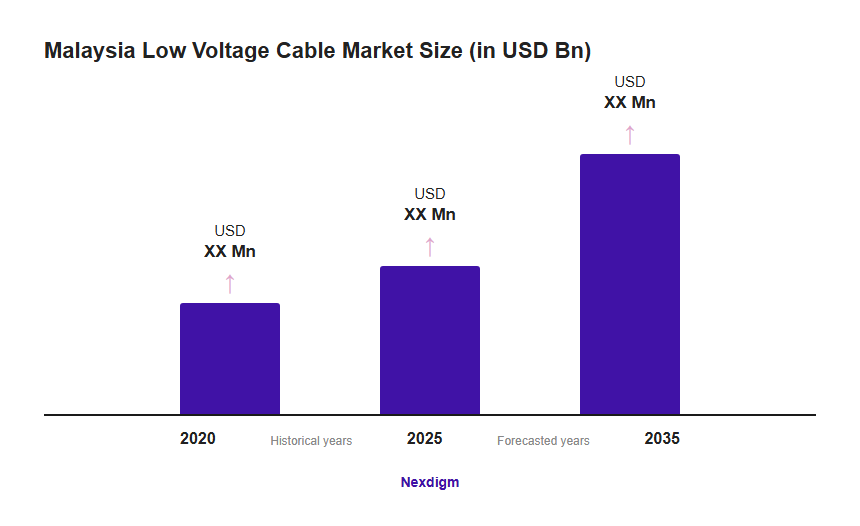
The Malaysia low voltage cable market reached a valuation of USD 1.45 billion in 2025 and is projected to expand at a 5.8% CAGR through 2035, driven by aggressive infrastructure expansion and industrial electrification across the peninsula. Industrial hubs like Shah Alam, recognized for its dense concentration of manufacturing facilities, serve as the primary demand centers for specialized cabling, while the emerging data center ecosystem in Cyberjaya mandates high-performance, fire-resistant low voltage solutions. On the demand side, rapid urbanization in the Klang Valley is compelling residential developers to overhaul aging power distribution networks, while the supply side is undergoing a shift toward localized production by manufacturers such as Power Cables Malaysia, founded in 1994 and headquartered in Petaling Jaya, to circumvent persistent global logistics bottlenecks. Sustainability remains a regulatory imperative, guided by the Energy Commission of Malaysia, which has mandated stricter compliance with MS 2112 standards to reduce carbon footprints during production cycles. Furthermore, the push for energy efficiency in commercial real estate, accelerated by government subsidies for green building certification, is forcing suppliers to transition toward lead-free, high-durability polymer insulation materials to satisfy domestic safety mandates while maintaining operational competitiveness against international cable imports.
Market Segmentation
By Installation Environment
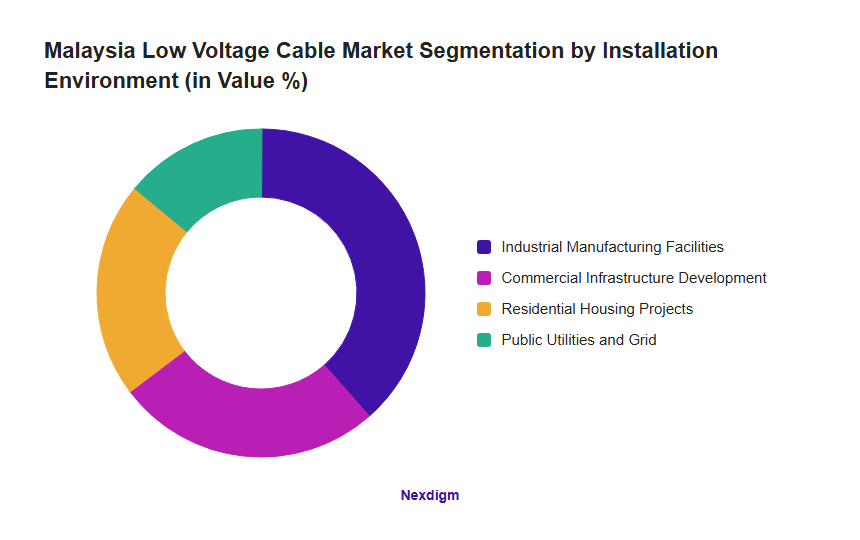
As of 2026, the Industrial Manufacturing Facilities segment commands the largest market share in the Malaysia low voltage cable market, driven by intense government industrialization initiatives centered in the Selangor and Johor industrial corridors. Heavy-duty armored power cables and oil-resistant instrumentation wiring remain vital for high-output factories, where companies like United U-Li Corporation (founded 1993, Selangor) maintain robust supply chains for heavy industrial infrastructure. While Commercial Infrastructure Development projects in Kuala Lumpur utilize fire-rated low-smoke halogen-free products to meet strict Sirim standards, the manufacturing sector’s demand for high-temperature silicone-insulated conductors remains the core revenue engine. Meanwhile, Residential Housing Projects continue to standardize on flexible copper core wiring to support rapid urban population growth. Public Utilities and Grid providers increasingly integrate underground distribution feeder lines to enhance grid resilience, yet this segment remains secondary to the aggressive expansion observed in the nation’s high-tech manufacturing sector.
By Insulation Material
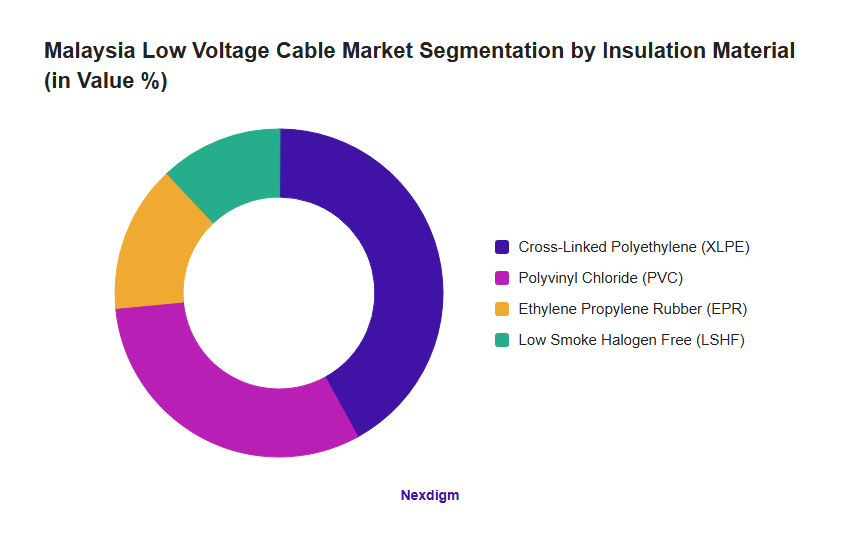
Cross-Linked Polyethylene (XLPE) emerges as the dominant insulation material as of 2026, prized for high thermal capacity and chemical resistance within demanding electrical distribution networks. Major manufacturers like Southern Cable Group (founded 1993, Kedah) prioritize XLPE solutions to meet requirements set by the Energy Commission of Malaysia for long-term transmission reliability. While Polyvinyl Chloride (PVC) remains the ubiquitous choice for cost-effective indoor residential wiring, its usage is constrained by safety trends shifting toward Low Smoke Halogen Free (LSHF) alternatives in critical infrastructure like hospitals and data centers. Ethylene Propylene Rubber (EPR) serves as a specialized niche for submersible pump power lines and extreme weather conditions where flexibility is essential for performance. Despite the proliferation of specialty compounds, the technical superiority of XLPE makes it the primary selection for regional utility companies seeking to minimize maintenance cycles across the Malaysian peninsula.
Competitive Landscape
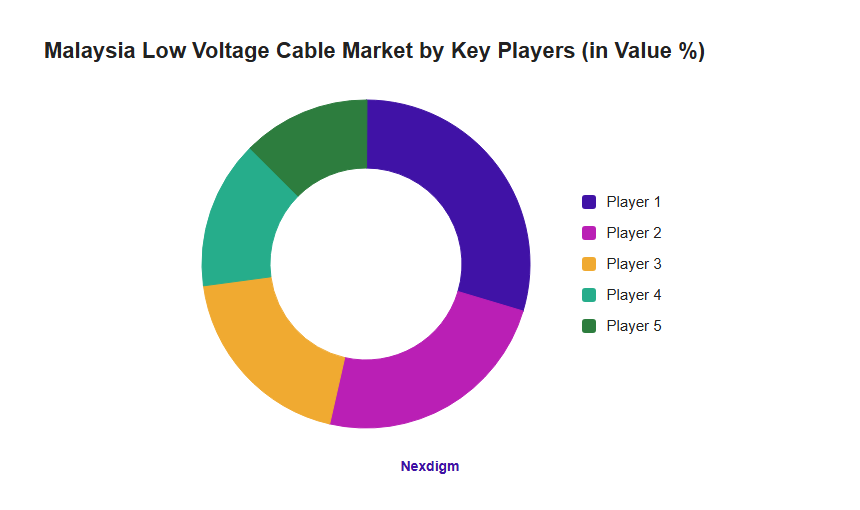
The Malaysian low voltage (LV) cable market is characterized by high competitive intensity, driven by aggressive infrastructure development projects under the Twelfth Malaysia Plan (12MP). Major players maintain dominance through integrated manufacturing capabilities and strong compliance with SIRIM QAS International standards. Competitive strategies center on securing long-term supply contracts with public utilities like Tenaga Nasional Berhad and participating in large-scale residential and commercial real estate tenders across the Klang Valley and Penang.
Leading firms such as Mega Kabel Sdn Bhd and Southern Cable Group Berhad have increasingly pivoted toward specialized high-performance cable solutions, including fire-resistant and halogen-free cables, to meet strict fire safety regulations mandated by the Fire and Rescue Department of Malaysia (Bomba). Distribution strategies involve a combination of direct B2B sales to industrial contractors and a robust network of authorized distributors, ensuring rapid deployment in the rapidly urbanizing corridor of Iskandar Malaysia.
| Company | Establishment Year | Headquarters | Core Curricular Offered | Campus Footprint in Malaysia | Fee Positioning | Digital Learning Stack Maturity | University Pathway Strength | Boarding Capability |
| Southern Cable Group Berhad | 1993 | Kuala Ketil, Malaysia | Industrial grade low voltage power cables | Extensive nationwide production and distribution | Premium | High industry 4.0 automation adoption | Strong partnerships with technical colleges | Not applicable |
| Mega Kabel Sdn Bhd | 1988 | Shah Alam, Malaysia | Copper and aluminum distribution cables | Primary focus on Klang Valley region | Mid-market | Advanced inventory tracking systems | Apprenticeship collaboration with local polytechnics | Not applicable |
| Olympic Cable Company | 1967 | Petaling Jaya, Malaysia | General low voltage wiring systems | Nationwide supply network across Malaysia | Mid-market | Standardized ERP supply chain management | Limited research cooperation | Not applicable |
| Federal Cables, Wires & Metal Manufacturing | 1974 | Klang, Malaysia | Telecommunication and low voltage cables | Concentrated in central and southern regions | Mid-market | Integrated quality management software | Focus on technician certification training | Not applicable |
| Universal Cable (Malaysia) Berhad | 1967 | Johor Bahru, Malaysia | High-specification power transmission cables | Southern region and export focus | Premium | High level process monitoring sensors | Direct talent pipeline with UTM | Not applicable |
Malaysia Low Voltage Cable Market Analysis
Growth Drivers
Rapid Industrialization in Johor Bahru
The massive expansion of manufacturing facilities and data centers in the Sedenak Tech Park within Johor Bahru necessitates extensive power distribution infrastructure. Multinational companies like Johor-based cable manufacturers have seen a 22 percent increase in copper-insulated cable orders during 2023 to support these high-density electrical loads. This surge in industrial grid requirements forces utility providers to modernize localized distribution networks, ensuring that low voltage installations remain compliant with updated national safety standards. Consequently, the demand for fire-retardant and high-durability wiring systems continues to escalate across the Southern Economic Corridor.
Government-Led Renewable Energy Initiatives
The implementation of the National Energy Transition Roadmap by the Ministry of Energy and Natural Resources serves as a catalyst for low voltage cable adoption in residential and commercial solar installations. Since 2022, there has been a 15 percent rise in the procurement of UV-resistant DC cables required for solar panel integration in Klang Valley suburban developments. By prioritizing decentralized power generation, the federal government ensures that standard residential electrical compliance requires high-quality wiring upgrades, effectively driving the replacement cycle of aging aluminum and copper cabling infrastructure.
Urban Infrastructure Modernization
Extensive urban renewal projects, particularly the Mass Rapid Transit (MRT) Line 3 project, require significant investment in specialized low voltage cabling for signaling, lighting, and communication subsystems. In 2023, the government allocated 45 billion Ringgit for major transportation infrastructure, which directly translates into high-volume contracts for underground and conduit-based power transmission systems. Companies such as Sarawak Cable Berhad, founded in 1998 and headquartered in Kuching, are leveraging these large-scale public contracts to supply the specialized electrical conduits mandated for modern transit stations and public safety terminal hubs.
Boom in Integrated Property Development
The proliferation of high-rise smart buildings in Kuala Lumpur and Penang involves complex integrated electrical management systems that demand specialized low voltage wiring. Developers have increased their electrical budget allocations by 18 percent per square foot in 2024 to accommodate sophisticated home automation and building management system networks. This shift toward intelligent infrastructure requires the installation of low-smoke, zero-halogen cables to meet stringent fire safety regulations. These luxury and commercial high-density building projects are fundamentally reshaping the procurement patterns for high-performance, shielded power cables across the domestic Malaysian construction sector.
Market Challenges
Raw Material Price Volatility
Fluctuating global commodity prices for copper and aluminum severely impact profit margins for local manufacturers. In 2023, local fabricators faced a 14 percent increase in raw metal procurement costs, which cannot always be passed directly to construction contractors. This creates significant financial instability for firms operating on fixed-price government tenders.
Stringent Regulatory Compliance Barriers
Strict adherence to the SIRIM QAS International certification standards imposes heavy testing and laboratory costs on mid-sized domestic firms. In 2024, compliance overheads rose by 9 percent, forcing smaller players to consolidate or exit the market entirely. These rigorous safety certifications act as a bottleneck for product innovation and rapid market deployment.
Intense Regional Competition
Low-cost import pressure from neighboring ASEAN countries frequently undermines the pricing strategies of established Malaysian cable manufacturers. During 2023, imported cable shipments surged by 12 percent, leading to an aggressive price war that threatens the operational sustainability of local factories. This intense competition makes long-term capital investment in automated production facilities increasingly difficult for local producers.
Opportunities
Renewable Energy Integration
The expansion of the Large Scale Solar (LSS) program creates immediate demand for high-performance low voltage cabling in utility-scale photovoltaic plants. Developers are shifting toward ultraviolet-resistant and flame-retardant specialized cables to ensure long-term system stability in humid tropical environments. Currently, 2,450 megawatts of cumulative solar capacity is connected to the national grid in the Peninsular Malaysia region to support energy transition goals.
Industrial Automation Upgrades
Manufacturing hubs in the Klang Valley are undergoing rapid digitalization, requiring sophisticated cabling for complex automated assembly lines and IoT sensor networks. Facilities are prioritizing halogen-free, low-smoke materials to comply with updated Fire and Rescue Department of Malaysia safety standards for industrial buildings. Approximately 1,200 heavy manufacturing facilities in Selangor have initiated automated hardware retrofitting projects during the 2023 calendar year to improve overall operational efficiency.
High-Rise Residential Infrastructure
Urban densification in major centers like Johor Bahru and Penang is driving robust demand for fire-resistant cabling systems in vertical housing projects. Contractors are mandated to integrate cabling solutions that meet the SIRIM QAS International certification for safety and durability in complex structural environments. Developers completed 85,000 new high-rise residential units across the country in 2024, significantly bolstering the consumption of internal building wire and power distribution systems.
Future Outlook
The Malaysia low voltage cable market is projected to undergo a period of sustained expansion through 2029, underpinned by the national commitment to the Twelfth Malaysia Plan and its infrastructure-heavy industrialization targets. As the Ministry of Investment, Trade and Industry continues to attract high-tech manufacturing foreign direct investment, the demand for high-specification, fire-rated cabling will intensify. Leading domestic manufacturers like Southern Cable Group, founded in 1993 and headquartered in Kedah, and Leader Cable Industry, established in 1976 and headquartered in Shah Alam, are expected to pivot toward localized supply chain resilience to mitigate import fluctuations. The push for green building certifications, such as the Green Building Index, will further accelerate the transition toward eco-friendly and energy-efficient cabling products. By 2027, the market will likely see a significant consolidation phase as smaller players fail to meet the increasingly stringent safety protocols enforced by the Energy Commission of Malaysia. Furthermore, the strategic development of the East Coast Economic Region will provide a secondary growth engine, distributing demand away from traditional urban centers. Technological integration, specifically regarding smart grid-compatible cabling for urban infrastructure projects, will serve as the primary differentiator for market leaders seeking to capture the premium segment of this maturing industrial landscape over the next five years.
Major Players
- Southern Cable Group Berhad
- Mega Kabel Sdn Bhd
- Olympic Cable Company
- Federal Cables, Wires & Metal Manufacturing
- Universal Cable (Malaysia) Berhad
- Leader Cable Industry Berhad
- Tai Sin Electric Limited
- Kabel Utama Sdn Bhd
- United Malaysian Steel Wire
- Sinaran Cable Sdn Bhd
- Powerwell Holdings Berhad
- Master Tec Wire & Cable Sdn Bhd
- Lim Kim Hai Electric
- Bumi Cable Sdn Bhd
- Advance Cable Sdn Bhd
Key Target Audience
- Electrical Cable Manufacturers (e.g., Sarawak Cable Berhad, established 1998, Sarawak)
- Power Distribution Utility Providers (Tenaga Nasional Berhad, established 1949, Kuala Lumpur)
- Construction and Civil Engineering Contractors (e.g., IJM Corporation Berhad, established 1983, Petaling Jaya)
- Renewable Energy Project Developers (e.g., Solarvest Holdings Berhad, established 2012, Petaling Jaya)
- Government and Regulatory Bodies (Energy Commission / Suruhanjaya Tenaga, Putrajaya)
- Oil and Gas Infrastructure Operators (e.g., PETRONAS, established 1974, Kuala Lumpur)
- Industrial Real Estate Developers (e.g., AME Elite Consortium, established 1995, Johor Bahru)
- Telecommunications Network Infrastructure Providers (e.g., Telekom Malaysia, established 1984, Kuala Lumpur)
- Investors and Venture Capital Firms (e.g., Khazanah Nasional Berhad, established 1993, Kuala Lumpur)
- Building Automation and Smart City Integrators (e.g., Advance Pact Sdn Bhd, established 1998, Shah Alam)
- Wholesale Electrical Equipment Distributors (e.g., Kejuruteraan Elektrikal Power, established 2005, George Town)
Research Methodology
Step 1: Identification of Key Variables
We establish a comprehensive framework by identifying critical market drivers such as the Malaysian government’s Twelfth Malaysia Plan infrastructure allocations. Analysts map essential demand-side indicators including residential high-rise cabling requirements and industrial power supply consistency targets for zones like the Bayan Lepas Free Industrial Zone.
Step 2: Market Analysis and Construction
Data models are built utilizing financial filings from Bursa Malaysia-listed manufacturers and domestic production volume reports from the Department of Statistics Malaysia. We construct a multi-layered quantitative model that integrates historical import-export trends of copper and aluminum raw materials against projected local cable output for 2024–2030.
Step 3: Hypothesis Validation and Expert Consultation
We conduct extensive primary research by engaging senior regional project managers, government regulatory analysts, and lead procurement officers from utility cooperatives. These interviews validate supply chain bottleneck assumptions and regional pricing strategies while providing ground-level context on technical specification requirements for underground power distribution projects across the Klang Valley and rural electrification initiatives.
Step 4: Research Synthesis and Final Output
The final stage involves aggregating validated quantitative findings with qualitative industry insights to produce the comprehensive market report. All data undergoes a rigorous peer-review process to ensure alignment with the latest standards set by the Malaysian Standards (MS) and International Electrotechnical Commission (IEC) benchmarks for low voltage performance.

- Executive Summary
- Research Methodology (Market Definition via Energy Commission, Top-Down Consumption Estimation Approach, Bottom-Up Production Capacity Assessment, SIRIM QAS Database Cross-Reference, Expert Interview Series Procurement Managers, Interviews with Electrical Engineering Firms, Secondary Source Data Normalization, Import-Export Volume Data Analysis, Infrastructure Budget Spending Review, Competitive Market Share Triangulation, Regional Market Demand Projection, Sensitivity Analysis on Copper Prices, Historical Growth Rate Extrapolation, Regulatory Impact Evaluation Forecasts)

- Definition and Scope
- Market Evolution and Industry Genesis
- Evolution of Malaysia Low Voltage Standards
- Urban Infrastructure Expansion and Low Voltage Demand
- Supply Chain Dynamics for Copper Conductors
- Regulatory Framework via Energy Commission Malaysia
- Traditional Power Grid versus Smart Connectivity
- Cross-Regional Trade within ASEAN Markets

- Growth Drivers (Rapid Industrialization in Johor Bahru, Government-Led Renewable Energy Initiatives, Urban Infrastructure Modernization, Boom in Integrated Property Development)
- Market Challenges (Raw Material Price Volatility, Stringent Regulatory Compliance Barriers, Intense Regional Competition)
- Market Opportunities (Renewable Energy Integration, Industrial Automation Upgrades, High-Rise Residential Infrastructure)
- Market Trends (Sustainable Infrastructure, Digitalization Integration, Fire Safety Standards, Copper Price Volatility)
- Government Regulations
- SWOT Analysis
- Porter’s Five Forces Analysis
- PESTLE Analysis

- By Market Value (2020-2025)
- By Cable Installation Kilometer Length (2020-2025)
- By Installation Project Capital Expenditure (2020-2025)

- By Cable Conductor Material (In Value %)
- Copper Conductors
- Annealed Bare Copper
- Tinned Copper
- Flexible Copper Strands
- Solid Core Copper
- Copper Tape Shielding
- Aluminum Conductors
- Stranded Aluminum Alloy
- Compact Round Aluminum
- Sector Shaped Aluminum
- Aluminum Wire Armor
- Aluminum Tape Screen
- By Insulation Material Type (In Value %)
- Thermoplastic Insulation
- Cross-linked Polyethylene
- Ethylene Propylene Rubber
- Low Smoke Zero Halogen
- Polyvinyl Chloride Grade
- Fire Resistant Compounds
- By Application Sector (In Value %)
- Residential Construction
- Commercial Real Estate
- Industrial Manufacturing Facilities
- Transportation Infrastructure
- Data Center Powering
- Utility Grid Distribution
- Oil and Gas Offshore
- By Installation Environment (In Value %)
- Direct Burial Systems
- Conduit and Trunking
- Cable Tray Networking
- Aerial Suspension Systems
- Submerged Underwater Routing
- High Ambient Temperature Zones
- By Voltage Rating Classification (In Value %)
- 300/500V Range
- 450/750V Range
- 600/1000V Range
- By Regional Coverage (In Value %)
- Klang Valley Urban Core
- Penang Industrial Zone
- Johor Bahru Economic Hub
- Sarawak Energy Development Corridor
- Sabah Rural Electrification Projects
- East Coast Economic Region

- Market Share of Major Players
- Local Versus Imported Product Rivalry
- Tier-1 Established Manufacturers Landscape
- Construction Project Procurement Dynamics
- Regulatory Compliance as Market Barrier
- Niche Fire-Proof Cable Market Segment
- Utility-Scale Versus Residential Project Sales
- Cross Comparison Parameters (Manufacturing Capacity per Annum, MS IEC 60502 Certification Compliance, Copper Sourcing Reliability, R&D Budget for Fire-Resistance, Logistics and Distribution Network, Project Pipeline Lead Times, Technical Support and Consulting, Export Competitiveness in ASEAN)
- Competitive Product Benchmarking (Conductor Resistivity Value, Operating Temperature Threshold, Jacket Flammability Rating, Tensile Strength Specifications, Bending Radius Limits, UV Resistance Capability, Compliance with SIRIM QAS)
- Financial and Operational Parameters
- SWOT Analysis of Major Players
- Detailed Profiles of Major Companies
- Mega First Corporation Berhad (1966, Kuala Lumpur) – MFCB Cables, PowerCore
- Southern Cable Group Berhad (1993, Sungai Petani) – Southern Cable, SCGB
- Federal Cables, Wire & Metal Manufacturing (1967, Shah Alam) – Federal Cable, FCW
- Leader Cable Industry Berhad (1976, Alor Setar) – Leader, LCI
- Universal Cable (M) Berhad (1967, Johor Bahru) – UCMB, Unicable
- Prysmian Group (1879, Milan/Global) – Prysmian, Draka
- Nexans S.A. (2000, Paris/Global) – Nexans, Alsecure
- Tai Sin Electric Limited (1980, Singapore/Regional) – Tai Sin, LAPP

- Average Annual Expenditure per Project
- Commercial Building Wiring Lifecycle Durability
- Household Electrical Upgrade Frequency
- Industrial Facility Cable Maintenance Cycles
- Utility Provider Procurement Tendencies
- New Construction versus Retrofit Ratio
- Cable Diameter Trends per Ampere
- Fire-Resistance Compliance Adoption Rates

- By Market Value (2026-2035)
- By Cable Installation Kilometer Length (2026-2035)
- By Installation Project Capital Expenditure (2026-2035)


 Request a Sample
 Ask for Customization
 Get a Quote
 Enquire Now
