
 Download PDF
Market Overview
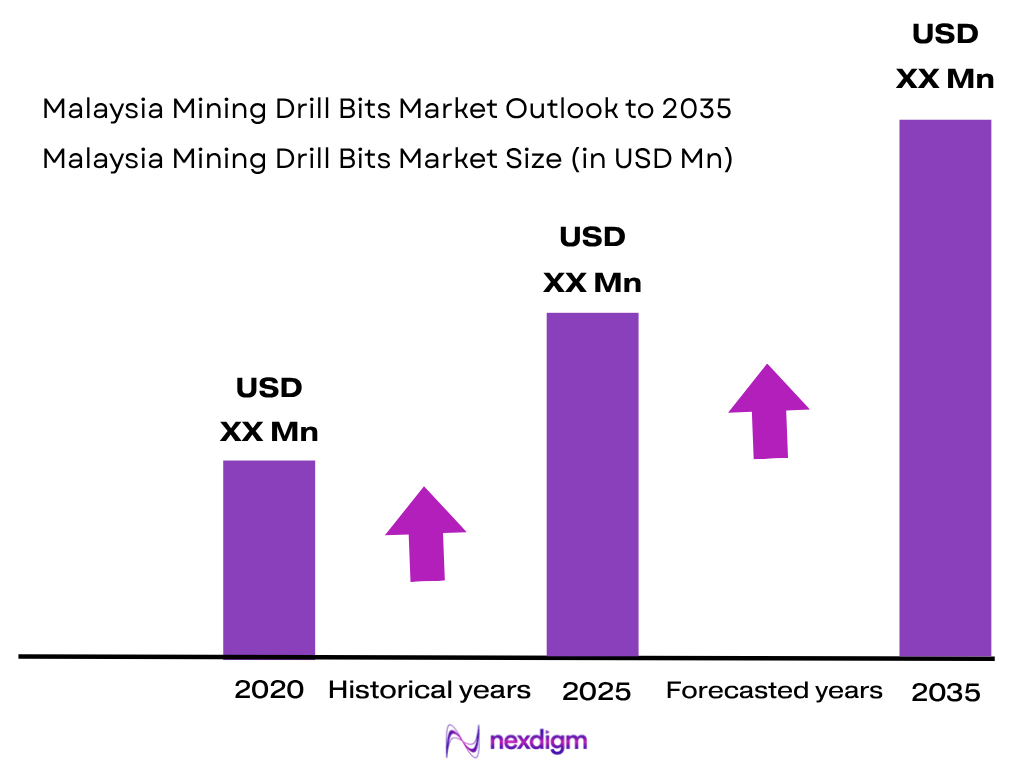
The Malaysia Mining Drill Bits Market is valued at approximately USD ~XX million, based on historical demand analysis, and is driven by mineral exploration, production drilling, quarrying and replacement of consumable rock tools. Malaysia’s constant-price GDP increased from RM1.57 trillion to RM1.65 trillion, while mining and quarrying output increased from approximately RM97.5 billion to RM98.4 billion. Strategic-mineral production reached RM178.97 million, supporting demand for exploration, blast-hole and production drilling equipment.
Perak, Pahang, Kelantan, Johor, Sabah and Sarawak form important demand clusters for the Malaysia Mining Drill Bits Market because their mineral, quarrying and geological activities generate recurring exploration and rock-drilling requirements. National mining and quarrying output increased from approximately RM97.5 billion to RM98.4 billion, while other mining, quarrying and supporting services expanded alongside strategic-mineral development. Perak’s established tin-mining ecosystem, Pahang’s gold and mineral operations, and East Malaysia’s extractive industries support geographically diversified drill-bit consumption.
Market Segmentation
By Drill Bit Type
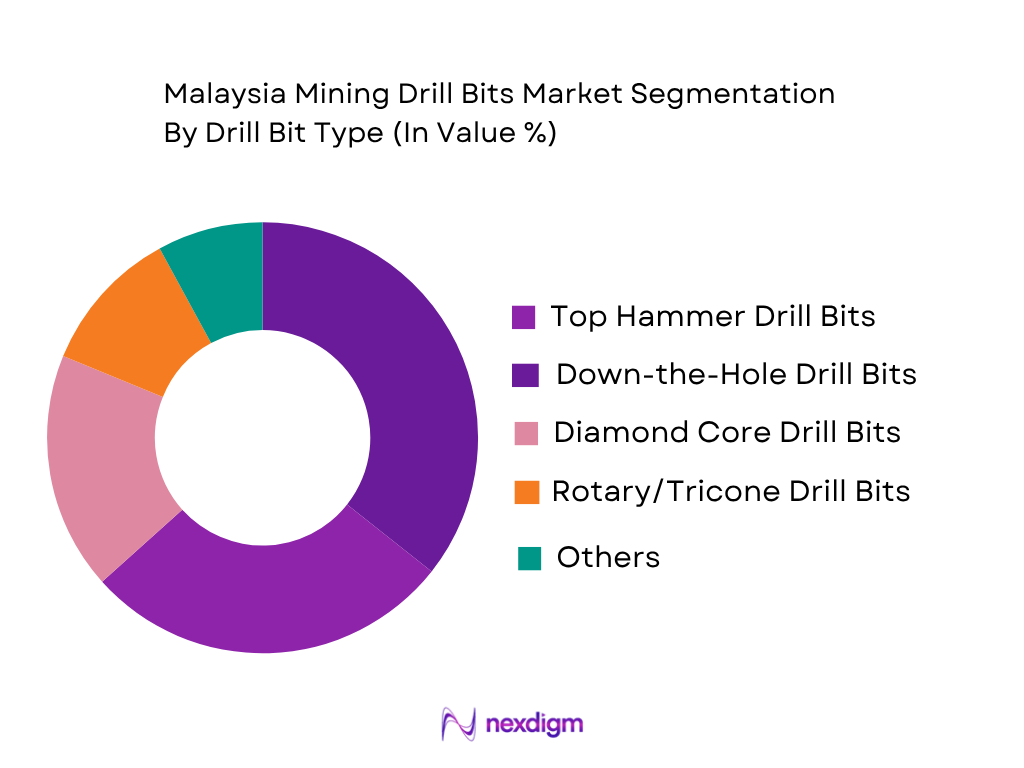
By Drill Bit Type: The Malaysia Mining Drill Bits Market is segmented into top hammer drill bits, down-the-hole drill bits, diamond core drill bits, rotary/tricone drill bits and tapered/other drill bits. Top hammer drill bits hold the dominant placeholder share because Malaysia has extensive quarrying and surface hard-rock applications where relatively shallow blast holes, bench drilling and high drilling frequency favor percussive systems. Button bits also represent consumable components requiring replacement and periodic regrinding as carbide buttons and gauge rows wear. Commercial products illustrate their broad operating envelope: Sandvik top-hammer rock drills support hole sizes ranging from approximately 43 mm to 178 mm, depending on drill model, while its heavy-duty top-hammer bits cover 54–140 mm. The format is therefore suitable for quarry benches, production drilling and rock excavation. Malaysia’s other mining and quarrying activities also provide a recurring consumables base. Top-hammer suppliers increasingly differentiate through carbide grades, button geometry, flushing, penetration rate, regrinding intervals and meters drilled per bit rather than simply through initial bit specification.
By Mineral Application
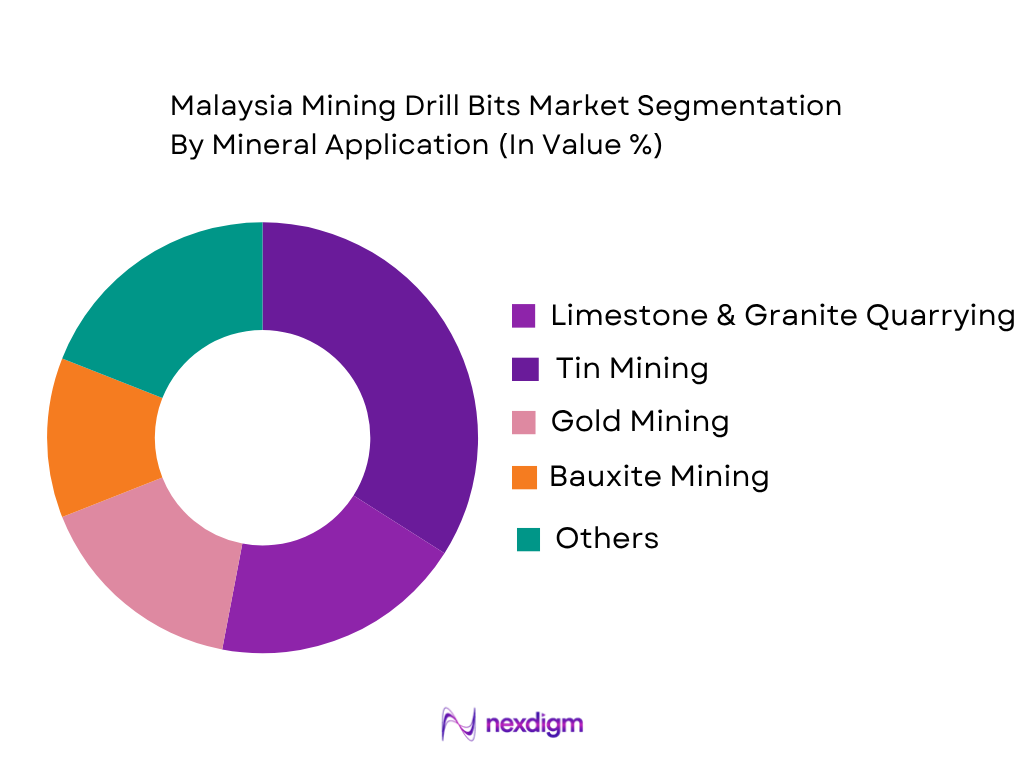
By Mineral Application: The Malaysia Mining Drill Bits Market is segmented into limestone and granite quarrying, tin mining, gold mining, bauxite mining, rare earth and strategic minerals, and other minerals. Limestone and granite quarrying represents the dominant placeholder application because quarry operations generate repetitive bench drilling and blasting requirements, creating recurring replacement demand for top-hammer and DTH consumables. Unlike one-off exploration campaigns, operating quarries continuously drill blast patterns, exposing carbide buttons and bit bodies to abrasive rock conditions. Mineral diversification provides additional demand: Malaysia officially identifies bauxite, tin ore, silica sand, kaolin and rare earth elements as strategic minerals. JMG reports RM178.97 million in primary strategic-mineral production in its 2024 records, while DOSM reports approximately RM98.4 billion in constant-price mining and quarrying output. Future drill-bit demand therefore extends beyond conventional quarrying toward exploration and resource delineation, particularly where diamond core drilling is required to establish geological continuity, mineralization, ore grade and mine-development parameters before commercial extraction.
Competitive Landscape
The Malaysia Mining Drill Bits Market is served primarily by global rock-tool manufacturers and specialized drilling-tool companies supplying mining operators, exploration contractors and quarry customers through direct sales and distributor networks. Sandvik and Epiroc possess particularly broad mining-equipment ecosystems, while Boart Longyear has strong diamond-core and exploration-drilling capabilities. Mincon specializes in hard-rock consumables including DTH systems, and Robit competes across top-hammer and DTH tooling. Competition centers on meters drilled per bit, penetration rate, carbide durability, hole-diameter coverage, rig compatibility, regrinding capability and mine-site technical support.
| Major Player | Establishment Year | Headquarters | Top Hammer Capability | DTH Capability | Diamond/Core Capability | Rotary Capability | Carbide/Bit Technology | Aftermarket & Technical Support |
| Sandvik | 1862 | Stockholm, Sweden | ~ | ~ | ~ | ~ | ~ | ~ |
| Epiroc | 1873 heritage / 2018 independent company | Stockholm, Sweden | ~ | ~ | ~ | ~ | ~ | ~ |
| Boart Longyear | 1890 | Salt Lake City, USA | ~ | ~ | ~ | ~ | ~ | ~ |
| Mincon Group | 1977 | Shannon, Ireland | ~ | ~ | ~ | ~ | ~ | ~ |
| Robit Plc | 1985 | Lempäälä, Finland | ~ | ~ | ~ | ~ | ~ | ~ |
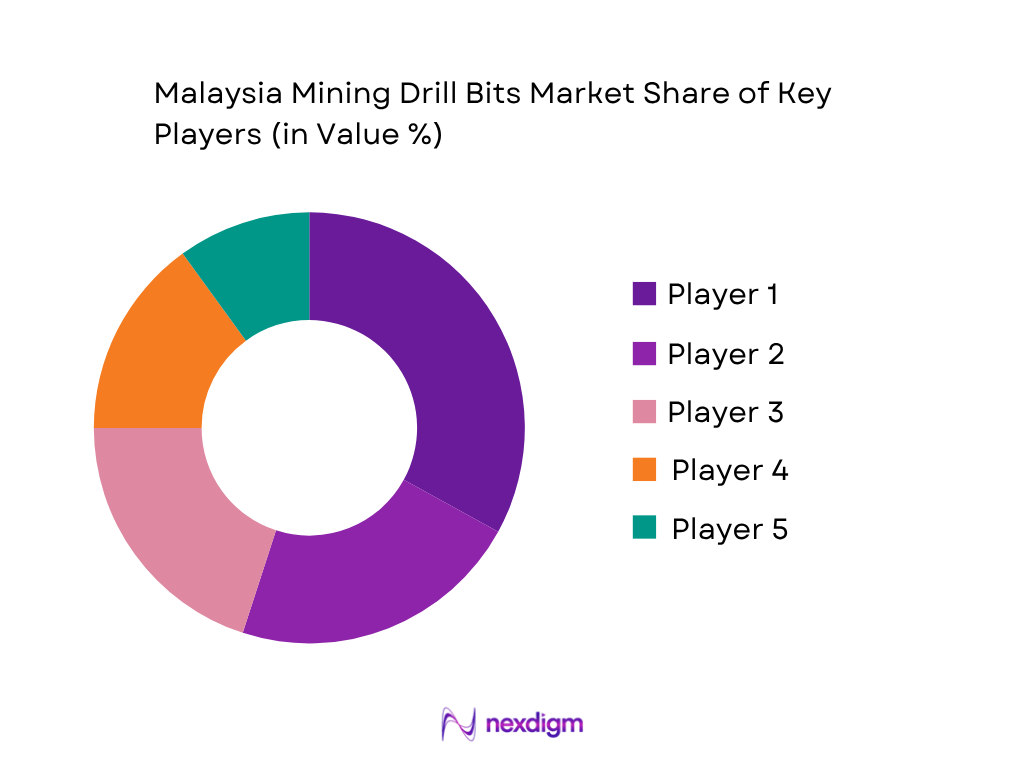
Malaysia Mining Drill Bits Market Analysis
Growth Drivers
Expansion of Strategic Mineral Exploration and Rare Earth Development
Malaysia’s push to develop strategic minerals is increasing the underlying requirement for exploration drilling, resource delineation, core sampling and subsequent mine-development drilling, directly supporting consumption of diamond core, DTH and top-hammer drill bits. The Department of Mineral and Geoscience Malaysia recorded RM178.97 million of primary strategic-mineral production in 2024, while its rare-earth studies covered 10 states, indicating the geographic breadth of resource-assessment activity. The Ministry of Natural Resources and Environmental Sustainability identifies 5 strategic minerals—bauxite, tin ore, silica sand, kaolin and rare earth elements—under the National Mineral Industry Transformation Plan. The policy framework is reinforced by National Mineral Policy 3, structured around 5 core pillars, 26 strategies and 77 initiatives. Malaysia’s wider economic capacity also supports continued mineral-sector investment: DOSM recorded real GDP at RM1.65 trillion in 2024, up from RM1.57 trillion previously. The mining and quarrying sector remained an established component of this industrial base. For drill-bit suppliers, increased geological investigation creates demand for diamond coring during resource definition, while projects progressing toward extraction require larger-diameter DTH and top-hammer tooling for development, bench drilling and production operations.
Quarrying, Production Drilling and Demand for Higher Drilling Productivity
Malaysia’s established mining and quarrying activity generates recurring drill-bit replacement demand because production drilling continuously exposes carbide buttons, gauge rows, bit faces and steel bodies to abrasive rock. DOSM recorded Malaysia’s real GDP at RM1.65 trillion in 2024, compared with RM1.57 trillion previously, while the mining and quarrying sector continued to expand in real terms. In 2025, national real GDP subsequently reached RM1.74 trillion, while mining and quarrying activity recorded further expansion, demonstrating continuity in the underlying extractive economy. This operating environment is particularly relevant for limestone, granite, aggregate, tin and other hard-rock applications where blast-hole drilling requires repeated drilling cycles. Drill-bit demand is therefore linked not simply to new mine development but also to meters drilled by existing rigs. Mechanization further raises the importance of bit productivity: modern top-hammer and DTH rigs require accurately matched bit diameters, button profiles, flushing arrangements and carbide grades to maximize energy transfer. As Malaysian operators seek higher equipment utilization, drill-bit selection increasingly centers on meters drilled before replacement, penetration performance, hole straightness and regrinding intervals. This favors premium tungsten-carbide button bits capable of maintaining drilling performance over extended operating cycles.
Market Challenges
Regulatory and Environmental Constraints on New Mining and Exploration Activity
Mining drill-bit demand depends on projects progressing from geological exploration to resource delineation, development and extraction, making regulatory restrictions directly relevant to tool consumption. Malaysia introduced a moratorium on exports of raw non-radioactive rare earth material from 1 January 2024, with the policy scheduled for review every 6 months, as part of efforts to encourage domestic midstream processing. Environmental constraints also limit where mining can proceed. NRES maintains restrictions on mining in Permanent Reserved Forests, Environmentally Sensitive Areas and protected reserves, while Malaysia retains a national commitment to maintain at least 50 parts out of every 100 parts of national land area under forest and tree cover. In 2025, NRES commissioned FRIM to assess the implications of potential REE mining in Permanent Reserved Forest areas before broader policy decisions are considered. Malaysia nevertheless had a sizeable macroeconomic base supporting industrial investment, with real GDP reaching RM1.65 trillion in 2024 and RM1.74 trillion in 2025. For mining drill-bit suppliers, however, national economic capacity does not automatically translate into drilling demand. Delays in environmental approvals, mine operational schemes, state-level mineral permissions and land-access decisions can postpone exploration campaigns and reduce near-term consumption of core bits, DTH tools and production-drilling consumables.
Imported Tool Dependence, Abrasive Rock Wear and Aftermarket Support Requirements
Malaysia’s mining drill-bit market faces an operational challenge from the specialized nature of premium rock tools. High-performance top-hammer, DTH, rotary and diamond-core systems depend on carefully engineered cemented-carbide inserts, alloy-steel bodies, diamond matrices and application-specific geometries, while Malaysia’s mineral portfolio includes hard and abrasive formations associated with granite, gold, tin and quarry operations. Such conditions progressively wear gauge buttons and cutting structures, making inventory availability and regrinding capability critical. The scale of Malaysia’s economy underscores the industrial logistics supporting this market: DOSM reported real GDP of RM1.65 trillion in 2024, rising to RM1.74 trillion in 2025. At the same time, JMG recorded RM178.97 million of primary strategic-mineral production in its 2024 records, illustrating ongoing activity in emerging mineral categories alongside established mining and quarrying. Geographic dispersion adds complexity because exploration and extraction occur across Peninsular Malaysia as well as Sabah and Sarawak. Drill-bit suppliers consequently require sufficient safety stock, regional distributors and technical expertise to match carbide grades and bit designs to formations and rigs. Incorrect bit selection can accelerate wear, increase regrinding frequency and cause drilling interruptions, making technical support and replacement-tool availability important competitive constraints.
Market Opportunities
Rare Earth Exploration and Strategic Mineral Development
Rare earth and strategic-mineral development offers a future growth pathway for Malaysia’s mining drill-bit industry because resource commercialization requires sequential exploration, delineation, development and production drilling. JMG recorded RM178.97 million of primary strategic-mineral production in 2024 and rare-earth study coverage across 10 Malaysian states, demonstrating an existing resource-development foundation. NRES identifies 5 strategic minerals, comprising bauxite, tin ore, silica sand, kaolin and rare earth elements. The policy structure supporting these resources is substantial: National Mineral Policy 3 contains 5 core pillars, 26 strategies and 77 initiatives, while the government’s REE strategy introduced 3 technical committees, including a committee led by NRES addressing upstream mining management. The Hulu Perak REE pilot project also provides a domestic reference site for responsible extraction practices. Malaysia’s real GDP reached RM1.65 trillion in 2024, providing a sizeable economic platform for capital-intensive mineral development. These current indicators create an opportunity for drill-bit suppliers as projects advance through their lifecycle. Diamond core bits can serve geological exploration and resource confirmation, while DTH and top-hammer systems can address development drilling, infrastructure preparation and eventual production. Suppliers establishing application expertise before projects enter commercial extraction can position themselves for recurring replacement-tool demand.
Local Aftermarket, Regrinding and High-Performance Drill Bit Services
Malaysia presents an opportunity to develop a stronger locally stocked aftermarket around premium tungsten-carbide bits, DTH tooling, regrinding and application engineering. The opportunity is supported by continuing extractive activity rather than hypothetical future production: JMG recorded RM178.97 million of primary strategic-mineral production in 2024, while DOSM recorded national real GDP of RM1.65 trillion and continuing mining and quarrying activity. Real GDP subsequently reached RM1.74 trillion in 2025, indicating a growing economic platform for industrial services and equipment distribution. Malaysia’s mineral policy simultaneously encompasses 5 strategic mineral groups, while rare-earth resource studies span 10 states, creating geographically dispersed drilling requirements. This dispersion increases the commercial importance of local inventory because operators cannot efficiently depend on long replenishment cycles when a consumable drill bit fails during active drilling. Suppliers can therefore differentiate through regional warehouses, mine-site delivery, carbide-button regrinding, bit inspection, failure analysis and application-specific selection. Regrinding services are particularly relevant because correctly reshaping worn carbide buttons can extend the usable operating cycle before final bit replacement. Expansion into Sabah and Sarawak also offers distributors an opportunity to build regional service coverage around mining, quarrying and exploration customers rather than concentrating inventories exclusively in Peninsular Malaysia.
Future Outlook
The Malaysia Mining Drill Bits Market is forecast to expand at approximately ~XX% CAGR during 2026-2035, with the rate retained as a placeholder pending primary validation. Growth is expected to be linked to strategic-mineral exploration, quarry activity, mine-development drilling, drill-fleet modernization and replacement demand for consumable rock tools. Malaysia’s mineral strategy is broadening beyond traditional extraction toward strategic and critical minerals. Government policy identifies bauxite, tin ore, silica sand, kaolin and rare earth elements as strategic resources, while the National Mineral Industry Transformation Plan establishes 5 core pillars, 26 strategies and 77 initiatives. Greater geological exploration and resource delineation would create demand for diamond core bits, while mine development and commercial production would increase requirements for top-hammer, DTH and blast-hole tooling.
Major Players
- Sandvik Mining and Rock Solutions
- Epiroc
- Boart Longyear
- Mincon Group
- Robit Plc
- Rockmore International
- Mitsubishi Materials Corporation
- Drillco Tools
- Numa Tool Company
- Bulroc
- JSI Rock Tools
- Sollroc
- DATC Group
- Wooke Rock Drilling Tools
- Changsha Heijingang Industrial
Key Target Audience
- Mining Drill Bit and Rock Tool Manufacturers
- Mining and Mineral Extraction Companies
- Quarry Operators and Aggregate Producers
- Mineral Exploration and Drilling Contractors
- Mining Equipment Importers and Authorized Distributors
- Investments and Venture Capitalist Firms
- Government and Regulatory Bodies (Ministry of Natural Resources and Environmental Sustainability, Department of Mineral and Geoscience Malaysia, Department of Environment Malaysia, State Mineral Authorities)
- Drill Rig OEMs, Aftermarket and Regrinding Service Providers
Research Methodology
Step 1: Identification of Key Variables
The initial phase involves constructing an ecosystem map encompassing drill-bit manufacturers, mining companies, quarry operators, exploration contractors, drill-rig OEMs, distributors and regrinding providers operating in the Malaysia Mining Drill Bits Market. Secondary and proprietary databases are used to identify variables including active drill fleets, drilling meterage, bit type, mineral application, hole diameter, rock hardness, replacement frequency and distribution structure.
Step 2: Market Analysis and Construction
Historical market construction combines top-down analysis of Malaysia’s mining, quarrying and mineral-exploration ecosystem with bottom-up analysis of drill-bit consumption. The bottom-up model evaluates active drilling rigs, utilization, meters drilled, bits consumed per rig, replacement intervals, regrinding cycles and average realized value by bit category. Import and distributor data are triangulated against these calculations to identify inconsistencies.
Step 3: Hypothesis Validation and Expert Consultation
Market hypotheses are validated through computer-assisted telephone interviews and structured discussions with mining operators, quarry managers, exploration contractors, drilling supervisors, procurement managers, equipment distributors and rock-tool specialists. Interviews test assumptions concerning penetration rates, bit life, carbide wear, preferred brands, rig compatibility, procurement frequency, regrinding practices and switching behavior between premium OEM and aftermarket products.
Step 4: Research Synthesis and Final Output
The final stage reconciles mine-level demand, quarry activity, exploration drilling, supplier information and primary interviews. Top-down indicators are compared with bottom-up unit-consumption estimates across top-hammer, DTH, rotary and diamond-core bits. Mineral-specific demand and regional drilling activity are subsequently incorporated into the forecast framework, producing a validated view of market segmentation, competitive positioning and long-term opportunities in the Malaysia Mining Drill Bits Market.

- Executive Summary
- Research Methodology (Market Definitions and Assumptions, Mining versus Quarrying Scope, Drill Bit Classification, Mineral Commodity Mapping, Active Mine and Quarry Mapping, Exploration Drilling Assessment, Production Drilling Assessment, Blast-Hole Drilling Assessment, Drill Rig Installed Base Assessment, Bit Consumption per Rig, Bit Replacement Frequency, Penetration Rate Assessment, Rock Abrasivity Mapping, Hole Diameter Mapping, Tungsten Carbide Consumption, Diamond Bit Consumption, Import Assessment, Distributor Mapping, Top-Down Market Sizing, Bottom-Up Rig-Level Market Sizing, Mine-Level Consumption Assessment, Demand-Side Assessment, Supply-Side Assessment, Primary Interviews with Mining Operators and Drilling Contractors, Data Triangulation, Forecasting Framework, Limitations and Future Conclusions)

- Definition and Scope
- Market Evolution and Development of Mining Drill Bits in Malaysia
- Mining Drill Bit Industry Value Chain Analysis
- Mining Drill Bit Supply Chain Analysis
- Malaysia Mineral Extraction and Drilling Ecosystem

- Growth Drivers (Expansion of Strategic Mineral Exploration, Tin and Gold Mining Activity, Rare Earth Element Development, Quarry and Aggregate Drilling, Increasing Mechanized Drilling, Mine Productivity Requirements, Higher Drilling Meterage, Drill Fleet Modernization, Demand for Longer Bit Life, Growth in Production Drilling)
- Market Challenges (Volatility in Mining Activity, Dependence on Imported Premium Rock Tools, Tungsten Carbide Supply Exposure, High Abrasive-Rock Wear, Counterfeit and Low-Quality Aftermarket Bits, Drill Rig Compatibility Requirements, Regrinding Capability Constraints, Mine Permitting Complexity, Environmental Compliance Requirements)
- Market Opportunities (Rare Earth Exploration and Mining, Strategic Mineral Development, Premium Tungsten-Carbide Bits, High-Performance DTH Bits, Automated Drilling-Compatible Bits, Bit Regrinding Services, Predictive Bit-Wear Monitoring, Locally Stocked Replacement Bits, Quarry Productivity Solutions, Distributor Expansion in East Malaysia)
- Market Trends (Long-Life Carbide Grades, Semi-Ballistic Buttons, Optimized Flushing Designs, Automated Drill-Compatible Bits, High-Penetration DTH Bits, Premium Diamond Core Bits, Digital Drilling Performance Monitoring, Bit Regrinding and Circularity, Application-Specific Bit Designs)
- Government Regulations (Mineral Development Act, State Mineral Enactments and Rules, National Mineral Policy, National Mineral Industry Transformation Plan, Mine Operational Scheme Requirements, Environmental Quality Requirements, Occupational Safety Requirements, Explosives and Blasting Requirements, Quarry Regulations, NR-REE Mining Procedures)
- SWOT Analysis
- Porter’s Five Forces Analysis
- PESTLE Analysis
- Stakeholder Ecosystem
- Competition Ecosystem

- By Market Value (2020-2025)
- By Unit Consumption (2020-2025)
- By Replacement Bit Consumption (2020-2025)
- By New Drill Bit Consumption (2020-2025)
- By Average Selling Price (2020-2025)

- By Drill Bit Type (In Value %)
Top Hammer Drill Bits
Down-the-Hole (DTH) Drill Bits
Rotary Drill Bits
Tricone/Roller Cone Bits
Threaded Button Bits
Cross Bits
Chisel Bits
PDC Drill Bits
Reaming Bits
Retrac Drill Bits - By Drilling Technology (In Value %)
Top Hammer Drilling
Down-the-Hole Drilling
Rotary Drilling
Diamond Core Drilling
Reverse Circulation Drilling
Percussive Drilling
Rotary-Percussive Drilling - By Mining Activity (In Value %)
Exploration Drilling
Production Drilling
Blast-Hole Drilling
Grade-Control Drilling
Pre-Split Drilling
Bench Drilling
Overburden Drilling - By Mineral Application (In Value %)
Bauxite Mining
Gold Mining
Iron Ore Mining
Rare Earth Element Mining
Kaolin Mining
Limestone and Dolomite Quarrying
Granite Quarrying
Aggregates and Dimension Stone Quarrying
Other Metallic Mineral Mining
Other Non-Metallic Mineral Mining - By Bit Material (In Value %)
Tungsten Carbide Button Bits
Polycrystalline Diamond Compact Bits
Impregnated Diamond Bits
Surface-Set Diamond Bits
Steel-Tooth Bits
Carbide-Insert Roller Cone Bits
Hybrid Carbide-Diamond Bits - By Hole Diameter (In Value %)
Below 45 mm
45–64 mm
65–89 mm
90–115 mm
116–152 mm
153–203 mm
Above 203 mm

- Market Share of Major Players (By Value, Unit Volume, Top Hammer Bits, DTH Bits, Rotary Bits, Diamond Core Bits, Mining Customers, Quarry Customers, Distribution Channel)
- Cross Comparison Parameters (Drill Bit Product Range, Bit Diameter Coverage, Penetration Rate Performance, Bit Life & Meters Drilled, Tungsten-Carbide/Diamond Technology, Drill Rig & Shank Compatibility, Malaysia Distribution & Mine-Site Service Coverage, Regrinding & Aftermarket Support)
- SWOT Analysis of Major Players
- Detailed Profiles of Major Companies
Sandvik Mining and Rock Solutions
Epiroc
Boart Longyear
Mincon Group
Robit Plc
Rockmore International
Mitsubishi Materials Corporation
Drillco Tools
Numa Tool Company
Bulroc
JSI Rock Tools
Sollroc
DATC Group
Wooke Rock Drilling Tools

- Mining Company Requirement Assessment
- Quarry Operator Requirement Assessment
- Exploration Company Requirement Assessment
- Drilling Contractor Requirement Assessment
- Blast-Hole Contractor Requirement Assessment
- Mine Maintenance Team Requirement Assessment
- Drill Operator Feedback Assessment

- By Market Value (2026-2035)
- By Unit Consumption (2026-2035)
- By Replacement Bit Consumption (2026-2035)
- By New Drill Bit Consumption (2026-2035)
- By Average Selling Price (2026-2035)


 Request a Sample
 Ask for Customization
 Get a Quote
 Enquire Now