

 Download PDF
Market Overview
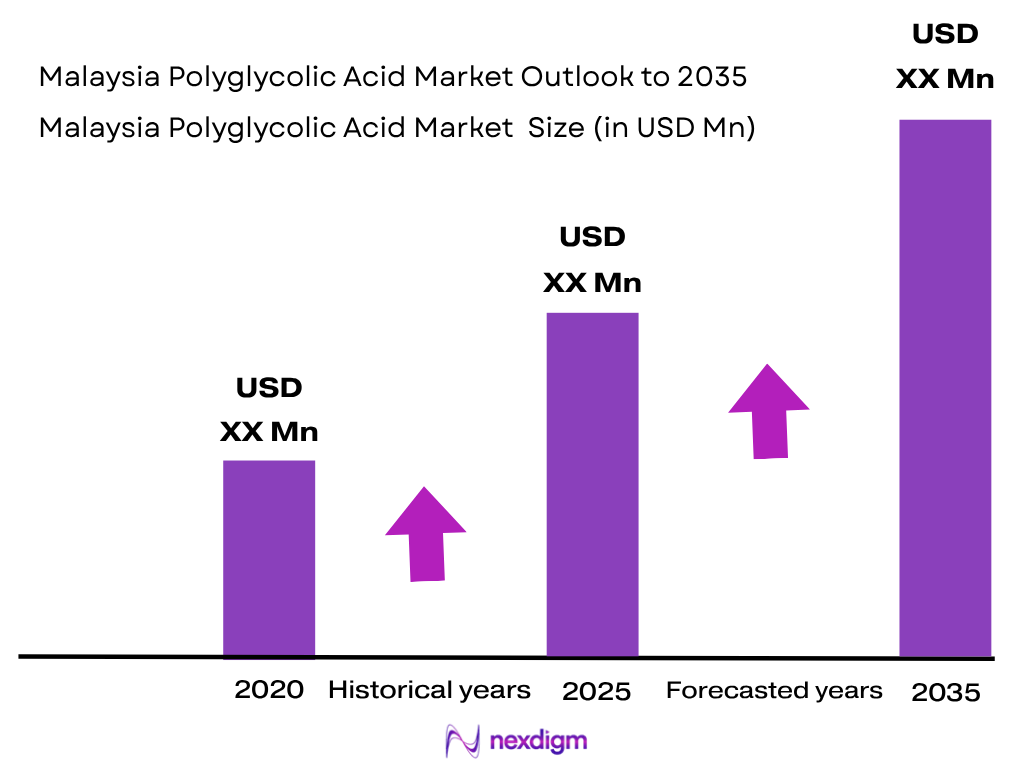
The Malaysia Polyglycolic Acid Market is valued at approximately USD ~XX million, based on historical demand analysis. Demand is primarily associated with absorbable surgical sutures, bioresorbable medical products, specialty polymer applications and emerging high-barrier packaging uses. Malaysia’s established medical-device manufacturing ecosystem provides a strong downstream platform for medical-grade PGA, while its plastics processing, pharmaceutical manufacturing and oil-and-gas industries create additional pathways for industrial-grade PGA and specialized biodegradable polymer applications.
Selangor, Kuala Lumpur, Penang and Johor represent the principal demand and commercialization centers for the Malaysia Polyglycolic Acid Market. Selangor and Kuala Lumpur benefit from concentrated hospitals, medical-product distributors, pharmaceutical companies and advanced manufacturing activities. Penang has developed a significant medical-device and electronics manufacturing ecosystem, supporting precision manufacturing and regulated products. Johor benefits from petrochemical, polymer-processing, healthcare and industrial activities, positioning these locations as important centers for PGA distribution, conversion, qualification and downstream application development.
Market Segmentation
By Grade
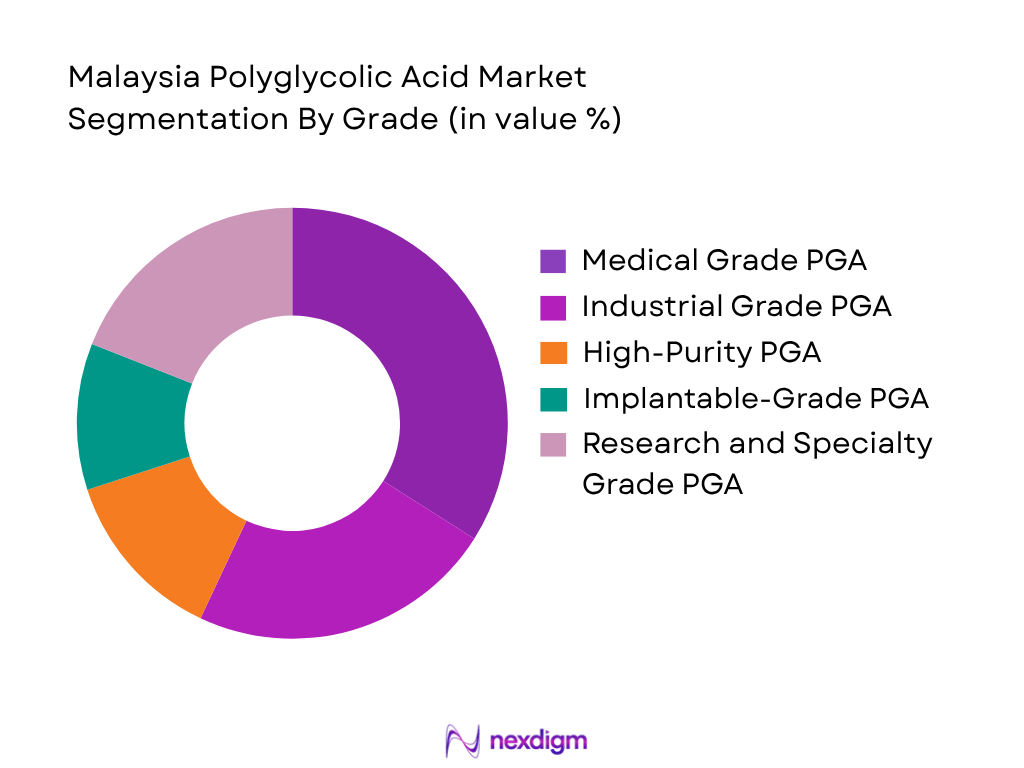
The Malaysia Polyglycolic Acid Market is segmented by grade into medical-grade PGA, industrial-grade PGA, high-purity PGA, implantable-grade PGA, and research and specialty-grade PGA. Medical-grade PGA holds the dominant market share because Malaysia has an established medical-device manufacturing ecosystem and PGA is commercially established in absorbable sutures and other bioresorbable medical applications. Medical-grade material requires tightly controlled molecular weight, purity, residual monomer content and degradation characteristics, creating a more specialized value proposition than general industrial material. Malaysia’s role as an export-oriented medical-device manufacturing location also supports demand for polymers that can meet international quality requirements. Industrial-grade PGA is relevant for high-barrier packaging, specialty polymer blends and dissolvable industrial components, but these applications remain more application-development intensive. High-purity and implantable grades address smaller but technically demanding areas such as tissue engineering, orthopedic fixation and controlled drug delivery, where material qualification and predictable bioresorption are critical.
By Application Type
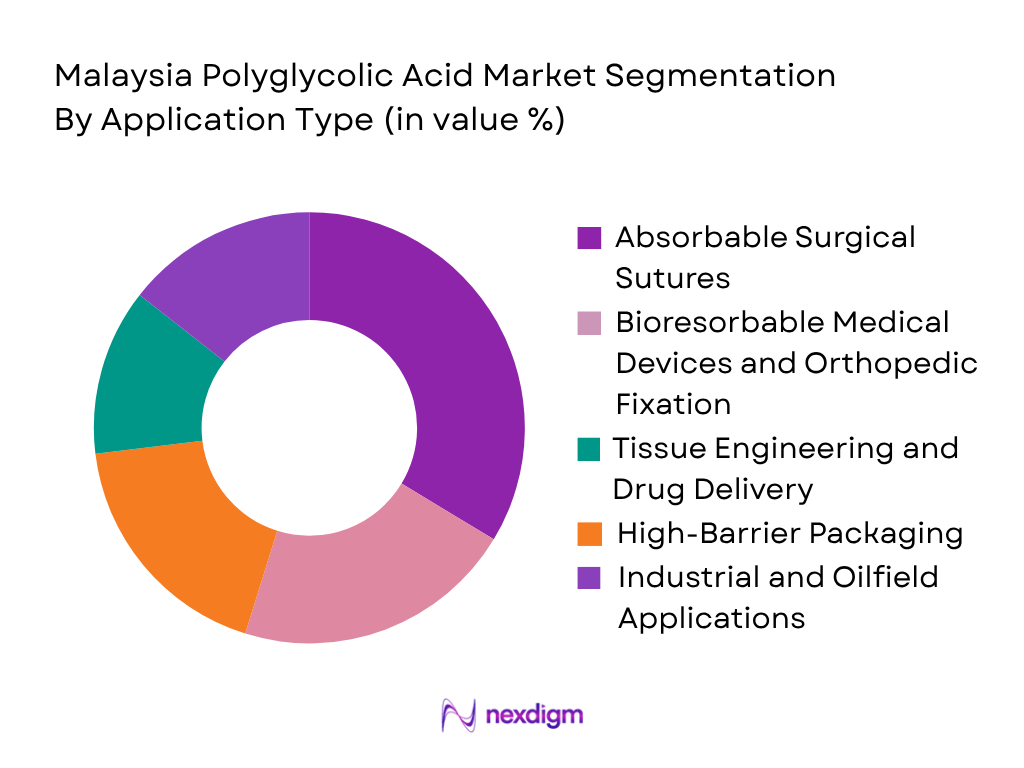
The Malaysia Polyglycolic Acid Market is segmented by application into absorbable surgical sutures, bioresorbable medical devices, orthopedic fixation devices, tissue engineering and drug delivery, high-barrier packaging, and industrial and oilfield applications. Absorbable surgical sutures hold the dominant market share because PGA’s high initial tensile strength and predictable hydrolytic degradation make it particularly suitable for temporary wound closure. Malaysia’s healthcare infrastructure and medical-device manufacturing capabilities create an established downstream channel for such products. Bioresorbable orthopedic and tissue-engineering applications require more sophisticated material engineering and longer qualification cycles, making their commercial base comparatively specialized. High-barrier packaging offers a developing non-medical pathway because PGA can improve oxygen and carbon-dioxide barrier performance in multilayer structures. Oil-and-gas applications provide another technically differentiated opportunity through temporary downhole components engineered to degrade after completing their intended function, although adoption depends strongly on application-specific material qualification.
Competitive Landscape
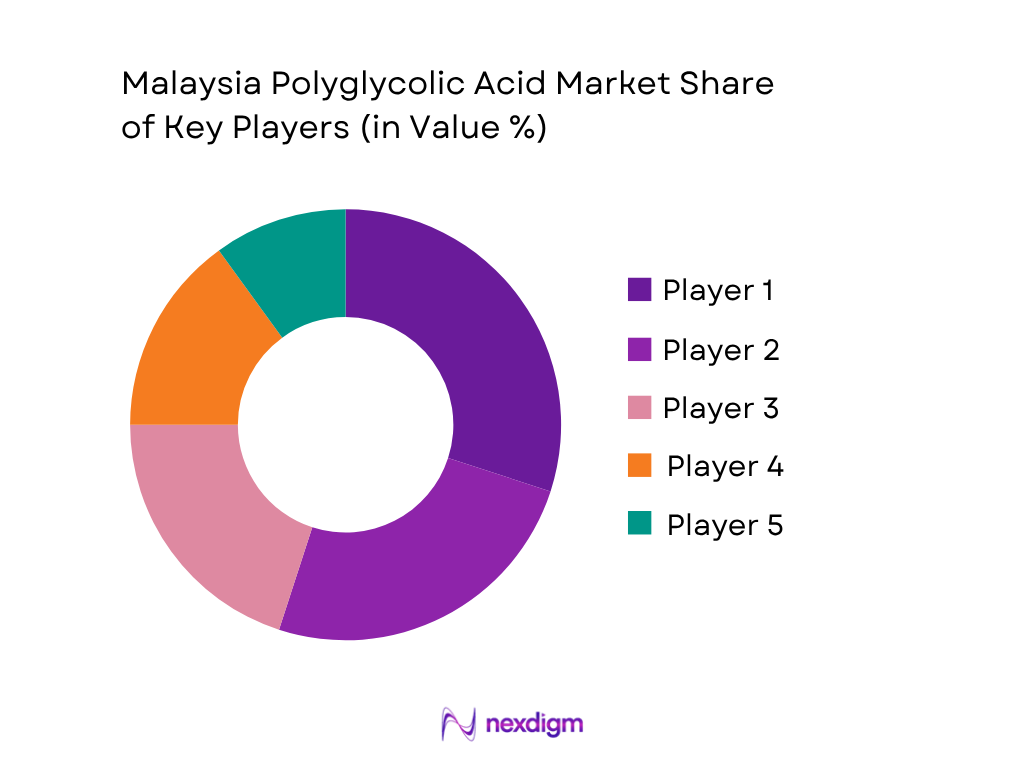
The Malaysia Polyglycolic Acid Market has a specialized competitive structure comprising international PGA resin manufacturers, bioresorbable polymer specialists and downstream medical-device companies. Kureha Corporation has a distinctive position in high-molecular-weight PGA resin and industrial applications, while Evonik and Corbion have extensive capabilities in resorbable medical polymers. Meta Biomed and Teleflex strengthen the downstream competitive environment through absorbable surgical products. Competition centers on medical-grade quality, controlled degradation, polymer-processing expertise, regulatory documentation, application development and ASEAN distribution capabilities.
| Major Player | Establishment Year | Headquarters | PGA/Biomaterial Focus | Medical-Grade Capability | Major Applications | Polymer Technology Capability | Malaysia/ASEAN Reach | Key Differentiation |
| Kureha Corporation | 1944 | Tokyo, Japan | ~ | ~ | ~ | ~ | ~ | ~ |
| Evonik Industries AG | 2007 | Essen, Germany | ~ | ~ | ~ | ~ | ~ | ~ |
| Corbion N.V. | 1919 | Amsterdam, Netherlands | ~ | ~ | ~ | ~ | ~ | ~ |
| Meta Biomed Co., Ltd. | 1990 | Cheongju, South Korea | ~ | ~ | ~ | ~ | ~ | ~ |
| Teleflex Incorporated | 1943 | Pennsylvania, USA | ~ | ~ | ~ | ~ | ~ | ~ |
Malaysia Polyglycolic Acid Market Analysis
Growth Drivers
Expansion of Malaysia’s Medical Device Manufacturing Ecosystem
Malaysia’s expanding medical-device manufacturing ecosystem is a direct growth driver for polyglycolic acid because medical-grade PGA is used in absorbable sutures, wound-closure materials, bioresorbable implants and other temporary medical devices. Malaysian Investment Development Authority data show that the medical-device industry recorded 23 approved projects, RM1.8 billion in approved investments and 2,406 employment opportunities in 2024, including RM1.1 billion of foreign investment and RM0.7 billion of domestic investment. These investments strengthen manufacturing capabilities relevant to precision medical products, polymer conversion, sterilization and regulated production. Malaysia’s Ministry of Health reported 150 public hospitals providing inpatient services, supported by 46,855 beds, alongside 1,131 health clinics, 1,656 rural clinics, 77 maternal and child health clinics and 205 community clinics in 2024. This healthcare infrastructure provides a substantial downstream environment for surgical consumables and absorbable materials. The macroeconomic base also supports specialized manufacturing: IMF data record Malaysia’s 2024 nominal GDP at USD422.2 billion, GDP per capita at USD12,397 and population at 34.1 million. These industrial and healthcare fundamentals strengthen the commercial environment for medical-grade PGA applications.
Growing Specialty Chemical and Polymer Processing Capabilities
Malaysia’s strengthening specialty chemical and polymer-processing ecosystem supports PGA adoption by providing capabilities required for resin handling, compounding, film extrusion, medical polymer conversion and biodegradable material development. Malaysian Investment Development Authority data show that Malaysia’s chemical industry secured RM10.6 billion in approved investments across 92 projects in 2024, with these projects associated with 4,476 employment opportunities. Of this investment, RM7.8 billion was associated with 64 new projects, while RM2.8 billion was linked to 28 expansion or diversification projects. The plastics industry also recorded RM565 million in approved investments during the first quarter of 2024, with the approved projects expected to generate 1,018 new employment opportunities. These investments are relevant to PGA because commercialization requires expertise in moisture-controlled resin handling, melt processing, polymer blending, extrusion and application engineering. Malaysia’s broader manufacturing environment recorded RM120.5 billion in approved manufacturing investments in 2024. IMF data place the country’s nominal GDP at USD422.2 billion, population at 34.1 million and GDP per capita at USD12,397 in 2024, providing an economic base capable of supporting higher-value specialty polymer processing and PGA downstream development.
Market Challenges
Dependence on Imported High-Specification PGA and Limited Domestic Polymerization
Malaysia’s PGA market faces a structural challenge from the limited domestic production of high-molecular-weight and medical-grade polyglycolic acid, making downstream manufacturers reliant on internationally sourced specialty polymers and associated technical documentation. This constraint is important because PGA production requires high-purity glycolide, controlled ring-opening polymerization, molecular-weight management and specialized moisture protection before downstream conversion. Malaysia has a substantial chemical manufacturing base, but current investment data indicate that broader chemical capacity is considerably larger than dedicated PGA capability. The Malaysian Investment Development Authority recorded 92 approved chemical-industry projects worth RM10.6 billion in 2024, generating 4,476 employment opportunities, while the medical-device sector recorded 23 projects worth RM1.8 billion and 2,406 employment opportunities. These figures demonstrate strong downstream industrial infrastructure but do not establish commercial-scale domestic PGA polymerization, leaving a supply-chain gap between Malaysia’s medical-device capabilities and specialty resin requirements. The country’s 2024 macroeconomic scale remains substantial, with IMF data recording nominal GDP of USD422.2 billion, GDP per capita of USD12,397 and population of 34.1 million. Consequently, local PGA users must combine Malaysia-based conversion capabilities with imported specialty feedstock, qualification documents and supplier technical support.
Stringent Medical Qualification and PGA Processing Requirements
The Malaysia Polyglycolic Acid Market faces technical and regulatory challenges because medical-grade PGA must satisfy stringent material, manufacturing and device-performance requirements while retaining predictable degradation characteristics. Malaysia’s Medical Device Authority regulates medical products under Medical Device Act 2012 (Act 737), meaning PGA-based sutures and implantable products entering regulated medical applications require formal conformity, establishment and device-registration processes. Processing complexity is equally significant because PGA is susceptible to moisture-induced hydrolysis, requiring controlled drying, storage, melt residence time and conversion conditions to protect molecular weight and finished-product performance. The scale of Malaysia’s healthcare infrastructure raises the importance of consistent quality: Ministry of Health data record 150 inpatient public hospitals with 46,855 beds, together with 1,131 health clinics, 1,656 rural clinics, 77 maternal and child health clinics and 205 community clinics in 2024. Meanwhile, Malaysia approved 23 medical-device manufacturing projects, generating 2,406 employment opportunities during 2024, demonstrating continued expansion of regulated manufacturing. IMF figures record nominal GDP of USD422.2 billion, GDP per capita of USD12,397 and a population of 34.1 million in 2024. These conditions create demand potential while simultaneously increasing the importance of validated PGA processing, traceability, sterilization compatibility and regulatory compliance.
Market Opportunities
Localization of PGA-Based Absorbable Sutures and Bioresorbable Devices
Malaysia has an opportunity to expand domestic conversion of imported medical-grade PGA into absorbable sutures, surgical meshes, temporary fixation products and other bioresorbable devices rather than relying predominantly on imported finished products. Existing manufacturing and healthcare infrastructure provides the foundation for this future development. Malaysian Investment Development Authority data show 23 medical-device projects with RM1.8 billion in approved investments and 2,406 employment opportunities in 2024, indicating continued capital deployment into regulated medical manufacturing. Malaysia’s Ministry of Health simultaneously operated 150 inpatient public hospitals containing 46,855 beds, supported by 1,131 health clinics, 1,656 rural clinics, 77 maternal and child health clinics and 205 community clinics. This infrastructure creates an established downstream environment for surgical consumables and medical products incorporating absorbable polymers. Localization opportunities include PGA fiber processing, suture braiding, coating, sterilization, packaging and manufacturing of specialized temporary implants, allowing more downstream value addition within Malaysia. The macroeconomic environment provides additional support: IMF data place 2024 nominal GDP at USD422.2 billion, GDP per capita at USD12,397 and population at 34.1 million. These current capabilities provide a credible platform for future PGA medical-product localization and ASEAN-oriented manufacturing.
Development of PGA-Based High-Barrier and Sustainable Polymer Applications
Malaysia has a future opportunity to develop PGA beyond medical applications through high-barrier packaging, biodegradable polymer blends and advanced specialty materials. PGA offers strong gas-barrier characteristics and can be incorporated as a functional layer within multilayer structures or combined with complementary biodegradable polymers where controlled degradation and material performance are required. Malaysia already possesses a sizeable plastics-processing and chemical manufacturing ecosystem capable of supporting application development. Malaysian Investment Development Authority data show RM565 million in approved plastics-industry investments during the first quarter of 2024, associated with 1,018 employment opportunities. The broader chemical industry recorded 92 approved projects, RM10.6 billion in investments and 4,476 employment opportunities in 2024, while Malaysia’s total manufacturing sector attracted RM120.5 billion in approved investments. These existing capabilities provide a platform for future PGA compounding, extrusion, multilayer-film development and specialty biodegradable material manufacturing without requiring assumptions about future demand volumes. Malaysia’s 2024 macroeconomic foundation includes nominal GDP of USD422.2 billion, GDP per capita of USD12,397 and population of 34.1 million, according to the IMF. Combined with existing polymer-processing infrastructure, these conditions support future commercialization of higher-value PGA-based packaging and engineered polymer applications.
Future Outlook
The Malaysia Polyglycolic Acid Market is projected to expand at approximately ~XX% CAGR during 2026-2035, supported by Malaysia’s medical-device manufacturing base, growing specialization in bioresorbable medical materials and development of higher-performance polymer applications. Absorbable surgical products are expected to remain central to demand, while bioresorbable implants, drug delivery and tissue-engineering applications create additional pathways for medical-grade PGA.
Malaysia’s position within the ASEAN medical-device manufacturing supply chain creates opportunities for international PGA and biomaterial suppliers to establish stronger technical-service, distribution and application-development relationships with domestic converters. Companies capable of providing medical documentation, consistent material quality and regulatory support should be better positioned for qualification by medical-device manufacturers. Industrial PGA is expected to gain relevance through multilayer high-barrier packaging, biodegradable polymer compounds and specialized temporary components. The opportunity is particularly relevant where conventional material structures can be redesigned using a thin functional PGA layer to improve barrier performance while minimizing total material requirements.
Major Players
- Kureha Corporation
- Evonik Industries AG
- Corbion N.V.
- BMG Incorporated
- Teleflex Incorporated
- Meta Biomed Co., Ltd.
- Samyang Biopharmaceuticals Corporation
- Shanghai Pujing Chemical Technology Co., Ltd.
- Danhua Chemical Technology Co., Ltd.
- Shenzhen Polymtek Biomaterial Co., Ltd.
- Huizhou Foryou Medical Devices Co., Ltd.
- WEGO Group
- Pertiwi Medik Sdn. Bhd.
- SMI AG
- Aurolab
Key Target Audience
- Polyglycolic Acid Resin and Specialty Biopolymer Manufacturers
- Absorbable Suture and Surgical Consumable Manufacturers
- Bioresorbable Medical Device and Implant Manufacturers
- Pharmaceutical and Drug Delivery Companies
- High-Barrier Packaging and Specialty Polymer Converters
- Oil and Gas Service and Dissolvable Tool Companies
- Investments and Venture Capitalist Firms
- Government and Regulatory Bodies (Medical Device Authority Malaysia, Ministry of Health Malaysia, Malaysian Investment Development Authority, Ministry of Investment, Trade and Industry)
Research Methodology
Step 1: Identification of Key Variables
The initial phase involves constructing an ecosystem map covering stakeholders in the Malaysia Polyglycolic Acid Market, including PGA resin suppliers, biomaterial companies, medical-device manufacturers, suture producers, polymer converters, distributors and industrial users. Desk research identifies critical variables including PGA grade, product form, purity, molecular weight, application, import dependency, processing technology and regulatory requirements.
Step 2: Market Analysis and Construction
Historical PGA demand is analyzed through top-down and bottom-up approaches. The top-down assessment examines Malaysia’s medical-device, healthcare, specialty polymer, packaging and industrial ecosystems, while the bottom-up model evaluates material consumption across absorbable sutures, bioresorbable devices, packaging and specialty applications. Import activity, domestic conversion capabilities and application-level demand are reconciled to develop the market structure.
Step 3: Hypothesis Validation and Expert Consultation
Market hypotheses are validated through computer-assisted telephone interviews with medical-device manufacturers, biomaterial suppliers, specialty polymer distributors, suture producers, packaging converters and industrial users. Discussions assess PGA procurement, grade requirements, supplier qualification, processing characteristics, application development and regulatory considerations. Primary findings are used to validate segmentation assumptions and identify differences between supply-side availability and downstream consumption.
Step 4: Research Synthesis and Final Output
The final stage integrates secondary research, primary interviews, company information and regulatory assessment into a consolidated Malaysia Polyglycolic Acid Market model. Bottom-up application estimates are reconciled with top-down industry indicators to validate results. Competitive analysis evaluates medical-grade capabilities, industrial PGA exposure, product portfolios, application expertise, Malaysia and ASEAN distribution coverage, and regulatory positioning to generate the final market outlook.

- Executive Summary
- Research Methodology (Market Definition and Scope, Malaysia Polyglycolic Acid Classification, Glycolide-to-PGA Value Chain Mapping, Medical-Grade and Industrial-Grade Assessment, PGA Resin Import Mapping, Demand-Side Consumption Analysis, Supply-Side Availability Assessment, Application-Level Consumption Assessment, Medical Device Registration Mapping, Primary Industry Interviews, Top-Down Market Sizing, Bottom-Up Demand Validation, Data Triangulation, Forecasting Framework, Regulatory Assessment, Limitations and Future Conclusions)

- Definition and Scope
- Malaysia Polyglycolic Acid Industry Evolution and Development of Bioresorbable and Biodegradable Polymer Ecosystem
- Polyglycolic Acid Chemistry, Glycolide Polymerization and Material Performance Structure
- Malaysia Polyglycolic Acid Value Chain Analysis
- Malaysia Polyglycolic Acid Supply Chain Analysis
- Glycolic Acid, Glycolide, PGA Resin, Biomaterial Supplier, Medical Device Manufacturer, Polymer Compounder and Packaging Converter Ecosystem Analysis
- PGA Integration Assessment Across Absorbable Sutures, Bioresorbable Medical Devices, Drug Delivery, High-Barrier Packaging and Specialty Industrial Applications

- Growth Drivers (Expansion of Malaysia Medical Device Manufacturing Ecosystem, Increasing Production of Surgical Consumables, Growth of Minimally Invasive and Implantable Medical Technologies, Development of High-Value Medical Manufacturing, Expansion of Specialty Polymer Processing, Increasing Demand for Sustainable High-Barrier Materials)
- Market Challenges (Dependence on Imported PGA Resin and Glycolide, Limited Domestic PGA Polymerization Capacity, Medical-Grade Purity Requirements, Moisture-Induced Hydrolysis, Narrow Melt Processing Window, Medical Device Registration Requirements, Specialized Storage and Processing Infrastructure)
- Market Opportunities (Localization of PGA Absorbable Suture Manufacturing, Expansion of Bioresorbable Medical Device Production, High-Barrier Sustainable Packaging Development, PGA-Based Biopolymer Compounding, Controlled Drug Delivery Materials, Tissue Engineering Applications, Dissolvable Oilfield Components)
- Market Trends (Medical-Grade PGA Adoption, Localization of Absorbable Surgical Materials, High-Purity Biomaterial Development, PGA/PLA Blend Development, Multilayer Barrier Packaging Innovation, Advanced Resorbable Implant Development, Specialty Polymer Supply Chain Localization)
- Regulatory and Standards Landscape (Medical Device Act 2012 Act 737, Medical Device Regulations 2012, Medical Device Authority Registration, Conformity Assessment Requirements, Common Submission Dossier Template, Medical Device Labelling Requirements, Essential Principles of Safety and Performance, Malaysia Plastics Sustainability Roadmap)
- SWOT Analysis
- Porter’s Five Forces Analysis
- PESTLE Analysis
- Stakeholder Ecosystem
- Competition Ecosystem

- By Market Value (2020-2025)
- By PGA Consumption Volume (2020-2025)
- By Medical-Grade PGA Consumption Volume (2020-2025)
- By Industrial-Grade PGA Consumption Volume (2020-2025)
- By Imported PGA Resin Volume (2020-2025)
- By Domestic PGA Conversion Volume (2020-2025)
- By PGA-Based Absorbable Suture Consumption Volume (2020-2025)

- By Grade (In Value %)
Medical Grade PGA
Industrial Grade PGA
High-Purity PGA
Implantable-Grade PGA
Research and Specialty Grade PGA - By Product Form (In Value %)
PGA Pellets and Granules
PGA Powder
PGA Fibers and Filaments
PGA Braided Suture Material
PGA Films and Sheets
PGA-Based Compounds and Blends
PGA Preforms and Semi-Finished Materials - By Application Type (In Value %)
Absorbable Surgical Sutures
Bioresorbable Medical Devices
Orthopedic Fixation Devices
Tissue Engineering Scaffolds
Drug Delivery Systems
Surgical Mesh and Wound Closure Applications
High-Barrier Packaging Films
Multilayer Food Packaging
Dissolvable Oil and Gas Components
Biodegradable Polymer Reinforcement
Specialty Fibers and Technical Applications - By Processing Technology (In Value %)
Fiber Spinning
Braiding and Suture Processing
Injection Molding
Film Extrusion
Multilayer Co-Extrusion
Compression Molding
Thermoforming
Solvent Processing
Medical Implant Fabrication - By Distribution Channel (In Value %)
Direct Manufacturer Supply
Authorized Medical Device Distributors
Specialty Polymer Distributors
Medical Biomaterial Suppliers
Chemical Importers and Trading Companies
Medical Device OEM Procurement
Specialty Compounders
Research Material Suppliers - By Region (In Value %)
Klang Valley
Selangor
Kuala Lumpur
Penang
Johor
Negeri Sembilan
Melaka
East Malaysia

- Market Share of Major Players (By PGA Supply Volume, Medical-Grade Portfolio, Industrial-Grade Portfolio, Absorbable Suture Portfolio, Bioresorbable Device Applications, Distribution Reach, End-Use Application, Customer Segment)
- Cross Comparison Parameters (PGA Grade Portfolio Breadth, High-Molecular-Weight PGA Capability, Medical-Grade and Implantable Biomaterial Capability, Absorbable Suture Manufacturing Expertise, Industrial and High-Barrier Packaging Application Coverage, Malaysia and ASEAN Distribution Reach, Polymer Processing and Technical Support Capability, Medical Device Regulatory and Application Development Strength)
- SWOT Analysis of Major Players
- Competitive Positioning Matrix
- Pricing and PGA Grade Category Benchmarking
- Detailed Profiles of Major Companies
Kureha Corporation – Kuredux PGA Resin, High-Molecular-Weight PGA, Barrier Packaging and Industrial Applications
Evonik Industries AG – RESOMER Bioresorbable Polymers, Medical Device Biomaterials and Implantable Polymer Solutions
Corbion N.V. – Resorbable Biomaterials, Medical Polymer Platforms and Drug Delivery Applications
BMG Incorporated – Medical-Grade PGA, Bioresorbable Polymer Materials and Biomedical Applications
Teleflex Incorporated – Absorbable Surgical Products, PGA-Based Medical Applications and Surgical Device Solutions
Meta Biomed Co., Ltd. – PGA Absorbable Sutures, Surgical Biomaterials and Medical Polymer Products
Samyang Biopharmaceuticals Corporation – Bioresorbable Polymer Materials, Absorbable Sutures and Medical Biomaterial Solutions
Shanghai Pujing Chemical Technology Co., Ltd. – PGA Resin, Industrial-Grade Polyglycolic Acid and Specialty Polymer Materials
Danhua Chemical Technology Co., Ltd. – Industrial PGA Resin, Glycolic Acid Integration and Polymer Production
Shenzhen Polymtek Biomaterial Co., Ltd. – Medical-Grade PGA, Bioresorbable Polymer Materials and Implant Applications
Huizhou Foryou Medical Devices Co., Ltd. – PGA Medical Materials, Absorbable Sutures and Surgical Applications
WEGO Group – PGA Absorbable Sutures, Surgical Suture Portfolio and Medical Consumables
Pertiwi Medik Sdn. Bhd. – Locally Manufactured PGA Absorbable Surgical Sutures and Medical Device Products
SMI AG – SURGICRYL PGA Absorbable Sutures, Braided Surgical Materials and Wound Closure Products
Aurolab – Polycryl PGA Absorbable Sutures, Ophthalmic Surgical Applications and Medical Suture Products

- Medical Device Manufacturer Procurement Assessment
- Absorbable Suture Manufacturer Requirement Analysis
- Hospital and Surgical Procurement Assessment
- Bioresorbable Device Manufacturer Requirement Analysis
- Packaging Converter Requirement Assessment
- Oilfield Application Requirement Assessment
- Polymer Compounder Demand Assessment
- PGA Supplier Selection Criteria
- Customer Pain Point Analysis

- By Market Value (2026-2035)
- By PGA Consumption Volume (2026-2035)
- By Medical-Grade PGA Consumption Volume (2026-2035)
- By Industrial-Grade PGA Consumption Volume (2026-2035)
- By Imported PGA Resin Volume (2026-2035)
- By Domestic PGA Conversion Volume (2026-2035)
- By PGA-Based Absorbable Suture Consumption Volume (2026-2035)


 Request a Sample
 Ask for Customization
 Get a Quote
 Enquire Now