
 Download PDF
Market Overview
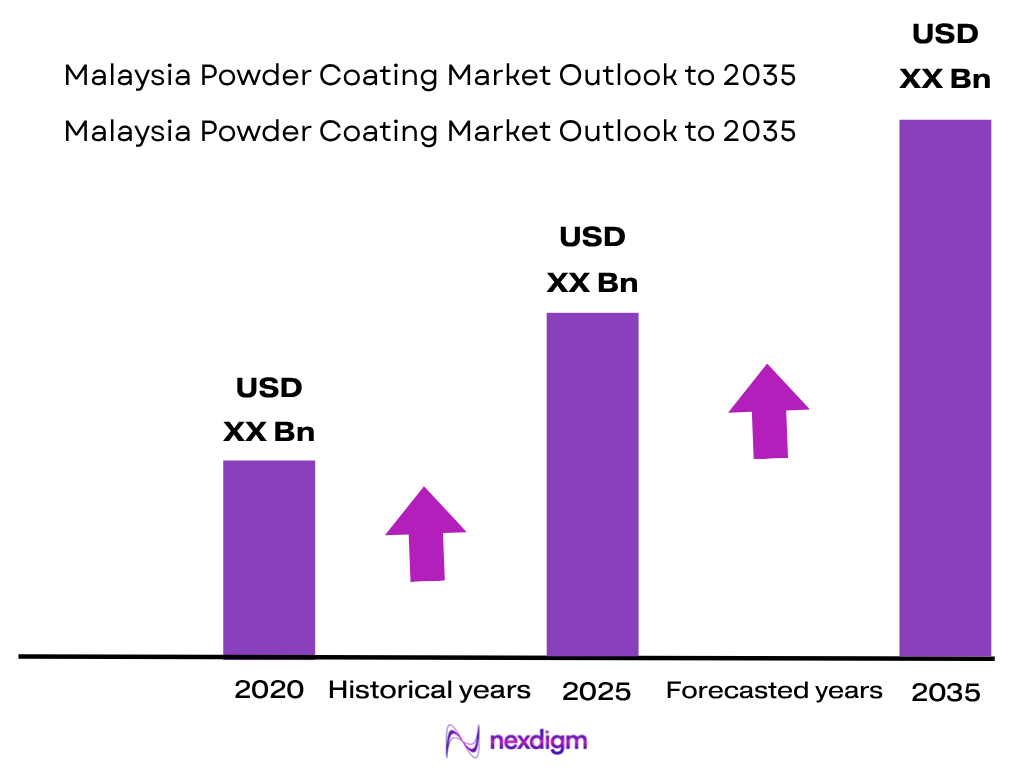
The Malaysia Powder Coating Market is valued at approximately ~USD 85 million, based on the report-model placeholder requested for the latest historical assessment. Demand is underpinned by Malaysia’s export-oriented manufacturing base, particularly electrical and electronics, appliances, automotive components, fabricated metal products and architectural aluminium. Manufacturing-sector sales increased from approximately RM1.8 trillion in the preceding annual cycle to RM1.9 trillion in the latest cycle, providing a substantial industrial substrate base for powder-coated metal components.
Selangor, Penang, Johor and Negeri Sembilan represent the most strategically important locations for the Malaysia Powder Coating Market. Selangor combines automotive, fabricated-metal and coatings manufacturing and hosts established powder operations in Shah Alam, while Penang is Malaysia’s principal E&E and semiconductor manufacturing cluster. Johor combines expanding construction and industrial activity with coatings manufacturing, while Nilai in Negeri Sembilan hosts an established powder-coating manufacturing facility. Johor’s GDP increased from RM148.6 billion to RM158.0 billion across the two latest annual observations.
Market Segmentation
By Resin Chemistry
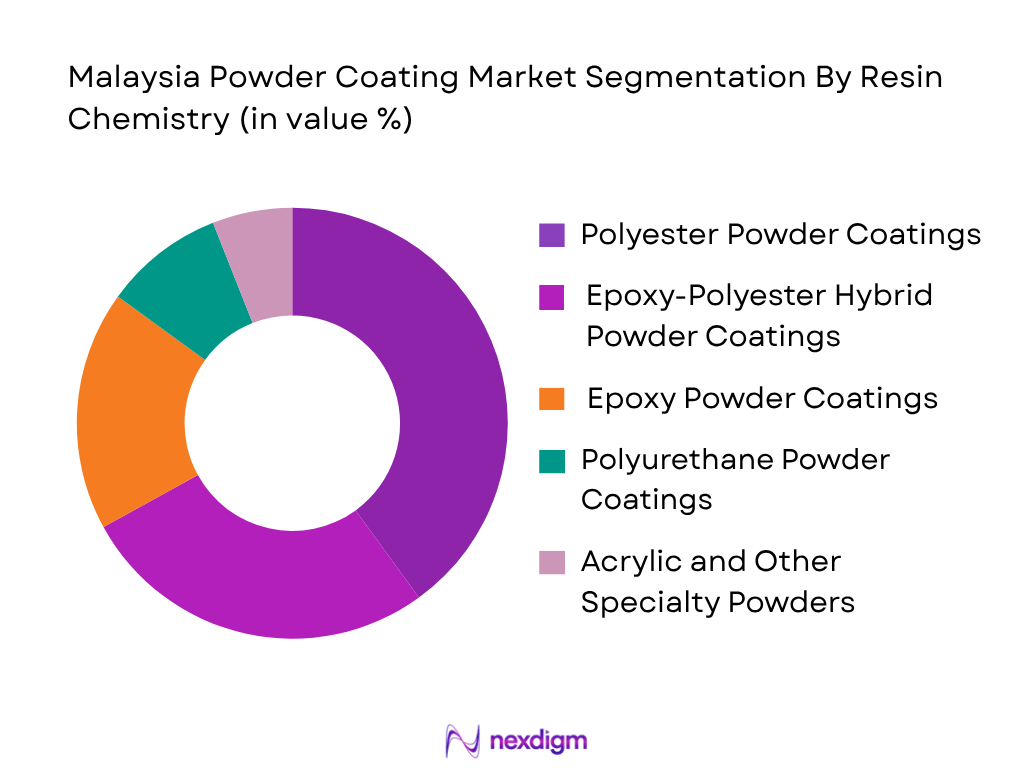
The Malaysia Powder Coating Market is segmented by resin chemistry into polyester, epoxy-polyester hybrid, epoxy, polyurethane, and acrylic and other specialty powders. Polyester powder coatings hold the dominant position in the report model because Malaysia has a large requirement for weather-resistant finishes across architectural aluminium, automotive parts, outdoor equipment, metal fabrication and general industrial products. Polyester systems provide UV stability, gloss retention and exterior durability suited to Malaysia’s humid tropical climate. Domestic availability also supports their adoption: Malaysia-based KOSKOTE offers TGIC polyester, metallic outdoor-durable polyester and super-durable architectural polyester formulations. Epoxy-polyester hybrids are particularly important for indoor appliances, furniture and equipment where appearance and mechanical properties are prioritized. Pure epoxy systems remain relevant for electrical equipment, primers and chemically demanding applications, while polyurethane and specialty powders address higher-performance niches. The structure therefore reflects Malaysia’s mix of architectural, E&E, appliance and general-industrial manufacturing rather than dependence on one downstream sector.
By End-Use Industry
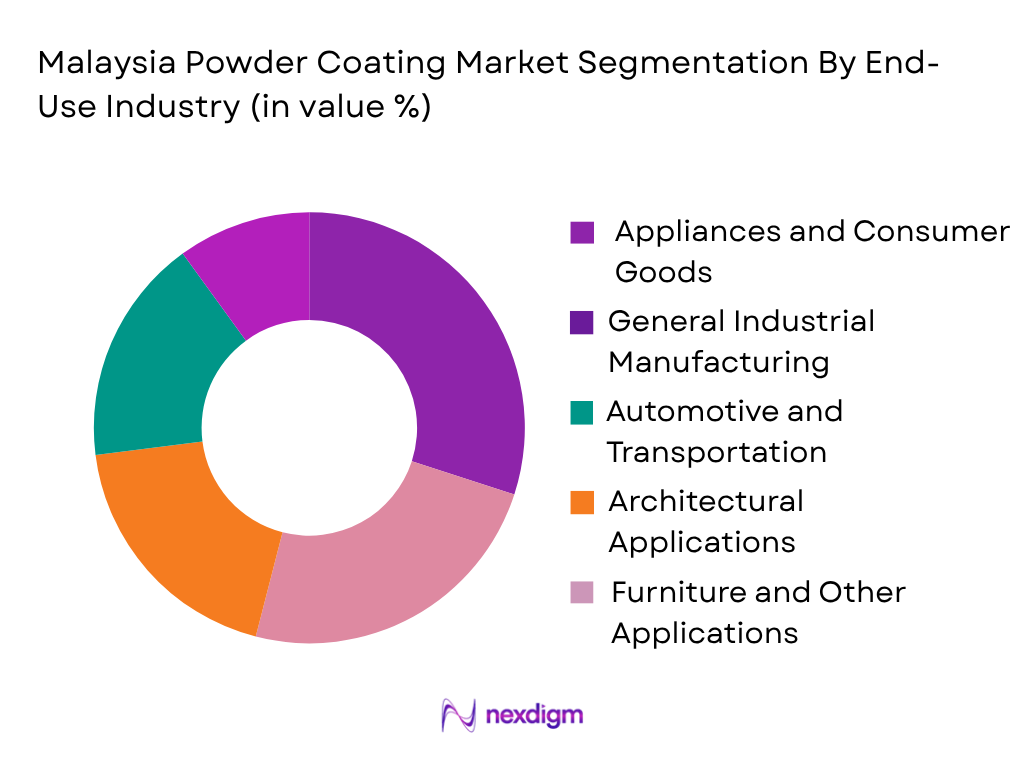
The Malaysia Powder Coating Market is segmented into appliances and consumer goods, general industrial manufacturing, automotive and transportation, architectural applications, and furniture and other applications. Appliances and consumer goods constitute the dominant modeled segment because Malaysia combines a sizeable E&E manufacturing ecosystem with production of electrical equipment, air-conditioning systems, appliances, cabinets and metal housings. Public country-level powder-coating analysis also identifies consumer goods as the largest application category. Malaysia’s E&E position is reinforced by extensive semiconductor and electronics manufacturing: six of the world’s twelve largest semiconductor companies operate in the country, while Malaysia accounts for a significant share of global assembly, testing and packaging activity. General industrial applications follow because fabricated metal, machinery, electrical enclosures and precision equipment require durable finishes. Automotive demand is also substantial, supported by nearly 790,000 locally produced vehicles, while architectural powder consumption benefits from aluminium profiles, windows, doors, façades and construction-related metal products.
Competitive Landscape
The Malaysia Powder Coating Market includes multinational powder specialists, locally established manufacturers and regional industrial-coatings suppliers. Competition is influenced by localized manufacturing and warehousing, resin chemistry breadth, OEM qualification, architectural durability, custom-color capability and technical support. AkzoNobel operates a dedicated powder-coatings facility in Nilai, Jotun maintains a powder factory in Shah Alam, and Axalta has a dedicated Malaysian powder operation in Shah Alam. Teknos operates a production facility in Pasir Gudang, while PPG maintains an established Malaysian industrial-coatings operation.
| Company | Establishment Year | Headquarters | Malaysia Presence | Powder Technology Breadth | Key Malaysia End Uses | Architectural Capability | Functional / Specialty Capability | Technical & Color Support |
| AkzoNobel – Interpon | 1792 heritage | Amsterdam, Netherlands | ~ | ~ | ~ | ~ | ~ | ~ |
| Jotun | 1926 | Sandefjord, Norway | ~ | ~ | ~ | ~ | ~ | ~ |
| Axalta Coating Systems | 1866 heritage | Philadelphia, USA | ~ | ~ | ~ | ~ | ~ | ~ |
| PPG Industries | 1883 | Pittsburgh, USA | ~ | ~ | ~ | ~ | ~ | ~ |
| Teknos Group | 1948 | Helsinki Region, Finland | ~ | ~ | ~ | ~ | ~ | ~ |
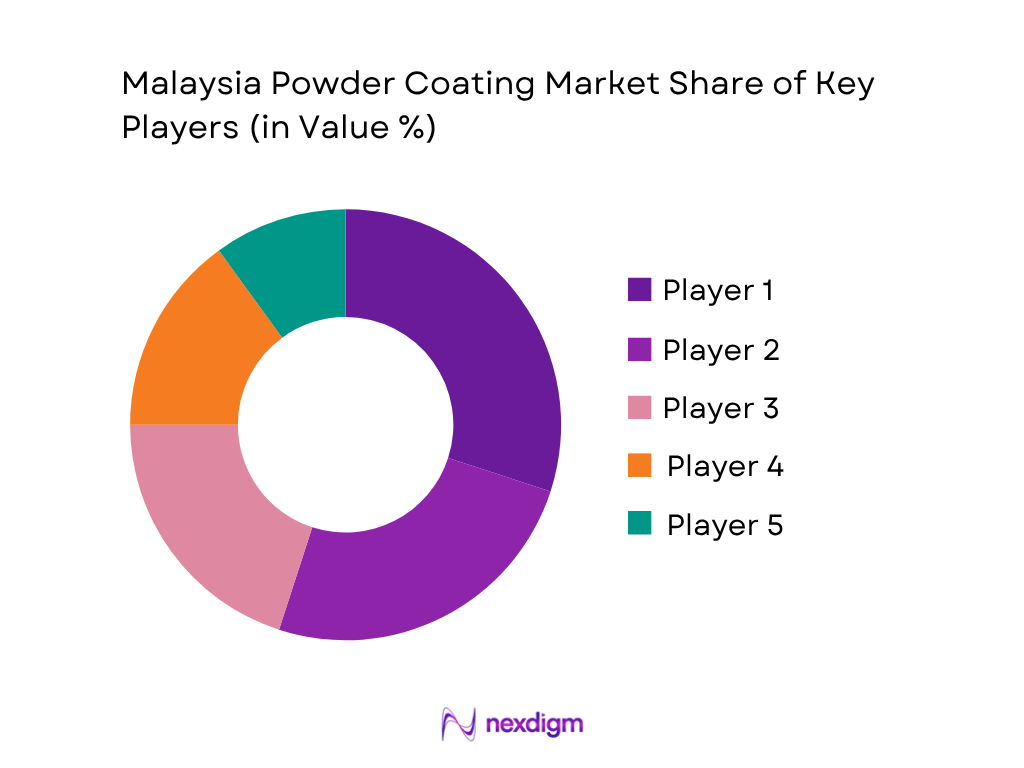
Malaysia Powder Coating Market Analysis
Growth Drivers
Expansion of Electrical, Electronics and Semiconductor Manufacturing
Malaysia’s electrical and electronics manufacturing base is a major structural driver for powder-coating demand because semiconductor equipment frames, electrical cabinets, control panels, server enclosures, motor housings, switchgear and automated machinery require durable protective finishes. MATRADE recorded RM601.18 billion of E&E exports in 2024, including RM313.1 billion of electronic integrated circuits, while machinery, equipment and parts exports reached RM69.04 billion. MIDA recorded RM48.1 billion of approved semiconductor investments across 46 projects in 2024, associated with 21,722 employment opportunities. The manufacturing ecosystem continued expanding in 2025, when DOSM recorded total manufacturing sales of RM1.97 trillion, compared with RM1.9 trillion in 2024. These investments expand the installed base of fabricated-metal housings, production machinery and electrical infrastructure suitable for polyester, epoxy, hybrid and functional powder coatings. The macroeconomic foundation is also substantial: the IMF recorded Malaysia’s 2024 nominal GDP at USD422.2 billion and population at 34.1 million. This combination of advanced manufacturing, semiconductor capital expenditure and electrical-equipment output creates recurring demand for corrosion-resistant, electrically insulating, low-bake and high-durability powder systems.
Strong Automotive Production and Metal Component Manufacturing
Malaysia’s automotive manufacturing ecosystem provides another direct demand base for powder coatings used on wheels, springs, seat structures, brackets, chassis parts, motorcycle components, suspension assemblies and emerging EV hardware. The Malaysian Automotive Association recorded 790,347 vehicles produced in 2024, compared with 774,600 units in 2023, an increase of 15,747 vehicles in physical output. MIDA subsequently reported RM15.8 billion of approved transport-equipment manufacturing investment in 2024, followed by RM14.9 billion in 2025, demonstrating continued capital deployment into automotive and transportation manufacturing facilities. Powder coating is well suited to these production lines because components require repeatable film build, mechanical durability, adhesion, corrosion resistance and compatibility with automated electrostatic application. The broader manufacturing environment reinforces this opportunity: DOSM reported RM1.9 trillion of manufacturing sales in 2024, while the IMF recorded Malaysia’s nominal GDP at USD422.2 billion. As domestic vehicle assembly and supplier localization deepen, coating demand extends beyond conventional decorative components into battery enclosures, electric motor housings, charging-equipment cabinets and other electrically sensitive metal parts, increasing the relevance of epoxy, polyester, hybrid and specialized functional powders.
Market Challenges
Dependence on Imported Epoxy Resins and Specialized Coating Inputs
Malaysia’s powder-coating formulators face significant supply-chain exposure because important resin chemistries and specialty formulation inputs are sourced through international trade. World Bank WITS data show that Malaysia imported exactly 34,636,300 kilograms of epoxide resins in primary forms in 2024, with China alone supplying 11,134,600 kilograms, Other Asia supplying 6,056,240 kilograms, the United States supplying 354,976 kilograms, and India supplying 94,716 kilograms. Epoxy resins are particularly important for epoxy powders, epoxy-polyester hybrids, anticorrosion primers, electrical insulation systems and other performance-oriented coatings. Malaysia simultaneously exported 12,553,500 kilograms of epoxide resins, demonstrating that the country participates in a regionally interconnected resin supply chain rather than operating as a completely self-contained raw-material base. This trade dependence exposes powder manufacturers to shipping disruptions, supplier qualification constraints, foreign-exchange movement and changes in regional availability of specific grades. The scale of the exposure matters within an economy where the IMF recorded USD422.2 billion of nominal GDP in 2024, while DOSM recorded RM1.9 trillion of manufacturing sales. Powder suppliers therefore need multiple qualified resin sources, larger safety inventories and formulation flexibility to preserve production continuity for Malaysian OEMs and job coaters.
Exposure to Export-Oriented Manufacturing Cycles and Customer Qualification Requirements
Malaysia’s powder-coating demand is closely linked to export-oriented manufacturing, creating sensitivity to changes in global electronics, machinery and fabricated-metal orders. MATRADE recorded RM1.289 trillion of manufactured-goods exports in 2024, including RM601.18 billion of E&E products, RM69.04 billion of machinery, equipment and parts, and RM61.55 billion of manufactures of metal. Malaysia’s total merchandise trade subsequently reached RM3.061 trillion in 2025, with exports of RM1.607 trillion and imports of RM1.455 trillion, illustrating how strongly domestic manufacturing is integrated into international supply chains. For powder suppliers, an export slowdown can reduce operating hours at appliance, electronics, automotive-component and metal-fabrication plants, lowering coating-line utilization even where domestic demand remains stable. At the same time, export-oriented OEMs commonly require approved colors, corrosion performance, consistent film thickness and qualified formulations before changing coating suppliers, making rapid customer substitution difficult. The IMF recorded Malaysia’s 2024 nominal GDP at USD422.2 billion, highlighting the sizeable economy supporting this industrial base, but the market remains commercially exposed to external manufacturing cycles. Powder producers therefore require diversified end-use portfolios spanning E&E, automotive, architecture, appliances and general industry rather than excessive dependence on a single export sector.
Market Opportunities
Semiconductor, Data Infrastructure and Advanced Electrical Equipment Applications
Malaysia’s continuing semiconductor investment provides a substantial future opportunity for high-performance powder coatings used on cleanroom equipment frames, testing-machine housings, server racks, electrical cabinets, automation systems, switchgear and precision metal enclosures. MIDA recorded RM48.1 billion of semiconductor investments across 46 approved projects in 2024, including 26 new projects and 20 expansion or diversification projects, together creating 21,722 employment opportunities. The broader manufacturing investment pipeline continued in 2025, when Malaysia approved RM131.3 billion across 1,354 manufacturing projects, compared with RM120.5 billion across 1,108 projects in 2024. MIDA also recorded RM16.9 billion across 59 electronic-components projects and RM4.0 billion across 58 industrial-electronics projects in 2025. These investments enlarge the addressable base for corrosion-resistant, anti-static, dielectric, thermally functional and low-temperature-cure powders required by advanced equipment manufacturers and their fabrication suppliers. IMF data place Malaysia’s 2024 nominal GDP at USD422.2 billion, providing a strong macroeconomic foundation for industrial upgrading. Powder suppliers that develop E&E-qualified formulations, rapid color matching, controlled film-build technologies and reliable local technical service can therefore capture additional demand as semiconductor and advanced-equipment ecosystems deepen.
Architectural Aluminium and Construction-Related Powder Coating Expansion
Malaysia’s active construction pipeline creates a future opportunity for super-durable polyester, TGIC-free, textured, metallic and architectural-grade powder coatings used on aluminium extrusions, windows, doors, curtain walls, railings, façades, HVAC components and external metalwork. DOSM recorded RM158.8 billion of construction work completed in 2024, including RM42.0 billion during the final quarter. Within that quarter, civil-engineering work contributed RM15.6 billion, non-residential buildings contributed RM11.8 billion, residential buildings contributed RM9.9 billion, and special-trade activities contributed RM4.7 billion. The same period included RM1.1 billion of electrical installation activity and RM1.0 billion of plumbing, heat and air-conditioning work, all of which support demand for coated metal fixtures, cabinets, equipment and structural components. Malaysia’s investment pipeline further reinforces future construction-linked demand: MIDA recorded RM101.1 billion of approved investment in Selangor, RM48.5 billion in Johor, and RM32.0 billion in Penang during 2024, all significant industrial and building-development locations. Against the IMF’s USD422.2 billion nominal GDP for 2024, these current construction and investment indicators support continued specification opportunities for weather-resistant powder systems designed for Malaysia’s humid, high-UV exterior environment.
Future Outlook
The Malaysia Powder Coating Market is expected to expand at an indicative ~5.5% CAGR during 2026–2035, used as the requested report placeholder. Growth will be supported by the modernization of electrical and electronics manufacturing, continued automotive activity, appliance production, architectural construction and increasing use of solvent-free industrial finishing. Malaysia’s semiconductor and advanced-electronics ecosystem provides an important future demand pathway. Semiconductor projects attracted RM48.1 billion of approved investment across 46 projects, with 21,722 employment opportunities associated with these projects. Powder suppliers can increasingly target semiconductor equipment frames, server and data-center enclosures, electrical cabinets, switchgear, automation equipment and other fabricated-metal assemblies surrounding electronics manufacturing.
Automotive applications are also expected to remain important. Malaysia produced 790,347 motor vehicles, including 744,604 passenger vehicles and 45,743 commercial vehicles, demonstrating a sufficiently large domestic platform for wheels, seat frames, springs, brackets, structural components and EV-related metal parts. Greater vehicle electrification should broaden requirements for dielectric, thermally relevant and corrosion-resistant specialty powders. Technology development should increasingly focus on low-temperature cure, shorter oven dwell times, high transfer efficiency and powder-recovery optimization. These solutions allow manufacturers to increase coating-line productivity while reducing material losses and energy requirements. PPG, for example, markets high-transfer-efficiency powder technologies capable of first-pass transfer efficiency of up to 85%, illustrating the direction of next-generation industrial finishing technology.
Major Players
- AkzoNobel Industrial Coatings Malaysia – Interpon
- Jotun Paints Malaysia – Powder Coatings
- Axalta Powder Coating Systems Malaysia
- PPG Coatings Malaysia
- Kossan Paint Malaysia – KOSKOTE Powder Coatings
- Teknos Malaysia – INFRALIT Powder Coatings
- Protech Group / Oxyplast
- TIGER Coatings / TIGER Drylac
- Nippon Paint Malaysia
- KCC Paint Malaysia
- The Sherwin-Williams Company
- Kansai Paint
- IGP Pulvertechnik
- ST Powder Coatings
- TCI Powder Coatings
Key Target Audience
- Powder Coating Manufacturers and Formulators
- Electrical, Electronics and Semiconductor Equipment Manufacturers
- Automotive OEMs and Automotive Component Manufacturers
- Appliance, HVAC and Consumer-Durable Manufacturers
- Architectural Aluminium Extruders and Industrial Job Coaters
- Resin, Pigment, Additive and Powder Application Equipment Suppliers
- Investments and Venture Capitalist Firms
- Government and Regulatory Bodies (Ministry of Investment, Trade and Industry; Malaysian Investment Development Authority; Department of Environment Malaysia; Department of Occupational Safety and Health; SIRIM; Standards Malaysia)
Research Methodology
Step 1: Identification of Key Variables
The initial phase involves constructing a complete ecosystem map encompassing powder manufacturers, raw-material suppliers, distributors, job coaters, aluminium extruders, E&E manufacturers, automotive suppliers, appliance OEMs and powder-application equipment companies. Secondary research identifies key variables including resin mix, powder consumption, domestic production, imports, coating-line utilization, film thickness, cure technology, transfer efficiency and end-use manufacturing activity.
Step 2: Market Analysis and Construction
Historical market development is constructed using both top-down and bottom-up methodologies. The top-down approach evaluates Malaysia’s broader coatings sector, manufacturing activity and powder-intensive downstream industries. The bottom-up model calculates addressable powder demand from appliances, E&E equipment, automobiles, architectural aluminium, fabricated metals and general industrial applications before reconciling consumption with domestic production, imports and supplier-level information.
Step 3: Hypothesis Validation and Expert Consultation
Market hypotheses are validated through computer-assisted telephone interviews (CATIs) and structured discussions with powder manufacturers, distributors, job coaters, raw-material suppliers, application-equipment providers and OEM procurement teams. These interactions evaluate resin preferences, powder consumption intensity, curing temperatures, film-build requirements, powder recovery practices, custom-color requirements, OEM qualification criteria and supplier switching behavior to validate and refine secondary-market assumptions.
Step 4: Research Synthesis and Final Output
The final stage triangulates supply-side findings with demand-side production indicators and primary industry feedback. Manufacturer shipments, powder imports, downstream production activity and application intensity are reconciled through both top-down and bottom-up approaches. The resulting dataset is then used to establish segmentation, competitive positioning, growth drivers, technology trends and the long-term outlook for the Malaysia Powder Coating Market while minimizing double counting.

- Executive Summary
- Research Methodology (Market Definition and Scope, Malaysia Powder Coating Taxonomy, Thermoset and Thermoplastic Powder Classification, Resin Chemistry Mapping, Functional and Decorative Powder Classification, Substrate Mapping, Surface Pretreatment Assessment, Electrostatic Application Technology Assessment, Cure Technology Assessment, Film Thickness Assessment, Powder Recovery and Reclaim Assessment, Market Sizing Framework)

- Definition and Scope
- Malaysia Powder Coating Industry Evolution and Technology Development
- Powder Coating Manufacturing and Formulation Process
- Powder Coating Value Chain Analysis
- Malaysia Powder Coating Supply Chain Analysis
- Resin, Pigment, Additive and Filler Ecosystem Analysis
- Malaysia Powder Coating Import Dependency and Localization Assessment
- OEM Powder Coating Application Architecture and Job-Coater Solution Framework

- Growth Drivers (Expansion of Electrical and Electronics Manufacturing, Strong Automotive and Auto Component Production, Growth of Appliance and HVAC Manufacturing, Expansion of Architectural Aluminum Applications, Increasing Industrial Metal Fabrication, Export-Oriented Manufacturing Growth, Liquid-to-Powder Conversion, Increasing Demand for Corrosion-Resistant Finishes)
- Market Challenges (Dependence on Imported Specialty Polyester and Epoxy Resins, Raw Material Supply Volatility, Energy-Intensive Cure Requirements, OEM Qualification Barriers, Pretreatment Quality Variation, Fragmented Job-Coater Ecosystem, Price Competition from Imported Powders, Skilled Applicator Constraints)
- Market Opportunities (Super-Durable Architectural Powders, Low-Bake and Fast-Cure Powders, EV Battery and Electrical Insulation Powders, Semiconductor Equipment Powder Coatings, Thermally Conductive Powder Coatings, Automated Powder Application Systems, Localized Specialty Powder Manufacturing, ASEAN Export Expansion)
- Market Trends (TGIC-Free Polyester Adoption, Low-Bake Fast-Cure Systems, Super-Durable Architectural Powders, Metallic and Textured Finishes, Functional Powder Coatings, Robotic Powder Application, Powder Recovery Systems, Sustainable Solvent-Free Finishing)
- Regulatory and Standards Landscape (Department of Environment Environmental Quality Requirements, Department of Occupational Safety and Health Requirements, SIRIM Standards, Malaysian Standards Requirements, Scheduled Waste Regulations, Industrial Emission Requirements, Chemical Handling Requirements, ASTM and ISO Powder Coating Test Standards)
- SWOT Analysis
- Porter’s Five Forces Analysis
- PESTLE Analysis
- Stakeholder Ecosystem
- Competition Ecosystem

- By Market Value (2020-2025)
- By Powder Coating Consumption Volume (2020-2025)
- By Coated Surface Area (2020-2025)
- By Domestic Production Volume (2020-2025)
- By Import Volume (2020-2025)
- By Export Volume (2020-2025)
- By Average Selling Price (2020-2025)
- By Thermoset Powder Consumption (2020-2025)
- By Thermoplastic Powder Consumption (2020-2025)

- By Resin Chemistry (In Value %)
Pure Polyester Powder Coatings
TGIC Polyester Powder Coatings
TGIC-Free Polyester Powder Coatings
Super-Durable Polyester Powder Coatings
Epoxy Powder Coatings
Epoxy-Polyester Hybrid Powder Coatings
Polyurethane Powder Coatings
Acrylic Powder Coatings
Fluoropolymer Powder Coatings
Silicone Polyester Powder Coatings
Nylon Powder Coatings
Polyethylene Powder Coatings
Other Specialty Thermoplastic Powders - By Coating Technology (In Value %)
Thermosetting Powder Coatings
Thermoplastic Powder Coatings
Low-Temperature Cure Powder Coatings
Low-Bake Fast-Cure Powder Coatings
Ultra-Low-Bake Powder Coatings
UV-Curable Powder Coatings
Thin-Film Powder Coatings
High-Temperature Resistant Powder Coatings - By Functional Performance (In Value %)
Decorative Powder Coatings
Corrosion-Resistant Powder Coatings
Super-Durable Architectural Powders
High-Temperature Powder Coatings
Electrical Insulation and Dielectric Powders
Antimicrobial Powder Coatings
Anti-Graffiti Powder Coatings
Scratch-Resistant Powder Coatings
Chemical-Resistant Powder Coatings
Marine Corrosion-Protection Powders
Fire-Retardant Powder Coatings
Fusion-Bonded Epoxy Powders
Rebar Powder Coatings
Zinc-Rich and Zinc-Free Powder Primers - By End-Use Industry (In Value %)
Electrical and Electronics
Automotive and Auto Components
Appliances and White Goods
Architectural Aluminum and Building Products
General Industrial Manufacturing
Furniture and Metal Fabrication
HVAC and Refrigeration Equipment
Marine and Shipbuilding
Industrial Machinery and Equipment
Infrastructure and Construction
Oil and Gas Equipment
Renewable Energy Equipment
Telecommunication Equipment
Semiconductor Equipment and Enclosures - By Distribution Channel (In Value %)
Direct Powder Manufacturer-to-OEM Sales
Direct Manufacturer-to-Job Coater Sales
Authorized Powder Coating Distributors
Industrial Paint and Coating Distributors
Regional Stocking Warehouses
Dealer and Reseller Networks
Equipment and Powder Bundled Distribution
Project-Specific Supply Contracts
Online B2B Industrial Platforms
Custom Color and Small-Batch Channels - By Region (In Value %)
Selangor
Kuala Lumpur
Negeri Sembilan
Penang
Kedah
Perak
Johor
Melaka
Pahang
Sabah
Sarawak
Other Malaysian States

- Market Share of Major Players (By Revenue, Volume, Resin Chemistry, Powder Technology, End-Use Industry, Application Type, Market Type, Distribution Channel)
- Cross Comparison Parameters (Resin Chemistry and Powder Technology Breadth, Malaysia and ASEAN Supply Footprint, Low-Temperature and Fast-Cure Technology Capability, Automotive and E&E OEM Qualification Coverage, Super-Durable Architectural Powder Portfolio Strength, Functional Electrical and High-Performance Powder Capability, Custom Color Matching and Technical Application Support, Sustainable and TGIC-Free Low-Energy Powder Portfolio)
- SWOT Analysis of Major Players
- Pricing and Distribution Network Benchmarking
- Detailed Profiles of Major Companies
AkzoNobel Industrial Coatings Malaysia – Interpon
Jotun Paints Malaysia – Powder Coatings
Axalta Powder Coating Systems Malaysia
PPG Coatings Malaysia
Kossan Paint Malaysia – KOSKOTE Powder Coatings
Teknos Malaysia – INFRALIT Powder Coatings
Protech Group / Oxyplast
TIGER Coatings / TIGER Drylac
Nippon Paint Malaysia
KCC Paint Malaysia
The Sherwin-Williams Company
Kansai Paint
IGP Pulvertechnik
ST Powder Coatings
TCI Powder Coatings

- Buyer Segmentation
- OEM Procurement Behaviour
- Supplier Selection Criteria
- Buyer Pain Points
- Technology Adoption Assessment
- Replacement and Repurchase Behaviour

- By Market Value (2026-2035)
- By Powder Coating Consumption Volume (2026-2035)
- By Coated Surface Area (2026-2035)
- By Domestic Production Volume (2026-2035)
- By Import Volume (2026-2035)
- By Export Volume (2026-2035)
- By Average Selling Price (2026-2035)
- By Thermoset Powder Consumption (2026-2035)
- By Thermoplastic Powder Consumption (2026-2035)


 Request a Sample
 Ask for Customization
 Get a Quote
 Enquire Now