
 Download PDF
Market Overview
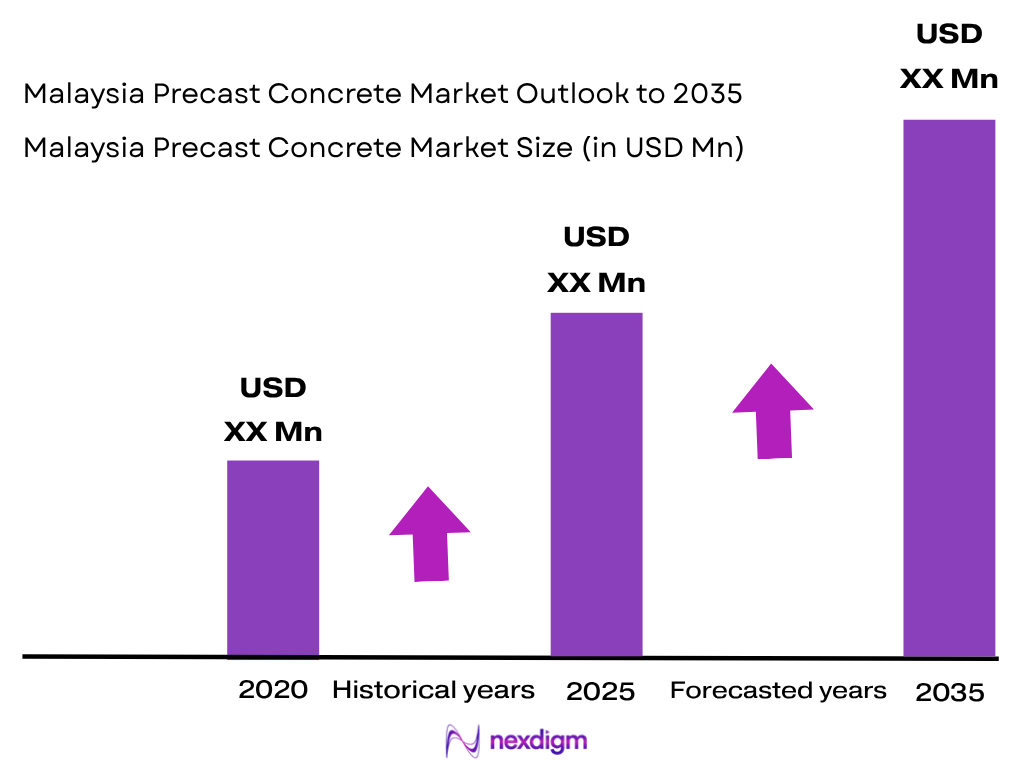
The Malaysia Precast Concrete Market is estimated at ~USD XX billion in 2024, compared with ~USD XX billion in 2023, with demand closely linked to construction output, infrastructure development, industrialised building systems and large-scale residential projects. Malaysia’s construction work done reached RM158.8 billion in 2024, compared with RM132.9 billion in 2023, according to the Department of Statistics Malaysia. Civil engineering accounted for RM61.1 billion, non-residential buildings RM44.4 billion and residential buildings RM35.8 billion in 2024, creating demand for structural, infrastructure and building precast components.
Kuala Lumpur, Selangor, Johor and Penang are important demand centres for the Malaysia Precast Concrete Market because they combine high construction activity, infrastructure development, industrial investment and concentrated urban development. Selangor, Johor, Kuala Lumpur and Sarawak were among the major contributors to construction activity during 2024, while Selangor and Johor recorded particularly significant construction work during the quarterly reporting period. Johor also benefits from industrial and logistics development and its connection to Singapore, while Klang Valley supports residential, commercial and infrastructure projects requiring standardized precast components.
Market Segmentation
By Product Type
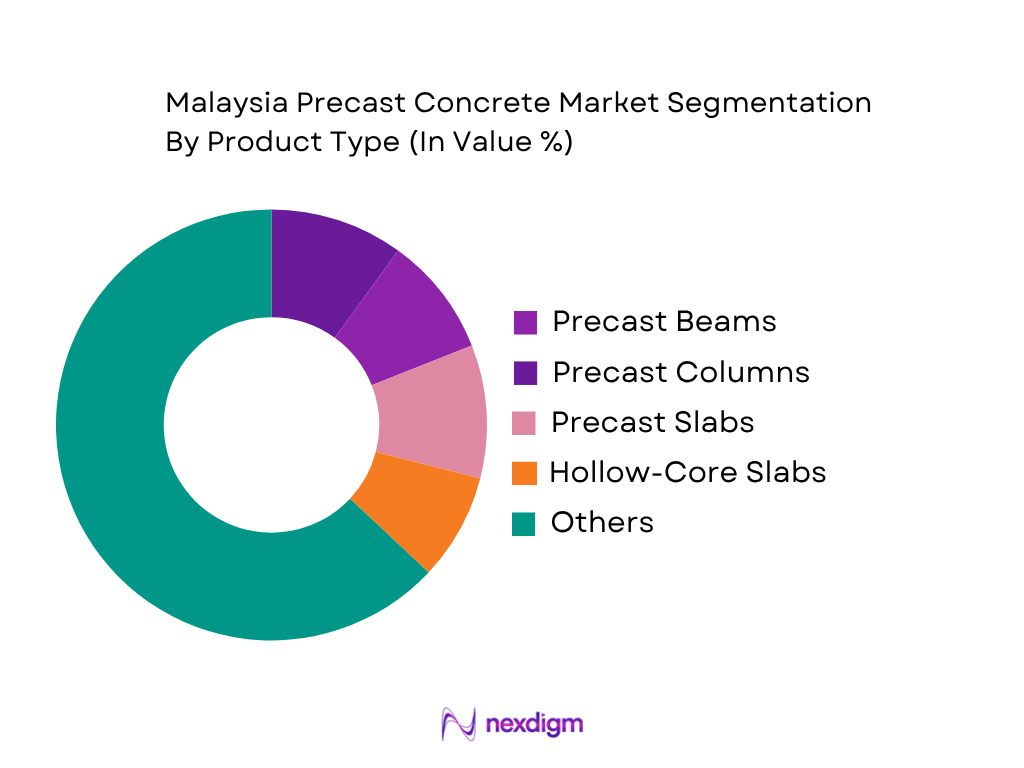
The Malaysia Precast Concrete Market is segmented by product type into precast beams, precast columns, precast slabs, hollow-core slabs, precast wall panels, staircases and landings, roof and floor systems, architectural precast components, drainage products, box culverts, pipes and utility products, road barriers, railway components, bridge girders, tunnel components and modular precast units. Precast beams, columns and slabs are expected to represent the leading sub-segment, supported by their applicability across residential, commercial, industrial and infrastructure projects. These components are particularly compatible with Industrialised Building System construction because they can be manufactured under controlled conditions and transported for rapid site assembly. CIDB describes IBS as a construction method in which components are produced in controlled conditions, transported and installed with minimal site labour. Malaysia’s 2024 construction work done of RM158.8 billion provides a broad project base for structural precast demand, particularly across residential buildings, non-residential buildings and civil engineering.
By End-Use Industry
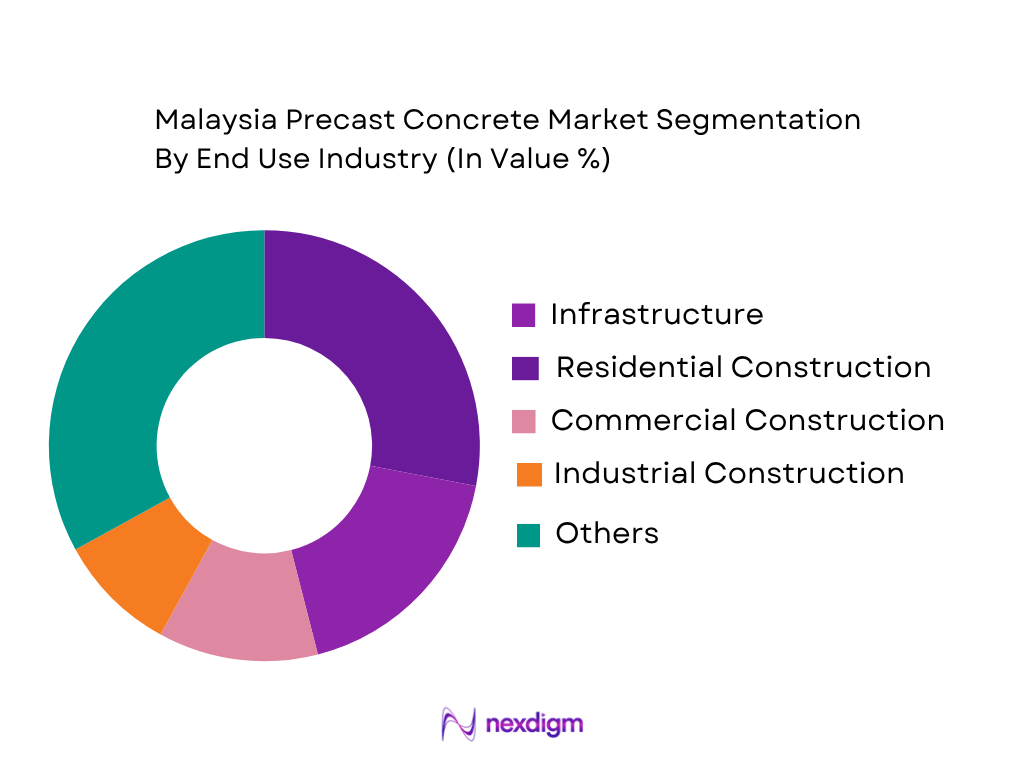
The Malaysia Precast Concrete Market is segmented by end-use industry into residential construction, commercial construction, industrial construction, infrastructure, transportation, railways and metro systems, roads and highways, water and wastewater infrastructure, power and utilities, warehousing and logistics, data centres, healthcare, education and hospitality. Infrastructure is expected to represent the leading end-use segment, supported by Malaysia’s substantial civil-engineering pipeline. Construction work done in 2024 included RM61.1 billion in civil engineering, while residential buildings contributed RM35.8 billion and non-residential buildings RM44.4 billion. Precast products are suited to infrastructure because repeated bridge beams, culverts, drainage systems, piles, barriers, utility structures and railway components can be manufactured under controlled factory conditions. CIDB’s precast and DfMA guidelines specifically address manufacturing, quality control, transportation and installation of precast systems, reinforcing the relevance of standardized production for large infrastructure projects.
Competitive Landscape
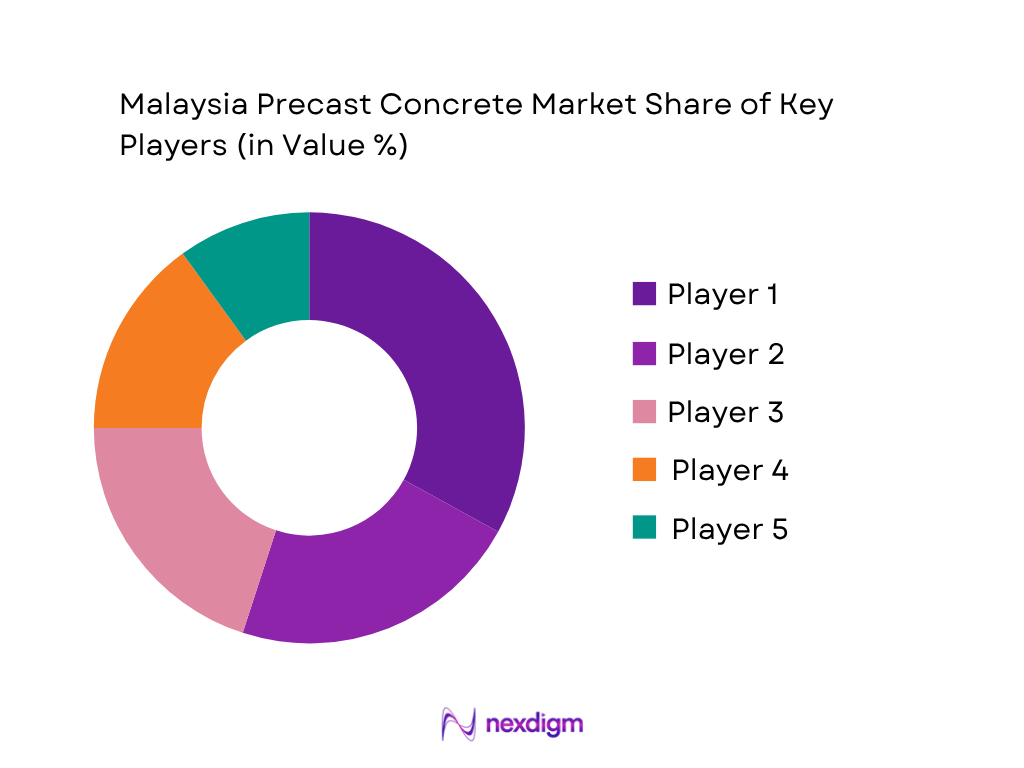
The Malaysia Precast Concrete Market includes integrated construction groups, dedicated precast manufacturers, infrastructure suppliers and IBS specialists. Companies such as Gamuda, Sunway Construction, IJM, Eastern Pretech and OKA participate across different portions of the precast and industrialised construction ecosystem. Their capabilities range from structural precast and hollow-core products to infrastructure components, IBS systems and integrated project execution. Eastern Pretech, for example, supplies hollow-core slabs, columns, beams, walls, bridge beams, railway sleepers and tunnel segments, while OKA supplies infrastructure products including pipes, box culverts, piles, beams and IBS components.
| Company | Establishment | Headquarters | Precast Focus | IBS / DfMA Capability | Key Product Coverage | Infrastructure Capability | Manufacturing / Project Capability |
| Gamuda Berhad | 1976 | Petaling Jaya, Selangor | ~ | ~ | ~ | ~ | ~ |
| Sunway Construction Group Berhad | 1981 | Bandar Sunway, Selangor | ~ | ~ | ~ | ~ | ~ |
| IJM Corporation Berhad | 1983 | Petaling Jaya, Selangor | ~ | ~ | ~ | ~ | ~ |
| Eastern Pretech Malaysia | ~1970s | Seri Kembangan, Selangor | ~ | ~ | ~ | ~ | ~ |
| OKA Corporation Berhad | 1981 | Ipoh, Perak | ~ | ~ | ~ | ~ | ~ |
Malaysia Precast Concrete Market Analysis
Growth Drivers
Expansion of Construction Work and Infrastructure Development
Malaysia’s construction pipeline provides a direct demand base for precast concrete across structural, residential, commercial and civil-engineering applications. The Department of Statistics Malaysia reported RM158.8 billion of construction work completed in 2024, including RM61.1 billion in civil engineering, RM44.4 billion in non-residential buildings and RM35.8 billion in residential buildings. Within civil engineering, roads and railways accounted for RM6.9 billion of work during the fourth quarter alone, while utility projects contributed RM6.8 billion. This activity supports demand for precast beams, columns, slabs, drainage products, culverts, barriers, bridge components and other repetitive components that can be manufactured away from the construction site. Major infrastructure programmes also remain relevant: CIDB identified the East Coast Rail Link, Rapid Transit System and Pan Borneo Highway among the major infrastructure developments supporting construction activity. The ECRL had reached 80% completion by November 2024, while the Johor Bahru–Singapore RTS Link had reached 83% completion by August 2024. These projects create requirements for standardized, durable and rapidly installable concrete components, supporting broader adoption of precast solutions across Malaysia’s infrastructure and building construction ecosystem.
Data Centre, Industrial and High-Value Building Expansion
Malaysia’s rapid expansion of digital infrastructure is creating an additional construction pipeline for precast concrete suppliers, particularly in Johor, Selangor and Kuala Lumpur. MIDA reported that Malaysia approved RM114.7 billion of investments in data centres and cloud services between 2021 and 2023, while digital investments approved during the first 10 months of 2024 reached RM141.72 billion and were associated with 41,078 job opportunities. Johor has become a particularly important construction location: nine data-centre projects with combined capacity of 1,280 megawatts had been completed by June 2024, while six additional projects with almost 1,490 megawatts of capacity were being completed. Google also announced a RM9.4 billion investment covering its first Malaysian data centre and Google Cloud region. These facilities require substantial quantities of structural concrete, foundations, floor systems, utility structures, boundary elements and other standardized components. Beyond data centres, Malaysia recorded RM378.5 billion in approved investments in 2024, with Selangor attracting RM101.1 billion, Kuala Lumpur RM91.5 billion and Johor RM48.5 billion. The combination of digital infrastructure, industrial investment and commercial development therefore expands the addressable construction base for precast manufacturers.
Market Challenges
Skilled Labour Constraints and Installation Requirements
Labour availability remains a structural challenge for Malaysia’s precast concrete industry because precast construction shifts part of the workload from conventional site construction toward factory production, specialist transportation, lifting and installation. CIDB identified skilled-labour shortages as an issue affecting the construction sector in 2024, noting that shortages had contributed to higher wages for certain trades and increased pressure on project execution. The government also introduced a construction-sector foreign-worker registration regularisation programme covering the period from May through December 2024, demonstrating the importance of workforce availability to project delivery. Precast components can reduce repetitive site activities, but installation still requires trained personnel capable of positioning, lifting, connecting and aligning heavy elements. Centralized production also requires coordination between manufacturing schedules and site readiness. Delays in foundations, transportation access, crane availability or installation sequencing can result in finished components remaining in storage rather than being installed. CIDB’s 2024 construction outlook also identified rising material costs and labour shortages as issues requiring industry attention. For precast manufacturers, these conditions increase the importance of production planning, skilled installation teams, lifting equipment coordination and integration between designers, manufacturers, contractors and developers.
Transportation, Site Logistics and Project Coordination Complexity
Heavy-component logistics can constrain the adoption of precast concrete when manufacturing facilities are located far from construction sites or when projects have restricted access for large transport vehicles and cranes. Malaysia’s geographically distributed construction pipeline increases the importance of production-location planning, transportation scheduling and site accessibility. Construction activity is particularly concentrated in major states: DOSM reported construction work done of RM9.4 billion in Selangor, RM7.4 billion in Johor, RM4.7 billion in the Federal Territories and RM4.6 billion in Sarawak during the fourth quarter of 2024. This geographic spread requires manufacturers to coordinate production and delivery across different project locations and infrastructure conditions. Precast elements such as beams, columns, slabs, culverts and bridge components may require specialized vehicles and lifting equipment, while storage space must be available when installation cannot proceed immediately. Project design changes create another challenge because factory-produced components are less flexible once manufacturing has started. The combination of transportation requirements, crane planning, temporary storage, dimensional accuracy and sequencing therefore makes coordination critical. As Malaysia’s construction sector reached RM158.8 billion of work completed in 2024, the scale and geographic diversity of construction activity reinforce the need for integrated production-to-installation planning.
Market Opportunities
Industrialised Building System and DfMA-Based Precast Adoption
Malaysia’s construction productivity requirements create an opportunity for wider adoption of Industrialised Building System and Design for Manufacture and Assembly approaches using precast concrete. The country’s construction sector completed RM158.8 billion of work in 2024, with residential buildings contributing RM35.8 billion and non-residential buildings RM44.4 billion. These building categories contain significant volumes of repetitive structural elements, creating suitable applications for factory-manufactured beams, columns, slabs, wall panels, staircases and other standardized components. Precast production can shift repetitive activities into controlled manufacturing environments while reducing the amount of formwork and wet-trade activity required at the construction site. The opportunity is particularly relevant to high-rise residential, industrial, logistics and commercial developments where repeated floor layouts and structural grids can support standardized component production. Malaysia’s investment environment also provides a broader construction base: MIDA reported RM378.5 billion in approved investments during 2024, including RM120.5 billion in manufacturing and RM252.7 billion in services. These investments can generate new factories, warehouses, commercial facilities and supporting infrastructure requiring rapid construction. The combination of large construction activity, standardized building designs and industrial investment creates scope for precast manufacturers to expand DfMA-oriented solutions and integrated design-to-installation services.
Data Centre and Specialized Infrastructure Precast Components
The rapid development of Malaysia’s data-centre ecosystem creates an opportunity for precast suppliers to expand into specialized components designed for digitally intensive facilities and associated infrastructure. MIDA reported RM141.72 billion in approved digital investments during the first 10 months of 2024, while 41,078 job opportunities were associated with the digital economy during the same period. Johor alone had nine completed data-centre projects with combined capacity of 1,280 megawatts by June 2024 and six additional projects with almost 1,490 megawatts of capacity under completion. MIDA also reported that 12 data centres had attracted RM90.2 billion of foreign direct investment commitments between 2021 and June 2024. These developments require large quantities of concrete for structural frames, equipment bases, utility structures, cable routes, drainage systems, perimeter structures and other specialized applications. Precast manufacturers can therefore develop standardized products tailored to data-centre construction, including heavy-duty floor elements, utility chambers, precast drainage systems, barriers and modular structural components. The opportunity also extends to industrial parks, logistics facilities and infrastructure supporting power and connectivity requirements. With digital infrastructure continuing to attract major investment commitments, specialized precast solutions can become an increasingly relevant component of Malaysia’s high-value construction supply chain.
Future Outlook
The Malaysia Precast Concrete Market is expected to develop through greater adoption of industrialised construction, infrastructure expansion, modular construction and Design for Manufacture and Assembly. The construction sector recorded RM158.8 billion in work done in 2024 and subsequently reached RM178.6 billion in 2025, according to DOSM. The market outlook is also supported by CIDB’s continued development of IBS, DfMA and BIM-related construction practices. CIDB identifies more than 300 registered Malaysian IBS manufacturers, while its technical publications include dedicated guidelines for IBS precast concrete and DfMA precast concrete. The forecasted CAGR for the Malaysia Precast Concrete Market during 2026–2035 is ~XX%, with future expansion expected across structural precast, infrastructure components, modular buildings, hollow-core slabs, IBS systems and specialized infrastructure products.
Major Players
- Gamuda Berhad
- Sunway Construction Group Berhad
- IJM Corporation Berhad
- Eastern Pretech Malaysia
- OKA Corporation Berhad
- SPC Industries Sdn Bhd
- Progressive Precast Sdn Bhd
- Utama Concrete Industries Sdn Bhd
- LM Precast Concrete Sdn Bhd
- Prebuild Material Sdn Bhd
- Macro Precasters
- Zentra Industries Sdn Bhd
- Gamuda IBS
- Sunway Construction Precast Manufacturing
- IJM IBS
Key Target Audience
- Real Estate Developers and Property Development Companies
- Infrastructure Developers and Main Contractors
- Precast Concrete Manufacturers and IBS System Providers
- Cement, Concrete and Construction Material Manufacturers
- Investments and Venture Capitalist Firms
- Government and Regulatory Bodies (Construction Industry Development Board Malaysia, Ministry of Works Malaysia, Public Works Department Malaysia, National Water Services Commission)
- Railway, Highway and Transportation Infrastructure Operators
- Architectural, Structural Engineering and Building-System Procurement Teams
Research Methodology
Step 1: Identification of Key Variables
The initial phase involves constructing a Malaysia Precast Concrete Market ecosystem covering manufacturers, cement suppliers, component suppliers, contractors, developers, infrastructure authorities and IBS stakeholders. Secondary research will establish the principal variables covering production capacity, product categories, installation volumes, project pipelines, construction output and IBS adoption.
Step 2: Market Analysis and Construction
Historical and current construction indicators will be compiled from official Malaysian sources, including construction work done, civil-engineering activity, residential and non-residential construction, infrastructure development and regional construction activity. The analysis will then connect these indicators with precast product applications, manufacturing capacity, project requirements and end-use demand.
Step 3: Hypothesis Validation and Expert Consultation
Market hypotheses will be validated through discussions with manufacturers, contractors, developers, engineers and other participants involved in precast production and installation. Interviews will examine product demand, plant utilization, project specifications, IBS adoption, procurement practices, transportation constraints and component installation requirements.
Step 4: Research Synthesis and Final Output
The final stage will triangulate supply-side production information, demand-side construction indicators, company-level information and project-level evidence. Bottom-up estimates will be reconciled with top-down construction expenditure and application data to develop the final market model, segmentation structure, competitive assessment and forecast framework.

- Executive Summary
- Research Methodology (Market Definitions and Assumptions, Malaysia Precast Concrete Market Classification, Precast Concrete Product Mapping, Industrialised Building System Scope, Structural Precast Assessment, Architectural Precast Assessment, Infrastructure Precast Assessment, Precast Manufacturing Assessment, Precast Plant Capacity Assessment, Production Process Assessment, Concrete Mix and Strength Assessment, Reinforcement and Prestressing Assessment, Mould and Casting Technology Assessment, Curing Technology Assessment, Quality Control Assessment, Handling and Transportation Assessment, Site Erection Assessment, Supply-Side Assessment, Demand-Side Assessment, Construction Pipeline Assessment, Top-Down Market Sizing, Bottom-Up Market Sizing, Primary Industry Interviews, Project-Level Validation, Data Triangulation, Forecasting Framework)

- Definition and Scope
- Malaysia Precast Concrete Industry Evolution and Development of Precast Structural Systems, Industrialised Building Systems, Precast Building Components, Precast Infrastructure Components, Precast Drainage Systems, Precast Sewerage Products, Precast Road Products, Precast Railway Components, Precast Bridge Components, Precast Tunnel Segments, Precast Architectural Components, Hollow-Core Slabs, Precast Wall Panels, Prefabricated Volumetric Components, Prefabricated Bathroom Units, Sustainable Precast Concrete Technologies
- Precast Concrete Value Chain Analysis
- Precast Concrete Supply Chain Analysis

- Growth Drivers (Expansion of Construction Work, Industrialised Building System Adoption, Urban Residential Development, Infrastructure Development, High-Rise Construction, Industrial and Logistics Expansion, Data Centre Construction, Transportation Infrastructure Investment, Construction Productivity Requirements, Labour Efficiency Requirements, Factory-Controlled Quality, Faster Project Execution)
- Market Challenges (High Initial Manufacturing Investment, Heavy Component Transportation Requirements, Site Accessibility Constraints, Crane and Lifting Requirements, Skilled Precast Installation Requirements, Project Design Changes, Manufacturing and Site Coordination Complexity, Limited Standardisation Across Projects, Precast Storage Requirements, Logistics Distance Constraints, Quality-Control Requirements, Manufacturing Capacity Utilisation Risk)
- Market Opportunities (IBS Precast Adoption, DfMA Precast Construction, Modular Building Systems, High-Rise Residential Precast, Data Centre Construction, Industrial and Logistics Facilities, Infrastructure Precast Components, Railway and Metro Components, Bridge and Highway Precast, Precast Drainage Systems, Sustainable Precast Concrete, Low-Carbon Concrete Components, Prefabricated Volumetric Construction, Precast Retrofit and Replacement Components)
- Market Trends (Industrialised Building System Adoption, DfMA Integration, BIM-Based Precast Design, Digital Precast Manufacturing, Automated Reinforcement Processing, Automated Casting Systems, High-Performance Concrete, Self-Compacting Concrete, Hollow-Core Slab Adoption, Prefabricated Bathroom Units, Volumetric Precast Construction, Modular Construction, Low-Carbon Concrete, Recycled Aggregate Integration, Factory-Based Quality Control)
- Government Regulations and Standards (CIDB Industrialised Building System Requirements, IBS Score Requirements, CIS 18 IBS Content Scoring System, CIS 24 IBS Assessment and Certification, CIS 8 Precast Hollow-Core Slab Guidelines, CIS 9 Precast Concrete Handling and Installation Guidelines, Precast Concrete Production Guidelines, DfMA Precast Guidelines, Malaysian Standards for Concrete Products, SIRIM Product Certification, Construction Material Compliance Requirements, Occupational Safety and Health Requirements, Building Control Requirements, Fire Safety Requirements, Structural Design Requirements, Quality Assessment Requirements)
- SWOT Analysis
- Porter’s Five Forces Analysis
- PESTLE Analysis
- Stakeholder Ecosystem

- By Market Value (2020-2025)
- By Precast Concrete Production Volume (2020-2025)
- By Precast Concrete Installation Volume (2020-2025)
- By Precast Concrete Installation Area (2020-2025)
- By Structural Precast Production Volume (2020-2025)
- By Infrastructure Precast Production Volume (2020-2025)

- By Product Type (In Value %)
Precast Beams
Precast Columns
Precast Slabs
Precast Wall Panels
Hollow-Core Slabs
Precast Staircases and Landings
Precast Roof and Floor Systems
Precast Architectural Components
Precast Facade Panels
Precast Bathroom and Volumetric Units
Precast Drainage Products
Precast Box Culverts and Manholes
Precast Pipes and Utility Products
Precast Road Barriers and Kerbs
Precast Railway Sleepers and Track Components
Precast Bridge Girders and Deck Components
Precast Tunnel and Metro Segments
Other Precast Concrete Products - By Construction Method (In Value %)
Industrialised Building System Precast
Conventional Precast Construction
Design for Manufacture and Assembly Precast
Prefabricated Volumetric Construction
Prefabricated Prefinished Volumetric Construction
Hybrid Precast and In-Situ Construction
Modular Precast Construction - By End-Use Industry (In Value %)
Residential Buildings
Commercial Buildings
Office Buildings
Retail and Shopping Centres
Hospitality and Hotels
Warehouses and Logistics Facilities
Data Centres
Healthcare Facilities
Educational Buildings
Government and Institutional Buildings
Transportation Infrastructure
Railways and Metro Infrastructure
Roads and Highways
Bridges and Elevated Structures
Water and Wastewater Infrastructure
Utility and Power Infrastructure - By Component Type (In Value %)
Structural Components
Non-Structural Components
Load-Bearing Wall Systems
Non-Load-Bearing Wall Systems
Floor Systems
Roof Systems
Staircase Systems
Facade Systems
Drainage and Utility Components
Transportation Components - By Region (In Value %)
Selangor
Kuala Lumpur
Johor
Penang
Perak
Negeri Sembilan
Sarawak
Sabah
Pahang
Melaka
Terengganu
Perlis

- Market Share of Major Players (By Malaysia Revenue, Precast Production Capacity, Precast Installation Volume, Manufacturing Plant Capacity, Structural Precast Capability, Infrastructure Precast Capability, IBS Capability, Modular Construction Capability, Product Portfolio Breadth, Regional Production Coverage, Project Portfolio, Transportation Capability, Installation Capability, Engineering Capability)
- Cross Comparison Parameters (Precast Product Portfolio Breadth, Manufacturing Capacity, IBS and DfMA Capability, Structural Precast Capability, Infrastructure Precast Capability, Automated Production Capability, BIM and Digital Engineering Capability, Precast Installation and Project Execution Capability)
- SWOT Analysis of Major Players
- Detailed Profiles of Major Companies
Gamuda BerhadSunway Construction Group BerhadIJM Corporation BerhadEastern Pretech (Malaysia) Sdn BhdOKA Corporation Berhad
UCI Resources Berhad
SPC Industries Sdn Bhd
Progressive Precast Sdn Bhd
Utama Concrete Industries Sdn Bhd
LM Precast Concrete Sdn Bhd
Prebuild Material Sdn Bhd
Macro Precasters
Zentra Industries Sdn Bhd
Sunway Construction Precast Manufacturing
IJM IBS

- Real Estate Developer Precast Requirement Assessment
- Main Contractor Procurement Assessment
- Precast Contractor Project Requirement Analysis
- Architect and Structural Engineer Specification Assessment
- IBS Adoption Assessment
- Residential High-Rise Precast Requirement Assessment

- By Market Value (2026-2035)
- By Precast Concrete Production Volume (2026-2035)
- By Precast Concrete Installation Volume (2026-2035)
- By Precast Concrete Installation Area (2026-2035)
- By Structural Precast Production Volume (2026-2035)
- By Infrastructure Precast Production Volume (2026-2035)


 Request a Sample
 Ask for Customization
 Get a Quote
 Enquire Now
