
 Download PDF
Market Overview
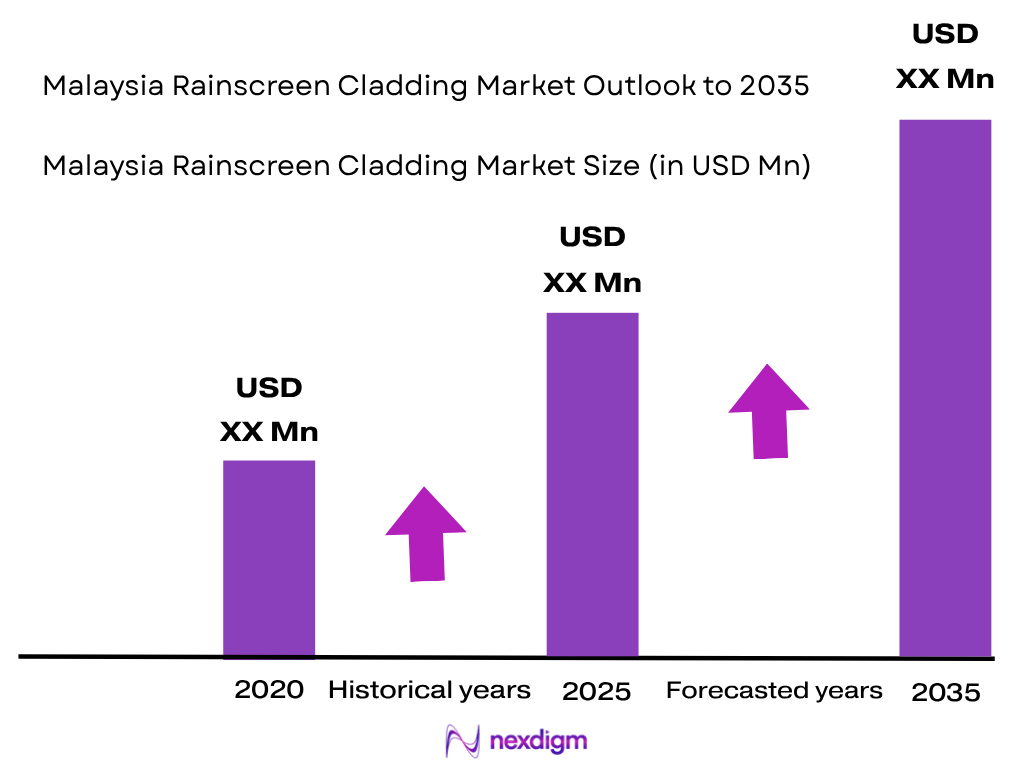
The Malaysia Rainscreen Cladding Market is valued at approximately ~USD XX million, based on the report’s bottom-up and top-down sizing framework. The underlying construction base strengthened materially, with construction work done increasing from RM132.2 billion in the preceding annual period to RM158.8 billion in the latest annual period. Non-residential buildings, residential developments, special trades and refurbishment activity are expanding the addressable façade area for ventilated cladding systems.
Klang Valley, particularly Kuala Lumpur and Selangor, dominates rainscreen specifications because of its concentration of high-rise offices, condominiums, malls, hotels and mixed-use developments, while Johor is becoming increasingly important for data centres and industrial buildings. Selangor recorded RM9.4 billion of construction work in the latest fourth quarter, Johor recorded RM7.4 billion, Federal Territories recorded RM4.7 billion, and Sarawak recorded RM4.6 billion, reflecting strong regional construction clusters suitable for engineered exterior façades.
Market Segmentation
By Material Type
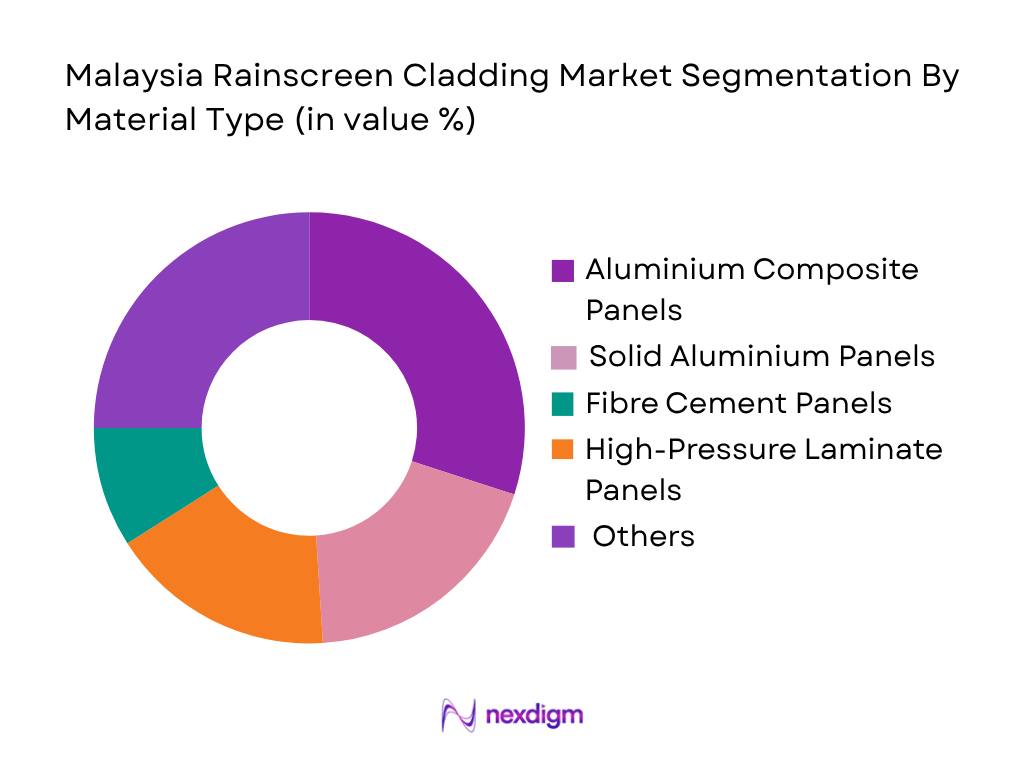
The Malaysia Rainscreen Cladding Market is segmented into aluminium composite panels, solid aluminium panels, fibre cement panels, high-pressure laminate panels, terracotta and ceramic panels, natural stone panels, metal panels, GRC/GFRC and other specialty materials. Aluminium composite panels are considered the dominant sub-segment because Malaysia has an established aluminium fabrication ecosystem and ACP systems remain widely applicable across retail, commercial, hospitality and mixed-use façades. Their lightweight construction reduces structural loading, while routing, folding and cassette fabrication allow designers to create large-format architectural surfaces. Aluminium systems also suit Malaysia’s high-rise environment because panels can be integrated with mechanically fixed rails and brackets. However, fire-performance requirements are increasingly shifting premium projects toward mineral-core ACP and solid aluminium systems. Fibre cement is another important segment due to its moisture resistance, architectural texture and suitability for ventilated façades. Terracotta, ceramic and HPL remain more specification-driven, typically serving premium developments where surface character and architectural differentiation justify higher system complexity.
By Building Type
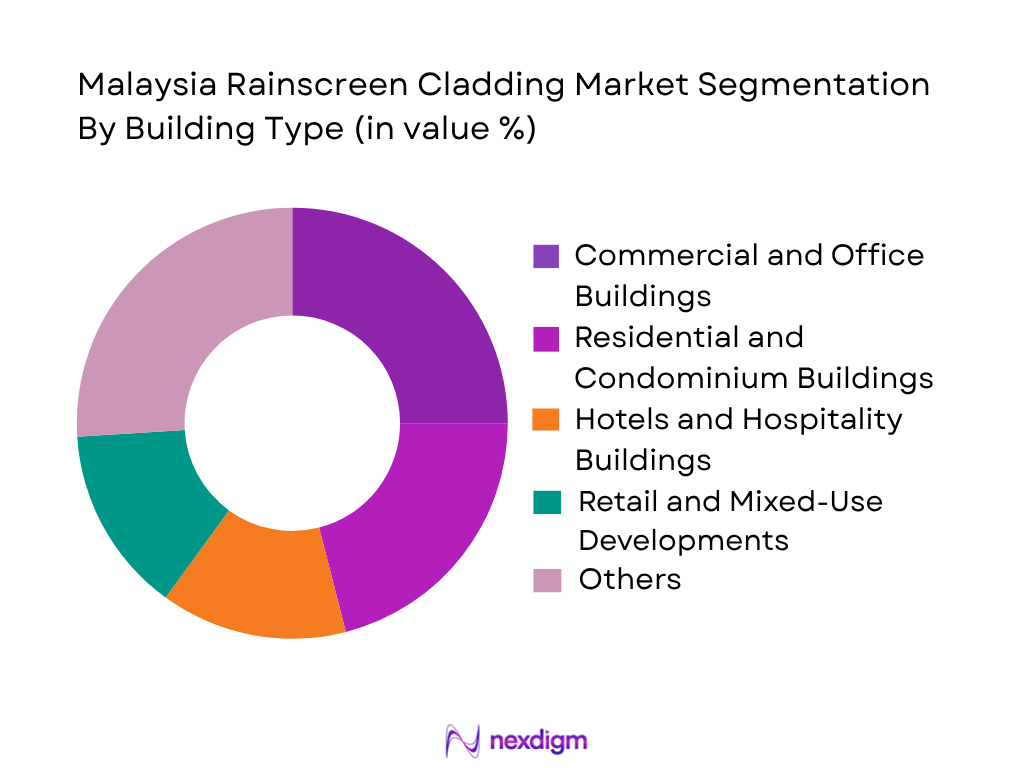
The Malaysia Rainscreen Cladding Market is segmented into commercial and office buildings, residential developments, hotels and resorts, retail and mixed-use properties, data centres, industrial and logistics facilities, institutional buildings and transportation infrastructure. Commercial and office buildings are considered the dominant sub-segment because Kuala Lumpur and Selangor contain a dense concentration of premium towers and income-generating properties where façade quality directly affects building positioning. Rainscreen systems provide architects with flexibility in panel dimensions, colours, joint patterns and surface finishes while also enabling ventilated cavities and external insulation. Mixed-use developments similarly generate substantial cladding demand because podiums, towers and retail components frequently require different exterior materials within one development. Johor’s rapidly expanding data-centre ecosystem is also becoming an increasingly important demand source. As of mid-2024, 9 data-centre projects with 1,280 MW of combined capacity had been completed in Johor and 6 additional projects approaching 1,490 MW were under development.
Competitive Landscape
The Malaysia Rainscreen Cladding Market is fragmented across domestic aluminium fabricators, façade contractors, fibre-cement manufacturers, international architectural-panel brands and specialist fixing-system suppliers. Local participants benefit from fabrication capabilities, shorter delivery cycles and relationships with main contractors, while international brands generally compete through proprietary panel technologies, architectural specifications, fire-performance credentials and global project references. Competition is therefore determined not only by panel supply but also by substructure engineering, fabrication support, testing documentation, technical assistance, local inventory and the ability to secure specification approval with architects and façade consultants.
| Major Player | Establishment Year | Headquarters | Core Rainscreen Offering | Material / Technology | Local Supply Capability | Fire & Weather Performance | Main Applications | Specification / Technical Support |
| PMB Facade Technology Sdn. Bhd. | 2008 | Malaysia | ~ | ~ | ~ | ~ | ~ | ~ |
| 3A Composites – ALUCOBOND / ALUCOLUX | 2010 under current identity | Germany | ~ | ~ | ~ | ~ | ~ | ~ |
| Etex Group – EQUITONE | 1905 | Zaventem, Belgium | ~ | ~ | ~ | ~ | ~ | ~ |
| Hilti Malaysia | 1941 | Schaan, Liechtenstein | ~ | ~ | ~ | ~ | ~ | ~ |
| ROCKWOOL Group | 1937 | Hedehusene, Denmark | ~ | ~ | ~ | ~ | ~ | ~ |
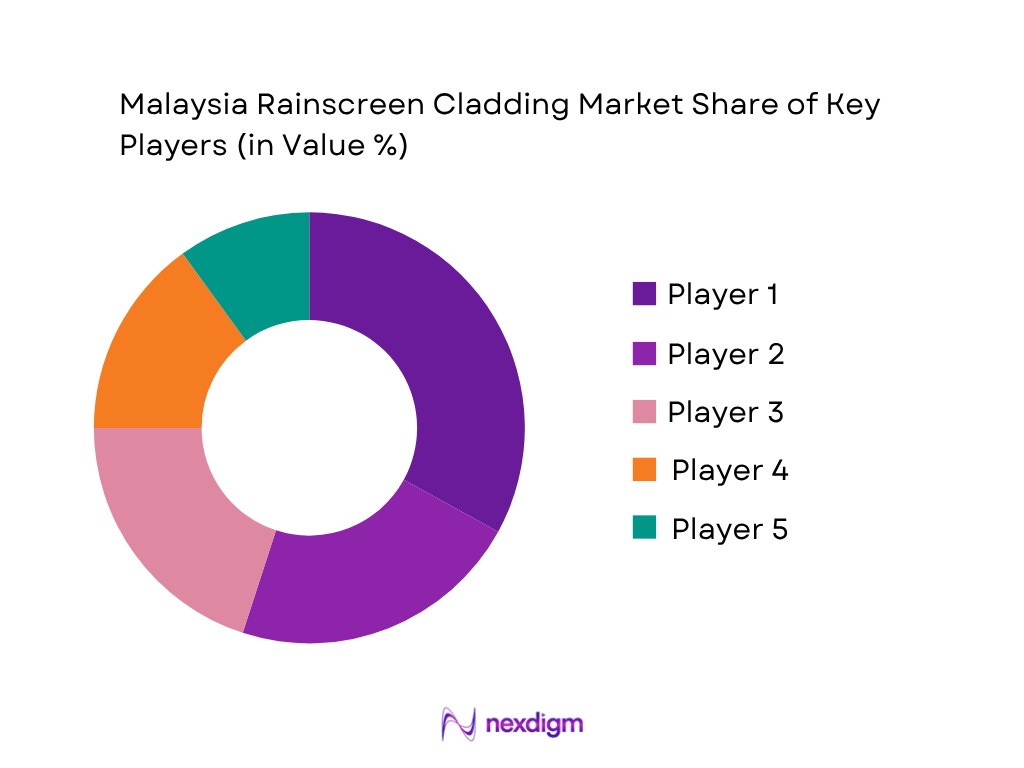
Malaysia Rainscreen Cladding Market Analysis
Growth Drivers
Expanding Non-Residential and High-Rise Construction Activity
Malaysia’s rainscreen cladding demand is being strengthened by a substantial pipeline of non-residential, residential and specialist construction requiring durable external envelopes, ventilated cavities, aluminium panels and fibre-cement systems. Department of Statistics Malaysia data show total construction work done reached RM158.8 billion in 2024, including RM44.4 billion from non-residential buildings, RM35.8 billion from residential buildings and RM17.5 billion from special trade activities. Selangor, Kuala Lumpur and Johor remain particularly relevant because they concentrate offices, condominiums, hotels, mixed-use projects, industrial buildings and data centres where engineered façade systems are more widely specified. The macroeconomic environment supports this underlying construction demand: the IMF recorded Malaysia’s nominal GDP at RM1,952 billion in 2024, while gross official reserves stood at USD116.2 billion and the current-account balance reached USD10.2 billion. These indicators reinforce the scale and financial capacity of the economy supporting large real-estate and infrastructure projects. For rainscreen suppliers, the combination of sizeable non-residential building activity and metropolitan high-rise construction expands opportunities for solid aluminium, mineral-core composite panels, ventilated fibre cement, terracotta systems and mechanically fixed façade substructures.
Data Centre and Advanced Digital Infrastructure Development
Malaysia’s rapid emergence as a regional data-centre hub is creating a highly relevant demand channel for rainscreen cladding, insulated façade panels, non-combustible exterior materials and corrosion-resistant substructures. Government investment data show RM141.72 billion of digital investments were approved during the first ten months of 2024, generating 41,078 jobs. Johor had 10 operating data centres and another 7 facilities under development as of October, while 36 additional infrastructure applications were being assessed. Earlier in 2024, Johor reported 9 completed data-centre projects with 1,280 MW of capacity and another 6 projects approaching 1,490 MW under development. Malaysia also attracted Google’s RM9.4 billion planned investment for its first Malaysian data centre and cloud region. The wider macroeconomic environment provides further support: IMF data place Malaysia’s nominal GDP at RM1,952 billion, official reserves at USD116.2 billion, and the current-account balance at USD10.2 billion in 2024. Data-centre campuses require external walls capable of providing fire safety, weather resistance, ease of replacement and coordinated thermal performance, positioning metal rainscreens, fibre-cement panels, mineral-wool insulation and engineered bracket systems for stronger specification across Johor and other digital-infrastructure clusters.
Market Challenges
Dependence on Imported Façade Materials and Components
Malaysia’s rainscreen cladding sector remains exposed to international supply chains because premium façade projects frequently rely on imported composite panels, specialist aluminium products, high-pressure laminates, terracotta systems, proprietary anchors, membranes and fire-protection components. Department of Statistics Malaysia recorded total imports of RM1,370.2 billion in 2024, while intermediate-goods imports reached RM748.84 billion and capital-goods imports amounted to RM166.86 billion. This broad import dependence illustrates the scale of Malaysia’s exposure to overseas equipment and material flows, which is relevant to façade contractors procuring products from Europe, China, Japan and other Asian manufacturing centres. Macroeconomic data reinforce the external exposure: the IMF recorded Malaysia’s total external debt at USD284.6 billion in 2024, alongside official reserves of USD116.2 billion and nominal GDP of RM1,952 billion. Rainscreen projects are particularly vulnerable because complete systems involve multiple interdependent components, including panels, rails, brackets, anchors, insulation and cavity barriers. A delay or substitution affecting one component can require redesign, engineering approval or revised testing documentation. This makes local inventory, domestic fabrication, alternative sourcing and standardized substructure systems increasingly important competitive capabilities for Malaysian rainscreen suppliers.
Specialist Labour and Façade Installation Capacity Constraints
Rainscreen cladding installation requires specialist competencies in façade surveying, bracket alignment, anchoring, panel fabrication, cavity detailing, waterproofing, fire stopping and high-rise access, making workforce capacity an important execution challenge as Malaysia’s construction pipeline expands. Department of Statistics Malaysia recorded approximately 1.415 million people employed in construction in the fourth quarter of 2024, while construction-sector value added per employment stood at RM12,274 per person and value added per hour worked was RM20.5. Average construction working time reached 46.3 hours per week, illustrating the labour intensity of project delivery. In early 2025, sector employment increased to approximately 1.419 million persons, with 851 million total hours worked during the first quarter. The broader Malaysian economy employed 16.79 million people in the fourth quarter of 2024, while the IMF recorded nominal GDP at RM1,952 billion and gross official reserves at USD116.2 billion. For rainscreen projects, labour availability becomes more critical because poor installation can cause misalignment, panel distortion, water ingress, fastener failure or incomplete cavity barriers. As high-rise, data-centre and complex commercial projects increase simultaneously, façade contractors must compete for experienced installers, site supervisors, fabricators and engineers capable of delivering compliant rainscreen assemblies.
Market Opportunities
Expansion of Energy-Efficient and High-Performance Building Envelopes
Malaysia’s growing construction and investment base creates a strong future opportunity for rainscreen systems designed around insulation, moisture drainage, thermal performance and durable exterior finishes. Non-residential construction work reached RM44.4 billion in 2024, residential building work reached RM35.8 billion, and special trade activities generated RM17.5 billion, providing a sizeable pool of projects where engineered façade upgrades can be incorporated. Malaysia also approved 6,700 investment projects with a combined value of RM378.5 billion, including RM252.7 billion in services and RM120.5 billion in manufacturing. These projects support additional offices, industrial buildings, logistics facilities, digital infrastructure and associated commercial property requiring modern building envelopes. The macroeconomic base remains substantial: the IMF recorded nominal GDP of RM1,952 billion, a current-account surplus of USD10.2 billion, and official reserves of USD116.2 billion in 2024. These conditions support continued investment in income-producing and operationally critical buildings. For rainscreen suppliers, future opportunity lies in combining exterior panels with mineral-wool insulation, thermally improved brackets, drainage cavities and non-combustible components, enabling developers to address envelope performance and architectural requirements simultaneously rather than treating cladding solely as a decorative exterior layer.
Johor, Selangor and Industrial-Corridor Façade Expansion
Malaysia’s concentration of new investment in Johor, Selangor and other industrialized states provides a clear geographic opportunity for rainscreen cladding suppliers targeting data centres, advanced manufacturing, logistics facilities and supporting commercial developments. Malaysia approved RM378.5 billion of investments across 6,700 projects in 2024, with Selangor attracting RM101.1 billion, Kuala Lumpur RM91.5 billion, Johor RM48.5 billion, Kedah RM45.8 billion and Penang RM32.0 billion. The same investment pipeline is expected to generate more than 207,000 jobs, expanding demand for supporting offices, housing, services and built infrastructure around these industrial clusters. Data-centre investment adds further relevance: Malaysia attracted RM24.1 billion of digital-infrastructure investment in 2024, covering data centres, cloud computing and data-hosting projects. From a macroeconomic perspective, World Bank data place Malaysia’s GDP at USD472.19 billion in 2025 and GDP per capita at USD13,124.6, while the IMF recorded official reserves of USD116.2 billion in 2024. These current indicators support an expanding base of capital-intensive projects where lightweight, replaceable and weather-resistant façade systems can outperform conventional exterior finishes. Rainscreen suppliers with local fabrication, regional warehouses and engineered non-combustible systems are positioned to benefit from this geographically concentrated development pipeline.
Future Outlook
The Malaysia Rainscreen Cladding Market is expected to record sustained expansion through 2035, supported by high-rise development, digital infrastructure investment, industrial construction, commercial refurbishment and increasing attention to energy-efficient building envelopes. The market is forecast to grow at approximately ~X.X% CAGR during 2026-2035. Demand is likely to shift progressively toward non-combustible materials, engineered substructures, externally insulated ventilated façades and systems offering stronger tropical-weather performance.
Johor is expected to become one of the most important incremental demand centres. Malaysia secured major technology and data-centre commitments during 2024, including Google’s RM9.4 billion planned investment in its first Malaysian data centre and cloud region. Digital investments approved during the first ten months reached RM141.72 billion, while 10 data centres were operating and another 7 were under development in Johor by October. These developments create demand for fire-safe, maintainable and rapidly installed external wall systems.
Major Players
- PMB Facade Technology Sdn. Bhd.
- Hunter Douglas (M) Sdn. Bhd.
- 3A Composites – ALUCOBOND / ALUCOLUX
- Etex Group – EQUITONE
- SHERA Public Company Limited
- ROCKWOOL Group
- Sika Malaysia
- Hilti Malaysia
- FunderMax
- Trespa International B.V.
- Swisspearl Group
- LB Aluminium Berhad
- Sung Yu Architectural Materials Sdn. Bhd.
- GNG Distributors / Terracotta Tiles Centre
- YAP GRC Construction Sdn. Bhd.
Key Target Audience
- Rainscreen Cladding and Architectural Panel Manufacturers
- Façade Contractors, Fabricators and Installation Companies
- Aluminium Extruders and Rainscreen Substructure Manufacturers
- Building Material Importers and Distributors
- Real Estate Developers, Property Owners and Asset Management Companies
- Investments and Venture Capitalist Firms
- Government and Regulatory Bodies (Construction Industry Development Board Malaysia, Department of Standards Malaysia, Fire and Rescue Department of Malaysia, Sustainable Energy Development Authority Malaysia, Local Authorities)
- Data Centre, Commercial, Hospitality, Industrial and Logistics Property Operators
Research Methodology
Step 1: Identification of Key Variables
The initial phase involves mapping the complete Malaysia Rainscreen Cladding Market ecosystem, including panel manufacturers, aluminium fabricators, importers, façade contractors, developers, architects, distributors, insulation companies and fixing-system suppliers. Secondary and proprietary datasets are examined to identify material categories, construction locations, building types, project pipelines and regulatory variables. Core sizing variables include façade area, rainscreen penetration, material mix, installation intensity and project value.
Step 2: Market Analysis and Construction
Historical construction activity is analysed alongside residential and non-residential building work, façade project awards, building completions and material supply. The top-down approach converts relevant construction activity into addressable exterior-wall area and estimated rainscreen penetration. The bottom-up approach evaluates manufacturer sales, distributor throughput, façade-contractor activity, fabrication capacity and project-level installations to develop an independently constructed market framework.
Step 3: Hypothesis Validation and Expert Consultation
Initial assumptions are validated through structured discussions and computer-assisted telephone interviews with façade manufacturers, fabricators, contractors, architects, developers, distributors and technical specialists. These interactions examine material preferences, specification conversion, procurement routes, imported versus local supply, fire-performance requirements, fixing technologies and project execution issues. Findings are compared with secondary information to identify inconsistencies and refine the market model.
Step 4: Research Synthesis and Final Output
The final phase triangulates supply-side information, demand-side construction activity and project-level façade data. Installed square metres, material consumption, supplier activity and building pipelines are reconciled across multiple sources. Long-term forecasts incorporate data-centre construction, high-rise development, refurbishment potential, façade regulation, material substitution, green-building requirements and regional expansion to produce a consistent outlook for the Malaysia Rainscreen Cladding Market.

- Executive Summary
- Research Methodology (Market Definitions and Assumptions, Malaysia Rainscreen Cladding Market Classification, Building-Envelope Scope, Rainscreen System Mapping, Ventilated Facade Assessment, Drained-and-Back-Ventilated Rainscreen Assessment, Pressure-Equalized Rainscreen Assessment, Open-Joint Rainscreen Assessment, Closed-Joint Rainscreen Assessment, Aluminium Composite Panel Assessment, Solid Aluminium Panel Assessment, Fibre Cement Panel Assessment, High-Pressure Laminate Assessment, Terracotta and Ceramic Panel Assessment, Natural Stone Rainscreen Assessment, Metal Panel Assessment, GRC and GFRC Panel Assessment, Rainscreen Substructure Assessment, Aluminium Rail and Bracket Assessment, Mechanical Fixing Assessment, Concealed Fixing Assessment, Thermal Insulation Assessment, Cavity Barrier Assessment, Thermal Performance Assessment, Fire Performance Assessment, Wind-Load Assessment, Water-Tightness Assessment, Tropical Moisture Assessment, Corrosion Resistance Assessment, OTTV Assessment, MS 1525 Compliance Assessment, CIDB Compliance Assessment, Supply-Side Assessment, Demand-Side Assessment, Top-Down Market Sizing, Bottom-Up Market Sizing, Primary Industry Interviews, Construction Project Pipeline Assessment, Data Triangulation, Forecasting Framework)

- Definition and Scope
- Malaysia Building-Envelope Industry Evolution and Development of Ventilated Rainscreen Systems, Drained-and-Back-Ventilated Facades, Pressure-Equalized Rainscreens, Open-Joint Facades, Closed-Joint Facades, Aluminium Composite Cladding, Solid Aluminium Cladding, Fibre Cement Facades, High-Pressure Laminate Facades, Terracotta Facades, Ceramic and Porcelain Cladding, Natural Stone Rainscreens, Metal Panel Facades, GRC and GFRC Cladding, Insulated Rainscreen Systems, Lightweight Building Envelopes, Prefabricated Facade Assemblies, Non-Combustible Facade Systems, Thermally Improved Substructures
- Rainscreen Cladding Value Chain Analysis
- Rainscreen Cladding Supply Chain Analysis
- Aluminium Coil and Sheet Suppliers, Aluminium Extrusion Suppliers, Aluminium Composite Panel Manufacturers, Solid Aluminium Panel Manufacturers, Fibre Cement Manufacturers, HPL Panel Manufacturers, Terracotta and Ceramic Panel Suppliers, Natural Stone Suppliers, GRC and GFRC Manufacturers, Insulation Material Suppliers

- Growth Drivers (Klang Valley High-Rise Development, Johor Data Centre Construction, Industrial and Semiconductor Investment, Premium Mixed-Use Development, Building Energy-Efficiency Requirements, OTTV Compliance, Tropical Weather Protection, Building Refurbishment Demand, Lightweight Dry Construction, Prefabricated Facade Adoption, Commercial and Hospitality Expansion)
- Market Challenges (Premium Installed Cost, Imported Material Dependency, Ringgit Exposure, Specialist Facade Installer Requirements, Specification Substitution, Fire Compliance Complexity, Tropical Moisture Management, Coastal Corrosion, Long Imported Material Lead Times, Substructure Quality Variability, Skilled Installation Labour Availability)
- Market Opportunities (Non-Combustible Rainscreen Systems, Solid Aluminium Facades, Architectural Fibre Cement, Terracotta Ventilated Facades, Data Centre Envelopes, High-Rise Recladding, Energy-Efficient Exterior Retrofits, Local Rainscreen Substructure Manufacturing, Prefabricated Rainscreen Assemblies, Industrial and Logistics Facades)
- Market Trends (Open-Joint Rainscreen Adoption, Concealed Mechanical Fixings, Large-Format Panels, Perforated Metal Screens, Solid Aluminium Adoption, Fire-Rated Composite Panels, Wood-Look Cladding, Textured Fibre Cement, Terracotta Facades, BIM-Based Facade Coordination, CNC Panel Fabrication, Modular Panelization, Low-Carbon Materials, EPD-Supported Specification, High-Durability Coatings)
- Government Regulations and Standards (Uniform Building By-Laws, CIDB Construction Requirements, QLASSIC External Wall Workmanship Requirements, Fire and Rescue Department Malaysia Requirements, MS 1525 Energy Efficiency Requirements, OTTV Requirements, Green Building Index Requirements, GreenRE Certification Requirements, Structural Wind-Load Requirements, Product Testing and Certification Requirements)
- SWOT Analysis
- Porter’s Five Forces Analysis
- PESTLE Analysis
- Stakeholder Ecosystem
- Construction and Facade Project Ecosystem

- By Market Value (2020-2025)
- By Installed Rainscreen Cladding Area (2020-2025)
- By Addressable External Wall Area (2020-2025)
- By Ventilated Facade Installation Area (2020-2025)
- By Aluminium Composite Rainscreen Installation Area (2020-2025)
- By Solid Aluminium Rainscreen Installation Area (2020-2025)
- By Fibre Cement Rainscreen Installation Area (2020-2025)
- By Terracotta and Ceramic Rainscreen Installation Area (2020-2025)
- By HPL Rainscreen Installation Area (2020-2025)
- By Natural Stone Rainscreen Installation Area (2020-2025)
- By Metal Rainscreen Installation Area (2020-2025)

- By Material Type (In Value %)
Aluminium Composite Panels
Fire-Retardant Aluminium Composite Panels
Mineral-Core Aluminium Composite Panels
Solid Aluminium Panels
Aluminium Honeycomb Panels
Fibre Cement Panels
High-Pressure Laminate Panels
Terracotta Panels
Ceramic and Porcelain Panels
Natural Stone Panels
Zinc Panels
Stainless Steel Panels
Coated Steel Panels
GRC and GFRC Panels
Wood and Wood-Composite Panels
Other Architectural Rainscreen Materials - By System Type (In Value %)
Ventilated Rainscreen Systems
Drained-and-Back-Ventilated Rainscreen Systems
Pressure-Equalized Rainscreen Systems
Open-Joint Rainscreen Systems
Closed-Joint Rainscreen Systems
Cassette Panel Systems
Linear and Plank Cladding Systems
Tile and Panel Carrier Systems
Insulated Rainscreen Systems
Non-Insulated Ventilated Facades
Perforated Screen Facade Systems - By Fixing and Substructure Type (In Value %)
Aluminium Rail and Bracket Systems
Galvanized Steel Substructures
Stainless Steel Substructures
Vertical Rail Systems
Vertical-Horizontal Grid Systems
Visible Rivet Fixing Systems
Visible Screw Fixing Systems
Concealed Clip and Hook Systems
Undercut Anchor Systems
Rear-Fixed Mechanical Systems
Adhesive-Bonded Panel Systems
Hybrid Mechanical-Adhesive Fixing Systems
Thermally Isolated Bracket Systems - By Application (In Value %)
New Building Construction
Facade Replacement and Refurbishment
Building Recladding
Energy-Efficiency Retrofit
Thermal Envelope Upgrades
Fire-Safety Facade Upgrades
Architectural Feature Facades
Asset Repositioning
Hotel and Retail Renovation
Commercial Building Modernization - By Building Type (In Value %)
High-Rise Residential Buildings
Private Condominiums
Serviced Apartments
Commercial Buildings
Grade-A Office Buildings
Retail and Shopping Centres
Hotels and Resorts
Healthcare Facilities
Educational Buildings
Industrial and Logistics Buildings
Data Centres
Airports and Transportation Buildings
Government and Institutional Buildings
Mixed-Use Developments
Religious and Cultural Buildings - By Region (In Value %)
Klang Valley
Kuala Lumpur
Selangor
Johor
Penang
Sarawak
Sabah
Putrajaya
Negeri Sembilan
Melaka
Rest of Malaysia

- Market Share of Major Players (By Malaysia Revenue, Rainscreen Project Value, Installed Rainscreen Area, Aluminium Composite Panel Portfolio, Solid Aluminium Panel Portfolio, Fibre Cement Panel Portfolio, Terracotta and Ceramic Portfolio, HPL Panel Portfolio, Rainscreen Substructure Capability, Local Fabrication Capability, Fire-Performance Capability, High-Rise Project Portfolio, Data Centre Project Portfolio, Architect and Facade Consultant Specification Reach, Distribution Network, Installation Support, Technical Service Capability)
- Cross Comparison Parameters (Malaysia Rainscreen Project Reference Portfolio, Rainscreen Material and System Portfolio Breadth, Fire and Non-Combustibility Credentials, Substructure and Fixing Engineering Capability, Local Fabrication and Stock Availability, Architect and Facade Consultant Specification Reach, Tropical Weather and Corrosion Performance Capability, Technical Support and Installation Network)
- SWOT Analysis of Major Players
- Competitive Positioning Matrix
- Major Companies
PMB Facade Technology Sdn. Bhd.
Hunter Douglas (M) Sdn. Bhd.
3A Composites – ALUCOBOND / ALUCOLUX
Etex Group – EQUITONE
SHERA Public Company Limited
ROCKWOOL Group
Sika Malaysia
Hilti Malaysia
FunderMax
Trespa International B.V.
Swisspearl Group
LB Aluminium Berhad
Sung Yu Architectural Materials Sdn. Bhd.
GNG Distributors / Terracotta Tiles Centre
YAP GRC Construction Sdn. Bhd.

- Real Estate Developer Rainscreen Requirement Assessment
- Main Contractor Procurement Assessment
- Facade Contractor Project Requirement Analysis
- Architect and Design Specification Assessment
- Facade Consultant Technical Requirement Assessment
- Commercial Building Rainscreen Requirement Assessment
- Residential High-Rise Rainscreen Requirement Assessment
- Hospitality and Resort Facade Requirement Assessment
- Data Centre Rainscreen Requirement Assessment
- Industrial and Logistics Facade Requirement Assessment
- Institutional and Healthcare Facade Requirement Assessment
- Infrastructure and Transportation Facade Assessment

- By Market Value (2026-2035)
- By Installed Rainscreen Cladding Area (2026-2035)
- By Addressable External Wall Area (2026-2035)
- By Ventilated Facade Installation Area (2026-2035)
- By Aluminium Composite Rainscreen Installation Area (2026-2035)
- By Solid Aluminium Rainscreen Installation Area (2026-2035)
- By Fibre Cement Rainscreen Installation Area (2026-2035)
- By Terracotta and Ceramic Rainscreen Installation Area (2026-2035)
- By HPL Rainscreen Installation Area (2026-2035)
- By Natural Stone Rainscreen Installation Area (2026-2035)
- By Metal Rainscreen Installation Area (2026-2035)


 Request a Sample
 Ask for Customization
 Get a Quote
 Enquire Now