
 Download PDF
Market Overview
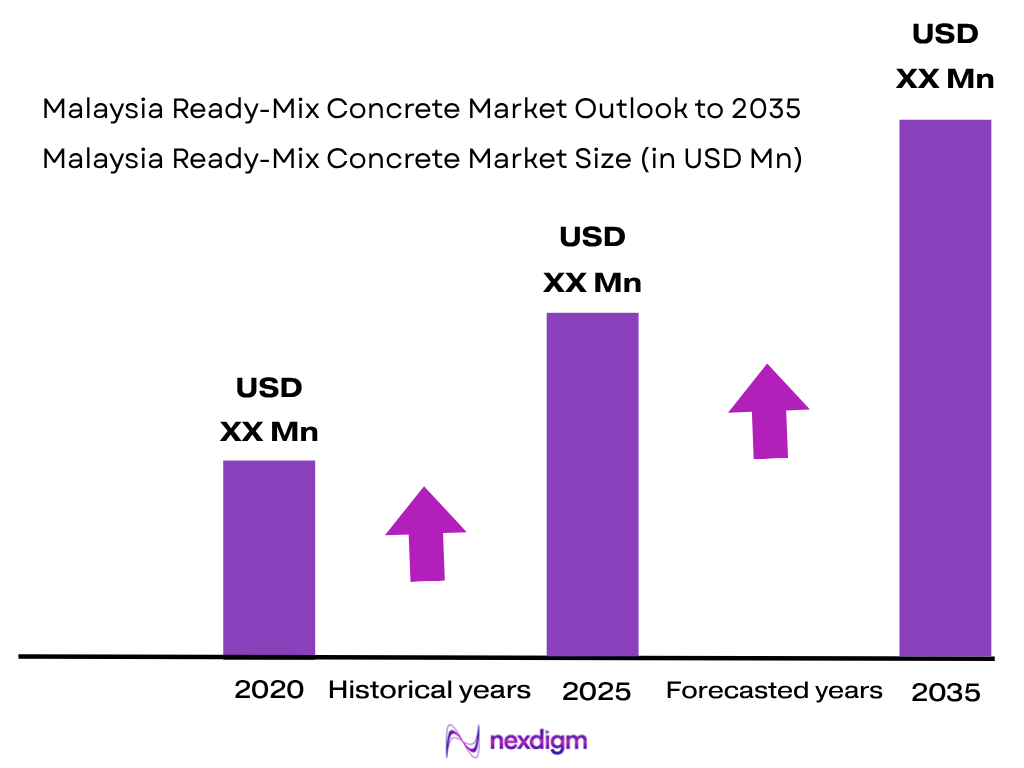
The Malaysia ready-mix concrete market is valued at USD ~ billion in 2024, supported by continued construction activity, infrastructure expansion, residential development, and commercial building projects. The market growth is linked with Malaysia’s construction industry performance, which recorded approximately RM 140 billion worth of construction work completed in 2023, according to the Department of Statistics Malaysia. Malaysia’s GDP reached approximately USD 422.2 billion in 2024, supporting investment activity across infrastructure, industrial, and real estate sectors. Demand for ready-mix concrete is further driven by increasing adoption of high-performance concrete, centralized batching systems, and quality-controlled concrete supply for large-scale construction projects.
The Malaysia ready-mix concrete market is primarily concentrated in major development hubs including Kuala Lumpur, Selangor, Johor Bahru, Penang, and Sarawak, driven by higher construction intensity, infrastructure development, and urban expansion. Kuala Lumpur and Selangor dominate due to extensive commercial construction, high-rise residential projects, transportation infrastructure, and government development initiatives. Johor Bahru benefits from large-scale mixed-use developments and industrial projects, while Penang experiences demand from manufacturing facilities and urban redevelopment. Sarawak and Sabah represent emerging demand centers due to infrastructure projects, regional connectivity programs, and public construction investments.
Market Segmentation
By Application Sector
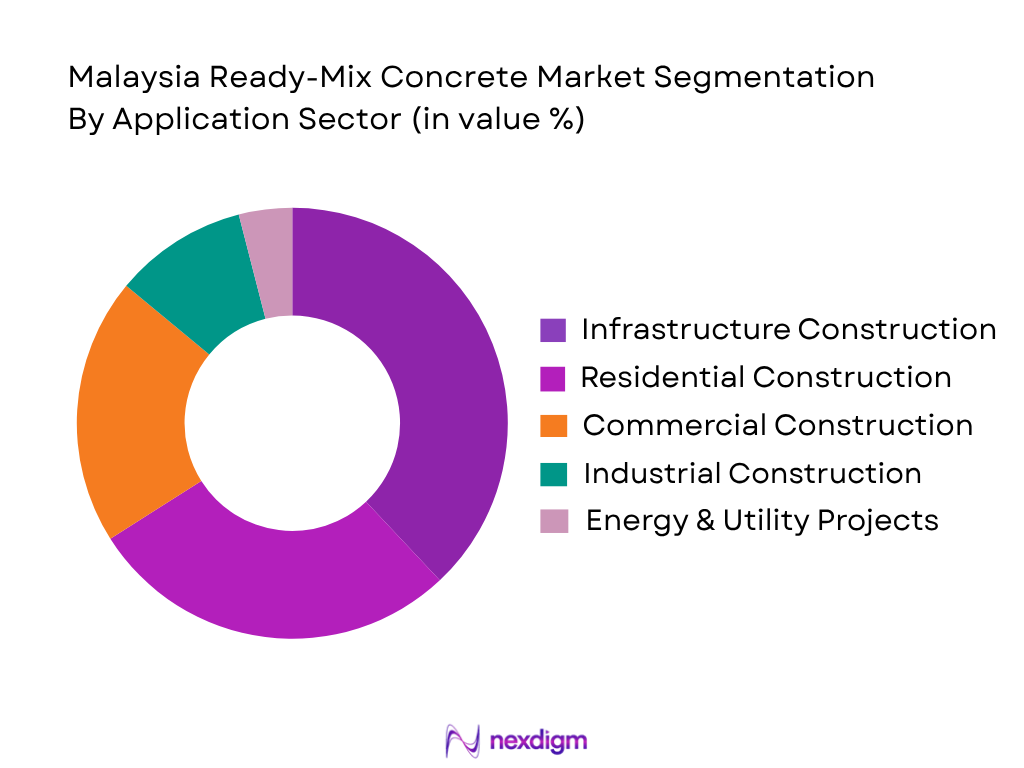
The Malaysia ready-mix concrete market is segmented by application sector into residential construction, commercial construction, infrastructure construction, industrial construction, and energy & utility projects. Among these, infrastructure construction represents the dominant segment, supported by extensive road development, rail expansion, bridge construction, and public infrastructure projects. Government-led infrastructure programs require large volumes of standardized and high-strength concrete supplied through centralized batching facilities. Malaysia’s infrastructure development initiatives, including transportation upgrades and urban connectivity projects, continue to generate demand for reliable concrete suppliers. The segment benefits from increasing requirements for durable concrete mixes, faster project execution, and consistent quality control. Large contractors and government infrastructure agencies prefer ready-mix concrete due to its controlled production environment, reduced onsite labor requirement, and ability to meet technical specifications for major construction projects.
By Concrete Grade Type
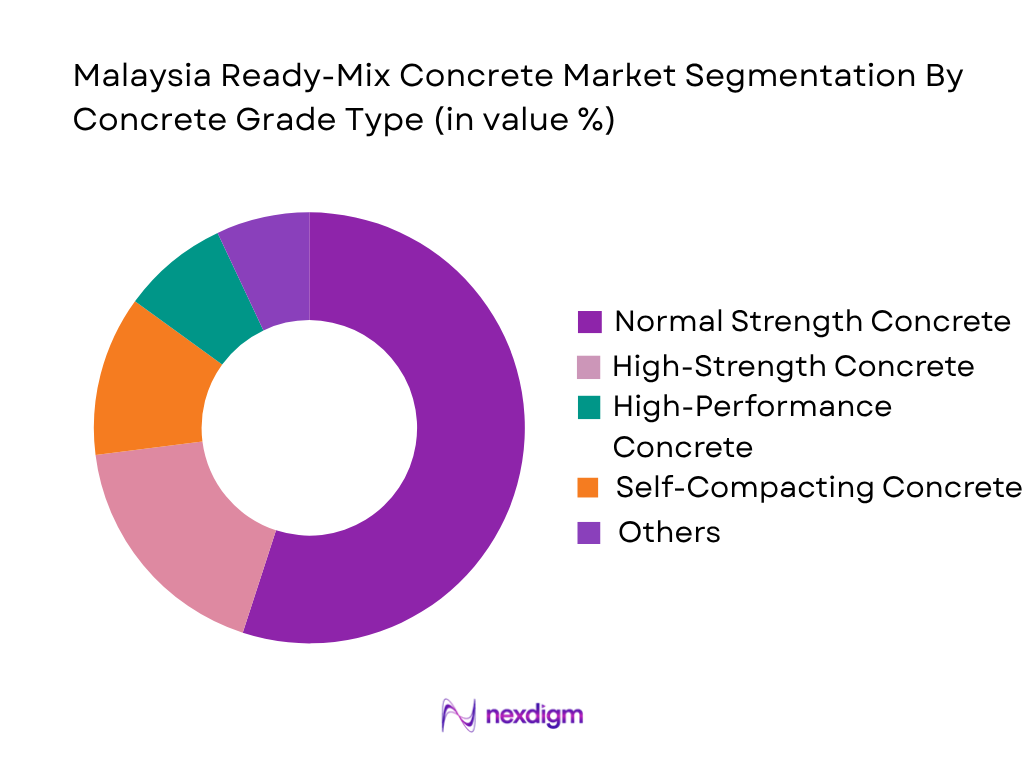
The Malaysia ready-mix concrete market is segmented by concrete grade type into normal strength concrete, high strength concrete, high performance concrete, self-compacting concrete, fiber reinforced concrete, and specialty concrete mixes. Normal strength concrete dominates the market, owing to its widespread usage in residential buildings, commercial structures, and general construction applications. The segment remains preferred due to its cost efficiency, availability, established production processes, and suitability for conventional construction requirements. Residential developments, affordable housing projects, and standard commercial buildings continue to generate consistent demand for normal strength concrete. However, high-performance and specialty concrete grades are gaining adoption in infrastructure projects, high-rise buildings, and industrial facilities requiring enhanced durability and structural performance.
Competitive Landscape
The Malaysia ready-mix concrete market is characterized by the presence of integrated cement companies, construction groups, and specialized ready-mix concrete suppliers. The market includes major players with extensive batching plant networks, large-scale production capabilities, and strong relationships with infrastructure developers and construction contractors. Companies compete based on concrete quality, production capacity, geographic coverage, delivery reliability, technical support, and sustainable concrete solutions. Integrated players benefit from control over cement supply chains, while specialized suppliers compete through operational flexibility and project-specific concrete solutions.
| Company | Establishment Year | Headquarters | Production Capability | Batching Plant Network | Key Application Focus | Concrete Technology | Geographic Presence | Sustainability Focus |
| YTL Cement Berhad | 1955 | Malaysia | ~ | ~ | ~ | ~ | ~ | ~ |
| Malayan Cement Berhad | 1950 | Malaysia | ~ | ~ | ~ | ~ | ~ | ~ |
| Heidelberg Materials Malaysia | 1964 | Malaysia | ~ | ~ | ~ | ~ | ~ | ~ |
| Hanson Malaysia | 1969 | Malaysia | ~ | ~ | ~ | ~ | ~ | ~ |
| Sunway Construction Group | 1981 | Malaysia | ~ | ~ | ~ | ~ | ~ | ~ |
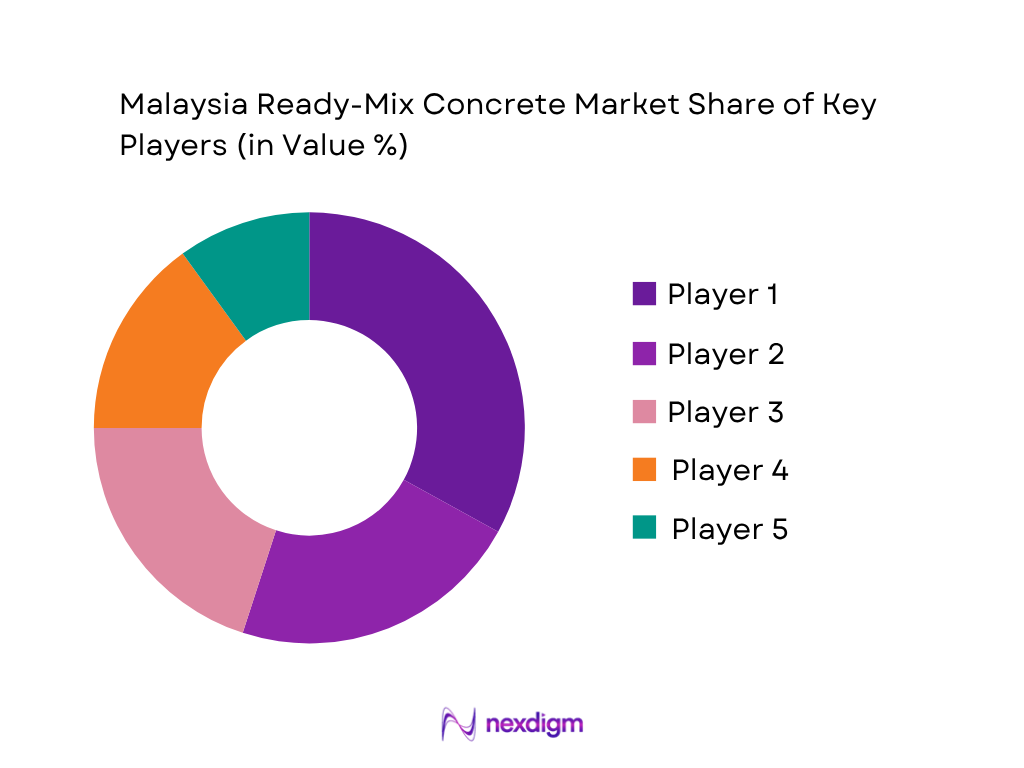
Malaysia Ready-Mix Concrete Market Analysis
Growth Drivers
Infrastructure Development and Construction Activity Expansion Supporting Ready-Mix Concrete Demand
Malaysia’s continuous infrastructure development and construction activity expansion are strengthening demand for ready-mix concrete across highways, rail networks, residential developments, commercial buildings, and industrial facilities. The World Bank reported that Malaysia’s GDP reached USD 422.23 billion in 2024, reflecting sustained economic activity supporting investment in infrastructure and construction-related sectors. Malaysia’s construction industry recorded RM 140.1 billion in completed construction work in 2023, according to the Department of Statistics Malaysia, demonstrating significant demand for building materials, including ready-mix concrete. The country’s population reached 34.1 million in 2024, creating additional requirements for housing, urban infrastructure, transportation systems, and public facilities. Ready-mix concrete adoption is increasing due to its ability to provide consistent quality, faster project execution, and controlled production compared with onsite concrete mixing. Large infrastructure projects, including transportation corridors, urban redevelopment programs, and industrial developments, require reliable concrete suppliers with extensive batching networks and delivery capabilities. Government-supported infrastructure modernization programs and private-sector property investments continue to generate demand for standardized concrete grades, high-strength concrete, and specialty concrete solutions. The increasing complexity of construction projects is encouraging contractors and developers to rely on professional ready-mix concrete providers for technical compliance and operational efficiency.
Urbanization and Residential Construction Growth Driving Ready-Mix Concrete Consumption
Increasing urbanization and residential development activity are major factors supporting ready-mix concrete demand in Malaysia, particularly across metropolitan areas such as Kuala Lumpur, Selangor, Johor Bahru, and Penang. According to the World Bank, Malaysia’s urban population reached approximately 79.2 million urban residents equivalent to 79% of the total population in 2024, increasing the need for housing infrastructure, high-rise residential buildings, and urban development projects. The Department of Statistics Malaysia reported that Malaysia’s population reached 34.1 million in 2024, creating sustained demand for residential construction and related infrastructure. The residential construction segment increasingly uses ready-mix concrete due to requirements for structural consistency, faster construction cycles, and compliance with modern building standards. High-rise apartments, affordable housing projects, and township developments require large volumes of concrete supplied through centralized batching plants to maintain construction efficiency. Urban expansion in economic centers is also increasing demand for commercial spaces, mixed-use developments, and supporting infrastructure, indirectly supporting ready-mix concrete consumption. The availability of advanced concrete grades, including high-strength and self-compacting concrete, enables developers to meet structural requirements for complex urban buildings. Continued urban development and housing requirements provide a stable demand foundation for ready-mix concrete suppliers operating across Malaysia.
Market Challenges
Raw Material Price Volatility and Supply Chain Constraints Affecting Production Efficiency
The Malaysia ready-mix concrete market faces challenges related to fluctuations in raw material availability, including cement, aggregates, sand, and supplementary cementitious materials. Concrete production depends heavily on stable access to construction materials, and disruptions in supply chains can impact production schedules and operational efficiency. Malaysia’s construction sector consumed significant volumes of building materials, supported by RM 140.1 billion of construction work completed in 2023, according to the Department of Statistics Malaysia, increasing pressure on material supply networks. Cement and aggregate availability remains critical because ready-mix concrete producers require continuous supply to maintain batching plant operations and meet project delivery timelines. Malaysia’s mineral production statistics reported continued extraction activity for construction-related materials, including aggregates and quarry products, but regional availability varies depending on location and environmental restrictions. Transportation of raw materials and finished concrete also creates operational challenges because ready-mix concrete has limited delivery windows due to setting characteristics. Increasing environmental requirements related to quarry operations, emissions reduction, and sustainable construction practices are creating additional compliance considerations for producers. These factors require companies to optimize supply chains, improve inventory management, and invest in alternative materials such as blended cement and supplementary cementitious solutions.
Transportation Limitations and Operational Challenges in Concrete Delivery Management
Ready-mix concrete delivery operations face challenges due to transportation constraints, project location factors, and the requirement for precise delivery scheduling. Concrete must be transported within controlled timeframes to maintain workability and performance, making logistics management a critical factor for suppliers. Malaysia’s road infrastructure network reached approximately 290,000 kilometers in 2023, according to national infrastructure statistics, supporting construction activities but also creating operational considerations related to traffic congestion, urban accessibility, and delivery planning. Major construction activities concentrated in urban centers such as Kuala Lumpur and Selangor often experience transportation challenges due to high traffic density and restricted delivery windows. Ready-mix suppliers must maintain extensive transit mixer fleets, strategically located batching plants, and digital monitoring systems to ensure timely supply. The Construction Industry Development Board Malaysia reported more than 100,000 registered construction contractors in 2024, creating a diverse customer base with varying project requirements and logistical needs. Increasing project complexity, remote infrastructure developments, and demand for faster construction timelines require suppliers to improve fleet management and operational coordination. Companies must increasingly adopt GPS tracking, automated scheduling systems, and optimized batching plant locations to overcome logistics-related constraints.
Market Opportunities
Adoption of Sustainable and Low-Carbon Concrete Solutions Creating Future Growth Opportunities
The increasing focus on sustainable construction practices is creating opportunities for ready-mix concrete producers to develop low-carbon and environmentally responsible concrete solutions. Malaysia’s construction industry is gradually shifting toward sustainable building practices due to government initiatives and increasing demand from developers for environmentally efficient materials. The World Bank reported that Malaysia’s economy reached USD 422.23 billion in 2024, supporting continued investment in modern infrastructure and sustainable development projects. Malaysia’s electricity consumption reached approximately 183,000 GWh in 2023, highlighting the importance of improving energy efficiency and reducing environmental impact across industries, including construction. Ready-mix producers are exploring solutions such as blended cement concrete, recycled aggregates, fly ash-based concrete, and other supplementary cementitious materials to reduce environmental impact. The Green Building Index Malaysia continues to encourage sustainable building practices, increasing interest in construction materials that support environmental objectives. Infrastructure projects, commercial developments, and industrial facilities are increasingly considering sustainability criteria during material selection. This creates opportunities for ready-mix concrete companies to expand their product portfolios through specialized green concrete solutions, helping them serve environmentally focused construction projects and differentiate themselves within the competitive market.
Digitalization and Advanced Concrete Technology Creating Opportunities for Market Expansion
Increasing adoption of digital construction technologies and advanced concrete production systems is creating opportunities for ready-mix concrete suppliers to improve efficiency, quality control, and customer service. Malaysia’s construction industry is moving toward technology-driven practices through initiatives focused on Construction 4.0, automation, and digital project management. The Malaysia Digital Economy Corporation reported that the digital economy contributed approximately 23% of Malaysia’s GDP in 2023, supporting wider adoption of digital tools across industries, including construction. Ready-mix concrete producers can benefit from technologies such as automated batching systems, GPS-enabled transit mixer tracking, digital ordering platforms, and real-time concrete quality monitoring. These technologies enable better production planning, reduced delivery delays, and improved coordination between suppliers and contractors. The increasing complexity of infrastructure and high-rise construction projects requires more precise concrete management systems to maintain quality and efficiency. Advanced concrete technologies, including high-performance concrete, self-compacting concrete, and specialty concrete mixes, are gaining importance in projects requiring enhanced durability and structural performance. As Malaysia’s construction sector continues adopting digital solutions, ready-mix concrete companies investing in automation and technology integration can strengthen operational capabilities and address evolving requirements from developers, contractors, and infrastructure project owners.
Future Outlook
Over the next decade, the Malaysia ready-mix concrete market is expected to experience steady expansion driven by infrastructure development, urbanization, residential construction demand, and increasing adoption of sustainable concrete solutions. Growth will be supported by government infrastructure programs, industrial development, and modernization of construction practices. Increasing demand for high-performance concrete, automated batching systems, and digital logistics management is expected to improve operational efficiency across the market.
Major Players
- YTL Cement Berhad
- Malayan Cement Berhad
- Cement Industries of Malaysia Berhad (CIMA)
- Heidelberg Materials Malaysia
- Hanson Malaysia
- Lafarge Malaysia Berhad
- Sunway Construction Group Berhad
- IJM Corporation Berhad
- Gamuda Berhad
- Kimlun Corporation Berhad
- KKB Engineering Berhad
- Naim Holdings Berhad
- Tasek Corporation Berhad
- Sungai Long Industries Sdn Bhd
- Buildmate Concrete Sdn Bhd
Key Target Audience
- Ready-Mix Concrete Manufacturers and Suppliers
- Cement Manufacturers and Building Material Companies
- Real Estate Developers and Construction Companies
- Infrastructure Contractors and Engineering Companies
- Investments and Venture Capitalist Firms (Private Equity Funds, Infrastructure Investment Funds, Construction Technology Investment Funds)
- Government and Regulatory Bodies (Construction Industry Development Board Malaysia, Ministry of Works Malaysia, Department of Standards Malaysia, Local Government Authorities)
- Industrial Project Developers and Facility Owners
- Concrete Equipment Manufacturers and Batching Plant Technology Providers
Research Methodology
Step 1: Identification of Key Variables
The initial phase involves developing a detailed ecosystem map covering cement suppliers, aggregate providers, ready-mix concrete manufacturers, contractors, developers, and regulatory bodies operating within the Malaysia ready-mix concrete market. Extensive desk research is conducted using industry databases, government publications, construction statistics, and company information to identify major market variables. The objective is to define supply-side and demand-side factors influencing concrete production, consumption, and market expansion.
Step 2: Market Analysis and Construction
This phase involves collecting and analyzing historical information related to ready-mix concrete production, construction activity, application demand, and regional consumption patterns. The assessment includes evaluation of batching plant capacity, concrete volume requirements, project pipelines, and supplier capabilities. Market estimates are developed through analysis of construction sector indicators and operational performance of major market participants.
Step 3: Hypothesis Validation and Expert Consultation
Market assumptions are validated through discussions with industry stakeholders including ready-mix concrete producers, contractors, developers, and construction material suppliers. These interactions provide insights into procurement behavior, concrete grade preferences, operational challenges, and technology adoption trends. Expert inputs are used to refine market calculations and validate industry dynamics.
Step 4: Research Synthesis and Final Output
The final stage integrates primary and secondary research findings to develop a comprehensive market assessment. Data collected from manufacturers, contractors, and construction stakeholders is analyzed through bottom-up and top-down approaches. The final report provides market sizing, segmentation analysis, competitive benchmarking, and strategic insights for business decision-making.

- Executive Summary
- Research Methodology (Market Definition and Scope, Malaysia Ready-Mix Concrete Market Classification, Ready-Mix Concrete Technology Mapping, Normal Strength Concrete Assessment, High Strength Concrete Evaluation, High Performance Concrete Analysis, Ultra High Performance Concrete Assessment, Self-Compacting Concrete Evaluation, Fiber Reinforced Concrete Analysis, Lightweight Concrete Assessment, Waterproof Concrete Evaluation, Concrete Mix Design Assessment, Cement Consumption Analysis, Aggregate Requirement Assessment, Sand and Manufactured Sand Evaluation, Chemical Admixture Usage Assessment, Supplementary Cementitious Material Analysis, Batching Plant Capacity Assessment, Transit Mixer Fleet Evaluation, Concrete Pumping Capability Assessment, Concrete Quality Testing Assessment, Construction Project Demand Mapping, Residential Construction Demand Assessment, Commercial Construction Demand Assessment, Infrastructure Construction Demand Assessment, Industrial Construction Demand Assessment, Domestic Production Capability Assessment, Supply-Side Assessment, Demand-Side Assessment)

- Definition and Scope
- Malaysia Ready-Mix Concrete Industry Evolution and Development of Centralized Ready-Mix Concrete Plants, Mobile Batching Plant Systems, Automated Concrete Production Facilities, High Strength Concrete Solutions, High Performance Concrete Applications, Self-Compacting Concrete Systems, Fiber Reinforced Concrete Adoption, Precast Concrete Integration, Sustainable Concrete Mix Development, Low Carbon Concrete Technologies, Digital Concrete Ordering Platforms, GPS-Based Concrete Logistics, Real-Time Quality Monitoring Systems, Infrastructure-Grade Concrete Applications, Green Construction Material Adoption, Advanced Concrete Testing Technologies
- Ready-Mix Concrete Value Chain Analysis
- Ready-Mix Concrete Supply Chain Analysis
- Cement Manufacturers, Low Carbon Cement Suppliers, Aggregate Suppliers, Manufactured Sand Suppliers, Chemical Admixture Manufacturers, Supplementary Cementitious Material Suppliers, Ready-Mix Concrete Producers, Batching Plant Operators

- Growth Drivers (Infrastructure Development Projects, Residential Construction Expansion, Urbanization Growth, High-Rise Building Development, Transportation Infrastructure Investment, Industrial Park Expansion, Commercial Real Estate Growth, Government Construction Programs, Demand for High Performance Concrete, Sustainable Construction Material Adoption)
- Market Challenges (Cement Price Volatility, Aggregate Supply Constraints, Transportation Cost Pressure, Diesel Price Fluctuation, Concrete Delivery Distance Limitations, Raw Material Availability Challenges, Skilled Labor Shortage, Environmental Compliance Requirements, Carbon Reduction Pressure, Project Construction Delays)
- Market Opportunities (Low Carbon Concrete Adoption, Green Building Projects, Smart Batching Plant Automation, Digital Concrete Management Systems, Infrastructure Modernization Projects, Sustainable Concrete Solutions, Regional Batching Network Expansion, Alternative Cementitious Materials, Data Center Construction Demand, Advanced Concrete Mix Development)
- Market Trends (Automated Batching Systems, Digital Ordering Platforms, GPS-Based Fleet Tracking, Sustainable Concrete Production, Carbon Reduced Concrete Mixes, High Strength Concrete Adoption, Self-Compacting Concrete Growth, Real-Time Concrete Quality Monitoring, Prefabricated Construction Integration, Construction Technology Digitalization)
- Government Regulations and Standards (Construction Industry Development Board Malaysia Requirements, Malaysian Standard Concrete Specifications, MS EN Concrete Standards, Concrete Quality Testing Requirements, Construction Safety Regulations, Environmental Compliance Requirements, Green Building Standards, Public Infrastructure Procurement Standards, Cement Testing Requirements, Occupational Safety Standards)
- SWOT Analysis
- Porter’s Five Forces Analysis
- PESTLE Analysis
- Stakeholder Ecosystem
- Competition Ecosystem

- By Market Value (2020-2025)
- By Ready-Mix Concrete Consumption Volume (2020-2025)
- By Concrete Production Capacity (2020-2025)
- By Installed Batching Plant Capacity (2020-2025)
- By Average Selling Price per Cubic Meter (2020-2025)
- By Transit Mixer Delivery Volume (2020-2025)
- By High Strength Concrete Consumption Volume (2020-2025)
- By Infrastructure Construction Concrete Consumption Volume (2020-2025)
- By Residential Construction Concrete Consumption Volume (2020-2025)
- By Commercial Construction Concrete Consumption Volume (2020-2025)

- By Concrete Grade Type (In Volume %)
Normal Strength Concrete (NSC)
High Strength Concrete (HSC)
High Performance Concrete (HPC)
Ultra High Performance Concrete (UHPC)
Self-Compacting Concrete (SCC)
Fiber Reinforced Concrete (FRC)
Lightweight Concrete
Waterproof Concrete - By Product Type (In Volume %)
Conventional Ready-Mix Concrete
High Strength Ready-Mix Concrete
High Performance Ready-Mix Concrete
Self-Compacting Concrete
Fiber Reinforced Concrete
Low Carbon Concrete
Specialty Concrete Mixes
Precast Concrete Mixes - By Application (In Volume %)
Residential Construction
High-Rise Buildings
Affordable Housing Projects
Landed Housing Developments
Township Developments
Commercial Construction
Office Buildings
Shopping Centers
Hotels and Hospitality Projects
Mixed-Use Developments
Infrastructure Construction
Highways and Roads
Bridges and Flyovers
Rail Infrastructure
Airports
Ports and Marine Structures
Industrial Construction
Manufacturing Facilities
Warehouses and Logistics Centers
Industrial Parks
Data Centers
Energy and Utility Construction
Power Generation Facilities
Water Treatment Infrastructure
Renewable Energy Projects - By End-Use Sector (In Volume %)
Government Infrastructure Projects
Real Estate Developers
Main Construction Contractors
Civil Engineering Contractors
Industrial Developers
Commercial Property Developers
Precast Concrete Manufacturers
Utility Project Developers - By Delivery Method (In Volume %)
Centralized Ready-Mix Concrete Delivery
Mobile Batching Plant Delivery
On-Site Batching Solutions
Transit Mixer Delivery
Concrete Pump Delivery - By Raw Material Composition (In Volume %)
Ordinary Portland Cement Concrete
Blended Cement Concrete
Fly Ash Concrete
Ground Granulated Blast Furnace Slag Concrete
Silica Fume Concrete
Recycled Aggregate Concrete - By Region (In Volume %)
Kuala Lumpur
Selangor
Putrajaya
Johor
Melaka
Negeri Sembilan
Penang
Perak
Kedah
Perlis
Pahang
Terengganu
Kelantan
Sabah
Sarawak

- Market Share of Major Players (By Malaysia Revenue, Ready-Mix Concrete Production Volume, Concrete Grade Portfolio, Batching Plant Network, Installed Production Capacity, Regional Presence, Infrastructure Project Portfolio, Residential Construction Supply Capability, Commercial Construction Supply Capability, Transit Mixer Fleet Size, Concrete Pumping Capability, Sustainable Concrete Portfolio, Customer Base, Technical Support Capability, Quality Certification Capability)
- Cross Comparison Parameters (Ready-Mix Concrete Production Capacity, Number of Batching Plants, Geographic Distribution Coverage, Transit Mixer Fleet Strength, Concrete Grade Portfolio Breadth, Sustainable Concrete Capability, Digital Logistics Management Capability, Infrastructure Project Execution Experience)
- SWOT Analysis of Major Player
- Competitive Positioning Matrix
- Ready-Mix Concrete Production Technology and Operational Benchmarking
- Concrete Quality Control and Testing Capability Assessment
- Malaysia Distribution Network and Project Supply Capability Assessment
- Detailed Profiles of Major Companies
YTL Cement Berhad
Malayan Cement Berhad
Cement Industries of Malaysia Berhad (CIMA)
Heidelberg Materials Malaysia
Hanson Malaysia
Lafarge Malaysia Berhad
Sunway Construction Group Berhad
IJM Corporation Berhad
Gamuda Berhad
Kimlun Corporation Berhad
KKB Engineering Berhad
Naim Holdings Berhad
Tasek Corporation Berhad
Sungai Long Industries Sdn Bhd
Buildmate Concrete Sdn Bhd

- Construction Contractor Requirement Assessment
- Concrete Grade Preference Analysis
- Delivery Reliability Requirement Assessment
- Quality Certification Requirement Assessment
- Supplier Selection Criteria Analysis
- Real Estate Developer Demand Analysis
- Residential Project Pipeline Assessment
- Commercial Development Requirement Assessment
- Large Volume Concrete Procurement Analysis
- Cost Optimization Requirement Assessment
- Infrastructure Project Requirement Analysis
- Highway Construction Demand Assessment

- By Market Value (2026-2035)
- By Ready-Mix Concrete Consumption Volume (2026-2035)
- By Concrete Production Capacity (2026-2035)
- By Installed Batching Plant Capacity (2026-2035)
- By Average Selling Price per Cubic Meter (2026-2035)
- By Transit Mixer Delivery Volume (2026-2035)
- By High Strength Concrete Consumption Volume (2026-2035)
- By Infrastructure Construction Concrete Consumption Volume (2026-2035)
- By Residential Construction Concrete Consumption Volume (2026-2035)
- By Commercial Construction Concrete Consumption Volume (2026-2035)


 Request a Sample
 Ask for Customization
 Get a Quote
 Enquire Now