
 Download PDF
Market Overview
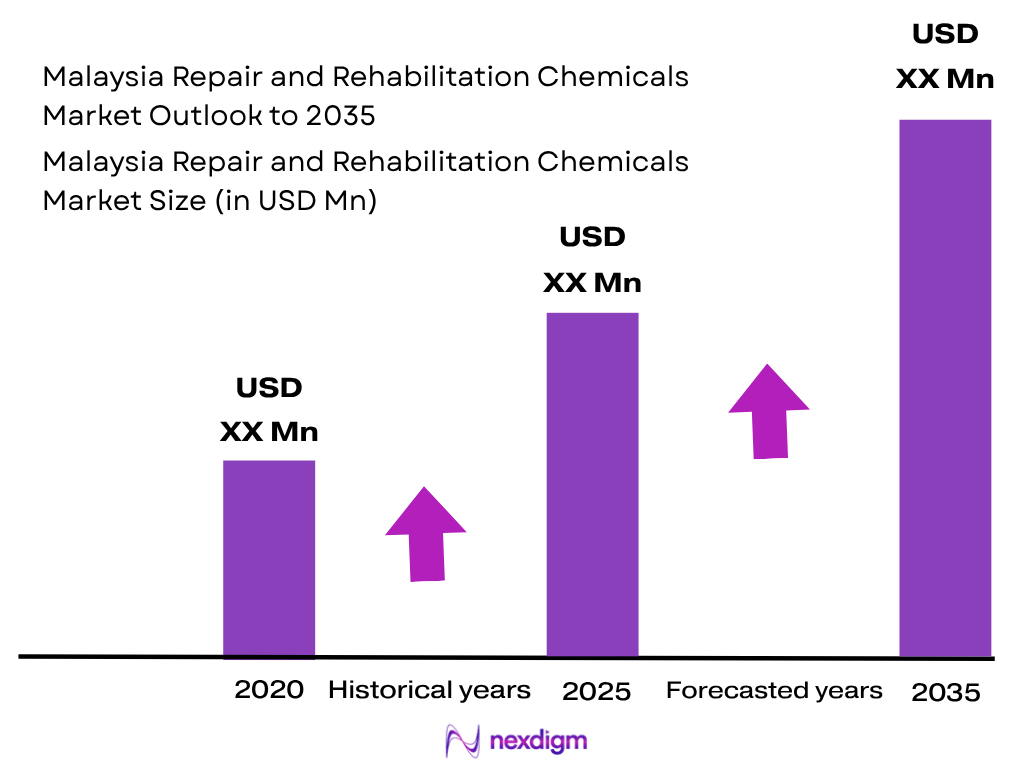
The Malaysia Repair and Rehabilitation Chemicals Market is valued at approximately ~USD XX million, supported by expanding construction activity and a growing installed base of concrete assets requiring lifecycle maintenance. Construction work completed increased from RM132.2 billion in the preceding period to RM158.8 billion in the latest period, including RM61.1 billion of civil engineering and RM44.4 billion of non-residential building work, enlarging the future rehabilitation base.
Selangor, Kuala Lumpur, Johor and Sarawak are major demand centres because they combine dense building stocks, transport infrastructure, utilities and industrial facilities. In comparable fourth-quarter periods, construction work in Selangor increased from RM8.6 billion to RM9.4 billion, Johor from RM4.0 billion to RM7.4 billion, and the Federal Territories from RM4.0 billion to RM4.7 billion, expanding the addressable stock requiring concrete repair, waterproofing and structural rehabilitation.
Market Segmentation
By Product Type
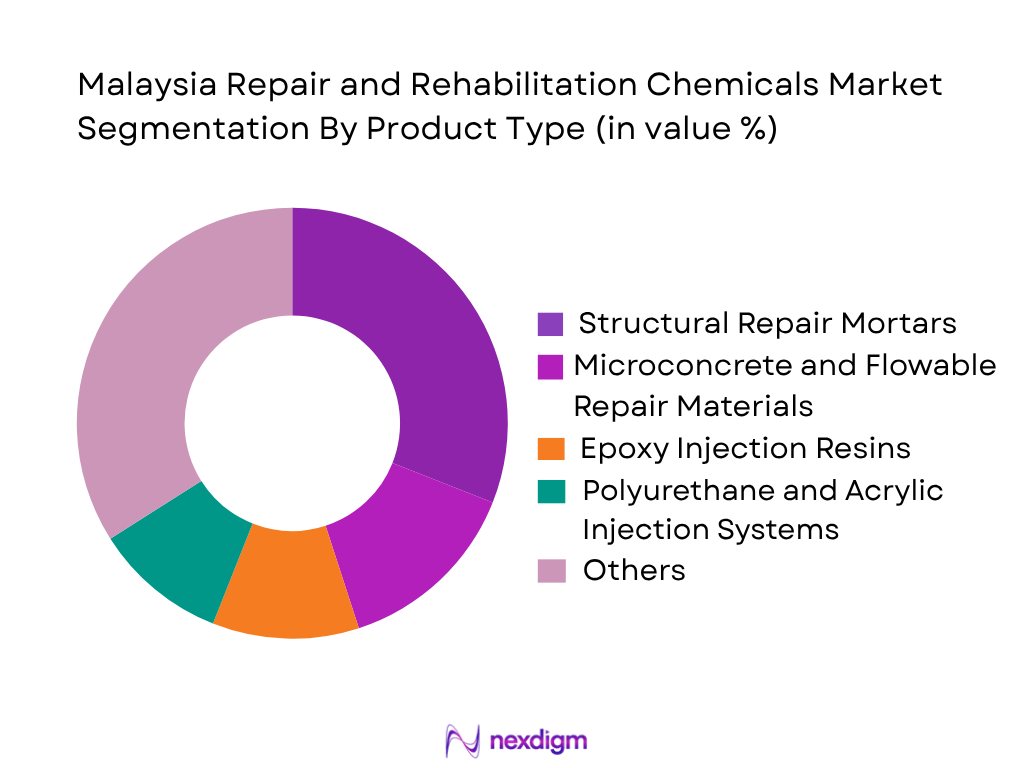
The Malaysia Repair and Rehabilitation Chemicals Market is segmented into structural repair mortars, cosmetic repair mortars, microconcrete, epoxy and polyurethane injection resins, corrosion-protection systems, protective coatings, FRP strengthening materials and specialist rehabilitation chemicals. Structural repair mortars represent the dominant subsegment because concrete reinstatement is required across bridges, high-rise buildings, parking structures, industrial facilities and water infrastructure. Malaysia recorded RM61.1 billion of civil-engineering construction and RM44.4 billion of non-residential work in the latest annual construction cycle, steadily enlarging the installed asset base requiring future repair. Modern systems also support R3/R4 structural reinstatement, overhead application and chloride protection. Major suppliers offer polymer-modified, fibre-reinforced and high-build mortars designed for reinforcement-corrosion damage, vertical repairs and infrastructure rehabilitation, strengthening the segment’s specification depth.
By Application
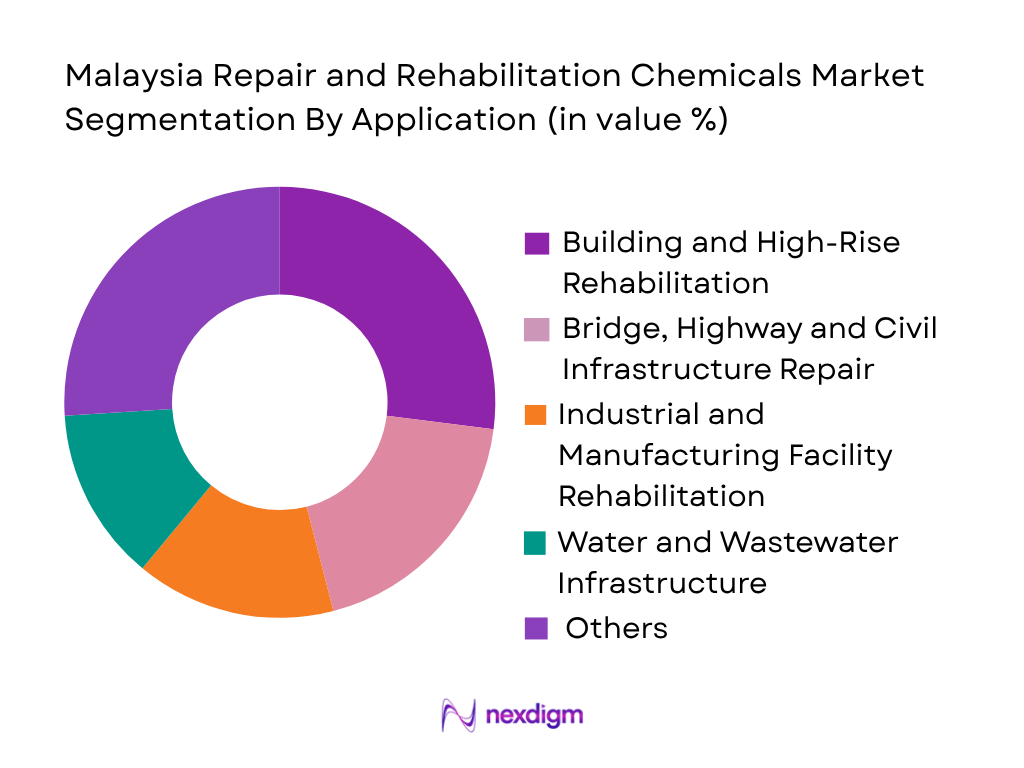
The Malaysia Repair and Rehabilitation Chemicals Market is segmented into building rehabilitation, bridge and highway repair, rail and underground infrastructure, industrial facilities, water and wastewater structures, marine assets and other concrete rehabilitation applications. Building rehabilitation holds the dominant share because the Klang Valley contains a dense concentration of high-rise residential, commercial, parking and mixed-use structures exposed to water ingress, carbonation, cracking and reinforcement corrosion. Selangor alone recorded RM9.4 billion of construction work in the latest fourth quarter, including substantial residential, non-residential and civil-engineering activity, while the Federal Territories recorded RM4.7 billion. Water infrastructure adds recurring rehabilitation requirements: Air Selangor allocated RM2.3394 billion to sustainable water-supply projects and RM548.8 million to sustainable water-management initiatives, including refurbishment of treatment plants, reservoirs, pump houses and distribution infrastructure.
Competitive Landscape
The Malaysia Repair and Rehabilitation Chemicals Market combines multinational construction-chemical groups with locally established suppliers and distributors. Competition is based less on individual repair products and more on complete rehabilitation systems covering concrete reinstatement, crack injection, reinforcement protection, waterproofing and structural strengthening. Sika maintains multiple Malaysian factories and nationwide sales coverage, while MAPEI, Fosroc and MC-Bauchemie publish broad concrete-repair and strengthening technologies for infrastructure and structural applications.
| Major Player | Establishment Year | Headquarters | Structural Repair Mortars | Injection Systems | Corrosion / Concrete Protection | Structural Strengthening | Malaysia Presence | Technical Support |
| Sika | 1910 | Baar, Switzerland | ~ | ~ | ~ | ~ | ~ | ~ |
| Fosroc | 1972 | Dubai, UAE | ~ | ~ | ~ | ~ | ~ | ~ |
| MAPEI | 1937 | Milan, Italy | ~ | ~ | ~ | ~ | ~ | ~ |
| Master Builders Solutions | 1909 heritage | Mannheim, Germany | ~ | ~ | ~ | ~ | ~ | ~ |
| MC-Bauchemie | 1961 | Bottrop, Germany | ~ | ~ | ~ | ~ | ~ | ~ |
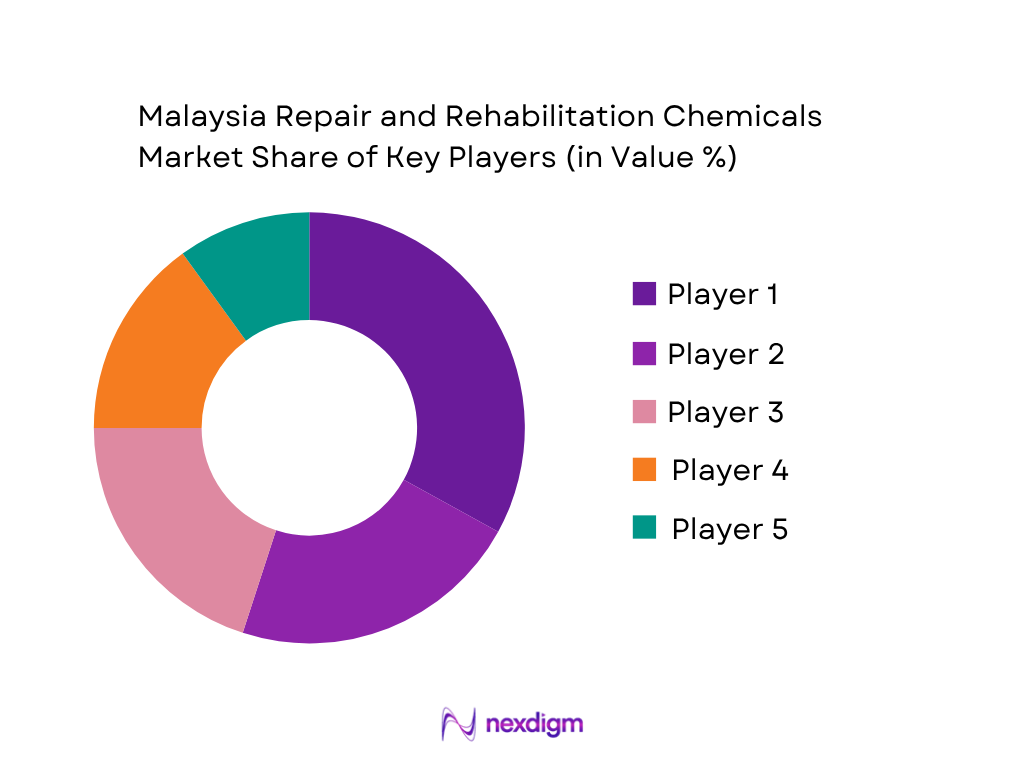
Malaysia Repair and Rehabilitation Chemicals Market Analysis
Growth Drivers
Expanding Infrastructure Asset Base Is Increasing Structural Repair and Rehabilitation Demand
Malaysia’s Repair and Rehabilitation Chemicals Market is supported by an expanding stock of concrete infrastructure that requires lifecycle maintenance, structural reinstatement, crack repair and corrosion protection. Department of Statistics Malaysia data show construction work completed reached RM158.8 billion in 2024, including RM61.1 billion of civil-engineering activity and substantial non-residential construction. Momentum continued in 2025, when construction work completed increased to RM178.6 billion; in the fourth quarter alone, civil-engineering works totaled RM16.2 billion, including RM8.8 billion of utility projects and RM5.8 billion of road and railway works. This growing installed base of bridges, flyovers, stations, utility structures and commercial assets progressively creates demand for R3/R4 repair mortars, microconcrete, epoxy injection, anti-carbonation coatings and reinforcement-protection systems. Maintenance requirements are already visible: the Ministry of Works allocated RM200 million for 337 Federal Road maintenance locations in 2024, while another RM230 million covered 218 slope maintenance and repair work orders. World Bank data record Malaysia’s 2024 GDP at USD422.23 billion and GDP per capita at USD11,874.4, providing the macroeconomic base supporting sustained public and private asset rehabilitation.
Water, Rail and Urban Asset Utilization Is Driving Lifecycle Maintenance Requirements
High utilization of Malaysia’s water and urban transport infrastructure is creating recurring demand for waterproofing rehabilitation, leakage injection, concrete protection and structural repair chemicals. Air Selangor reported that its ageing-pipe replacement programme covered 5,600 km of targeted network, of which 636.55 km had been replaced as of 2024. Although pipeline renewal is not itself a repair-chemical application, associated reservoirs, pump houses, chambers, treatment structures and reinforced-concrete utility assets require crack sealing, protective coatings and water-compatible rehabilitation systems. Urban rail adds another maintenance-intensive asset base. Prasarana recorded an average of 1.18 million passengers per day in 2024, compared with 955,000 in the preceding period, while recorded rail-service disruptions declined from 118 to 71, reflecting continuing maintenance activity. High passenger loading places sustained service demands on stations, viaducts, platforms and underground structures where leakage, cracking and concrete deterioration require intervention. World Bank data record Malaysia’s 2024 GDP at USD422.23 billion and GDP per capita at USD11,874.4. These infrastructure-utilization levels support long-term demand for repair mortars, epoxy injection, PU leak sealing and concrete protection systems.
Market Challenges
Flooding and Persistent Moisture Exposure Increase Repair Complexity and Recurrence Risk
Malaysia’s tropical environment creates a significant challenge for the Repair and Rehabilitation Chemicals Market because heavy rainfall, flooding and prolonged substrate moisture can complicate diagnosis, adhesion, curing and injection performance. Department of Statistics Malaysia reported RM933.4 million of flood-related losses in 2024, including RM303.4 million of damage to public assets and infrastructure and RM372.2 million to living quarters. Flood impacts remained material in 2025, with total losses of RM636.9 million and public-asset and infrastructure damage increasing to RM380.2 million. Concrete exposed to repeated saturation can experience reinforcement corrosion, coating failure, water ingress through joints and recurring leakage if the root cause is not treated. Wet substrates also affect epoxy bonding, repair-mortar adhesion and surface-protection application, while active water flow can require PU injection before cementitious repair begins. For rehabilitation suppliers, this increases the need for wet-substrate-compatible systems, hydrophilic or hydrophobic injection products and reliable surface-preparation protocols. World Bank data record Malaysia’s 2024 GDP at USD422.23 billion and GDP per capita at USD11,874.4, highlighting the economic scale of the asset base exposed to climate-driven deterioration.
Condition Assessment and Application Quality Remain Critical to Long-Term Repair Performance
The Malaysia Repair and Rehabilitation Chemicals Market faces execution risk because successful rehabilitation depends on accurate diagnosis, adequate concrete removal, reinforcement preparation, substrate conditioning and correct product application rather than chemical selection alone. The scale of maintenance activity illustrates the challenge. In 2024, the Ministry of Works approved RM200 million for 337 Federal Road maintenance locations, while an additional programme covered 280 maintenance works valued at RM100 million. In Hulu Langat alone, the Ministry approved RM18.36 million for Federal Road maintenance, including 10 bridge-maintenance works worth RM1.18 million. A separate 2025 inspection of the Kampung Bertam Bridge found deterioration serious enough that JKR had already completed RM90,000 of temporary works and was considering additional PU injection following forensic assessment conducted in 2024. These cases show why crack mapping, chloride assessment, carbonation evaluation and structural diagnosis must precede repair. Inadequate preparation can cause debonding or corrosion recurrence. World Bank data record Malaysia’s 2024 GDP at USD422.23 billion and GDP per capita at USD11,874.4, supporting continued demand but also raising expectations for technically validated rehabilitation systems.
Market Opportunities
Advanced Injection and Water-Control Systems Can Capture Growing Infrastructure Rehabilitation Needs
Epoxy injection, polyurethane water-cutoff and acrylic injection systems represent a strong future opportunity in Malaysia’s Repair and Rehabilitation Chemicals Market because existing infrastructure is increasingly exposed to cracking, groundwater ingress and flood-related deterioration. Department of Statistics Malaysia recorded RM303.4 million of flood damage to public assets and infrastructure in 2024, followed by RM380.2 million in 2025, demonstrating continued pressure on public structures. Water infrastructure also offers a sizeable repair base: Air Selangor’s programme addresses 5,600 km of ageing pipelines, with 636.55 km replaced as of 2024, while associated treatment plants, reservoirs, chambers and pump structures remain part of the wider water-asset system. Transport infrastructure provides additional applications. Prasarana carried an average of 1.18 million passengers daily in 2024, exposing rail stations, elevated structures and underground assets to sustained operational use. These conditions create future demand for low-viscosity epoxy crack injection, hydrophilic PU leak stopping, acrylic-gel curtain injection and wet-substrate repair systems. World Bank data record Malaysia’s 2024 GDP at USD422.23 billion and GDP per capita at USD11,874.4, supporting investment in longer-life rehabilitation technologies rather than temporary patching.
Structural Strengthening and High-Performance Repair Systems Offer Scope for Higher-Value Rehabilitation
Malaysia’s growing inventory of ageing bridges, high-rise buildings, industrial facilities and transport assets creates future opportunity for R3/R4 mortars, flowable microconcrete, CFRP strengthening, corrosion inhibitors and protective coatings. The Ministry of Works allocated RM230 million in 2024 for 218 slope maintenance and repair work orders, while its Federal Road programme included 337 maintenance locations under a RM200 million allocation. In Negeri Sembilan, the Ministry separately channelled RM135.8 million for road, slope, bridge and federal-building maintenance. These programmes show an established public-maintenance pipeline where rapid structural reinstatement and asset-life extension can increasingly replace full reconstruction. Private-sector asset growth reinforces the opportunity: Malaysia recorded RM158.8 billion of construction work completed in 2024, increasing to RM178.6 billion in 2025, thereby expanding the future stock of commercial, industrial and infrastructure structures requiring rehabilitation. Higher-value systems such as CFRP, corrosion-management coatings and low-shrinkage structural mortars are well suited to strengthening without extensive demolition. World Bank data record Malaysia’s 2024 GDP at USD422.23 billion and GDP per capita at USD11,874.4, supporting further adoption of durable lifecycle-extension solutions.
Future Outlook
The Malaysia Repair and Rehabilitation Chemicals Market is expected to expand at approximately ~X.X% CAGR during 2026–2035, driven by the increasing maintenance requirements of buildings, bridges, rail infrastructure, industrial facilities and water assets. Future demand is expected to shift progressively from basic patch repair toward integrated diagnosis, structural reinstatement, corrosion control, waterproofing and strengthening systems.
The construction base continues to expand. Malaysia’s construction work completed reached RM178.6 billion in 2025, compared with RM158.8 billion in 2024, enlarging the stock of assets that will ultimately require inspection and rehabilitation. Non-residential and special-trade activity remained particularly active.
Major Players
- Sika Malaysia
- Fosroc Malaysia / Saint-Gobain Construction Chemicals
- MAPEI Malaysia
- Master Builders Solutions Malaysia
- MC-Bauchemie Malaysia
- Saint-Gobain Weber Malaysia
- Penetron Malaysia
- Starken Drymix Solutions Sdn Bhd
- CEMKRETE (M) Sdn Bhd
- NCL Chemical & Equipment Sdn Bhd
- Greco Asia Sdn Bhd
- Qualibit Sdn Bhd
- LATICRETE Malaysia
- Kryton International / Malaysia Distribution
- Drizoro / Malaysia Distribution
Key Target Audience
- Repair and Rehabilitation Chemical Manufacturers
- Structural Repair, Injection and Strengthening Contractors
- Bridge, Highway, Rail and Infrastructure Asset Operators
- Water, Wastewater and Utility Infrastructure Operators
- Property Developers, Building Owners and Facility Management Companies
- Investments and Venture Capitalist Firms
- Government and Regulatory Bodies (Construction Industry Development Board Malaysia, Jabatan Kerja Raya Malaysia, Suruhanjaya Perkhidmatan Air Negara, Lembaga Lebuhraya Malaysia, Prasarana Malaysia Berhad)
- Construction Chemical Distributors and Specialist Material Suppliers
Research Methodology
Step 1: Identification of Key Variables
The initial phase involves constructing an ecosystem map encompassing repair-chemical manufacturers, raw-material suppliers, specialist repair contractors, asset owners, infrastructure agencies and distributors operating in the Malaysia Repair and Rehabilitation Chemicals Market. Desk research identifies structural-repair technologies, deterioration mechanisms and application environments. Critical variables include repair depth, crack width, chloride exposure, carbonation, substrate moisture, bond strength and structural loading.
Step 2: Market Analysis and Construction
Historical market demand is assessed using construction work completed, infrastructure activity, water-asset rehabilitation, building stock and industrial maintenance indicators. A top-down approach estimates addressable rehabilitation expenditure by asset class, while bottom-up analysis assesses product consumption through repair contractors and suppliers. The two approaches are reconciled across mortars, microconcrete, injection systems, coatings, corrosion protection and strengthening materials.
Step 3: Hypothesis Validation and Expert Consultation
Market hypotheses are validated through computer-assisted telephone interviews with structural repair contractors, injection specialists, waterproofing applicators, infrastructure contractors, facility managers and product manufacturers. Discussions evaluate repair-material selection, deterioration diagnosis, specification requirements, application productivity and procurement channels. These consultations refine product shares and differentiate preventive maintenance, localized repair and major structural rehabilitation demand.
Step 4: Research Synthesis and Final Output
The final phase triangulates government construction statistics, infrastructure-owner information, supplier technical portfolios and primary interviews. Demand is validated across product type, application, customer and geography. Forecasting incorporates expansion of the installed concrete asset base, infrastructure lifecycle requirements, water leakage control, rail maintenance, marine exposure, strengthening requirements and increasing adoption of EN 1504-oriented repair systems.

- Executive Summary
- Research Methodology (Market Definitions and Assumptions, Malaysia Repair and Rehabilitation Chemicals Market Classification, Structural Repair Mortar Scope, Cosmetic Repair Mortar Assessment, Microconcrete Assessment, Non-Shrink Grout Assessment, Epoxy Grout Assessment, Epoxy Crack Injection Assessment, Polyurethane Injection Assessment, Acrylic Injection Assessment, Cementitious Injection Assessment, Structural Epoxy Bonding Assessment, Reinforcement Corrosion Protection Assessment, Migrating Corrosion Inhibitor Assessment, Protective Coating Assessment, Hydrophobic Impregnation Assessment, Anti-Carbonation Coating Assessment, Crystalline Repair Assessment, Waterproofing Rehabilitation Assessment, Rebar Anchoring Assessment, FRP Strengthening Assessment, Spray-Applied Repair Assessment, Industrial Floor Rehabilitation Assessment, Bridge Rehabilitation Assessment, MRT and Rail Rehabilitation Assessment, Marine Concrete Repair Assessment, Water and Wastewater Structure Repair Assessment, EN 1504 Repair Principle Mapping, ASTM C882 Bond Strength Assessment, ASTM C109 Compressive Strength Assessment, Crack Width Assessment, Repair Depth Assessment, Chloride Exposure Assessment, Carbonation Depth Assessment, Substrate Condition Assessment)

- Definition and Scope
- Malaysia Repair and Rehabilitation Chemicals Industry Evolution and Development of Conventional Cement Patching, Polymer-Modified Repair Mortars, Fibre-Reinforced Structural Repair Mortars, High-Build Vertical Repair Mortars, Overhead Repair Mortars, Microconcrete, Flowable Repair Materials, Non-Shrink Cementitious Grouts, Epoxy Grouts, Low-Viscosity Epoxy Injection Resins, Polyurethane Leakage Injection Systems, Acrylic Injection Gels, Structural Epoxy Bonding Agents, Reinforcement Corrosion Protection Materials, Migrating Corrosion Inhibitors, Anti-Carbonation Coatings, Hydrophobic Silane Treatments, Crystalline Repair Systems, Protective Coatings, FRP Strengthening Systems, Anchoring Adhesives, Rapid-Setting Infrastructure Repair Materials and Integrated Repair-and-Protection Systems
- Repair and Rehabilitation Chemicals Value Chain Analysis
- Repair and Rehabilitation Chemicals Supply Chain Analysis
- Cement and Specialty Binder Suppliers, Redispersible Polymer Powder Suppliers, Epoxy Resin Suppliers, Polyurethane Raw Material Suppliers, Acrylic Polymer Suppliers, Corrosion Inhibitor Suppliers, Microsilica Suppliers, Fibre Suppliers, Specialty Additive Suppliers, Repair Chemical Manufacturers, Malaysian Dry-Mix Producers

- Growth Drivers (Ageing Concrete Infrastructure, Kuala Lumpur High-Rise Building Rehabilitation, Bridge and Flyover Maintenance, Expressway Asset Rehabilitation, MRT and Rail Maintenance, Industrial Plant Maintenance, Water and Wastewater Infrastructure Rehabilitation, Marine and Port Concrete Exposure, Parking Structure Repair, Building Refurbishment, Structural Safety Upgrading, Lifecycle Extension of Existing Concrete Assets)
- Market Challenges (Incomplete Concrete Condition Assessment, Hidden Reinforcement Corrosion, Chloride Contamination, Carbonation Depth, High Substrate Moisture, Tropical Humidity, Heavy Rainfall, Crack Recurrence, Incorrect Repair Material Selection, Weak Surface Preparation, Repair Mortar Debonding, Imported Epoxy and Specialty Raw Material Dependence, Skilled Injection Contractor Availability, Structural Shutdown Constraints, Specification Fragmentation, Quality Control of Site Application)
- Market Opportunities (R3 and R4 Structural Repair Mortars, High-Early-Strength Rapid Repair, Flowable Microconcrete, Epoxy Crack Injection, PU Leakage Injection, Acrylic Gel Injection, Migrating Corrosion Inhibitors, Anti-Carbonation Coatings, Hydrophobic Impregnation, FRP Strengthening, Marine Repair Systems, Water Infrastructure Rehabilitation, Wastewater Chemical-Resistant Repair, Bridge Deck Repair, Preventive Concrete Protection)
- Market Trends (Pre-Bagged Polymer-Modified Repair Mortars, Fibre-Reinforced Structural Repair Systems, EN 1504-Based Specification, Low-Shrinkage Repair Mortars, Spray-Applied Structural Repair, Low-Viscosity Epoxy Injection, Fast-Curing PU Injection, Integrated Repair-and-Protection Systems, Corrosion Management, FRP Strengthening, Low-Carbon Repair Mortars, Rapid Return-to-Service Materials, Preventive Rehabilitation, Asset-Life Extension)
- Government Regulations and Standards (CIDB Malaysia Requirements, Jabatan Kerja Raya Specifications, Malaysian Standards for Concrete Repair, BS EN 1504 Repair Principles, Highway and Expressway Maintenance Requirements, SPAN Requirements for Water Infrastructure, Local Authority Building Maintenance Requirements, Occupational Safety and Health Requirements, Environmental and VOC Requirements)
- SWOT Analysis
- Porter’s Five Forces Analysis
- PESTLE Analysis
- Stakeholder Ecosystem
- Repair Chemical Manufacturing Contractor and Asset Rehabilitation Ecosystem

- By Market Value (2020-2025)
- By Repair Chemical Consumption Volume (2020-2025)
- By Structural Repair Mortar Consumption (2020-2025)
- By Cosmetic Repair Mortar Consumption (2020-2025)
- By Microconcrete Consumption (2020-2025)
- By Epoxy Injection Consumption (2020-2025)
- By Polyurethane Injection Consumption (2020-2025)
- By Non-Shrink Grout Consumption (2020-2025)
- By Epoxy Grout Consumption (2020-2025)
- By Corrosion Protection Material Consumption (2020-2025)
- By Protective Coating Consumption (2020-2025)
- By Structural Strengthening Chemical Consumption (2020-2025)
- By Building Rehabilitation Chemical Consumption (2020-2025)
- By Bridge and Infrastructure Repair Chemical Consumption (2020-2025)

- By Product Type (In Value %)
Structural Repair Mortars
Cosmetic and Surface Repair Mortars
Microconcrete and Flowable Repair Materials
Non-Shrink Cementitious Grouts
Epoxy Grouts
Epoxy Injection Resins
Polyurethane Injection Resins
Acrylic Injection Systems
Structural Epoxy Bonding Agents
Reinforcement Corrosion Protection Materials
Migrating Corrosion Inhibitors
Protective Coatings
Hydrophobic Impregnation Systems
Crystalline Repair Materials
FRP Strengthening Resins and Adhesives
Anchoring and Rebar Fixing Adhesives
Rapid-Setting Repair Materials
Specialty Rehabilitation Chemicals - By Repair Chemistry (In Value %)
Polymer-Modified Cementitious Systems
Epoxy Resin Systems
Polyurethane Systems
Acrylic Polymer Systems
Crystalline Cementitious Systems
Silane and Siloxane Systems
Corrosion-Inhibiting Chemistries
Vinyl-Ester and Specialty Resin Systems
Hybrid Polymer-Cement Systems
Other Specialty Chemistries - By Application (In Value %)
Concrete Spall Repair
Honeycomb Repair
Crack Injection
Water Leakage Injection
Reinforcement Corrosion Repair
Carbonation-Damaged Concrete Repair
Chloride-Damaged Concrete Repair
Structural Section Restoration
Beam and Column Repair
Slab and Deck Repair
Bridge Deck Rehabilitation
Pier and Abutment Repair
MRT and Rail Structure Rehabilitation
Tunnel Lining Repair
Industrial Floor Repair
Marine and Coastal Concrete Repair
Water Tank and Reservoir Repair
Wastewater Structure Rehabilitation
Parking Structure Repair
Façade and Balcony Rehabilitation - By Performance Requirement (In Value %)
High Compressive Strength
High Bond Strength
Low Shrinkage
High Early Strength
Rapid Return-to-Service
High Flexural Strength
High Tensile Strength
Overhead Application Capability
High Build Thickness
Sulfate Resistance
Chloride Resistance
Carbonation Resistance
Chemical Resistance
Water Immersion Resistance
Crack Bridging
Corrosion Protection
Low Permeability
Wet-Substrate Adhesion
Structural Load Transfer - By Region (In Value %)
Klang Valley
Kuala Lumpur
Selangor
Johor
Penang
Perak
Negeri Sembilan
Melaka
Pahang
Sabah
Sarawak

- Market Share of Major Players (By Malaysia Revenue, Repair Chemical Consumption Volume, Structural Repair Mortar Portfolio, Epoxy Injection Portfolio, Polyurethane Injection Portfolio, Grout Portfolio, Corrosion Protection Capability, Protective Coating Capability, Waterproofing Rehabilitation Exposure, FRP Strengthening Exposure, Bridge and Infrastructure Project Exposure, Industrial Rehabilitation Exposure, Malaysia Manufacturing or Blending Capacity, Distributor Network, Technical Laboratory Capability)
- Cross Comparison Parameters (Structural Repair Mortar R3 and R4 Microconcrete and Spray-Repair Portfolio Breadth, Epoxy PU Acrylic and Water-Cut-Off Injection Technology Capability, Reinforcement Corrosion Anti-Carbonation and Chloride Protection Capability, CFRP Structural Strengthening Anchoring and Structural Bonding Capability, Bridge MRT High-Rise Water Infrastructure Marine and Industrial Rehabilitation Reference Base, Rapid-Setting High-Early-Strength Wet-Substrate and Tropical-Application Repair Capability, Malaysia Manufacturing Blending Warehousing and Nationwide Distribution Network Reach, Condition Assessment Structural Engineer Contractor Training Field Testing and Project-Site Technical Support Capability)
- SWOT Analysis of Major Players
- Competitive Positioning Matrix
- Major Companies
Sika Malaysia
Fosroc Malaysia / Saint-Gobain Construction Chemicals
MAPEI Malaysia
Master Builders Solutions Malaysia
MC-Bauchemie Malaysia
Saint-Gobain Weber Malaysia
Penetron Malaysia
Starken Drymix Solutions Sdn Bhd
CEMKRETE (M) Sdn Bhd
NCL Chemical & Equipment Sdn Bhd
Greco Asia Sdn Bhd
Qualibit Sdn Bhd
LATICRETE Malaysia
Kryton International / Malaysia Distribution
Drizoro / Malaysia Distribution

- Structural Repair Contractor Requirement Assessment
- Infrastructure Contractor Requirement Assessment
- Industrial Maintenance Contractor Requirement Assessment
- Injection Contractor Requirement Assessment
- Waterproofing Contractor Requirement Assessment
- Structural Strengthening Contractor Requirement Assessment
- Property Developer Rehabilitation Requirement Assessment
- Asset Owner Rehabilitation Requirement Assessment
- Facility Management Requirement Assessment
- Bridge and Expressway Maintenance Requirement Assessment
- MRT and Rail Infrastructure Maintenance Requirement Assessment
- Water and Wastewater Operator Requirement Assessment
- Marine and Port Asset Rehabilitation Requirement Assessment
- Technical Laboratory and Site Support Requirement Assessment

- By Market Value (2026-2035)
- By Repair Chemical Consumption Volume (2026-2035)
- By Structural Repair Mortar Consumption (2026-2035)
- By Cosmetic Repair Mortar Consumption (2026-2035)
- By Microconcrete Consumption (2026-2035)
- By Epoxy Injection Consumption (2026-2035)
- By Polyurethane Injection Consumption (2026-2035)
- By Non-Shrink Grout Consumption (2026-2035)
- By Epoxy Grout Consumption (2026-2035)
- By Corrosion Protection Material Consumption (2026-2035)
- By Protective Coating Consumption (2026-2035)
- By Structural Strengthening Chemical Consumption (2026-2035)
- By Building Rehabilitation Chemical Consumption (2026-2035)
- By Bridge and Infrastructure Repair Chemical Consumption (2026-2035)


 Request a Sample
 Ask for Customization
 Get a Quote
 Enquire Now
