
 Download PDF
Market Overview
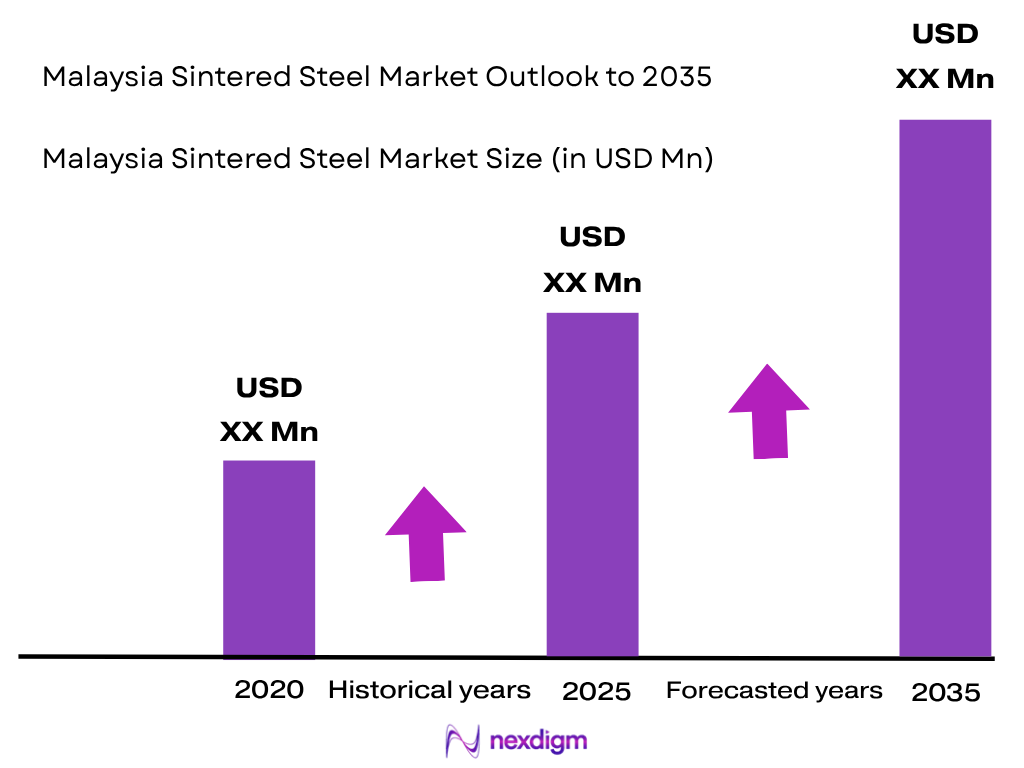
The Malaysia Sintered Steel Market is supported by an established automotive and industrial manufacturing base requiring high-volume precision components. Malaysia produced 790,347 motor vehicles and sold 816,747 units, compared with 774,600 vehicles produced in 2023, creating a substantial downstream requirement for gears, bearings, bushings, engine components, transmission components, and other powder-metal parts. MIDA also identifies automotive as contributing RM40 billion to Malaysia’s economy and employing more than 700,000 people, supporting sustained industrial demand for efficient near-net-shape component manufacturing.
Selangor represents a key manufacturing centre for Malaysia’s sintered steel ecosystem because of its concentration of automotive suppliers, industrial facilities, precision engineering companies, and established powder metallurgy manufacturers. Malaysia’s manufacturing investment environment further reinforces this position, with Selangor attracting RM101.1 billion in approved investments and Kuala Lumpur RM91.5 billion. Sumitomo Electric Sintered Components operates its Malaysian powder metallurgy manufacturing facility in Shah Alam, Selangor, while Diamet Klang also operates in Port Klang, illustrating the concentration of established sintered-component capabilities in the region.
Market Segmentation
By Product Type
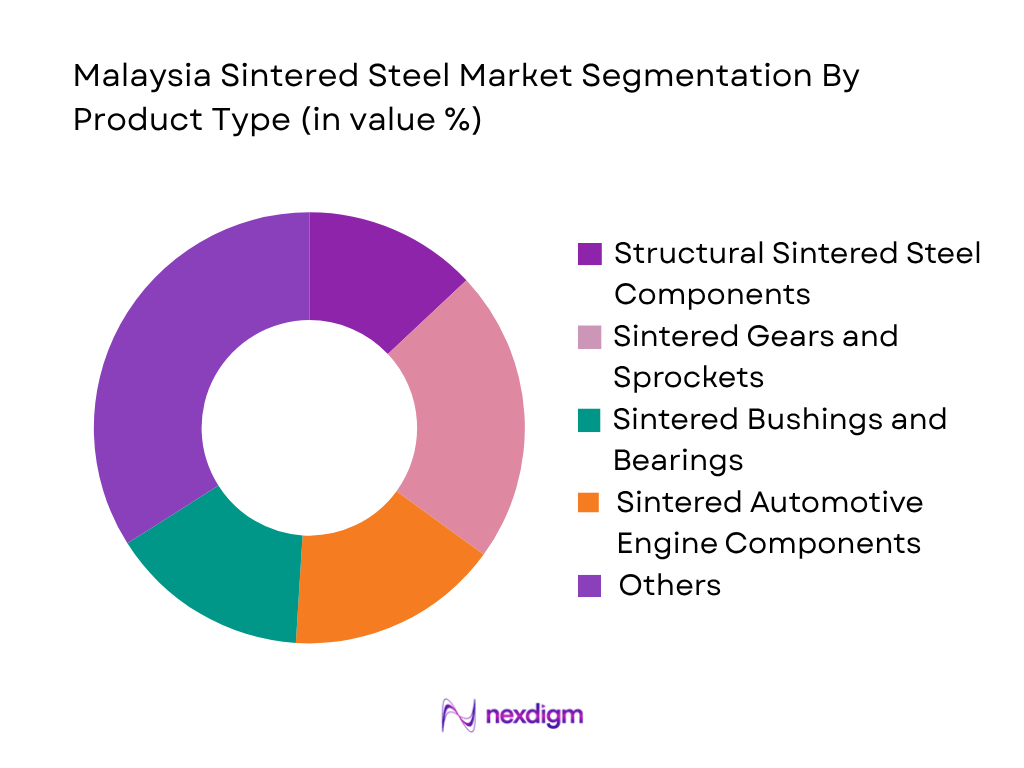
The Malaysia Sintered Steel Market is segmented by product type into structural sintered steel components, sintered gears and sprockets, sintered bushings and bearings, automotive engine components, transmission components, chassis and suspension components, electrical and magnetic components, compressor components, power-tool components, and other precision sintered steel components. Sintered gears and sprockets represent a major demand category because powder metallurgy enables complex geometries, consistent dimensions, controlled density, and efficient high-volume production. Automotive and motorcycle applications provide a particularly important outlet because gears, sprockets, rotors, bushings, and related parts require repeatable performance and wear resistance. Malaysia’s 790,347-unit vehicle production base provides substantial downstream potential for such components. Established manufacturers in Selangor already supply automotive, motorcycle, compressor, appliance, and industrial applications. Sumitomo Electric Sintered Components specifically manufactures automotive and motorcycle parts, air-conditioning and refrigerator compressor components, demonstrating the breadth of local application demand.
By End-Use Industry
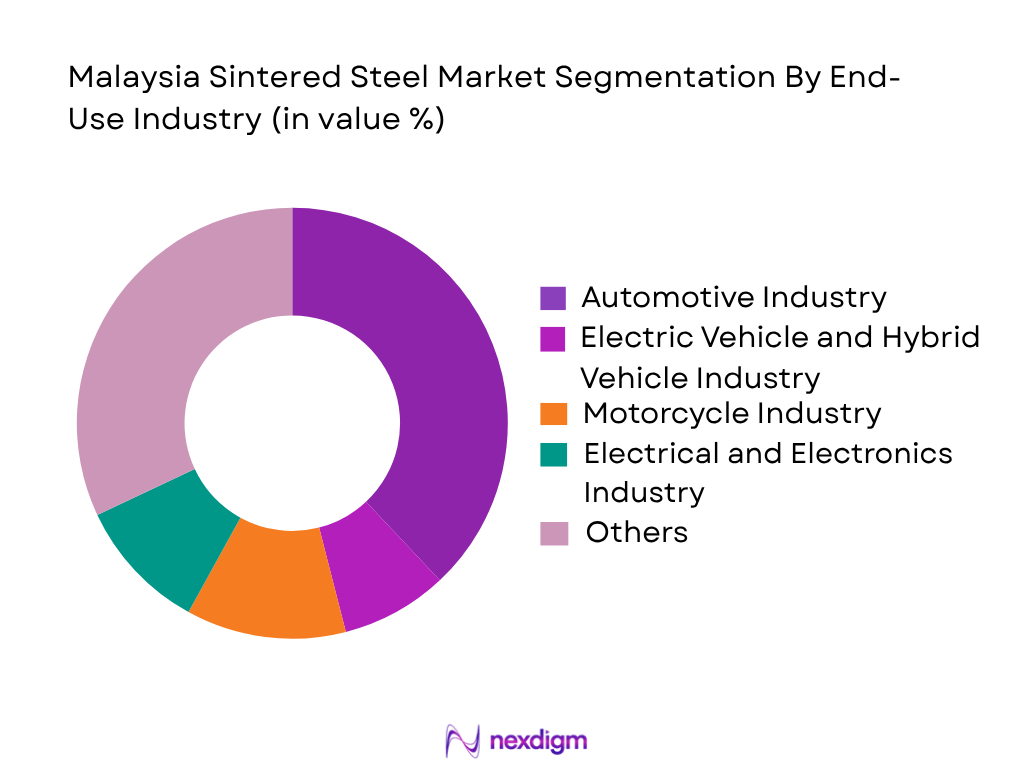
The Malaysia Sintered Steel Market is segmented by end-use industry into automotive, electric vehicle and hybrid vehicle, motorcycle, electrical and electronics, home appliance, industrial machinery, HVAC and refrigeration, power tools, consumer products manufacturing, and precision engineering. The automotive industry represents a major application segment because Malaysia has a developed vehicle assembly and component ecosystem requiring large volumes of engineered metal components. MIDA reports 790,347 vehicles produced and 816,747 vehicles sold, while the country secured RM15.8 billion in approved automotive investments, including RM5.07 billion specifically associated with EV and component manufacturing and assembly. The Automotive Hi-Tech Valley initiative in Tanjong Malim is additionally intended to develop next-generation vehicle manufacturing and high-tech automotive components. These developments create opportunities for sintered gears, bearings, rotors, structural components, and other precision parts across conventional and electrified vehicle platforms.
Competitive Landscape
The Malaysia Sintered Steel Market includes established powder metallurgy manufacturers serving automotive, motorcycle, appliance, HVAC, industrial machinery, and precision engineering applications. Sumitomo Electric Sintered Components is particularly established in Malaysia, having been incorporated in 1989 and identifying itself as Malaysia’s first structural powder-metallurgy parts manufacturer. Diamet Klang and Porite Malaysia provide additional local powder-metallurgy capabilities, while international groups such as GKN Powder Metallurgy, AMES, Miba, and Fine Sinter bring broader global technology and application expertise.
| Company | Establishment Year | Headquarters | Core Sintered Product Capability | Automotive Application | Bearing Capability | Gear/Transmission Capability | Quality/Manufacturing Capability | Key End Markets |
| Sumitomo Electric Sintered Components | 1989 | Shah Alam, Malaysia / Osaka, Japan | ~ | ~ | ~ | ~ | ~ | ~ |
| Diamet Klang | 1992 | Port Klang, Malaysia / Tokyo, Japan | ~ | ~ | ~ | ~ | ~ | ~ |
| Porite Malaysia | 1991 | Shah Alam, Malaysia / Japan | ~ | ~ | ~ | ~ | ~ | ~ |
| GKN Powder Metallurgy | 1951 | Global / Europe | ~ | ~ | ~ | ~ | ~ | ~ |
| AMES Group | 1951 | Barcelona, Spain | ~ | ~ | ~ | ~ | ~ | ~ |
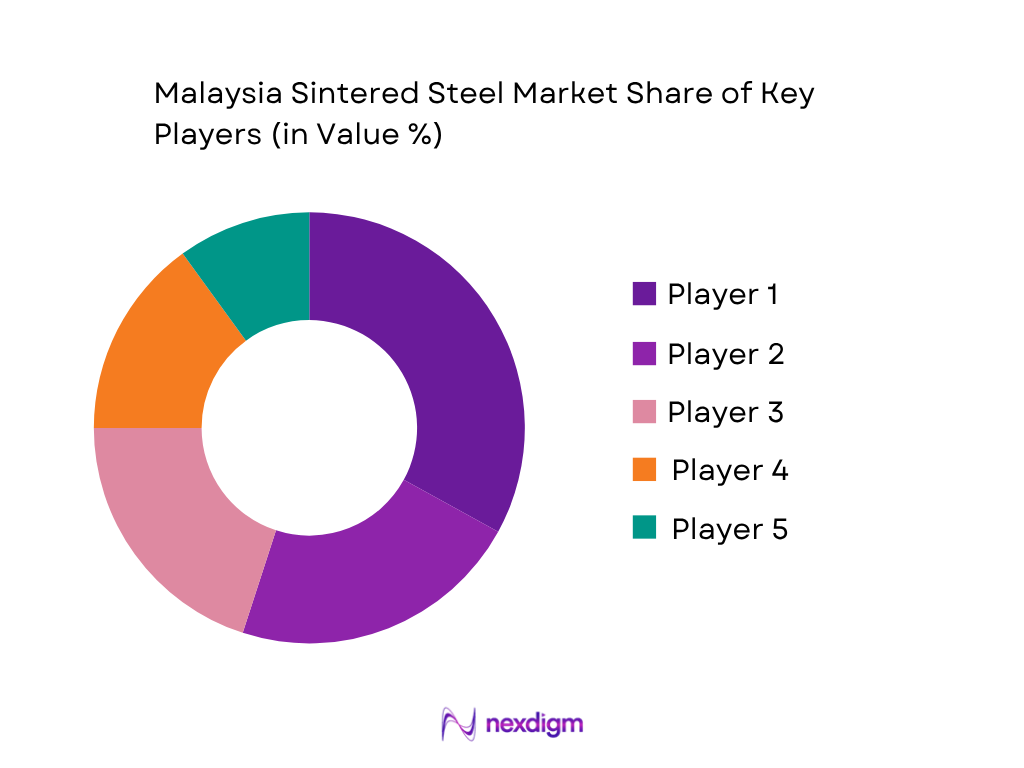
Malaysia Sintered Steel Market Analysis
Growth Drivers
Expansion of Automotive Manufacturing and Vehicle Component Demand
The Malaysia Sintered Steel Market is directly supported by the country’s sizeable automotive manufacturing ecosystem, where powder-metallurgy components are used in gears, sprockets, bearings, bushings, rotors, transmission parts, and other precision components. According to the Malaysian Investment Development Authority (MIDA), Malaysia recorded 790,347 units of total vehicle production and 816,747 units of industry sales in 2024, providing a substantial downstream manufacturing base for engineered metal components. The automotive sector also secured RM15.8 billion in approved investments through 94 projects, generating 9,675 job opportunities. Within this investment pool, electric vehicles and components manufacturing and assembly accounted for RM5.07 billion across 22 approved projects. These developments are relevant to the Malaysia Sintered Steel Market because increasing vehicle production and the transition toward electrified powertrains require lightweight, repeatable, dimensionally controlled, and increasingly complex components. MIDA also identifies Malaysia’s automotive sector as contributing approximately RM40 billion to the national economy and supporting more than 700,000 jobs. The continued development of next-generation vehicle manufacturing, component localisation, automated production, and EV supply chains therefore provides a broad industrial base for sintered steel manufacturers and suppliers.
Growth of Electrical, Electronics and Advanced Manufacturing Activities
The expansion of Malaysia’s electrical and electronics ecosystem is creating additional downstream opportunities for the Malaysia Sintered Steel Market, particularly in precision components, magnetic components, actuators, motors, industrial equipment, and specialised electronic hardware. Malaysia’s Ministry of Investment, Trade and Industry reported RM1,056 billion in total E&E trade in 2024, consisting of RM601.18 billion in exports and RM455.68 billion in imports. Semiconductor trade alone reached RM655.13 billion, including RM387.95 billion of exports and RM267.18 billion of imports. The E&E industry also attracted RM55.8 billion in investment, with semiconductors accounting for RM48.1 billion, demonstrating the scale of Malaysia’s advanced manufacturing ecosystem. The Department of Statistics Malaysia reported that manufacturing contributed 23.1% to the national economy and expanded by 4.2%, while electrical, electronic and optical products recorded 4.1% growth. Manufacturing sales reached RM1.9 trillion, with electrical and electronics products contributing to sales expansion. These conditions support sintered-steel applications where compact, high-precision and repeatable components are required. The National Semiconductor Strategy introduced in 2024 further focuses on strengthening production capacity, advanced technology, research, talent, and semiconductor value-chain participation, supporting the broader industrial environment in which precision powder-metallurgy components can expand.
Market Challenges
Dependence on Imported Advanced Materials and Specialized Powder Metallurgy Inputs
The Malaysia Sintered Steel Market faces supply-chain challenges because advanced powder-metallurgy manufacturing depends on consistent availability of iron powders, alloy powders, stainless-steel powders, lubricants, tooling materials, and specialised production equipment. Malaysia’s manufacturing sector remains strongly integrated with international supply chains, making global material availability, trade conditions, currency movements, and logistics relevant to local component manufacturers. MITI reported RM601.18 billion of E&E exports and RM455.68 billion of E&E imports in 2024, illustrating the scale of Malaysia’s dependence on internationally connected industrial inputs. Semiconductor trade alone involved RM267.18 billion of imports, reinforcing the importance of imported advanced manufacturing materials and equipment across the wider industrial ecosystem. Manufacturing also attracted RM120.5 billion in approved investments across 1,108 projects, indicating rapid development of capacity that can increase demand for specialised materials, machinery, tooling, and technical inputs. For sintered-steel producers, maintaining uninterrupted powder availability and consistent metallurgical specifications is particularly important because variations in powder morphology, particle size, composition, flowability, and compressibility can affect compaction behaviour and finished-component performance. Consequently, manufacturers must manage international sourcing, supplier qualification, inventory continuity, material traceability, and alternative sourcing arrangements while maintaining the dimensional and mechanical requirements demanded by automotive, industrial, electrical, and precision-engineering customers.
Production Complexity, Technical Capability and Scaling Requirements
The Malaysia Sintered Steel Market faces technical challenges associated with achieving consistent density, dimensional accuracy, mechanical strength, surface quality, and fatigue performance across high-volume production. Powder metallurgy requires coordinated control of powder formulation, mixing, lubrication, compaction pressure, tooling geometry, sintering temperature, atmosphere, cooling conditions, sizing, heat treatment, and secondary machining. Malaysia’s manufacturing environment is increasingly shifting toward higher-value production, raising technical expectations for component suppliers. MIDA recorded 87,695 employment opportunities associated with approved manufacturing projects and reported that 41.6% of the positions were high-value management, technical, and skilled roles, demonstrating the increasing importance of specialised industrial capabilities. The manufacturing sector also recorded RM120.5 billion in approved investments across 1,108 projects, while the E&E industry attracted RM55.8 billion. Such investment expansion can increase demand for advanced component manufacturing but also raises qualification requirements for suppliers. Sintered-steel producers must therefore maintain sophisticated process controls and skilled technical personnel while investing in tooling, automated presses, sintering furnaces, quality inspection, material testing, and secondary processing. Scaling production without compromising density distribution, dimensional tolerances, porosity, and metallurgical consistency remains a central operational challenge, particularly when serving automotive and industrial customers that require repeatable component performance across large production volumes.
Market Opportunities
Expansion of Electric Vehicle and Next-Generation Automotive Components
The transition toward electric and next-generation vehicles creates an opportunity for the Malaysia Sintered Steel Market to expand beyond traditional engine and transmission applications into lightweight structural components, motor-related parts, thermal-management components, actuators, braking systems, pumps, magnetic assemblies, and other precision applications. MIDA recorded RM5.07 billion in approved investments for EV and components manufacturing and assembly through 22 projects in 2024. Total automotive approved investments reached RM15.8 billion, supported by 94 projects and 9,675 employment opportunities, while total vehicle production reached 790,347 units. Malaysia is also developing the Automotive Hi-Tech Valley in Tanjong Malim as a next-generation vehicle manufacturing and high-technology automotive-component ecosystem. These developments create an opportunity for powder-metallurgy suppliers to qualify components for both conventional and electrified platforms. Sintered steel can be particularly relevant where manufacturers seek near-net-shape production, reduced material waste, controlled component weight, complex geometries, and repeatable performance. The development of EV manufacturing can also stimulate demand for specialised soft-magnetic materials, high-strength alloys, precision gears, rotors, pump components, and compact mechanical assemblies. As Malaysia increases participation in next-generation vehicle supply chains, local sintered-component manufacturers can pursue deeper relationships with OEMs, Tier-1 suppliers, EV manufacturers, and component integrators.
Development of High-Value Precision Manufacturing and Industrial Components
The Malaysia Sintered Steel Market has opportunities to move toward higher-value precision components as the country expands advanced manufacturing, semiconductor, electronics, machinery, automation, and industrial activities. MIDA reported RM120.5 billion in approved manufacturing investments involving 1,108 projects, while Malaysia’s E&E industry attracted RM55.8 billion and the semiconductor segment attracted RM48.1 billion in investment. MITI also reported RM655.13 billion in semiconductor trade, including RM387.95 billion in exports, highlighting the scale of Malaysia’s technology-oriented manufacturing base. The Department of Statistics Malaysia reported RM1.9 trillion in manufacturing sales, while basic metals and fabricated metal products recorded 7.5% growth within the manufacturing economy. These developments create opportunities for sintered-steel manufacturers to supply precision components used in industrial machinery, motors, actuators, pumps, compressors, automation equipment, electrical systems, and specialised production machinery. Higher-value manufacturing also supports adoption of advanced alloy powders, high-density compaction, controlled-atmosphere sintering, automated inspection, secondary machining, and heat treatment. The opportunity extends to suppliers capable of integrating powder-metallurgy design support with customer engineering requirements, rapid prototyping, tooling development, process validation, and high-volume production. This could strengthen the position of sintered steel within Malaysia’s increasingly sophisticated industrial component ecosystem.
Future Outlook
Over the coming decade, the Malaysia Sintered Steel Market is expected to be influenced by continued automotive production, next-generation vehicle development, industrial automation, precision engineering, and electrification. Malaysia’s automotive industry recorded 790,347 vehicles produced and 816,747 vehicles sold, while automotive investment initiatives increasingly focus on next-generation vehicles and high-tech components. The development of Automotive Hi-Tech Valley and the expansion of EV manufacturing provide opportunities for suppliers capable of producing lightweight, durable, high-precision components.
Future market development is also likely to involve higher-density powder-metal components, improved alloy formulations, automated compaction, advanced sintering, secondary machining, heat treatment, and digitally monitored production. The market can increasingly extend beyond traditional engine and transmission applications toward electrified powertrains, thermal-management systems, sensors, actuators, industrial automation, and precision machinery. GKN’s current focus on e-drivetrain, body and chassis, thermal-management, and electrification applications illustrates the direction of technological development in advanced powder metallurgy.
Major Players
- Sumitomo Electric Sintered Components (M) Sdn. Bhd.
- Diamet Klang (Malaysia) Sdn. Bhd.
- Porite Malaysia Sdn. Bhd.
- GKN Powder Metallurgy
- Miba Sinter Group
- AMES Group
- Fine Sinter Co., Ltd.
- NTN Advanced Materials Corporation
- Höganäs AB
- Hitachi Powder Metals Co., Ltd.
- Burgess-Norton Mfg. Co., Inc.
- Sintercom India Ltd.
- SSI Sintered Specialties
- Metal Powder Products, LLC
- Tosoh Corporation
Key Target Audience
- Automotive OEMs and Vehicle Manufacturers
- Automotive Tier-1 and Tier-2 Component Suppliers
- Electric Vehicle and Hybrid Vehicle Component Manufacturers
- Powder Metallurgy and Metal Powder Manufacturers
- Industrial Machinery and Precision Engineering Companies
- Investments and Venture Capitalist Firms (Industrial Manufacturing, Advanced Materials and Automotive Technology Investors)
- Government and Regulatory Bodies (Malaysian Investment Development Authority, Ministry of Investment, Trade and Industry, Malaysia Automotive Robotics and IoT Institute, Department of Standards Malaysia)
- Manufacturing Equipment and Industrial Automation Companies
Research Methodology
Step 1: Identification of Key Variables
The initial phase involves constructing a Malaysia Sintered Steel Market ecosystem covering powder suppliers, component manufacturers, tooling providers, sintering equipment manufacturers, automotive suppliers, industrial users, and distribution networks. Key variables include powder consumption, component production, material grades, manufacturing processes, density requirements, application penetration, production capacity, and downstream industry demand.
Step 2: Market Analysis and Construction
Historical market information will be compiled using a combination of production statistics, automotive manufacturing data, industrial activity indicators, company disclosures, trade information, manufacturing capacity assessments, and application-level analysis. Top-down calculations will connect downstream industry demand with sintered-component requirements, while bottom-up analysis will evaluate individual manufacturers, component categories, and production capabilities.
Step 3: Hypothesis Validation and Expert Consultation
Market hypotheses will be validated through structured discussions with powder metallurgy manufacturers, automotive component suppliers, precision engineering companies, material suppliers, equipment providers, and industrial procurement specialists. Discussions will examine material preferences, component specifications, production technologies, qualification requirements, customer applications, supply-chain dependencies, and adoption barriers.
Step 4: Research Synthesis and Final Output
The final research stage will triangulate manufacturer-level information with automotive production, industrial investment, trade, company disclosures, and application-specific evidence. Findings will be organized across product type, material type, manufacturing process, application, end-use industry, geography, and competitive positioning to create a consolidated view of the Malaysia Sintered Steel Market.

- Executive Summary
- Research Methodology (Market Definition and Scope, Malaysia Sintered Steel Market Classification, Powder Metallurgy Technology Mapping, Sintered Steel Product Mapping, Ferrous Powder Material Evaluation, Alloy Steel Powder Assessment, Stainless Steel Powder Analysis, Compaction Technology Evaluation, Sintering Process Assessment, Vacuum Sintering Evaluation, Continuous Furnace Sintering Analysis, Sintered Component Density Assessment, Porosity and Mechanical Property Evaluation, Heat Treatment and Secondary Processing Analysis, Sintered Bearing Assessment, Sintered Gear Evaluation, Automotive Sintered Component Assessment, Electric Vehicle Sintered Component Evaluation, Industrial Application Mapping, Precision Engineering Application Assessment, Supply-Side Assessment, Demand-Side Assessment, Primary Industry Interviews, Data Triangulation, Forecasting Framework)

- Definition and Scope
- Malaysia Sintered Steel Industry Evolution and Development of Powder Metallurgy Manufacturing, Automotive Sintered Component Adoption, Sintered Bearing Production, Sintered Gear Manufacturing, Motorcycle Component Applications, Electrical and Electronic Component Development, HVAC Component Manufacturing, Industrial Machinery Applications, Precision Engineering Expansion, Lightweight Component Manufacturing, Electric Vehicle Component Integration and Advanced Powder Metallurgy Technology Development
- Sintered Steel Value Chain Analysis
- Sintered Steel Supply Chain Analysis
- Iron Powder Suppliers, Alloy Steel Powder Manufacturers, Stainless Steel Powder Suppliers, Metal Powder Processors, Powder Lubricant Suppliers, Powder Mixing Equipment Providers, Compaction Press Manufacturers, Sintering Furnace Manufacturers, Powder Metallurgy Component Producers, Secondary Machining Providers, Heat Treatment Companies, Surface Finishing Providers, Automotive Component Manufacturers, Tier-1 Automotive Suppliers, Motorcycle Component Manufacturers, Electrical and Electronic Component Manufacturers, HVAC Equipment Manufacturers, Industrial Machinery Producers, Precision Engineering Companies and End-Use Industries

- Growth Drivers (Expansion of Automotive Manufacturing, Growth of Vehicle Component Production, Increasing Powder Metallurgy Adoption, Expansion of Precision Engineering, Growth of Electrical and Electronics Manufacturing, Rising Demand for Lightweight Components, Expansion of Motorcycle Manufacturing, Industrial Machinery Development, Increasing Manufacturing Automation, Electric Vehicle Component Localization)
- Market Challenges (Dependence on Imported Metal Powders, Limited Domestic Powder Metallurgy Raw Material Production, High Precision Tooling Requirements, Advanced Sintering Equipment Dependency, Specialized Workforce Requirements, Material Quality Consistency Challenges, Complex Secondary Processing Requirements, Energy-Intensive Sintering Operations)
- Market Opportunities (Electric Vehicle Sintered Components, Lightweight Automotive Components, Advanced Sintered Gears, High-Performance Sintered Bearings, Soft Magnetic Components, Industrial Automation Components, Precision HVAC Components, Advanced Electrical Components, Sustainable Powder Metallurgy Manufacturing, High-Density Sintered Steel Applications)
- Market Trends (Increasing Automotive Powder Metal Adoption, Electric Vehicle Component Development, High-Density Sintered Materials, Advanced Alloy Powder Utilization, Lightweight Component Design, Precision Gear Manufacturing, Soft Magnetic Material Adoption, Automated Compaction Systems, Advanced Sintering Furnace Technologies, Digital Process Monitoring and Quality Control)
- Government Regulations and Standards (Malaysia Investment Development Authority Manufacturing Framework, Ministry of Investment Trade and Industry Industrial Policies, Department of Standards Malaysia Requirements, Malaysian Standards for Powder Metallurgy Components, Occupational Safety and Health Requirements, Environmental Quality Regulations, Scheduled Waste Management Requirements)
- SWOT Analysis
- Porter’s Five Forces Analysis
- PESTLE Analysis
- Stakeholder Ecosystem
- Competition Ecosystem

- By Market Value (2020-2025)
- By Sintered Steel Consumption Volume (2020-2025)
- By Powder Metallurgy Steel Powder Consumption Volume (2020-2025)
- By Structural Sintered Component Production Volume (2020-2025)
- By Sintered Bearing Production Volume (2020-2025)
- By Sintered Gear Production Volume (2020-2025)
- By Automotive Sintered Component Production Volume (2020-2025)
- By Motorcycle Sintered Component Production Volume (2020-2025)
- By Industrial Sintered Component Production Volume (2020-2025)
- By Electrical and Electronic Sintered Component Production Volume (2020-2025)

- By Product Type (In Value %)
Structural Sintered Steel Components
Sintered Gears and Sprockets
Sintered Bushings and Bearings
Sintered Automotive Engine Components
Sintered Transmission Components
Sintered Chassis and Suspension Components
Sintered Electrical and Magnetic Components
Sintered Compressor Components
Sintered Power Tool Components
Other Precision Sintered Steel Components - By Material Type (In Value %)
Iron-Based Sintered Steel
Low-Alloy Steel Powder
Nickel-Alloyed Steel Powder
Copper-Alloyed Steel Powder
Chromium-Alloyed Steel Powder
Stainless Steel Powder
High-Carbon Steel Powder
Pre-Alloyed Steel Powder
Diffusion-Alloyed Steel Powder
Soft Magnetic Steel Materials - By Manufacturing Process (In Value %)
Powder Mixing and Blending
Die Compaction
Warm Compaction
Cold Isostatic Processing
Conventional Sintering
High-Temperature Sintering
Vacuum Sintering
Continuous Belt Furnace Sintering
Sizing and Calibration
Secondary Machining and Heat Treatment - By Application Area (In Value %)
Automotive Powertrain Components
Automotive Transmission Components
Automotive Chassis and Suspension Components
Motorcycle Components
Air-Conditioning and Refrigeration Components
Electrical and Electronic Equipment
Power Tools and Industrial Machinery
Home Appliances
Industrial Pumps and Compressors
Precision Engineering Components - By End-Use Industry (In Value %)
Automotive Industry
Electric Vehicle and Hybrid Vehicle Industry
Motorcycle Industry
Electrical and Electronics Industry
Home Appliance Industry
Industrial Machinery Industry
HVAC and Refrigeration Industry
Power Tool Industry
Consumer Products Manufacturing
Precision Engineering Industry - By Region (In Value %)
Selangor
Penang
Johor
Kuala Lumpur
Perak
Negeri Sembilan
Melaka
Other Malaysian Regions

- Market Share of Major Players (By Malaysia Revenue, Sintered Steel Product Portfolio, Powder Metallurgy Production Capability, Automotive Component Coverage, Sintered Bearing Portfolio, Sintered Gear Manufacturing Capability, Material Grade Coverage, Manufacturing Capacity, Customer Base, Export Reach, Quality Certification Coverage, Secondary Processing Capability, Research and Development Capability, Regional Presence)
- Cross Comparison Parameters (Sintered Steel Product Portfolio Breadth, Powder Metallurgy Production Capability, Automotive Sintered Component Coverage, Sintered Bearing Manufacturing Capability, Sintered Gear Manufacturing Capability, Advanced Steel Powder Grade Coverage, Secondary Processing and Heat Treatment Capability, Electric Vehicle Component Development Capability)
- SWOT Analysis of Major Players
- Competitive Positioning Matrix
- Sintered Steel Product and Application Benchmarking
- Powder Metallurgy Manufacturing Process and Technology Assessment
- Material Grade, Density and Mechanical Property Benchmarking
- Automotive and Electric Vehicle Sintered Component Assessment
- Sintered Bearing and Gear Technology Assessment
- Production Capacity, Quality Certification and Manufacturing Capability Assessment
- Detailed Profiles of Major Companies
Sumitomo Electric Sintered Components (M) Sdn. Bhd.
Porite Malaysia Sdn. Bhd.
GKN Powder Metallurgy
Miba Sinter Group
Höganäs AB
Fine Sinter Co., Ltd.
NTN Advanced Materials Corporation
Hitachi Powder Metals Co., Ltd.
AMES Group
Burgess-Norton Mfg. Co., Inc.
Perry Technology Corporation
Sintercom India Ltd.
SSI Sintered Specialties
Metal Powder Products, LLC
Tosoh Corporation

- Automotive OEM Sintered Component Requirement Assessment
- Automotive Tier-1 Supplier Demand Analysis
- Electric Vehicle Component Manufacturer Requirement Assessment
- Motorcycle Component Manufacturer Demand Analysis
- Sintered Bearing Procurement Assessment
- Sintered Gear Application Requirement Analysis
- HVAC and Compressor Component Demand Assessment
- Electrical and Electronic Component Requirement Analysis
- Industrial Machinery Component Procurement Assessment
- Power Tool Component Demand Analysis
- Home Appliance Component Requirement Assessment
- Precision Engineering Component Demand Analysis
- Powder Metallurgy Material Procurement Preference Assessment
- Sintered Component Quality and Certification Requirement Analysis

- By Market Value (2026-2035)
- By Sintered Steel Consumption Volume (2026-2035)
- By Powder Metallurgy Steel Powder Consumption Volume (2026-2035)
- By Structural Sintered Component Production Volume (2026-2035)
- By Sintered Bearing Production Volume (2026-2035)
- By Sintered Gear Production Volume (2026-2035)
- By Automotive Sintered Component Production Volume (2026-2035)
- By Motorcycle Sintered Component Production Volume (2026-2035)
- By Industrial Sintered Component Production Volume (2026-2035)
- By Electrical and Electronic Sintered Component Production Volume (2026-2035)


 Request a Sample
 Ask for Customization
 Get a Quote
 Enquire Now