

 Download PDF
Market Overview
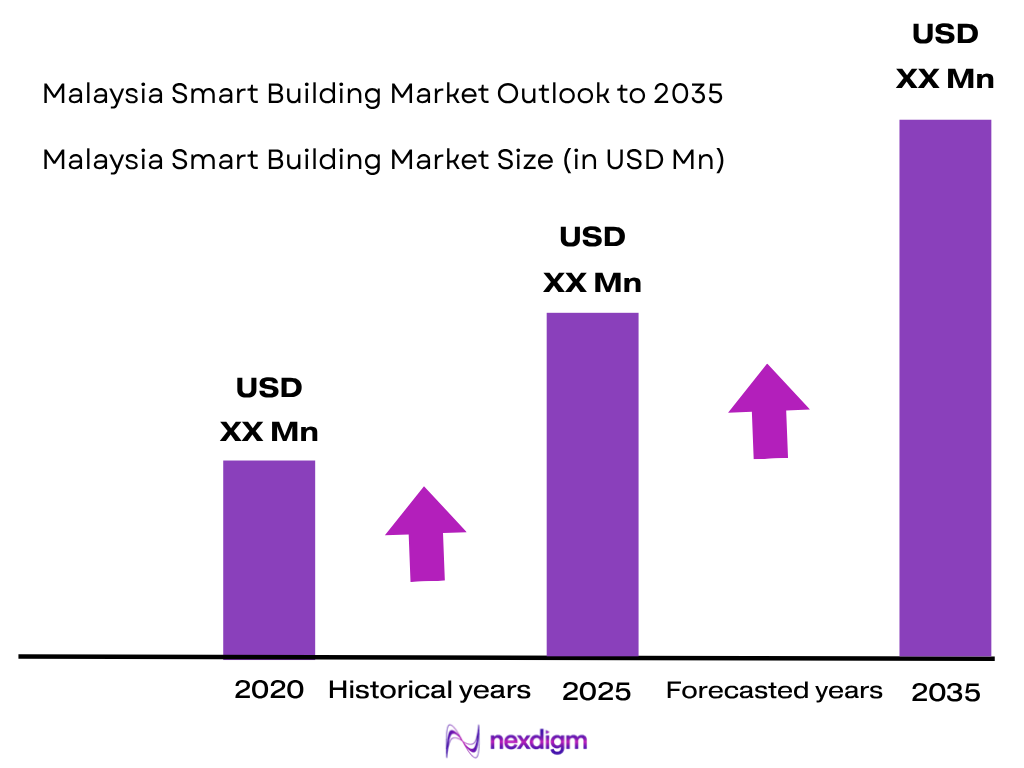
The Malaysia Smart Building Market is represented by integrated building automation, energy management, HVAC controls, smart lighting, security, IoT connectivity, and related software and services. For report modelling, the 2024 market size is represented as ~USD XX million, with the 2026–2035 CAGR represented as ~XX%. The underlying demand environment is supported by Malaysia’s construction sector, where construction work completed reached RM158.8 billion in 2024, while non-residential building work reached RM44.4 billion.
Malaysia’s smart-building deployment is concentrated around major commercial, industrial, technology and data-centre clusters, particularly Selangor, Kuala Lumpur and Johor. Selangor recorded RM101.1 billion in approved investments, Kuala Lumpur RM91.5 billion, and Johor RM48.5 billion in 2024, creating substantial demand for digitally managed commercial and industrial facilities. Data-centre development is particularly relevant: 12 data-centre projects representing RM90.2 billion of approved investment were recorded through June 2024, with projects distributed across Johor, Selangor, Kuala Lumpur and Negeri Sembilan.
Market Segmentation
By Component Type
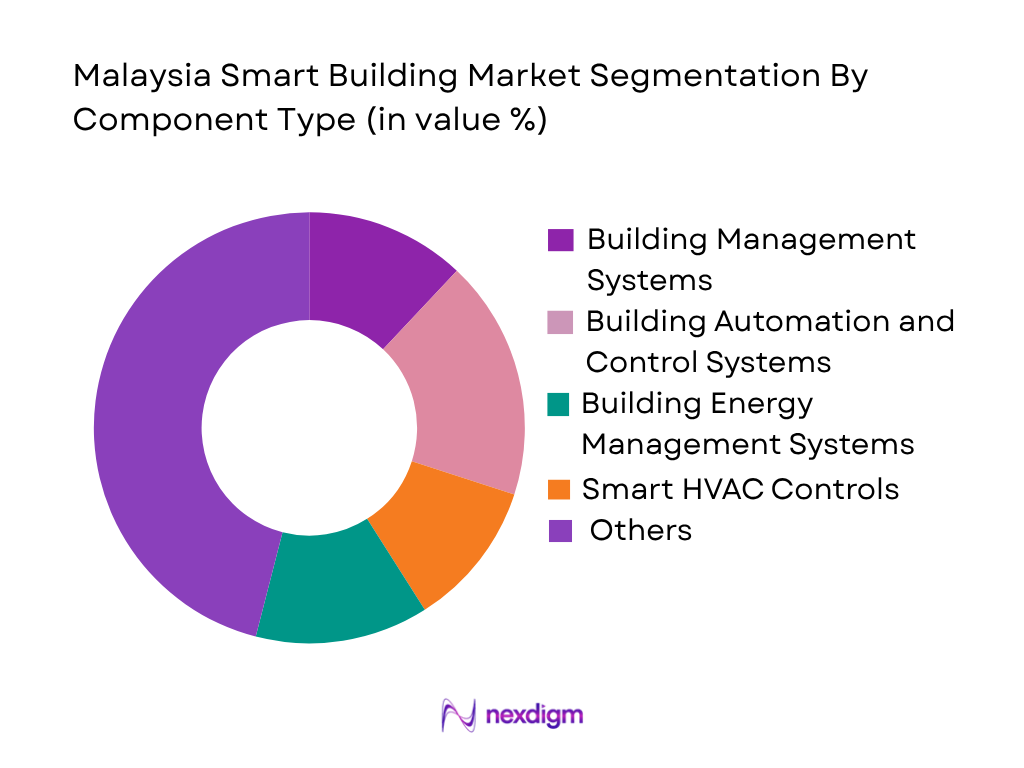
The Malaysia Smart Building Market is segmented by component type into building management systems, building automation and control systems, building energy management systems, smart HVAC controls, smart lighting controls, smart security and access control systems, fire and life safety systems, IoT sensors and connected devices, energy monitoring systems, and integrated workplace management systems. Building automation and control systems are positioned as the leading segment in the report framework because they provide the central infrastructure through which HVAC, lighting, energy, security and other building functions can be coordinated. Their relevance is reinforced by Malaysia’s rapidly expanding commercial and industrial construction environment. Construction work completed reached RM158.8 billion in 2024, including RM44.4 billion from non-residential buildings, providing a substantial installed-base opportunity for automation technologies. The expansion of digital infrastructure also strengthens the requirement for centralized monitoring, automated environmental controls and equipment management. Malaysia recorded RM163.6 billion of digital investments in 2024, compared with RM46.8 billion in 2023, supporting broader adoption of connected digital infrastructure.
By Building Type
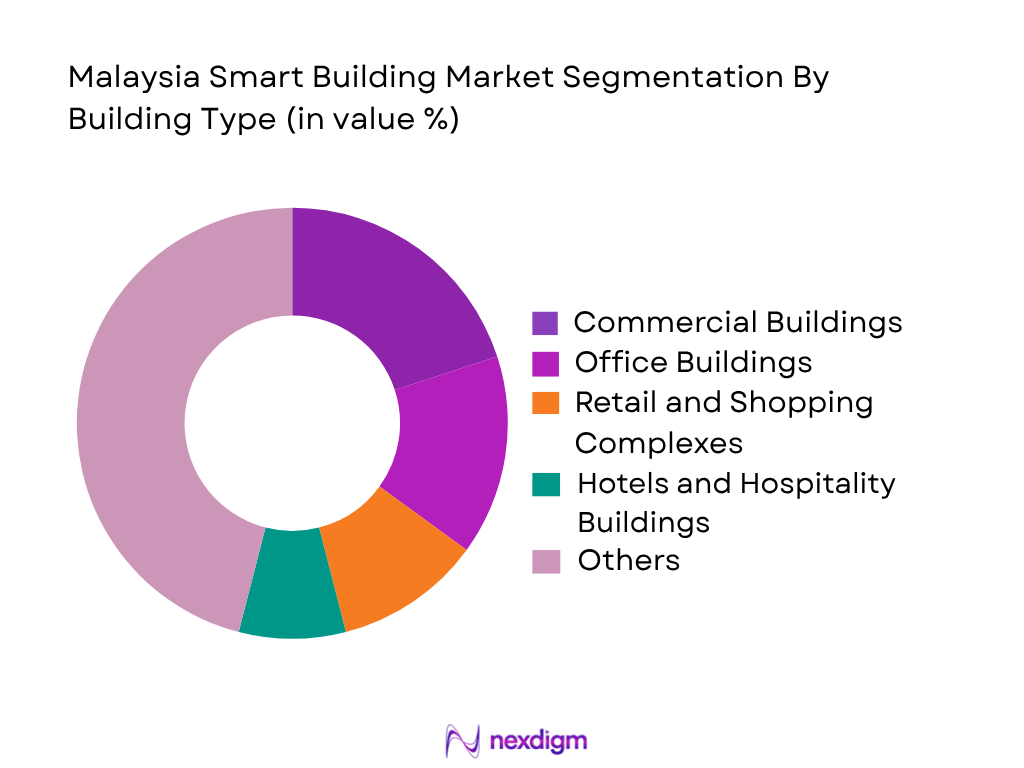
The Malaysia Smart Building Market is segmented by building type into commercial buildings, office buildings, retail and shopping complexes, hotels and hospitality buildings, healthcare facilities, educational buildings, industrial buildings, warehouses and logistics facilities, data centres, and residential buildings. Commercial buildings represent the leading segment within the report framework because large commercial facilities can integrate multiple smart-building functions simultaneously, including HVAC automation, lighting control, access management, energy monitoring, occupancy analytics and centralized facility management. Malaysia’s non-residential construction activity provides an important demand base, with non-residential buildings generating RM44.4 billion in construction work in 2024. Data-centre infrastructure is another important contributor to advanced-building technology demand, with MIDA recording 12 approved data-centre projects worth RM90.2 billion through June 2024. Google separately announced a US$2 billion investment in Malaysia covering a data centre and Google Cloud region. These developments require sophisticated power, cooling, security, monitoring and automation infrastructure.
Competitive Landscape
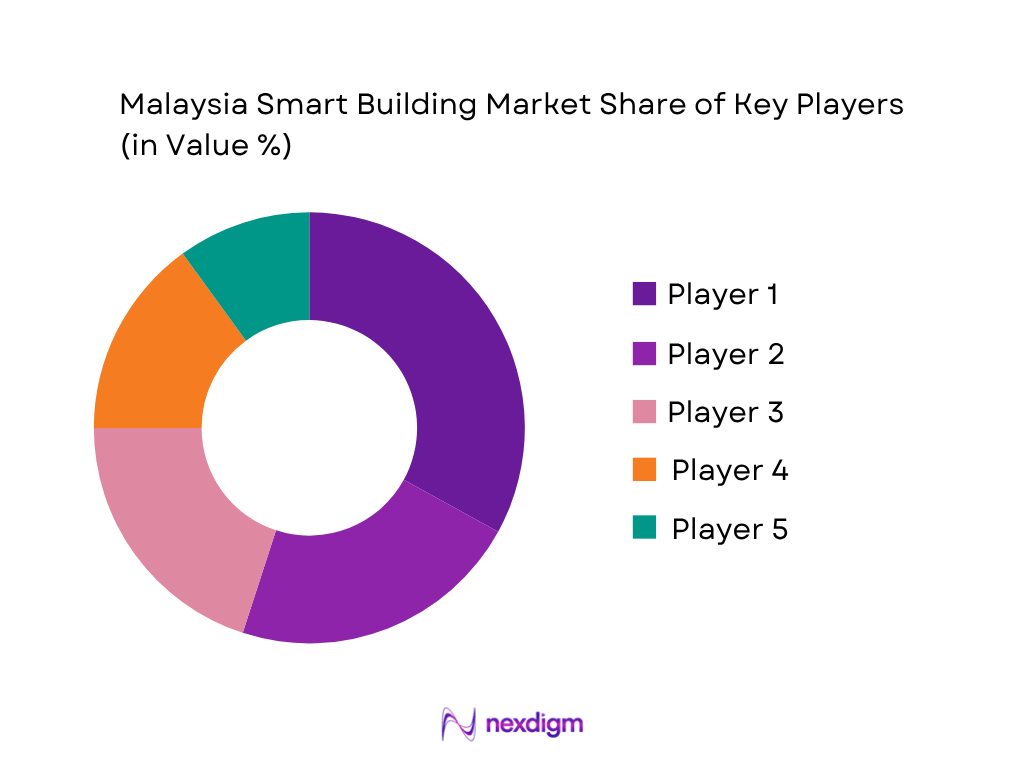
The Malaysia Smart Building Market comprises global building-technology companies, automation specialists, HVAC technology providers, electrical-system suppliers, security companies and industrial-control providers. Competition is increasingly shaped by the ability to integrate multiple building systems rather than supplying standalone hardware. Major international participants such as Siemens, Schneider Electric, Honeywell, Johnson Controls and ABB have portfolios spanning automation, energy management, controls, connected infrastructure and building-management technologies. Local system integrators and engineering companies also participate through project implementation, customization and maintenance. The competitive environment is supported by Malaysia’s large investment pipeline, with RM378.5 billion of approved investments across 6,700 projects in 2024.
| Company | Establishment | Headquarters | Building Automation | Energy Management | HVAC Controls | IoT / Connectivity | Security Integration | System Integration |
| Siemens AG | 1847 | Munich, Germany | ~ | ~ | ~ | ~ | ~ | ~ |
| Schneider Electric SE | 1836 | Rueil-Malmaison, France | ~ | ~ | ~ | ~ | ~ | ~ |
| Honeywell International Inc. | 1906 | Charlotte, USA | ~ | ~ | ~ | ~ | ~ | ~ |
| Johnson Controls International plc | 1885 | Cork, Ireland | ~ | ~ | ~ | ~ | ~ | ~ |
| ABB Ltd | 1988 | Zurich, Switzerland | ~ | ~ | ~ | ~ | ~ | ~ |
Malaysia Smart Building Market Analysis
Growth Drivers
Rapid Expansion of Commercial, Industrial and Digital Infrastructure
The Malaysia Smart Building Market is being supported by strong construction activity and expanding investment in technology-intensive facilities, which increases the addressable base for building automation, HVAC controls, smart lighting, access control, energy management and connected monitoring systems. Malaysia recorded RM158.8 billion in construction work completed in 2024, while non-residential construction increased to RM44.4 billion. The manufacturing sector generated RM1.9 trillion in sales during the same year, creating demand for digitally managed factories, warehouses and production facilities. Digital investment also reached RM163.6 billion, compared with RM46.8 billion in 2023, strengthening the ecosystem for IoT-enabled infrastructure, cloud-connected building systems and automated facility management. Data-centre development provides another market-specific demand channel, with RM24.1 billion in data-centre investments recorded during 2024 and cumulative data-centre, cloud-computing and data-hosting investments reaching RM113.8 billion across 2021–2024. These developments increase requirements for continuous cooling, power monitoring, environmental controls, physical security and equipment optimization. The combination of construction, manufacturing and digital infrastructure therefore provides a broad installed-base opportunity for smart-building technologies across commercial, industrial and technology facilities.
Manufacturing Digitalization and Industry 4.0 Adoption
The Malaysia Smart Building Market is gaining structural support from manufacturing digitalization as industrial facilities increasingly require integrated monitoring, automation, connectivity and energy-management capabilities. Malaysia’s manufacturing sector recorded RM1.9 trillion in sales in 2024, while the Industrial Production Index increased 4.6% in December 2024 and manufacturing output increased 5.8% during the month. These production conditions support investment in automated facilities where building-management systems can coordinate HVAC, lighting, environmental conditions, equipment monitoring and security. Malaysia’s industrial transformation programme targets 3,000 smart factories, creating a long-term technology-adoption framework for connected industrial environments. The government reported that nearly 500 companies had already benefited from the Industry 4.0 intervention fund, indicating an established base of businesses progressing toward technology-enabled manufacturing. Digital investments reached RM163.6 billion in 2024 and generated more than 48,000 jobs, reinforcing the country’s expanding digital infrastructure ecosystem. For smart-building suppliers, this transition creates opportunities to integrate building systems with industrial automation platforms, IoT networks and operational analytics. Demand is therefore increasingly linked not only to new construction but also to modernization of existing factories, logistics facilities and production sites requiring greater visibility, automation and resource-management capabilities.
Market Challenges
High Integration Complexity and Digitalization Readiness Constraints
The Malaysia Smart Building Market faces implementation challenges because smart buildings require multiple technologies to operate through interoperable networks rather than as isolated systems. Building management systems, HVAC controls, lighting, access control, fire safety, energy meters, sensors and IoT platforms may originate from different vendors and use different communication architectures. This creates integration requirements for engineering expertise, cybersecurity controls, data architecture and ongoing technical support. Malaysia’s Industry 4.0 programme identifies 5 major barriers for manufacturers adopting smart technologies, including financial or technological obstacles, insufficient knowledge, limited readiness to change processes, inadequate technical skills and unstandardized procedures and data. These constraints are directly relevant to smart-building deployment because successful implementation similarly requires integration between physical infrastructure and digital platforms. The challenge is particularly significant for existing buildings where legacy HVAC, electrical and security equipment may not have been designed for cloud connectivity or centralized control. Malaysia also has more than 97.5% of businesses classified as SMEs, with 87% categorized as micro SMEs, creating a large group of smaller businesses for which sophisticated digital-building integration may require additional technical and financial support. Consequently, suppliers must address interoperability, skills, cybersecurity and retrofit complexity alongside technology performance.
Energy and Infrastructure Requirements of Technology-Intensive Buildings
The Malaysia Smart Building Market faces infrastructure-related challenges as increasingly connected facilities, particularly data centres and technology-intensive buildings, place substantial demands on electricity, cooling and building-management infrastructure. Malaysia’s peak electricity demand was reported at close to 20 GW, while the government had approved approximately 4 GW of data-centre capacity, highlighting the scale of additional infrastructure requirements associated with digital facilities. Data-centre investments reached RM24.1 billion in 2024, while cumulative digital-infrastructure investments across data centres, cloud computing and data hosting reached RM113.8 billion from 2021 through 2024. These facilities require continuous cooling, power management, environmental monitoring and resilient building systems, increasing the technical complexity of smart-building projects. Malaysia’s broader construction sector also recorded RM158.8 billion in work completed during 2024, creating a large but heterogeneous building base with differing electrical, mechanical and automation specifications. For smart-building providers, this means systems must accommodate varying infrastructure conditions while maintaining reliability and energy efficiency. The challenge extends beyond installation because connected equipment requires continuous monitoring, software management and cybersecurity maintenance. As technology-intensive facilities expand, smart-building solutions must therefore manage increasing system complexity without compromising operational resilience, power efficiency or facility availability.
Market Opportunities
Smart Factory and Industrial Building Modernization
The Malaysia Smart Building Market has an opportunity to expand through the modernization of manufacturing facilities as industrial operators move toward connected and automated production environments. Malaysia’s manufacturing sector recorded RM1.9 trillion in sales in 2024, demonstrating the scale of industrial activity requiring reliable production infrastructure. The national industrial transformation programme is targeting 3,000 smart factories, creating a substantial potential deployment environment for connected building-management technologies. Smart factories require more than production automation; they also need coordinated HVAC, lighting, power monitoring, environmental sensing, security, access control and facility analytics. Nearly 500 companies had already benefited from the Industry 4.0 intervention fund, indicating that technology adoption is progressing beyond policy formulation toward enterprise implementation. Malaysia also recorded RM120.5 billion in approved manufacturing investments in 2024, supporting continued industrial development and modernization. New industrial projects provide opportunities to embed smart-building architecture during the design stage, while existing facilities create retrofit opportunities for wireless sensors, energy-management platforms, automated HVAC controls and centralized building-management systems. Suppliers capable of integrating operational technology with building systems can therefore address a broader portion of the industrial technology stack. This creates an opportunity for smart-building providers to move from standalone equipment toward integrated facility-management solutions.
Data Centres and High-Performance Commercial Infrastructure
The Malaysia Smart Building Market has significant opportunity in data centres and other high-performance facilities that require sophisticated automation, environmental control, security and energy-management systems. Malaysia attracted RM24.1 billion of data-centre investments in 2024, while cumulative investments in data centres, cloud computing and data hosting reached RM113.8 billion across 2021–2024. The country’s digital investment ecosystem also recorded RM163.6 billion in approved digital investments in 2024, strengthening demand for digitally enabled infrastructure. Google announced a RM9.4 billion investment for its first Malaysian data centre and Google Cloud region, demonstrating the scale of individual technology infrastructure projects entering the country. Data centres require continuous temperature and humidity monitoring, automated cooling, power-quality management, access control, fire protection and real-time equipment monitoring, making them particularly compatible with integrated smart-building technologies. The expansion of hyperscale and cloud infrastructure also increases the importance of predictive maintenance and centralized facility analytics because equipment availability directly affects operational continuity. Smart-building suppliers can therefore target data-centre developers, operators, electrical contractors and facility-management providers with solutions combining building automation, energy optimization, IoT sensors, security and predictive analytics. The concentration of digital infrastructure investment creates a specialized opportunity for high-reliability smart-building systems.
Future Outlook
The Malaysia Smart Building Market is expected to develop alongside the country’s commercial construction, industrial modernization and digital-infrastructure investment cycle. The combination of connected building systems, energy optimization, AI-enabled analytics and automated facility management is expected to increase the technological content of new developments and retrofit projects. Data-centre expansion is creating an additional requirement for advanced cooling, power monitoring, security and infrastructure-management systems. Sustainability requirements and energy-efficiency considerations are also encouraging property owners to evaluate integrated building-management solutions. Malaysia’s digital investments reached RM163.6 billion in 2024, while approved investments across the wider economy reached RM378.5 billion, providing a strong investment environment for technology-intensive infrastructure. Malaysia Digital Economy Corporation
Major Players
- Siemens AG
- Schneider Electric SE
- Honeywell International Inc.
- Johnson Controls International plc
- ABB Ltd
- Delta Electronics, Inc.
- Carrier Global Corporation
- Trane Technologies plc
- Bosch Building Technologies
- Legrand SA
- Lutron Electronics Co., Inc.
- Azbil Corporation
- Distech Controls
- Beckhoff Automation
- Kieback&Peter GmbH
Key Target Audience
- Commercial property developers and building owners
- Data centre developers and operators
- Industrial facility owners and manufacturing companies
- Facility management and building operations companies
- Investments and venture capitalist firms
- Government and regulatory bodies (Ministry of Energy Transition and Water Transformation, Ministry of Investment, Trade and Industry, Suruhanjaya Tenaga, Malaysian Investment Development Authority)
- Building automation, HVAC and electrical-system manufacturers
- Real estate investment trusts and commercial asset managers
Research Methodology
Step 1: Identification of Key Variables
The initial phase involves mapping the Malaysian smart-building ecosystem across technology providers, property developers, system integrators, facility operators, construction companies and building owners. The assessment covers automation, energy management, HVAC, lighting, security, IoT, connectivity and building-management platforms. Key variables influencing technology adoption, project deployment and replacement demand are identified.
Step 2: Market Analysis and Construction
Historical and current information is compiled to establish the structure of the Malaysia Smart Building Market. Construction activity, commercial development, industrial investment, data-centre deployment and digital infrastructure are evaluated alongside technology adoption across building types. Bottom-up calculations are developed using component deployments, project activity, system values and application-level demand.
Step 3: Hypothesis Validation and Expert Consultation
Market hypotheses are validated through discussions with building-automation providers, system integrators, facility managers, property developers, engineering companies and industrial users. The consultation process focuses on purchasing criteria, technology preferences, deployment barriers, replacement cycles, integration requirements and application-specific demand. Conflicting evidence is reconciled through source triangulation.
Step 4: Research Synthesis and Final Output
The final research model integrates demand-side, supply-side, construction and technology indicators into a unified market framework. Segment-level findings are cross-checked against company capabilities, project activity, investment announcements and industry developments. The resulting analysis provides the historical market structure, competitive environment, segmentation framework and forward-looking assessment of Malaysia’s smart-building ecosystem.

- Executive Summary
- Research Methodology (Market Definition and Scope, Malaysia Smart Building Market Classification, Smart Building Technology Mapping, Building Automation System Assessment, Building Energy Management System Evaluation, HVAC Automation Analysis, Smart Lighting Control Assessment, Smart Security and Access Control Evaluation, Fire and Life Safety System Assessment, IoT Sensor and Connected Device Mapping, Building Management Platform Assessment, Artificial Intelligence and Machine Learning Integration, Cloud-Based Building Management Analysis, Edge Computing Infrastructure Assessment, Digital Twin Application Evaluation, Occupancy and Space Utilization Analytics, Energy Monitoring and Optimization Assessment, Indoor Air Quality Monitoring, Predictive Maintenance Analysis, Renewable Energy Integration Assessment, EV Charging Infrastructure Integration)

- Definition and Scope
- Malaysia Smart Building Industry Evolution and Development of Building Automation Systems, Intelligent HVAC Systems, Smart Lighting Systems, Building Energy Management Systems, IoT-Enabled Buildings, Connected Security Systems, Smart Access Control, Intelligent Fire Safety Systems, Occupancy Analytics, Indoor Air Quality Monitoring, Digital Twin Solutions, AI-Based Building Optimization, Cloud Building Management Platforms, Edge-Based Building Automation, Smart Workplace Technologies, Integrated Facility Management Platforms
- Smart Building Value Chain Analysis
- Smart Building Supply Chain Analysis
- Building Automation Component Suppliers, HVAC Equipment Manufacturers, Lighting Control Manufacturers, IoT Sensor Providers, Building Management System Providers, Energy Management Software Developers, Access Control Technology Providers, Video Surveillance Providers, Fire Detection System Manufacturers, Network Infrastructure Providers, Cloud Platform Providers, Cybersecurity Solution Providers, System Integrators, Facility Management Companies, Engineering Contractors, Property Developers, Commercial Building Owners, Industrial Facility Operators, Data Center Operators, Hospitality Operators, Healthcare Facility Operators, Retail Property Operators

- Growth Drivers (Increasing Demand for Energy-Efficient Buildings, Expansion of Commercial and Mixed-Use Developments, Growth of Data Centers and Digital Infrastructure, Increasing Industrial Automation, Rising Adoption of IoT-Enabled Building Systems, Government Energy Efficiency Initiatives, Expansion of Green Building Certification, Growing Demand for Integrated Facility Management)
- Market Challenges (High Initial Technology Investment, Integration Complexity Across Legacy Building Systems, Limited Interoperability Between Proprietary Platforms, Cybersecurity and Data Privacy Risks, Shortage of Specialized Building Automation Expertise, Retrofit Constraints in Existing Buildings, Fragmented System Integration Ecosystem, Long Technology Payback Periods)
- Market Opportunities (Smart Building Retrofit Programs, Data Center Infrastructure Expansion, AI-Based Building Optimization, Smart Energy Management Deployment, Digital Twin Adoption, Integrated IoT Building Platforms, Smart HVAC Modernization, Smart Lighting Replacement, Building Electrification and EV Charging Integration, Green Building Development)
- Market Trends (AI-Enabled Building Management, Cloud-Based Building Automation, IoT Sensor Deployment, Predictive Building Maintenance, Occupancy-Based HVAC Control, Smart Energy Analytics, Digital Twin Integration, Wireless Building Automation, Integrated Security Platforms, Indoor Air Quality Monitoring, Smart Workplace Management, Building Electrification)
- Government Regulations and Standards (Energy Efficiency and Conservation Act, MS 1525 Energy Efficiency Requirements, Green Building Index Requirements, Uniform Building By-Laws, Suruhanjaya Tenaga Requirements, Malaysian Standards for Building Services, Fire and Life Safety Requirements, Personal Data Protection Act, Cybersecurity Requirements, Environmental Sustainability Guidelines)
- SWOT Analysis
- Porter’s Five Forces Analysis
- PESTLE Analysis
- Stakeholder Ecosystem
- Competition Ecosystem

- By Market Value (2020-2025)
- By Smart Building System Installations (2020-2025)
- By Connected Building Devices (2020-2025)
- By Smart Building Projects (2020-2025)
- By Building Automation System Deployments (2020-2025)
- By Building Energy Management System Deployments (2020-2025)
- By Smart HVAC System Deployments (2020-2025)
- By Smart Lighting System Deployments (2020-2025)
- By Smart Security System Deployments (2020-2025)
- By IoT Sensor Deployments (2020-2025)

- By Component Type (In Value %)
Building Management Systems
Building Automation and Control Systems
Building Energy Management Systems
Smart HVAC Controls
Smart Lighting Controls
Smart Security and Access Control Systems
Fire and Life Safety Systems
IoT Sensors and Connected Devices
Energy Monitoring Systems
Integrated Workplace Management Systems - By Building Type (In Value %)
Commercial Buildings
Office Buildings
Retail and Shopping Complexes
Hotels and Hospitality Buildings
Healthcare Facilities
Educational Buildings
Industrial Buildings
Warehouses and Logistics Facilities
Data Centers
Residential Buildings - By Application (In Value %)
Energy Management
HVAC Management
Lighting Management
Security and Access Management
Fire and Life Safety Management
Occupancy and Space Management
Indoor Air Quality Management
Asset and Facility Management
Water Management
Parking Management - By Technology (In Value %)
Internet of Things
Artificial Intelligence and Machine Learning
Cloud Computing
Edge Computing
Building Digital Twins
Wireless Building Automation
BACnet-Based Systems
KNX-Based Systems
Modbus-Based Systems
Cybersecurity and Connected Building Platforms - By Region (In Value %)
Kuala Lumpur
Selangor
Penang
Johor
Sarawak
Sabah
Perak
Negeri Sembilan
Melaka
Rest of Malaysia

- Market Share of Major Players (By Malaysia Revenue, Smart Building Product Portfolio, Building Automation Capability, Energy Management Capability, HVAC Automation Capability, Smart Lighting Capability, Security System Capability, IoT Platform Capability, AI and Analytics Capability, Cloud Platform Capability, System Integration Capability, Project Deployment Capability, Industry Coverage, Customer Base)
- Cross Comparison Parameters (Building Automation Platform Capability, HVAC Control Integration, Energy Management Analytics, IoT Device Connectivity, AI-Based Optimization Capability, Cybersecurity and Data Protection Capability, Open Protocol and Interoperability Support, System Integration and Retrofit Capability)
- SWOT Analysis of Major Players
- Competitive Positioning Matrix
- Major Companies
Honeywell International Inc.
Siemens AG
Schneider Electric SE
Johnson Controls International plc
ABB Ltd
Delta Electronics, Inc.
Carrier Global Corporation
Trane Technologies plc
Bosch Building Technologies
Legrand SA
Lutron Electronics Co., Inc.
Azbil Corporation
Distech Controls
Beckhoff Automation
Kieback&Peter GmbH

- Commercial Property Owner Requirement Assessment
- Office Building Smart Technology Demand Analysis
- Retail and Shopping Complex Smart Building Assessment
- Hospitality Smart Building Technology Requirement Analysis
- Healthcare Facility Automation Assessment
- Industrial Facility Automation Requirement Analysis
- Data Center Smart Infrastructure Assessment
- Warehouse and Logistics Facility Automation Assessment
- Residential Smart Building Technology Assessment
- Building Developer Smart Technology Adoption Analysis
- Facility Manager Requirement Assessment (Energy Efficiency, Predictive Maintenance, Occupant Comfort, Asset Monitoring, Security, Operational Visibility)

- By Market Value (2026-2035)
- By Smart Building System Installations (2026-2035)
- By Connected Building Devices (2026-2035)
- By Smart Building Projects (2026-2035)
- By Building Automation System Deployments (2026-2035)
- By Building Energy Management System Deployments (2026-2035)
- By Smart HVAC System Deployments (2026-2035)
- By Smart Lighting System Deployments (2026-2035)
- By Smart Security System Deployments (2026-2035)
- By IoT Sensor Deployments (2026-2035)


 Request a Sample
 Ask for Customization
 Get a Quote
 Enquire Now
