
 Download PDF
Market Overview
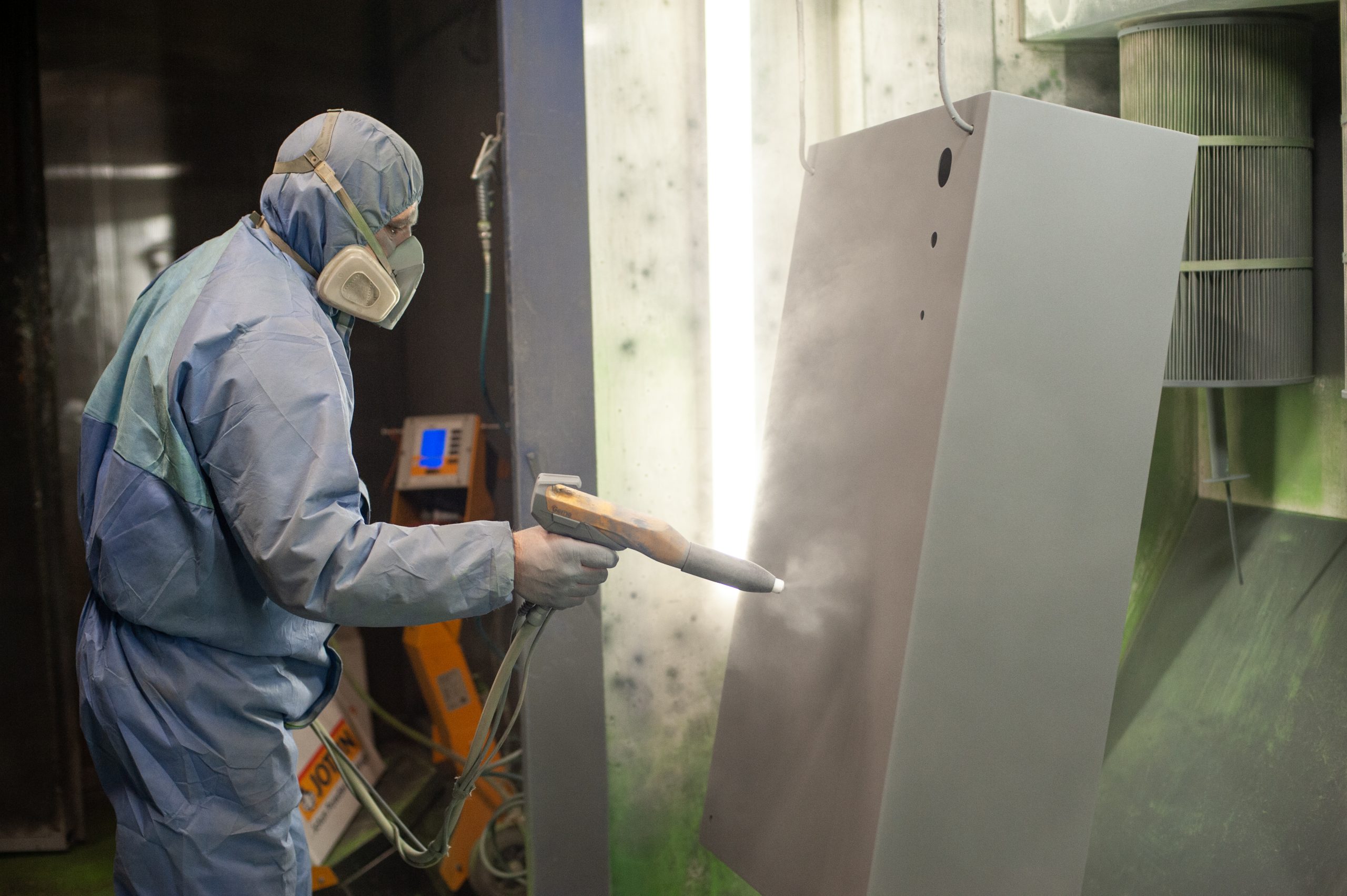
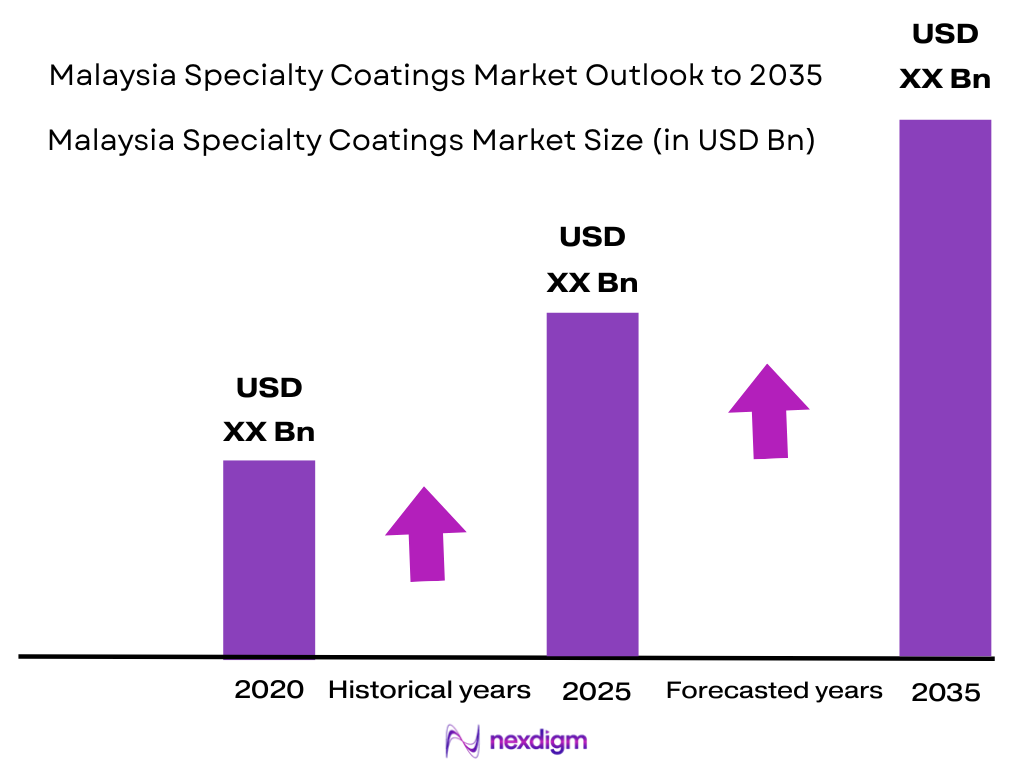
The Malaysia Specialty Coatings Market is valued at ~USD XX billion in 2024, supported by increasing demand from semiconductor manufacturing, electronics, automotive, marine, construction, industrial machinery, oil and gas, and infrastructure applications. The market expansion is driven by the requirement for high-performance coatings offering corrosion resistance, chemical protection, thermal stability, and extended asset life. Malaysia’s manufacturing-oriented economy, supported by electronics exports, automotive production, industrial investments, and infrastructure development, continues to strengthen demand for advanced specialty coating solutions.
The Malaysia Specialty Coatings Market is expected to expand at a CAGR of ~6.8% during 2026-2035, driven by rising adoption of water-based coatings, powder coatings, sustainable formulations, and functional coatings across high-value industries. Semiconductor and electronics manufacturing in Penang, automotive production in Selangor and Kedah, petrochemical activities in Johor, and marine-related industries in coastal regions are expected to remain major demand contributors. The market is also influenced by increasing environmental compliance requirements encouraging manufacturers to shift toward low-VOC and high-performance coating technologies.
Market Segmentation
By Resin Type
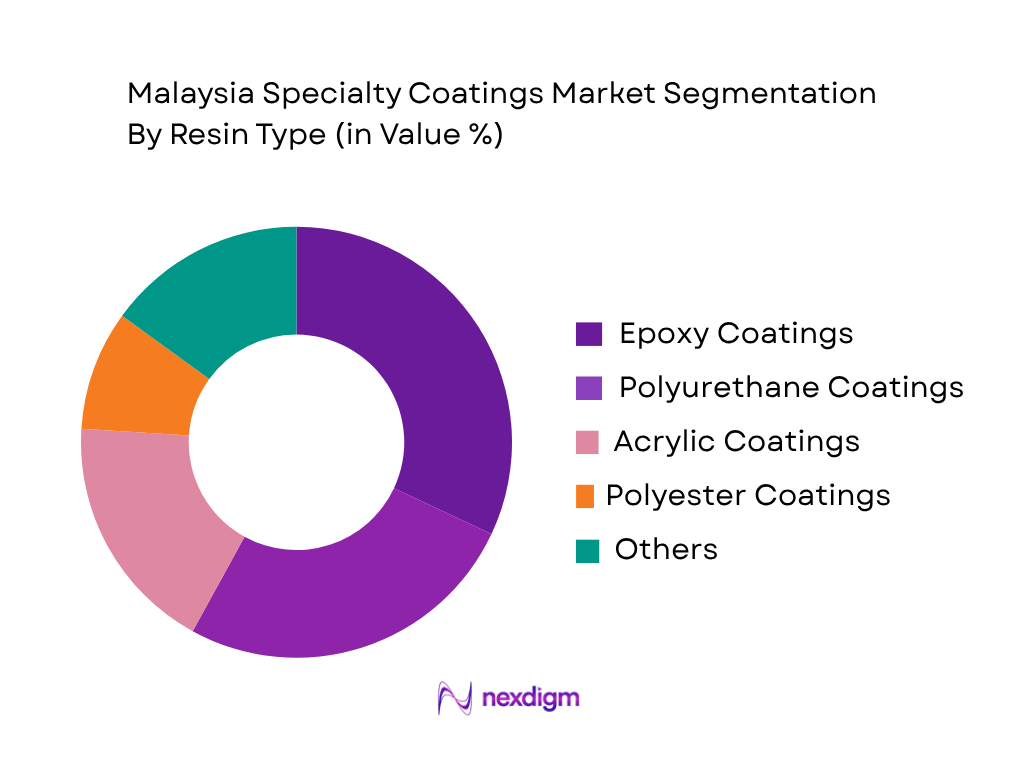
Malaysia Specialty Coatings Market is segmented by resin type into epoxy coatings, polyurethane coatings, acrylic coatings, polyester coatings, fluoropolymer coatings, silicone coatings, alkyd coatings, and other specialty resin systems. Epoxy-based specialty coatings hold the dominant position due to their superior adhesion, chemical resistance, corrosion protection capability, and suitability across industrial, marine, infrastructure, and oil and gas applications. Epoxy coatings are widely used for steel structures, pipelines, industrial floors, storage tanks, and protective applications where durability is critical. Polyurethane coatings are gaining adoption in automotive, decorative, and industrial applications due to their weather resistance and aesthetic performance. Increasing industrial asset maintenance requirements and infrastructure protection needs continue supporting epoxy coating demand in Malaysia.
By Application
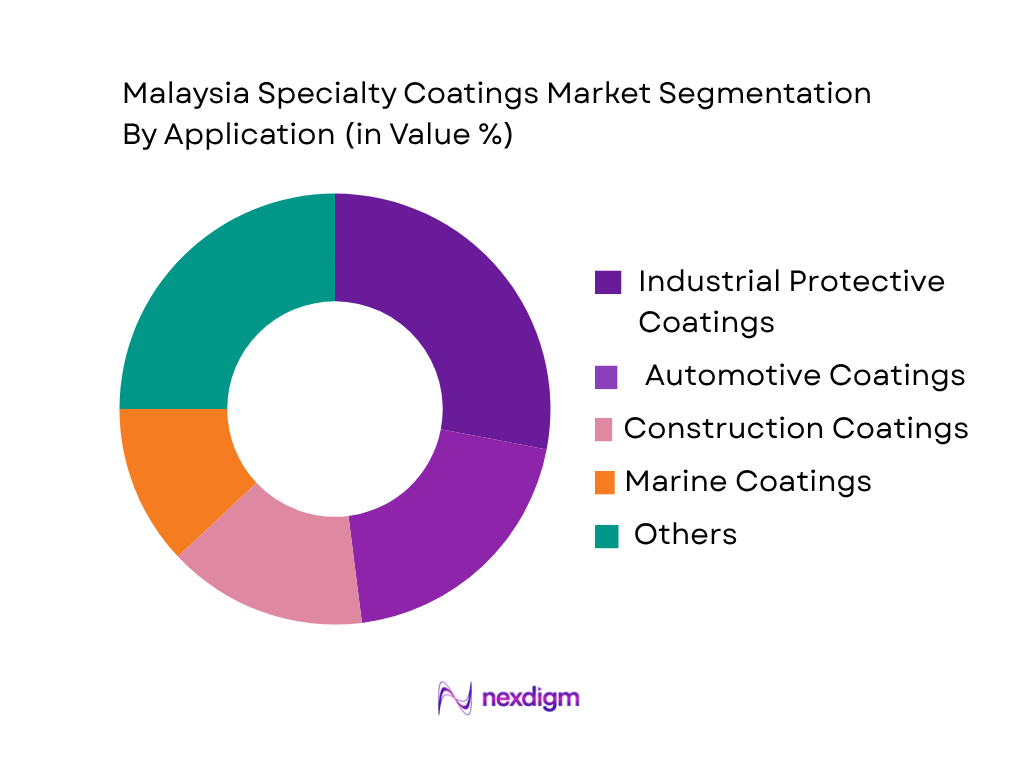
Malaysia Specialty Coatings Market is segmented by application into automotive, aerospace, marine, industrial equipment, construction, electronics, oil and gas, and other applications. Industrial protective coatings dominate the application segment because Malaysia’s manufacturing sector requires coatings that protect equipment, machinery, structures, and processing facilities from corrosion, chemicals, humidity, and mechanical wear. Industrial coatings are extensively used in manufacturing plants, petrochemical facilities, power-generation assets, and heavy equipment. The growth of electronics manufacturing and industrial automation further increases demand for coatings providing electrical insulation, thermal resistance, and surface protection. Automotive and marine applications also contribute significantly due to Malaysia’s vehicle manufacturing base and coastal industrial activities.
Competitive Landscape
The Malaysia Specialty Coatings Market is moderately consolidated, with global coating manufacturers dominating advanced technology segments while regional manufacturers compete in industrial, decorative, and application-specific markets. Major companies compete through product innovation, sustainable coating technologies, technical support capabilities, industrial distribution networks, and application expertise. Leading players including AkzoNobel, PPG Industries, Sherwin-Williams, Nippon Paint, Jotun, and BASF supply specialty coatings across automotive, marine, industrial, construction, and electronics sectors.
| Company | Establishment Year | Headquarters | Major Product Focus | Key Industries Served | Technology Strength | Regional Presence | Sustainability Focus | Distribution Capability |
| AkzoNobel | 1646 | Amsterdam, Netherlands | ~ | ~ | ~ | ~ | ~ | ~ |
| PPG Industries | 1883 | Pittsburgh, USA | ~ | ~ | ~ | ~ | ~ | ~ |
| Sherwin-Williams | 1866 | Cleveland, USA | ~ | ~ | ~ | ~ | ~ | ~ |
| Nippon Paint | 1881 | Osaka, Japan | ~ | ~ | ~ | ~ | ~ | ~ |
| Jotun | 1926 | Sandefjord, Norway | ~ | ~ | ~ | ~ | ~ | ~ |
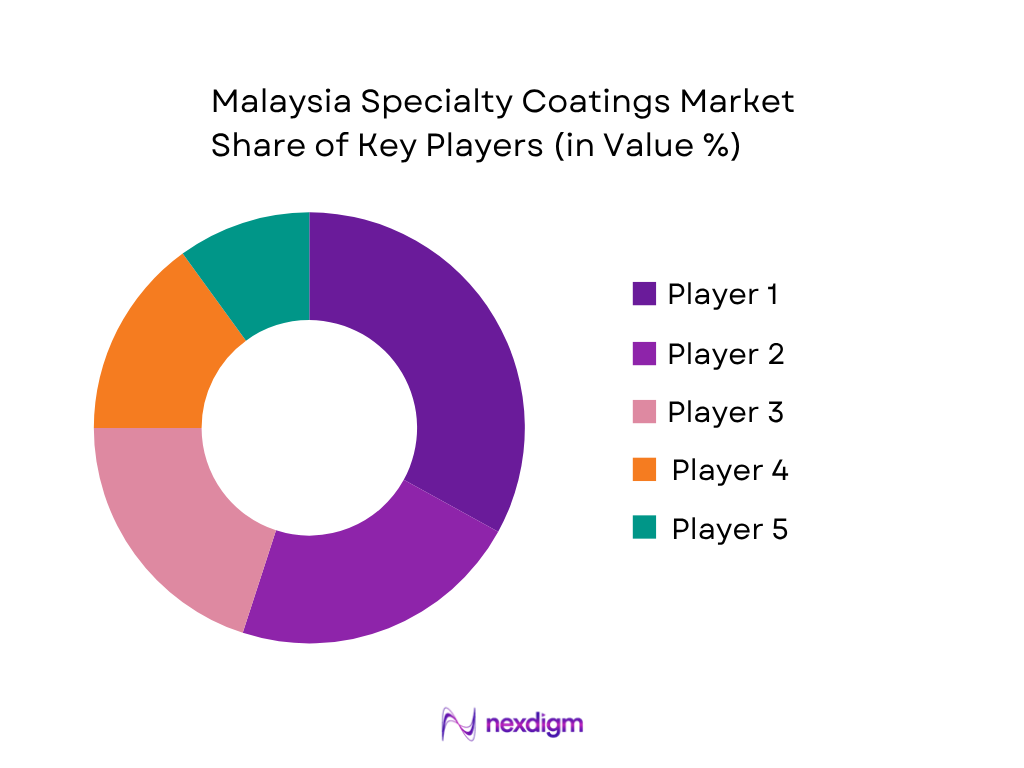
Malaysia Specialty Coatings Market Analysis
Market Growth Drivers
Expansion of Semiconductor Manufacturing
The Malaysia Specialty Coatings Market is supported by the expansion of semiconductor and electrical manufacturing activities, where advanced coatings are required for corrosion protection, insulation, thermal management and surface durability of equipment and components. Malaysia recorded USD 445.5 billion GDP in 2024, reflecting continued industrial activity and investment capacity. The country’s electrical and electronics sector remained one of the largest contributors to manufacturing exports, with Malaysia’s electronics exports reaching approximately RM 575 billion in 2024, according to national trade statistics. Semiconductor facilities in Penang, Kedah and Selangor require specialized coatings for cleanroom equipment, machinery parts, packaging systems and precision manufacturing environments. The semiconductor industry also benefits from Malaysia’s position within global electronics supply chains, supported by investments in semiconductor assembly, testing and advanced manufacturing. Increased adoption of high-performance coatings in semiconductor plants is driven by requirements for chemical resistance, contamination control and longer equipment life. The growth of wafer fabrication, outsourced semiconductor assembly and testing facilities, and electronic component manufacturing continues to create demand for specialty coatings designed for high-temperature, low-particle and chemically aggressive environments.
Automotive Production Growth
The Malaysia Specialty Coatings Market benefits from automotive manufacturing growth, where coatings are increasingly used for corrosion protection, appearance enhancement, lightweight vehicle components and electric vehicle applications. Malaysia produced approximately 780,000 motor vehicles in 2024, supported by domestic automotive demand and regional manufacturing activities. The automotive sector contributes significantly to industrial consumption of electro-coatings, protective coatings, functional coatings and surface treatment technologies. Malaysia’s GDP growth reached around 5.1 in 2024, reflecting improving industrial and consumer activity that supports vehicle production and component manufacturing. Automotive hubs in Selangor, Kedah and Melaka require specialty coatings for body panels, engine components, batteries, electrical systems and metal assemblies. The transition toward electric vehicles is creating additional demand for thermal-resistant, electrically insulating and anti-corrosion coatings used in battery packs and charging infrastructure. Growing localization of automotive components, increasing production of hybrid and electric vehicles, and expansion of automotive supply chains are encouraging manufacturers to adopt advanced coating solutions that improve durability, reduce maintenance requirements and meet environmental performance standards.
Market Challenges
Dependence on Imported Specialty Raw Materials
The Malaysia Specialty Coatings Market faces challenges due to dependence on imported specialty chemicals, resins, additives and advanced coating ingredients required for high-performance formulations. Malaysia’s chemical manufacturing sector continues to rely on international supply networks for certain high-value inputs, particularly epoxy resins, fluoropolymers, specialty additives and functional pigments. The country imported approximately RM 1.2 trillion worth of goods in 2024, highlighting the importance of international supply chains for industrial materials and manufacturing inputs. Specialty coating producers experience exposure to global raw material availability, transportation disruptions and foreign exchange fluctuations. Although Malaysia has a developed petrochemical industry, advanced coating formulations often require specialized materials produced in limited global locations. Environmental regulations and customer requirements for low-VOC and sustainable coatings further increase dependence on technically advanced raw materials. Manufacturers must maintain supply reliability while managing formulation consistency, regulatory compliance and performance requirements. This challenge is particularly significant for semiconductor, aerospace, marine and oil and gas applications where coating failure can result in operational downtime and higher maintenance costs.
Environmental Regulations and VOC Restrictions
The Malaysia Specialty Coatings Market is challenged by increasing environmental requirements related to volatile organic compound emissions, hazardous substances management and sustainable chemical usage. Industrial users are increasingly adopting coatings that comply with environmental standards while maintaining required performance characteristics. Malaysia’s industrial sector continues to expand, with manufacturing contributing approximately 24% of national GDP in 2024, increasing the importance of sustainable production practices. Coating manufacturers face pressure to develop water-based, powder-based and low-emission formulations that reduce environmental impact. Regulatory requirements related to chemical handling, workplace safety and industrial emissions increase compliance responsibilities for manufacturers and applicators. Specialty coatings used in marine, automotive and industrial applications require high durability, but replacing conventional solvent-based systems with sustainable alternatives requires technological investment and qualification processes. Smaller coating producers may face challenges in upgrading production capabilities and maintaining compliance with evolving standards. The need for environmentally responsible formulations while preserving corrosion resistance, chemical stability and application performance remains a major challenge for market participants.
Market Opportunities
Semiconductor Protective Coatings
The Malaysia Specialty Coatings Market presents opportunities from semiconductor protective coating applications due to continued investment in electronics manufacturing and advanced semiconductor operations. Malaysia’s electrical and electronics industry generated approximately RM 575 billion in exports in 2024, demonstrating the scale of the country’s electronics manufacturing ecosystem. Semiconductor facilities require specialized coatings for machinery protection, cleanroom equipment, wafer-processing tools and electronic components exposed to chemicals, heat and humidity. Growth in semiconductor packaging, testing and advanced manufacturing creates opportunities for coatings with properties such as chemical resistance, anti-static performance, thermal stability and contamination control. Penang, Kedah and Selangor continue to attract electronics-related investments due to established industrial infrastructure and skilled manufacturing capabilities. Specialty coating suppliers can benefit by developing customized solutions for semiconductor equipment protection, high-purity environments and precision manufacturing processes. Increasing global demand for semiconductor components used in automotive electronics, artificial intelligence systems and consumer devices is expected to encourage further adoption of advanced coating technologies within Malaysia’s semiconductor supply chain.
EV Component Coatings and Sustainable Coating Technologies
The Malaysia Specialty Coatings Market has growing opportunities from electric vehicle component coatings and sustainable coating technologies as automotive manufacturing evolves toward electrification. Malaysia’s automotive industry produced approximately 780,000 vehicles in 2024, creating a strong manufacturing base for advanced automotive coating applications. Electric vehicle components such as battery enclosures, electrical systems, charging equipment and lightweight materials require coatings with thermal resistance, corrosion protection and electrical insulation properties. Malaysia’s industrial transformation initiatives are encouraging investment in higher-value manufacturing activities, including electric mobility and advanced engineering. Sustainable coatings such as water-based, bio-based and low-VOC systems are gaining importance as manufacturers seek environmentally compliant solutions. The development of smart functional coatings, including antimicrobial, self-healing and thermal management coatings, creates additional opportunities across automotive, electronics and infrastructure applications. Companies investing in localized formulation capabilities and application expertise can address growing demand from EV manufacturers, industrial facilities and technology-driven sectors requiring durable and environmentally responsible coating solutions.
Future Outlook
The Malaysia Specialty Coatings Market is expected to experience steady expansion through 2035, supported by semiconductor manufacturing growth, industrial modernization, infrastructure development, automotive transformation, and increasing demand for sustainable coating solutions. Future growth will be shaped by adoption of water-based coatings, powder coatings, functional coatings, and advanced protective technologies. Demand from electronics, electric vehicles, renewable energy, and industrial maintenance will create opportunities for manufacturers developing specialized high-performance formulations.
Major Players
- AkzoNobel Malaysia
- PPG Industries Malaysia
- Sherwin-Williams
- Nippon Paint Malaysia
- Jotun Malaysia
- Hempel Malaysia
- BASF Malaysia
- Axalta Coating Systems
- Kansai Paint Malaysia
- Sika Malaysia
- Henkel Malaysia
- KCC Malaysia
- Asian Paints Berger Malaysia
- RPM International
- Chugoku Marine Paints
Key Target Audience
- Specialty coatings manufacturers and formulators
- Industrial coating application companies
- Automotive and electric vehicle manufacturers
- Semiconductor and electronics manufacturing companies
- Marine, shipbuilding and offshore engineering companies
- Oil and gas companies and petrochemical operators
- Investments and venture capitalist firms (industrial chemicals, advanced materials and manufacturing sectors)
- Government and regulatory bodies (Ministry of Investment, Trade and Industry Malaysia (MITI), Department of Environment Malaysia (DOE), Malaysian Investment Development Authority (MIDA))
Research Methodology
Step 1: Identification of Key Variables
The initial phase involves defining the Malaysia Specialty Coatings Market ecosystem by identifying major stakeholders including coating manufacturers, raw material suppliers, industrial users, regulatory bodies, distributors and application service providers. Secondary research is conducted to evaluate industry structure, demand drivers, application areas, coating technologies, regulatory influences and end-user industries influencing specialty coating consumption.
Step 2: Market Analysis and Construction
This phase focuses on analysing historical market trends, production capabilities, consumption patterns, application-wise demand and industrial sector contribution. The assessment covers specialty coating demand from automotive, electronics, marine, construction, oil and gas and manufacturing industries. Market sizing is developed through demand-side and supply-side evaluation, supported by industry-level production and trade indicators.
Step 3: Hypothesis Validation and Expert Consultation
Market assumptions are validated through discussions with coating manufacturers, distributors, application specialists and industrial users operating across Malaysia. Expert consultations provide insights into technology adoption, customer preferences, raw material availability, competitive intensity and evolving requirements for sustainable coating formulations.
Step 4: Research Synthesis and Final Output
The final stage combines primary and secondary findings to create a comprehensive assessment of the Malaysia Specialty Coatings Market. Data points related to product segments, applications, competitive positioning, regulations and future growth opportunities are analysed to develop strategic insights for industry participants and investors.

- Executive Summary
- Research Methodology (Market Definition and Scope, Specialty Coatings Classification, Market Boundary Assessment, Market Sizing Framework, Top-Down Analysis, Bottom-Up Analysis, Demand-Side Assessment, Supply-Side Assessment, Manufacturer Mapping, Import-Export Analysis, Production Capacity Assessment, End-Use Industry Validation, Primary Interviews, Data Triangulation, Forecasting Model, Assumptions and Limitations)

- Definition and Scope
- Specialty Coatings Industry Structure
- Evolution of Malaysia Specialty Coatings Industry
- Major Industry Development Timeline
- Malaysia Specialty Coatings Value Chain Analysis
- Raw Material Supply Ecosystem

- Market Growth Drivers (Expansion of Semiconductor Manufacturing, Automotive Production Growth, Electronics Export Industry, Infrastructure Development, Oil and Gas Asset Maintenance, Marine Industry Expansion, Industrial Manufacturing Growth, Palm Oil Processing Industry Requirements)
- Market Challenges (Dependence on Imported Specialty Raw Materials, Volatility in Resin Prices, Environmental Regulations, VOC Restrictions, Limited Advanced Coating Manufacturing Capability, Skilled Application Workforce Requirement, High Technology Qualification Barriers, Supply Chain Exposure)
- Market Opportunities (Semiconductor Protective Coatings, EV Component Coatings, Offshore Energy Coatings, Anti-Corrosion Infrastructure Coatings, Sustainable Water-Borne Coatings, Bio-Based Coatings, Smart Functional Coatings, Thermal Management Coatings, Antimicrobial Surface Technologies)
- Market Trends (Low-VOC Coatings, Water-Borne Conversion, Powder Coating Adoption, SustainableResin Systems, High-Solids Technology, Nanocoatings, Functional Surface Protection, Antimicrobial Coatings, Lightweight Material Coatings, Smart Coating Solutions)
- Regulatory and Standards Analysis (Malaysia Environmental Quality Regulations, Occupational Safety and Health Requirements, Chemical Management Regulations, VOC Control Requirements, Industrial Emission Standards, Hazardous Chemical Handling, Product Safety Standards, Construction Coating Standards)
- SWOT Analysis
- Porter’s Five Forces Analysis
- PESTLE Analysis

- By Market Value (2020-2025)
- By Consumption Volume (2020-2025)
- By Domestic Production Volume (2020-2025)
- By Import Volume (2020-2025)
- By Export Volume (2020-2025)
- By Average Selling Price (2020-2025)
- By Resin Consumption (2020-2025)
- By Coating Technology (2020-2025)
- By Application (2020-2025)
- By End-Use Industry (2020-2025)
- By Substrate Type (2020-2025)

- By Resin Type (In Value %)
Epoxy-Based Specialty Coatings
Polyurethane-Based Specialty Coatings
Acrylic-Based Specialty Coatings
Polyester-Based Specialty Coatings
Fluoropolymer-Based Specialty Coatings
Silicone-Based Specialty Coatings
Alkyd-Based Specialty Coatings
Polyaspartic-Based Specialty Coatings
Vinyl-Based Specialty Coatings
Other Specialty Resin Systems - By Coating Technology (In Value %)
Water-Borne Specialty Coatings
Solvent-Borne Specialty Coatings
Powder Coatings
High-Solids Coatings
UV-Curable Coatings
Electrocoatings
Thermal-Cured Coatings
Radiation-Cured Coatings - By Specialty Coating Function (In Value %)
Corrosion-Resistant Coatings
Chemical-Resistant Coatings
Heat-Resistant Coatings
Abrasion-Resistant Coatings
Fire-Resistant and Intumescent Coatings
Antimicrobial Coatings
Anti-Fouling Coatings
Thermal Barrier Coatings
Electrical Insulation Coatings
Conductive Coatings
Self-Cleaning Coatings
Wear-Protection Coatings - By Application (In Value %)
Industrial Protective Coatings
Marine Coatings
Automotive OEM Coatings
Automotive Refinish Coatings
Aerospace Coatings
Oil and Gas Coatings
Petrochemical Equipment Coatings|
Infrastructure Coatings
Electronics Coatings
Semiconductor Manufacturing Coatings
Packaging Coatings
Wood and Furniture Coatings
Construction Material Coatings - By End-Use Industry (In Value %)
Automotive and Transportation
Electronics and Semiconductor Manufacturing
Construction and Infrastructure
Oil and Gas
Petrochemicals and Chemicals
Marine and Shipbuilding
Power Generation
Industrial Machinery
Palm Oil Processing
Food and Beverage Processing
Medical Devices and Healthcare
Renewable Energy - By Substrate Type (In Value %)
Steel and Ferrous Metals
Aluminium and Non-Ferrous Metals
Concrete and Cement Surfaces
Plastics and Polymer Components
Glass Surfaces
Wood Materials
Electronic Components

- Market Share of Major Players (By Value, Volume, Resin System, Technology, Application, End-Use Industry, Distribution Channel)
- Cross Comparison Parameters (Resin-System Portfolio Breadth, Semiconductor Coating Capability, Automotive OEM Penetration, Marine Coating Expertise, Corrosion Protection Portfolio, Sustainable Coating Solutions, Technical-Service Network, Manufacturing and Distribution Reach)
- SWOT Analysis of Major Players
- Detailed Profiles of Major Companies
AkzoNobel Malaysia
PPG Industries Malaysia
The Sherwin-Williams Company
Jotun Malaysia
Hempel Malaysia
Nippon Paint Malaysia
Kansai Paint Malaysia
BASF Malaysia
Axalta Coating Systems
RPM International Inc.
Sika Malaysia
Henkel Malaysia
Chugoku Marine Paints
KCC Malaysia
Asian Paints Berger Malaysia

- Semiconductor and Electronics Coatings
- Automotive and EV Coatings
- Marine and Offshore Coatings
- Oil and Gas Coatings
- Construction and Infrastructure Coatings
- Industrial Machinery Coatings
- Palm Oil Processing Coatings
- Food and Beverage Processing Coatings

- By Market Value (2026-2035)
- By Consumption Volume (2026-2035)
- By Domestic Production Volume (2026-2035)
- By Import Volume (2026-2035)
- By Export Volume (2026-2035)
- By Average Selling Price (2026-2035)
- By Resin Consumption (2026-2035)
- By Coating Technology (2026-2035)
- By Application (2026-2035)
- By End-Use Industry (2026-2035)
- By Substrate Type (2026-2035)


 Request a Sample
 Ask for Customization
 Get a Quote
 Enquire Now