
 Download PDF
Market Overview
The Malaysia Superabsorbent Polymers Market is valued at approximately USD ~ billion in 2024, with demand concentrated in absorbent hygiene products, healthcare applications, agriculture, and selected industrial uses. Growth is supported by Malaysia’s established personal-care manufacturing base, increasing requirements for high-performance absorbent materials, and the continued development of healthcare and consumer-product manufacturing. Baby diapers, adult incontinence products, feminine hygiene products, and medical absorbents remain important downstream applications, while improved absorption capacity, lower rewet, and thinner product designs are encouraging adoption of advanced SAP grades.
The Malaysia Superabsorbent Polymers Market is concentrated around major manufacturing and logistics centers including Selangor, Kuala Lumpur, Penang, Johor, and Negeri Sembilan. Selangor and Kuala Lumpur benefit from extensive consumer-goods manufacturing, distribution infrastructure, and proximity to major demand centers. Penang provides an important electronics and industrial manufacturing ecosystem, while Johor benefits from its proximity to Singapore and established industrial infrastructure. Negeri Sembilan is relevant to manufacturing activities and consumer-product production. These locations provide SAP suppliers with access to converters, manufacturers, ports, logistics networks, and downstream industrial customers.
Market Segmentation
By Application Type
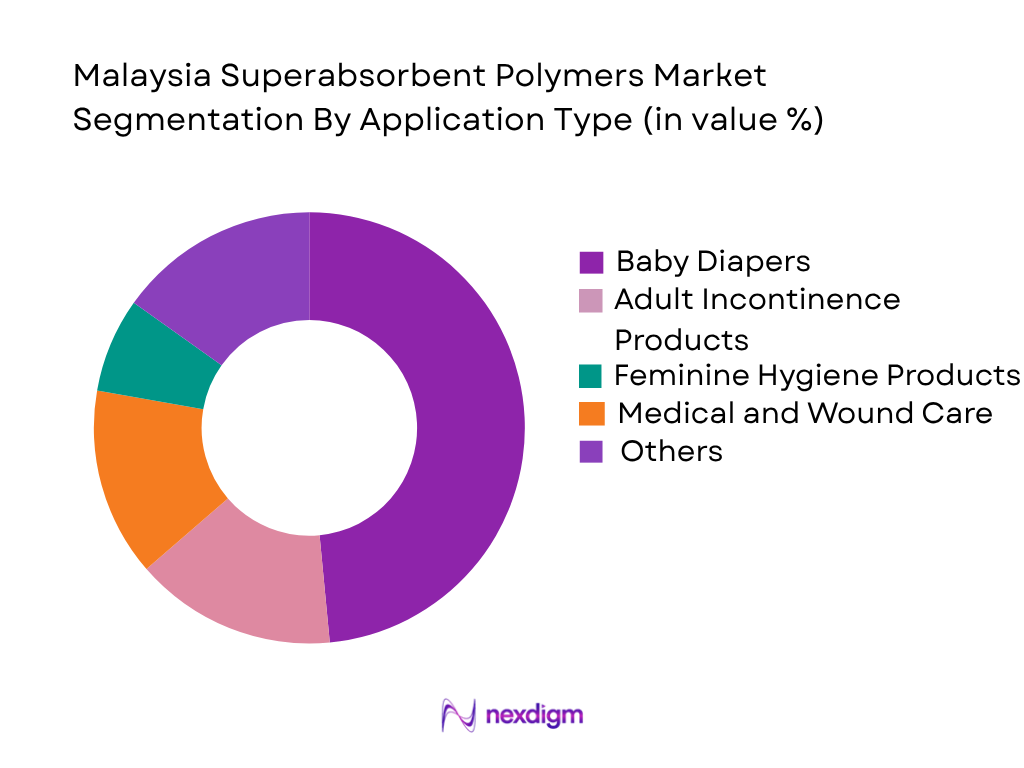
The Malaysia Superabsorbent Polymers Market is segmented by application type into baby diapers, adult incontinence products, feminine hygiene products, medical and wound care, agriculture and horticulture, cable and wire protection, industrial absorbents, and packaging and other applications. Baby diapers represent the dominant application segment, primarily because SAP is an essential functional material in modern disposable diaper cores. Its high liquid absorption, retention capability, and ability to support thinner absorbent structures make it suitable for mass-market hygiene products. Malaysia’s established consumer-goods manufacturing ecosystem further supports demand from diaper converters and personal-care manufacturers. Adult incontinence and feminine hygiene applications represent additional important consumption areas, while healthcare applications require specialized grades with controlled absorption and retention characteristics. Agricultural applications provide a separate demand avenue through soil-moisture management. Overall, application demand is closely linked to the development of disposable hygiene products, healthcare consumption, product innovation, and manufacturers’ efforts to reduce absorbent-core thickness while maintaining leakage protection and liquid-retention performance.
By Absorbent Hygiene Product
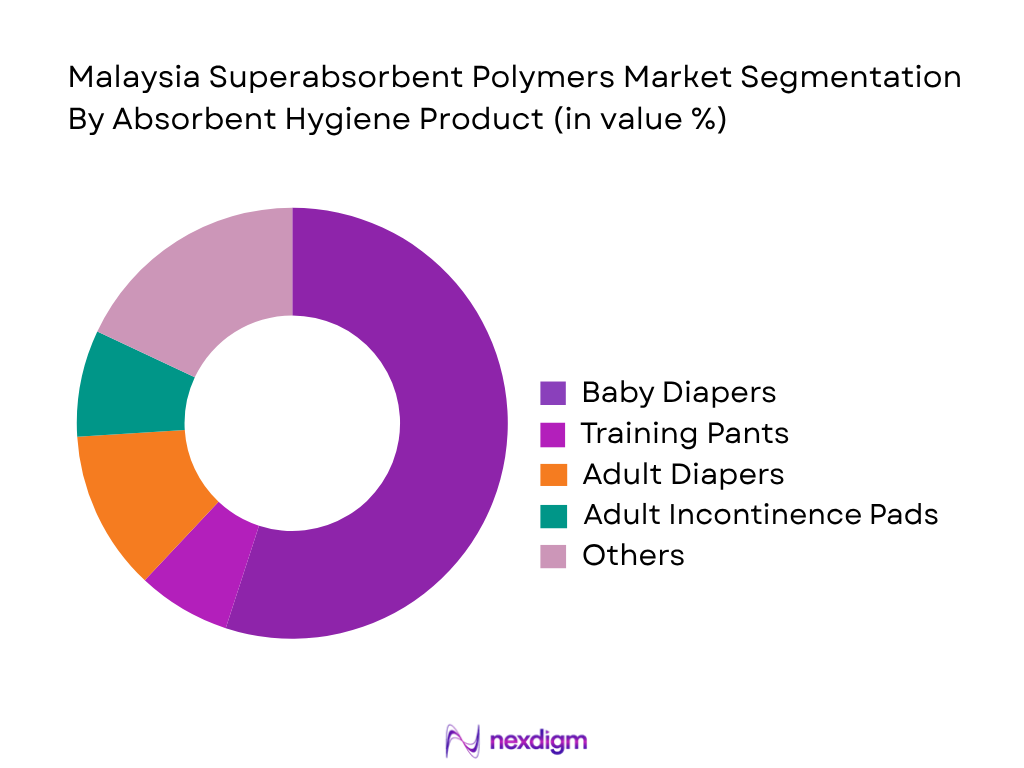
The Malaysia Superabsorbent Polymers Market is segmented by absorbent hygiene product into baby diapers, training pants, adult diapers, adult incontinence pads, feminine sanitary pads, panty liners, underpads and bed pads, and other absorbent hygiene products. Baby diapers represent the leading product category, reflecting the extensive use of SAP in disposable infant-care products. SAP enables diaper manufacturers to increase liquid-retention capacity while reducing dependence on bulky absorbent materials, supporting thinner and more comfortable product designs. The material is particularly important in premium and high-performance diaper constructions where manufacturers seek rapid liquid uptake, high absorption under load, improved permeability, and low rewet. Adult diapers and incontinence pads are gaining importance as manufacturers respond to demand for products offering higher retention and improved comfort. Feminine hygiene products also use SAP to support rapid fluid absorption and leakage management. Underpads and bed pads provide another specialized application in healthcare and elder-care environments. Product innovation is therefore increasingly centered on optimizing SAP loading, particle-size distribution, gel strength, and liquid-distribution characteristics.
Competitive Landscape
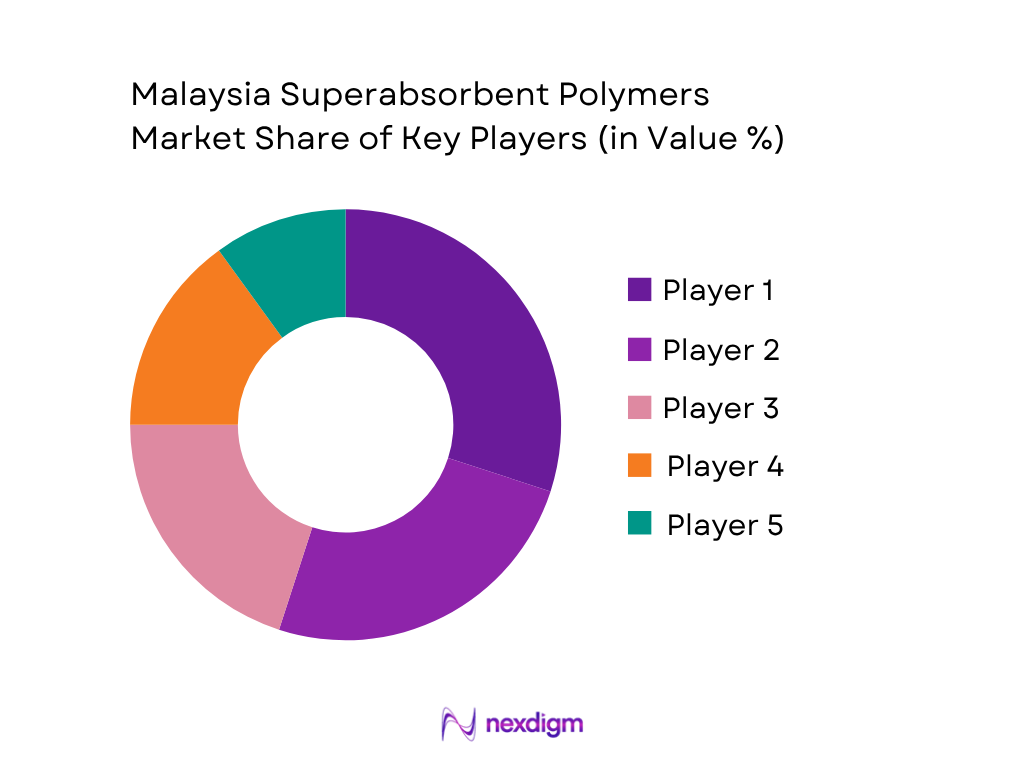
The Malaysia Superabsorbent Polymers Market comprises global specialty chemical and polymer manufacturers supplying SAP directly or through regional distribution networks. Competition is influenced by polymer chemistry, absorption performance, production capacity, supply reliability, technical support, and relationships with hygiene-product manufacturers. Major international producers including BASF, Nippon Shokubai, Evonik, Sumitomo Seika Chemicals, and Sanyo Chemical Industries participate in the broader SAP supply ecosystem. Product differentiation increasingly focuses on absorption under load, centrifuge retention capacity, permeability, gel strength, particle-size control, and suitability for thinner absorbent-core designs.
| Company | Establishment Year | Headquarters | SAP Product Portfolio | Key SAP Capability | Major Application | Manufacturing Capability | Malaysia Supply Presence | Technical Focus |
| BASF SE | 1865 | Germany | ~ | ~ | ~ | ~ | ~ | ~ |
| Nippon Shokubai Co., Ltd. | 1941 | Japan | ~ | ~ | ~ | ~ | ~ | ~ |
| Evonik Industries AG | 2007 | Germany | ~ | ~ | ~ | ~ | ~ | ~ |
| Sumitomo Seika Chemicals Co., Ltd. | 1944 | Japan | ~ | ~ | ~ | ~ | ~ | ~ |
| Sanyo Chemical Industries, Ltd. | 1949 | Japan | ~ | ~ | ~ | ~ | ~ | ~ |
Malaysia Superabsorbent Polymers Market Analysis
Growth Drivers
Expansion of Absorbent Hygiene Product Consumption
The Malaysia Superabsorbent Polymers Market is supported by continued demand for baby diapers, feminine hygiene products, adult incontinence products, and other absorbent hygiene applications. Malaysia’s population reached 34.1 million in 2024, compared with 33.4 million in 2023, according to the Department of Statistics Malaysia (DOSM), creating a substantial domestic consumer base for hygiene products. The country recorded 414,918 live births in 2024, following 455,761 births in 2023, according to DOSM, sustaining a sizeable requirement for infant-care products even as the birth count moderated. At the same time, Malaysia had 2.6 million people aged 65 years and above in 2024, compared with 2.5 million in 2023, indicating a gradually expanding demographic base relevant to adult incontinence and healthcare absorbent products. DOSM also reported 3.9 million people aged 60 years and above in 2024, compared with 3.8 million in 2023. These demographic conditions support consumption of SAP-based products because superabsorbent polymers provide high liquid retention, absorption under load, reduced rewet, and thinner product-core designs. Consequently, hygiene-product manufacturers have continued incentives to incorporate higher-performance SAP grades into diapers, sanitary products, underpads, and adult-care products.
Growth of Manufacturing, Trade and Industrial Supply Chains
The Malaysia Superabsorbent Polymers Market is supported by Malaysia’s broad manufacturing and trade ecosystem, which facilitates production and distribution of absorbent hygiene products, medical supplies, agricultural inputs, and industrial materials. Malaysia recorded RM1.5 trillion in exports in 2024, compared with approximately RM1.4 trillion in 2023, according to DOSM, demonstrating the scale of the country’s export-oriented industrial economy. Total trade remained substantial, with ASEAN alone accounting for 26.5% of Malaysia’s total trade in 2024, according to DOSM. This manufacturing and trade infrastructure supports SAP demand by connecting imported polymer materials with downstream converters and manufacturers producing diapers, feminine hygiene products, medical absorbents, and specialty industrial products. Malaysia’s labour force also reached 16.9 million persons in 2024, according to DOSM, supporting manufacturing and processing activity. The combination of established industrial estates, ports, chemical distribution networks, and export-oriented manufacturing provides SAP suppliers with access to downstream producers and regional markets. These conditions are particularly relevant for high-performance SAP grades used where absorption capacity, absorption under load, gel strength, permeability, and low rewet characteristics are important product specifications.
Market Challenges
Dependence on International Chemical and Polymer Supply Chains
The Malaysia Superabsorbent Polymers Market faces supply-chain challenges because manufacturers and downstream users remain exposed to international sources of specialty polymers, chemical intermediates, and feedstock-linked materials. Malaysia’s merchandise imports reached approximately RM1.4 trillion in 2024, according to DOSM, reflecting the scale of imported inputs entering the country’s manufacturing ecosystem. The country’s total trade reached RM2.9 trillion in 2024, demonstrating the importance of international supply networks to domestic industrial activity. For SAP manufacturers and converters, exposure to global supply chains is particularly relevant because production depends on materials such as acrylic acid, sodium acrylate, specialty additives, and polymerization inputs. Disruptions affecting shipping, chemical production, or regional logistics can therefore influence material availability and procurement planning. Malaysia’s location within Asian manufacturing supply chains provides strong connectivity but also exposes companies to disruptions across regional production centers. The challenge is more significant for specialized SAP grades requiring tightly controlled particle-size distribution, absorption capacity, absorption under load, permeability, and gel strength. Maintaining consistent specifications requires reliable feedstock availability and qualified suppliers, while downstream hygiene manufacturers require uninterrupted material supply to maintain continuous production of diapers, sanitary products, adult-care products, and medical absorbent products.
Waste Management and Sustainability Requirements
The Malaysia Superabsorbent Polymers Market faces increasing sustainability and waste-management requirements associated with the disposal of SAP-containing absorbent hygiene products. Malaysia’s population reached 34.1 million in 2024, while the population aged 65 years and above reached 2.6 million, according to DOSM, creating continuing demand for disposable hygiene and healthcare products. The number of people aged 60 years and above reached 3.9 million, providing an additional demographic base for adult-care and medical absorbent applications. As consumption of disposable absorbent products expands, manufacturers face increasing pressure to improve material efficiency, reduce product thickness, and address end-of-life waste. SAP is valued for its ability to absorb and retain large quantities of liquid, but conventional SAP-containing products are generally integrated into multi-material structures that complicate recovery and recycling. Malaysia’s Department of Environment administers environmental requirements covering waste management and pollution control, creating an important regulatory context for manufacturers. The challenge is therefore shifting from absorption performance alone toward balancing liquid-retention capability with sustainability, material efficiency, and disposal considerations. This encourages development of biodegradable, bio-based, lower-impact, and resource-efficient SAP technologies without compromising absorption capacity, gel strength, permeability, and rewet performance.
Market Opportunities
Expansion of Adult Incontinence and Medical Absorbent Applications
The Malaysia Superabsorbent Polymers Market has an opportunity to expand through adult incontinence products, medical absorbents, underpads, wound-care products, and other healthcare applications requiring high liquid-retention performance. Malaysia had 2.6 million people aged 65 years and above in 2024, compared with 2.5 million in 2023, according to DOSM, while the population aged 60 years and above reached 3.9 million, compared with 3.8 million previously. These demographic figures provide a growing consumer and patient base for products requiring advanced absorbent materials. Malaysia’s total population also increased from 33.4 million in 2023 to 34.1 million in 2024, supporting the broader healthcare-consumption base. SAP can provide functional advantages in adult diapers, incontinence pads, bed underpads, medical dressings, and fluid-management products through high absorption capacity, absorption under pressure, fluid retention, and reduced rewet. The opportunity extends beyond conventional hygiene products because healthcare manufacturers can use specialty SAP grades where controlled absorption and retention are important. Suppliers capable of providing consistent particle size, high gel strength, rapid absorption, and improved permeability can address increasingly demanding product specifications. Product development can therefore focus on thinner adult-care products, improved leakage protection, higher fluid-retention performance, and application-specific medical absorbent materials.
Development of High-Performance and Sustainable SAP Applications
The Malaysia Superabsorbent Polymers Market presents opportunities for high-performance and more sustainable SAP solutions across hygiene, agriculture, healthcare, and specialty industrial applications. Malaysia’s exports reached RM1.5 trillion in 2024, according to DOSM, while the country’s manufacturing and trade infrastructure connects domestic producers with regional markets. This creates an opportunity for suppliers to develop differentiated SAP grades that serve both Malaysian manufacturers and export-oriented production. In hygiene applications, manufacturers can pursue thinner absorbent cores using SAP with higher absorption under load, improved permeability, stronger gel structure, faster liquid uptake, and lower rewet. Agriculture provides another potential application because water-retention polymers can support moisture management around plant roots and improve the efficiency of irrigation practices. Malaysia’s established agricultural and plantation industries create a relevant downstream environment for such technologies. Sustainability is also creating opportunities for bio-based, biodegradable, and resource-efficient absorbent materials. The opportunity is to develop products that combine absorption performance with improved environmental characteristics rather than treating sustainability and functionality as separate requirements. Suppliers with polymer chemistry expertise and application-development capabilities can therefore address hygiene, healthcare, agriculture, and industrial customers through differentiated SAP formulations.
Future Outlook
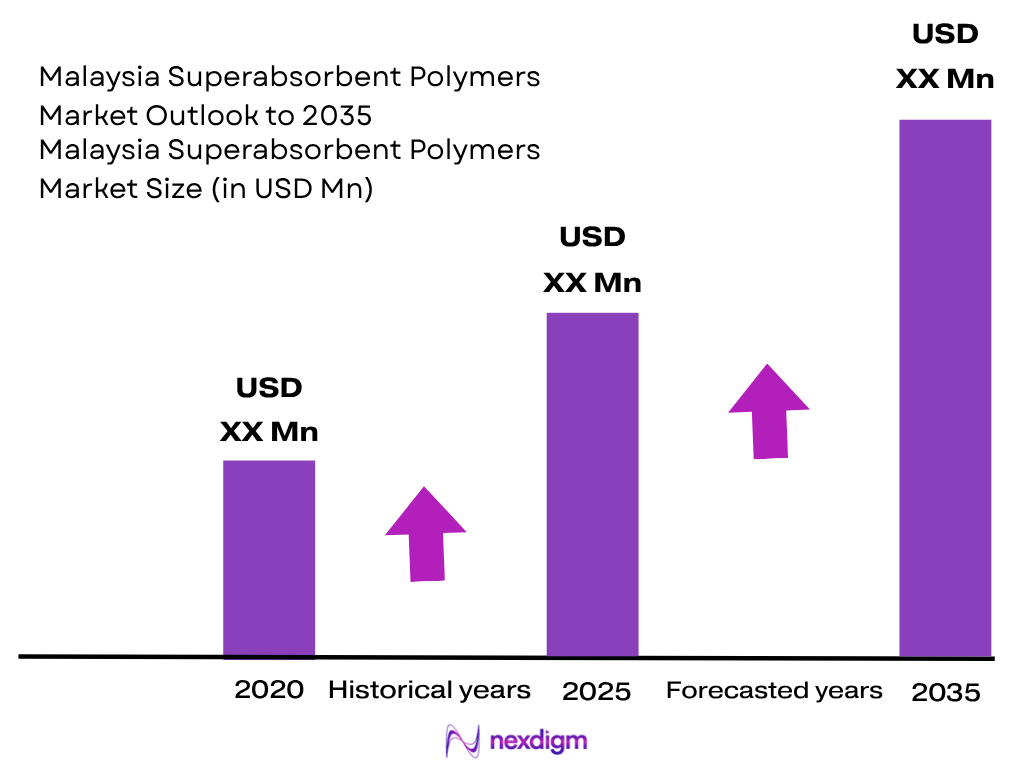
Over the coming decade, the Malaysia Superabsorbent Polymers Market is expected to develop alongside demand for advanced absorbent hygiene products, adult-care solutions, medical absorbents, and specialized water-retention applications. Product innovation is expected to emphasize thinner absorbent cores, higher SAP utilization, improved absorption under load, lower rewet, and enhanced permeability. Sustainability considerations are also expected to encourage development of bio-based, biodegradable, and resource-efficient absorbent materials. The Malaysia Superabsorbent Polymers Market is projected to expand at a CAGR of ~% during 2026-2035, reaching approximately USD ~ billion by 2035.
Major Players
- BASF SE
- Nippon Shokubai Co., Ltd.
- Evonik Industries AG
- Sumitomo Seika Chemicals Co., Ltd.
- Sanyo Chemical Industries, Ltd.
- SDP Global Co., Ltd.
- Kao Corporation
- LG Chem Ltd.
- Formosa Plastics Corporation
- Mitsui Chemicals, Inc.
- Songwon Industrial Co., Ltd.
- Yixing Danson Technology
- Chinafloc
- SNF Group
- Química Amtex S.A. de C.V.
Key Target Audience
- Superabsorbent polymer manufacturers
- Baby diaper and hygiene-product manufacturers
- Adult incontinence and medical-product manufacturers
- Feminine hygiene product manufacturers
- Agricultural input and specialty polymer companies
- Investments and venture capitalist firms
- Government and regulatory bodies (Department of Environment Malaysia, Department of Standards Malaysia, Medical Device Authority)
- Industrial chemical distributors and importers
Research Methodology
Step 1: Identification of Key Variables
The initial phase involves constructing a comprehensive ecosystem map covering SAP producers, polymer and chemical feedstock suppliers, hygiene-product manufacturers, medical-product companies, agricultural users, distributors, and industrial customers. The assessment identifies critical variables including polymer type, absorption capacity, absorption under load, gel strength, permeability, rewet performance, application requirements, supply sources, and downstream consumption patterns.
Step 2: Market Analysis and Construction
In this phase, historical and current information relating to the Malaysia Superabsorbent Polymers Market is compiled across application, product, performance, end-use, distribution, and regional dimensions. The analysis evaluates baby diapers, adult incontinence products, feminine hygiene products, medical absorbents, agricultural applications, and industrial uses to establish demand relationships and market-development patterns.
Step 3: Hypothesis Validation and Expert Consultation
Market hypotheses are validated through discussions with SAP suppliers, hygiene-product manufacturers, medical-product companies, distributors, agricultural input suppliers, and industrial users. Expert consultations examine procurement specifications, product qualification requirements, absorption performance, supply reliability, formulation preferences, application trends, and competitive dynamics to validate findings derived from secondary research.
Step 4: Research Synthesis and Final Output
The final stage integrates primary and secondary findings into a structured assessment of the Malaysia Superabsorbent Polymers Market. Market estimates, segmentation structures, competitive assessments, application trends, supply-chain factors, and future opportunities are cross-checked through data triangulation. The resulting analysis provides a consolidated view of demand drivers, technology requirements, customer applications, competitive activity, and future market development.

- Executive Summary
- Research Methodology (Market Definition and Scope, Malaysia Superabsorbent Polymers Market Classification, SAP Product Mapping, Polymer Chemistry Assessment, Absorption Performance Assessment, Application-Level Demand Analysis, End-Use Industry Assessment, Production Capacity Mapping, Domestic Manufacturing Assessment, Import and Export Trade Analysis, Acrylic Acid and Sodium Acrylate Feedstock Assessment, Raw Material Supply Assessment, Hygiene Product Manufacturing Assessment, Demand-Side Assessment, Supply-Side Assessment, Top-Down Market Sizing, Bottom-Up Market Sizing, Primary Industry Interviews, Data Triangulation, Forecasting Framework, Market Share Validation, Limitations and Future Conclusions)

- Definition and Scope
- Malaysia Superabsorbent Polymers Industry Evolution and Development of Superabsorbent Polymer Applications, Absorbent Hygiene Product Manufacturing, Polymerization Technologies and Specialty Absorbent Material Infrastructure
- Superabsorbent Polymers Value Chain Analysis
- Superabsorbent Polymers Supply Chain Analysis
- Acrylic Acid and Sodium Acrylate Suppliers, Polymer Manufacturers, SAP Producers, Hygiene Product Manufacturers, Diaper Converters, Medical Product Manufacturers, Agricultural Input Suppliers, Chemical Distributors, Industrial Buyers, End-Use Industries
- SAP Integration Across Baby Diapers, Adult Incontinence Products, Feminine Hygiene Products, Medical and Wound Care, Agriculture and Horticulture, Cable and Wire Protection, Industrial Absorbents and Packaging Applications

- Growth Drivers (Expansion of Baby Diaper Manufacturing, Rising Adult Incontinence Product Demand, Growth of Feminine Hygiene Consumption, Expansion of Medical Absorbent Products, Agricultural Water Conservation Requirements, Growth of Modern Hygiene Product Manufacturing, Increasing Demand for High-Performance SAP Grades)
- Market Challenges (Dependence on Imported SAP and Specialty Polymer Grades, Acrylic Acid and Sodium Acrylate Feedstock Exposure, Petrochemical Raw Material Volatility, Limited Domestic SAP Manufacturing Capacity, Disposal and Waste Management Challenges, Competition from Cellulose-Based Absorbent Materials, Product Qualification Requirements, Supply Chain Dependency)
- Market Opportunities (Premium SAP for Thin-Core Diapers, Adult Incontinence Product Expansion, Sustainable and Bio-Based SAP Development, Agricultural Water-Retention Applications, Medical and Wound-Care Absorbents, High-Performance Low-Rewet SAP, Local SAP Manufacturing and Feedstock Integration, Specialty Industrial Absorbent Applications)
- Market Trends (Thinner Absorbent Hygiene Products, Higher SAP Loading, Fluff-Free Diaper Core Development, Low-Rewet SAP Adoption, High-Permeability SAP Technology, Sustainable Absorbent Materials, Bio-Based SAP Development, Odor-Control SAP, Premium Adult Incontinence Products, Precision Agriculture Applications)
- Government Regulations and Standards (Department of Environment Malaysia Environmental Requirements, Department of Standards Malaysia Product Standards, Medical Device Authority Requirements, National Pharmaceutical Regulatory Agency Requirements, Department of Agriculture Agricultural Input Requirements, Occupational Safety and Health Chemical Handling Requirements, Scheduled Waste Management Requirements, Product Safety and Chemical Labeling Requirements)
- SWOT Analysis
- Porter’s Five Forces Analysis
- PESTLE Analysis
- Stakeholder Ecosystem
- Competition Ecosystem

- By Market Value (2020-2025)
- By Market Volume (2020-2025)
- By SAP Consumption Volume (2020-2025)
- By Domestic Production Volume (2020-2025)
- By Import Volume (2020-2025)
- By Export Volume (2020-2025)
- By Average Selling Price (2020-2025)

- By Polymer Type (In Value %)
Sodium Polyacrylate
Polyacrylate / Polyacrylamide Copolymers
Acrylic Acid-Based Superabsorbent Polymers
Polyacrylamide-Based Superabsorbent Polymers
Bio-Based Superabsorbent Polymers
Biodegradable Superabsorbent Polymers
Other Specialty SAP Types - By Application Type (In Value %)
Baby Diapers
Adult Incontinence Products
Feminine Hygiene Products
Medical and Wound Care
Agriculture and Horticulture
Cable and Wire Protection
Industrial Absorbents
Packaging and Other Applications - By Absorbent Hygiene Product (In Value %)
Baby Diapers
Training Pants
Adult Diapers
Adult Incontinence Pads
Feminine Sanitary Pads
Panty Liners
Underpads and Bed Pads
Other Absorbent Hygiene Products - By Performance Parameter (In Value %)
High Absorption Capacity SAP
High Absorption Under Load SAP
High Gel Strength SAP
Fast Absorption SAP
High Permeability SAP
Low Rewet SAP
Odor-Control SAP
Specialty High-Performance SAP - By End-Use Industry (In Value %)
Personal Hygiene Industry
Medical and Healthcare Industry
Agriculture and Horticulture Industry
Cable and Electrical Industry
Industrial Manufacturing Industry
Packaging Industry
Chemical and Specialty Materials Industry - By Distribution Channel (In Value %)
Direct Sales to Hygiene Product Manufacturers
Direct Sales to Medical Product Manufacturers
Industrial Chemical Distributors
Agricultural Input Distributors
Specialty Polymer Distributors
Importers and Trading Companies
Online Industrial Procurement Platforms - By Region (In Value %)
Central Region
Southern Region
Northern Region
Eastern Region
East Coast Region
Sabah
Sarawak

- Market Share of Major Players (By Malaysia Revenue, SAP Sales Volume, Polymer Type, Application Exposure, Production Capacity, Regional Supply Coverage, Hygiene Customer Coverage, Specialty SAP Portfolio, Technology Portfolio, Import Distribution Reach, Product Certification, R&D Capability, Technical Service Capability)
- Cross Comparison Parameters (SAP Revenue, SAP Production Capacity, Polymer Type Portfolio Breadth, Absorption Performance Portfolio, Hygiene Application Coverage, Specialty SAP Technology Capability, Sustainable SAP Product Coverage, Regional Supply Network Reach)
- SWOT Analysis of Major Players
- Competitive Positioning Matrix
- Absorbent Hygiene Product Application and Core Technology Assessment
- SAP Polymer Chemistry and Production Technology Assessment
- Sustainability and Bio-Based SAP Technology Assessment
- Detailed Profiles of Major Companies
BASF SE
Nippon Shokubai Co., Ltd.
Evonik Industries AG
Sumitomo Seika Chemicals Co., Ltd.
Sanyo Chemical Industries, Ltd.
SDP Global Co., Ltd.
Kao Corporation
LG Chem Ltd.
Formosa Plastics Corporation
Mitsui Chemicals, Inc.
Songwon Industrial Co., Ltd.
Yixing Danson Technology
Chinafloc
SNF Group
Química Amtex S.A. de C.V.

- Baby Diaper Manufacturer SAP Procurement Assessment
- Adult Incontinence Product Manufacturer SAP Requirement Analysis
- Feminine Hygiene Manufacturer SAP Application Assessment
- Medical and Wound-Care Manufacturer SAP Requirement Analysis
- Agricultural Input Manufacturer SAP Procurement Assessment
- Cable Manufacturer SAP Application Assessment
- Industrial Absorbent Manufacturer SAP Requirement Assessment
- Hygiene Product Converter SAP Qualification Analysis
- Packaging Manufacturer SAP Application Assessment

- By Market Value (2026-2035)
- By Market Volume (2026-2035)
- By SAP Consumption Volume (2026-2035)
- By Domestic Production Volume (2026-2035)
- By Import Volume (2026-2035)
- By Export Volume (2026-2035)
- By Average Selling Price (2026-2035)


 Request a Sample
 Ask for Customization
 Get a Quote
 Enquire Now