
 Download PDF
Market Overview
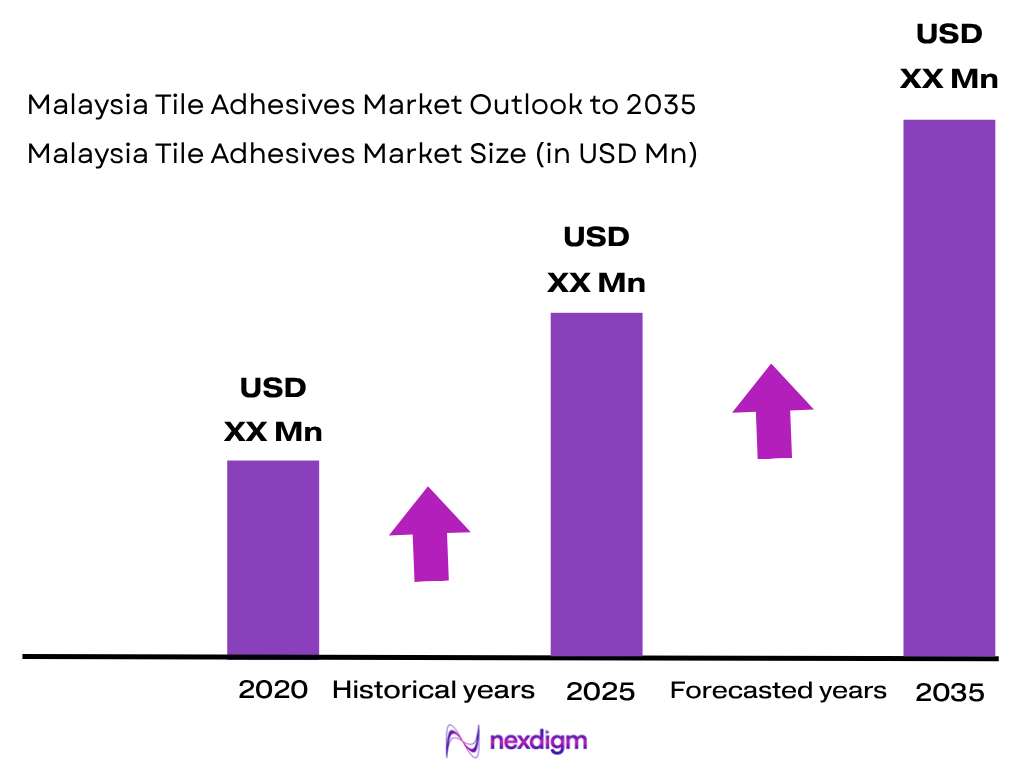
The Malaysia Tile Adhesives Market is valued at approximately ~USD XX million, supported by residential construction, commercial fit-outs, renovation and growing use of porcelain and large-format tiles. National construction work done increased from RM132.2 billion in the preceding reporting period to RM158.8 billion in the latest period. Strong residential, non-residential and specialty-trade activity supports demand for cementitious, polymer-modified, flexible and high-adhesion tiling systems.
Selangor, Kuala Lumpur and Johor are the major demand centres for Malaysia Tile Adhesives due to dense residential, commercial and hospitality development. Selangor’s quarterly construction work increased from RM8.6 billion to RM9.4 billion, while Johor rose from around RM4.0 billion to RM7.4 billion and Federal Territory activity increased from RM4.0 billion to RM4.7 billion, reinforcing tiling demand across high-rise and non-residential projects.
Market Segmentation
By Adhesive Classification
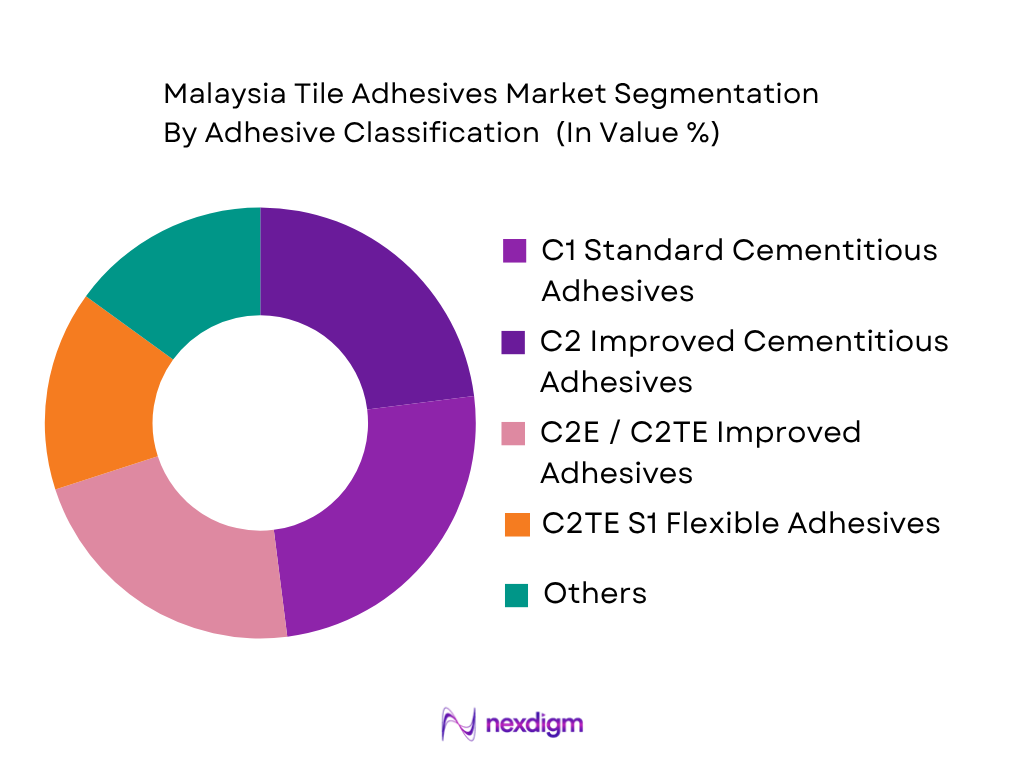
The Malaysia Tile Adhesives Market is segmented into C1 standard cementitious adhesives, C2 improved cementitious adhesives, C2E extended-open-time adhesives, C2TE reduced-slip systems, C2TE S1 flexible adhesives, S2 highly deformable adhesives and rapid-setting systems. C2-class polymer-modified adhesives hold the dominant position because Malaysia increasingly uses low-absorption porcelain and homogeneous tiles that require stronger adhesion than conventional ceramic installations. C2TE systems are particularly relevant for wall applications because reduced slip improves positioning, while extended open time is valuable under Malaysia’s warm installation conditions. Flexible S1 products are gaining importance for larger tile formats, balconies, terraces and waterproofed substrates where movement must be accommodated. Local product ranges already reflect this hierarchy: Sika offers C1, C2E, C2TE and C2TE S1 systems, while Nippon Paint’s CMI portfolio includes both C1 and C2TE products. Large-format installations further encourage migration toward S1 and S2 deformable adhesives.
By Application
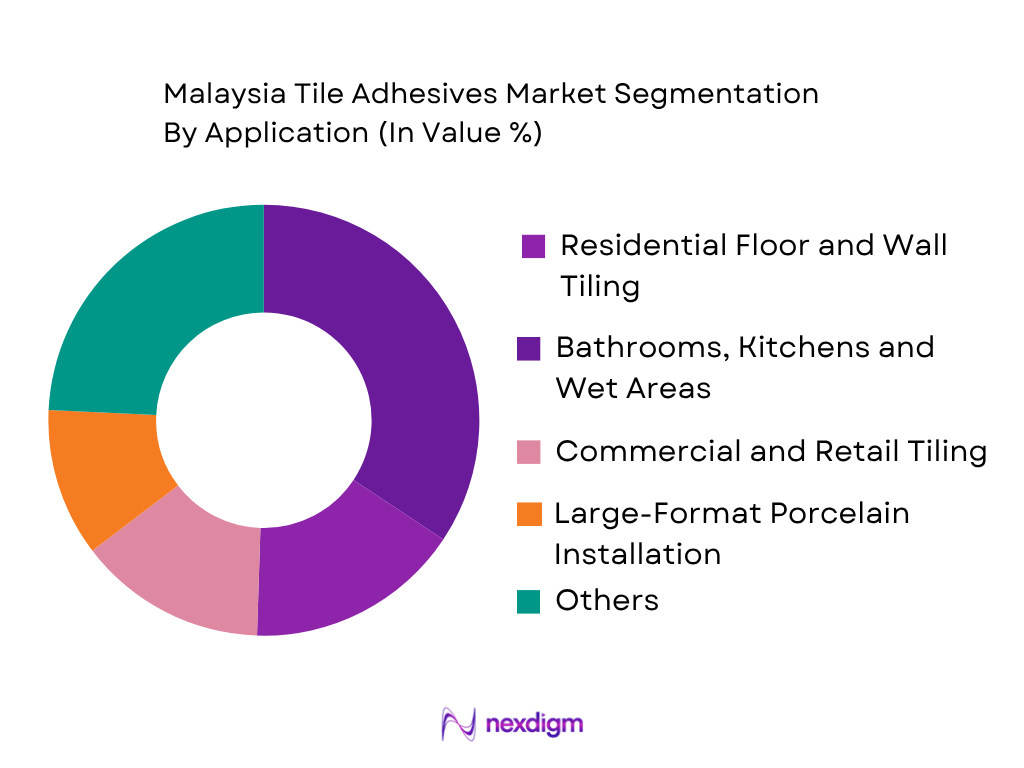
The Malaysia Tile Adhesives Market is segmented into residential floor tiling, wall tiling, bathrooms and wet areas, commercial flooring, swimming pools, tile-on-tile renovation, exterior tiling, large-format tile installation and natural-stone applications. Residential floor and wall tiling represents the dominant demand pool because houses and condominiums use ceramic, porcelain and homogeneous tiles extensively in living areas, bathrooms, kitchens and balconies. Residential construction activity remained a major contributor to national construction work, with the residential segment valued at RM9.9 billion in the final quarter of the latest reporting period. Commercial buildings create additional demand for high-bond and traffic-resistant products, while renovation increases tile-on-tile applications. Swimming pools, balconies and exterior surfaces require water-resistant, flexible adhesives, while large porcelain slabs increasingly need C2 and S1/S2 products. MAPEI specifically recommends C2 adhesives for low-absorption porcelain and S1 or S2 deformability depending on tile dimensions.
Competitive Landscape
The Malaysia Tile Adhesives Market combines global construction-chemical manufacturers with locally established dry-mix businesses. Competition increasingly extends beyond commodity cement-based adhesives toward performance classes such as C2TE and C2TE S1, large-format tile systems, waterproofing-compatible adhesives and technical installation support. MAPEI operates a production facility in Nilai and has manufactured powder products for ceramic and stone installation locally since the early 2000s, while Sika and CMI offer broad EN 12004-classified tile adhesive ranges for the Malaysian market.
| Major Player | Establishment Year | Headquarters | C1 / C2 Portfolio | S1 / S2 Capability | Large-Format / Porcelain | Wet-Area / Pool Systems | Malaysia Manufacturing | Technical Support |
| Sika | 1910 | Baar, Switzerland | ||||||
| Nippon Paint / CMI | 1881 | Tokyo, Japan | ||||||
| MAPEI | 1937 | Milan, Italy | ||||||
| Saint-Gobain Weber | 1665 | Courbevoie, France | ||||||
| ARDEX / QUICSEAL | 1949 | Witten, Germany |
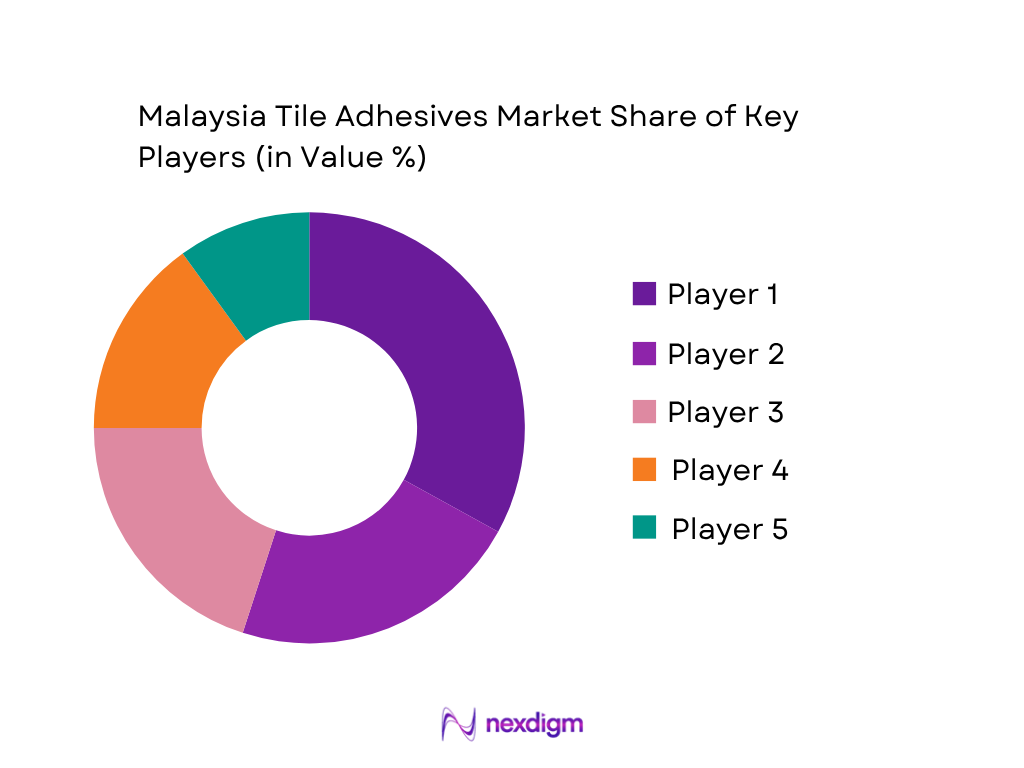
Malaysia Tile Adhesives Market Analysis
Growth Drivers
Residential, High-Rise and Commercial Construction Is Expanding Professional Tile-Adhesive Consumption
Malaysia’s tile adhesives demand is being supported by sustained residential, condominium and commercial construction, which creates large tiled surfaces across bathrooms, kitchens, corridors, balconies, retail spaces and hospitality properties. Department of Statistics Malaysia recorded RM158.8 billion of construction work completed in 2024. In the fourth quarter alone, Selangor recorded RM9.4 billion of construction work, Johor RM7.4 billion, Federal Territories RM4.7 billion and Sarawak RM4.6 billion. Activity remained substantial into 2026, when second-quarter residential building work reached RM10.9 billion and non-residential building work reached RM14.0 billion. These projects enlarge the addressable installation base for cementitious, polymer-modified and flexible tile adhesives, particularly in Klang Valley and Johor where high-rise and mixed-use construction is concentrated. The World Bank recorded Malaysia’s nominal GDP at USD422.227 billion in 2024 and GDP per capita at USD11,874.4, indicating a sizeable construction and consumption economy. Continued building execution therefore supports professional dry-mix adhesive use across residential floors, commercial interiors, bathrooms, balconies and common areas rather than relying solely on conventional cement-sand fixing.
Porcelain and Large-Format Tiling Is Increasing the Need for Higher-Performance Adhesive Systems
The shift toward porcelain, homogeneous and larger-format tiles is strengthening demand for improved tile adhesives because low-absorption surfaces and heavier formats require more reliable bonding, longer workable open time and deformation tolerance than traditional bedding methods. This trend is supported by the scale of construction requiring modern interior finishes: Department of Statistics Malaysia recorded RM12.9 billion of non-residential building work and RM10.5 billion of residential building work in the third quarter of 2025, while second-quarter 2026 activity reached RM14.0 billion and RM10.9 billion, respectively. Johor alone recorded RM8.3 billion of total construction work in the fourth quarter of 2025, while Selangor recorded RM11.0 billion, providing substantial project exposure for premium porcelain and large-format installations. Such projects increasingly favour polymer-modified C2-class, reduced-slip, extended-open-time and flexible adhesive technologies for commercial floors, condominium bathrooms, façades and large tiled walls. World Bank data place Malaysia’s 2024 nominal GDP at USD422.227 billion and GDP per capita at USD11,874.4. The widening sophisticated project base therefore supports migration from basic tile-fixing methods toward engineered adhesive systems with controlled factory formulation.
Market Challenges
Installer Skill Variation and Workforce Dependence Increase Application-Quality Risks
Malaysia’s Tile Adhesives Market faces a significant workmanship challenge because adhesive performance depends on substrate preparation, water addition, mixing time, adhesive-bed thickness, back coverage and correct selection for individual tile formats. CIDB recorded 465,591 registered foreign construction workers as of September 2024, including 150,699 in Kuala Lumpur and 166,456 in Selangor, two of the country’s most important tiling markets. The broader construction industry had approximately 1.1 million registered workers by December 2024, demonstrating the scale and diversity of the labour force involved in project execution. From January 2025, foreign construction workers became subject to source-country competency certification and construction safety-induction requirements, reflecting the authorities’ focus on verified skills. Tile installation is particularly sensitive to inconsistent workmanship because inadequate adhesive transfer can create hollow areas, debonding and failures around low-porosity porcelain or larger tiles. World Bank data record Malaysia’s nominal GDP at USD422.227 billion in 2024 and GDP per capita at USD11,874.4. The market therefore requires stronger installer training, clearer C1/C2/S1 product selection and contractor-level technical support alongside growing adhesive consumption.
Tropical Rainfall, Heat and Moisture Increase Tile-Bonding and Substrate-Control Complexity
Malaysia’s tropical environment creates demanding installation conditions for tile adhesives used on exterior walls, balconies, swimming pools, bathrooms and other moisture-exposed substrates. Department of Statistics Malaysia’s environmental statistics show that Kapit recorded 5,624.0 mm of rainfall in 2024, while even the lowest recorded station, Kuala Pilah, received 1,704.3 mm. Chuping recorded a mean maximum temperature of 32.0°C, highlighting the simultaneous heat and moisture conditions that installers must manage. Severe water exposure was also visible during the 2024 monsoon period, when more than 143,000 people were evacuated across 9 states and 710 temporary relief centres were opened. For tile systems, wet substrates, high humidity and elevated surface temperatures can affect curing, workable open time, waterproofing interfaces and long-term bond reliability, particularly when incorrect adhesive classes or inadequate surface preparation are used. World Bank data record Malaysia’s nominal GDP at USD422.227 billion in 2024 and GDP per capita at USD11,874.4. These environmental conditions make water-resistant, flexible and extended-open-time adhesive systems increasingly necessary, while raising the technical consequences of incorrect installation.
Market Opportunities
C2TE S1 and Large-Format Tile Adhesives Have Strong Scope in Higher-Specification Projects
Malaysia offers substantial future opportunity for C2TE, S1 flexible and other high-performance tile adhesives as residential and non-residential projects increasingly require dependable installation of porcelain, homogeneous and larger tile formats. Current construction activity provides a substantial application base: Department of Statistics Malaysia recorded RM178.6 billion of construction work in 2025. In the fourth quarter, non-residential building activity reached RM14.0 billion, residential buildings reached RM10.5 billion and special trade activities reached RM5.7 billion. The pipeline remained active in the second quarter of 2026, with another RM14.0 billion of non-residential work and RM10.9 billion of residential work. Selangor and Johor, important markets for condominiums, commercial properties and mixed-use projects, recorded RM11.0 billion and RM8.3 billion respectively in fourth-quarter 2025 construction work. These projects create future room for flexible adhesives designed for large tiles, balconies, façades and movement-sensitive substrates. World Bank data record Malaysia’s 2024 nominal GDP at USD422.227 billion and GDP per capita at USD11,874.4, supporting a construction ecosystem capable of adopting increasingly specification-driven tile-installation systems.
Wet-Area, Tile-on-Tile and Integrated Waterproofing Systems Create a Diversified Growth Path
Integrated waterproofing and tiling systems represent a strong future opportunity in Malaysia because bathrooms, balconies, pools, terraces and refurbishment projects require both water management and durable tile adhesion. Current climate and construction data demonstrate the scale of this requirement. Department of Statistics Malaysia recorded 5,624.0 mm of annual rainfall at Kapit in 2024, while 22 monitored stations recorded increases in annual rainfall ranging from 51.0 mm to 2,230.9 mm. At the same time, residential construction work reached RM10.5 billion in the fourth quarter of 2025 and RM10.9 billion in the second quarter of 2026, creating continuing volumes of bathrooms, wet kitchens, balconies and common-area tiling. Tile-on-tile systems can also reduce demolition requirements during refurbishment by bonding new finishes over suitable existing ceramic surfaces, while rapid-setting products can shorten closure periods in occupied properties. Malaysia’s World Bank-recorded nominal GDP stood at USD422.227 billion in 2024, with GDP per capita of USD11,874.4. These conditions support future growth for waterproofing-compatible, rapid-setting and flexible adhesives that combine renovation productivity with improved moisture resistance.
Future Outlook
The Malaysia Tile Adhesives Market is expected to expand at approximately ~X.X% CAGR during 2026-2035, with demand increasingly shifting toward polymer-modified, flexible and application-specific systems. Residential and commercial construction will remain important, while renovation, large-format porcelain tiles and integrated waterproofing-plus-tiling systems will raise the technical performance required from adhesives. Malaysia’s construction work done increased further to RM178.6 billion in the latest subsequent full-year release, with non-residential and residential construction continuing to expand. Selangor remained the largest construction contributor, followed by Johor, strengthening the long-term concentration of tile adhesive demand in Klang Valley and southern Malaysia.
Major Players
- Sika Malaysia Sdn. Bhd. / SikaCeram / Davco
- Nippon Paint Malaysia / CMI
- MAPEI Malaysia Sdn. Bhd.
- Saint-Gobain Weber Malaysia
- ARDEX QUICSEAL Malaysia
- Fosroc Malaysia
- LATICRETE Malaysia / Regional Solutions
- Bostik Malaysia / Arkema
- ParexGroup / Regional Tile-Fixing Solutions
- MC-Bauchemie Malaysia / Regional Solutions
- Terraco Malaysia / Regional Solutions
- Henkel Malaysia
- KCC Paints Malaysia / Construction Materials
- TOA Paint Malaysia / Construction Solutions
- YTL Cement / Dry-Mix and Construction Materials
Key Target Audience
- Tile Adhesive and Dry-Mix Mortar Manufacturers
- Ceramic, Porcelain and Natural Stone Manufacturers and Distributors
- Tiling, Waterproofing and Interior Fit-Out Contractors
- Residential and Commercial Property Developers
- Building Material, Hardware and Tile Distribution Companies
- Investments and Venture Capitalist Firms
- Government and Regulatory Bodies (Construction Industry Development Board Malaysia, Department of Standards Malaysia, Ministry of Works Malaysia, National Housing Department)
- Hotel, Retail and Institutional Project Owners
Research Methodology
Step 1: Identification of Key Variables
The initial phase involves constructing an ecosystem map covering cement suppliers, polymer manufacturers, dry-mix producers, tile distributors, contractors, developers and specification stakeholders. Secondary and proprietary databases are reviewed to identify adhesive classes, tile formats, substrates, applications and regional construction activity. Key variables include installed tiled area, adhesive consumption intensity, C1/C2 classification, deformation class, project type and distribution route.
Step 2: Market Analysis and Construction
Historical market demand is assessed using construction work done, residential and non-residential building activity, refurbishment demand and tile-installation patterns. The top-down methodology assesses addressable tiled construction area, while the bottom-up approach evaluates manufacturer sales, distributor throughput and typical adhesive consumption per square metre. Results are reconciled across C1, C2, C2TE, S1, S2 and specialty adhesive categories.
Step 3: Hypothesis Validation and Expert Consultation
Market hypotheses are validated through computer-assisted telephone interviews and structured discussions with adhesive manufacturers, tile contractors, distributors, architects, waterproofing specialists and project developers. Interviews evaluate product-class selection, tile-format trends, installer preferences, tile-on-tile usage and substrate conditions. Findings are used to differentiate commodity cementitious products from performance-driven professional systems.
Step 4: Research Synthesis and Final Output
The final stage triangulates government construction statistics, manufacturer disclosures, technical product classifications, distributor information and primary research. Demand is validated by adhesive class, application, tile type and region. Forecasting incorporates residential construction, commercial projects, large-format porcelain adoption, renovation, wet-area installations, local dry-mix capacity and increasing use of engineered tiling systems.

- Executive Summary
- Research Methodology (Market Definitions and Assumptions, Malaysia Tile Adhesives Market Classification, Cementitious Adhesive Assessment, Polymer-Modified Adhesive Assessment, Flexible Adhesive Assessment, Dispersion Adhesive Assessment, Epoxy and Reactive Resin Adhesive Assessment, C1 Adhesive Assessment, C2 Adhesive Assessment, C2E Adhesive Assessment, C2TE Adhesive Assessment, C2TE S1 Adhesive Assessment, S2 Highly Deformable Adhesive Assessment, Large-Format Tile Assessment, Porcelain Tile Assessment, Homogeneous Tile Assessment, Ceramic Tile Assessment, Natural Stone Assessment, Marble and Granite Assessment, Mosaic Assessment, Tile-on-Tile Assessment, Wet-Area Assessment, Swimming Pool Assessment, Façade Tiling Assessment, Interior Floor Assessment, Interior Wall Assessment, Exterior Application Assessment, Tensile Adhesion Strength Assessment, Slip Resistance Assessment, Extended Open Time Assessment, Transverse Deformation Assessment, Water Immersion Resistance Assessment, Tropical Climate Performance Assessment, EN 12004 Classification Assessment, Substrate Compatibility Assessment, Local Dry-Mix Manufacturing Assessment, Distributor Mapping, Contractor Interviews, Top-Down Market Sizing, Bottom-Up Market Sizing, Data Triangulation, Forecasting Framework)

- Definition and Scope
- Malaysia Tile Adhesives Industry Evolution and Development of Conventional Cement-Sand Bedding, Thin-Bed Cementitious Adhesives, Polymer-Modified Tile Adhesives, C1 Adhesives, C2 High-Adhesion Systems, Extended-Open-Time Adhesives, Anti-Slip Adhesives, Flexible S1 Systems, High-Deformation S2 Systems, Rapid-Setting Adhesives, Large-Format Tile Adhesives, Porcelain and Homogeneous Tile Adhesives, Natural Stone Adhesives, White Cement Adhesives, Tile-on-Tile Systems, Wet-Area Adhesives, Swimming Pool Adhesives, Exterior Façade Adhesives and Low-Dust Dry-Mix Technologies
- Tile Adhesives Value Chain Analysis
- Tile Adhesives Supply Chain Analysis
- Cement Suppliers, Silica and Mineral Filler Suppliers, Redispersible Polymer Powder Suppliers, Cellulose Ether Suppliers, Performance Additive Suppliers, Latex Admixture Suppliers, Pigment Suppliers, Dry-Mix Mortar Manufacturers, Tile Adhesive Manufacturers, Local Blenders, Importers, Building Material Distributors, Tile Distributors, Ceramic and Porcelain Tile Dealers, Hardware Dealers, Contractors, Tiling Specialists, Waterproofing Contractors, Developers, Architects, Interior Fit-Out Contractors and Applicators

- Growth Drivers (Residential Building Construction, High-Rise Condominium Development, Commercial Construction, Hotel and Hospitality Fit-Out, Bathroom Renovation, Large-Format Tile Adoption, Porcelain and Homogeneous Tile Usage, Tile-on-Tile Refurbishment, Wet-Area Construction, Swimming Pool Development, Polymer-Modified Adhesive Adoption, Professional Tiling Practices)
- Market Challenges (Traditional Cement-Sand Installation Competition, Installer Skill Variation, Incorrect Adhesive Selection, Insufficient Back Coverage, Poor Substrate Preparation, Premature Skin Formation, High Tropical Humidity, Tile Debonding Risk, Hollow Tile Formation, Large-Format Tile Handling, Low-Porosity Porcelain Adhesion, Contractor Price Sensitivity, Product Classification Awareness)
- Market Opportunities (C2TE S1 Flexible Adhesives, Large-Format Tile Adhesives, Rapid-Setting Adhesives, Tile-on-Tile Renovation Systems, Wet-Area Adhesives, Swimming Pool Adhesives, Exterior Façade Adhesives, Low-Dust Adhesives, White Adhesives for Natural Stone, Ready-Mixed Specialty Adhesives, Green-Label Dry-Mix Products, Integrated Waterproofing and Tiling Systems)
- Market Trends (C2 Adhesive Adoption, S1 Flexible Adhesives, Large-Format Porcelain Installation, Polymer Modification, One-Component Dry-Mix Systems, Tile-on-Tile Application, Reduced-Slip Technology, Extended Open Time, Rapid-Setting Systems, System-Based Waterproofing and Tiling, Low-Dust Formulations, Green-Label Products, Installer-Oriented Product Selection)
- Government Regulations and Standards (EN 12004 Tile Adhesive Classification, EN 12002 Deformability Classification, Malaysian Standards Adoption Framework, CIDB Construction Quality Requirements, QLASSIC Workmanship Assessment, Product Safety Requirements, Chemical SDS Requirements, Occupational Safety Requirements, Green Building Material Considerations, Construction Product Certification Requirements)
- SWOT Analysis
- Porter’s Five Forces Analysis
- PESTLE Analysis

- By Market Value (2020-2025)
- By Tile Adhesive Consumption Volume (2020-2025)
- By Cementitious Tile Adhesive Consumption (2020-2025)
- By Polymer-Modified Tile Adhesive Consumption (2020-2025)
- By Flexible S1 and S2 Adhesive Consumption (2020-2025)
- By C1 Adhesive Consumption (2020-2025)

- By Adhesive Chemistry and Technology (In Value %)
Standard Cementitious Tile Adhesives
Polymer-Modified Cementitious Tile Adhesives
Flexible Cementitious Tile Adhesives
Highly Deformable Cementitious Adhesives
Ready-Mixed Dispersion Adhesives
Epoxy and Reactive Resin Adhesives
Latex-Modified Two-Component Adhesives
White Cement-Based Tile Adhesives
Rapid-Setting Cementitious Adhesives - By EN 12004 Performance Class (In Value %)
C1 Normal Cementitious Adhesives
C1T Reduced-Slip Adhesives
C1E Extended-Open-Time Adhesives
C2E Improved Extended-Open-Time Adhesives
C2T Improved Reduced-Slip Adhesives
C2TE Improved Reduced-Slip Extended-Open-Time Adhesives
C2TE S1 Flexible Adhesives
C2TE S2 Highly Deformable Adhesives
Rapid-Setting C2F Systems - By Tile Type (In Value %)
Ceramic Glazed Tiles
Homogeneous Vitrified Tiles
Large-Format Porcelain Tiles
Thin Porcelain Panels
Mosaic Tiles
Glass Mosaics
Marble
Granite
Natural Stone
Terrazzo Tiles
Quarry Tiles
Decorative Wall Tiles - By Application (In Value %)
Interior Floor Tiling
Interior Wall Tiling
Bathroom and Shower Areas
Wet Kitchens
Balconies and Terraces
Swimming Pools and Spas
Exterior Wall Tiling
Façade Tiling
Tile-on-Tile Renovation
Commercial Heavy-Traffic Floors
Retail and Hospitality Tiling
Industrial Floor Tiling
Natural Stone Installation
Large-Format Tile Installation - By Performance Requirement (In Value %)
High Tensile Adhesion Strength
Extended Open Time
Reduced Vertical Slip
S1 Deformability
S2 High Deformability
Rapid Setting
Water Resistance
Immersion Resistance
Tropical Heat Resistance
High-Humidity Performance
Heavy-Traffic Resistance
Large-Format Tile Support
Tile-on-Tile Adhesion
Low-Absorption Tile Adhesion
Chemical Resistance - By Substrate Type (In Value %)
Concrete
Cement-Sand Screed
Cement Render
Brickwork
Lightweight Blockwork
Existing Ceramic Tiles
Waterproofing Membranes
Drywall and Cement Boards
Precast Concrete
Masonry
Heated Screeds
Exterior Rendered Surfaces

- Market Share of Major Players (By Malaysia Revenue, Tile Adhesive Consumption Volume, C1 Portfolio, C2 Portfolio, C2TE Portfolio, S1 and S2 Flexible Adhesive Portfolio, Large-Format Tile Exposure, Porcelain and Homogeneous Tile Exposure, Wet-Area and Pool Exposure, Renovation Exposure, Local Dry-Mix Manufacturing Capacity, Distributor Network, Tile Dealer Coverage, Contractor Training, Technical Specification Support)
- Cross Comparison Parameters (C1 C2 C2TE S1 and S2 Tile Adhesive Portfolio Breadth, Large-Format Porcelain and Homogeneous Tile Bonding Capability, Wet-Area Swimming Pool and Exterior Tiling System Capability, Tile-on-Tile Renovation and Rapid-Setting Adhesive Capability, Malaysia Dry-Mix Manufacturing and Production Capacity, Tile Dealer Hardware and Construction Distribution Network Reach, Tropical Climate Workability Open-Time and Water-Resistance Performance, Contractor Training Technical Specification and On-Site Application Support Capability)
- SWOT Analysis of Major Players
- Major Companies
Sika Malaysia Sdn. Bhd. / SikaCeram / Davco
Nippon Paint Malaysia / CMI
MAPEI Malaysia Sdn. Bhd.
Saint-Gobain Weber Malaysia
ARDEX QUICSEAL Malaysia
Fosroc Malaysia
LATICRETE Malaysia / Regional Solutions
Bostik Malaysia / Arkema
ParexGroup / Regional Tile-Fixing Solutions
MC-Bauchemie Malaysia / Regional Solutions
Terraco Malaysia / Regional Solutions
Henkel Malaysia
KCC Paints Malaysia / Construction Materials
TOA Paint Malaysia / Construction Solutions
YTL Cement / Dry-Mix and Construction Materials

- Tile Installer Requirement Assessment
- Tiling Contractor Procurement Assessment
- Waterproofing Contractor Requirement Assessment
- Interior Fit-Out Contractor Requirement Assessment
- General Contractor Procurement Assessment
- Residential Developer Specification Assessment
- Commercial Developer Specification Assessment

- By Market Value (2026-2035)
- By Tile Adhesive Consumption Volume (2026-2035)
- By Cementitious Tile Adhesive Consumption (2026-2035)
- By Polymer-Modified Tile Adhesive Consumption (2026-2035)
- By Flexible S1 and S2 Adhesive Consumption (2026-2035)
- By C1 Adhesive Consumption (2026-2035)


 Request a Sample
 Ask for Customization
 Get a Quote
 Enquire Now
