
 Download PDF
Market Overview
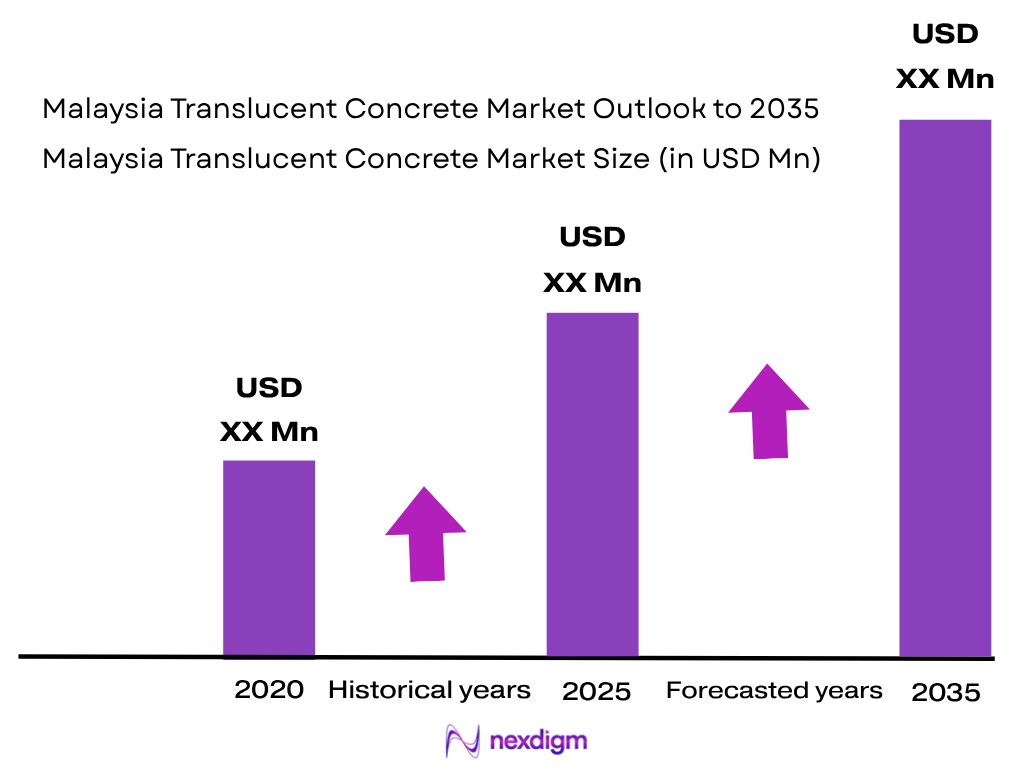
The Malaysia Translucent Concrete Market is a niche architectural-material market positioned within the broader construction, precast-concrete and premium building-material ecosystem. The market size for 2024 is represented as USD ~XX million, with the forecast CAGR for 2026–2035 represented as ~XX%. Demand is supported by Malaysia’s active construction pipeline, where construction work completed reached RM158.8 billion in 2024. Residential buildings accounted for RM35.8 billion, non-residential buildings for RM44.4 billion, and civil engineering for RM61.1 billion, creating multiple potential application channels for decorative and light-transmitting concrete products.
Kuala Lumpur, Selangor, Johor and Penang represent the principal demand centres for Malaysia Translucent Concrete Market applications because they combine commercial development, high-value construction, architectural activity, industrial investment and premium real-estate projects. Kuala Lumpur and Selangor provide a strong base of offices, hotels, retail complexes and high-end residential projects, while Johor benefits from industrial and cross-border development. Penang is important because of its manufacturing, technology and commercial ecosystem. The concentration of approved investment in these locations provides a stronger project pipeline for specialized architectural materials.
Market Segmentation
By Product Form
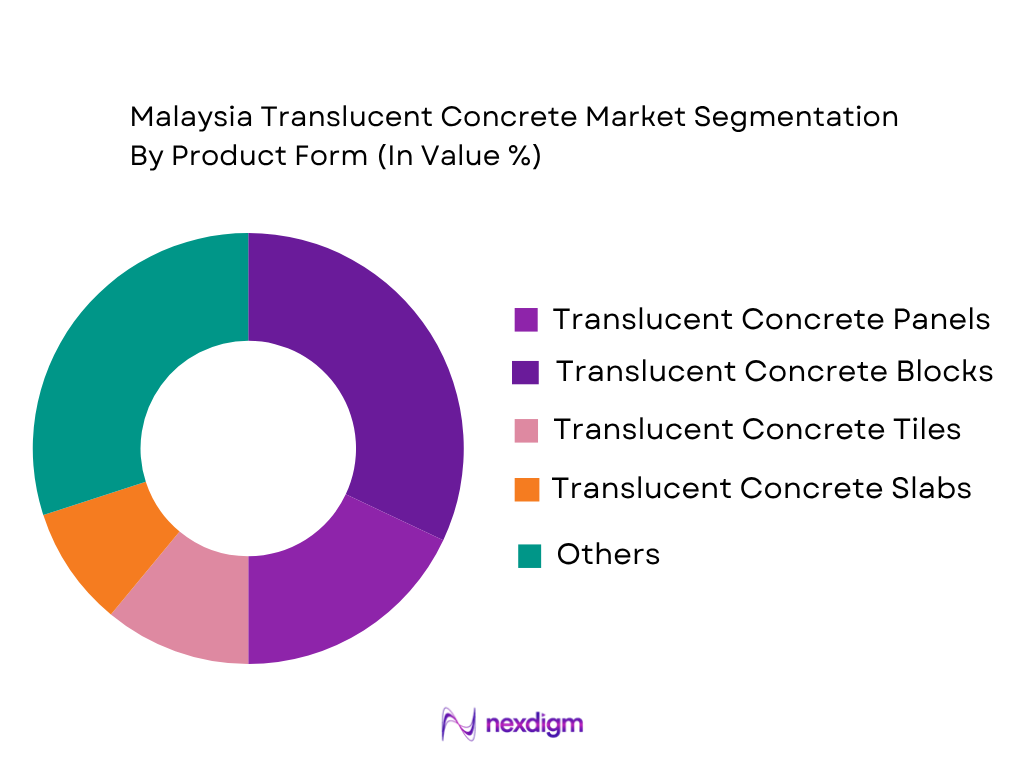
The Malaysia Translucent Concrete Market is segmented by product form into translucent concrete blocks, translucent concrete panels, translucent concrete tiles, translucent concrete slabs, wall-cladding elements, flooring elements, partitions and screens, countertops and furniture, and customized architectural elements. Translucent concrete panels are positioned as the leading sub-segment in the market model because they provide greater flexibility for façade and interior-wall applications while allowing architects to integrate daylight transmission with conventional concrete aesthetics. Panels can be produced in different dimensions, finishes, colors and optical patterns, making them suitable for commercial buildings, hospitality projects, premium residences and public architecture. Their modular characteristics also support prefabricated construction and controlled factory production. The wider Malaysian construction environment provides an application base across residential and non-residential developments, while major investment centres such as Kuala Lumpur, Selangor, Johor and Penang create opportunities for customized architectural specifications. The segment is further supported by the ability to combine translucent panels with artificial lighting, enabling feature walls and façades to function as architectural surfaces rather than conventional structural elements.
By Application
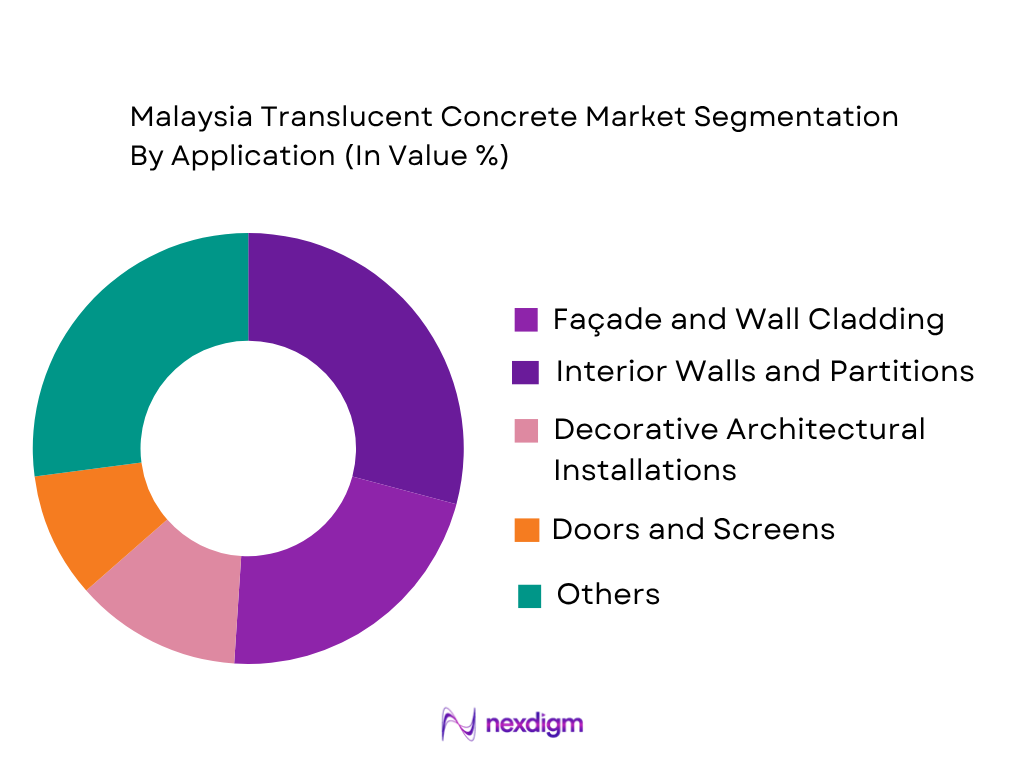
The Malaysia Translucent Concrete Market is segmented by application into façade and wall cladding, interior walls and partitions, flooring, ceilings, staircases, doors and screens, furniture and countertops, landscaping and public art, architectural signage, and decorative architectural installations. Façade and wall-cladding applications are positioned as the leading sub-segment because translucent concrete can combine the visual mass of concrete with controlled light transmission, creating differentiated building envelopes and feature surfaces. This makes the material particularly relevant to commercial buildings, hotels, retail developments, corporate offices and premium residences. Malaysia’s construction sector recorded RM158.8 billion in construction work completed in 2024, including RM44.4 billion in non-residential buildings and RM35.8 billion in residential buildings, providing a broad building base for façade and interior specification. The concentration of approved investment in Selangor, Kuala Lumpur, Johor and Penang further supports architectural-material demand. Translucent façades can also be combined with LED systems, daylight-oriented design and customized patterns, allowing architects to use the material for branding, wayfinding and visual identity.
Competitive Landscape
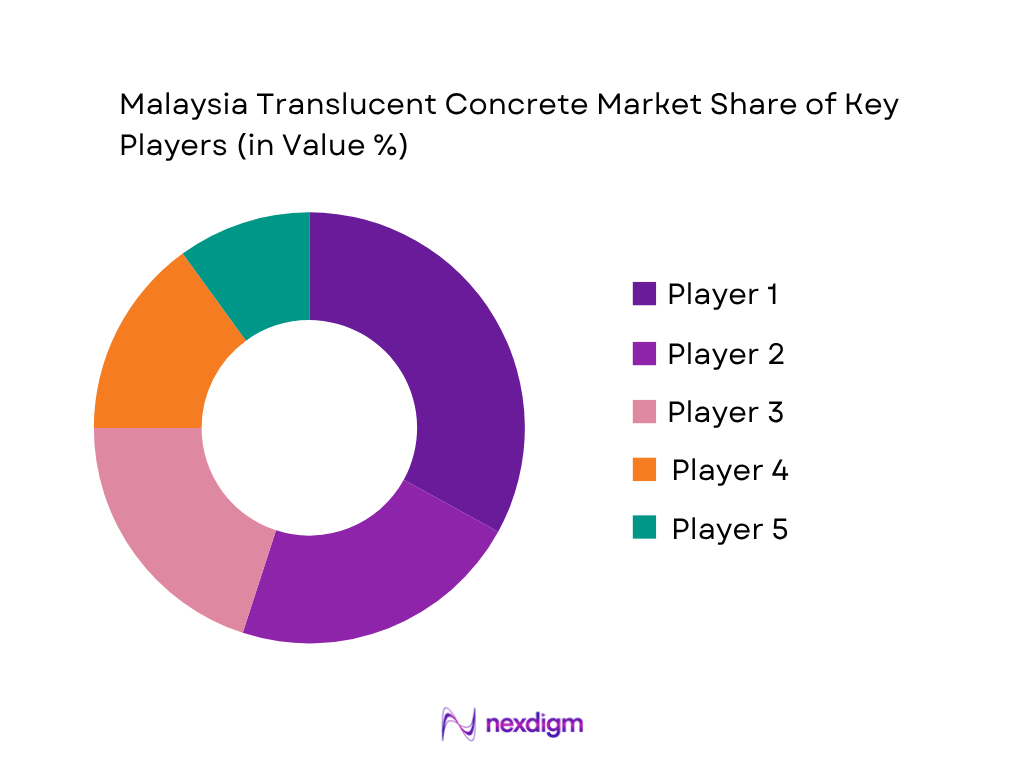
The Malaysia Translucent Concrete Market has a specialized competitive structure involving dedicated translucent-concrete technology developers, architectural-material specialists, concrete manufacturers and broader building-material companies. Competition is influenced less by conventional concrete volume and more by optical performance, manufacturing consistency, customization, panel dimensions, architectural specification capability and project execution. Global specialists such as LUCEM, LiTraCon and LiCrete provide dedicated light-transmitting concrete technologies, while larger building-material groups can contribute concrete manufacturing, precast production and distribution capabilities. Malaysia’s substantial construction and investment activity creates opportunities for both specialist suppliers and established construction-material companies to participate through partnerships, project specifications and local fabrication.
| Major Player | Establishment Year | Headquarters | Optical Technology | Product Capability | Customization | Architectural Applications | Distribution / Project Reach |
| LUCEM GmbH | 2007 | Aachen, Germany | ~ | ~ | ~ | ~ | ~ |
| LiTraCon | 2001 | Csongrád, Hungary | ~ | ~ | ~ | ~ | ~ |
| LiCrete | 2004 | United Kingdom | ~ | ~ | ~ | ~ | ~ |
| Heidelberg Materials | 1873 | Heidelberg, Germany | ~ | ~ | ~ | ~ | ~ |
| Pan-United Corporation | 1958 | Singapore | ~ | ~ | ~ | ~ | ~ |
Malaysia Translucent Concrete Market Analysis
Growth Drivers
Expansion of Commercial Construction
Expansion of commercial construction is a direct demand driver for the Malaysia Translucent Concrete Market because the material is primarily positioned for architectural façades, feature walls, partitions, reception areas and premium interior applications. Malaysia recorded RM158.8 billion in construction work completed, with RM44.4 billion generated by non-residential buildings and RM17.5 billion by special-trade activities. The construction pipeline continued into 2026, with construction work completed reaching RM46.5 billion in Q1 2026, including RM13.0 billion from non-residential buildings. The investment environment also provides a strong project base: Malaysia recorded RM396.9 billion in gross fixed capital formation, while private-sector investment accounted for 77.4% of GFCF. These figures support continued development of offices, retail facilities, hotels, mixed-use projects and institutional buildings where differentiated façade materials can be specified. The concentration of construction activity in major development centres further improves accessibility for specialized architectural-material suppliers. Translucent concrete can therefore participate in higher-value architectural applications where conventional concrete is insufficient from an aesthetic or daylight-transmission perspective. The combination of commercial construction, private investment and specialized building activities provides a structural demand base for greater adoption of translucent concrete in Malaysia.
Growth of Green Building Development
Green-building development is strengthening the addressable opportunity for the Malaysia Translucent Concrete Market because architects and developers increasingly evaluate building materials according to energy performance, carbon impact, lifecycle characteristics and architectural functionality. Malaysia’s construction authorities operate MyCREST, a building-assessment framework covering design, construction and operation while incorporating carbon reduction and lifecycle environmental considerations. The framework specifically evaluates environmental impacts and supports lower-carbon construction practices. Malaysia’s construction sector generated RM158.8 billion of construction work in 2024, providing a substantial building base in which sustainable-material specifications can be incorporated. Gross fixed capital formation reached RM396.9 billion, with structure-related investment representing the principal asset category. The material’s ability to transmit natural or integrated artificial light gives it a potential role in façade and interior applications where designers seek architectural differentiation alongside daylight-oriented design. Current construction activity also remains substantial, with RM46.5 billion of work completed during Q1 2026. This combination of sustainability assessment, construction investment and architectural innovation can support greater consideration of translucent concrete for green commercial buildings, hospitality properties and premium developments. The opportunity is particularly relevant where developers require distinctive materials that can contribute to building design objectives while maintaining a concrete-based architectural appearance.
Market Challenges
High Product Manufacturing Complexity
High manufacturing complexity remains a significant challenge for the Malaysia Translucent Concrete Market because translucent concrete requires controlled integration of light-transmitting elements within a cementitious matrix while maintaining dimensional consistency, surface quality and structural integrity. Unlike conventional concrete production, manufacturers must manage optical-element positioning, concrete casting, curing, finishing and quality inspection simultaneously. Malaysia’s construction industry generated RM158.8 billion of completed work in 2024, but the specialized nature of translucent concrete means that this large construction base does not automatically translate into equivalent demand for the product. The manufacturing challenge becomes more pronounced for customized panels, large-format façades and complex architectural geometries, where tolerances and installation requirements can vary from project to project. Malaysia’s gross fixed capital formation reached RM396.9 billion, demonstrating a substantial investment environment, but specialized producers still need appropriate fabrication capabilities to convert construction opportunities into commercially viable projects. The issue also extends to contractor execution, because handling, transportation, panel alignment, lighting integration and site installation require greater coordination than standard concrete elements. As a result, manufacturers must combine concrete-processing capabilities with optical-material handling, architectural fabrication and engineering expertise. These requirements can lengthen project preparation and restrict the number of suppliers capable of delivering consistent translucent-concrete products at commercial scale.
Limited Local Production Capacity
Limited local production capacity can constrain the Malaysia Translucent Concrete Market by increasing dependence on specialized manufacturing know-how, optical components and project-specific fabrication capabilities. Malaysia has a substantial construction ecosystem, with RM158.8 billion of construction work completed in 2024 and RM178.6 billion recorded in 2025, demonstrating that the broader building market is considerably larger than the niche translucent-concrete segment. However, translucent concrete requires specialized production processes that differ from conventional ready-mix, precast and decorative concrete manufacturing. Optical fibers or other light-transmitting elements must be incorporated with controlled spacing and alignment, while finished components must satisfy architectural and engineering specifications. The challenge is amplified by project-specific requirements for panel thickness, dimensions, surface treatment, lighting integration and fixing systems. Malaysia’s construction sector remained active in 2026, recording RM46.5 billion in construction work completed during Q1, but specialized materials need a dependable supplier ecosystem to capture this activity. Limited domestic manufacturing can also create longer procurement cycles and increase reliance on imported technologies or specialist fabrication partners. Building a broader local production ecosystem would require investment in equipment, technical skills, quality-control systems and architectural-material distribution. Until such capabilities become more established, market development may remain concentrated around selected premium projects rather than widespread adoption across mainstream construction.
Market Opportunities
Energy-Efficient Architectural Façades
Energy-efficient architectural façades represent an opportunity for the Malaysia Translucent Concrete Market because translucent concrete can be incorporated into building envelopes where designers seek controlled daylight transmission, visual differentiation and integrated lighting effects. Malaysia’s construction sector completed RM158.8 billion of work in 2024, including RM44.4 billion in non-residential buildings, creating a substantial potential project base for specialized façade materials. The sustainability opportunity is reinforced by MyCREST, which evaluates environmental performance across the building lifecycle and includes carbon-reduction considerations in design, construction and operation. Malaysia also recorded RM396.9 billion in gross fixed capital formation, with structures representing the dominant asset category, indicating continued investment in physical infrastructure and buildings. These conditions create an environment in which façade systems with additional architectural and environmental functionality can be considered alongside conventional materials. Translucent concrete can be developed into façade panels that combine concrete’s visual solidity with controlled light transmission, while integrated LEDs can extend their architectural function after dark. The opportunity is particularly applicable to offices, hotels, retail developments, cultural buildings and premium residences where façade design contributes to project identity. Manufacturers that can provide customized dimensions, optical patterns, engineering documentation and installation support can address projects where architectural performance is valued alongside conventional concrete functionality.
Hotel and Resort Applications
Hotel and resort applications provide a distinct growth opportunity for the Malaysia Translucent Concrete Market because hospitality projects place strong emphasis on architectural identity, lighting, interiors and experiential design. Malaysia’s construction activity provides an established project base, with RM158.8 billion in construction work completed in 2024 and RM35.8 billion attributed to residential buildings alongside RM44.4 billion in non-residential buildings. The investment environment is also significant, with Malaysia recording RM378.5 billion in approved investments across 6,700 projects during 2024. Hospitality-related development can use translucent concrete for reception walls, illuminated partitions, room dividers, feature façades, spa interiors, restaurants and outdoor architectural installations. The material’s ability to incorporate natural or artificial light can help create differentiated guest environments without relying exclusively on conventional glass or decorative lighting surfaces. Green-building considerations add another potential specification pathway because MyCREST evaluates environmental and lifecycle characteristics of buildings. The opportunity therefore extends beyond simple decorative use: translucent concrete can become part of a broader architectural system combining concrete aesthetics, lighting and sustainability-oriented design. Suppliers able to provide custom patterns, hotel-specific branding elements, prefabricated panels and installation support can target hospitality developments in Kuala Lumpur, Selangor, Johor, Penang and other tourism-oriented locations where premium architectural materials can be integrated into new-build and refurbishment projects.
Future Outlook
Over the forecast period, the Malaysia Translucent Concrete Market is expected to develop through greater architectural experimentation, premium building design and increased specification of differentiated construction materials. Demand is likely to remain concentrated in commercial, hospitality, luxury residential and public architectural projects rather than conventional mass construction. Integration with LED systems, customized optical patterns and prefabricated panels can broaden applications. The market can also benefit from Malaysia’s continued construction activity and industrial investment pipeline, particularly in major urban and economic-development centres.
Future development is expected to focus on large-format panels, improved light transmission, customized patterns, thinner architectural elements, integrated lighting, prefabricated components and sustainable concrete formulations. Suppliers capable of combining material engineering with architectural design support may gain access to higher-value projects. Local fabrication partnerships can also reduce project complexity by bringing manufacturing, finishing and installation capabilities closer to Malaysian construction sites.
Major Players
- LUCEM GmbH
- LiTraCon
- LiCrete
- Luccon Lichtbeton GmbH
- Fapinex LLC
- Pan-United Corporation Ltd.
- Heidelberg Materials
- Holcim Group
- Sika AG
- CEMEX
- Italcementi
- DITON
- Butong AB
- CRE Panel GmbH
- Gravelli s.r.o.
Key Target Audience
- Architectural Material Manufacturers and Suppliers
- Precast Concrete Manufacturers and Fabricators
- Property Developers and Real-Estate Development Groups
- Commercial Building and Hospitality Developers
- Construction Contractors and Specialist Façade Contractors
- Investments and Venture Capitalist Firms
- Government and Regulatory Bodies (Construction Industry Development Board Malaysia, Ministry of Works Malaysia, Ministry of Housing and Local Government)
- Architectural, Engineering and Building-Design Procurement Teams
Research Methodology
Step 1: Identification of Key Variables
The initial phase involves mapping the Malaysia Translucent Concrete Market ecosystem across material suppliers, optical-fiber suppliers, concrete manufacturers, precast producers, architects, contractors, developers and distributors. Key variables include product form, optical technology, panel dimensions, application type, project specification, manufacturing capability and distribution structure.
Step 2: Market Analysis and Construction
Historical market information is compiled through construction-industry statistics, investment records, company disclosures, product documentation and building-material information. The analysis distinguishes translucent concrete from conventional concrete and evaluates demand according to product form, application, end-use sector and project procurement route.
Step 3: Hypothesis Validation and Expert Consultation
Market hypotheses are validated through discussions with participants involved in architectural-material specification, concrete production, precast manufacturing, façade contracting and property development. Industry inputs are used to evaluate technology adoption, product preferences, project requirements, customization needs and supply-chain conditions.
Step 4: Research Synthesis and Final Output
The final stage triangulates market estimates against construction activity, investment conditions, company capabilities and application-level demand. Bottom-up calculations are cross-checked with top-down construction indicators before developing the final segmentation, competitive assessment and future-market outlook.

- Executive Summary
- Research Methodology (Market Definitions and Assumptions, Translucent Concrete Classification, Light-Transmitting Concrete Technology Mapping, Optical Fiber Integration Assessment, Cementitious Matrix Assessment, Light Transmission Efficiency Analysis, Optical Fiber Density Assessment, Concrete Strength Assessment, Panel Thickness and Dimension Analysis, Surface Finish Assessment, Precast Manufacturing Assessment, Custom Fabrication Assessment, Installation Method Assessment, Architectural Application Mapping, Demand-Side Assessment, Supply-Side Assessment, Import and Distribution Assessment, Primary Industry Interviews, Data Triangulation, Forecasting Framework, Limitations and Future Conclusions)

- Definition and Scope
- Translucent Concrete Industry Evolution
- Translucent Concrete Value Chain Analysis
- Translucent Concrete Supply Chain Analysis

- Growth Drivers (Expansion of Commercial Construction, Growth of Green Building Development, Industrialised Building System Adoption, Demand for Architectural Façade Innovation, Expansion of Premium Interior Design, Increasing Adoption of Prefabricated Components, Demand for Natural and Artificial Light Integration, Smart Building Development, Sustainable Construction Initiatives, Growth of Tourism and Hospitality Infrastructure)
- Market Challenges (High Product Manufacturing Complexity, Optical Fiber Integration Requirements, Limited Local Production Capacity, Dependence on Specialized Imported Components, High Technical Fabrication Requirements, Limited Contractor Familiarity, Structural Design and Engineering Constraints, Limited Standardized Product Availability, Project-Specific Installation Requirements, Competition from Glass and Conventional Decorative Concrete)
- Market Opportunities (Energy-Efficient Architectural Façades, Green Building Projects, Premium Commercial Interiors, Hotel and Resort Applications, Smart Building Features, Illuminated Public Infrastructure, Translucent Concrete Partitions, Customized Architectural Panels, Prefabricated Translucent Concrete Components, Integration with LED Lighting Systems)
- Market Trends (Optical-Fiber Integration, Customized Light Patterns, Large-Format Translucent Panels, LED-Integrated Concrete Surfaces, Sustainable Concrete Formulations, Prefabricated Architectural Components, Digital Design and Fabrication, Decorative Façade Innovation, Lightweight Translucent Panels, Application-Specific Light Transmission)
- Government Regulations and Standards (CIDB Construction Product Requirements, Construction Industry Standard CIS:24, Malaysia Standards for Concrete Products, MS EN Concrete Standards, Uniform Building By-Laws, National Construction Industry Policy, Industrialised Building System Requirements, MyCREST Sustainability Requirements, CIDB Product Certification Requirements, Construction Material Import Compliance)
- SWOT Analysis
- Porter’s Five Forces Analysis
- PESTLE Analysis
- Stakeholder Ecosystem
- Competition Ecosystem

- By Market Value (2020-2025)
- By Volume Consumption (2020-2025)
- By Average Selling Price (2020-2025)
- By Translucent Concrete Panel Consumption Volume (2020-2025)
- By Translucent Concrete Block Consumption Volume (2020-2025)

- By Raw Material Type (In Value %)
Cement-Based Translucent Concrete
Optical-Fiber-Based Translucent Concrete
Polymer-Based Translucent Concrete
Glass-Aggregate-Based Translucent Concrete
Glass-Fiber-Reinforced Translucent Concrete
Acrylic Light-Guide Translucent Concrete
Hybrid Fiber-Cement Translucent Concrete
Custom Composite Translucent Concrete - By Product Form (In Value %)
Translucent Concrete Blocks
Translucent Concrete Panels
Translucent Concrete Tiles
Translucent Concrete Slabs
Translucent Concrete Wall Cladding
Translucent Concrete Flooring Elements
Translucent Concrete Screens and Partitions
Translucent Concrete Countertops and Furniture
Custom Architectural Elements
Prefabricated Light-Transmitting Concrete Modules - By Application (In Value %)
Façade and Wall Cladding
Interior Walls and Partitions
Flooring
Ceilings
Staircases
Doors and Screens
Furniture and Countertops
Landscaping and Public Art
Wayfinding and Architectural Signage
Decorative Architectural Installations - By End-Use Sector (In Value %)
Commercial Buildings
Residential Buildings
Hospitality and Tourism
Retail and Shopping Centres
Corporate Offices
Transportation Infrastructure
Public and Government Buildings
Cultural and Entertainment Facilities
Healthcare Facilities
Educational and Institutional Buildings - By Distribution Channel (In Value %)
Direct Project Sales
Precast Concrete Manufacturers
Architectural Material Suppliers
Building Material Distributors
Specialty Construction Material Dealers
Lighting and Architectural Solution Providers
Contractor and Developer Procurement
Online B2B Distribution
Custom Fabrication and Project-Based Supply

- Market Share of Major Players (By Malaysia Revenue, Translucent Concrete Product Portfolio, Optical-Fiber Integration Capability, Panel Manufacturing Capability, Custom Fabrication Capability, Façade Application Coverage, Interior Application Coverage, Lighting Integration Capability, Precast Manufacturing Capability, Distribution Network, Architectural Project Coverage, Technical Installation Support, Product Customization Capability, Regional Project Reach)
- Cross Comparison Parameters (Translucent Concrete Product Portfolio Breadth, Light Transmission Technology Capability, Optical Fiber Integration Density, Panel and Block Manufacturing Capability, Custom Architectural Design Capability, Façade and Interior Application Coverage, LED and Lighting Integration Capability, Malaysia Project and Distribution Coverage)
- SWOT Analysis of Major Players
- Detailed Profiles of Major Companies
LUCEM GmbH
LiTraCon Oy
LiTraCon Bt
Luccon Lichtbeton GmbH
LiCrete
Fapinex LLC
Pan-United Corporation Ltd.
Heidelberg Materials
Italcementi S.p.A.
FIBROBETON
Gravelli s.r.o.
CRE Panel GmbH
DITON
Butong AB
Sino-Sina Building Materials Co., Ltd.

- Architect and Designer Specification Assessment
- Property Developer Procurement Analysis
- Commercial Building Façade Requirement Assessment
- Luxury Residential Interior Application Analysis
- Hotel and Resort Architectural Material Assessment
- Retail and Shopping Centre Design Requirement Analysis

- By Market Value (2026-2035)
- By Volume Consumption (2026-2035)
- By Average Selling Price (2026-2035)
- By Translucent Concrete Panel Consumption Volume (2026-2035)
- By Translucent Concrete Block Consumption Volume (2026-2035)


 Request a Sample
 Ask for Customization
 Get a Quote
 Enquire Now