
 Download PDF
Market Overview
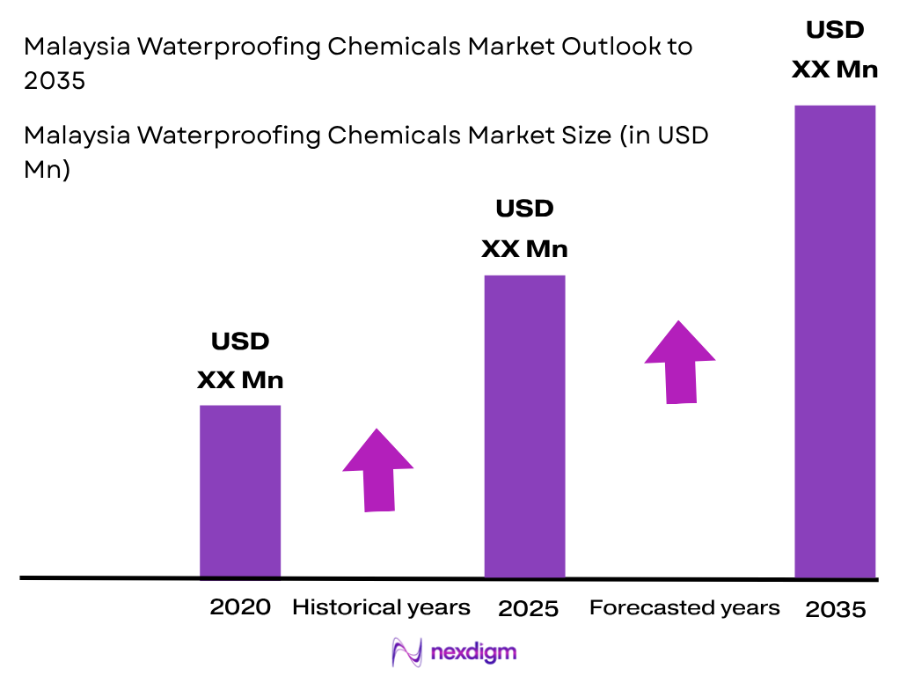
The Malaysia Waterproofing Chemicals Market is valued at approximately ~USD XX million, supported by expanding residential, non-residential, civil engineering and refurbishment activity. Construction work done increased from RM132.2 billion to RM158.8 billion across the two latest annual observations. The latest period also recorded RM42.0 billion of quarterly construction work, including RM11.8 billion in non-residential buildings and RM9.9 billion in residential buildings, supporting sustained demand for roof, basement, wet-area and structural waterproofing systems.
Selangor, Johor, Kuala Lumpur and Sarawak are the principal demand centers because they combine dense urban construction, industrial development, infrastructure and data-center activity. Selangor’s quarterly construction value moved from RM8.6 billion to RM9.4 billion, while Johor increased from RM4.0 billion to RM7.4 billion across the two latest observations. Johor’s growing non-residential construction base and large digital infrastructure pipeline particularly strengthen demand for below-grade membranes, roofing systems, wet-area waterproofing and critical water-ingress protection.
Market Segmentation
By Product Technology
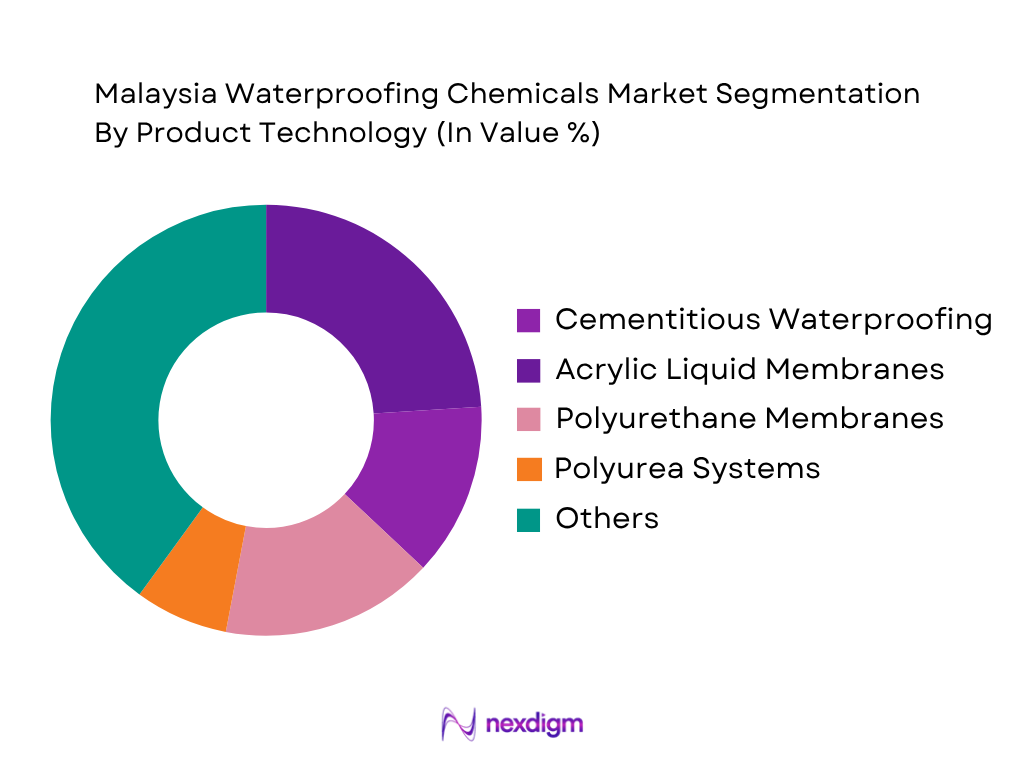
The Malaysia Waterproofing Chemicals Market is segmented into cementitious waterproofing, acrylic liquid membranes, polyurethane membranes, polyurea systems, bituminous membranes, crystalline waterproofing, integral waterproofing admixtures, hydrophobic systems and specialty joint-sealing products. Cementitious waterproofing represents the dominant modeled sub-segment because it is widely used across bathrooms, balconies, swimming pools, water tanks, basements and concrete structures where compatibility with cement-based substrates is essential. Flexible polymer-modified systems are particularly suitable for Malaysia because they can be applied directly over concrete and screed while accommodating minor substrate movement. Their broad use in new residential construction and refurbishment also gives them an advantage over specialist membrane systems that require more complex application equipment. The technology is commonly specified in wet areas and water-retaining structures because it can combine waterproofing, adhesion and surface protection in one system. MAPEI’s Malaysia portfolio, for example, includes cementitious, acrylic, polyurethane, polyurea, bituminous and below-grade solutions, demonstrating the broad application spectrum of modern waterproofing technologies.
By Application Area
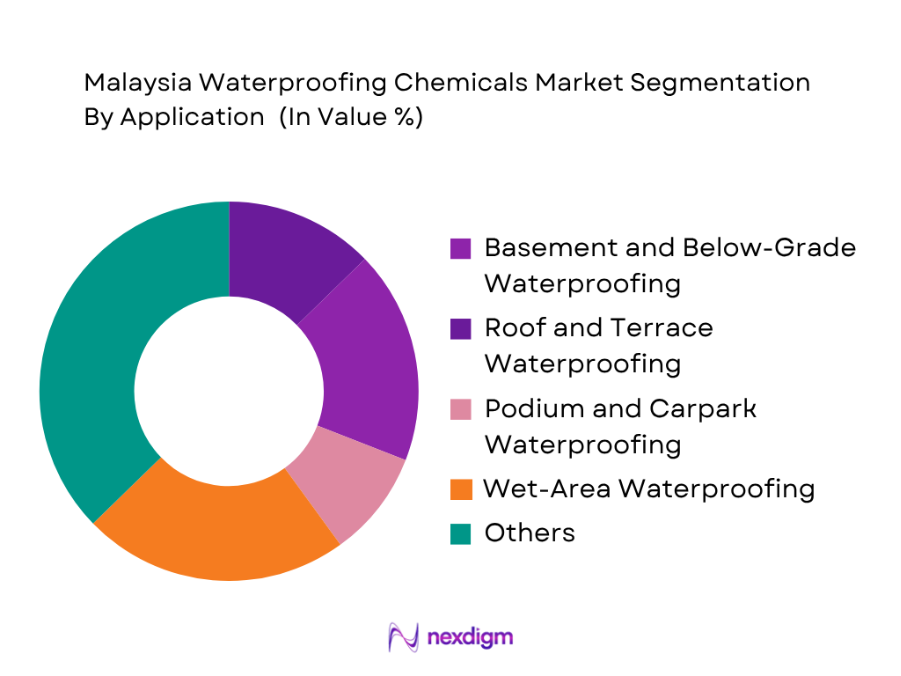
The Malaysia Waterproofing Chemicals Market is segmented into roofs, terraces, balconies, bathrooms, basements, foundations, podium decks, swimming pools, water tanks, tunnels, bridge decks, wastewater structures and marine applications. Roof and wet-area waterproofing represent the dominant modeled application group because Malaysia’s tropical environment creates recurring exposure to rainwater, humidity and moisture penetration, while dense residential construction creates large volumes of bathrooms, balconies and terraces requiring membrane protection. Roof waterproofing also generates recurring refurbishment demand because UV exposure, ponding water, substrate movement and aging can cause cracking or membrane deterioration. Liquid-applied acrylic and polyurethane systems are favored on complex roofs because they create seamless coatings around drains, penetrations and irregular details. Cementitious products dominate many bathrooms and wet areas due to compatibility with tile adhesives and cement screeds. MAPEI identifies terraces, bathrooms, roofs, basins, tanks and below-grade structures as core waterproofing applications, while Fosroc positions membrane, waterstop and protective systems from basement through roof.
Competitive Landscape
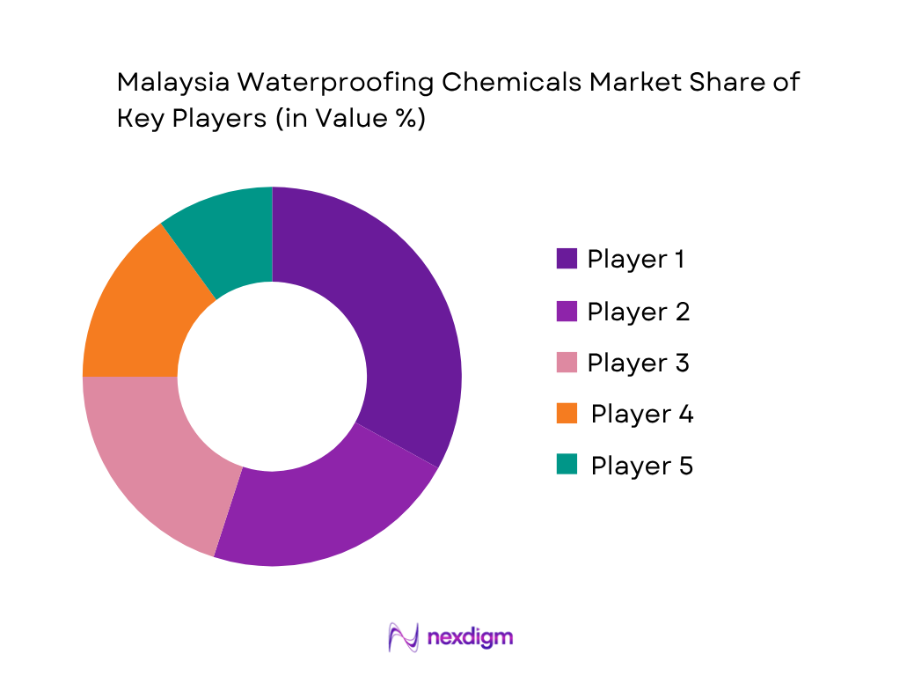
The Malaysia Waterproofing Chemicals Market combines multinational construction-chemical groups with specialist waterproofing companies possessing local manufacturing, technical service and applicator networks. Sika, MAPEI, Fosroc, Penetron and Xypex compete across cementitious, liquid membrane, crystalline, below-grade and infrastructure applications. Competitive differentiation is driven by system breadth, local production, specification support, applicator training, warranty structures and the ability to supply complete systems rather than isolated products.
| Major Player | Establishment Year | Headquarters | Waterproofing Portfolio | Local Manufacturing / Presence | Below-Grade Capability | Roof & Wet-Area Capability | Crystalline / Integral Capability | Technical & Applicator Support |
| Sika | 1910 | Baar, Switzerland | ||||||
| MAPEI | 1937 | Milan, Italy | ||||||
| Fosroc | 1972 | Dubai, UAE | ||||||
| Penetron | 1978 | East Setauket, USA | ||||||
| Xypex | 1969 | Richmond, Canada |
Malaysia Waterproofing Chemicals Market Analysis
Growth Drivers
High Rainfall Exposure and Expanding Construction Activity Strengthen Waterproofing Demand
Malaysia’s tropical environment and continuing construction activity are driving sustained demand for roof membranes, cementitious coatings, basement waterproofing, wet-area systems and water-ingress protection. The Department of Statistics Malaysia recorded RM158.8 billion of construction work completed in 2024, while quarterly construction activity subsequently reached RM47.8 billion in the second quarter of 2026, including RM16.7 billion of civil engineering work and RM13.9 billion of non-residential construction in the first quarter. Climate exposure intensifies the requirement for durable waterproofing: NADMA reported 120,202 flood-affected people from 36,182 families across 38 districts during the November 2024 flood episode, with 697 temporary evacuation centres activated. Persistent water exposure creates recurring requirements for crack-bridging membranes, roof recoating, joint sealing, negative-side basement treatment and remedial injection systems. The combination of expanding built assets and severe moisture exposure therefore creates both new-build and maintenance demand for waterproofing chemicals. Malaysia’s macroeconomic base supports continued building investment, with the IMF recording 2024 nominal GDP at USD 422.2 billion, population at 34.1 million, and GDP per capita at USD 12,397.
Johor Data Centre and Klang Valley Development Expand Critical Waterproofing Applications
Malaysia’s rapid data-centre and non-residential construction expansion is creating a strong demand driver for high-reliability waterproofing systems, particularly in Johor and the Klang Valley. MIDA reported that 9 data centres with 1,280 MW of combined capacity were already completed in Johor during 2024, while 6 additional projects approaching 1,490 MW were under development. A separate TM-Nxera project commenced with 64 MW of initial capacity, while Princeton Digital delivered the first 52 MW phase of a planned 150 MW Johor campus. Data centres require stringent water-ingress prevention around roofs, basements, cooling infrastructure, electrical rooms, expansion joints and service penetrations because leakage can affect mission-critical equipment. Construction activity remains concentrated in the same regions: DOSM recorded RM12.2 billion of work in Selangor and RM9.4 billion in Johor during the second quarter of 2026, including RM4.8 billion and RM3.5 billion of non-residential work respectively. Malaysia’s 2024 economy generated USD 422.2 billion of nominal GDP according to the IMF, supporting continued capital-intensive commercial and digital infrastructure development that expands the addressable waterproofing base.
Market Challenges
Heavy Moisture Exposure Magnifies Application and Detailing Failures
Poor substrate preparation, inconsistent membrane thickness, inadequately sealed penetrations and weak joint detailing represent major challenges for Malaysia’s waterproofing chemicals market because tropical water exposure can rapidly reveal application defects. NADMA reported that the November 2024 flood emergency affected 120,202 people, 36,182 families and 38 districts, requiring 697 evacuation centres nationwide. Kelantan alone recorded 80,725 affected people, while Terengganu recorded 31,170, demonstrating the severity of water loading that Malaysian buildings and infrastructure can face. At the same time, DOSM recorded RM158.8 billion of construction work during 2024 and RM94.3 billion during the first half of 2026, meaning a large volume of newly completed roofs, basements, bathrooms, façades and infrastructure must be waterproofed correctly. Rapid construction can increase execution pressure on specialist applicators, while liquid membranes depend heavily on substrate moisture, curing, coating thickness and reinforcement at corners and joints. Even premium polyurethane, acrylic or crystalline systems can underperform when installation conditions are poorly controlled. The IMF places Malaysia’s 2024 nominal GDP at USD 422.2 billion and population at 34.1 million, highlighting the scale of assets exposed to workmanship-related waterproofing risk.
Imported Chemical Feedstock Dependence Creates Supply-Chain and Formulation Risk
Malaysia’s waterproofing industry remains exposed to international chemical supply chains because polyurethane resins, acrylic polymers, silicones, specialty additives and other membrane feedstocks are internationally traded inputs. MATRADE reported total Malaysian imports of RM1.371 trillion in 2024, including RM748.84 billion of intermediate goods. Imports from China reached RM296.45 billion, while imports from ASEAN totalled RM327.17 billion and imports from the United States reached RM126.26 billion; chemicals and chemical products were identified among major import categories from several of these markets. Malaysian customs schedules separately classify polyurethanes under HS 3909.50 and silicones under HS 3910, both relevant material groups for liquid-applied membranes, sealants and hydrophobic waterproofing systems. This dependence can complicate inventory planning for local manufacturers and applicators because waterproofing systems often require matched primers, membranes, hardeners and accessory products rather than interchangeable commodities. Supply disruption can therefore affect formulation continuity and project approvals. The macroeconomic context remains robust, with the IMF recording Malaysia’s 2024 nominal GDP at USD 422.2 billion, GDP per capita of USD 12,397, and population of 34.1 million, sustaining demand but also increasing the importance of resilient construction-chemical supply chains.
Market Opportunities
Data Centre Waterproofing Creates a High-Specification Growth Avenue
Malaysia’s expanding data-centre base creates a significant future opportunity for polyurethane membranes, polyurea systems, pre-applied basement membranes, joint sealants and high-performance roof waterproofing. Current activity already provides a strong foundation: Johor had 9 completed data centres totaling 1,280 MW and 6 projects approaching 1,490 MW under development in 2024. Princeton Digital’s JH1 campus carries 150 MW of planned capacity, with 52 MW delivered in its first phase, while TM and Nxera began construction of a separate 64 MW AI-ready campus capable of later scaling to 200 MW. These facilities require more stringent water-ingress control than conventional buildings because roofs, cooling-water systems, underground spaces and cable penetrations are positioned near high-value electrical and computing equipment. Johor’s broader construction base remains strong, with DOSM recording RM9.4 billion of work in the second quarter of 2026, including RM3.5 billion in non-residential buildings. These current indicators support future specification of multi-layer membranes, rapid-curing systems and monitored waterproofing assemblies. IMF data place Malaysia’s 2024 nominal GDP at USD 422.2 billion, providing a substantial macroeconomic platform for continued digital-infrastructure investment.
Infrastructure Rehabilitation and Water-Retaining Structures Expand Advanced Waterproofing Potential
Malaysia’s ongoing civil-engineering activity creates a future growth opportunity for crystalline waterproofing, injection systems, bridge-deck membranes, tunnel protection, waterstop systems and coatings for water-retaining structures. DOSM recorded RM16.7 billion of civil-engineering work in the second quarter of 2026, including RM8.1 billion of utility-project construction and RM6.9 billion of road and railway construction. During the first half of 2026, total construction work reached RM94.3 billion, showing a substantial current base of structures that will require both initial waterproofing and future rehabilitation. Tunnels, reservoirs, sewage infrastructure and bridge decks create technically demanding applications because waterproofing systems must tolerate hydrostatic pressure, concrete cracking, chemical exposure and joint movement. High rainfall and flood exposure reinforce this requirement: NADMA recorded 120,202 flood-affected people and 697 evacuation centres during a major 2024 flood event, demonstrating the scale of water-management pressures facing infrastructure assets. These current conditions create scope for higher-value membrane, crystalline and injection technologies as asset owners emphasize lifecycle protection rather than simple surface coating. Malaysia’s 2024 nominal GDP stood at USD 422.2 billion, while GDP per capita reached USD 12,397, according to the IMF, supporting continued investment in resilient public infrastructure.
Future Outlook
The Malaysia Waterproofing Chemicals Market is forecast to expand at approximately ~X.X% CAGR during 2026–2035, driven by continued building construction, data-center development, refurbishment activity and demand for more durable building envelopes. Product demand is expected to shift gradually toward higher-performance polyurethane, polyurea, crystalline and pre-applied membrane systems while cementitious waterproofing retains a major role in mainstream residential and commercial applications.
Construction activity provides the principal structural foundation. Malaysia recorded RM158.8 billion of construction work done in the latest complete annual dataset, compared with RM132.2 billion previously. Residential, non-residential and civil engineering all contributed to this expansion, creating simultaneous waterproofing demand across roofs, bathrooms, basements, podiums, water-retaining structures and infrastructure.
Major Players
- Sika Malaysia
- MAPEI Malaysia Sdn. Bhd.
- Fosroc Malaysia / Saint-Gobain
- GCP Applied Technologies / Saint-Gobain
- Weber-E.MIX / Saint-Gobain Malaysia
- Tremco CPG Malaysia
- Master Builders Solutions Malaysia
- Penetron Malaysia Sdn. Bhd.
- Xypex Malaysia
- Kryton International
- Bostik Malaysia
- ARDEX Malaysia
- MC-Bauchemie Malaysia
- Pentens Holdings Sdn. Bhd.
- Denka Construction Solutions Malaysia
Key Target Audience
- Waterproofing Chemical and Membrane Manufacturers
- Waterproofing Applicators and Specialist Contractors
- Property Developers and Building Owners
- Infrastructure and Civil Engineering Contractors
- Facility Management and Building Maintenance Companies
- Construction Chemical Distributors and Building Material Suppliers
- Investments and Venture Capitalist Firms
- Government and Regulatory Bodies (Construction Industry Development Board Malaysia, SIRIM QAS International, Public Works Department Malaysia, Department of Standards Malaysia, Department of Occupational Safety and Health)
Research Methodology
Step 1: Identification of Key Variables
The initial phase involves constructing an ecosystem map covering waterproofing chemical manufacturers, membrane suppliers, applicators, distributors, developers, contractors and infrastructure owners. Desk research identifies critical variables including construction type, waterproofing area, substrate, product technology, membrane thickness, application method, new-build versus refurbishment demand and regional construction concentration.
Step 2: Market Analysis and Construction
Historical market demand is developed using top-down and bottom-up methods. Top-down analysis assesses construction work done, residential and non-residential building activity, infrastructure pipelines and refurbishment trends. Bottom-up analysis models waterproofing consumption using treated surface area, product coverage, number of coating layers, application-specific product usage and project-type penetration.
Step 3: Hypothesis Validation and Expert Consultation
Market hypotheses are validated through computer-assisted telephone interviews with manufacturers, waterproofing applicators, contractors, distributors, architects and facility managers. These discussions validate technology adoption, cementitious versus liquid membrane usage, below-grade specifications, application practices, failure modes, product warranties, distributor coverage and contractor preferences.
Step 4: Research Synthesis and Final Output
The final phase triangulates DOSM construction statistics, MIDA investment information, company disclosures and primary research. Bottom-up product-consumption estimates are reconciled against top-down construction activity. The resulting model assesses technology mix, application demand, competitive positioning, regional concentration, refurbishment opportunity and future demand from data centers, infrastructure and advanced waterproofing systems.

- Executive Summary
- Research Methodology (Market Definitions and Assumptions, Malaysia Waterproofing Chemicals Market Boundary, Waterproofing Chemical Classification, Liquid-Applied Membrane Assessment, Cementitious Waterproofing Assessment, Bituminous Waterproofing Assessment, Polyurethane Membrane Assessment, Acrylic Membrane Assessment, Polyurea Assessment, Crystalline Waterproofing Assessment, Integral Waterproofing Assessment, Sheet Membrane Chemical Assessment, Joint and Waterstop Assessment, Below-Grade Waterproofing Assessment, Roof Waterproofing Assessment, Wet-Area Waterproofing Assessment, Podium and Balcony Waterproofing Assessment, Basement Waterproofing Assessment, Water-Retaining Structure Assessment, Tunnel Waterproofing Assessment, Bridge Deck Waterproofing Assessment, Marine Structure Assessment, New-Build Demand Assessment, Repair and Refurbishment Assessment, Applicator Mapping, Contractor Specification Mapping, Supply-Side Assessment, Demand-Side Assessment, Top-Down Market Sizing, Bottom-Up Market Sizing, Primary Industry Interviews, Construction Pipeline Assessment, Data Triangulation, Forecasting Framework)

- Definition and Scope
- Evolution of Waterproofing Technologies in Malaysia, Development of Cementitious Coatings, Bituminous Membranes, Acrylic Liquid Membranes, Polyurethane Waterproofing, Polyurea Systems, Crystalline Waterproofing, Pre-Applied Below-Grade Membranes, Self-Adhesive Membranes, Integral Concrete Waterproofing, Trafficable Deck Systems, Green Roof Waterproofing, Wet-Area Waterproofing, Infrastructure Waterproofing, Sustainable Low-VOC Waterproofing Systems
- Waterproofing Chemicals Industry Value Chain Analysis
- Waterproofing Chemicals Supply Chain Analysis
- Polymer Resin Suppliers, Acrylic Emulsion Suppliers, Polyurethane Raw Material Suppliers, Bitumen Suppliers, Cementitious Additive Suppliers, Crystalline Chemical Suppliers, Reinforcement Fabric Suppliers, Membrane Manufacturers, Construction Chemical Manufacturers, Local Blenders, Importers, Distributors, Waterproofing Applicators, Main Contractors, Specialist Subcontractors, Property Developers, Facility Managers, Infrastructure Owners, Testing Laboratories

- Growth Drivers (High Rainfall and Tropical Humidity, High-Rise Residential Construction, Data Centre Development, Johor Construction Expansion, Klang Valley Urban Development, Building Refurbishment, Roof Leakage Remediation, Basement Construction, Wet-Area Waterproofing Demand, Water Infrastructure Expansion, Industrial Facility Construction, Preventive Building Maintenance)
- Market Challenges (Poor Surface Preparation, Application Quality Variability, Skilled Waterproofing Applicator Availability, Membrane Delamination, Substrate Cracking, Ponding Water, Product-System Mismatch, Low-Cost Contractor Competition, Imported Raw Material Dependence, Moisture Entrapment, Inadequate Detailing at Joints and Penetrations, Post-Installation Damage)
- Market Opportunities (Liquid-Applied Roof Waterproofing, Polyurea Systems, Crystalline Waterproofing, Pre-Applied Below-Grade Membranes, Data Centre Waterproofing, Basement Tanking, Green Roof Waterproofing, Podium Deck Systems, Wet-Area Renovation, Infrastructure Rehabilitation, Water Tank Protection, Low-VOC Waterproofing, Building Refurbishment Packages)
- Market Trends (Seamless Liquid Membranes, Fast-Curing Polyurea, Flexible Cementitious Systems, Crystalline Concrete Protection, Pre-Applied Membranes, Self-Adhesive Bituminous Membranes, Root-Resistant Roof Systems, UV-Resistant Roof Coatings, Low-VOC Formulations, Hybrid Polymer Systems, System-Based Waterproofing Specifications, Digital Leak Detection)
- Government Regulations and Standards (CIDB Construction Product Requirements, SIRIM Product Certification, MS and BS EN Waterproofing Standards, MS EN 1504 Concrete Protection Requirements, Building By-Law Requirements, JKR Specifications, Occupational Safety and Health Requirements, Chemical Classification and Labelling Requirements, Environmental Compliance, Public Infrastructure Material Approval Requirements)
- SWOT Analysis
- Porter’s Five Forces Analysis
- PESTLE Analysis
- Stakeholder Ecosystem

- By Market Value (2020-2025)
- By Waterproofing Chemical Consumption Volume (2020-2025)
- By Liquid-Applied Waterproofing Consumption (2020-2025)
- By Cementitious Waterproofing Consumption (2020-2025)
- By Bituminous Waterproofing Consumption (2020-2025)
- By Polyurethane Waterproofing Consumption (2020-2025)

- By Product Technology (In Value %)
Cementitious Waterproofing Systems
Polymer-Modified Cementitious Coatings
Acrylic Liquid-Applied Membranes
Polyurethane Liquid-Applied Membranes
Polyurea Waterproofing Systems
Bituminous Coatings
Polymer-Modified Bituminous Membranes
Crystalline Waterproofing Systems
Integral Concrete Waterproofing Admixtures
Silane and Siloxane Water Repellents
Epoxy Waterproofing Systems
Hybrid Polymer Waterproofing
Bentonite Waterproofing Systems
PVC and Synthetic Membrane Accessories
Specialty Waterproofing Sealants - By Application Area (In Value %)
Roofs and Flat Roofs
Terraces and Balconies
Bathrooms and Wet Areas
Kitchens and Utility Areas
Basements
Foundations and Retaining Walls
Podium Decks
Car Parks
Swimming Pools
Water Tanks and Reservoirs
Sewerage and Wastewater Structures
Bridge Decks
Tunnels and Underground Structures
Marine and Coastal Structures
Industrial Floors and Process Areas - By Construction Type (In Value %)
New Building Construction
Existing Building Refurbishment
Leak Repair and Remedial Waterproofing
Infrastructure Rehabilitation
Residential Renovation
Commercial Building Renovation
Industrial Maintenance
Public Building Upgrades - By Building Type (In Value %)
High-Rise Residential Buildings
Landed Residential Buildings
Commercial Offices
Shopping Malls
Hotels and Resorts
Hospitals and Healthcare Facilities
Educational Buildings
Industrial and Manufacturing Facilities
Data Centres
Warehouses and Logistics Facilities
Government Buildings
Transport Infrastructure
Water and Wastewater Facilities
Mixed-Use Developments - By Waterproofing Mechanism (In Value %)
Positive-Side Waterproofing
Negative-Side Waterproofing
Integral Waterproofing
Surface-Applied Waterproofing
Pre-Applied Waterproofing
Post-Applied Waterproofing
Crack-Bridging Waterproofing
Pore-Blocking Waterproofing
Hydrophobic Water Repellency
Crystalline Self-Sealing Protection - By Substrate Type (In Value %)
Reinforced Concrete
Precast Concrete
Cement Screed
Masonry
Metal Roof
Existing Bituminous Membrane
Ceramic Tile Substrate
Cement Board
Lightweight Concrete
Other Construction Substrates - By Installation Method (In Value %)
Brush-Applied
Roller-Applied
Trowel-Applied
Torch-Applied
Loose-Laid Membrane
Mechanically Fixed Membrane
Pre-Applied Membrane
Injection and Crack-Sealing Systems - By End User (In Value %)
Property Developers
Main Contractors
Waterproofing Applicators
Infrastructure Contractors
Industrial Facility Owners
Facility Management Companies
Government Project Contractors
Residential Renovation Contractors
Data Centre Developers
Hospitality Developers - By Distribution Channel (In Value %)
Direct Manufacturer Sales
Authorized Distributor Network
Construction Chemical Dealers
Waterproofing Applicator Channel
Main Contractor Procurement
Project-Specified Procurement
Developer-Nominated Supplier Channel
Hardware and Building Material Retail
Online and Digital Procuremen - By Region (In Value %)
Klang Valley
Selangor
Johor
Penang
Negeri Sembilan
Melaka
Perak
Pahang
Sabah
Sarawak
Northern Malaysia
East Coast Malaysia
Other Malaysia

- Market Share of Major Players (By Malaysia Revenue, Waterproofing Chemical Volume, Liquid Membrane Portfolio, Cementitious Waterproofing Portfolio, Bituminous Membrane Portfolio, Crystalline Waterproofing Portfolio, Roof Waterproofing Exposure, Basement Waterproofing Exposure, Infrastructure Exposure, Local Manufacturing Presence, Distributor Network, Applicator Network, Technical Support, Project Specification Presence)
- Cross Comparison Parameters (Waterproofing Technology Portfolio Breadth, Roof Wet-Area and Below-Grade System Capability, Liquid-Applied Polyurethane Acrylic and Polyurea Capability, Crystalline Integral and Concrete Waterproofing Capability, Malaysia Manufacturing and Distribution Footprint, Infrastructure Marine and Water-Retaining Structure Capability, Applicator Training Technical Support and Warranty Capability, Low-VOC Sustainable and Refurbishment Waterproofing Capability)
- SWOT Analysis of Major Players (Technology Portfolio, Manufacturing, Distribution, Specifications, Applicator Network)
- Major Companies
Sika Malaysia
Mapei Malaysia Sdn. Bhd.
Fosroc Malaysia / Saint-Gobain
GCP Applied Technologies / Saint-Gobain
Weber-E.MIX / Saint-Gobain Malaysia
Tremco CPG Malaysia
Master Builders Solutions Malaysia
Penetron Malaysia Sdn. Bhd.
Xypex Malaysia
Kryton International
Bostik Malaysia
ARDEX Malaysia
MC-Bauchemie Malaysia
Pentens Holdings Sdn. Bhd.
Denka Construction Solutions Malaysia

- Property Developer Requirement Assessment
- Main Contractor Procurement Assessment
- Waterproofing Applicator Requirement Assessment
- Facility Manager Requirement Assessment
- Data Centre Developer Requirement Assessment
- Hospitality Developer Requirement Assessment

- By Market Value (2026-2035)
- By Waterproofing Chemical Consumption Volume (2026-2035)
- By Liquid-Applied Waterproofing Consumption (2026-2035)
- By Cementitious Waterproofing Consumption (2026-2035)
- By Bituminous Waterproofing Consumption (2026-2035)
- By Polyurethane Waterproofing Consumption (2026-2035)


 Request a Sample
 Ask for Customization
 Get a Quote
 Enquire Now