

 Download PDF
Market Overview
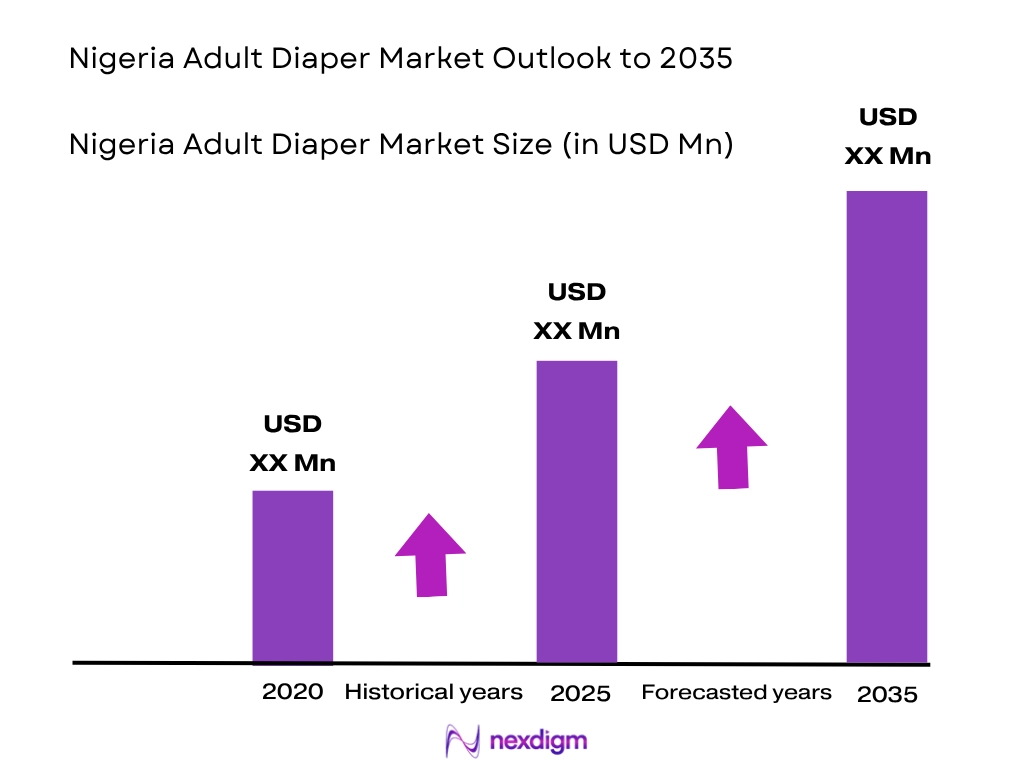
The Nigeria adult diaper market was valued at approximately USD ~ million in 2025. The market is largely driven by the aging population and increased awareness of incontinence care. Nigeria’s demographic shift towards an older population is fueling the demand for adult diapers, particularly in urban centers where healthcare infrastructure is more accessible. Additionally, growing consumer awareness of hygiene, coupled with improved healthcare facilities and government initiatives to support the elderly, have contributed to the market’s growth.
The dominant cities in the Nigeria adult diaper market include Lagos, Abuja, and Port Harcourt. These urban centers account for a significant share of demand due to higher income levels, urbanization, and better access to healthcare services. Lagos, being the largest metropolitan area, leads the market, driven by its status as a commercial hub and its concentration of healthcare facilities and retail outlets. Abuja, with its growing middle class and a high concentration of medical centers, follows closely in terms of market demand.
Market Segmentation
By Product Type
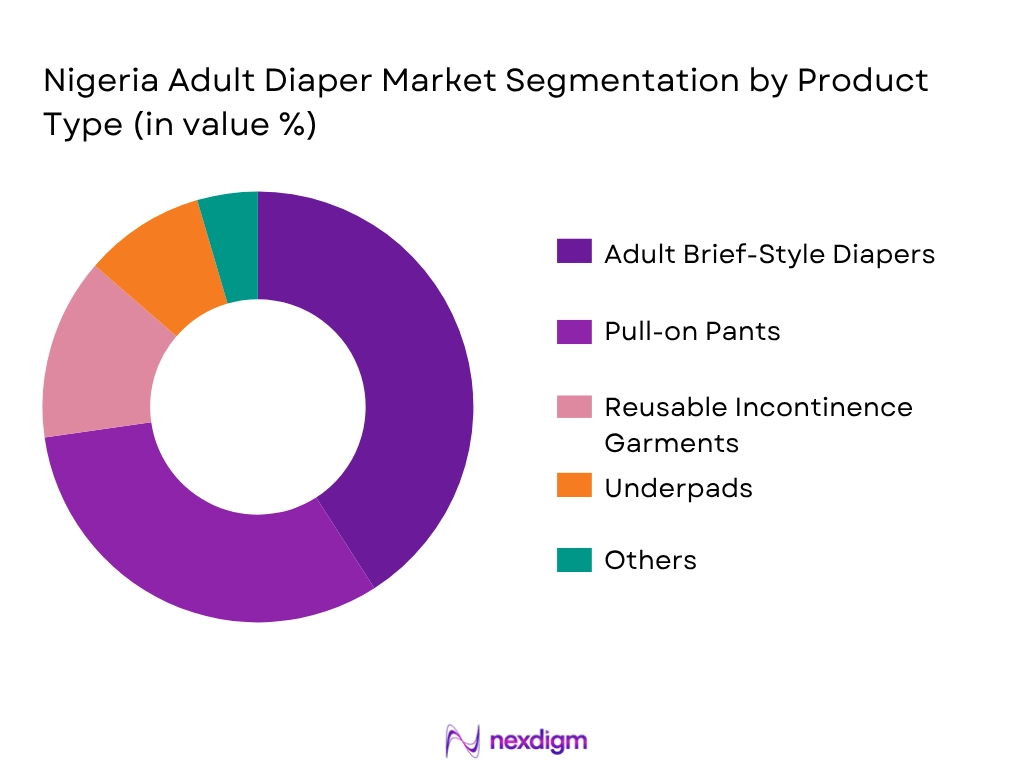
The Nigeria adult diaper market is segmented by product type into tape-on, pull-on, ultra-thin, night-use, and economy packs. The tape-on and pull-on sub-segments are the most dominant due to their widespread use in healthcare settings and consumer preference for convenience and comfort. Tape-on diapers, known for their secure fit and ease of use, are highly favored by caregivers in hospitals and elderly care centers. Pull-on diapers, often resembling regular underwear, are gaining popularity among individuals seeking discreet incontinence solutions.
By Absorbency Level
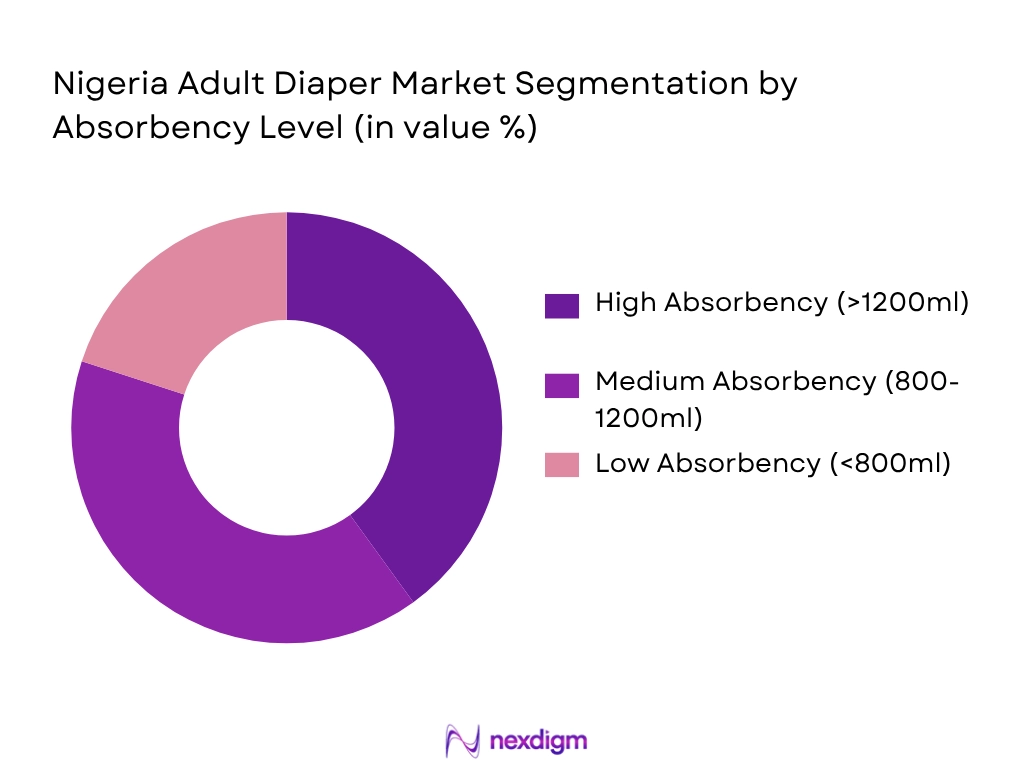
The absorbency grade segment is categorized into low, medium, and high absorbency levels. High absorbency diapers, capable of holding more than 1200ml of fluid, dominate the market due to their suitability for overnight use and long-duration protection. These diapers are preferred by consumers with severe incontinence, especially in elderly care settings. The demand for high absorbency products is particularly pronounced in urban regions where elderly care facilities are more common.
Competitive Landscape
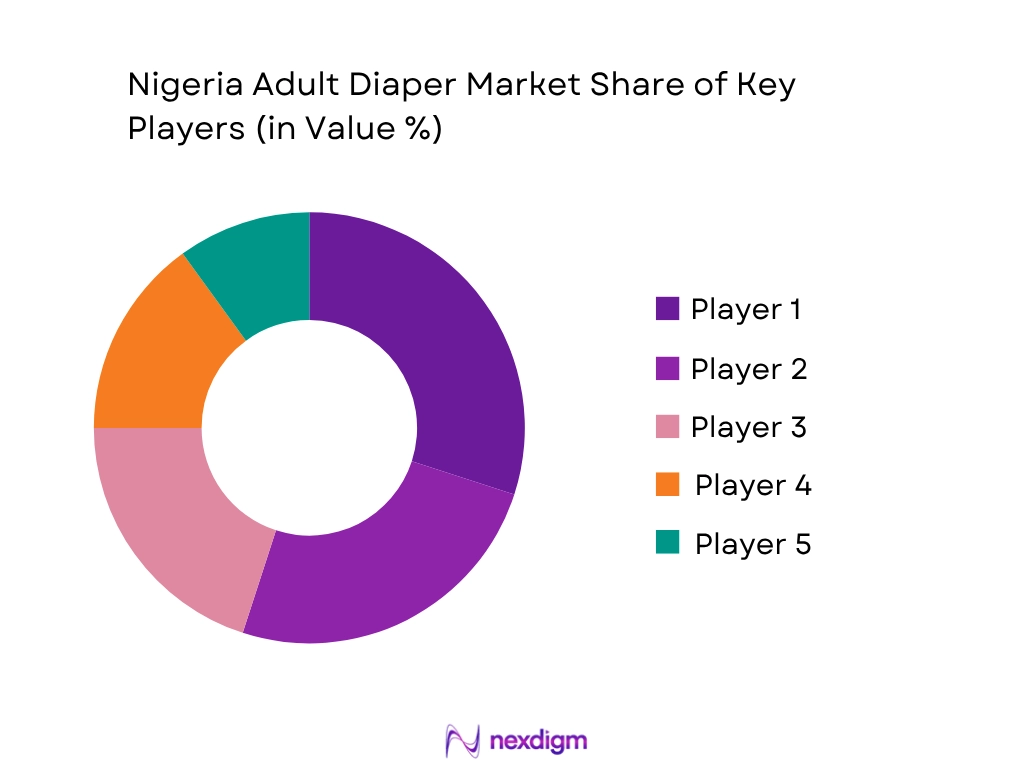
The Nigeria adult diaper market is characterized by the presence of both local and international players. Major international brands such as Kimberly-Clark (Depend), Procter & Gamble (Always), and local manufacturers dominate the market. Local players are gaining traction by offering affordable alternatives that cater to price-sensitive segments, while international brands lead in premium product offerings with superior quality and innovation.
| Company Name | Establishment Year | Headquarters | Product Portfolio | Market Presence | Distribution Channels | Price Positioning |
| Kimberly-Clark | 1872 | USA | ~ | ~ | ~ | ~ |
| Procter & Gamble | 1837 | USA | ~ | ~ | ~ | ~ |
| Molicare | 1987 | Germany | ~ | ~ | ~ | ~ |
| First Quality | 1988 | USA | ~ | ~ | ~ | ~ |
| Ogotex | 1995 | Nigeria | ~ | ~ | ~ | ~ |
Nigeria Adult Diaper Market Analysis
Growth Drivers
Incontinence Incidence
In Nigeria, urinary incontinence (UI) a primary driver of demand for adult diapers is a documented health condition within the adult population. Clinical research conducted among adult women shows prevalence rates as high as 33.88% in older female cohorts in community settings, indicating significant symptomatic incontinence requiring management solutions like adult diapers. Studies also document UI affecting more than half (56.3%) of sampled women in some clinical populations, with mixed incontinence being the predominant form observed. These observed rates underscore a substantial underlying health need for continence products in healthcare and home settings, reflecting a genuine, physiologically driven demand base for adult diaper usage in Nigeria’s population. Furthermore, macro‑demographic data from the World Bank shows that approximately 3.05% of Nigeria’s population is aged 65 and above an increasing cohort associated with higher incontinence prevalence due to aging physiology and healthcare needs reinforcing the potential for sustained and growing demand for adult incontinence products.
Social Acceptance
The adult diaper category in Nigeria has gained traction as social perceptions around incontinence management and personal hygiene evolve, particularly in urban healthcare contexts and among caregivers. Healthcare literature indicates that conditions like UI, historically under‑reported due to stigma, are receiving greater clinical attention, which correlates with rising product uptake among affected populations seeking practical solutions. Clinical samples show a high prevalence of UI among women attending healthcare services, demonstrating both awareness and willingness to engage with continence care modalities. Additionally, Nigeria’s demographic profile, with an estimated 232.6 million total population, implies a vast potential consumer base where societal norms gradually tolerate open discussion of health needs and hygiene products, especially in metropolitan areas. The increasing household penetration of personal care products and visible availability of adult diapers in pharmacies and retail stores reflect a normalization of usage as an acceptable hygiene practice, which drives broader acceptance beyond clinical settings.
Market Challenges
Price Sensitivity & Affordability Constraints
Affordability remains a key structural challenge for the adult diaper market in Nigeria, particularly given income constraints and price sensitivity among consumers. Nigeria’s GDP per capita is comparatively low relative to global benchmarks, and although detailed per capita income stats are periodically updated by macroeconomic institutions like the World Bank, broad economic indicators consistently reflect constrained disposable incomes among large segments of the population. This results in many consumers prioritizing essential goods over healthcare hygiene products, pressuring price margins for manufacturers and distributors of adult diapers. Market‑specific pricing pressures are exacerbated in segments where import costs and foreign exchange volatility add to retail prices, further limiting adoption among cost‑conscious buyers. These affordability constraints are especially acute outside major urban centres where retail markup and distribution costs are higher, dampening effective demand among lower‑income groups and constraining product penetration across broader population segments.
Distribution Inefficiencies in Rural Nigeria
One of the persistent challenges facing market expansion in Nigeria is uneven and inefficient distribution infrastructure, particularly in rural and underserved regions. According to digital inclusion statistics, only 45.5% of the population has internet access even though digital and mobile connectivity has increased overall, indicating infrastructure disparities between urban and rural populations that similarly affect physical goods distribution. Rural areas often lack reliable roads, logistics networks, retail density, and pharmacy chain presence, which limits consistent availability of adult diapers outside major cities. The digital divide also translates into limited e‑commerce reach in these rural communities, where only a fraction of people can access online platforms for product delivery. These systemic inefficiencies translate into patchy supply, elevated last‑mile delivery costs, stockouts, and slower inventory turnover, thereby constraining both market reach and brand penetration for continence care products in rural Nigeria.
Market Opportunities
Private Label & Local OEM Manufacture
The Nigeria adult diaper market presents a significant opportunity in private label products and localized manufacturing, driven by the need to address cost barriers and improve product accessibility. With a substantial segment of consumers facing affordability pressures linked to global import cost structures, locally manufactured adult diapers can leverage lower production and supply chain costs to offer competitively priced alternatives without sacrificing quality. This positioning aligns with Nigeria’s broader economic initiatives that support domestic manufacturing and import substitution. Furthermore, private label products offer retailers and pharmacy networks the chance to build exclusive offerings that improve customer loyalty and expand margins. By enabling local OEM players to produce diapers tailored to Nigeria’s consumer needs, including targeted sizes, absorbency levels, and cultural fit preferences, this segment can capture previously untapped demand, particularly among price‑sensitive buyers. Localization also mitigates foreign exchange exposure related to imported goods, making products more stable in price year‑on‑year, which strengthens long‑term growth prospects for the market.
Digital Retail & Tele‑pharmacy Growth
Expansion of digital retail and tele‑pharmacy services represents a future growth pathway for the adult diaper market in Nigeria, especially as mobile and e‑commerce adoption accelerates. According to digital data insights, Nigeria had 103 million internet users and 205.4 million active mobile connections in early 2024, indicating robust hardware penetration that supports online health‑focused retail channels. This digital adoption trend enables online pharmacies and e‑commerce platforms to deliver adult diapers directly to consumers, bridging gaps in traditional retail distribution. Growth in digital retail also aligns with broader healthcare service trends where tele‑health consultations and virtual medicine dispensaries are growing, making it feasible for patients with mobility limitations or chronic health conditions to order products without travel. As digital literacy and connectivity improve, tele‑pharmacy platforms can integrate reusable reorder mechanisms, subscription models for chronic users, and tailored product recommendations, enhancing both convenience and consistent product uptake across diverse regional markets.
Future Outlook
Over the next decade, the Nigeria adult diaper market is expected to see steady growth. This growth is driven by the increasing demand for hygiene products due to Nigeria’s aging population, rising healthcare accessibility, and growing awareness of incontinence management. Additionally, as more elderly individuals require long-term care, the market is set to benefit from an increase in institutional demand. Innovations in product design, such as eco-friendly diapers and high-performance materials, will also contribute to market expansion.
Major Players
- Kimberly-Clark
- Procter & Gamble
- Molicare
- First Quality
- Ogotex
- Seni
- HARTMANN Group
- Attends Healthcare
- DryPro
- Unicharm Corporation
- SCA Hygiene Products
- ConvaTec
- DynaCare
- Essity
- Medline Industries
Key Target Audience
- Elderly Care Providers
- Healthcare Institutions (Hospitals, Nursing Homes, Clinics)
- Investment and Venture Capitalist Firms
- Government and Regulatory Bodies (National Health Insurance Scheme, Nigerian Ministry of Health)
- Distribution and Retail Networks
- E-commerce Platforms and Online Retailers
- Private Label Manufacturers
- Wholesale Distributors
Research Methodology
Step 1: Identification of Key Variables
The first phase involves identifying key factors that impact the adult diaper market in Nigeria, such as demographic trends, healthcare infrastructure, and consumer purchasing behavior. This is achieved through desk research, utilizing industry databases and healthcare reports to capture the variables influencing demand.
Step 2: Market Analysis and Construction
In this step, historical market data is analyzed to estimate the market size and growth trajectory. Market penetration and distribution trends are assessed, and insights are gathered regarding product adoption, which will contribute to reliable projections.
Step 3: Hypothesis Validation and Expert Consultation
Market hypotheses about demand drivers and consumer preferences are validated through interviews with industry experts, including manufacturers, distributors, and healthcare professionals. These consultations help refine and confirm initial assumptions.
Step 4: Research Synthesis and Final Output
The final research phase involves synthesizing insights from all collected data. Direct consultations with manufacturers, healthcare providers, and retailers ensure that the final output reflects accurate and current market conditions, delivering a comprehensive analysis.

- Executive Summary
- Research Methodology (Market Definitions and Scope, Data Sources and Validation (Primary, Secondary, Retail Scan), Market Sizing & Forecasting Techniques;Top‑Down & Bottom‑Up, Volume‑to‑Value Modelling, Assumptions, Conventions & Extrapolation Logic (Population Ageing, Incontinence Prevalence), Limitations and Confidence Levels)

- Market Definition and Key Product Attributes
- Consumer Demographics & Health Incidence Analysis
- Healthcare and Institutional Usage Landscape
- Distribution Structure
- Supply Chain & Value Chain: Import Flow, Local Sourcing, Last‑mile Challenges

- Growth Drivers (Ageing Population and Incontinence Incidence, Rising Hygiene Awareness and Social Acceptance, Expansion of Pharmacy Chains and Retail Coverage)
- Market Challenges (Price Sensitivity, Affordability Constraints, Distribution Inefficiencies in Rural Nigeria, Import Dependency and FX Pressure)
- Market Opportunities (Private Label, Local OEM Manufacture, Digital Retail & Tele‑pharmacy Growth)
- MarketTrends (Premiumization, Comfort‑focused Designs, Eco‑friendly/Reusable Product Innovations)
- Regulatory Environment (Import Tariffs, Medical Device Classifications)
- SWOT Analysis (Brand Trust, Aging Demand, Stigma, Reimbursement, Premiumization, Private Label Threat)
- Porter’s Five Forces (Buyer Power, Supplier Power, Substitution Risk, New Entrants, Competitive Rivalry)
- Stakeholder Ecosystem (Manufacturers, Retailers, DME Suppliers, Care Facilities, Payers, Clinicians, Caregivers, End Users)
- Competition Ecosystem (National Brands, Institutional Brands, Specialty DTC Brands, Retail Private Labels, Medical Distributors)

- By Value (2020-2025)
- By Volume (2020-2025)
- By Average Price per Unit Analysis (2020-2025)

- By Product Type (In Value %)
Tape‑On/Tab Style (Standard)
Pull‑On/Pants Style
Ultra Thin/Discreet
Night Use High‑Absorbency
Economy/Value Packs - By Absorbency Grade (In Value %)
Low Absorbency (<800ml)
Mid Absorbency (800–1200ml)
High Absorbency (>1200ml) - By Distribution Channel (In Value %)
Pharmacy & Chemist Chains
Modern Retail & Supermarkets
Hospitals & Contract Tenders
E‑Commerce/Online Marketplaces
Traditional/Mom‑and‑Pop Outlets - By End User Category (In Value %)
Elderly Consumers
Mobility Impaired Patients
Post‑surgery and Rehabilitation
Continence Disorder Patients - By Packaging Format (In Value %)
Individual Packs
Multipacks/Bulk
Institutional Packs

- Market Share by Value/Volume Analysis (By Value Share, By Volume Share, By Product Category, By Distribution Channel )
- Cross‑Comparison Parameters (Product Portfolio Breadth & Depth (Absorbency, Styles), Distribution Footprint (National Coverage), Brand Equity & Awareness Levels, Price Positioning and SKU Pricing Tiers, Retail Presence Metrics (Pharmacy Chains, E‑commerce),Retailer Incentives & Trade Margins, Local Assembly/Manufacturing Capability, Consumer Loyalty & Repeat Purchase Ratios)
- SWOT Analysis of Major Players (Dependence on Retail Channels, Institutional Strength, Brand Recall, Premium Innovation, Private Label Risk)
- SKU-Level Pricing Analysis (Briefs, Pull-Ups, Guards, Pads, Underpads, Overnight Products, Bariatric Products)
- Recent Strategic Developments (Product Launches, Packaging Redesigns, DTC Expansion, Retail Partnerships, Institutional Contracts, Sustainability Initiatives)
- Detailed Profiles of Major Companies
Dr. Brown’s Adult Diapers
Molicare
Ogotex Adult Diapers
Prevail Adult Diapers
Virony Adult Diapers
Kimberly‑Clark Brands
Unicharm
First Quality
Abena
Attends (Domtar)
TENA (Essity)
Seni (TZMO)
Zewa/Libra
Local OEM Private Label Brands
Online Marketplace Own Brands

- Adoption Metrics (Adoption trends across different age groups, Cohort Analysis, Brand Loyalty and Product Switching Behavior)
- Purchase Frequency & Inventory Cycle (Repurchase Rate, Seasonal Purchasing Patterns) Channel Preference Index (Physical retail vs digital retail, In‑store vs Online Buying Preferences)
- Pain Points & Needs Analysis (Leakage, skin irritation, diaper fit issues, Price vs Comfort/Absorbency Trade-Off, Environmental Impact Concerns)
- Decision-Making Criteria( Absorbency, comfort, brand reputation, eco-friendliness, price, Online reviews, physical retail presence) Adoption Metrics (Adoption trends across different age groups, Cohort Analysis, Brand Loyalty and Product Switching Behavior)
- Purchase Frequency & Inventory Cycle (Repurchase Rate, Seasonal Purchasing Patterns) Channel Preference Index (Physical retail vs digital retail, In‑store vs Online Buying Preferences)
- Pain Points & Needs Analysis (Leakage, skin irritation, diaper fit issues, Price vs Comfort/Absorbency Trade-Off, Environmental Impact Concerns)
- Decision-Making Criteria( Absorbency, comfort, brand reputation, eco-friendliness, price, Online reviews, physical retail presence)

- By Revenue (2026-2035)
- By Units Sold Projection (2026-2035)
- By Average Unit Price Trend (2026-2035)


 Request a Sample
 Ask for Customization
 Get a Quote
 Enquire Now