

 Download PDF
 Download PDF
Market Overview
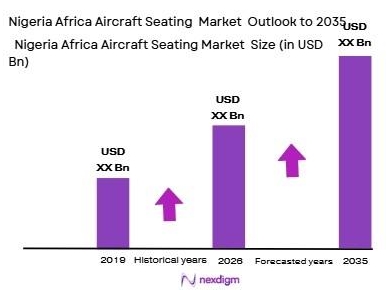
The Nigeria Africa Aircraft Seating market is valued at approximately USD ~million in 2024, driven by Nigeria’s expanding aviation sector and increasing demand for air travel within Africa. The growing number of commercial airlines and government initiatives aimed at improving the aviation infrastructure are major factors driving market demand. In 2024, Nigeria’s air traffic is expected to continue its upward trajectory, supported by rising business travel, tourism, and economic growth, which increases demand for modern and comfortable seating options on both domestic and international flights
Nigeria, with its strategic location in West Africa, remains a dominant player in the aircraft seating market. Cities like Lagos, Abuja, and Kano are central hubs for both domestic and international air travel in the region. Lagos, in particular, serves as a primary gateway for international flights, including intercontinental flights to Europe and the Middle East. The country’s government support for infrastructure development, combined with the growing middle class and tourism industry, positions Nigeria as the leader in aircraft seating demand within Africa.
Market Segmentation
By System Type
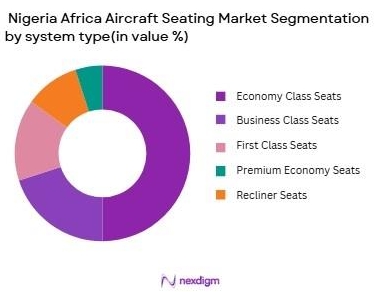
The Nigeria Africa Aircraft Seating market is segmented by system type into economy class seats, business class seats, first class seats, premium economy seats, and recliner seats. Economy class seats dominate the market due to the high demand for affordable seating solutions in both regional and international flights. As the most widely used seating type, economy class seats are essential for accommodating the large number of passengers, particularly on short-haul flights within Africa. This demand is further driven by the growing number of low-cost carriers in the region, which favor economy class seating to maximize capacity.
By Platform Type
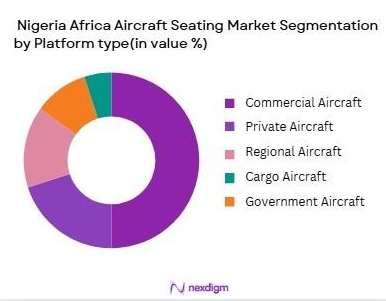
The market is also segmented by platform type into commercial aircraft, private aircraft, regional aircraft, cargo aircraft, and government aircraft. Commercial aircraft seats dominate the market due to Nigeria’s growing commercial aviation sector. Lagos, Abuja, and other regional hubs are seeing an increasing number of commercial flights, both within Africa and internationally. This trend is contributing to the demand for commercial aircraft seating, especially in light of a growing tourism industry and business travel across the continent. The increasing fleet size of African airlines and the rise of low-cost carriers also drive demand for seating in commercial
Competitive Landscape
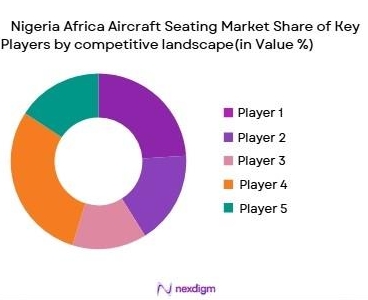
The Nigeria Africa Aircraft Seating market is highly competitive, with both global and regional players striving for market share. International companies such as Recaro Aircraft Seating, B/E Aerospace, and Zodiac Aerospace lead the market, while regional players are gaining ground due to their ability to offer customized solutions suited to African airlines. As a result, there is a strong focus on providing cost-effective and lightweight seating solutions that meet the specific demands of Nigerian airlines and their passengers.
Competitive Landscape Table
| Company Name | Establishment Year | Headquarters | Focus Area | Market Segment | Product Innovation | Strategic Initiatives |
| Recaro Aircraft Seating | 1906 | Germany | ~ | ~ | ~ | ~ |
| B/E Aerospace | 1954 | USA | ~ | ~ | ~ | ~ |
| Zodiac Aerospace | 1896 | France | ~ | ~ | ~ | ~ |
| Geven | 1952 | Italy | ~ | ~ | ~ | ~ |
| Aciturri Aeronáutica | 1993 | Spain | ~ | ~ | ~ | ~ |
Market Analysis
Growth Drivers
Urbanization
Urbanization plays a critical role in driving the air quality monitoring system market in Indonesia. As of 2024, Indonesia’s urban population is projected to surpass ~, with cities like Jakarta, Surabaya, and Bandung experiencing rapid population growth. This urbanization leads to increased vehicular emissions, industrialization, and construction activities, all contributing to deteriorating air quality. The increasing urban population and its associated environmental impact are fueling the demand for air quality monitoring systems to track pollution levels and inform policy decisions.
Industrialization
Industrialization in Indonesia has contributed significantly to air pollution, especially in regions with high manufacturing and energy production, such as East Java and Banten. The Indonesian economy’s industrial sector contributes approximately 40% to GDP in 2024, leading to higher emissions from factories and power plants. This industrial expansion necessitates efficient air quality monitoring systems to meet regulatory standards and reduce environmental impacts. In 2024, Indonesia’s industrial output is forecasted to grow, which will further drive the demand for air quality management solutions.
Restraints
High Initial Costs
The high initial cost of air quality monitoring systems remains a major barrier in Indonesia. While technology has improved, advanced monitoring systems—especially those that offer real-time data and high accuracy—are still costly. The upfront costs associated with deploying and maintaining these systems pose a challenge, especially for smaller businesses and governmental bodies in rural areas. These expenses, including the need for supporting infrastructure, often delay the widespread implementation of air quality monitoring technologies across the country.
Technical Challenges
Indonesia faces significant technical challenges in the deployment of air quality monitoring systems. The country’s diverse geography, which includes tropical forests, high altitudes, and dense urban areas, makes it difficult to ensure consistent and accurate data collection. Additionally, rural regions lack the necessary infrastructure, such as stable electricity and internet connectivity, which hampers the effective deployment of monitoring systems. These challenges impact the reliability and efficiency of monitoring solutions in various parts of the country. [Source: Ministry of Environment and Forestry, Indonesia]
Opportunities
Technological Advancements
Technological advancements in air quality monitoring systems present a significant opportunity for growth in Indonesia. In 2024, the Indonesian government is investing in IoT-enabled sensors and cloud-based data analytics for real-time air quality monitoring. These advancements make monitoring systems more affordable, accurate, and scalable, especially for remote and underdeveloped regions. The increasing availability of cost-effective and efficient monitoring technologies opens up new avenues for wider deployment in various sectors, including industrial, urban, and governmental. [Source: Ministry of Industry, Indonesia]
International Collaborations
International collaborations offer valuable opportunities for Indonesia to enhance its air quality monitoring capabilities. In 2024, Indonesia is involved in collaborations with international organizations such as the United Nations Environment Programme (UNEP) and the World Bank, which provide access to cutting-edge technologies and expertise. These partnerships enable Indonesia to adopt advanced air quality monitoring systems and enhance its regulatory frameworks. As international collaboration continues, the market for air quality monitoring solutions will expand in Indonesia.
Future Outlook
Over the next decade, the Nigeria Africa Aircraft Seating market is expected to experience consistent growth, driven by an increase in air travel demand, especially due to the expanding middle class and rising tourism. Investments in infrastructure, such as the expansion of airports and modernizing regional hubs, will further fuel market growth. The ongoing fleet expansions by both legacy and low-cost carriers in the region will also contribute to a steady increase in the need for both standard and premium seating options. Technological advancements in seating materials and designs, focused on improving comfort and reducing weight, will be key factors in the market’s growth trajectory.
Major Players
- Recaro Aircraft Seating
- B/E Aerospace
- Zodiac Aerospace
- Geven
- Aciturri Aeronáutica
- Thales Group
- Safran
- Panasonic Avionics
- Collins Aerospace
- JAMCO Corporation
- Stelia Aerospace
- HAECO
- Aviointeriors
- Rockwell Collins
- Armstrong Aerospace
Key Target Audience
- Investments and Venture Capitalist Firms
- Government and Regulatory Bodies
- Commercial Airlines
- Private Aviation Operators
- Aircraft Seat Manufacturers
- Aviation Infrastructure Development Agencies
- Airlines and Aircraft Operators
- Regional Aviation Associations
Research Methodology
Step 1: Identification of Key Variables
This phase involves constructing an ecosystem map encompassing all relevant stakeholders within the Nigeria Africa Aircraft Seating market. Desk research and proprietary databases are utilized to gather comprehensive industry-level information. The key objective is to define the critical variables that impact market dynamics, such as consumer demand for different seat types and airline growth rates.
Step 2: Market Analysis and Construction
The market analysis phase focuses on compiling and analyzing historical data related to the aircraft seating market in Nigeria. This involves assessing the ratio of seat types used across different airline segments and evaluating revenue generation from various seating solutions. Historical growth trends in Nigeria’s aviation sector are incorporated into this analysis.
Step 3: Hypothesis Validation and Expert Consultation
In this phase, market hypotheses are validated through expert consultations with representatives from airlines, seating manufacturers, and aviation regulatory bodies. These consultations help refine the market data and validate assumptions regarding seat preferences, material innovations, and growth rates.
Step 4: Research Synthesis and Final Output
The final phase involves synthesizing data gathered from primary and secondary research sources. This step includes direct engagement with key manufacturers and airlines to acquire detailed insights into their seating preferences and the performance of different seat types. The data is then analyzed and presented to provide a comprehensive, accurate market report.

- Executive Summary
- Research Methodology (Definitions, Scope, Industry Assumptions, Market Sizing Approach, Primary & Secondary Research Framework, Data Collection & Verification Protocol, Analytic Models & Forecast Methodology, Limitations & Research Validity Checks)

- Market Definition and Scope
- Value Chain & Stakeholder Ecosystem
- Regulatory / Certification Landscape
- Sector Dynamics Affecting Demand
- Strategic Initiatives & Infrastructure Growth

Nigeria Africa Aircraft Seating Market Dynamics
- Growth Drivers
Increasing demand for air travel in Africa
Growth in regional and international airline fleets
Advancements in seating comfort and customization options - Market Challenges
High cost of premium seating materials
Limited local manufacturing capabilities
Stringent safety and certification regulations - Market Opportunities
Rising focus on eco-friendly and lightweight materials
Growing low-cost carrier market in Africa
Expansion of regional air connectivity - Trends
Shift towards more ergonomic seating designs
Integration of in-flight entertainment systems with seating
Adoption of lighter, sustainable materials for seat manufacturing
- Government regulations
Aviation safety standards compliance
Environmental impact reduction regulations
Aircraft seating certification standards - SWOT analysis
Strength: Strong growth potential in regional aviation
Weakness: Limited local manufacturing capacity
Opportunity: Market for premium seating growing in Nigeria
Threat: Currency fluctuations impacting import costs - Porters 5 forces
Threat of new entrants: Moderate
Bargaining power of suppliers: High
Bargaining power of buyers: Moderate
Threat of substitute products: Low
Industry rivalry: High

- By Market Value 2020-2025
- By Installed Units 2020-2025
- By Average System Price 2020-2025
- By System Complexity Tier 2020-2025

- By System Type (In Value%)
Economy Class Seats
Business Class Seats
First Class Seats
Premium Economy Seats
Recliner Seats - By Platform Type (In Value%)
Commercial Aircraft
Private Aircraft
Regional Aircraft
Cargo Aircraft
Government Aircraft - By Fitment Type (In Value%)
Retrofit Seats
Linefit Seats
Modular Seats
Customizable Seats
Standard Seats - By End-user Segment (In Value%)
Commercial Airlines
Private Operators
Government Agencies
Cargo Airlines
Charter Services - By Procurement Channel (In Value%)
Direct Purchase from Manufacturers
OEMs (Original Equipment Manufacturers)
Distributors and Resellers
Online Platforms
Second-hand Procurement

- Cross Comparison Parameters (System Type, Platform Type, Procurement Channel, Pricing Strategy, Global Reach,)
- SWOT Analysis of Key Competitors
Key Players
Zodiac Aerospace
Recaro Aircraft Seating
B/E Aerospace
SABIC
Aciturri Aeronautical
HAECO
Thompson Aero Seating
Given
Avio interiors
Panasonic Avionics
Collins Aerospace
JAMCO Corporation
Stelia Aerospace
Harris Corporation
Armstrong Aerospace

- Expansion of low-cost carriers in the region
- Increased air travel demand due to economic growth
- Rising adoption of business and first-class seating
- Government investments in regional aviation infrastructure

- Forecast Market Value ,2026-2035
- Forecast Installed Units ,2026-2035
- Price Forecast by System Tier, 2026-2035
- Future Demand by Platform ,2026-2035


 Request a Sample
 Ask for Customization
 Get a Quote
 Enquire Now