
 Download PDF
Market Overview
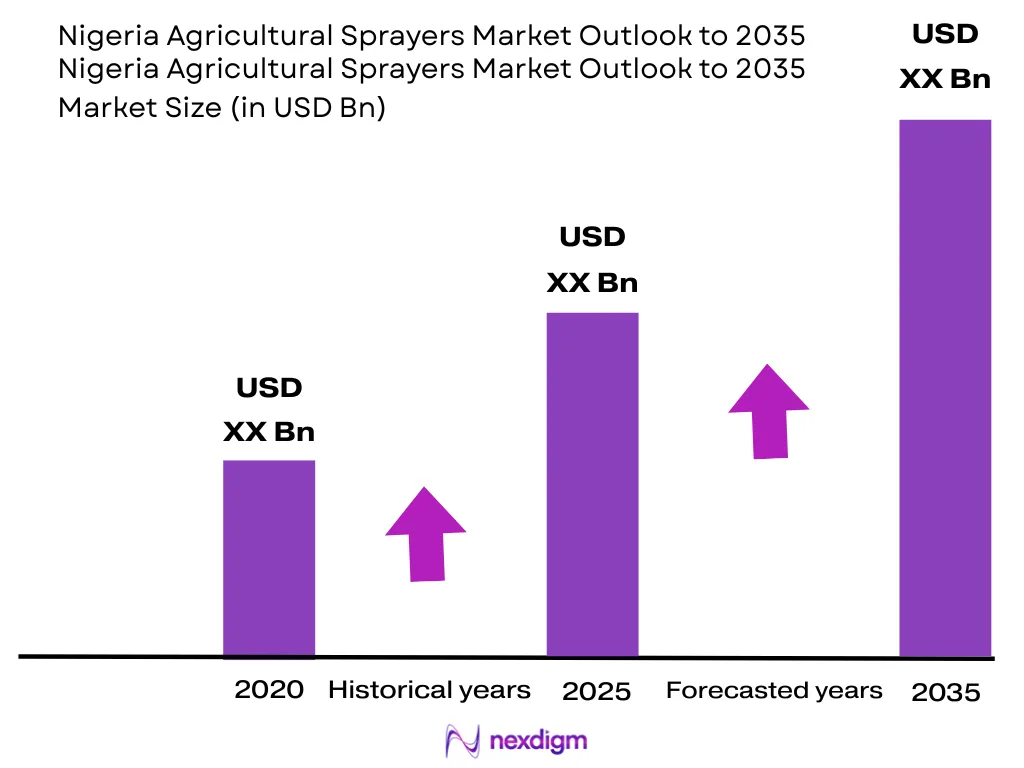
The Nigeria Agricultural Sprayers Market was valued at approximately USD ~ billion in 2024 based on a comprehensive assessment of agricultural machinery sales, crop protection equipment demand, and mechanization trends across major farming regions. The market is primarily driven by Nigeria’s position as one of Africa’s largest producers of rice, maize, cassava, sorghum, and cocoa. According to data published by the National Bureau of Statistics (NBS) and the Federal Ministry of Agriculture and Rural Development (FMARD), national food crop production spans millions of hectares of cultivated land, with planted acreage expanding across commercial and smallholder farming belts. Rising government emphasis on food security, increasing crop protection chemical usage, and greater adoption of mechanized farming practices have accelerated demand for spraying equipment across both large-scale agribusiness operators and smallholder cooperatives.
Market Segmentation
By Sprayer Type
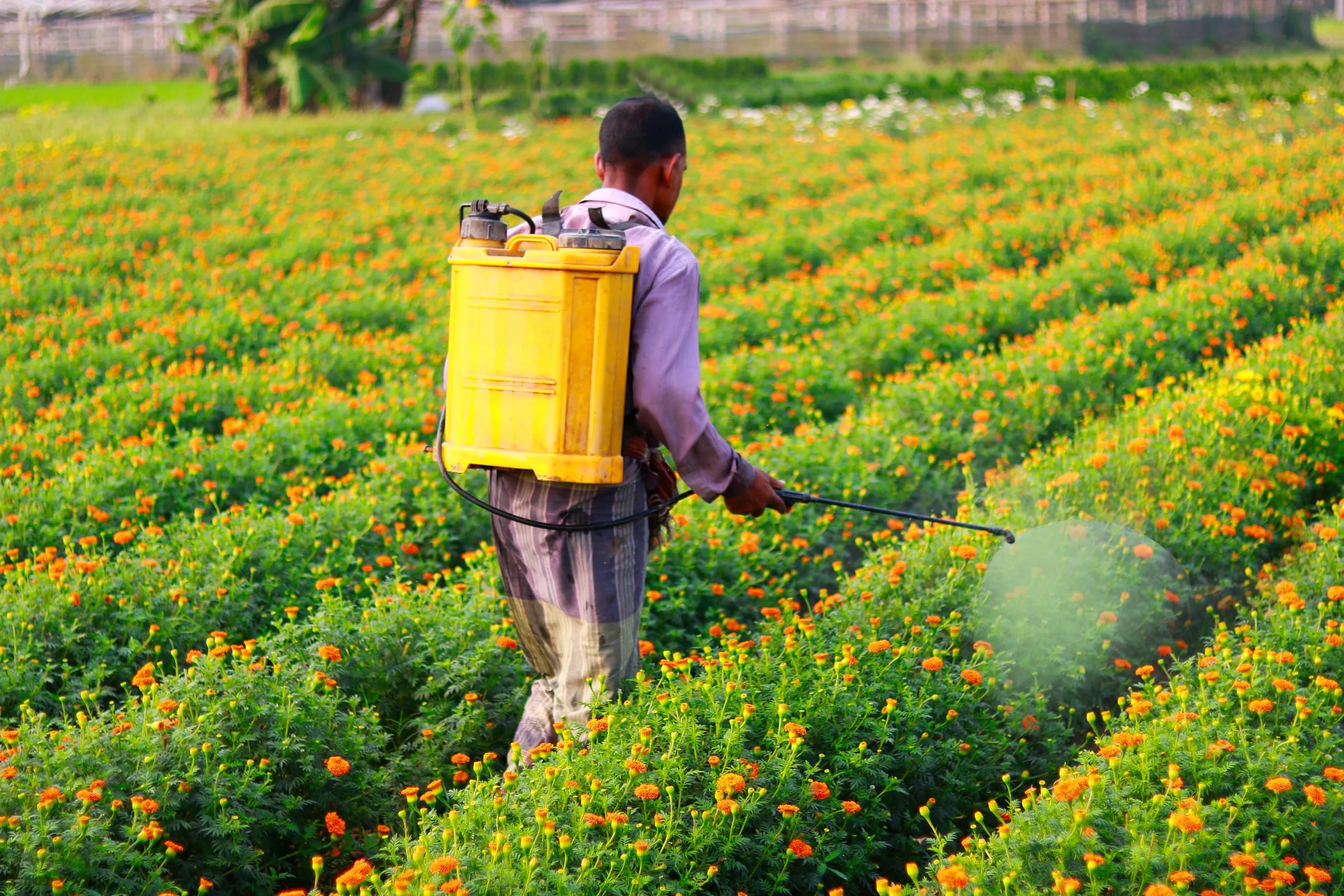
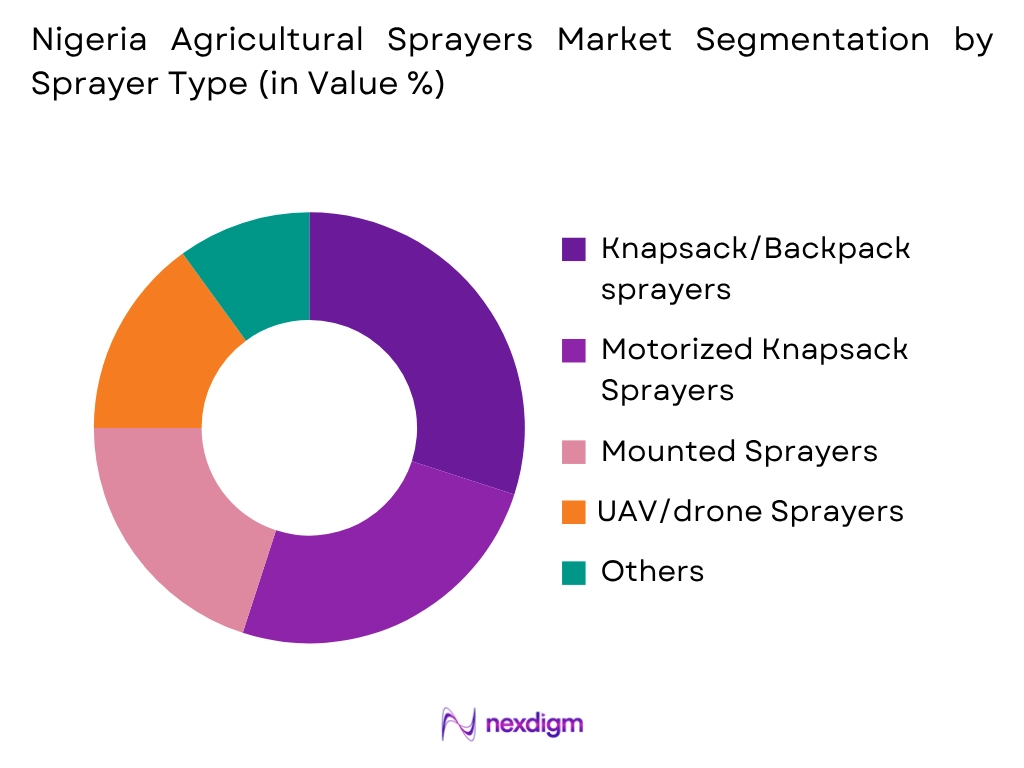
Nigeria Agricultural Sprayers Market is segmented by sprayer type into knapsack/backpack sprayers, motorized knapsack sprayers, mounted sprayers, tractor-mounted boom sprayers, self-propelled sprayers, UAV/drone sprayers, manual hand sprayers, and orchard and garden sprayers. Knapsack and motorized knapsack sprayers dominate the market due to their affordability, ease of operation, portability, and suitability for smallholder farming conditions prevalent across Nigeria. The majority of Nigerian farmers operate small landholdings of less than five hectares, making compact and manually operated sprayers the most practical equipment choice. These sprayers are widely used for pesticide and fertilizer application across a diverse range of food and cash crops, including rice, maize, cassava, vegetables, and cocoa. The accessibility of knapsack sprayers through agro-input dealers, government distribution programs, and rural cooperative networks continues to strengthen their dominance within the market. Growing demand for motorized variants, which improve application efficiency and reduce operator fatigue, is further expanding the segment.
By Crop Type
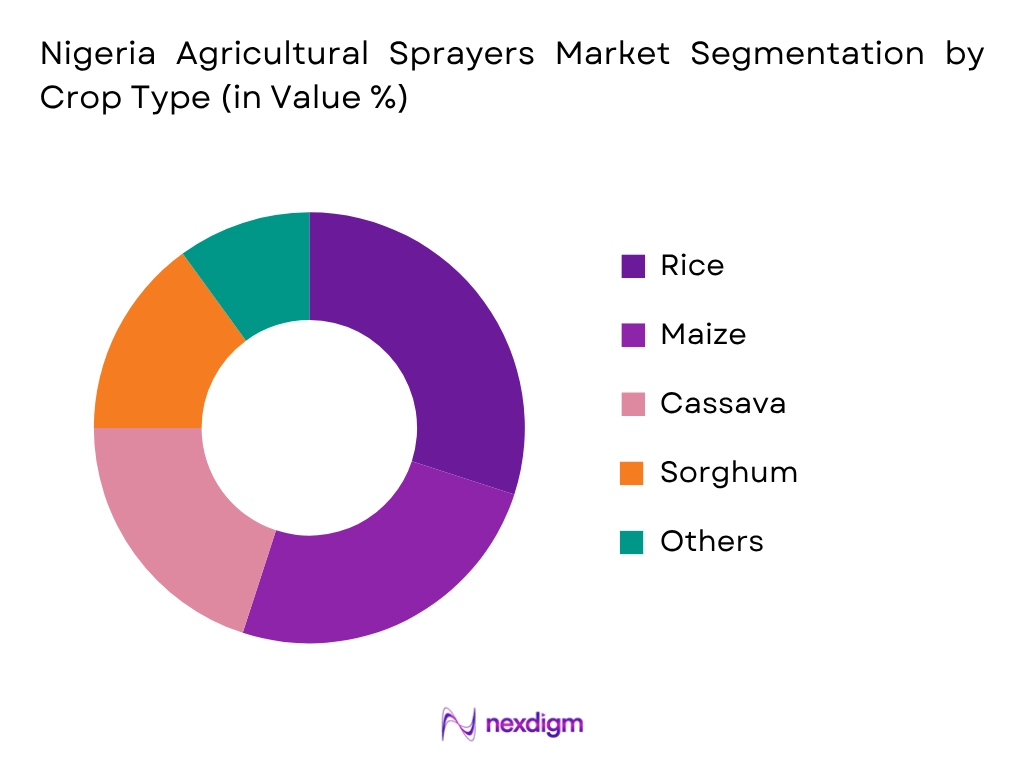
Nigeria Agricultural Sprayers Market is segmented by crop type into rice, maize, cassava, sorghum, cocoa, vegetables and fruits, cotton, and other crops. Rice cultivation accounts for a significant share of sprayer demand owing to Nigeria’s status as one of Africa’s largest rice producers and its substantial import substitution ambitions. Rice cultivation requires multiple spray applications throughout the growing season for weed management, disease control, and insect protection, particularly in irrigated and rain-fed farming systems. The considerable acreage dedicated to rice production across the North West, North Central, and South South zones creates sustained demand for spraying equipment. Additionally, government programs supporting domestic rice production through input subsidies and mechanization initiatives have increased the frequency of crop protection activities. Smallholder and medium-scale rice farmers increasingly rely on sprayers to improve yield performance and manage pest and disease pressure efficiently.
Competitive Landscape
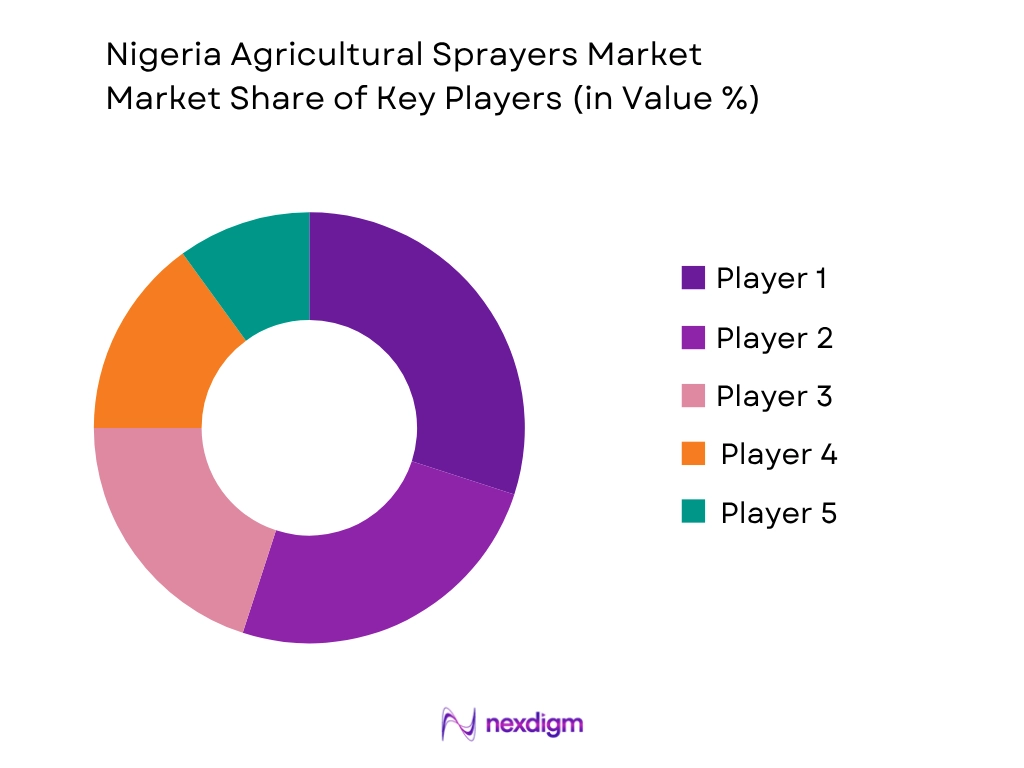
The Nigeria Agricultural Sprayers Market is characterized by the presence of international agricultural equipment distributors, locally established agro-input companies, and government-linked supply programs. The competitive environment is moderately fragmented, with established distributors benefiting from import networks, dealer partnerships, government supply contracts, and after-sales service capabilities. International manufacturers rely on authorized distributors to reach Nigeria’s diverse farming communities, while local agro-input companies leverage their distribution reach and knowledge of smallholder needs to expand market penetration.
| Company | Establishment Year | Headquarters | Product Portfolio | Precision Agriculture Integration
|
Tank Capacity Range | Dealer Network Strength | After-Sales Support | Innovation Capability |
| John Deere Nigeria | 1837 | ~ | ~ | ~ | ~ | ~ | ~ | ~ |
| CNH Industrial (Case IH ) | 2013 | ~ | ~ | ~ | ~ | ~ | ~ | ~ |
| AGCO Corporation (Massey Ferguson ) | 1990 | ~ | ~ | ~ | ~ | ~ | ~ | ~ |
| Hardi Nigeria | 1957 | ~ | ~ | ~ | ~ | ~ | ~ | ~ |
| Dizengoff Nigeria | 1958 | ~ | ~ | ~ | ~ | ~ | ~ | ~ |
Nigeria Agricultural Sprayers Market Analysis
Growth Drivers
Expansion of Food Crop Production and Government Agricultural Programs
Nigeria’s agricultural sprayers market is strongly supported by the country’s expanding food crop production and government-driven mechanization initiatives aimed at improving food security and reducing import dependency. According to the National Bureau of Statistics, Nigeria’s agricultural sector contributes significantly to GDP, with crop production spanning tens of millions of hectares across diverse agro-ecological zones. Major crops including rice, maize, sorghum, cassava, and cocoa require regular crop protection interventions to manage pest, disease, and weed pressure. The North West and North Central regions account for a large concentration of grain and legume farming activities, while the South South and South East zones support cocoa, oil palm, and vegetable cultivation. Government programs such as the Agricultural Transformation Agenda, Anchor Borrowers’ Programme, and the Presidential Initiative on Fertilizer and Agricultural Input Supply have provided critical support for input access and mechanization investment. These initiatives create structured demand channels for spraying equipment, particularly among smallholder cooperatives and state-level agricultural development projects. The broad scope of crop production activities and policy-driven agricultural modernization efforts remain fundamental demand drivers for the Nigeria Agricultural Sprayers Market.
Increasing Government Support for Agricultural Mechanization
Access to government-supported mechanization programs and agricultural financing continues to accelerate the adoption of sprayers across Nigeria. The Anchor Borrowers’ Programme, managed by the Central Bank of Nigeria, has disbursed billions of naira to smallholder farmers to support input acquisition, including crop protection equipment and mechanized spraying tools. The Federal Ministry of Agriculture and Rural Development has also implemented targeted programs providing subsidized agricultural equipment to state governments, farming cooperatives, and youth agricultural enterprises. Agricultural Development Projects (ADPs) operating across Nigeria’s states have historically served as important distribution channels for spraying equipment, connecting farmers with affordable tools and agronomic advisory support. Growing private sector involvement through agro-input dealers, cooperative networks, and mobile input delivery platforms is also improving equipment accessibility in rural areas. The combined effect of government-backed distribution channels, subsidized financing, and expanding input retail networks is strengthening smallholder farmers’ capacity to invest in spraying equipment and improve crop protection practices.
Market Challenges
Low Mechanization Index and Dominance of Manual Farming Practices
The agricultural sprayers market in Nigeria faces structural challenges related to the country’s persistently low mechanization index compared with global averages. A large proportion of Nigeria’s farming population relies on manual labor and traditional farming tools, limiting the adoption of mechanical and motorized spraying equipment. According to the Food and Agriculture Organization and Federal Ministry of Agriculture assessments, Nigeria’s mechanization level remains significantly below the thresholds observed in comparable agricultural economies. Most smallholder farmers operate fragmented landholdings of less than five hectares, which reduces the economic justification for investing in advanced or motorized spraying equipment. Additionally, poor rural infrastructure including limited road networks, irregular electricity supply, and inadequate irrigation systems constrains operational efficiency and equipment utilization. The absence of a well-developed agricultural machinery servicing ecosystem further discourages equipment investment among smallholder operators. These structural barriers restrict broader market expansion and limit adoption of even basic motorized sprayers among a significant portion of the farming population.
Limited Access to Agricultural Finance and High Equipment Costs
Despite government financing initiatives, access to affordable agricultural credit remains a significant challenge for the majority of Nigerian farmers seeking to invest in spraying equipment. High interest rates, collateral requirements, and complex loan processing procedures limit smallholder farmers’ ability to access formal financial products. While programs such as the Anchor Borrowers’ Programme have reached a significant number of beneficiaries, coverage gaps remain across many farming communities. Imported sprayers and motorized equipment often carry prices that exceed the purchasing capacity of smallholder and medium-scale operators without dedicated financing support. Currency depreciation and rising import costs have further increased equipment prices in the local market, constraining affordability. Farmers who rely on informal credit sources such as cooperative savings groups or trader credit face additional financial risks associated with high repayment costs and limited loan amounts. The combination of high equipment costs, limited formal finance access, and currency-related price pressures continues to create a significant barrier to broader sprayer adoption among Nigeria’s smallholder farming majority.
Market Opportunities
Growing Demand for Affordable Mechanization and Drone Spraying Solutions
Nigeria’s agricultural sector presents significant opportunities for manufacturers and distributors of affordable mechanized and technology-enabled spraying solutions. The federal government’s commitment to achieving food self-sufficiency and reducing agricultural import dependency has intensified focus on productivity improvement through input efficiency and mechanization adoption. Expanding rice, maize, and vegetable cultivation acreage across irrigated and rain-fed systems is creating sustained demand for reliable and cost-effective spraying equipment. UAV/drone sprayers represent a particularly high-growth opportunity in Nigeria, given their ability to cover large areas efficiently and reduce labor dependency in areas with access challenges. Programs linking drone spraying services to smallholder cooperatives through service provider models are beginning to emerge, offering accessible spraying solutions without requiring individual equipment ownership. Additionally, the growing youth agribusiness movement supported by government schemes such as AGSMEIS and N-Power Agro is creating new operator segments interested in mechanized spraying as an income-generating activity. These dynamics present significant market expansion opportunities for equipment suppliers capable of delivering affordable, durable, and locally serviceable spraying solutions.
Expansion of Agro-Input Distribution Networks and E-Commerce Platforms
Nigeria’s rapidly expanding agro-input retail ecosystem and growing mobile commerce infrastructure are creating new distribution opportunities for spraying equipment suppliers. Agricultural input retailers, cooperative networks, and mobile agri-commerce platforms are increasingly extending their product offerings to include spraying equipment, replacement parts, and maintenance services. The proliferation of mobile phone penetration and digital payment systems is enabling online procurement of agricultural equipment among farmers in semi-urban and peri-urban areas. Platforms linking farmers to equipment suppliers, service providers, and agronomic advisors are improving market access beyond traditional dealer-based distribution channels. Growing private sector investment in agricultural supply chains supported by development finance institutions and impact investors is further strengthening distribution infrastructure across Nigeria’s major agricultural zones. Opportunities exist for manufacturers to develop localized product configurations suited to smallholder farming conditions, including lightweight motorized sprayers, solar-powered equipment, and service-linked financing arrangements. Suppliers able to combine product affordability with reliable after-sales support and extended distribution reach are well positioned to capture growing market demand.
Future Outlook
The Nigeria Agricultural Sprayers Market is expected to experience sustained growth over the forecast period supported by rising food production requirements, increasing government mechanization investments, and growing awareness of crop protection practices among farming communities. Demand for both affordable smallholder-oriented spraying equipment and technologically advanced solutions is anticipated to expand as the farming sector modernizes. Innovations including drone-based spraying services, solar-powered sprayers, mobile-linked application advisory tools, and cooperative equipment sharing models are expected to reshape market dynamics. Continued government commitment to agricultural transformation and growing private sector engagement in input supply chains are likely to strengthen equipment adoption across Nigeria’s diverse agro-ecological zones.
Major Players
- John Deere
- Dizengoff Nigeria
- AGCO Corporation (Massey Ferguson)
- CNH Industrial (Case IH & New Holland)
- Hardi International
- Kuhn Group
- Buhler Industries
- DJI Agriculture
- Farmklass Nigeria
- Saro Agrosciences
- Premier Agri Tools
- Agromate Nigeria
- AFEX Commodities Exchange
- Gossy Warm Spring Farms
- TechnoServe Nigeria
Key Target Audience
- Agricultural Equipment Manufacturers
- Agricultural Machinery Distributors and Dealers
- Large Commercial Farming Enterprises
- Smallholder Farmer Cooperatives and Associations
- Crop Protection Chemical Manufacturers
- Investments and Venture Capitalist Firms
- Government and Regulatory Bodies (FMARD – Federal Ministry of Agriculture and Rural Development, NAQS, CBN, NAFDAC)
- Agricultural Equipment Rental and Leasing Companies
Research Methodology
Step 1: Identification of Key Variables
The initial phase involves constructing an ecosystem map encompassing all major stakeholders within the Nigeria Agricultural Sprayers Market. This process includes extensive secondary research through industry publications, government agricultural databases, manufacturer reports, trade associations, and agricultural machinery statistics. The objective is to identify critical market variables including equipment demand, crop acreage, mechanization rates, technology adoption, and purchasing behavior.
Step 2: Market Analysis and Construction
Historical market data relating to agricultural machinery sales, crop production trends, farm equipment penetration, and spraying technology adoption are collected and analyzed. Demand-side assessment focuses on farm-level purchasing patterns and crop protection requirements, while supply-side analysis evaluates manufacturer revenues, dealer sales, production capacities, and distribution networks. Both approaches contribute to market size estimation and forecasting.
Step 3: Hypothesis Validation and Expert Consultation
Preliminary market findings and assumptions are validated through structured interviews with industry participants including agricultural equipment manufacturers, distributors, farm operators, agronomists, extension service officers, and industry associations. These consultations provide practical insights regarding market trends, technological developments, operational challenges, and future demand outlook, thereby strengthening the reliability of the research findings.
Step 4: Research Synthesis and Final Output
The final stage involves triangulating information collected from primary interviews, secondary research sources, and proprietary databases. Market estimates are refined through cross-verification across multiple data points and stakeholder perspectives. Forecast models are developed using agricultural production outlooks, mechanization trends, technology adoption rates, and investment patterns to generate comprehensive and reliable market intelligence.

- Executive Summary
- Research Methodology (Market Definitions and Assumptions, Abbreviations, Market Sizing Approach, Top-Down Analysis, Bottom-Up Analysis, Demand-Side Assessment, Supply-Side Assessment, Primary Industry Interviews, Distributor and Dealer Validation, Farm-Level Survey Assessment, Data Triangulation, Forecasting Framework, Limitations and Future Conclusions)

- Definition and Scope
- Industry Evolution and Market Genesis
- Timeline of Technological Advancements in Agricultural Spraying
- Agricultural Equipment Value Chain Analysis
- Agricultural Sprayer Supply Chain Analysis

- Growth Drivers (Expansion of Arable Farming Land, Growth in Crop Protection Chemical Usage, Rising Mechanization Rate, Government Agricultural Modernization Programs, Increasing Smallholder Farmer Support Initiatives)
- Market Challenges (Low Mechanization Index, Limited Access to Finance, Skilled Operator Shortages, Poor Rural Infrastructure, Counterfeit and Low-Quality Equipment)
- Market Opportunities (Drone Sprayer Penetration, Biological Crop Input Application, Government-Backed Mechanization Programs, Smallholder Cooperative Equipment Access, Sustainable Farming Practices)
- Market Trends (Solar-Powered Sprayers, Motorized Knapsack Upgrades, Mobile-Linked Advisory Services, Extension Service-Driven Adoption, Low-Drift Nozzle Adoption)
- Government Regulations (Federal Ministry of Agriculture Standards, NAQS Pesticide Regulations, SON Equipment Standards, Environmental Compliance, Agricultural Transformation Agenda Programs)
- SWOT Analysis
- PESTLE Analysis
- Stakeholder Ecosystem
- Porter’s Five Forces Analysis
- Competition Ecosystem

- By Market Value (2020-2025)
- By Units Sold (2020-2025)
- By Average Selling Price (2020-2025)

- By Sprayer Type (In Value %)
Knapsack/Backpack Sprayers
Motorized Knapsack Sprayers
Mounted Sprayers
Tractor-Mounted Boom Sprayers
Self-Propelled Sprayers
UAV/Drone Sprayers
Manual Hand Sprayers
Orchard and Garden Sprayers - By Application (In Value %)
Herbicide Application
Fungicide Application
Insecticide Application
Foliar Fertilizer Application
Biological Inputs Application - By Crop Type (In Value %)
Rice
Maize
Cassava
Sorghum
Cocoa
Vegetables and Fruits
Cotton
Other Crops - By Distribution Channel (In Value %)
Agricultural Input Retailers
OEM Direct Sales
Agricultural Equipment Dealers
Government Distribution Programs
Online Agricultural Platforms - By Region (In Value %)
North West (Kano, Kaduna, Katsina)
North Central (Benue, Niger, Plateau)
South West (Oyo, Ogun, Osun)
South South (Rivers, Cross River, Akwa Ibom)
North East (Adamawa, Borno, Gombe)
South East (Anambra, Enugu, Imo)

- Market Share of Major Players (By Value, Units Sold, Sprayer Type, Crop Segment, Region)
- Cross Comparison Parameters (Boom Width Portfolio, Tank Capacity Range, Field Coverage Efficiency (ha/hr), Precision Spraying Capability, Variable Rate Application Integration, Dealer Network Strength, After-Sales Service Reach, Spray Drift Reduction Technology)
- Competitive Positioning Matrix (Technology Leadership, Pricing Competitiveness, Brand Recognition, Regional Presence)
- SWOT Analysis of Major Players
- Pricing Analysis by Sprayer Category and Capacity
- Detailed Profiles of Major Companies
John Deere
Dizengoff Nigeria
AGCO Corporation (Massey Ferguson)
CNH Industrial (Case IH & New Holland)
Hardi International
Kuhn Group
Buhler Industries
DJI Agriculture
Farmklass Nigeria
AFEX Commodities Exchange
Saro Agrosciences
Premier Agri Tools
Agromate Nigeria
Gossy Warm Spring Farms
TechnoServe Nigeria

- Farm Equipment Ownership and Utilization Analysis (Hours of Operation, Spraying Frequency, Fleet Age, Seasonal Utilization Rate)
- Farm Mechanization Assessment (Mechanization Index, Equipment Density per Hectare, Technology Adoption Rate)
- Purchasing Power and Investment Capacity Analysis (Farm Income, Access to Rural Credit, ROI Expectations, Capital Expenditure Trends)
- Crop Protection Spending Analysis (Chemical Input Spend, Application Cost per Hectare, Spray Frequency by Crop)
- Farmer Needs and Pain Point Assessment (Labor Availability, Input Efficiency, Downtime Reduction, Coverage Accuracy, Fuel Consumption)

- By Market Value (2026-2035)
- By Units Sold (2026-2035)
- By Average Selling Price (2026-2035)


 Request a Sample
 Ask for Customization
 Get a Quote
 Enquire Now