

 Download PDF
 Download PDF
Market Overview
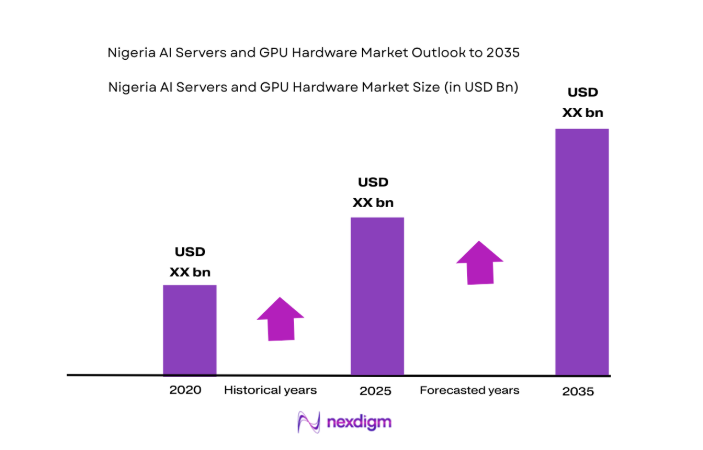
Nigeria’s AI servers and GPU hardware market reached approximately USD ~ million based on a recent historical assessment, driven by accelerated investments in hyperscale data centers, telecom AI infrastructure, and enterprise digital transformation platforms. Demand expansion is supported by rapid cloud adoption, financial sector analytics deployment, and government-backed sovereign data infrastructure programs. Import-based procurement of GPU accelerators and high-performance AI servers by colocation operators and telecom providers continues to anchor national compute capacity expansion and hardware modernization.
Lagos and Abuja dominate Nigeria’s AI servers and GPU hardware deployments due to concentration of data centers, telecom switching infrastructure, and financial technology ecosystems requiring advanced compute. Lagos hosts major carrier-neutral facilities and submarine cable landings enabling AI cloud infrastructure density, while Abuja’s government digitalization and cybersecurity programs drive sovereign AI hardware installations. Additional growth clusters are emerging in Port Harcourt energy operations and Ogun industrial zones where industrial AI analytics and automation workloads are expanding.
Market Segmentation
By Product Type
Nigeria AI Servers and GPU Hardware market is segmented by product type into AI GPU Training Servers, AI Inference Servers, High Density Accelerated Compute Clusters, Edge AI Servers, and AI Storage Optimized Servers. Recently, AI GPU Training Servers has a dominant market share due to factors such as demand patterns, brand presence, infrastructure availability, or consumer preference.
By Platform Type
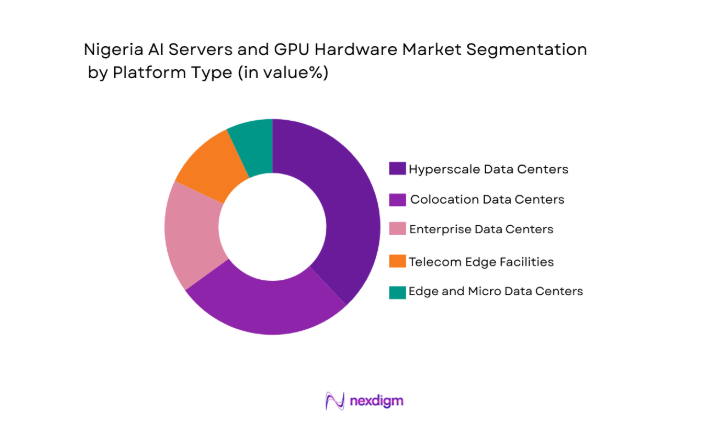
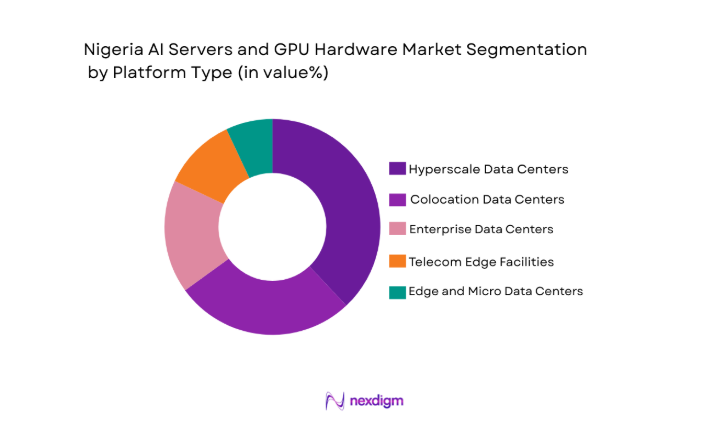
Nigeria AI Servers and GPU Hardware market is segmented by platform type into Hyperscale Data Centers, Colocation Data Centers, Enterprise On Premise Facilities, Edge and Micro Data Centers, and Telecom Network Facilities. Recently, Hyperscale Data Centers has a dominant market share due to factors such as demand patterns, brand presence, infrastructure availability, or consumer preference.
Competitive Landscape
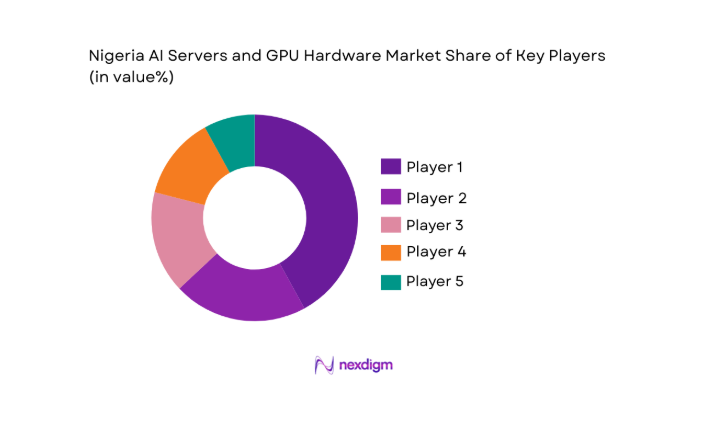
Nigeria’s AI servers and GPU hardware market exhibits moderate consolidation with global OEMs and accelerator vendors supplying core hardware while domestic data center operators and integrators control deployment and procurement channels. International suppliers dominate GPU technology and high-density AI server platforms, whereas Nigerian colocation providers and sovereign cloud operators shape infrastructure rollouts. Partnerships between global hardware manufacturers and local telecom or data center firms strongly influence purchasing cycles and platform standardization.
| Company Name | Establishment Year | Headquarters | Technology Focus | Market Reach | Key Products | Revenue | Nigeria Presence |
| Dell Technologies | 1984 | USA | ~ | ~ | ~ | ~ | ~ |
| Hewlett Packard Enterprise | 2015 | USA | ~ | ~ | ~ | ~ | ~ |
| Lenovo | 1984 | China | ~ | ~ | ~ | ~ | ~ |
| NVIDIA | 1993 | USA | ~ | ~ | ~ | ~ | ~ |
| Huawei | 1987 | China | ~ | ~ | ~ | ~ | ~ |
Nigeria AI Servers And GPU Hardware Market Analysis
Growth Drivers
Expansion of Hyperscale and Sovereign AI Data Center Infrastructure
Nigeria’s accelerated construction of carrier-neutral and sovereign cloud data centers is driving large-scale procurement of GPU-accelerated AI servers and high-performance compute clusters across Lagos and Abuja technology corridors. Hyperscale facilities require dense GPU training infrastructure to support cloud AI services, fintech analytics, and national data localization requirements, creating sustained hardware demand for training-optimized servers and accelerated storage systems. Telecom operators and cloud providers are co-investing in AI-ready facilities to enable low-latency AI services, content delivery optimization, and digital platform scaling across West Africa. Government digital sovereignty initiatives are also mandating domestic processing of sensitive data, leading to deployment of sovereign AI compute clusters within national borders and increasing procurement volumes of advanced GPU hardware platforms. Financial institutions and fintech platforms are expanding AI-driven fraud detection, risk modeling, and transaction analytics workloads that rely on high-performance GPU training environments, further reinforcing hyperscale infrastructure demand. Energy sector digitalization, particularly in oil and gas analytics and predictive maintenance, is increasing requirement for accelerated compute clusters within industrial data centers. As data generation from telecom networks, mobile services, and IoT systems rises, hyperscale and sovereign facilities must expand AI training capacity, sustaining long-term growth in AI server hardware deployment. Partnerships between global server OEMs and Nigerian data center operators are lowering deployment barriers and enabling standardized AI hardware architectures nationwide. Continuous expansion of submarine cable connectivity and inter-metro fiber networks is improving data center economics and enabling large-scale GPU cluster installations across major Nigerian digital hubs.
Enterprise and Telecom Adoption of AI Analytics and Edge Compute
Nigerian enterprises and telecom operators are rapidly integrating AI-driven analytics, automation, and network intelligence platforms, which is significantly increasing demand for inference-optimized GPU servers and edge AI hardware deployments across distributed infrastructure environments. Telecom providers are deploying AI servers within network facilities to enable real-time traffic optimization, predictive maintenance, and customer behavior analytics, creating sustained demand for compact and ruggedized GPU inference platforms at edge sites. Financial institutions are scaling AI workloads for credit scoring, fraud detection, and algorithmic trading analytics, requiring both centralized training clusters and distributed inference hardware across branch and transaction processing systems. Retail and digital commerce firms are deploying recommendation engines and consumer analytics platforms that rely on GPU inference acceleration to deliver personalized services at scale. Government smart city and surveillance programs are expanding deployment of edge AI servers for video analytics, public safety monitoring, and urban management systems across metropolitan regions. Industrial enterprises in energy, manufacturing, and logistics are adopting AI-enabled automation and predictive analytics solutions that require localized GPU compute at operational sites. Cloud service providers are offering AI platform services to enterprises, driving backend procurement of GPU inference infrastructure to support customer workloads nationwide. The proliferation of IoT devices and connected infrastructure is increasing real-time data processing needs, reinforcing distributed AI hardware deployment across telecom and enterprise networks. Local system integrators are packaging AI hardware with software analytics solutions, accelerating enterprise adoption and expanding national AI server penetration.
Market Challenges
High Cost and Import Dependency of Advanced GPU Hardware Platforms
Nigeria’s AI servers and GPU hardware market faces significant constraints due to reliance on imported accelerators, high-density servers, and advanced cooling infrastructure that expose buyers to foreign exchange volatility and elevated acquisition costs. Most AI GPU platforms are sourced from global OEMs, and currency fluctuations directly increase procurement budgets for data center operators, enterprises, and telecom providers investing in AI infrastructure. Import duties, logistics costs, and limited local assembly capabilities further inflate total cost of ownership for AI server deployments across the country. Supply chain disruptions and global shortages of high-end GPUs periodically delay infrastructure expansion plans and limit availability of training-grade accelerators for hyperscale facilities. High capital expenditure requirements restrict smaller enterprises from adopting AI hardware, slowing market penetration beyond large telecom and financial sectors. Financing constraints and limited hardware leasing ecosystems reduce affordability of GPU clusters for emerging digital firms and industrial adopters. Advanced cooling technologies such as liquid or immersion cooling are also imported, increasing deployment costs for high-density AI compute facilities in Nigeria’s climate conditions. Maintenance and spare part dependencies on foreign vendors raise lifecycle costs and operational risks for AI infrastructure owners. The absence of domestic semiconductor or accelerator manufacturing capabilities perpetuates structural import dependence and cost vulnerability across the Nigerian AI hardware market.
Power Reliability and Technical Skill Constraints in AI Infrastructure Deployment
Nigeria’s AI servers and GPU hardware expansion is constrained by power instability, cooling challenges, and limited availability of specialized technical expertise required to deploy and maintain high-performance AI compute environments across data centers and enterprise facilities. GPU clusters and accelerated servers require uninterrupted power and advanced thermal management, yet grid reliability issues increase reliance on backup generation and raise operational costs for AI infrastructure operators. High ambient temperatures in many regions necessitate sophisticated cooling systems, increasing capital and energy consumption for data center deployments supporting AI workloads. Skilled engineers capable of designing, installing, and optimizing GPU clusters and AI servers remain scarce locally, creating dependence on foreign technical support and vendor-led deployment models. Training gaps in AI hardware architecture, interconnect optimization, and cluster orchestration slow efficient infrastructure utilization across enterprises and telecom operators. Maintenance complexity of high-density GPU systems increases downtime risks when specialized expertise is unavailable within local operations teams. Data center operators must invest heavily in workforce training and international partnerships to sustain AI infrastructure performance and reliability. Regional disparities in technical workforce availability limit AI hardware deployment beyond major urban centers such as Lagos and Abuja. Without sustained technical capacity development and infrastructure reliability improvements, scaling AI server deployments nationwide remains structurally challenging.
Opportunities
Expansion of Sovereign AI Cloud and National Compute Infrastructure Programs
Nigeria’s push toward digital sovereignty and domestic data processing presents a major opportunity for large-scale deployment of national AI cloud infrastructure and sovereign GPU compute clusters across government and strategic sectors. Public sector digitalization programs require domestic AI processing capacity for cybersecurity, surveillance, and national analytics platforms, driving procurement of high-performance AI servers within sovereign facilities. Government-backed cloud platforms for healthcare, finance, and citizen services will require scalable GPU infrastructure to support AI-enabled applications nationwide. Localization mandates for sensitive data processing encourage domestic installation of training clusters rather than reliance on foreign cloud providers, increasing national hardware demand. Strategic partnerships between government agencies, telecom operators, and data center providers can accelerate sovereign AI compute expansion across multiple regions. National research and innovation programs in artificial intelligence and advanced analytics will require high-performance computing infrastructure, creating demand for GPU clusters in academic and research environments. Defense and security modernization initiatives also depend on AI compute platforms for intelligence analysis and autonomous systems development. Domestic AI cloud ecosystems can attract regional digital services workloads from West Africa, further increasing infrastructure deployment. Policy support and investment incentives for sovereign compute infrastructure can stimulate long-term growth in Nigeria’s AI servers and GPU hardware market.
Growth of Edge AI Infrastructure Across Telecom, Smart Cities, and Industrial Sectors
Nigeria’s rapid urbanization, telecom network expansion, and industrial digitalization create strong opportunities for distributed edge AI server deployments supporting real-time analytics, automation, and connected infrastructure applications nationwide. Telecom operators are expanding 5G and fiber networks that enable low-latency AI services, requiring GPU inference hardware at edge network nodes and regional data centers. Smart city programs in major urban areas are deploying AI-enabled surveillance, traffic management, and public safety systems that depend on localized compute platforms. Industrial operations in energy, manufacturing, and logistics sectors are adopting edge AI for predictive maintenance, asset monitoring, and automation analytics requiring ruggedized GPU servers near operational sites. Ports, transportation hubs, and industrial corridors are emerging as edge AI infrastructure clusters supporting logistics optimization and security analytics workloads. Retail and financial service providers are deploying edge AI for customer analytics, fraud detection, and real-time transaction processing across distributed locations. Edge compute reduces latency and bandwidth costs for AI applications in bandwidth-constrained environments, encouraging hardware deployment outside central data centers. Local integrators are developing packaged edge AI solutions combining hardware and analytics software tailored to Nigerian industry needs. As connected devices and IoT systems proliferate, distributed AI server infrastructure will expand significantly across telecom and industrial networks.
Future Outlook
Nigeria’s AI servers and GPU hardware market is expected to expand steadily as hyperscale data centers, sovereign cloud initiatives, and enterprise AI adoption accelerate nationwide. Continued telecom AI deployment, fintech analytics growth, and smart infrastructure programs will sustain demand for GPU-accelerated compute. Advancements in liquid-cooled high-density servers and modular data centers will improve deployment efficiency. Policy support for local data processing and digital economy expansion will further strengthen national AI hardware investments.
Major Players
- Dell Technologies
- Hewlett Packard Enterprise
- Lenovo
- NVIDIA
- Huawei
- Supermicro
- AMD
- Cisco Systems
- IBM
- Inspur
- Oracle
- Rack Centre
- MDXi
- Galaxy Backbone
- Zinox Technologies
Key Target Audience
- Telecom network operators
- Cloud service providers
- Data center operators
- Financial institutions
- Energy and industrial enterprises
- Investments and venture capitalist firms
- Government and regulatory bodies
- Technology infrastructure distributors
Research Methodology
Step 1: Identification of Key Variables
Key demand drivers, infrastructure investments, GPU deployment volumes, and end-user adoption patterns were identified through secondary sources and industry datasets. Hardware categories, platform types, and procurement structures were defined to establish segmentation baselines for Nigeria’s AI servers and GPU hardware ecosystem.
Step 2: Market Analysis and Construction
Supply-side shipment data, import statistics, and data center capacity expansions were integrated to estimate national AI server and GPU hardware deployment values. Market structure was constructed by mapping hyperscale, telecom, enterprise, and sovereign infrastructure demand across major Nigerian technology clusters.
Step 3: Hypothesis Validation and Expert Consultation
Preliminary market assumptions were validated through consultations with data center operators, telecom infrastructure specialists, and AI hardware integrators active in Nigeria. Expert inputs refined segmentation shares, deployment trends, and infrastructure adoption drivers across sectors and regions.
Step 4: Research Synthesis and Final Output
All quantitative and qualitative insights were synthesized into a structured market framework covering segmentation, competitive dynamics, growth factors, and deployment outlook. Final estimates were cross-checked against infrastructure investment patterns and hardware procurement cycles to ensure consistency and accuracy.

- Executive Summary
- Research Methodology (Definitions, Scope, Industry Assumptions, Market Sizing Approach, Primary & Secondary Research Framework, Data Collection & Verification Protocol, Analytic Models & Forecast Methodology, Limitations & Research Validity Checks)

- Market Definition and Scope
- Value Chain & Stakeholder Ecosystem
- Regulatory / Certification Landscape
- Sector Dynamics Affecting Demand
- Strategic Initiatives & Infrastructure Growth

- Growth Drivers
Expansion of AI enabled digital services and cloud adoption across Nigeria
Rising hyperscale and colocation data center investments in Lagos and Abuja
Growing enterprise demand for AI analytics in finance telecom and energy
Government digital economy and local data infrastructure initiatives
Increased adoption of AI driven automation and cybersecurity systems - Market Challenges
High capital cost of GPU servers and accelerated infrastructure
Power reliability and cooling constraints in data center operations
Limited local technical expertise in AI hardware deployment and maintenance
Import dependency and foreign exchange exposure for advanced hardware
Supply chain delays and global GPU availability constraints - Market Opportunities
Localization of AI infrastructure through regional data center expansion
Partnerships between global OEMs and Nigerian system integrators
Adoption of edge AI infrastructure for telecom and smart city deployments - Trends
Shift toward liquid cooled high density GPU clusters
Growth of AI inference infrastructure at network edge locations
Integration of AI hardware with sovereign cloud initiatives
Increasing deployment of modular prefabricated AI data centers
Adoption of hardware as a service models for AI compute access - Government Regulations & Defense Policy
National data protection and localization requirements influencing infrastructure deployment
Government cloud and digital economy policies supporting domestic compute capacity
Public sector AI and cybersecurity programs driving sovereign hardware investments - SWOT Analysis
- Stakeholder and Ecosystem Analysis
- Porter’s Five Forces Analysis
- Competition Intensity and Ecosystem Mapping

- By Market Value, 2020-2025
- By Installed Units, 2020-2025
- By Average System Price, 2020-2025
- By System Complexity Tier, 2020-2025

- By System Type (In Value%)
AI GPU Training Servers
AI Inference Servers
High Density Accelerated Compute Clusters
Edge AI Servers
AI Storage Optimized Servers - By Platform Type (In Value%)
Hyperscale Data Centers
Colocation Data Centers
Enterprise On Premise Facilities
Edge and Micro Data Centers
Telecom Network Facilities - By Fitment Type (In Value%)
Rack Scale Integrated Systems
Blade AI Servers
Modular AI Pod Systems
Appliance Based AI Systems
Pre Integrated AI Racks - By End User Segment (In Value%)
Cloud and Digital Service Providers
Telecommunications Operators
Financial Services Institutions
Government and Research Institutions
Energy and Industrial Enterprises - By Procurement Channel (In Value%)
Direct OEM Procurement
Local System Integrators and Resellers
Government Tender Programs
Colocation Bundled Infrastructure Deals
Leasing and Hardware as a Service - By Material / Technology (in Value %)
NVIDIA GPU Accelerated Platforms
AMD GPU Accelerated Platforms
Custom AI Accelerators and ASICs
Liquid and Immersion Cooling Systems
High Speed NVMe and Interconnect Fabrics

- Market structure and competitive positioning
Market share snapshot of major players - Cross Comparison Parameters (GPU Density, Compute Performance, Energy Efficiency, Cooling Technology, Deployment Model)
- SWOT Analysis of Key Competitors
- Pricing & Procurement Analysis
- Key Players
Dell Technologies
Hewlett Packard Enterprise
Lenovo
Supermicro
NVIDIA
AMD
Huawei
Inspur
Cisco Systems
IBM
Oracle
Rack Centre
MDXi
Galaxy Backbone
Zinox Technologies

- Cloud providers expanding AI compute capacity to support local digital services
- Telecom operators deploying edge AI servers for network optimization and analytics
- Financial institutions adopting GPU infrastructure for fraud detection and risk modeling
- Government and research entities investing in sovereign AI and HPC capabilities

- Forecast Market Value, 2026-2035
- Forecast Installed Units, 2026-2035
- Price Forecast by System Tier, 2026-2035
- Future Demand by Platform, 2026-2035


 Request a Sample
 Ask for Customization
 Get a Quote
 Enquire Now