
 Download PDF
Market Overview
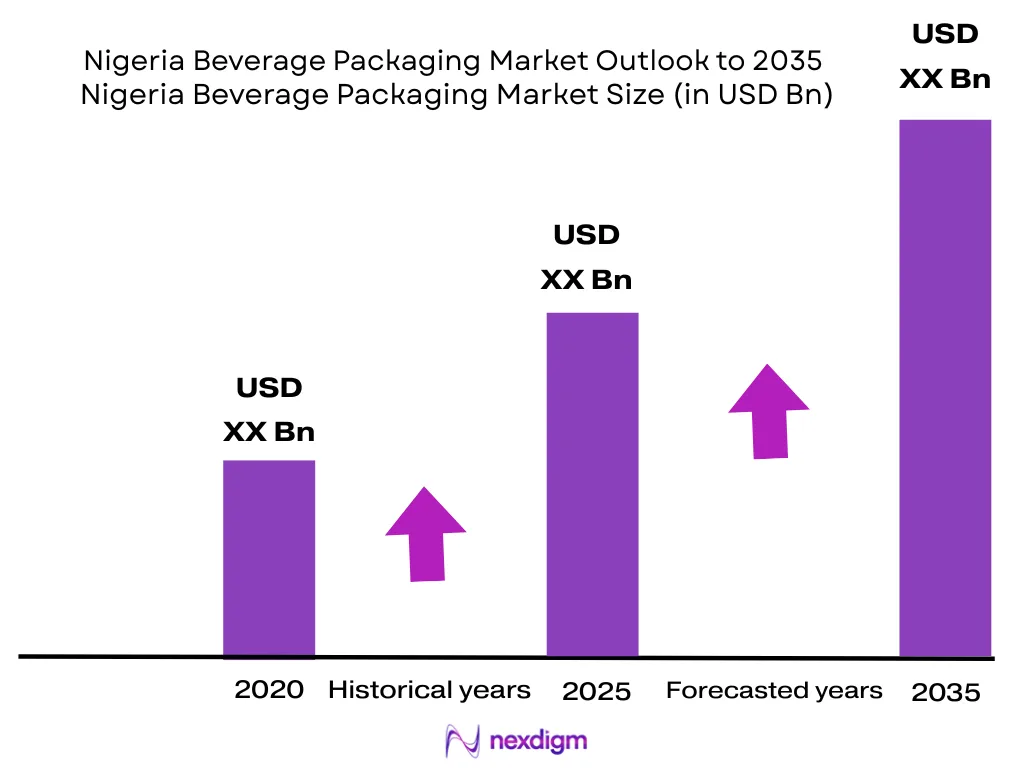
The Nigeria Beverage Packaging Market is valued at approximately USD ~ billion and is forecast to expand at a CAGR of % during 2026–2035. The latest two annual economic readings include GDP of approximately USD 363 billion and a population that increased from about 225.5 million to 233 million people. Demand is driven by packaged water, soft drinks, malt beverages, beer, dairy drinks, juice, energy drinks and low-unit-price formats distributed through formal and informal retail. Lagos, Ogun, Ibadan, Port Harcourt, Onitsha, Benin City, Kano and Abuja dominate the Nigeria Beverage Packaging Market. Lagos and Ogun contain major bottling plants, glass operations, PET converters, can manufacturers, breweries, ports and national distribution centres. Ibadan supports western consumer markets and beverage processing. Port Harcourt serves the South South region, while Onitsha and Aba connect eastern manufacturing and wholesale trade. Kano and Abuja function as northern production, warehousing and distribution hubs.
Market Segmentation
By Packaging Material
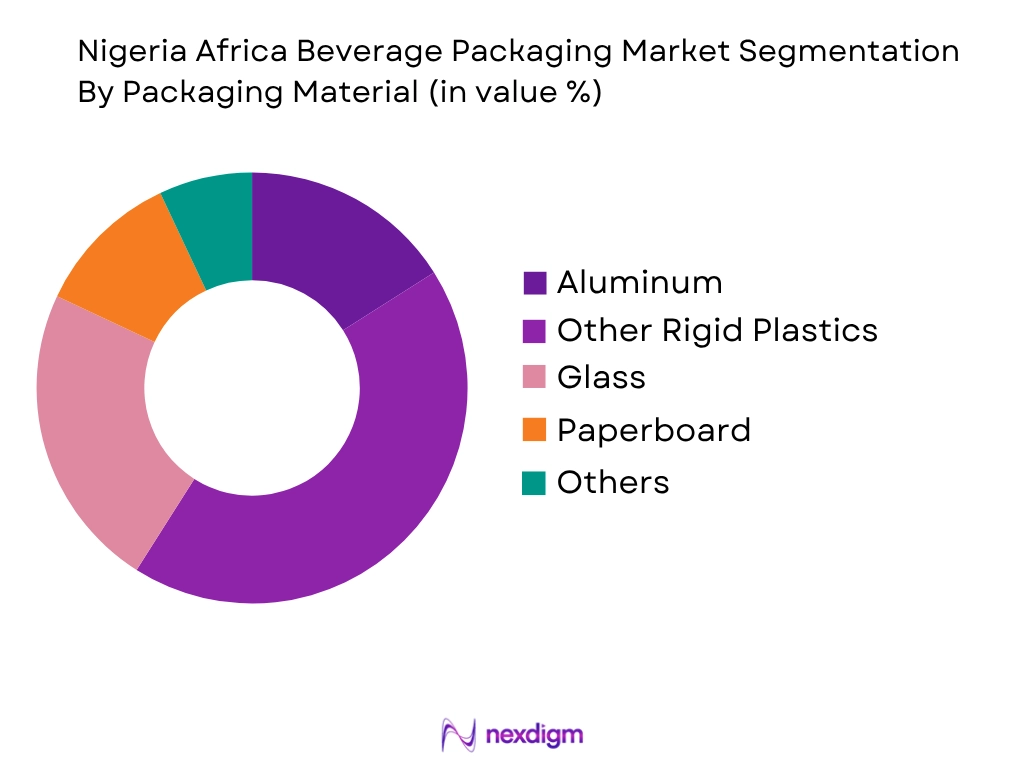
The Nigeria Beverage Packaging Market is segmented into PET and other rigid plastics, flexible plastics, glass, aluminium and steel, and paperboard or aseptic cartons. PET and other rigid plastics hold the dominant indicative share because bottled water, carbonated soft drinks, juice, dairy drinks and family-size beverages use PET bottles, preforms, caps and labels across almost every distribution channel. PET combines low transport weight, clarity, reclosure and compatibility with high-speed filling. It is also suitable for both major national bottlers and regional water producers. Flexible plastics remain significant because sachet water and low-unit-price beverage packs are deeply embedded in Nigerian consumption. Glass continues to support beer, malt, spirits and returnable soft-drink systems. Metal cans are expanding in energy drinks, malt beverages and premium products, while aseptic cartons serve juice, flavoured milk and shelf-stable dairy products.
By Beverage Category
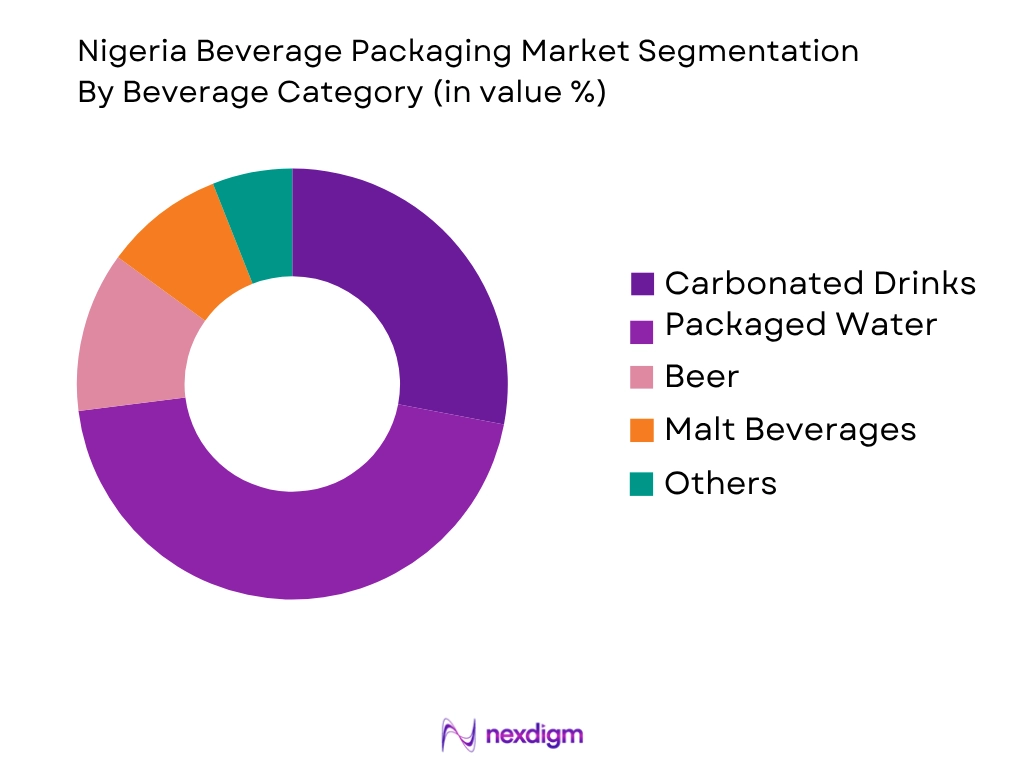
The Nigeria Beverage Packaging Market is segmented into packaged and sachet water, carbonated soft drinks, beer and stout, malt beverages, juice and fruit drinks, dairy beverages, spirits and ready-to-drink alcohol, energy drinks, and functional beverages. Packaged and sachet water hold the dominant indicative share because uneven access to reliable drinking water creates sustained demand for sealed consumer formats. The category uses sachet films, PET bottles, large dispenser containers, caps, labels, shrink film and corrugated cases. Carbonated soft drinks require PET bottles, returnable glass, aluminium cans and multipacks. Breweries depend on glass bottles, crowns, crates, cans and kegs. Malt beverages use both cans and returnable glass, while juice and dairy producers rely on PET, HDPE, pouches and aseptic cartons. Spirits support premium glass, PET miniatures, security closures and tamper-evident labels.
Competitive Landscape
Nigeria’s beverage-packaging market is concentrated around a group of established glass, metal, plastic and carton suppliers supported by machinery and closure companies. Beta Glass and Frigoglass Industries Nigeria provide glass containers, plastic crates and metal crowns. GZ Industries participates in aluminium beverage cans, while Shongai Packaging supplies crates, rigid containers and printed plastic products. Tetra Pak supports beverage producers with aseptic cartons, processing systems and filling technology. Competition is shaped by local manufacturing scale, power reliability, import exposure, beverage-filler relationships, food-contact compliance and recycling capability.
| Company | Establishment Year | Headquarters | Core Beverage Portfolio | Material Capability | Main Beverage Applications | Nigeria Footprint | Circularity Capability | Strategic Differentiation |
| Beta Glass | 1974 | Lagos, Nigeria | ~ | ~ | ~ | ~ | ~ | ~ |
| GZ Industries | 2006 | Agbara, Ogun State, Nigeria | ~ | ~ | ~ | ~ | ~ | ~ |
| Frigoglass Industries Nigeria | Group operations established over several decades | Lagos, Nigeria | ~ | ~ | ~ | ~ | ~ | ~ |
| Shongai Packaging Industries | 1977 | Ota, Ogun State, Nigeria | ~ | ~ | ~ | ~ | ~ | ~ |
| Tetra Pak West Africa | 1951 group heritage | Pully, Switzerland | ~ | ~ | ~ | ~ | ~ | ~ |
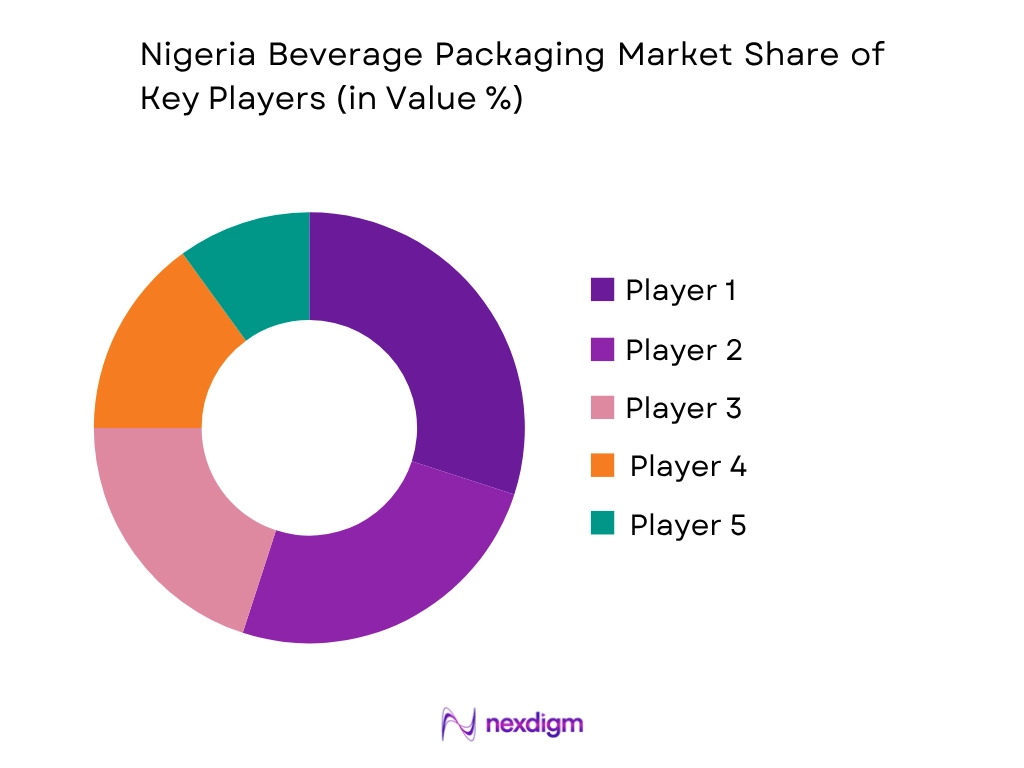
Nigeria Beverage Packaging Market Analysis
Growth Drivers
Expanding Urban Beverage Consumption and Packaged-Water Distribution
Nigeria’s large and increasingly urban consumer base is a structural driver of demand for PET bottles, water sachets, returnable glass bottles, aluminium cans, aseptic cartons, closures, labels, shrink films, corrugated cases, and reusable beverage crates. World Bank indicators place the national population at 232.7 million people in 2024, compared with 227.9 million people in 2023, adding approximately 4.8 million consumers within one year. The IMF’s current country profile places the population at 242.578 million people in 2026, illustrating the scale of the consumer base served by beverage producers, wholesalers, open markets, kiosks, neighbourhood stores, restaurants, hotels, schools, hospitals, workplaces, and transport terminals. The World Bank records Nigerian economic output at USD 250.2167 billion in 2024, while the IMF’s April 2026 database records current-price output of USD 377.37 billion in 2026. These macroeconomic indicators support substantial movement of packaged drinking water, carbonated soft drinks, malt beverages, beer, juice, dairy drinks, energy products, herbal beverages, and low-unit-price refreshments. Packaged drinking water is particularly packaging-intensive because it is sold through several formats and routes. Small PET bottles serve commuters, offices, schools, restaurants, and events. Multi-serve bottles serve households and foodservice operators, while large refillable containers support homes, workplaces, hospitals, and institutions. Sachet water remains important where consumers prioritise low unit expenditure and immediate availability. This creates continuous demand for food-grade polyethylene film, reliable heat seals, date coding, batch identification, branded printing, outer bags, and distribution sacks. The volume of water packaging is reinforced by Nigeria’s large geographical coverage and varying access to dependable drinking-water infrastructure. Beverage products must travel from major filling corridors in Lagos, Ogun, Oyo, Rivers, Anambra, Edo, Kano, Kaduna, and the Federal Capital Territory to thousands of formal and informal sales points.
Domestic Beverage Manufacturing and Packaging Conversion Capacity
Nigeria’s beverage-packaging demand is also driven by an established manufacturing base encompassing carbonated soft drinks, packaged water, malt beverages, beer, stout, spirits, juice, dairy products, energy drinks, and traditional beverages. The National Bureau of Statistics identifies food, beverages, and tobacco as a major component of Nigerian manufacturing. Under the rebased national accounts, nominal activity attributed to food, beverage, and tobacco manufacturing reached approximately NGN 10.638 trillion in the latest annual series, compared with NGN 8.989 trillion in the preceding annual observation. This represents an increase of approximately NGN 1.649 trillion in recorded activity. Nigeria’s broader manufacturing sector also continued expanding during 2024, while national real output grew by 3.46 points for every 100 points of output in the third quarter and 3.84 points in the fourth quarter. The IMF subsequently estimated national economic growth at 4 points for every 100 points of output in 2025 and projected 4.1 points in 2026. The scale and variety of domestic beverage production support multiple packaging-material chains. Carbonated soft drinks require pressure-resistant PET bottles, aluminium cans, returnable glass, closures, labels, syrup bags, corrugated trays, and shrink-wrapped multipacks. Breweries use returnable amber glass, one-way bottles, cans, crowns, reusable crates, kegs, and printed cartons. Malt-beverage producers rely heavily on glass and cans because these materials protect flavour and provide strong shelf presentation. Juice processors use hot-fill PET, aseptic cartons, glass, HDPE bottles, and flexible pouches. Dairy and yoghurt-drink producers require light barriers, hygienic filling, cold-chain durability, and secure reclosure. Spirits producers need glass or PET containers combined with pilfer-resistant closures, tax markings, tamper-evident bands, and anti-counterfeit labels.
Market Challenges
Power Reliability, Imported Inputs, and Production Continuity
Nigeria’s beverage-packaging industry faces a major operational challenge from unstable electricity, dependence on backup generation, imported production inputs, and exchange-rate exposure. Packaging conversion requires uninterrupted power for PET preform injection, bottle blowing, film extrusion, can forming, glass melting, closure moulding, printing, compressed-air systems, water treatment, cooling, conveyors, inspection equipment, and warehouse operations. A short interruption can leave partially formed products in moulds, destabilise heating profiles, damage print consistency, reduce seal quality, or halt a beverage-filling line. Glass furnaces are particularly sensitive because they operate continuously at very high temperatures. PET plants need stable electrical power and compressed air to maintain bottle wall distribution and neck accuracy. Sachet-water operations require consistent film tension, sealing temperature, coding, and hygienic filling. National macroeconomic conditions intensify these risks. The World Bank records Nigerian current-price GDP at USD 250.2167 billion in 2024, compared with USD 487.1005 billion in 2023 under the latest converted series. The sharp difference reflects exchange-rate conversion and currency depreciation rather than an equivalent collapse in physical beverage activity. Gross international reserves increased from USD 32.9 billion at the end of 2023 to USD 36.3 billion in August 2024, adding USD 3.4 billion, but packaging producers remained exposed to foreign-currency requirements for aluminium can sheet, specialist polymers, barrier resins, printing inks, coatings, aseptic materials, moulds, compressors, inspection cameras, and replacement parts. The IMF reported that exchange-rate unification and subsequent depreciation contributed to persistent domestic inflation pressure, affecting working capital and procurement planning.
Fragmented Collection and Low-Value Flexible Packaging Recovery
Nigeria has an extensive informal recycling economy, but beverage-packaging recovery is fragmented across waste pickers, scrap dealers, aggregators, collection hubs, state waste agencies, commercial contractors, producer organisations, and recycling plants. The problem varies considerably by material. PET bottles and aluminium cans have identifiable secondary value and can be sorted, compacted, and sold. Returnable glass bottles move through controlled distributor systems where deposits and reusable crates are available. Water sachets, juice sachets, shrink films, labels, multilayer pouches, and small closures are harder to recover because each unit contains little material and is frequently contaminated with sand, food residue, or mixed waste.
Market Opportunities
Food-Grade rPET and Closed-Loop Bottle Collection
Nigeria has a substantial opportunity to develop food-grade rPET systems linking beverage companies, PET converters, retailers, collection hubs, aggregators, waste pickers, recyclers, preform manufacturers, and regulatory laboratories. The current consumer base of 232.7 million people in 2024 creates large volumes of post-consumer water, soft-drink, juice, and dairy bottles. The IMF’s 242.578 million population reading for 2026 indicates that the potential collection base has continued to expand. National economic output of USD 250.2167 billion in 2024, combined with food, beverage, and tobacco activity of approximately NGN 10.638 trillion in the rebased accounts, provides an industrial foundation for collection equipment, washing plants, optical sorters, decontamination systems, pelletising lines, testing laboratories, and preform production. A successful bottle-to-bottle system starts with packaging design. Clear PET bottles are easier to sort and have broader recycling applications than strongly coloured containers. Smaller labels, compatible caps, removable sleeves, and wash-off adhesives improve material yield. Beverage producers can standardise bottle specifications and provide recyclers with information on resin, pigments, barriers, labels, and closures. Retailers, offices, schools, hotels, airports, bus terminals, and event venues can generate cleaner streams than mixed municipal waste when dedicated bins are installed. Distributor vehicles can return compacted bottles to depots after delivering full products, improving backhaul efficiency.
Local Can Manufacturing, Returnable Glass, and Affordable Circular Formats
Nigeria has a second major opportunity in aluminium beverage cans, improved returnable-glass systems, reusable transport packaging, and redesigned affordable beverage formats. Energy drinks, malt beverages, beer, ready-to-drink alcohol, carbonated soft drinks, flavoured water, and premium juices increasingly require containers that provide strong branding, light protection, pressure resistance, and efficient cooling. Aluminium cans meet these requirements and can be compacted into dense bales after consumption. Their material value also creates incentives for collection by informal waste pickers and scrap dealers. Nigeria already has domestic beverage-can manufacturing in the Lagos–Ogun industrial corridor, allowing beverage producers to source standard and specialty can formats closer to filling plants. Local supply reduces dependence on imported finished empty cans, which occupy substantial shipping volume. Future investment can expand slim, sleek, mini, and standard formats, as well as can ends, printing, sleeving, and smaller production runs. Digital decoration allows regional beverage brands to order promotional or seasonal packs without committing to extremely large inventories. Contract can-filling plants could serve smaller energy-drink, malt, coffee, and functional-beverage companies that lack their own high-speed lines.
Future Outlook
The Nigeria Beverage Packaging Market is expected to develop through 2035 as population growth, urban consumption, packaged-water demand, domestic beverage production and modern retail sustain container volumes. PET bottles, sachet films, returnable glass, aluminium cans and aseptic cartons will remain the principal formats. Growth will increasingly depend on local material conversion, power resilience, package affordability and regulatory compliance. Manufacturers that reduce exposure to imported inputs, provide technical support and work with collection organisations will be better positioned.
Major Players
- Beta Glass
- GZ Industries
- Frigoglass Industries Nigeria
- Shongai Packaging Industries
- Veepee Industries
- Sonnex Packaging Nigeria
- Lexcel Products and Packaging
- Sacvin Nigeria
- PrimePak Industries Nigeria
- Tetra Pak West Africa
- SIG West Africa
- Guala Closures Nigeria
- Krones West Africa
- Sidel West Africa
- Shan Packaging
Key Target Audience
- Beverage-container and packaging-material manufacturers
- Packaged-water, soft-drink, juice and dairy-beverage producers
- Breweries, malt producers and spirits companies
- Contract beverage fillers and co-packaging companies
- Retailers, beverage distributors and foodservice operators
- Investments and venture capitalist firms
- Private-equity and strategic packaging investors
- Government and regulatory bodies
Research Methodology
Step 1: Identification of Key Variables
The first phase constructs an ecosystem map covering resin suppliers, bottle and preform manufacturers, glass producers, can companies, carton suppliers, closures, beverage fillers, distributors, producer-responsibility organisations and recyclers. Critical variables include container units, packaging weight, beverage volume, pack size, returnability, local production, imported inputs and EPR exposure.
Step 2: Market Analysis and Construction
Historical data is compiled by packaging material, container format, beverage category, pack size, region and distribution channel. Bottom-up analysis evaluates manufacturing capacity, container shipments, filling lines, material tonnage and supplier revenues. Top-down analysis reviews GDP, population, beverage production, manufacturing activity, trade, retail and recycling flows.
Step 3: Hypothesis Validation and Expert Consultation
Market hypotheses are validated through computer-assisted telephone interviews with packaging converters, beverage producers, breweries, packaged-water companies, contract fillers, distributors, waste aggregators and regulatory specialists. These consultations assess capacity utilisation, package qualification, raw-material sourcing, power reliability, collection economics and customer procurement behaviour.
Step 4: Research Synthesis and Final Output
Supply-side and demand-side findings are triangulated to reconcile domestic packaging production, imports, beverage filling, container use and post-consumer recovery. Segment shares and forecasts are tested against package weights, filling capacity, company disclosures, NAFDAC requirements, NESREA guidelines and primary-industry feedback.

- Executive Summary
- Research Methodology (Market Definitions and Assumptions, Beverage Packaging Inclusion and Exclusion Criteria, Abbreviations, Market Sizing Approach, Top-Down Analysis, Bottom-Up Analysis, Beverage Filling Volume Model, Container Unit Conversion Model, Packaging Material Tonnage Assessment, Domestic Production Analysis, Import and Export Assessment, Demand-Side Interviews, Supply-Side Interviews, Distributor and Informal-Retail Interviews, Data Triangulation, Regional Scenario Modelling, Forecasting Framework, Limitations and Future Conclusions)

- Definition and Scope
- Market Evolution and Industry Genesis
- Evolution of Beverage Packaging Materials
- Development of Returnable Glass Beverage Bottles
- Expansion of PET Beverage Bottles
- Development of Plastic Sachet Beverage Packaging

- Growth Drivers (Population Expansion, Urban Beverage Consumption, Packaged-Water Demand, Soft-Drink Production, Brewery Capacity, Dairy Processing, Informal Retail and Local Manufacturing)
- Market Challenges (Currency Volatility, Resin and Metal Import Dependence, Power Reliability, Packaging Counterfeiting, Collection Fragmentation, Sachet-Waste Recovery and Food-Contact Compliance)
- Market Opportunities (Food-Grade rPET, Aluminium Can Localisation, Returnable Glass Optimisation, Sachet Recovery, Aseptic Cartons, Anti-Counterfeit Closures, Digital Printing and Regional Co-Packing)
- SWOT Analysis
- Porter’s Five Forces Analysis
- PESTLE Analysis

- By Market Value (2020-2025)
- By Beverage Container Units (2020-2025)
- By Packaged Beverage Volume (2020-2025)

- By Packaging Material (In Value %)
PET
HDPE
Polypropylene
Low-Density Polyethylene
Linear Low-Density Polyethylene
Aluminium - By Beverage Category (In Value %)
Packaged Drinking Water
Sachet Drinking Water
Natural Mineral Water
Flavoured and Enhanced Water
Carbonated Soft Drinks
Energy Drinks - By Distribution Channel (In Value %)
Supermarkets and Hypermarkets
Neighbourhood Supermarkets
Open Markets
Traditional Grocery Stores
Kiosks and Roadside Retailers
Convenience Stores - By Geographic Region (In Value %)
South West
South South
South East
North Central
North West
North East

- Market Share of Major Players
- Cross Comparison Parameters (Beverage Container Material and Format Breadth, Annual Beverage Container Closure and Crate Manufacturing Capacity, Nigerian Plant Footprint and Proximity to Filling Clusters, Food-Grade rPET Cullet and Post-Consumer Recovery Capability, Filling-Line Compatibility and Technical-Service Coverage, Beverage Category Pack-Size and Low-Unit-Price Format Coverage, NAFDAC SON NESREA and EPR Compliance Support, Lightweighting Anti-Counterfeit and New-Format Commercialisation Capability)
- SWOT Analysis of Major Players
- Detailed Profiles of Major Companies
Beta Glass
GZ Industries
Frigoglass Industries Nigeria
Shongai Packaging Industry
Veepee Industries
Sonnex Packaging Nigeria
Lexcel Products and Packaging
Shan Packaging
Sacvin Nigeria
PrimePak Industries Nigeria
Tetra Pak West Africa
SIG West Africa
Guala Closures Nigeria
Krones West Africa
Sidel West Africa

- Packaged-Water Producer Analysis
- Carbonated Soft Drink Producer Analysis
- Malt Beverage Producer Analysis
- Beer and Stout Producer Analysis
- Energy and Sports Drink Producer Analysis

- By Market Value (2026-2035)
- By Beverage Container Units (2026-2035)
- By Packaged Beverage Volume (2026-2035)


 Request a Sample
 Ask for Customization
 Get a Quote
 Enquire Now