
 Download PDF
Market Overview
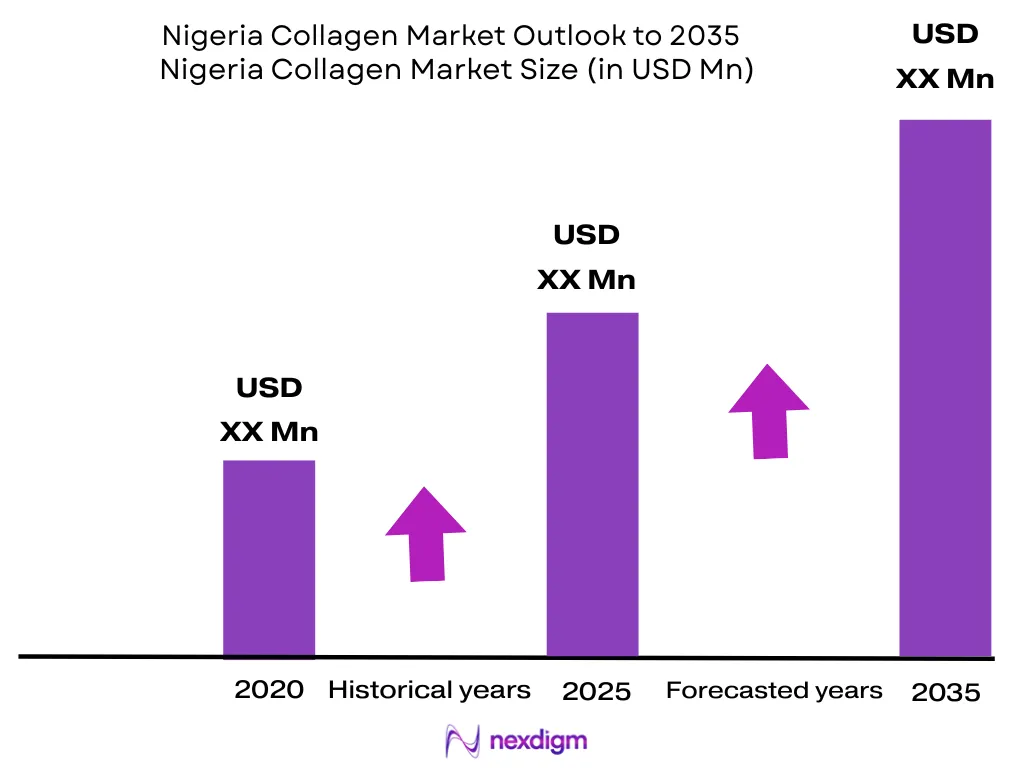
The Nigeria collagen market is valued at USD ~ million, based on a five-year historical analysis using Nigeria’s collagen supplement, gelatin, nutraceutical, beauty supplement and imported peptide demand pool. Public country-level collagen disclosures remain limited; therefore, the long-term 2026–2035 CAGR benchmark used for Nigeria is 6.32%, aligned with the published global collagen outlook to 2035. Nigeria’s GDP stood at USD 252.26 billion, while GDP per capita reached USD 1,084.2, supporting selective premium wellness consumption. Lagos, Abuja, Port Harcourt, Kano, Ibadan and Ogun dominate Nigeria collagen demand because they concentrate pharmacies, imported supplement distributors, beauty retailers, aesthetic clinics, sports nutrition outlets, e-commerce fulfilment and higher-income urban consumers. Nigeria’s population reached 232.68 million, creating Africa’s largest consumer base, while GDP growth reached 4.1 in the latest base year. Lagos dominates because it combines port logistics, beauty commerce, pharmacies, Jumia/Konga delivery density and social-commerce supplement sellers.
Market Segmentation
By Product Type
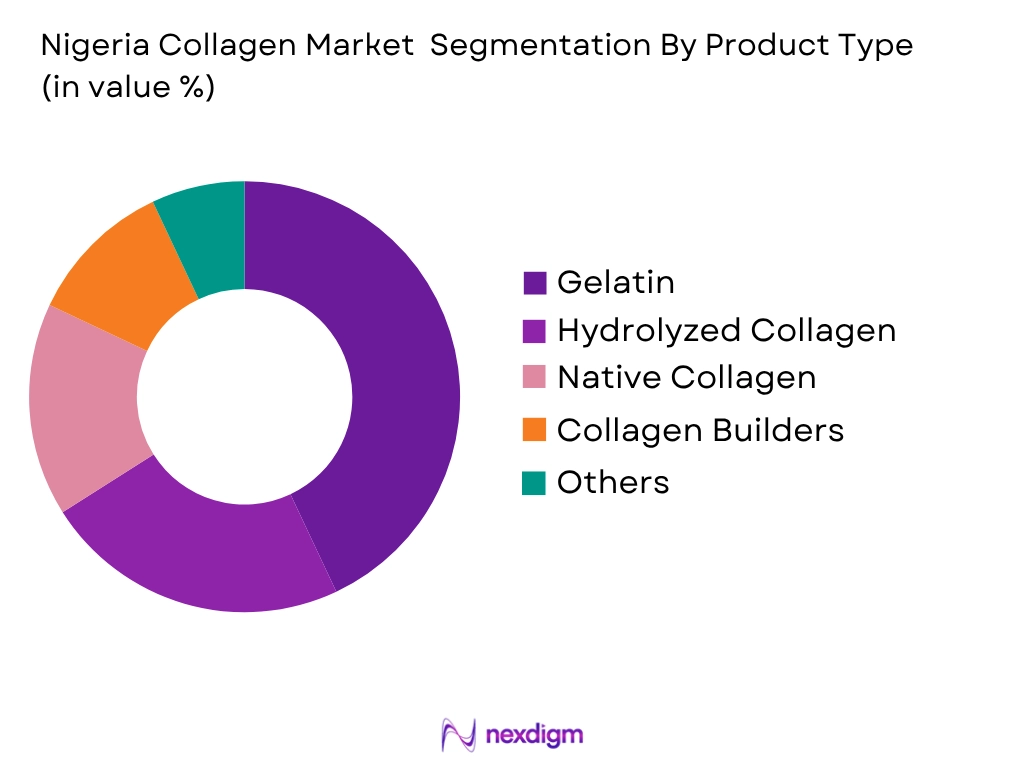
Nigeria collagen market is segmented by product type into gelatin, hydrolyzed collagen peptides, native collagen, undenatured Type II collagen and collagen-builder products. Recently, gelatin has a dominant market share in Nigeria under product type segmentation, because it has wider application across pharmaceutical capsules, gummies, confectionery, dairy desserts, food thickening, bakery and functional food systems. Gelatin is commercially broader than hydrolyzed collagen because it acts as a gelling, stabilizing, binding and film-forming ingredient, while hydrolyzed collagen is more concentrated in beauty, skin-health, sports recovery and joint-health products. Nigeria’s pharmaceutical, food and confectionery sectors create stronger baseline demand for gelatin, while premium collagen powders and marine peptides are still concentrated among higher-income urban consumers. Regional Middle East and Africa collagen data also identifies gelatin as the dominant product segment.
By Source
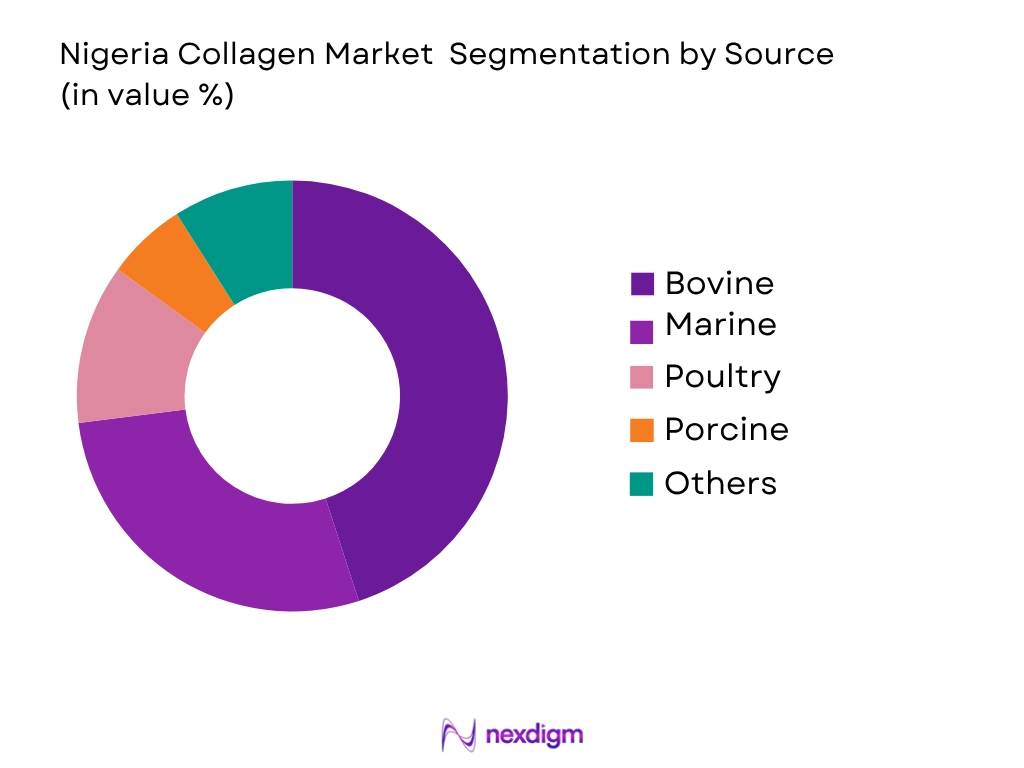
Nigeria collagen market is segmented by source into bovine, marine, poultry, porcine and others. Recently, bovine collagen has a dominant market share in Nigeria under source segmentation because it is comparatively scalable, widely used in gelatin and hydrolyzed collagen products, and compatible with mass-market beauty, sports nutrition and joint-health applications. Bovine collagen provides Type I and Type III collagen, allowing brands to position products for skin, hair, nails, bones, joints and recovery. Marine collagen is gaining premium appeal among beauty consumers because it is associated with Type I collagen and skin hydration claims, but it remains more dependent on imported finished products and higher-cost peptide inputs. Porcine collagen faces religious and dietary sensitivity, especially across Muslim-majority northern markets, strengthening bovine and marine alternatives.
Competitive Landscape
Nigeria collagen market is fragmented, import-led and channel-driven, with pharmacies, e-commerce marketplaces, social-commerce sellers, wellness retailers and beauty stores shaping consumer access. Imported U.S., European, South African and Asian brands compete with pharmacy-curated ranges and local distributors. Brands such as Vital Proteins, NeoCell, Youtheory and Doctor’s Best compete through imported collagen peptides and tablets, while pharmacy-led ranges from HealthPlus and MedPlus provide trust and urban retail access. NAFDAC compliance, English labeling, registration status, source declaration, authenticity, price accessibility and influencer visibility are critical competitive factors.
| Company | Establishment Year | Headquarters | Collagen Portfolio | Main Source Focus | Application Coverage | Nigeria Market Role | Distribution Model | Strategic Strength |
| Nature’s Field Nigeria | 1981 | Lagos, Nigeria | ~ | ~ | ~ | ~ | ~ | ~ |
| HealthPlus Pharmacy Collagen Range | 1999 | Lagos, Nigeria | ~ | ~ | ~ | ~ | ~ | ~ |
| Vital Proteins / Nestlé Health Science | 2013 | Chicago, USA | ~ | ~ | ~ | ~ | ~ | ~ |
| NeoCell | 1998 | Irvine, USA | ~ | ~ | ~ | ~ | ~ | ~ |
| Youtheory | 2010 | Irvine, USA | ~ | ~ | ~ | ~ | ~ | ~ |
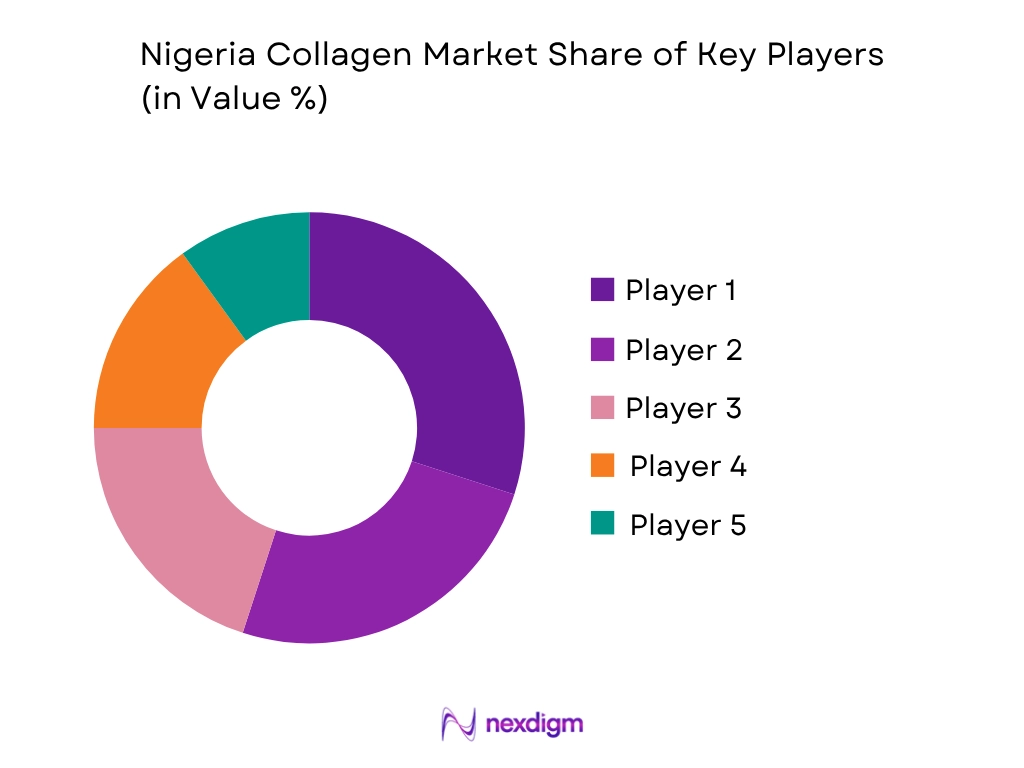
Nigeria Collagen Market Analysis
Growth Drivers
Large Consumer Base Supporting Beauty and Joint-Health Collagen Adoption
Nigeria collagen market is supported by a large consumer base for bovine collagen powders, marine collagen capsules, gummies, tablets and collagen-builder products positioned around skin hydration, hair support, nail health, joint mobility and sports recovery. World Bank reports Nigeria’s population at 232.68 million in 2024, GDP at USD 252.26 billion in 2024 and GDP growth at 4.1 in 2024, creating Africa’s largest addressable consumer pool for pharmacy, beauty retail and e-commerce wellness products. GDP per capita stood at USD 1,084.2, making smaller packs and value formats important for mass collagen adoption.
Digital Reach Supporting Collagen Discovery Through E-Commerce and Social Commerce
Nigeria collagen market is driven by digital access because collagen products are commonly discovered through Jumia, Konga, Instagram sellers, WhatsApp vendors, pharmacy websites and imported supplement listings. Collagen brands depend on online product education because consumers compare bovine, marine, Type I, Type II, tablet, capsule and powder formats before purchase. World Bank’s internet indicator confirms Nigeria has 2024 data for individuals using the internet, while FRED’s World Bank-linked series provides Nigeria internet-user data through 2024. Nigeria’s GDP stood at USD 252.26 billion, population reached 232.68 million, and GDP growth reached 4.1 in 2024, supporting digital supplement distribution across Lagos, Abuja and Port Harcourt.
Market Challenges
Affordability Pressure for Imported Marine and Multi-Collagen Products
Nigeria collagen market faces affordability pressure because premium marine collagen, imported multi-collagen blends, collagen powders and beauty tablets remain discretionary wellness products for many households. World Bank reports GDP per capita at USD 1,084.2 in 2024, while GDP stood at USD 252.26 billion and population reached 232.68 million, showing a large but price-sensitive consumer base. This directly affects collagen brands because regular use requires repeat monthly purchases, while many consumers may shift toward smaller packs, single bottles, tablets, sachets or lower-cost bovine collagen instead of premium marine collagen powders.
NAFDAC Registration and Claims Compliance for Collagen Supplements
Nigeria collagen market faces a compliance challenge because collagen powders, gummies, capsules and tablets are often sold as dietary supplements with beauty, skin, hair, joint or recovery claims. NAFDAC Dietary Supplement Regulations, 2025 state that a dietary supplement shall not be manufactured, imported, exported, advertised, sold or distributed in Nigeria unless it has been registered. This is material for collagen brands because imported products must manage registration, labeling, ingredient documentation and claims control before formal pharmacy or e-commerce distribution. Nigeria’s population of 232.68 million and GDP of USD 252.26 billion make compliance commercially important for national-scale distribution.
Market Opportunities
Formal Pharmacy and Verified E-Commerce Channels for Registered Collagen Products
Nigeria collagen market has an opportunity in formal pharmacy and verified e-commerce channels because consumers buying collagen for beauty, anti-aging, joint mobility and sports recovery require product authenticity, NAFDAC registration, importer details and clear source disclosure. NAFDAC’s 2025 rules require dietary supplements to be registered before manufacture, import, advertisement, sale or distribution, creating room for compliant brands to differentiate from grey imports. World Bank reports Nigeria’s population at 232.68 million, GDP at USD 252.26 billion and GDP growth at 4.1 in 2024, giving registered collagen brands a large formal-channel opportunity across Lagos, Abuja, Port Harcourt and Kano.
Local Bovine and Marine Collagen Positioning Through Animal-Source Transparency
Nigeria collagen market has an opportunity in bovine and marine collagen products that clearly disclose source, allergen status, halal suitability and quality documentation. Bovine collagen can address mass wellness, sports recovery and joint-health consumers, while marine collagen can target premium beauty consumers seeking Type I skin-health positioning. Nigeria’s National Bureau of Statistics reported livestock scale of 273.80 million animals in the 2022–2023 agricultural census release, including 54.81 million cattle, 138.95 million goats and 64.93 million sheep, showing a large animal-agriculture base for source mapping. World Bank reports GDP at USD 252.26 billion in 2024, supporting future formalization of traceable animal-origin wellness ingredients.
Future Outlook
Over the next decade, Nigeria collagen market is expected to expand gradually from a small premium base, supported by urban beauty consumption, imported supplement availability, pharmacy-led trust, social-commerce education, sports nutrition adoption and joint-health demand. Demand will remain concentrated in Lagos, Abuja, Port Harcourt, Kano and Ibadan because these cities combine purchasing power, pharmacy access, beauty retail and e-commerce delivery. Public Nigeria-specific collagen CAGR data to 2035 is not openly disclosed. For this report horizon, the most relevant long-range benchmark is the global collagen market outlook, which indicates 6.32% CAGR during 2026–2035. Nigeria is likely to grow from a lower base, but adoption will be shaped by affordability, NAFDAC registration, imported product availability and premium urban consumer demand.
Future demand will concentrate in bovine collagen powders, marine collagen capsules, Type I beauty supplements, Type II joint-health products, collagen gummies, collagen coffee, collagen-builder formulations and multi-collagen blends. Local market development will be strongest where brands combine NAFDAC registration, affordable pack sizes, transparent source declarations, influencer education and credible pharmacy availability. Nigeria’s market will also remain sensitive to counterfeit risk and grey imports. Collagen products sold through Instagram, WhatsApp sellers and informal import channels may face authenticity and storage concerns. Brands that build verified distribution through pharmacies, Jumia, Konga, branded websites and registered importers will be better positioned for repeat purchase and premiumization.
Major Players
- Nature’s Field Nigeria
- Vitabiotics Nigeria
- HealthPlus Pharmacy Collagen Range
- MedPlus Pharmacy Collagen Range
- Vital Proteins / Nestlé Health Science
- NeoCell
- Youtheory
- Doctor’s Best
- 21st Century HealthCare
- Applied Nutrition
- Nature’s Bounty
- GNC
- Swisse
- Solgar
- Wellwoman / Perfectil Collagen-Adjacent Range
Key Target Audience
- Collagen supplement importers
- Dietary supplement and nutraceutical brands
- Pharmacy and drugstore chains
- Beauty and nutricosmetic brands
- E-commerce and social-commerce wellness sellers
- Sports nutrition and wellness distributors
- Investments and venture capitalist firms
- Government and regulatory bodies, National Agency for Food and Drug Administration and Control, Standards Organisation of Nigeria, Federal Ministry of Health and Social Welfare, Federal Ministry of Agriculture and Food Security
Research Methodology
Step 1: Identification of Key Variables
The initial phase involves constructing an ecosystem map of Nigeria collagen market, covering imported supplement brands, local distributors, pharmacies, beauty retailers, e-commerce platforms, social-commerce sellers, sports nutrition outlets and regulators. The objective is to identify key variables such as source, product type, format, channel, registration status, price band and consumer use case.
Step 2: Market Analysis and Construction
In this phase, historical and current data is compiled across collagen supplement sales, gelatin demand, hydrolyzed peptide adoption, pharmacy listings, e-commerce SKUs, social-commerce visibility, import activity and source mix. The analysis evaluates bovine, marine, poultry, porcine and multi-collagen products across beauty, joint-health, functional food, sports nutrition and pharmaceutical applications.
Step 3: Hypothesis Validation and Expert Consultation
Market hypotheses are validated through computer-assisted telephone interviews with supplement importers, pharmacy buyers, beauty retailers, e-commerce sellers, wellness distributors, dermatology clinics and regulatory specialists. These consultations help validate assumptions around gelatin dominance, bovine source leadership, marine premiumization, affordability barriers and NAFDAC registration requirements.
Step 4: Research Synthesis and Final Output
The final phase combines top-down macroeconomic and category indicators with bottom-up SKU, channel and company-level checks. This approach validates Nigeria collagen market size, segmentation, competitive structure, regulatory risk, demand outlook and growth opportunities for manufacturers, importers, investors, pharmacies and consumer-health companies.

- Executive Summary
- Research Methodology (Market Definitions and Assumptions, Abbreviations, Market Sizing Approach, Top-Down Validation, Bottom-Up Validation, Import Mapping, SKU Benchmarking, Primary Interviews, Regulatory Review, Competitive Mapping, Forecast Model, Limitations)

- Definition and Scope
- Market Genesis and Evolution
- Timeline of Major Players
- Business Cycle and Supplement Consumption Seasonality
- Nigeria Collagen Supply Chain and Value Chain Analysis

- Growth Drivers (Beauty-from-Within Demand, Urban Middle-Class Consumers, Bovine Collagen Acceptance, Active Aging Demand, Pharmacy Channel Trust, E-Commerce
- Market Challenges (Imported Peptide Dependency, Naira Volatility, NAFDAC Registration, Claim Restrictions, Price Sensitivity, Counterfeit Risk, Source Transparency)
- Market Opportunities (Bovine Collagen, Marine Collagen, Multi-Collagen Blends, Collagen Coffee, Sports Recovery, Pharmacy-Led Joint Health, Pet Collagen, Medical-Grade Collagen)
- Market Trends (Multi-Collagen Blends, Clean-Label Collagen, Marine Premiumization, Collagen Coffee, Third-Party Testing, BSE-Free Claims, Sugar-Free Gummies, Influencer Education)
- SWOT Analysis
- Porter’s Five Forces
- PESTLE Analysis

- By Value (2020-2025)
- By Volume (2020-2025)
- By Average Selling Price (2020-2025)

- By Source (In Value %)
Bovine Collagen
Marine Collagen
Poultry Collagen
Porcine Collagen
Eggshell Membrane Collagen - By Product Type (In Value %)
Gelatin
Hydrolyzed Collagen Peptides
Native Collagen
Undenatured Type II Collagen
Multi-Collagen Blends
Collagen Beauty Foods - By Distribution Channel (In Value %)
Pharmacies and Drugstores
Beauty and Wellness Retailers
E-Commerce Marketplaces
Supermarkets and Hypermarkets
Social Commerce - By Region (In Value %)
Lagos
Abuja FCT
Rivers
Kano
Oyo
Ogun
Anambra and Enugu

- Market Share of Major Players on the Basis of Value and Volume
- Cross Comparison Parameters (Collagen Source Portfolio, Product Format Portfolio, NAFDAC Registration Readiness, Pharmacy and E-Commerce Reach, Country-of-Origin Positioning, Certification and Traceability, Ingredient Stacking Capability, Social Commerce and Influencer Strength)
- SWOT Analysis of Major Players
- Detailed Profiles of Major Companies
Nature’s Field Nigeria
Vitabiotics Nigeria
HealthPlus Pharmacy Collagen Range
MedPlus Pharmacy Collagen Range
Vital Proteins / Nestlé Health Science
NeoCell
Youtheory
Doctor’s Best
21st Century HealthCare
Applied Nutrition
Nature’s Bounty
GNC
Swisse
Solgar
Wellwoman / Perfectil Collagen-Adjacent Range

- Supplement Brand and Importer Demand
- Beauty and Nutricosmetic Brand Demand
- Pharmacy and Drugstore Buyer Demand
- E-Commerce Seller Demand
- Sports Nutrition Retail Demand

- By Value (2026-2035)
- By Volume (2026-2035)
- By Average Selling Price (2026-2035)


 Request a Sample
 Ask for Customization
 Get a Quote
 Enquire Now