
 Download PDF
Market Overview
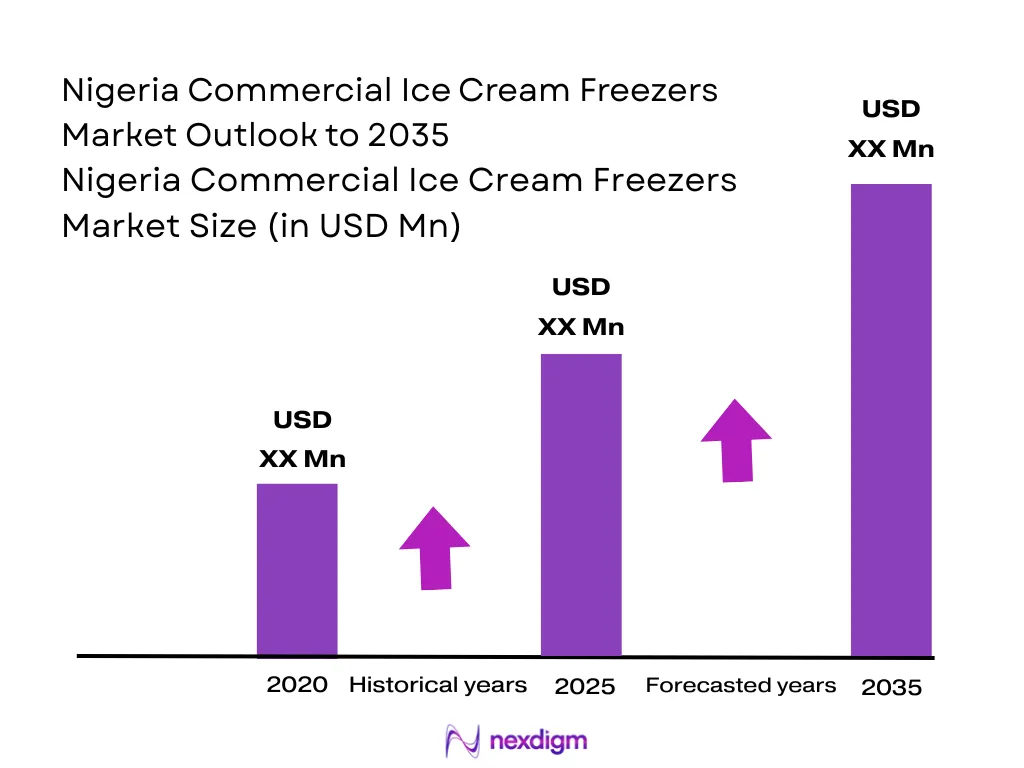
The Nigeria Commercial Ice Cream Freezers Market is valued at USD ~ million, using WITS/UN Comtrade import data for HS 841850, covering refrigerating or freezing chests, cabinets, display counters and showcases used for frozen-food and ice cream display. The same category stood at USD 7.70 million in the preceding period, indicating higher imported cabinet demand. Growth is driven by supermarkets, QSR dessert counters, bakeries, kiosks and frozen dessert retailers requiring display-led cold storage.
Lagos, Abuja, Port Harcourt, Ibadan, Enugu and Kano dominate demand because Nigeria’s HRI establishments are concentrated in Lagos and Abuja, while Port Harcourt, Ibadan, Enugu and Kano are emerging hospitality hubs. The market is also supported by Nigeria’s large foodservice base, valued at USD 9.26 billion, and urbanization, with the urban population reported at 55.03%. These cities concentrate supermarkets, malls, QSR outlets, fuel-station marts and high-income dessert consumption.
Market Segmentation
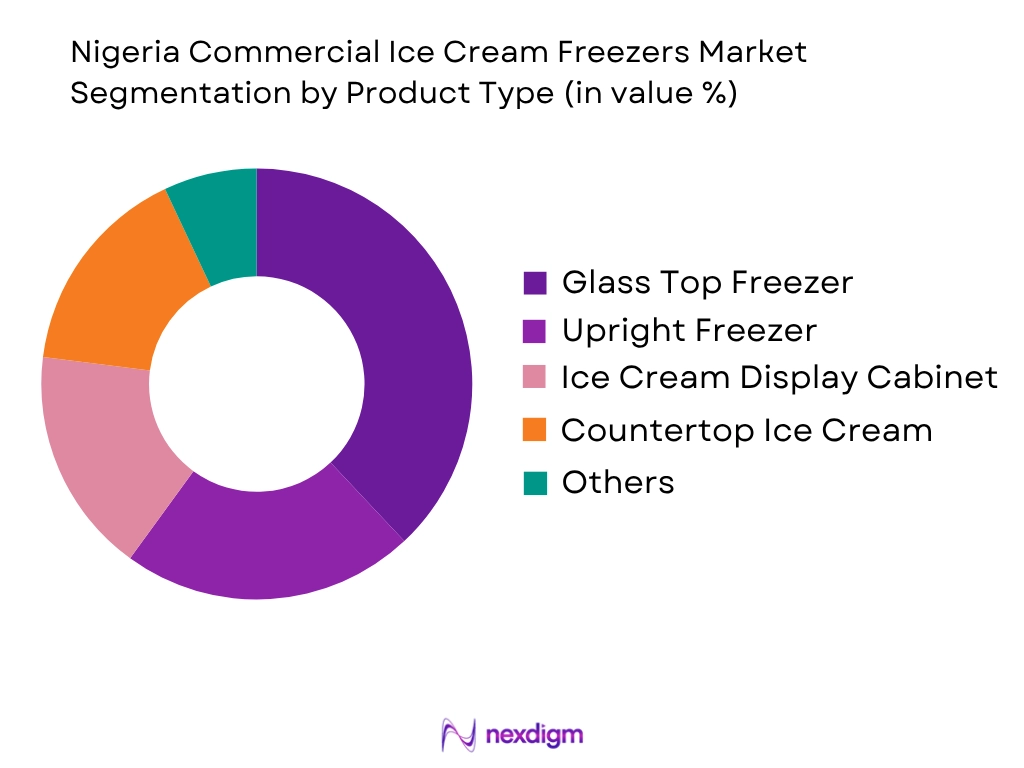
By Product Type
Nigeria Commercial Ice Cream Freezers Market is segmented by product type into glass-top chest ice cream freezers, upright glass-door display freezers, scoop display cabinets, countertop units, gelato cabinets and mobile cart freezers. Glass-top chest ice cream freezers dominate because they fit Nigeria’s price-sensitive frozen dessert retail structure, where mini-marts, kiosks, supermarkets and informal resellers need low-cost visibility, high storage volume and longer holdover during outages. Their use is reinforced by imported HS 841850 cabinet demand, where display and storage cabinets form the core trade category. They are also easier to service, tolerate frequent lid opening, and are preferred by ice cream brands for branded freezer placement across small-format retail.
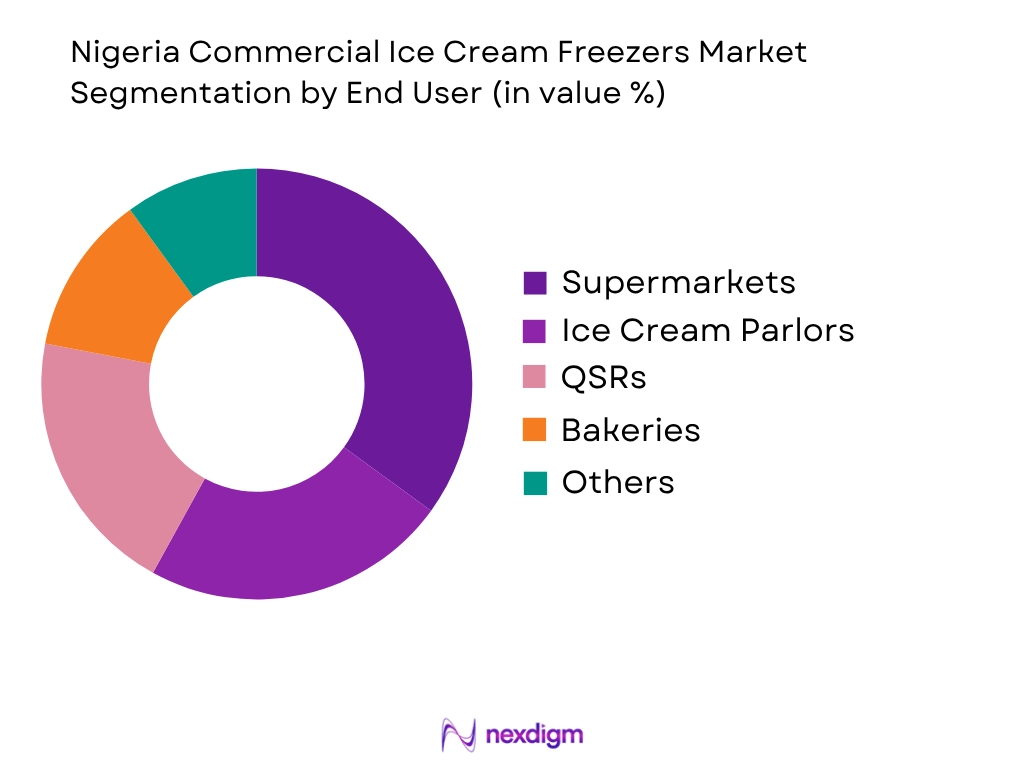
By End User
Nigeria Commercial Ice Cream Freezers Market is segmented by end user into supermarkets, hypermarkets, mini-marts, ice cream parlors, dessert cafés, QSRs, restaurants, bakeries, hotels, caterers and kiosks. Supermarkets, hypermarkets and mini-marts hold the dominant position because ice cream freezers in these outlets operate as both storage and point-of-sale display assets. Frozen dessert cabinets are placed near checkout zones, frozen aisles and branded impulse sections, enabling higher stock rotation across tubs, cones, cups and multipacks. Nigeria’s foodservice and hospitality growth also supports freezer demand, but organized and semi-organized retail channels dominate due to their wider outlet base, stronger brand merchandising and higher reliance on visible cold cabinets.
Competitive Landscape
The Nigeria Commercial Ice Cream Freezers Market is fragmented, with appliance brands, commercial kitchen equipment suppliers, importers, online retailers and refurbished equipment dealers competing across price tiers. Haier Thermocool, Scanfrost, Hisense, Nexus and Polystar are highly visible across commercial and semi-commercial freezer buyers due to dealer presence, brand familiarity, local servicing and availability through Nigerian appliance channels. The competitive edge is shaped less by freezer technology alone and more by voltage tolerance, warranty support, compressor reliability and spare-part availability.
| Player | Establishment Year | Headquarters | Core Freezer Positioning | Nigeria Channel Strength | Commercial Ice Cream Freezer Relevance | Power-Condition Suitability | After-Sales / Service Signal | Price Tier |
| Haier Thermocool | 1975 | Lagos, Nigeria / Qingdao, China | ~ | ~ | ~ | ~ | ~ | ~ |
| Scanfrost | 1983 | Lagos, Nigeria | ~ | ~ | ~ | ~ | ~ | ~ |
| Hisense | 1969 | Qingdao, China | ~ | ~ | ~ | ~ | ~ | ~ |
| Nexus | 2000s | Lagos, Nigeria | ~ | ~ | ~ | ~ | ~ | ~ |
| Polystar | 2000s | Lagos, Nigeria | ~ | ~ | ~ | ~ | ~ | ~ |
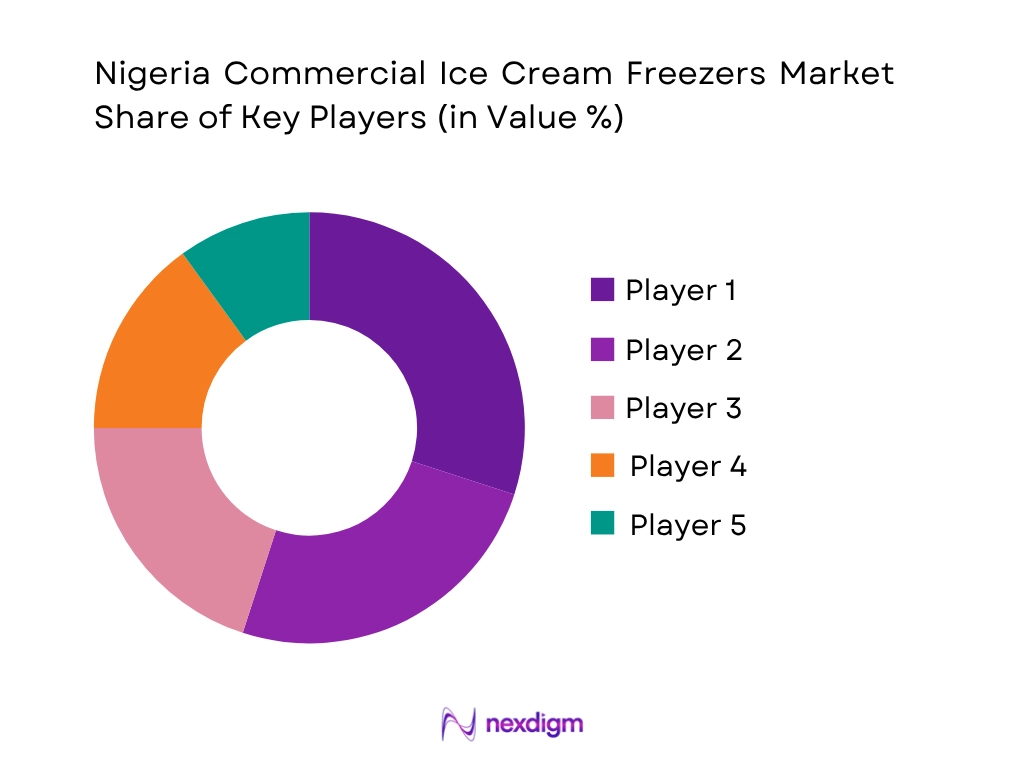
Nigeria Commercial Ice Cream Freezers Market Outlook to 2035
Growth Drivers
Urban Concentration and Foodservice Expansion Supporting Display Freezer Demand
Nigeria Commercial Ice Cream Freezers Market is supported by a large urban consumer base and the expansion of foodservice formats where frozen desserts are sold through glass-top cabinets, upright display freezers, scoop cabinets and branded freezer placements. World Bank data records Nigeria’s total population at 232,679,478 people and GDP per capita at USD 1,084.2 in 2024, creating a large base of urban retail and foodservice consumers even under constrained purchasing conditions. The USDA Foreign Agricultural Service states that Nigeria has more than 230 million people, with urbanization supporting demand for convenient meal formats, and lists leading foodservice chains including Chicken Republic, KFC, Cold Stone Creamery, Domino’s Pizza, Tantalizers, Kilimanjaro, The Place and Burger King. For ice cream freezer suppliers, these chains and related dessert cafés require freezer assets for cups, cones, tubs, milkshake bases, frozen cakes and impulse display. The same USDA report states that Lagos alone has over 3,000 hotels and about 10 international hotel brands, adding hotel, catering and dessert-service demand for commercial freezing equipment. Sources: World Bank; USDA FAS.
Import Availability of Refrigerating and Freezing Display Cabinets Strengthening Equipment Supply
Nigeria Commercial Ice Cream Freezers Market is driven by the availability of imported refrigerating and freezing display cabinets, because the market depends heavily on imported commercial freezer equipment rather than local manufacturing. WITS/UN Comtrade data for HS 841850, covering refrigerating or freezing chests, cabinets, display counters and showcases, records 19,182 items exported from China to Nigeria, 7,594 items from India, 1,581 items from the European Union, 1,047 items from Turkey and 658 items from Thailand in 2024. This supply base is market-specific because these HS 841850 products include the same freezer formats used by ice cream parlors, supermarkets, QSR dessert counters, bakeries, kiosks and convenience stores. The breadth of supplier origins also supports multiple price and format tiers, from value chest freezers to premium display cabinets. USDA FAS separately identifies cold chain and distribution infrastructure as a constraint outside major cities, which increases the commercial relevance of freezer cabinet placement in Lagos, Abuja, Port Harcourt and other urban retail clusters. Sources: WITS/World Bank; USDA FAS.
Market Challenges
Power Supply Instability Increasing Operating Risk for Ice Cream Freezer Users
Nigeria Commercial Ice Cream Freezers Market faces a direct operating challenge from grid instability, because ice cream freezers must hold stable low temperatures to avoid product softening, spoilage and inventory loss. The Nigerian Electricity Regulatory Commission reports 28 grid-connected power plants in 2024/Q4, consisting of 19 gas plants, 5 hydro plants, 2 steam plants and 2 gas/steam plants. Average available generation capacity stood at 5,296.89 MW, while average hourly generation was 4,207.41 MWh/h and total quarterly generation was 9,289.95 GWh. The same report states that average lower daily frequency was 49.39 Hz and average upper daily frequency was 50.91 Hz, outside the normal operating band of 49.75 Hz to 50.25 Hz. These figures matter for commercial ice cream freezer buyers because compressor performance, thermostat stability and temperature recovery are exposed to voltage and frequency fluctuations. As a result, buyers prioritize low-voltage compressors, voltage stabilizers, stronger insulation, longer holdover time and rapid after-sales repair coverage. Source: Nigerian Electricity Regulatory Commission.
Weak Consumer Purchasing Power and Inflation Pressuring Freezer Utilization
Nigeria Commercial Ice Cream Freezers Market is constrained by weak consumer purchasing power because ice cream, frozen desserts and café desserts are discretionary products for many households. World Bank data records Nigeria’s inflation at 33.2 in 2024, while GDP per capita stood at USD 1,084.2 in the same year. The IMF also lists Nigeria’s 2026 projected consumer prices at 16.0, indicating that inflation remains a key macroeconomic pressure in the outlook period. USDA FAS reports that Nigeria’s Hotel, Restaurant and Institutional sector is recovering, but expansion is hampered by high food price inflation, weakened currency, elevated import costs, rising operational expenses and insecurity. These pressures affect ice cream freezer demand in two ways: end users delay new equipment purchases, and existing freezer owners focus on higher-utilization units rather than premium formats. For sellers, this makes mid-market chest display freezers, reliable refurbished cabinets, installment-based procurement and service-backed equipment packages more relevant than purely premium imported gelato cabinets. Sources: World Bank; IMF; USDA FAS.
Market Opportunities
Energy-Resilient and Low-Voltage Freezers for Urban Retail and Foodservice Operators
Nigeria Commercial Ice Cream Freezers Market has a clear opportunity in energy-resilient freezer formats because electricity performance directly affects frozen dessert quality and outlet profitability. NERC records average available generation capacity of 5,296.89 MW and total quarterly generation of 9,289.95 GWh in 2024/Q4, while system frequency moved between 49.39 Hz and 50.91 Hz on average daily lower and upper ranges. For ice cream retailers, these numbers support demand for commercial freezers that can operate through unstable supply conditions, including inverter compressors, low-voltage compressor systems, thick insulation, strong gaskets, chest-style cold retention and solar-compatible freezer designs. This is particularly relevant for supermarkets, mini-marts, fuel-station stores, bakeries, kiosks and dessert cafés that cannot afford freezer downtime. Brands and distributors can differentiate through freezer warranties covering compressor failure, preventive maintenance contracts, spare-part availability and technician response networks. The opportunity is market-specific because Nigeria’s commercial freezer purchase decision is not only about display capacity; it is also about temperature security during grid interruptions. Source: Nigerian Electricity Regulatory Commission.
Branded Freezer Placement Across QSRs, Hotels, Supermarkets and Ice Cream Stands
Nigeria Commercial Ice Cream Freezers Market has an opportunity in branded freezer placement because the country’s foodservice and retail ecosystem already includes multiple outlet formats suited for freezer-led merchandising. USDA FAS lists leading foodservice chains such as Chicken Republic, KFC, Cold Stone Creamery, Domino’s Pizza, Tantalizers, Kilimanjaro, The Place and Burger King, while also identifying leading retailers including Shoprite, SPAR, Roban Stores, Prince Ebeano, Market Square, Justrite Superstore and FoodCo. The same report states that Lagos has over 3,000 hotels and about 10 international hotel brands, while catering operations include cafés, bakeries, bars, supermarkets, ice cream stands and special-event caterers. This creates a broad installed-location universe for ice cream freezer deployment, especially for glass-top branded cabinets and scoop display units. For freezer suppliers and ice cream manufacturers, the opportunity lies in controlled freezer fleets, exclusive stocking agreements, freezer asset tracking, retailer financing and after-sales support. These models can expand freezer penetration without relying only on one-time equipment sales. Source: USDA FAS.
Future Outlook
The Nigeria Commercial Ice Cream Freezers Market is expected to grow at a forecast CAGR of 6.1% during 2026-2035, benchmarked to the global commercial ice cream freezers outlook. Growth will be shaped by urban foodservice expansion, dessert café openings, QSR dessert menus, branded freezer placement by frozen dessert manufacturers and the replacement of older inefficient freezers. However, Nigeria-specific growth will remain sensitive to FX volatility, import duties, grid instability and diesel-generator operating costs.
Energy resilience will become the central purchase criterion. Nigeria’s power grid disruptions increase the value of thick insulation, low-voltage compressors, inverter systems, hydrocarbon refrigerants and solar-compatible freezer designs. The market is also expected to shift from basic storage freezers toward display-led cabinets as supermarkets, bakeries, fuel-station marts and dessert outlets use freezers as merchandising assets rather than only cold-storage equipment.
The strongest opportunities will be in Lagos and Abuja, followed by Port Harcourt, Ibadan, Enugu and Kano. Distributor-financed freezers, lease-to-own equipment, refurbished-quality certification and service contracts will become important commercial tools because many small retailers cannot absorb high upfront capex. Brands with fast compressor replacement, thermostat availability, glass-lid replacement and technician density will outperform brands competing only on price.
Major Players
- Haier Thermocool
- Scanfrost
- LG
- Hisense
- Samsung
- Nexus
- Midea
- Bruhm
- Polystar
- Royal
- Kenstar
- Snowsea
- Maxima
- Vestfrost Solutions
- Liebherr
Key Target Audience
- Commercial freezer manufacturers
- Ice cream and frozen dessert manufacturers
- Supermarket, hypermarket and mini-mart chains
- QSR, café, bakery and HoReCa operators
- Commercial kitchen equipment distributors
- Appliance importers, wholesalers and authorized dealers
- Investments and venture capitalist firms
- Government and regulatory bodies
Research Methodology
Step 1: Identification of Key Variables
The initial phase involves mapping the Nigeria Commercial Ice Cream Freezers Market ecosystem, including OEMs, importers, appliance dealers, commercial kitchen equipment distributors, supermarkets, QSRs, parlors, bakeries and service technicians. Core variables include import value, cabinet volume, capacity mix, product format, end-user demand, replacement cycle, power resilience and after-sales coverage.
Step 2: Market Analysis and Construction
The market is constructed using top-down and bottom-up approaches. Top-down analysis uses trade data for HS 841850 and related commercial refrigeration benchmarks, while bottom-up analysis assesses freezer demand across supermarkets, dessert cafés, QSRs, bakeries, kiosks and HoReCa buyers. Pricing is validated through SKU-level cabinet comparison across capacity and format.
Step 3: Hypothesis Validation and Expert Consultation
Market hypotheses are validated through interviews with freezer dealers, importers, commercial kitchen equipment suppliers, service technicians, ice cream brand distributors and end users. These consultations test assumptions on dominant freezer types, replacement cycles, price sensitivity, voltage-related failures, spare-part availability and the role of branded freezer placement.
Step 4: Research Synthesis and Final Output
The final stage synthesizes secondary data, trade statistics, dealer intelligence, competitive benchmarking and end-user interviews. The output presents market size, segmentation, competitive landscape, demand drivers, challenges and forecast outlook for business professionals evaluating Nigeria’s commercial ice cream freezer opportunity.

- Executive Summary
- Research Methodology (Market definitions and assumptions, commercial ice cream freezer taxonomy, TAM/SAM/SOM model, top-down sizing using foodservice and retail outlet universe, bottom-up sizing using dealer sales and installed base, import-flow triangulation, distributor and technician interviews, end-user interviews, price basket tracking, limitations and future conclusions)

- Definition and Scope
- Overview Genesis
- Evolution of Commercial Ice Cream Freezer Adoption
- Business Cycle
- Supply Chain and Value Chain Analysis

- Growth Drivers (Urbanization, youth-led dessert consumption, mall culture, QSR expansion, supermarket frozen aisle growth, bakery and confectionery diversification, ice cream delivery, low-voltage freezer innovation)
Expansion of Ice Cream Parlors and Dessert Cafés
Growth of Organized Retail and Frozen Dessert Aisles
Rise of QSR, Bakery and Café Chains
High Ambient Temperature and Year-Round Frozen Dessert Demand
Demand for Energy-Efficient and Low-Voltage Freezers - Market Challenges (Power instability, high diesel cost, FX-linked import pricing, counterfeit units, limited technician quality, spare-part delays, product loss during outages)
- Market Opportunities (Energy-as-a-service, solar-compatible freezers, free-on-loan branded cabinets, IoT temperature monitoring, local assembly, refurbished-quality certification, distributor financing)
- Market Trends (Curved glass visibility, LED canopy branding, inverter compressors, eco-friendly refrigerants, compact-footprint units, online freezer procurement, used-import trading)
- Government Regulation and Standards (SON certification, NAFDAC-linked food safety relevance, import documentation, customs duties, energy performance, refrigerant transition, electrical safety)
- Supply Chain Analysis (OEM manufacturing, importers, ports, distributors, appliance dealers, HoReCa equipment suppliers, installers, technicians, spare-part markets, end users)
- Pricing Analysis (Capacity-based pricing, brand premium, glass-lid premium, inverter premium, warranty premium, refurbished discount, dealer margin, logistics cost)
- SWOT Analysis
- Porter’s Five Forces
- PESTLE Analysis
- Competition Ecosystem (Global brands, Nigerian appliance brands, Chinese OEM imports, refurbished dealers, HoReCa specialists, ice cream brand-owned cabinets)

- By Value (2020-2025)
- By Volume (2020-2025)
- By Average Selling Price (2020-2025)

- By Product Configuration (In Value %)
Chest Display Freezers
Curved Glass-Top Ice Cream Freezers
Upright Glass-Door Freezers
Scoop Ice Cream Display Cabinets
Gelato Display Cabinets - By End User (In Value %)
Ice Cream Parlors and Dessert Cafés
Supermarkets and Hypermarkets
QSRs, Restaurants and Cafés
Bakeries and Confectionery Chains
Hotels, Caterers and Institutions - By Region (In Value %)
South West
North Central
South South
North West
South East - By Cooling Technology (In Value %)
Static Cooling
Ventilated Air Cooling
Split / Remote Systems
Solar / Hybrid Power Freezers
Smart & Temperature Controlled Systems

- Cross Comparison Parameters (Low-voltage compressor capability, power-outage holdover time, gross and net capacity range, glass-lid and display visibility, refrigerant and energy consumption, dealer and service-center coverage, spare-part availability and repair turnaround time, landed price and warranty terms)
- SWOT Analysis of Major Players
- Pricing Analysis by SKU Basket
- Dealer and Distributor Network Benchmarking
- After-Sales Service Benchmarking
- Brand Visibility and Retail Placement Analysis
- Detailed Profiles of Major Companies
Haier Thermocool
Scanfrost
LG
Hisense
Samsung
Nexus
Midea
Bruhm
Polystar
Royal
Kenstar
Snowsea
Maxima
Vestfrost Solutions
Liebherr

- Market Demand and Utilization
- Purchasing Power and Budget Allocation
- Procurement Criteria
- Needs, Desires and Pain Point Analysis
- Decision-Making Process
- End-User Cohort Mapping
- Channel Preference by End User
- Replacement and Upgrade Triggers

- By Value (2026-2035)
- By Volume (2026-2035)
- By Average Selling Price (2026-2035)
- By Installed Base


 Request a Sample
 Ask for Customization
 Get a Quote
 Enquire Now