
 Download PDF
Market Overview
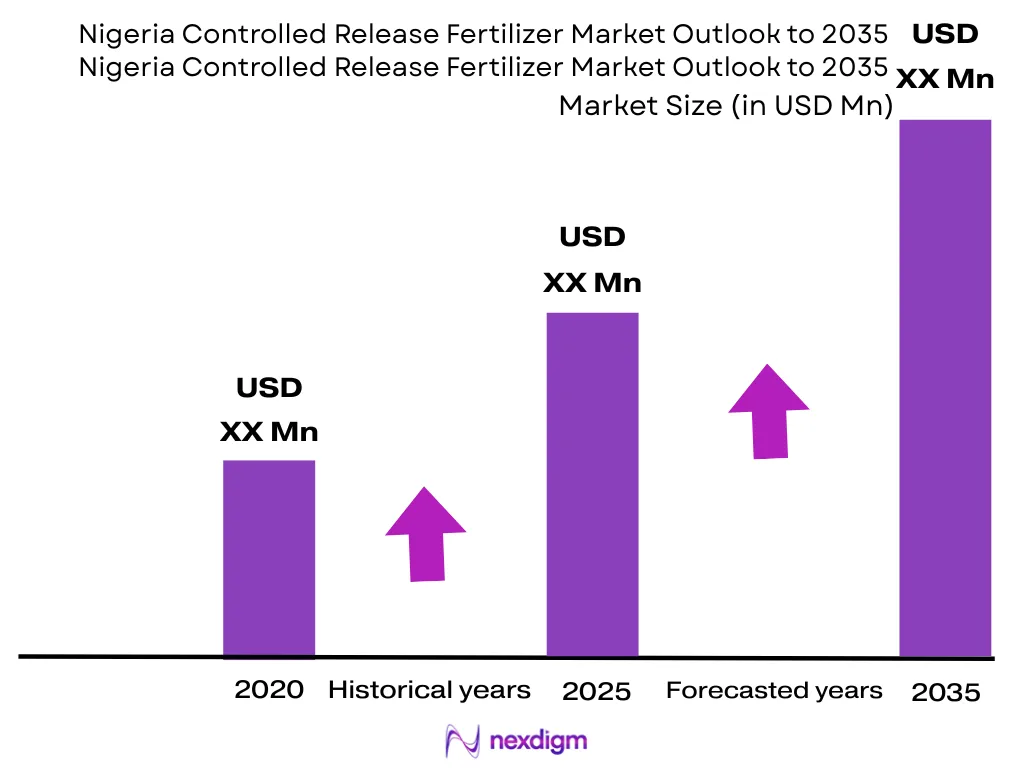
The Nigeria Controlled Release Fertilizer Market was valued at approximately USD ~ million in 2024, compared to USD ~ million in 2023, based on industry analysis of specialty fertilizer consumption, enhanced-efficiency fertilizer adoption, and agricultural input utilization trends. The market is driven by Nigeria’s large agricultural sector, which contributes over USD 70 billion to national economic activity and supports cultivation of maize, rice, cassava, sorghum, cocoa, and other crops. Government-backed fertilizer programs, increasing demand for higher crop productivity, and growing awareness regarding nutrient-use efficiency are accelerating adoption of controlled release fertilizer products across commercial and progressive farming operations.
Market Segmentation
By Nutrient Type
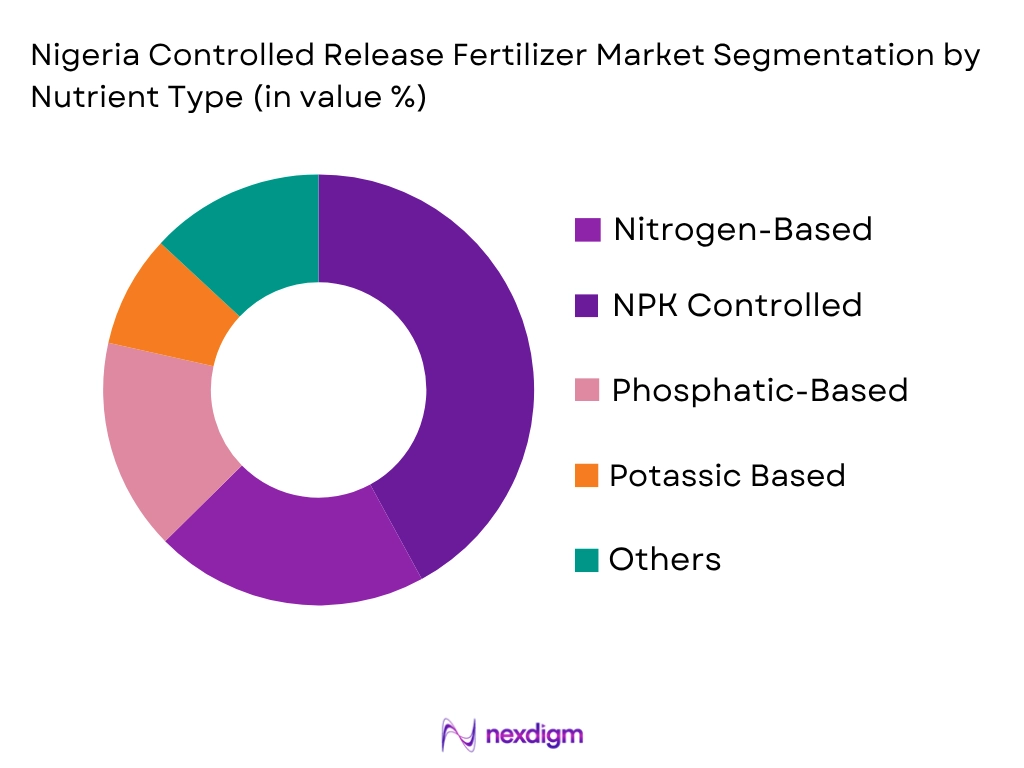
Nigeria Controlled Release Fertilizer Market is segmented by nutrient type into nitrogen-based, phosphatic, potassic, NPK, micronutrient-enriched, and multi-nutrient formulations. Recently, nitrogen-based controlled release fertilizers have held the dominant market share. Their leadership is linked to Nigeria’s heavy cultivation of nitrogen-intensive crops such as maize, rice, sorghum, and wheat. Farmers increasingly prefer nitrogen-controlled release products because they reduce nitrogen losses through leaching and volatilization while ensuring sustained nutrient availability throughout crop growth cycles. In addition, government-supported initiatives aimed at improving cereal productivity encourage adoption of advanced nitrogen fertilizers. Major suppliers continue introducing coated urea and slow-release nitrogen products designed for tropical farming conditions, further strengthening the segment’s position. The widespread need for yield improvement and fertilizer-use efficiency makes nitrogen-based products the preferred choice among commercial farms and large agricultural cooperatives.
By Crop Type
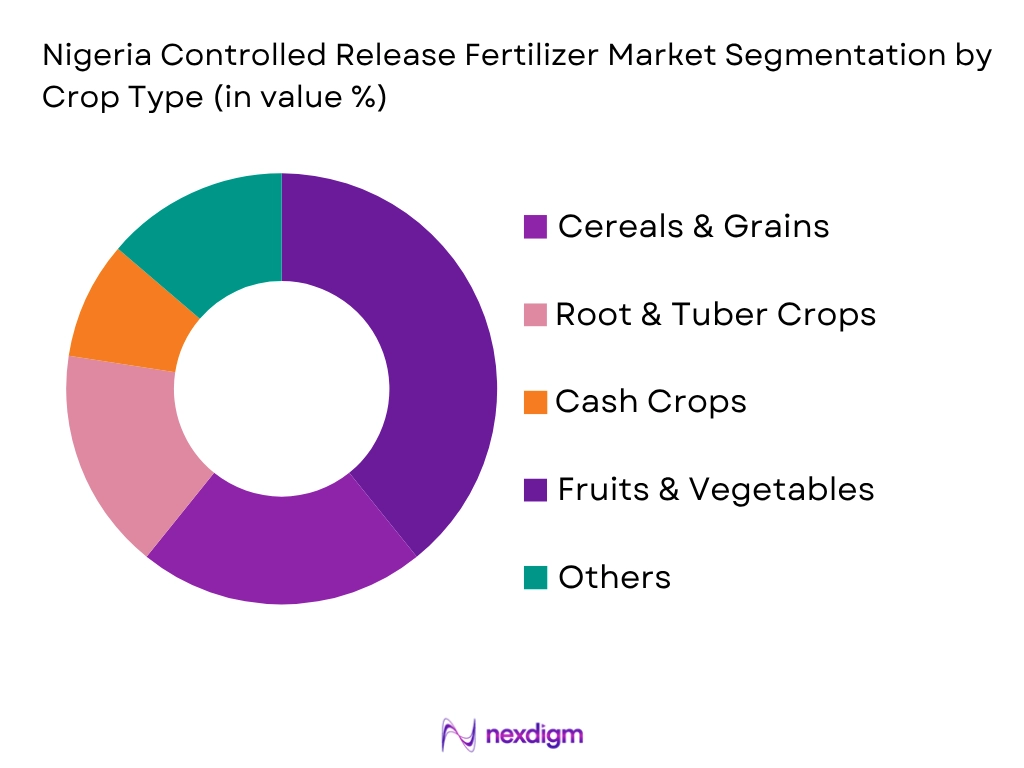
Nigeria Controlled Release Fertilizer Market is segmented by crop type into cereals and grains, root and tuber crops, cash crops, fruits and vegetables, plantation crops, and horticulture crops. Cereals and grains currently dominate the market due to their extensive cultivation across northern and central Nigeria. Crops such as maize, rice, millet, sorghum, and wheat require significant nutrient inputs to achieve commercial yields, making them primary consumers of controlled release fertilizers. Government food security programs and investments in domestic grain production continue to strengthen fertilizer demand within this segment. Controlled release fertilizers are increasingly preferred because they provide steady nutrient availability while reducing application frequency. Large-scale farming operations and commercial producers are also adopting these products to improve productivity and minimize nutrient losses. As cereal production remains a strategic priority for national food security, the segment continues to account for the largest share of controlled release fertilizer consumption.
Competitive Landscape
The Nigeria Controlled Release Fertilizer Market is moderately concentrated, with participation from domestic fertilizer manufacturers, blending companies, international specialty fertilizer suppliers, and agricultural input distributors. Large fertilizer producers leverage established distribution networks and government partnerships, while international players contribute advanced coating technologies and specialty nutrient formulations. Competition is increasingly centered on product innovation, nutrient efficiency, agronomic support services, and regional distribution capabilities.
| Company | Establishment Year | Headquarters | CRF Portfolio | Coating Technology Capability | Production Presence in Nigeria | Crop Focus | Distribution Strength | Sustainability Focus |
| Dangote Fertilizer | 2021 | ~ | ~ | ~ | ~ | ~ | ~ | ~ |
| Indorama Eleme | 2006 | ~ | ~ | ~ | ~ | ~ | ~ | ~ |
| Notore Chemical Industries | 2005 | ~ | ~ | ~ | ~ | ~ | ~ | ~ |
| OCP Africa Nigeria | 2016 | ~ | ~ | ~ | ~ | ~ | ~ | ~ |
| Yara International | 1905 | ~ | ~ | ~ | ~ | ~ | ~ | ~ |
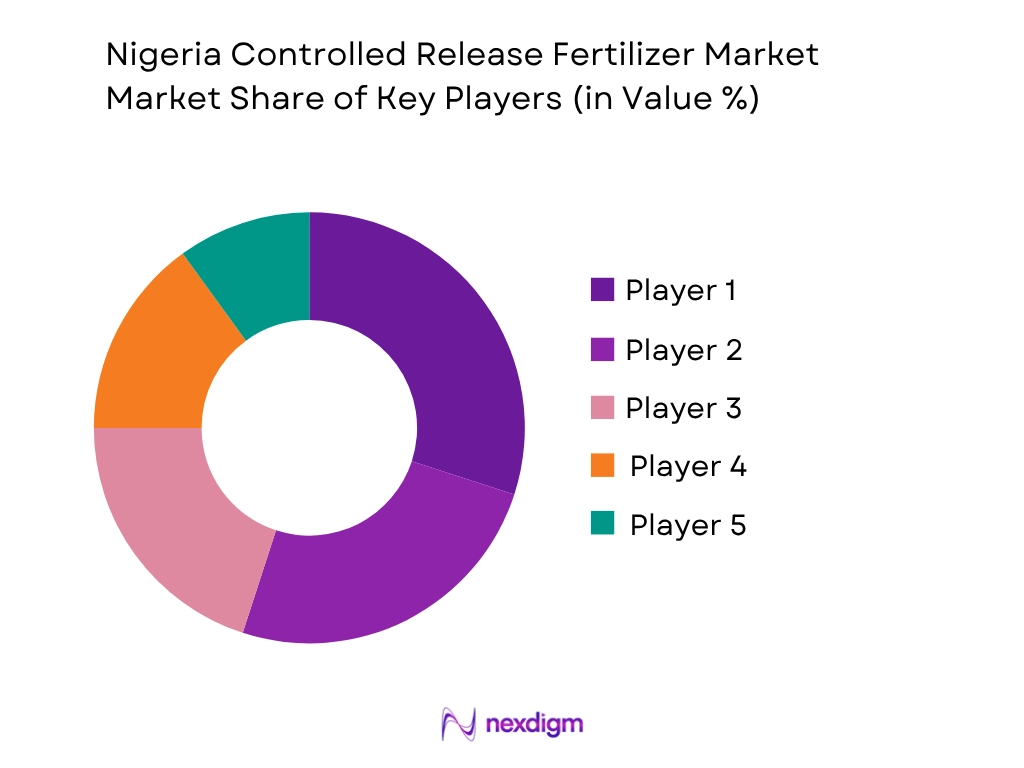
Nigeria Controlled Release Fertilizer Market Analysis
Growth Drivers
Expanding Agricultural Production and Food Security Requirements
Nigeria’s controlled release fertilizer market is being supported by the increasing scale of agricultural production and the country’s growing need to improve crop productivity. Agriculture contributed 28.65 of Nigeria’s GDP during Q3 2024 according to the National Bureau of Statistics (NBS), making it one of the largest economic sectors in the country. Nigeria’s population exceeded 230 million people in 2024, creating sustained pressure on domestic food production systems and increasing demand for efficient nutrient management technologies in farming. The World Bank reports that Nigeria possesses more than 34 million hectares of arable land, one of the largest agricultural land resources in Africa. Major staple crops including maize, rice, sorghum, cassava, and yam continue to require improved nutrient application efficiency to maintain yields amid land degradation and climate variability. According to the USDA, Nigeria’s corn production remained around 11 million metric tons during the 2024/25 season despite significant production challenges, highlighting the importance of productivity-enhancing agricultural inputs. Controlled release fertilizers help improve nutrient utilization while reducing nutrient losses through volatilization and leaching, making them increasingly relevant for commercial farming operations focused on yield optimization and sustainable land management. These agricultural fundamentals continue to create a strong foundation for adoption of advanced fertilizer technologies across Nigeria’s farming sector.
Rising Domestic Fertilizer Production Capacity and Supply Chain Development
Nigeria’s emergence as a major fertilizer-producing nation is creating favorable conditions for the controlled release fertilizer market. According to Africa Fertilizer statistics, Nigeria produced approximately 4.18 million metric tons of urea in 2024, representing the highest production level recorded in the country. The expansion of domestic production facilities has strengthened fertilizer availability while improving the technical capabilities of the broader fertilizer industry. Nigeria exported fertilizer products to more than 100 international destinations during 2024, demonstrating the scale and maturity of its manufacturing infrastructure. In addition, expanded NPK blending activities across the country have increased industry expertise in customized fertilizer formulations. According to United Nations COMTRADE data, Nigeria also imported fertilizer products valued at USD 244.74 million during 2024, indicating continued investment in diversified fertilizer inputs and technologies. The presence of large-scale production facilities, blending plants, logistics networks, and distribution channels creates an ecosystem that supports the development and commercialization of value-added products such as controlled release fertilizers. As domestic manufacturers continue investing in product differentiation and nutrient efficiency solutions, controlled release fertilizer products are becoming increasingly viable for both commercial agriculture and high-value crop cultivation throughout Nigeria.
Market Challenges
Limited Fertilizer Application Intensity Across Farmland
A significant challenge for the controlled release fertilizer market is the relatively low intensity of fertilizer use across Nigeria’s agricultural land. According to World Bank and FAO data, fertilizer consumption in Nigeria amounted to approximately 4.24 kilograms per hectare of arable land in the latest available reporting period. This level remains substantially below application rates observed in many emerging agricultural economies. The low adoption intensity reflects several structural constraints including limited access to modern agricultural inputs, fragmented farm ownership patterns, and financial limitations among smallholder farmers who dominate agricultural production. Nigeria’s agricultural workforce accounts for a large share of rural employment, yet many farms operate on small landholdings where purchasing advanced fertilizer products can be challenging. Controlled release fertilizers generally require greater technical understanding regarding nutrient management and crop-specific application strategies. Consequently, farmers accustomed to conventional fertilizer products may be hesitant to transition without adequate extension support and demonstration programs. The persistence of low fertilizer application rates indicates that significant educational and infrastructure barriers must be addressed before advanced nutrient technologies can achieve widespread adoption across Nigeria’s agricultural landscape.
Dependence on Imported Raw Materials and Supply Vulnerability
Despite strong domestic urea production, Nigeria’s fertilizer sector remains dependent on imported raw materials used in specialty fertilizer manufacturing and nutrient blending. According to United Nations COMTRADE data, Nigeria imported fertilizers worth USD 244.74 million during 2024. Additional trade data indicate fertilizer imports from Russia alone reached USD 59.1 million in 2024. Industry reports further show that more than half of fertilizer imports were received during the first six months of 2024, highlighting the importance of international supply chains for domestic fertilizer availability. Controlled release fertilizers often require specialized coating materials, polymers, micronutrients, and advanced processing technologies that may not be fully available through local sourcing channels. Dependence on imported inputs exposes manufacturers to foreign exchange volatility, shipping disruptions, geopolitical risks, and fluctuations in global commodity markets. These factors can complicate production planning and create uncertainty for suppliers seeking to expand controlled release fertilizer offerings. Maintaining stable access to critical raw materials therefore remains an important challenge for the long-term development of Nigeria’s controlled release fertilizer industry.
Market Opportunities
Increasing Demand for Precision Agriculture and Nutrient Efficiency Technologies
Nigeria’s agricultural sector presents substantial opportunities for controlled release fertilizer adoption through the growing focus on precision farming and efficient nutrient management. The country’s large agricultural base, comprising more than 34 million hectares of arable land according to World Bank data, creates significant potential for technologies that improve nutrient-use efficiency. At the same time, concerns regarding soil fertility decline and climate-related production risks are encouraging farmers to adopt solutions that maximize crop output from existing farmland. Controlled release fertilizers align closely with these objectives because they provide gradual nutrient release and reduce nutrient losses. Nigeria’s fertilizer industry has already demonstrated strong manufacturing capability through urea production exceeding 4 million metric tons during 2024. This industrial capacity provides a platform for innovation into higher-value specialty fertilizer products. Furthermore, government initiatives focused on food security and agricultural productivity continue to encourage the adoption of technologies capable of improving farm performance. As commercial farming operations expand and agribusiness investments increase, demand for precision nutrient solutions is expected to strengthen across cereal, horticulture, plantation, and export-oriented crop segments.
Expansion of Commercial Farming and Export-Oriented Agriculture
Commercial agriculture is becoming increasingly important in Nigeria as producers seek to improve productivity and meet growing domestic and international demand for agricultural products. Agriculture employs nearly 70 million workers according to FAO and NBS-based assessments, making it one of the largest employment sectors in the country. Nigeria’s fertilizer industry exported products to over 100 countries during 2024, demonstrating strong integration with international agricultural supply chains. The development of large-scale farming operations, agro-industrial projects, and contract farming systems is creating demand for advanced crop nutrition solutions that deliver consistent performance. Controlled release fertilizers are particularly suited to commercial farms because they reduce application frequency, improve nutrient management efficiency, and support higher-value crop production systems. In addition, increasing investment in irrigation infrastructure and mechanized farming practices is enhancing the feasibility of precision input management. As Nigeria continues strengthening its position within regional and global agricultural markets, producers are likely to prioritize technologies that improve crop quality, resource efficiency, and operational productivity, creating favorable conditions for sustained growth in the controlled release fertilizer segment.
Future Outlook
The Nigeria Controlled Release Fertilizer Market is expected to witness significant expansion through the forecast period, supported by increasing agricultural modernization, rising food security requirements, and stronger adoption of enhanced-efficiency fertilizers. Government initiatives promoting fertilizer accessibility, combined with growing awareness of nutrient management practices, are expected to encourage market penetration. Expansion of commercial farming, improved irrigation infrastructure, and rising cultivation of high-value crops will further strengthen demand. Technological advancements in coating materials and precision agriculture solutions are also expected to support broader adoption across Nigeria’s agricultural landscape.
Major Players
- Dangote Fertilizer Limited
- Indorama Eleme Fertilizer & Chemicals Limited
- Notore Chemical Industries Plc
- OCP Africa Nigeria
- Yara International
- Golden Fertilizer Company Limited
- Springfield Agro Limited
- TAK Agro Plc
- WACOT Limited
- Harvestfield Industries Limited
- Candel Company Limited
- Matrix Fertilizer Limited
- AgroMall Discovery and Extension Limited
- Jubilant Agri Solutions
- FEPSAN Member Companies
Key Target Audience
- Fertilizer Manufacturers
- Specialty Fertilizer Importers and Distributors
- Commercial Farming Enterprises
- Agricultural Cooperatives
- Plantation and Cash Crop Producers
- Investments and Venture Capitalist Firms
- Government and Regulatory Bodies (Federal Ministry of Agriculture and Food Security, National Agricultural Seeds Council, Standards Organisation of Nigeria)
- Agricultural Input Retailers and Agro-Dealer Networks
Research Methodology
Step 1: Identification of Key Variables
The research process begins with identification of key market variables influencing the Nigeria Controlled Release Fertilizer Market. This includes analysis of fertilizer consumption patterns, agricultural production trends, nutrient management practices, government support programs, and specialty fertilizer adoption levels. Secondary research is conducted using industry publications, government databases, trade statistics, and agricultural reports.
Step 2: Market Analysis and Construction
Historical market information is collected and analyzed to stablish market structure and revenue contribution by segment. Product penetration rates, fertilizer utilization patterns, crop-specific nutrient requirements, and regional agricultural activity are assessed. The collected information forms the foundation for estimating market size and segment shares.
Step 3: Hypothesis Validation and Expert Consultation
Preliminary findings are validated through consultations with fertilizer manufacturers, distributors, agronomists, agricultural cooperatives, and industry experts. Insights obtained through structured interviews help refine assumptions related to market demand, product adoption trends, and competitive dynamics.
Step 4: Research Synthesis and Final Output
The final stage integrates findings from primary and secondary research sources. Data triangulation techniques are applied to ensure consistency and accuracy of market estimates. Segment-level analysis, competitive assessment, and forecast models are then developed to provide a comprehensive view of the Nigeria Controlled Release Fertilizer Market.

- Executive Summary
- Research Methodology (Market Definitions and Assumptions, Abbreviations, Market Sizing Approach, Top-Down Analysis, Bottom-Up Analysis, Demand-Side Assessment, Supply-Side Assessment, Primary Industry Interviews, Data Triangulation, Forecasting Framework, Limitations and Future Conclusions)

- Definition and Scope
- Market Evolution and Industry Genesis
- Timeline of Major Industry Developments
- Nigeria Agricultural Input Ecosystem Analysis
- Fertilizer Industry Value Chain Analysis

- Growth Drivers (Expansion of Rice and Maize Cultivation, Government Fertilizer Intervention Programs, Rising Demand for Nutrient Use Efficiency, Growth in Commercial Agriculture, Increasing Adoption of Precision Farming)
- Market Challenges (High Dependence on Imported Coating Technologies, Low Farmer Awareness, Foreign Exchange Volatility, Distribution Network Constraints, Counterfeit Fertilizer Availability)
- Market Opportunities (Expansion of Specialty Crop Farming, Development of Domestic Controlled Release Fertilizer Manufacturing, Sustainable Agriculture Initiatives, Fertigation Adoption, Climate-Smart Farming Practices)
- Market Trends (Polymer-Coated Fertilizer Adoption, Integration with Precision Agriculture, Customized Nutrient Formulations, Bio-Based Coating Technologies, Smart Nutrient Management Solutions)
- Government Regulations (National Fertilizer Quality Control Act, Presidential Fertilizer Initiative Framework, Federal Ministry of Agriculture Standards, SON Quality Regulations, Environmental Compliance Requirements)
- PESTLE Analysis
- Porter’s Five Forces Analysis
- SWOT Analysis
- Stakeholder Ecosystem
- Competition Ecosystem

- By Market Value (2020-2025)
- By Volume Consumption (2020-2025)
- By Average Selling Price (2020-2025)

- By Nutrient Type (In Value %)
Nitrogen-Based Controlled Release Fertilizers
Phosphatic Controlled Release Fertilizers
Potassic Controlled Release Fertilizers
NPK Controlled Release Fertilizers
Micronutrient-Enriched Controlled Release Fertilizers
Multi-Nutrient Controlled Release Fertilizers - By Coating Technology (In Value %)
Polymer-Coated Fertilizers
Sulfur-Coated Fertilizers
Resin-Coated Fertilizers
Bio-Based Coated Fertilizers
Hybrid Coated Fertilizers - By End User (In Value %)
Smallholder Farmers
Commercial Farms
Plantation Operators
Agricultural Cooperatives
Government Agricultural Programs
Contract Farming Organizations - By Crop Type (In Value %)
Cereals and Grains (Maize, Rice, Sorghum, Millet)
Cash Crops (Cocoa, Cotton, Sesame, Cashew)
Fruits and Vegetables
Root and Tuber Crops (Cassava, Yam, Potato)
Plantation Crops
Horticulture and Greenhouse Crops - By Application Method (In Value %)
Soil Application
Fertigation
Foliar Integrated Nutrient Programs
Precision Agriculture Application
Seed Treatment and Starter Application

- Market Share of Major Players (By Value, Volume, Nutrient Type, Crop Segment, Coating Technology)
- Cross Comparison Parameters (Product Portfolio Diversity, Controlled Release Fertilizer Production Capacity, Coating Technology Portfolio, Distribution Network Reach, Agro-Dealer Coverage, Crop-Specific Product Offerings, R&D and Product Innovation Capability, Strategic Partnerships and Government Program Participation)
- SWOT Analysis of Major Players
- Pricing Analysis by Nutrient Grade and Product Grade
- Detailed Profiles of Major Companies
Dangote Fertilizer Limited
Indorama Eleme Fertilizer & Chemicals Limited
Notore Chemical Industries Plc
OCP Africa Nigeria
Fertilizer Producers and Suppliers Association of Nigeria (FEPSAN)
Golden Fertilizer Company Limited
Springfield Agro Limited
TAK Agro Plc
WACOT Limited
Jubilant Agri and Consumer Products Nigeria
Harvestfield Industries Limited
Candel Company Limited
AgroMall Discovery and Extension Limited
Matrix Fertilizer Limited
Yara International

- Fertilizer Consumption Patterns by Farm Size
- Crop-Wise Nutrient Requirement Analysis
- Farmer Purchasing Power Assessment
- Government Subsidy Utilization Analysis
- Adoption Barriers and Pain Point Assessment

- By Market Value (2026-2035)
- By Volume Consumption (2026-2035)
- By Average Selling Price (2026-2035)


 Request a Sample
 Ask for Customization
 Get a Quote
 Enquire Now