

 Download PDF
 Download PDF
Market Overview
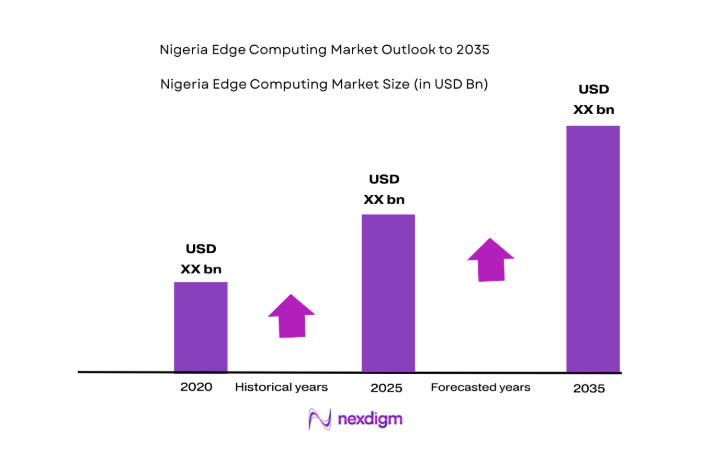
Nigeria’s edge computing market reached approximately USD ~ million based on a recent historical assessment, driven by expanding mobile broadband traffic exceeding ~ petabytes monthly and telecom capital expenditure surpassing USD ~ billion reported by the Nigerian Communications Commission. Increasing deployment of localized data processing for financial transactions exceeding USD ~ billion annually and rising IoT endpoints across oil and gas operations exceeding ~ connected assets have accelerated adoption of distributed computing infrastructure across telecom, energy, and banking sectors.
Lagos dominates Nigeria’s edge computing deployments due to hosting over ~ percent of the nation’s commercial data center capacity exceeding 60 MW and serving as headquarters for major telecom operators and financial institutions processing over USD ~ billion digital payments annually. Abuja follows with strong government digital infrastructure investments and smart surveillance networks, while Port Harcourt leads in industrial edge adoption linked to oil and gas production assets valued above USD ~ billion requiring real-time analytics and remote monitoring.
Market Segmentation
By Product Type
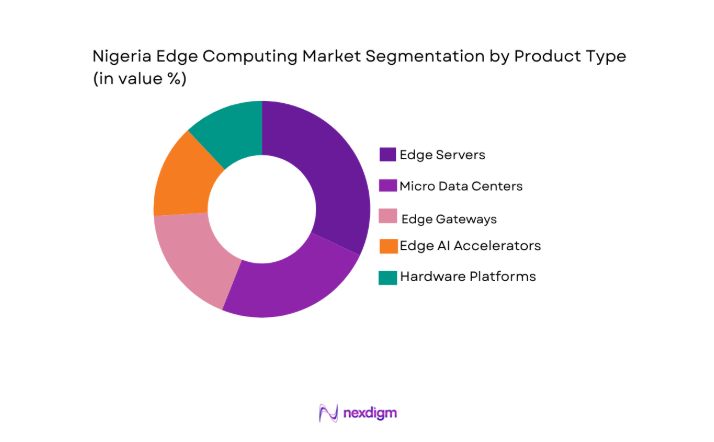
Nigeria edge computing market is segmented by product type into hardware platforms, edge servers, micro data centers, edge gateways, and edge AI accelerators. Recently, edge servers have a dominant market share due to factors such as telecom network expansion, enterprise data localization requirements, hyperscale cloud partnerships, and financial sector latency sensitive workloads. Operators prefer carrier grade edge servers supporting virtualization and MEC integration, while banks and content providers deploy them for transaction processing and content caching across urban connectivity hubs.
By Platform Type
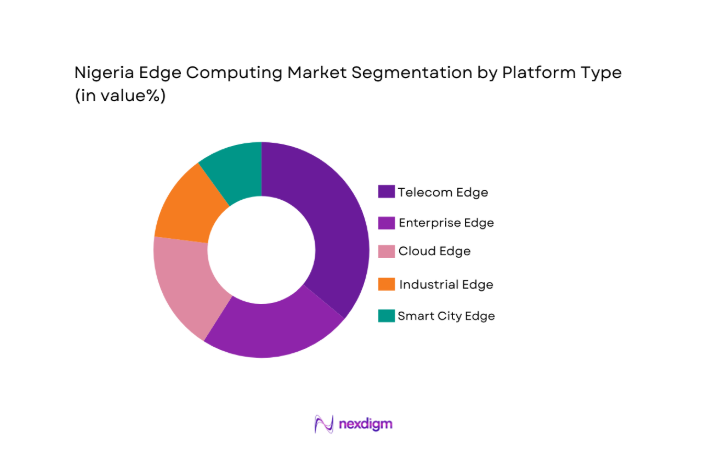
Nigeria edge computing market is segmented by platform type into. telecom edge, enterprise edge, cloud edge, industrial edge, and smart city edge Recently, telecom edge has a dominant market share due to factors such as nationwide 4G and emerging 5G rollout, mobile data traffic concentration, operator owned infrastructure, and MEC deployment strategies. Telecom operators integrate edge nodes into base station aggregation sites enabling low latency services, content delivery, and network virtualization across metropolitan corridors and high density subscriber clusters.
Competitive Landscape
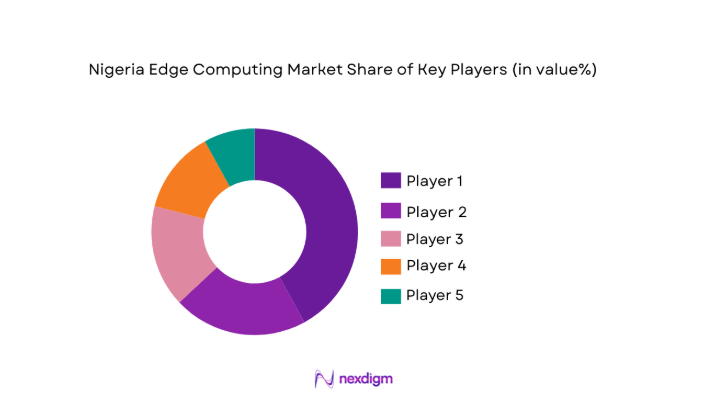
Nigeria’s edge computing market shows moderate consolidation led by telecom operators, data center providers, and global technology vendors forming infrastructure partnerships. Multinational hardware and cloud companies supply edge platforms while local operators control network proximity assets and enterprise relationships. Strategic alliances between telecom carriers and hyperscale cloud providers are expanding MEC deployments, while industrial technology firms target energy and manufacturing sectors. Competition focuses on latency performance, deployment scale, and managed service capabilities.
| Company Name | Establishment Year | Headquarters | Technology Focus | Market Reach | Key Products | Revenue | Edge Deployment Footprint |
| MTN Nigeria | 2001 | Lagos, Nigeria | ~ | ~ | ~ | ~ | ~ |
| Globacom | 2003 | Lagos, Nigeria | ~ | ~ | ~ | ~ | ~ |
| Airtel Nigeria | 2010 | Lagos, Nigeria | ~ | ~ | ~ | ~ | ~ |
| Rack Centre | 2013 | Lagos, Nigeria | ~ | ~ | ~ | ~ | ~ |
| MainOne | 2010 | Lagos, Nigeria | ~ | ~ | ~ | ~ | ~ |
Nigeria Edge Computing Market Analysis
Growth Drivers
5G and Mobile Data Traffic Expansion Driving Low Latency Infrastructure Demand
Nigeria’s rapid growth in mobile broadband consumption exceeding hundreds of petabytes monthly has fundamentally shifted network architecture requirements toward distributed processing close to users and devices, creating strong demand for edge computing infrastructure across telecom aggregation points and enterprise sites. Telecom operators are expanding fiber backhaul networks across metropolitan regions and deploying 5G capable radio infrastructure, which inherently requires multi access edge computing nodes to support latency sensitive applications such as video streaming, fintech transactions, augmented reality services, and enterprise virtualization workloads. Financial services institutions processing digital payments volumes exceeding hundreds of billions of dollars annually require localized compute nodes to reduce transaction latency, improve fraud detection speeds, and maintain compliance with national data localization policies, further reinforcing enterprise edge deployment. Content providers and streaming platforms serving tens of millions of mobile users increasingly rely on caching and content delivery edge nodes embedded within operator networks to maintain quality of experience amid bandwidth constraints and international transit costs. Industrial sectors including oil and gas are integrating IoT sensors across pipelines, drilling equipment, and production facilities generating continuous telemetry streams that must be processed locally due to connectivity variability in remote regions, strengthening the business case for ruggedized industrial edge systems. Government digital infrastructure initiatives focused on smart surveillance, e governance, and national identity systems are also driving deployment of localized computing nodes across urban administrative centers to support real time analytics and secure data handling. Global cloud providers are forming partnerships with Nigerian telecom and data center operators to extend hybrid cloud services through localized edge zones, accelerating enterprise adoption by enabling consistent cloud architectures with low latency access. Declining hardware costs for compact edge servers and virtualization platforms are lowering entry barriers for mid sized enterprises, expanding market penetration beyond large corporations and telecom operators. The convergence of telecom, cloud, and enterprise IT ecosystems around distributed architectures has therefore positioned edge computing as a foundational infrastructure layer supporting Nigeria’s digital economy expansion.
Enterprise and Industrial Digitalization Requiring LowLatency Processing
Nigerian enterprises across banking, oil and gas, manufacturing, and logistics sectors are increasingly digitizing operations through automation, sensor integration, and real-time analytics platforms that depend on immediate data processing at the point of generation. Industrial facilities require localized compute to monitor equipment conditions, optimize production processes, and maintain safety compliance in environments where network disruptions or latency could cause operational risk or downtime. Financial institutions are deploying edge systems within branches and regional hubs to support secure transaction processing, fraud detection, and customer analytics while maintaining data residency compliance and service continuity. Retail chains and logistics providers similarly use edge nodes for inventory tracking, smart surveillance, and demand forecasting applications that rely on instant processing rather than centralized cloud latency. The proliferation of IoT sensors across oil fields, pipelines, and manufacturing plants is generating large volumes of telemetry data that must be filtered and analyzed locally to reduce bandwidth costs and improve response time to anomalies. Edge platforms also support AI inference workloads such as video analytics, predictive maintenance, and operational optimization, enabling enterprises to derive insights directly at operational sites. As Nigerian organizations adopt hybrid IT architectures combining on-premise and cloud resources, edge computing becomes a bridging layer that ensures responsiveness while integrating with centralized analytics environments. This enterprise-driven demand is fostering partnerships between system integrators, telecom providers, and hardware vendors to deliver turnkey edge deployments tailored to sector-specific operational requirements.
Market Challenges
Power Infrastructure Instability and High Energy Costs Limiting Edge Deployment Scalability
Nigeria’s electricity reliability challenges, characterized by frequent grid outages and heavy reliance on diesel backup generation, significantly increase operational expenditure for edge computing infrastructure that requires continuous uptime and stable environmental conditions across distributed sites. Edge nodes deployed in telecom towers, enterprise campuses, and industrial facilities must maintain uninterrupted power supply, often necessitating redundant battery systems and generator integration, which raises capital and maintenance costs compared with centralized data centers located in optimized facilities. Fuel price volatility and logistics constraints further elevate long term operational costs for remote industrial and rural edge deployments, undermining economic viability for latency driven use cases outside major urban regions. Thermal management requirements in high temperature climates demand additional cooling infrastructure, increasing energy consumption and hardware stress, thereby shortening equipment lifespan and raising replacement cycles. Limited availability of standardized edge ready facilities across secondary cities restricts geographic scalability of distributed computing architectures and concentrates deployments within major metropolitan corridors. Small and medium enterprises face financial barriers in adopting edge systems due to combined costs of hardware, power conditioning, site preparation, and network integration, slowing broader market penetration. Telecom operators must also balance investments between core network upgrades, fiber expansion, and edge infrastructure, creating capital allocation pressures that delay widespread MEC rollout. Regulatory uncertainties around energy tariffs and infrastructure permits further complicate deployment planning timelines for distributed sites. Consequently, despite strong demand drivers, infrastructure and energy constraints remain a primary barrier shaping deployment density, cost structures, and long term sustainability of Nigeria’s edge computing market expansion.
Limited Local Manufacturing and Import Dependence for Edge Hardware
Nigeria’s edge computing ecosystem relies heavily on imported servers, networking equipment, and modular data center components, exposing deployments to supply chain disruptions, currency fluctuations, and extended procurement cycles. Most advanced edge platforms are produced by global vendors outside the region, requiring international logistics and foreign exchange expenditure that increase project costs and lead times. Currency depreciation amplifies capital requirements for infrastructure providers and enterprises planning distributed deployments, often delaying expansion decisions or scaling plans. Limited domestic electronics manufacturing capacity prevents localization of key hardware components such as processors, storage systems, and cooling modules, constraining the development of cost-optimized solutions tailored to local conditions. Maintenance and spare parts availability also depend on imports, increasing downtime risks and service expenses when failures occur at remote sites. Regulatory import processes and tariffs can further extend deployment timelines, affecting time-sensitive projects such as telecom network upgrades or industrial automation initiatives. Local integrators and assemblers exist but typically rely on imported core technologies, limiting value-chain depth within the country. This structural dependence reduces competitiveness compared with regions possessing stronger domestic hardware ecosystems. Until local assembly or regional manufacturing capabilities expand, Nigeria’s edge infrastructure growth remains vulnerable to external supply and currency pressures.
Opportunities
Industrial IoT and Energy Sector Digitalization Creating High Value Edge Deployment Use Cases
Nigeria’s oil and gas industry, valued in hundreds of billions of dollars and operating across geographically dispersed offshore and onshore assets, presents substantial opportunity for industrial edge computing systems capable of processing sensor data locally for predictive maintenance, safety monitoring, and production optimization in connectivity constrained environments. Upstream facilities generate continuous streams of equipment telemetry, seismic data, and environmental measurements that require immediate processing to prevent operational disruptions, making ruggedized edge servers and gateways essential components of digital oilfield architectures. Refineries and downstream distribution networks are also adopting real time monitoring systems for pipeline integrity and logistics coordination, further expanding industrial edge deployment demand. Manufacturing sectors in industrial zones such as Ogun and Lagos corridors are implementing automation, machine vision inspection, and robotics systems that depend on low latency local computing to maintain production efficiency and quality assurance. Smart grid modernization initiatives across Nigeria’s power distribution networks require distributed analytics nodes for load forecasting, outage detection, and grid balancing across substations and feeder lines. Transportation infrastructure including ports and logistics hubs are integrating surveillance analytics and asset tracking systems supported by localized edge processing to improve operational throughput. Industrial enterprises prioritize on premises processing for sensitive operational data and cybersecurity control, aligning with edge computing architectures. Technology vendors are therefore targeting industrial verticals with specialized rugged hardware, industrial protocols, and AI analytics software tailored to energy and manufacturing environments. The scale and mission critical nature of Nigeria’s industrial economy positions industrial edge computing as one of the most financially attractive and sustainable growth avenues within the broader national edge infrastructure market.
Localized Cloud and Content Delivery Expansion Across Secondary Cities
As digital services penetration spreads beyond Lagos and Abuja into emerging urban centers, there is growing demand for localized computing infrastructure that can deliver cloud applications and digital content with minimal latency and reliable performance. Streaming media, online gaming, e-commerce platforms, and fintech services require distributed edge nodes to maintain user experience quality in cities distant from core data center hubs. Telecom operators and data center providers are expanding micro data center footprints into regional aggregation points to cache content and host localized cloud workloads. Enterprises in secondary cities increasingly adopt SaaS and digital platforms that benefit from nearby compute resources, stimulating regional edge deployment. Government digital inclusion programs and broadband expansion initiatives are also extending connectivity coverage, indirectly increasing demand for localized compute layers. Edge-enabled CDN infrastructure allows efficient delivery of video and software updates while reducing backbone congestion and transit costs. As user bases grow across regional markets, service providers gain incentives to position compute closer to demand clusters. This geographic decentralization of digital services creates a long-term opportunity for modular and scalable edge deployments across Nigeria’s expanding urban network.
Future Outlook
Nigeria’s edge computing market is expected to expand steadily over the next five years supported by telecom 5G evolution, enterprise digitalization, and industrial IoT adoption. Increasing partnerships between telecom operators and cloud providers will extend localized computing zones across major cities. Government smart infrastructure and surveillance programs will further stimulate deployments. Improvements in fiber connectivity and data center ecosystems will gradually enable broader geographic expansion beyond core urban hubs.
Major Players
- MTN Nigeria
- Globacom
- Airtel Nigeria
- Rack Centre
- MainOne
- Huawei Nigeria
- Ericsson Nigeria
- Nokia Nigeria
- Dell Technologies Nigeria
- Hewlett Packard Enterprise Nigeria
- IBM Nigeria
- Microsoft Nigeria
- Schneider Electric Nigeria
- Siemens Nigeria
- Layer3
Key Target Audience
- Telecom operators
- Cloud service providers
- Oil and gas companies
- Financial institutions
- Manufacturing enterprises
- Smart city authorities
- Investments and venture capitalist firms
- Government and regulatory bodies
Research Methodology
Step 1: Identification of Key Variables
Key supply and demand variables including telecom infrastructure density, data traffic volumes, enterprise digitalization levels, industrial IoT adoption, and data center capacity were identified to frame the Nigeria edge computing market structure and deployment drivers.
Step 2: Market Analysis and Construction
Market size and segmentation were constructed using telecom investment data, data center capacity benchmarks, enterprise IT spending patterns, and infrastructure deployment indicators across telecom, financial, and industrial sectors.
Step 3: Hypothesis Validation and Expert Consultation
Industry assumptions regarding adoption drivers, deployment economics, and technology trends were validated through vendor insights, operator strategies, and infrastructure investment patterns observed across Nigeria’s digital ecosystem.
Step 4: Research Synthesis and Final Output
Validated data and qualitative insights were synthesized into market sizing, segmentation, competitive landscape, and forward outlook assessments to produce a comprehensive Nigeria edge computing market analysis.

- Executive Summary
- Research Methodology (Definitions, Scope, Industry Assumptions, Market Sizing Approach, Primary & Secondary Research Framework, Data Collection & Verification Protocol, Analytic Models & Forecast Methodology, Limitations & Research Validity Checks)

- Market Definition and Scope
- Value Chain & Stakeholder Ecosystem
- Regulatory / Certification Landscape
- Sector Dynamics Affecting Demand
- Strategic Initiatives & Infrastructure Growth

- Growth Drivers
Expansion of 5G and Fiber Connectivity Infrastructure
Rising Data Localization and Sovereignty Requirements
Growth in IoT Adoption Across Industry Verticals
Increasing Demand for Low Latency Digital Services
Expansion of Smart City and Surveillance Programs - Market Challenges
Power Reliability and Energy Cost Constraints
Limited Edge Ready Data Center Footprint
Cybersecurity and Physical Security Risks
High Import Dependence for Hardware Components
Skills Gap in Distributed IT Infrastructure Management - Market Opportunities
Edge Enablement for Oil and Gas Digitalization
Localized Cloud and CDN Expansion in Tier2 Cities
AI Driven Video Analytics at Network Edge - Trends
Integration of Edge with Telecom Core Networks
Adoption of Micro Modular Data Centers
Growth of Private Edge for Enterprises
AI and GPU Acceleration at Edge Sites
Partnerships Between Telcos and Cloud Providers - Government Regulations & Defense Policy
Nigeria Data Protection and Privacy Compliance Requirements
Telecommunications Infrastructure Licensing Policies
National Digital Economy and Broadband Strategies - SWOT Analysis
- Stakeholder and Ecosystem Analysis
- Porter’s Five Forces Analysis
- Competition Intensity and Ecosystem Mapping

- By Market Value, 2020-2025
- By Installed Units, 2020-2025
- By Average System Price, 2020-2025
- By System Complexity Tier, 2020-2025

- By System Type (In Value%)
Edge Servers
Micro Data Centers
Edge Gateways
Edge Management Platforms
Edge Security Appliances - By Platform Type (In Value%)
Telecom Network Edge
Enterprise IT Edge
Industrial IoT Edge
Smart City Edge
Content Delivery Edge - By Fitment Type (In Value%)
On Premise Edge Nodes
Network Edge Deployments
Far Edge Devices
Hybrid Edge Architectures
Containerized Edge Units - By End User Segment (In Value%)
Telecom Operators
Oil and Gas Companies
Banking and Financial Services
Manufacturing and Logistics Firms
Government and Public Sector Agencies - By Procurement Channel (In Value%)
Direct OEM Procurement
Telecom Operator Managed Services
System Integrator Contracts
Cloud Marketplace Procurement
Government Tender Programs - By Material / Technology (in Value %)
ARM Based Edge Processors
x86 Edge Compute Platforms
GPU Accelerated Edge Systems
FPGA Enabled Edge Hardware
LiquidCooled Edge Infrastructure

- Market structure and competitive positioning
Market share snapshot of major players - Cross Comparison Parameters (Deployment Scale, Edge Hardware Portfolio, Telecom Integration Capability, Local Data Center Presence, Managed Services Offering)
- SWOT Analysis of Key Competitors
- Pricing & Procurement Analysis
- Key Players
MainOne Data Centers
Rack Centre
MTN Nigeria
Airtel Nigeria
Huawei Technologies Nigeria
Cisco Systems Nigeria
Dell Technologies Nigeria
Hewlett Packard Enterprise Nigeria
Nokia Nigeria
Zinox Technologies
Layer3
Galaxy Backbone
Internet Solutions Nigeria
Cloudflex Computing Services
WIOCC Nigeria

- Telecom operators deploying distributed edge to support 5G and content delivery
- Oil and gas sector using edge for remote monitoring and safety analytics
- Banks adopting edge for secure transaction processing and branch digitization
- Public sector leveraging edge for surveillance and smart infrastructure

- Forecast Market Value, 2026-2035
- Forecast Installed Units, 2026-2035
- Price Forecast by System Tier, 2026-2035
- Future Demand by Platform, 2026-2035


 Request a Sample
 Ask for Customization
 Get a Quote
 Enquire Now