
 Download PDF
 Download PDF
Market Overview
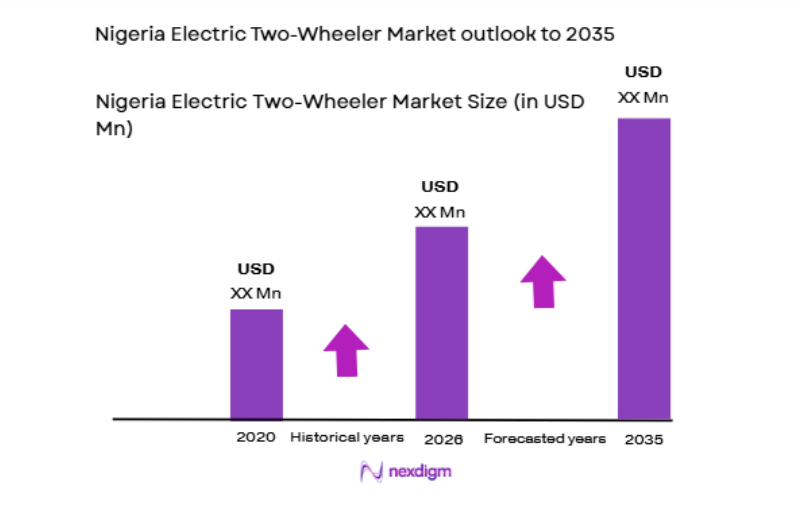
Nigeria’s electric two-wheeler market has begun expanding as part of the broader transition toward sustainable mobility solutions, with a recent historical assessment indicating a market valuation of approximately USD ~ million based on electric mobility deployment data compiled by the International Energy Agency and regional transport electrification programs supported by the African Development Bank. Market expansion is driven by increasing fuel costs, rising demand for affordable urban mobility solutions, and growing investment in clean transportation technologies across emerging African economies.
Lagos, Abuja, and Kano represent the most influential urban centers shaping the Nigeria electric two-wheeler market due to strong demand for last-mile mobility, expanding urban populations, and high motorcycle usage for commercial transportation services. Lagos dominates adoption because of its dense traffic conditions and widespread use of motorcycles for urban commuting, while Abuja benefits from government-supported mobility innovation programs. Kano’s large population and expanding commercial delivery ecosystem also encourage growing adoption of electric two-wheelers.
Market Segmentation
By Product Type
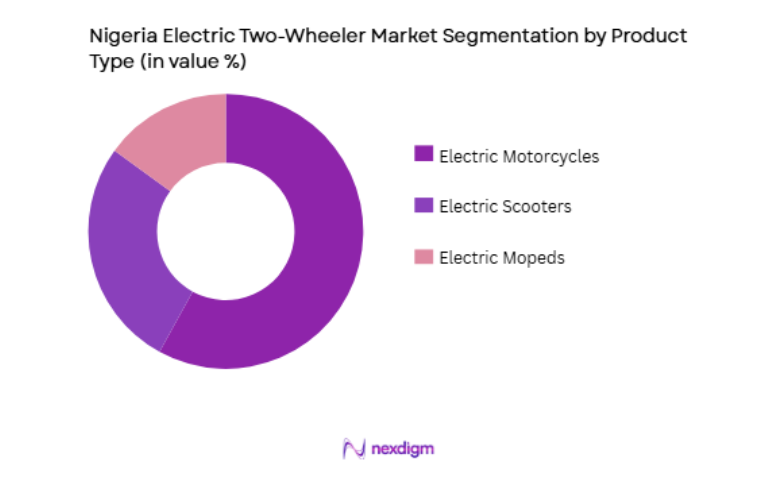
Nigeria Electric Two-Wheeler Market is segmented by product type into electric motorcycles, electric scooters, and electric mopeds. Recently, electric motorcycles have a dominant market share due to factors such as strong demand from commercial transport riders, greater power capacity, and compatibility with long-distance urban mobility requirements. Commercial motorcycle operators, commonly used for ride-hailing and last-mile passenger services, prefer electric motorcycles because they provide longer travel ranges and better durability for daily intensive use. Additionally, logistics and delivery companies operating within urban areas increasingly adopt electric motorcycles to reduce fuel expenses and maintenance costs while improving operational efficiency. Government interest in promoting cleaner urban transport also supports pilot programs deploying electric motorcycles for commercial mobility fleets. As battery performance improves and charging infrastructure gradually expands, electric motorcycles continue to dominate electric two-wheeler adoption across Nigeria’s growing urban mobility ecosystem.
By Battery Type
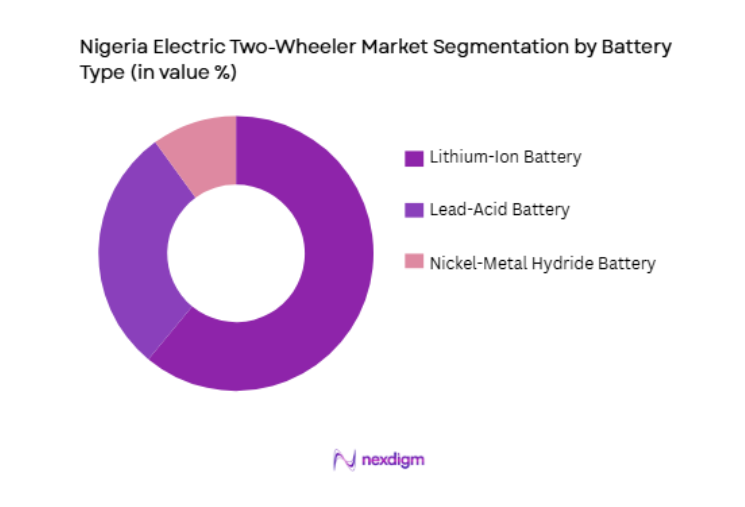
Nigeria Electric Two-Wheeler Market Outlook to 2035 market is segmented by battery type into lithium-ion batteries, lead-acid batteries, and nickel-metal hydride batteries. Recently, lithium-ion batteries have a dominant market share due to factors such as superior energy density, longer operational life, and faster charging capabilities compared with traditional battery technologies. Electric two-wheeler manufacturers increasingly favor lithium-ion batteries because they provide improved vehicle range and reduced maintenance requirements for riders who rely heavily on their vehicles for commercial transport services. Additionally, the declining global cost of lithium-ion battery production driven by electric vehicle manufacturing expansion has made this battery technology more affordable for emerging markets. Delivery service operators and ride-hailing platforms deploying electric motorcycle fleets prefer lithium-ion battery systems due to their reliability and improved performance under continuous operational conditions.
Competitive Landscape
The Nigeria electric two-wheeler market is characterized by growing collaboration between international electric vehicle manufacturers, African mobility technology startups, and local transportation service providers. Global electric vehicle manufacturers provide advanced vehicle technology and battery systems, while regional mobility companies focus on fleet deployment, battery swapping infrastructure, and local distribution networks. Competition is increasingly shaped by battery technology innovation, vehicle affordability, and the development of charging and battery swapping ecosystems supporting commercial riders.
| Company Name | Establishment Year | Headquarters | Technology Focus | Market Reach | Key Products | Revenue | Vehicle Range |
| Ampersand | 2016 | Rwanda | ~ | ~ | ~ | ~ | ~ |
| Gogoro | 2011 | Taiwan | ~ | ~ | ~ | ~ | ~ |
| NIU Technologies | 2014 | China | ~ | ~ | ~ | ~ | ~ |
| Hero Electric | 2007 | India | ~ | ~ | ~ | ~ | ~ |
| TVS Motor Company | 1978 | India | ~ | ~ | ~ | ~ | ~ |
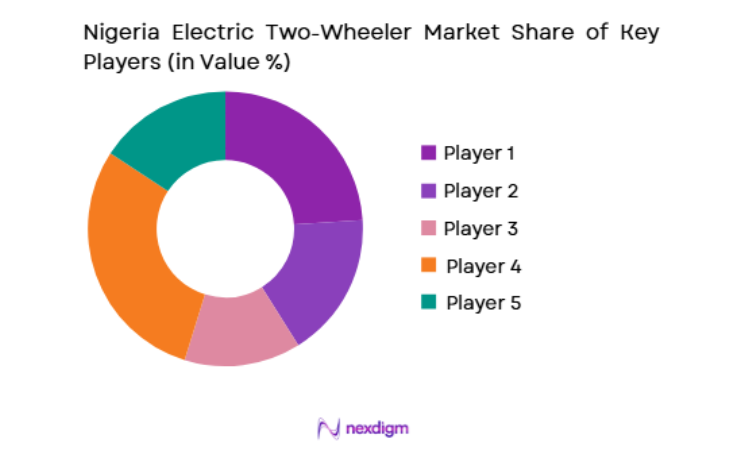
Nigeria Electric Two-Wheeler Market Analysis
Growth Drivers
Rapid Expansion of Urban Last-Mile Mobility and Ride-Hailing Services
Nigeria’s rapidly expanding urban population and the increasing demand for affordable last-mile mobility solutions are significantly accelerating the adoption of electric two-wheelers across major cities where motorcycles already represent one of the most widely used forms of transportation for commercial passenger services and delivery operations. Urban congestion combined with limited public transportation capacity encourages commuters to rely heavily on motorcycles for short-distance travel, creating strong demand for efficient and cost-effective mobility solutions. Electric motorcycles provide a practical alternative because they significantly reduce fuel expenses for riders who depend on their vehicles as a primary source of income. Commercial ride-hailing platforms and logistics companies operating in Nigeria are increasingly exploring electrified two-wheeler fleets in order to reduce operating costs and improve sustainability performance. Delivery services supporting e-commerce and food distribution platforms also rely heavily on motorcycle fleets to ensure rapid last-mile delivery across densely populated urban areas. Electric two-wheelers offer operational advantages including lower maintenance costs, simplified mechanical systems, and improved energy efficiency compared with conventional internal combustion motorcycles.
Declining Global Lithium-Ion Battery Costs and Technological Advancements in Electric Mobility
Continuous improvements in battery technology combined with increasing global investment in electric vehicle manufacturing are significantly reducing the cost of lithium-ion battery systems, which represent the most critical component of electric two-wheelers. As global electric vehicle production expands and battery manufacturing capacity increases, economies of scale are helping reduce battery prices and improve the affordability of electric mobility technologies for emerging markets such as Nigeria. Lithium-ion batteries provide significant advantages including longer lifecycle performance, faster charging capability, and higher energy density compared with traditional lead-acid battery technologies previously used in early electric vehicles. Electric two-wheeler manufacturers are increasingly integrating advanced battery management systems that optimize charging efficiency and extend battery lifespan, making vehicles more reliable for riders operating in commercial transportation services. Additionally, improvements in electric motor efficiency and lightweight vehicle design contribute to better vehicle performance and increased travel range. These technological developments reduce operational costs for riders and improve the overall value proposition of electric two-wheelers compared with gasoline-powered motorcycles. As battery costs continue declining and vehicle performance improves, electric two-wheelers are becoming increasingly accessible to a broader range of consumers and commercial riders across Nigeria’s urban mobility markets.
Market Challenges
Limited Charging Infrastructure and Battery Swapping Ecosystem Development
One of the primary challenges facing the Nigeria electric two-wheeler market is the limited availability of charging infrastructure and battery swapping networks required to support large-scale deployment of electric motorcycle fleets. Electric two-wheelers depend on reliable charging access in order to maintain operational efficiency for commercial riders who rely on their vehicles throughout the day for passenger transport or delivery services. However, many Nigerian cities lack sufficient charging stations or dedicated battery swapping facilities capable of supporting high numbers of electric vehicles operating simultaneously. Without widespread charging infrastructure, riders may experience operational limitations related to battery range and charging downtime. The development of battery swapping ecosystems could address this challenge by allowing riders to exchange depleted batteries for fully charged units within minutes, minimizing operational interruptions. However, establishing such infrastructure requires significant investment in battery management systems, charging facilities, and standardized battery technology platforms compatible with multiple vehicle models. Additionally, inconsistent electricity supply across some regions can further complicate charging infrastructure development. Overcoming these infrastructure challenges will require coordinated collaboration between electric vehicle manufacturers, energy companies, government agencies, and mobility service providers seeking to develop sustainable electric mobility ecosystems.
High Initial Purchase Costs Compared with Conventional Motorcycles
Electric two-wheelers typically involve higher upfront purchase costs compared with traditional gasoline-powered motorcycles, creating a financial barrier for many potential buyers who rely on motorcycles for income-generating activities. Many commercial riders operate within tight financial margins and prioritize vehicles with the lowest possible purchase price rather than long-term operational cost savings. Although electric motorcycles offer lower operating costs due to reduced fuel consumption and maintenance requirements, the higher initial price can discourage adoption among riders with limited access to financing options. Financial institutions and mobility companies are beginning to explore innovative financing models such as pay-as-you-ride programs, battery leasing arrangements, and vehicle subscription services designed to reduce the upfront cost burden for riders. However, such financing solutions remain relatively limited within the Nigerian mobility ecosystem. Currency fluctuations affecting imported electric vehicle components and battery systems can also increase vehicle prices and create uncertainty for manufacturers seeking to enter the Nigerian market.
Opportunities
Growth of E-Commerce and Delivery Logistics Electrification
Nigeria’s rapidly expanding digital commerce ecosystem presents a significant opportunity for electric two-wheeler adoption as logistics companies increasingly rely on motorcycle fleets to provide fast and efficient last-mile delivery services across major urban centers. Online retail platforms, food delivery applications, and courier services all depend heavily on motorcycle-based logistics networks capable of navigating congested city streets while ensuring rapid delivery times. Electric two-wheelers offer substantial advantages for logistics operators because they reduce fuel costs, simplify maintenance requirements, and enable companies to achieve sustainability targets associated with reducing transportation emissions. Delivery fleet electrification also improves operational predictability because electricity costs remain more stable than gasoline prices, allowing logistics companies to manage transportation expenses more effectively. As Nigeria’s e-commerce sector continues expanding, demand for cost-efficient delivery infrastructure will increase significantly. Electric motorcycles are particularly well suited for delivery operations because they can operate quietly, require fewer mechanical repairs, and provide sufficient travel range for daily logistics routes. Logistics companies partnering with electric vehicle manufacturers and battery infrastructure providers can therefore create scalable delivery networks supported by sustainable electric mobility technologies.
Development of Battery Swapping Infrastructure and Electric Mobility Ecosystems
The emergence of battery swapping technology represents a transformative opportunity for accelerating electric two-wheeler adoption across Nigeria’s urban transportation networks. Battery swapping systems allow riders to quickly exchange depleted batteries for fully charged units at dedicated stations, eliminating long charging times and significantly improving vehicle availability for commercial operations. Such systems are particularly beneficial for commercial riders who rely on their motorcycles continuously throughout the day for passenger transport or delivery services. Battery swapping infrastructure also allows energy providers to manage battery charging more efficiently through centralized charging facilities connected to stable electricity sources or renewable power generation systems. Mobility technology companies developing battery swapping platforms can establish integrated ecosystems that include electric vehicles, battery management software, charging infrastructure, and digital fleet management tools. As these ecosystems expand, they create a supportive infrastructure environment that encourages riders and logistics operators to transition from gasoline motorcycles to electric alternatives. The development of standardized battery formats and scalable swapping networks therefore represents a major opportunity for accelerating the growth of Nigeria’s electric two-wheeler market.
Future Outlook
Nigeria’s electric two-wheeler market is expected to experience strong expansion over the next five years as urban mobility demand increases and electric vehicle technologies become more affordable. Improvements in battery technology, expansion of charging infrastructure, and increasing investment in electric mobility startups will support market development. Government initiatives promoting cleaner transportation solutions and private sector innovation in battery swapping ecosystems will further strengthen adoption. Growing demand for efficient last-mile transportation and logistics services will also drive sustained growth across the market.
Major Players
- Ampersand
- Gogoro
- NIU Technologies
- Hero Electric
- TVS Motor Company
- Bajaj Auto
- Yadea Group
- Ather Energy
- Ola Electric
- Honda Motor Company
- Yamaha Motor Company
- Zero Motorcycles
- Energica Motor Company
- Vmoto Limited
- Mahindra Electric
Key Target Audience
- Electric Two-Wheeler Manufacturers
- Urban Mobility Platform Operators
- Delivery and Logistics Companies
- Charging Infrastructure Developers
- Battery Technology Providers
- Investments and venture capitalist firms
- Government and regulatory bodies
Research Methodology
Step 1: Identification of Key Variables
Key market variables such as electric vehicle adoption rates, battery technology developments, charging infrastructure expansion, and mobility policy frameworks are identified to understand the structural dynamics influencing the Nigeria Electric Two-Wheeler Market.
Step 2: Market Analysis and Construction
Data from international mobility reports, electric vehicle deployment programs, and regional transport electrification initiatives is analyzed to construct segmentation models and identify demand patterns shaping the Nigeria Electric Two-Wheeler Market Outlook to 2035.
Step 3: Hypothesis Validation and Expert Consultation
Industry specialists, electric mobility companies, transportation planners, and energy infrastructure experts are consulted to validate assumptions regarding technology adoption trends and regulatory impacts.
Step 4: Research Synthesis and Final Output
Validated research insights are synthesized into structured market intelligence covering competitive landscape, segmentation, growth drivers, and long-term opportunities influencing the Nigeria Electric Two-Wheeler Market Outlook to 2035.

- Executive Summary
- Research Methodology (Definitions, Scope, Industry Assumptions, Market Sizing Approach, Primary & Secondary Research Framework, Data Collection & Verification Protocol, Analytic Models & Forecast Methodology, Limitations & Research Validity Checks)

- Market Definition and Scope
- Value Chain & Stakeholder Ecosystem
- Regulatory / Certification Landscape
- Sector Dynamics Affecting Demand

- Growth Drivers
Growing demand for affordable and energy efficient urban mobility solutions
Rising fuel prices encouraging adoption of electric mobility alternatives
Expansion of last mile delivery services increasing demand for electric two wheelers - Market Challenges
Limited charging and battery swapping infrastructure across major cities
High upfront cost compared to conventional gasoline two wheelers
Dependence on imported battery components and electric drivetrain systems - Market Opportunities
Expansion of battery swapping networks for commercial delivery fleets
Partnerships between mobility startups and electric two wheeler manufacturers
Development of locally assembled electric two wheelers for cost reduction - Trends
Increasing deployment of electric two wheelers for e commerce and logistics delivery
Adoption of lithium iron phosphate batteries for durability and safety - Government Regulations
Policies promoting reduction of urban transport emissions
Electric mobility initiatives encouraging adoption of clean transport solutions
Import duty structures influencing electric vehicle component supply chains - SWOT Analysis
- Porter’s Five Forces

- By Market Value, 2020-2025
- By Installed Units, 2020-2025
- By Average System Price, 2020-2025
- By System Complexity Tier, 2020-2025

- By System Type (In Value%)
Electric Scooters
Electric Motorcycles
Electric Mopeds
Electric Cargo Two Wheelers
High Performance Electric Motorcycles - By Platform Type (In Value%)
Personal Commuter Two Wheelers
Shared Mobility Two Wheelers
Delivery and Logistics Two Wheelers
Ride Hailing and Taxi Service Two Wheelers
Commercial Utility Two Wheelers - By Fitment Type (In Value%)
Original Equipment Manufacturer Electric Two Wheelers
Battery Swappable Electric Two Wheelers
Fixed Battery Electric Two Wheelers
Retrofitted Electric Two Wheelers - By End User Segment (In Value%)
Urban Commuters
Logistics and Delivery Companies
Ride Hailing Service Providers

- Market Share Analysis
- Cross Comparison Parameters (Battery Capacity, Driving Range per Charge, Charging Time, Motor Power Output, Maximum Speed Capability, Battery Chemistry Type, Energy Consumption per Kilometer, Swappable Battery Compatibility)
- SWOT Analysis of Key Competitors
- Pricing & Procurement Analysis
- Key Players
Yadea Technology Group
NIU Technologies
Vmoto Limited
Hero Electric
Okinawa Autotech
Ather Energy
Gogoro
Segway Ninebot
Ampersand Rwanda
Roam Electric
Dayun Electric Vehicles
Sunra Electric Vehicle
Horwin Global
Tork Motors
Zero Motorcycles

- Urban commuters adopting electric scooters for affordable daily transportation
- Delivery companies integrating electric two wheelers to reduce fuel expenses
- Ride hailing services exploring electric motorcycles for cost efficient mobility
- Small businesses using electric cargo bikes for urban logistics operations

- Forecast Market Value, 2026-2035
- Forecast Installed Units, 2026-2035
- Price Forecast by System Tier, 2026-2035
- Future Demand by Platform, 2026-2035


 Request a Sample
 Ask for Customization
 Get a Quote
 Enquire Now