
 Download PDF
Market Overview
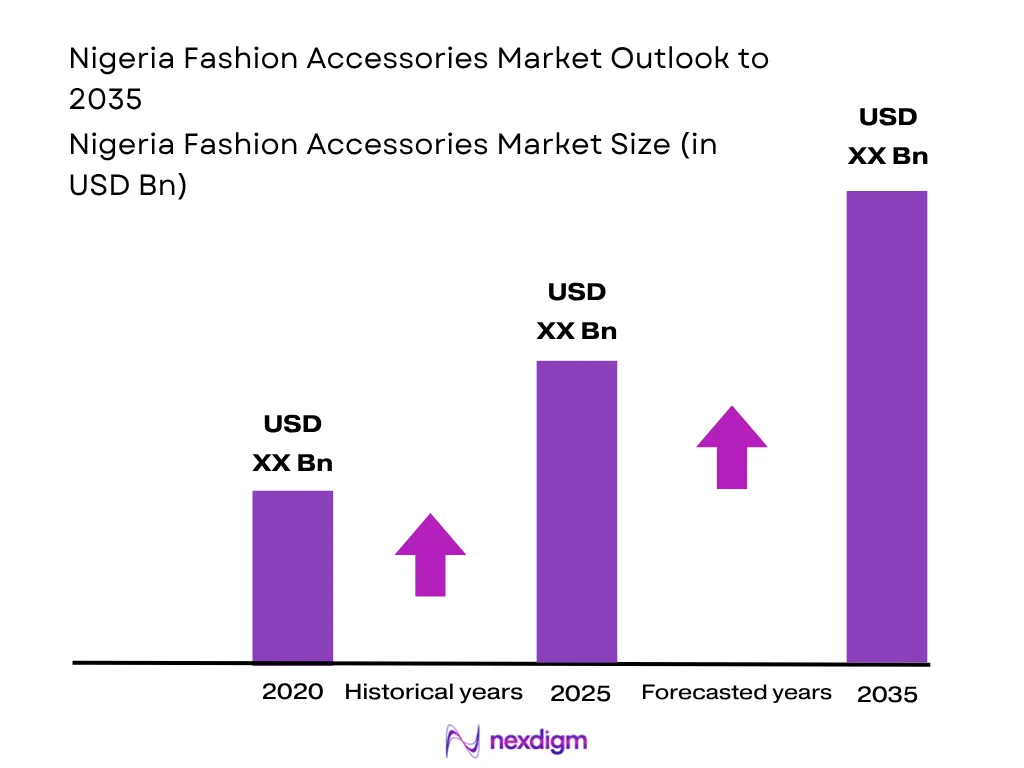
The Nigeria Fashion Accessories Market is valued at USD ~ billion, based on Nexdigm’s historical study period covering 2021–2023 and a disclosed 2024 base-year market size. Growth is driven by handbags, watches, eyewear, jewelry, and offline retail, with handbags contributing USD ~ billion, men’s accessories contributing USD ~ billion, and offline channels contributing USD ~ billion. E-commerce also supports demand, with Nigeria’s online fashion market projected at USD ~ million and representing 19% of national e-commerce value.
Lagos, Abuja, Port Harcourt, Aba, and Onitsha dominate the Nigeria Fashion Accessories Market because they combine premium consumption, open-market wholesale, artisan production, and digital retail. Lagos leads through fashion events, concept stores, online shoppers, and retailer density; Abuja benefits from affluent government and professional consumers; Port Harcourt has oil-sector disposable income; Aba is a leather, belt, bag, and footwear production cluster; and Onitsha functions as a southeastern wholesale redistribution hub.
Market Segmentation
By Product Type
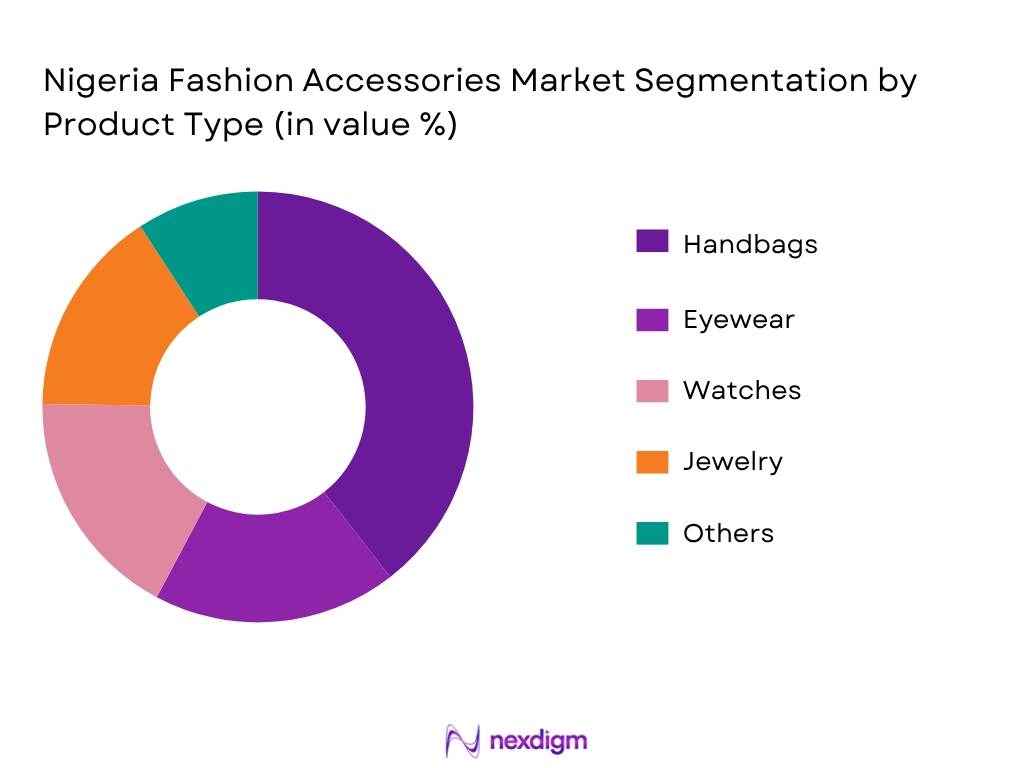
The Nigeria Fashion Accessories Market is segmented by product type into handbags, eyewear, watches, and jewelry. Recently, handbags have held the dominant market share in Nigeria under the product type segmentation, due to their functional use across workwear, religious events, travel, weddings, and everyday styling. Handbags are also highly visible in both formal boutiques and informal open markets, making the category accessible across mass, mid-market, and premium consumer groups. Domestic leather clusters in Aba and designer-led Lagos brands further reinforce the category because bags can be produced locally, imported in bulk, or sold as premium Afrocentric fashion pieces. The segment benefits from strong gifting demand, occasionwear matching, Instagram-led styling, and women’s formalwear consumption. In comparison, eyewear and watches are growing but remain more dependent on imported supply, brand trust, and price sensitivity.
By Distribution Channel
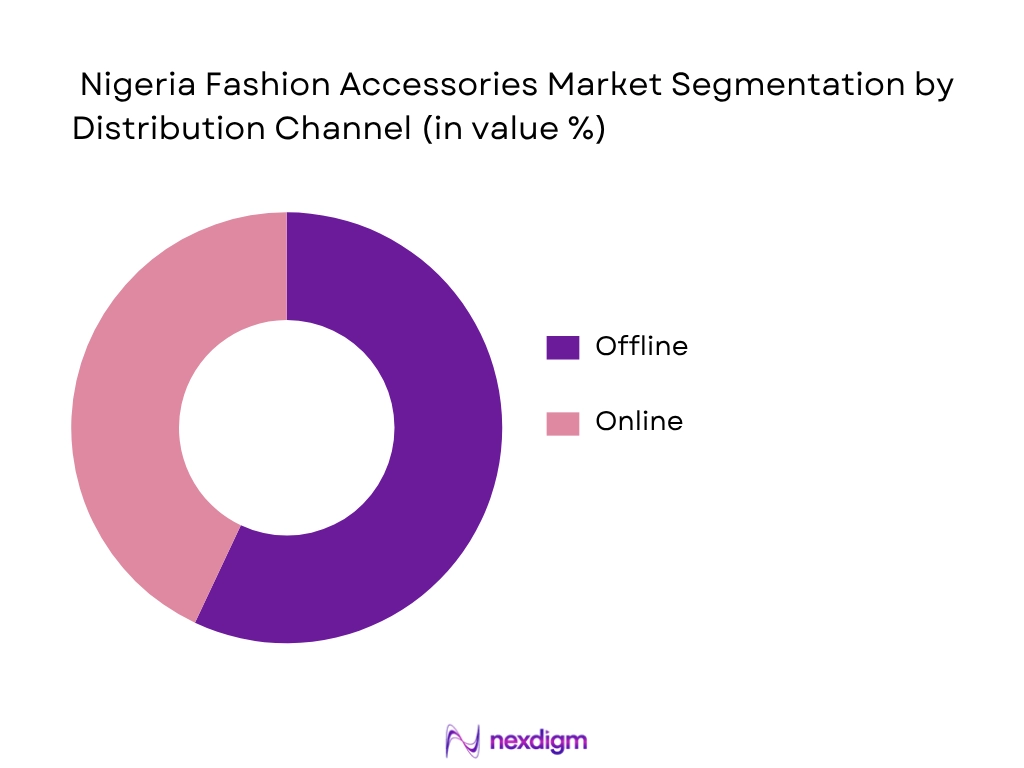
The Nigeria Fashion Accessories Market is segmented by distribution channel into offline and online channels. Recently, offline retail has retained the dominant market share in Nigeria under distribution channel segmentation because fashion accessories are still heavily purchased through open markets, malls, boutiques, concept stores, street retailers, and informal traders. Consumers often prefer physical inspection for handbags, sunglasses, belts, jewelry finish, watch quality, and color matching with outfits. Offline retail also benefits from bargaining culture, immediate product availability, and trust-based seller relationships in Lagos, Aba, Onitsha, Kano, Abuja, and Port Harcourt. Online retail is expanding through Jumia, Konga, Instagram, WhatsApp, TikTok sellers, and cross-border platforms, but return friction, counterfeit risk, payment trust, and delivery reliability continue to keep offline retail ahead. The online segment remains strategically important because social commerce accelerates discovery and impulse purchases.
Competitive Landscape
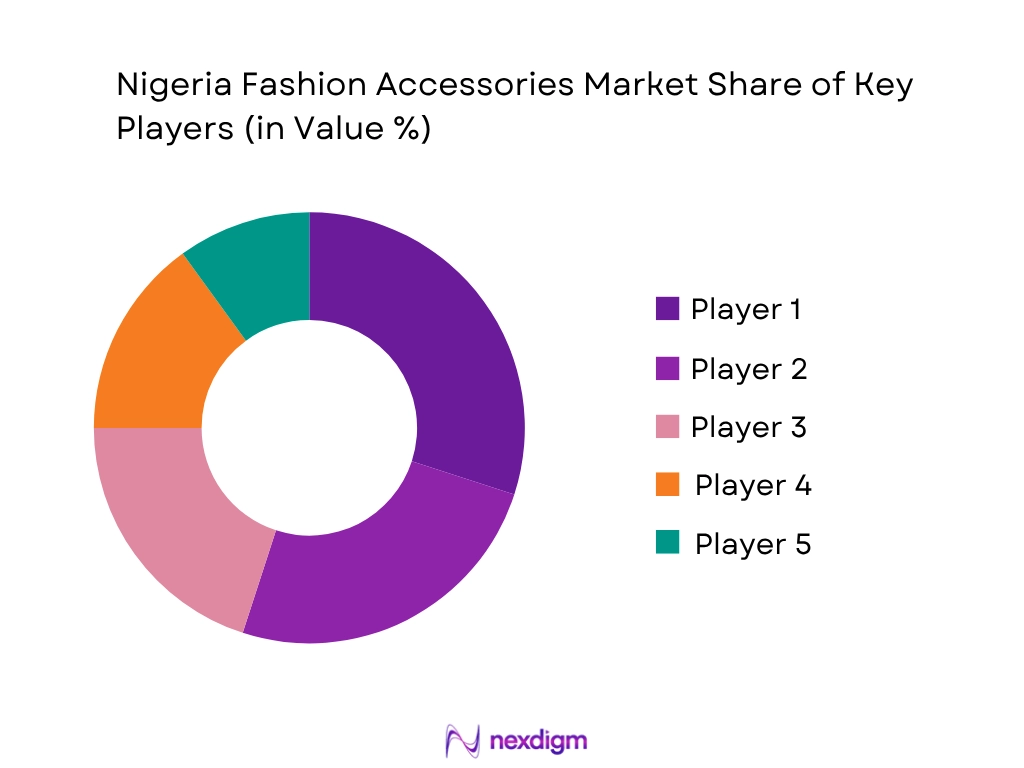
The Nigeria Fashion Accessories Market is fragmented across e-commerce marketplaces, luxury concept stores, independent boutiques, social-commerce sellers, local leather producers, and artisan-led premium brands. Jumia and Konga compete on assortment, delivery coverage, marketplace sellers, and discount-led mass access. Alara Lagos and Temple Muse influence premium fashion curation, while Zashadu represents the locally crafted luxury leather-goods space. The competitive structure is shaped by SKU breadth, authenticity controls, Lagos presence, imported product access, local production capability, and social-commerce visibility.
| Company | Establishment Year | Headquarters | Product Focus | Operating Model | Channel Strength | Price Positioning | Sourcing Model | Market-Specific Strength |
| Jumia Nigeria | 2012 | Lagos, Nigeria | ~ | ~ | ~ | ~ | ~ | ~ |
| Konga | 2012 | Gbagada, Lagos, Nigeria | ~ | ~ | ~ | ~ | ~ | ~ |
| Alara Lagos | 2014/2015 | Lagos, Nigeria | ~ | ~ | ~ | ~ | ~ | ~ |
| Zashadu | 2010 | Victoria Island, Lagos, Nigeria | ~ | ~ | ~ | ~ | ~ | ~ |
| Temple Muse | 2008 | Lagos, Nigeria | ~ | ~ | ~ | ~ | ~ | ~ |
Nigeria Fashion Accessories Market Analysis
Growth Drivers
Rising Youth Fashion Consciousness
Nigeria’s fashion accessories demand is structurally supported by a large young and working-age consumer base. World Bank data records Nigeria’s population at 232,679,478 people and population growth at 2.1 in 2024, creating a large addressable base for handbags, jewelry, watches, sunglasses, belts, scarves, hair accessories, and occasionwear add-ons. The country also recorded 41 internet users per 100 people in 2024, which directly supports fashion discovery through Instagram boutiques, TikTok styling, WhatsApp vendors, Jumia, Konga, and cross-border platforms. For accessory brands, this matters because fashion accessories are lower-ticket, trend-responsive, and frequently bought to refresh outfits rather than replace full apparel wardrobes. Nigeria’s GDP stood at USD 252.26 billion, GDP per capita at USD 1,084.2, and real GDP growth at 4.1 in 2024, indicating that even amid constrained purchasing power, a large urban and digitally reachable consumer base remains available for affordable, mass-market, and mid-market accessories. High inflation of 33.2 in 2024 also encourages consumers to use accessories as economical styling upgrades instead of larger apparel purchases, making earrings, sunglasses, scarves, mini bags, belts, and costume jewelry more relevant to youth-led fashion behavior.
Lagos and Abuja Premium Retail Growth
Lagos and Abuja support premium fashion accessories because they concentrate purchasing power, formal retail infrastructure, government and corporate employment, lifestyle consumption, airports, malls, boutiques, luxury concept stores, and event-led demand. Lagos State’s official economic update states that the state’s GDP was NGN 54.77 trillion in 2024, confirming its role as Nigeria’s largest consumer and commercial hub. This strengthens demand for premium handbags, designer jewelry, sunglasses, leather goods, watches, and occasion accessories through Victoria Island, Lekki, Ikoyi, Ikeja, and mall-led retail corridors. Abuja’s premium retail base is reinforced by public-sector income, diplomatic presence, federal contractors, and infrastructure spending; the FCT statutory budget was approved at NGN 1.28 trillion for 2024, including allocations linked to urban infrastructure and mobility, which supports footfall and formal retail development. Nationally, the services sector contributed 58.76 to aggregate GDP in Q2 2024 and recorded 3.79 real growth, showing the strength of urban services, finance, real estate, trade, hospitality, and professional activity that typically supports premium accessory purchases. For the Nigeria Fashion Accessories Market, Lagos drives premium visibility and trend origination, while Abuja strengthens high-value gifting, formalwear accessories, imported luxury, and boutique-led discretionary purchases.
Market Challenges
FX Volatility
FX volatility is a direct challenge for Nigeria Fashion Accessories Market participants because many watches, sunglasses, jewelry components, fast-fashion bags, zippers, buckles, synthetic leather, packaging, and branded accessories depend on imported inputs or finished goods. World Bank data places Nigeria’s official exchange rate at NGN 1,478.97 per USD in 2024, compared with much lower historical levels before the currency reforms, while IMF reporting notes that the naira moved from NGN 461 per USD in May 2023 to about NGN 900 per USD after reform implementation. This affects fashion accessories more sharply than essential goods because retailers often hold mixed inventories across China, Turkey, UAE-linked trade routes, Europe, and local suppliers, while consumer purchasing decisions remain highly price-sensitive. Inflation at 33.2 in 2024 intensified the same pressure by reducing discretionary wallet allocation for non-essential purchases, including premium handbags, watches, and sunglasses. At the same time, Nigeria’s external reserves later strengthened to USD 40.19 billion at year-end 2024, but currency pass-through had already changed replacement cost assumptions for importers and online sellers. For local accessory makers, FX volatility raises input costs for imported hardware, adhesives, finishing materials, machinery parts, and branded packaging, making margin management and SKU repricing difficult.
Import Clearance Costs
Import clearance costs are a major market challenge because Nigeria’s accessories ecosystem depends heavily on imported fashion goods and components. NBS data shows Nigeria’s total merchandise trade reached NGN 31,810.59 billion in Q1 2024, while imports stood at NGN 12,643.23 billion, indicating a large import-processing environment for customs, port charges, freight handling, clearing agents, demurrage risk, and documentation. The Nigeria Customs Service reported NGN 6.1 trillion revenue collection in 2024, reflecting the scale of import-duty, levies, VAT-on-imports, and related border revenue obligations faced by importers. For fashion accessories, clearance friction is particularly relevant because products are seasonal, trend-driven, and SKU-fragmented; delayed sunglasses, handbags, bridal accessories, jewelry sets, belts, or watch shipments can miss religious festivities, weddings, Valentine gifting, back-to-office demand, or December shopping. World Integrated Trade Solution data shows Nigeria imported 217,753 kg of plastic apparel and clothing accessories under one accessory-related HS line in 2024, with China supplying 203,581 kg, showing the relevance of Asian import corridors to low-cost accessory availability. Clearance delays and customs-cost uncertainty therefore reduce inventory reliability for wholesalers in Lagos, Onitsha, Aba, Abuja, and online sellers, while pushing some businesses toward informal routing, smaller consignments, and faster but costlier logistics channels.
Opportunities
Made-in-Nigeria Premium Accessories
Made-in-Nigeria premium accessories have a strong growth opportunity because macro conditions are pushing consumers and retailers to consider locally crafted handbags, leather goods, beadwork, Aso Oke accessories, raffia bags, belts, wallets, and jewelry as substitutes for imported premium goods. Nigeria’s population reached 232,679,478 people in 2024, giving local brands a deep domestic base, while GDP stood at USD 252.26 billion, supporting a large national consumer economy for fashion-led MSMEs. The opportunity is strongest for Lagos designer labels and Aba leather clusters because local production can reduce exposure to overseas finished-goods imports, while still using Nigerian cultural identity, craftsmanship, and occasionwear relevance as differentiators. Import data reinforces the opportunity: under one apparel-accessory import line, Nigeria brought in 217,753 kg in 2024, of which China supplied 203,581 kg, showing how much low-cost accessory demand is currently served externally. Substituting even part of this import dependence with higher-quality Nigerian leather, bead, textile, and raffia products can strengthen domestic value addition without relying on market-size assumptions. In addition, World Bank data records personal remittances received at 8.4 of GDP in 2024, which supports diaspora-linked gifting and export storytelling for Nigerian-designed accessories. The opportunity is therefore not just local substitution; it is premium identity-led positioning across domestic boutiques, social commerce, tourist gifting, and diaspora-facing online channels.
Bridal Accessories
Bridal accessories represent a future-facing opportunity in the Nigeria Fashion Accessories Market because weddings, religious ceremonies, introductions, engagements, traditional marriages, and Aso Ebi events create repeated demand for clutches, gele pins, jewelry sets, hair accessories, beaded pieces, pearl designs, luxury-inspired handbags, embellished footwear accessories, brooches, and headpieces. The market context is supported by Nigeria’s large population of 232,679,478 people in 2024 and an urban consumer environment where fashion visibility is amplified through social media; World Bank records 41 internet users per 100 people in 2024, which strengthens online discovery for bridal stylists, Instagram vendors, jewelry sellers, and custom accessory designers. Inflation at 33.2 in 2024 makes full wardrobe replacement expensive, but it also encourages bridesmaids, wedding guests, and celebrants to elevate outfits through accessories rather than complete apparel changes. Nigeria’s services-led economy further supports event ecosystems: NBS reported services contributed 58.76 to aggregate GDP in Q2 2024, covering trade, hospitality, real estate, entertainment, professional services, logistics, and financial services that surround wedding consumption. Lagos and Abuja are particularly relevant because they concentrate premium venues, stylists, designers, makeup artists, photographers, event planners, and boutiques, creating bundled demand for bridal jewelry, clutches, scarves, custom bags, and coordinated occasion accessories. The opportunity lies in curated bridal sets, customization, rental-to-purchase models, social-commerce catalogues, and collaboration with wedding vendors rather than generic mass accessory retail.
Future Outlook
The Nigeria Fashion Accessories Market is expected to expand at a forecast CAGR of 8.2% for the 2026–2035 period, anchored by the published Nigeria-specific growth outlook through 2033. Growth will be driven by online fashion adoption, social-commerce selling, urban youth fashion demand, rising premiumization in Lagos and Abuja, locally crafted leather accessories, and broader marketplace access. However, FX volatility, import duties, counterfeit luxury products, and logistics costs will continue to influence margins and pricing strategy.
Future growth will be strongest in handbags, watches, affordable jewelry, sunglasses, and textile-based accessories. The online segment will gain relevance through Instagram boutiques, Jumia, Konga, Temu, SHEIN, and WhatsApp sellers, while offline markets will remain important for price-sensitive and bulk-purchase customers. Local brands will have an opportunity to move from small-batch production to premium export-oriented positioning, especially in leather goods, beaded jewelry, raffia bags, and Aso Oke or Ankara-inspired accessories.
Major Players
- Jumia Nigeria
- Konga
- Jiji Nigeria
- Temu Nigeria
- AliExpress Nigeria
- SHEIN
- ASOS
- Polo Luxury Group
- Alara Lagos
- Temple Muse
- Grey Velvet
- Zashadu
- Shekudo
- FemiHandbags
- MINISO Nigeria
Key Target Audience
- Fashion accessory brands and manufacturers
- E-commerce marketplaces and social-commerce platforms
- Luxury boutiques and premium lifestyle retailers
- Leather goods manufacturers and artisan clusters
- Handbag, jewelry, eyewear, and watch importers
- Investments and venture capitalist firms
- Government and regulatory bodies — Federal Ministry of Industry, Trade and Investment; Nigerian Export Promotion Council; Standards Organisation of Nigeria; Nigeria Customs Service; Federal Inland Revenue Service; Nigeria Data Protection Commission
- Retail real estate developers and mall operators
Research Methodology
Step 1: Identification of Key Variables
The initial phase involves mapping the Nigeria Fashion Accessories Market ecosystem across product categories, retail formats, import channels, leather clusters, online marketplaces, and social-commerce sellers. Variables include handbag demand, eyewear imports, watch penetration, jewelry consumption, offline retail contribution, online GMV, and city-level demand concentration.
Step 2: Market Analysis and Construction
Historical and base-year data is compiled from public market intelligence, company sources, trade references, marketplace listings, and retail channel mapping. The analysis evaluates product-level revenue, average selling prices, channel contribution, imported versus local supply, and formal versus informal retail participation.
Step 3: Hypothesis Validation and Expert Consultation
Market hypotheses are validated through interviews with accessory retailers, e-commerce sellers, boutique operators, importers, leather-goods producers, designers, and logistics providers. These discussions verify pricing ladders, SKU movement, seasonal demand, product quality issues, and channel-level conversion behavior.
Step 4: Research Synthesis and Final Output
The final stage integrates top-down market sizing with bottom-up category and channel validation. Findings are triangulated using disclosed market-size sources, segment benchmarks, company profiles, and trade-flow indicators to produce a structured, decision-ready view of the Nigeria Fashion Accessories Market.

- Executive Summary
- Research Methodology (Market Definitions and Assumptions, Fashion Accessories Taxonomy, Top-Down Market Sizing Approach, Bottom-Up SKU and Channel Build-Up, Primary Interviews with Retailers/Wholesalers/Designers/Importers, Trade Lane Assessment, Online Marketplace Scraping Framework, Balogun–Aba–Onitsha Market Validation, Cross-Channel Price Benchmarking, Limitations and Forecast Assumptions)

- Definition and Scope
- Overview Genesis
- Evolution of Fashion Accessory Consumption
- Business Cycle
- Supply Chain and Value Chain Analysis
- Import-Dependent and Locally Crafted Accessory Ecosystem
- Formal Retail, Informal Market, and Social-Commerce Landscape
- Key Demand Clusters: Lagos, Abuja, Port Harcourt, Kano, Ibadan, Onitsha, Aba

- Growth Drivers (Rising Youth Fashion Consciousness, Lagos and Abuja Premium Retail Growth, Social Media and Influencer Commerce, Wedding and Occasionwear Spending, Mobile-First E-Commerce Adoption, Local Artisan Revival, Demand for Affordable Statement Accessories)
- Market Challenges (FX Volatility, Import Clearance Costs, Counterfeit Luxury Products, Informal Retail Fragmentation, Low Brand Loyalty, Quality Inconsistency, Limited Cold-Chain-Like Inventory Discipline for Leather Storage, Logistics Cost Inflation)
- Opportunities (Made-in-Nigeria Premium Accessories, Bridal Accessories, Men’s Accessories, Modest Fashion Accessories, Sustainable Materials, Diaspora Commerce, Luxury Authentication, Retail-Tech Enablement)
- Trends (Statement Bags, Beaded Jewelry, Ankara/Aso Oke Fusion, Quiet Luxury, Dupe Culture, Gender-Neutral Accessories, Afrocentric Craft Revival, Affordable Luxury, Creator-Led Drops, Fashion Week Influence)
- Government Regulation (Customs Tariffs, Import Documentation, SON Product Standards, VAT Compliance, E-Commerce Consumer Protection, Counterfeit Goods Enforcement, Leather Goods Export Promotion, MSME Formalization)
- SWOT Analysis (Local Craft Strength, Import Reliance Weakness, Diaspora Export Opportunity, FX and Counterfeit Threat)
- Stakeholder Ecosystem (Importers, Wholesalers, Open-Market Traders, Designers, Artisans, Leather Clusters, Online Marketplaces, Social Sellers, Logistics Providers, Payment Providers, Mall Retailers, Fashion Event Platforms)
- Porter’s Five Forces (Supplier Power, Buyer Power, Threat of Substitutes, Threat of New Entrants, Competitive Rivalry Across Informal and Organized Channels)
- Pricing Analysis (Entry-Level SKUs, Mid-Market SKUs, Premium Designer SKUs, Luxury Imported SKUs, Online Discounting, Open-Market Bargaining, Bundle Pricing, Flash Sales)
- Consumer Behaviour Analysis (Impulse Buying, Occasion-Led Purchasing, Influencer Discovery, Bargaining Culture, Authenticity Sensitivity, Payment-on-Delivery Preference, Gift Purchases, Repeat Purchase Cycles)

- By Value (2020-2025)
- By Volume (2020-2025)
- By Average Selling Price (2020-2025)
- By Online Gross Merchandise Value (2020-2025)
- By Offline Retail and Informal Market Sales (2020-2025)

- By Product Category (In Value%)
Handbags
Jewelry
Watches
Sunglasses and Eyewear
Belts
Scarves and Headwraps
Hair Accessories
Wallets and Small Leather Goods
Hats and Caps
Tech-Fashion Accessories - By Price Tier (In Value%)
Mass-Market Accessories
Affordable Fashion Accessories
Mid-Premium Accessories
Premium Designer Accessories
Luxury and Imported Statement Accessories - By Consumer Group (In Value%)
Women
Men
Unisex
Kids and Teens
Gen Z Buyers
Working Professionals
Bridal and Occasion Buyers
Diaspora-Linked Consumers - By Distribution Channel (In Value%)
Open Markets
Independent Boutiques
Shopping Malls
E-Commerce Marketplaces
Social Commerce
Designer Studios
Department and Lifestyle Stores
Supermarkets and Gift Stores - By City/Region (In Value%)
Lagos
Abuja
Port Harcourt
Kano
Ibadan
Onitsha
Aba
Benin City
Enugu
Kaduna - By Material Type (In Value%)
Faux Leather
Beads
Gold-Plated and Costume Metals
Ankara/Aso Oke/Textile-Based Accessories
Wood and Raffia
Plastic and Resin
Stainless Steel
Recycled and Upcycled Materials - By Occasion and Use Case (In Value%)
Everyday Wear
Workwear
Weddings and Aso Ebi
Religious Events
Parties and Nightlife
Travel
Gifting
Fashion Week and Statement Styling - By Source of Supply (In Value%)
Imported China/Turkey/Dubai Products
Locally Manufactured Leather Goods
Artisanal Handmade Accessories
Designer-Led Collections
Thrift/Pre-Owned Accessories
Cross-Border Social Sellers

- Market Share of Major Players (By Value, By Volume, By Product Category, By Channel, By City Cluster, By Online Visibility, By Premium vs Mass-Market Positioning)
- Cross Comparison Parameters (Accessory SKU Depth Across Bags, Jewelry, Watches, Eyewear, Belts, Scarves, Price Ladder in Across Mass-to-Luxury SKUs, Verified Seller and Authenticity Controls, Payment Flexibility Including Cash-on-Delivery/Digital Wallet/Card, Nationwide Delivery and Return Coverage, Local Artisan/Leather Manufacturing Capability, Import Sourcing Mix from China/Turkey/UAE/Europe, Influencer and Social-Commerce Conversion Strength)
- Competitive Benchmarking Matrix (Product Assortment, Category Specialization, Price Tier, Channel Presence, Fulfilment Capability, Brand Perception, Customer Reviews, Return Policy, Promotional Intensity, Regional Reach)
- SWOT Analysis of Major Players (Marketplace Scale, Boutique Differentiation, Luxury Positioning, Local Craft Advantage, Inventory Risk, Counterfeit Exposure, Margin Pressure, FX Exposure)
- Pricing Analysis by SKU Basket (Women’s Handbags, Costume Jewelry Sets, Watches, Sunglasses, Belts, Scarves/Headwraps, Wallets, Hair Accessories, Bridal Accessories, Premium Designer Bags)
- Detailed Profiles of Major Companies
Jumia Nigeria
Konga
Jiji Nigeria
Temu Nigeria
AliExpress Nigeria
SHEIN
ASOS
Polo Luxury Group
Alara Lagos
Temple Muse
Grey Velvet
Zashadu
Shekudo
FemiHandbags
MINISO Nigeria

- Demand and Utilization (Daily Styling, Office Dressing, Occasionwear, Gift Purchases, Travel Accessories, Social Media Content Styling)
- Purchasing Power and Budget Allocation (Mass-Market Spend, Mid-Premium Spend, Luxury Splurge Behaviour, Seasonal/Event-Led Spending, Installment and Pay-on-Delivery Behaviour)
- Needs, Desires, and Pain Points (Affordability, Uniqueness, Durability, Authenticity, Trend Relevance, Delivery Reliability, Easy Returns, Size/Fit Compatibility for Belts and Rings)
- Purchase Journey (Discovery, Price Comparison, Social Validation, Seller Trust Check, Payment Mode Selection, Delivery/Collection, Return/Exchange, Repeat Purchase)
- Decision-Making Process (Influencer Recommendation, Peer Styling, Brand Reputation, Marketplace Reviews, Seller Ratings, Occasion Urgency, Discount Sensitivity, Product Authenticity)

- By Value (2026-2035)
- By Volume (2026-2035)
- By Average Selling Price (2026-2035)
- By Online Gross Merchandise Value (2026-2035)
- By Offline Retail and Informal Market Sales (2026-2035)


 Request a Sample
 Ask for Customization
 Get a Quote
 Enquire Now